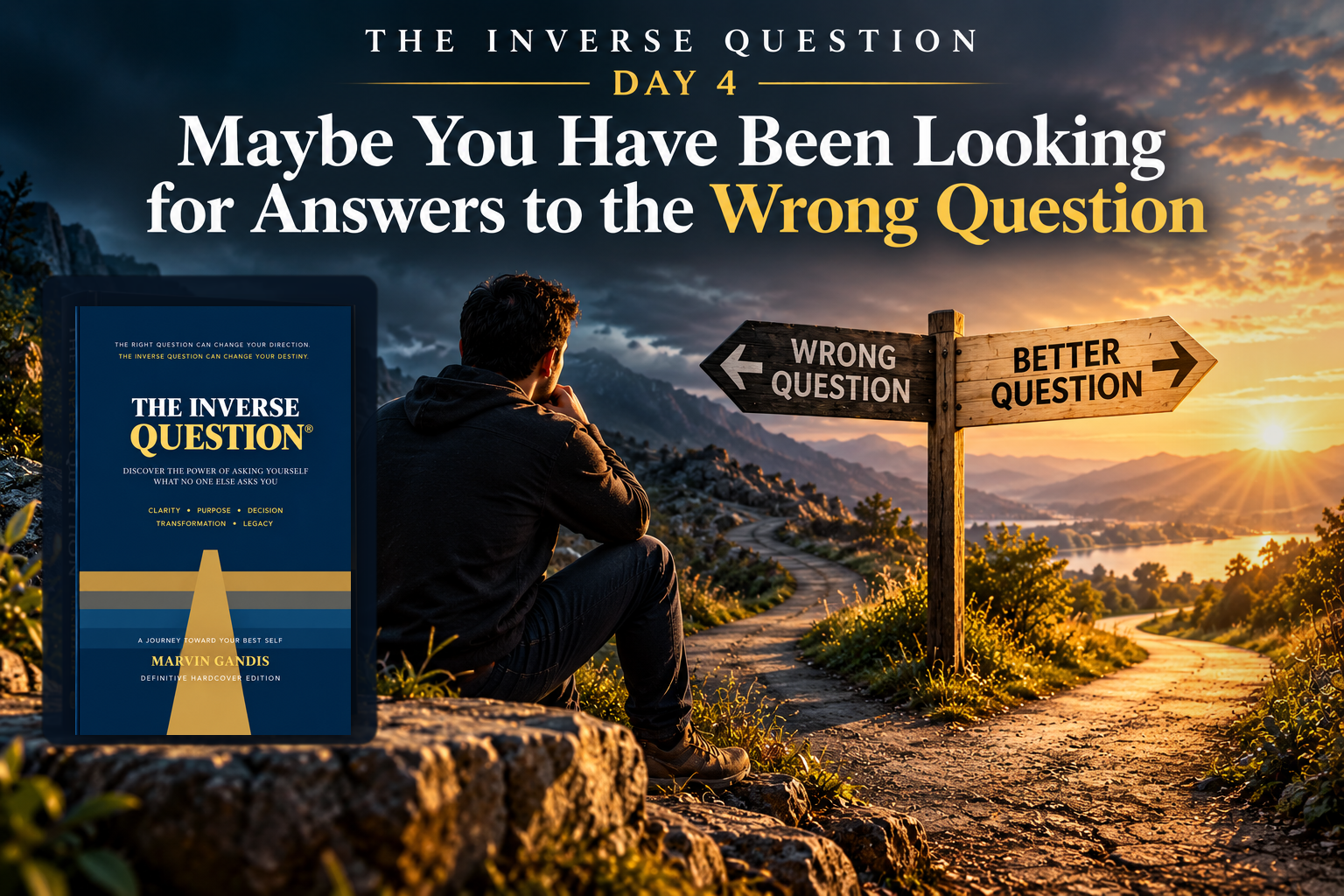
“Sometimes the problem is not that you cannot find an answer. Sometimes you have been asking the wrong question.”
— Marvin Gandis
We are taught to search for answers.
We search online.
We ask friends.
We watch videos.
We read books.
We listen to experts.
We compare opinions.
We collect advice.
And sometimes, after all of that, we still feel stuck.
Why?
Because an answer can only be as useful as the question that created it.
If the question is incomplete, the answer may be incomplete.
If the question is misleading, the answer may send us in the wrong direction.
And if we keep asking the wrong question, we can spend years becoming very efficient at solving the wrong problem.
That realization is one of the reasons The Inverse Question exists.
WE NATURALLY FOCUS ON WHAT IS MOST VISIBLE
Suppose someone says:
- “Why am I not making enough money?”
That sounds like a financial question.
And perhaps it is.
But maybe the deeper question is:
- “What skills am I building that the market is willing to reward?”
Or:
- “How well am I managing the money I already earn?”
Or:
- “Am I depending on one source of income without developing alternatives?”
Or:
- “Am I solving a problem people are actually willing to pay to solve?”
The first question looks at the symptom.
The better question may reveal the structure underneath it.
That difference matters.
THE FIRST QUESTION IS NOT ALWAYS THE BEST QUESTION
We often ask the question that comes most naturally.
- Why is this happening?
- Why is this taking so long?
- Why do people not support me?
- Why am I not getting results?
- Why do I keep failing?
- Why can’t I stay motivated?
Those questions are understandable.
But some of them keep our attention focused on the frustration rather than the mechanism.
A stronger question may be:
- What pattern keeps producing this result?
- What assumption am I making?
- What am I avoiding?
- What am I repeating?
- What skill am I missing?
- What information do I not yet have?
What part of the problem am I treating as permanent when it may actually be adjustable?
The moment the question changes, the direction of thought changes too.
A WRONG QUESTION CAN CREATE A WRONG PLAN
Imagine spending months asking:
- “How can I get more followers?”
You may learn algorithms.
Posting times.
Hashtags.
Trends.
Content formats.
Engagement techniques.
But perhaps the better question was:
“How can I become more useful to the people I already reach?”
That changes the strategy.
Instead of chasing numbers, you begin improving value.
Instead of asking only how to attract attention, you ask how to deserve it.
Instead of measuring success only through reach, you begin considering trust, relevance, usefulness, and relationships.
- Same situation.
- Different question.
- Different plan.
✦ THE INVERSE QUESTION ✦
For Day 4, ask yourself:
What question have you been repeating that may be keeping you focused on the symptom instead of the cause?
Do not rush to answer.
- Think carefully.
Sometimes the question we repeat has been with us for years.
- It may sound reasonable.
- It may even sound intelligent.
But if it keeps producing the same frustration, it deserves examination.
Try this:
The question I keep asking is: __________
Now ask:
What assumption is hidden inside that question? __________
Then:
What would I ask if I looked at the situation from the opposite direction? __________
That reversal may reveal something important.
FROM “HOW DO I GET?” TO “WHAT DO I CREATE?”
This is one of the most powerful reversals.
We often ask:
- How do I get more customers?
- How do I get more money?
- How do I get more opportunities?
- How do I get more recognition?
- How do I get more support?
There is nothing inherently wrong with those questions.
But now reverse them.
- What value am I creating?
- What problem am I solving?
- What trust am I building?
- What reason am I giving people to choose me?
- What contribution am I making?
That shift from getting to creating can change how we approach work, business, relationships, and life.
FROM “WHY AM I NOT MOTIVATED?” TO “WHAT SYSTEM AM I MISSING?”
Motivation is unreliable.
- It rises.
- It falls.
Some mornings we feel ready.
Other mornings we do not.
If the entire plan depends on motivation, the plan becomes fragile.
So instead of asking:
- “How do I stay motivated every day?”
Try:
“What system can help me act even when motivation is low?”
That question leads somewhere practical.
- A schedule.
- A checklist.
- A deadline.
- A routine.
- A smaller task.
- A prepared environment.
- Accountability.
- Automation.
A system reduces the amount of emotion required to act.
Sometimes what looks like a motivation problem is actually a system problem.
FROM “WHY DO I KEEP FAILING?” TO “WHAT IS THIS PATTERN TEACHING ME?”
The word failure can become too heavy.
It can make one unsuccessful attempt feel like an identity.
But an unsuccessful attempt is information.
Maybe the offer was wrong.
Maybe the timing was wrong.
Maybe the execution was weak.
Maybe the audience was wrong.
Maybe the expectation was unrealistic.
Maybe more practice is needed.
Maybe the strategy simply does not work.
Asking “Why do I keep failing?” can become discouraging.
Asking:
“What is this repeated result trying to teach me?”
creates a different mental posture.
Now you are investigating.
Not condemning yourself.
FROM “WHY DOES NO ONE SUPPORT ME?” TO “AM I BUILDING THE RIGHT CONNECTIONS?”
This question can be uncomfortable.
We may expect support from people who do not understand our goals.
We may wait for encouragement from people who are not interested in the same journey.
We may assume everyone close to us should automatically become part of what we are building.
But perhaps a better question is:
- Who understands this kind of work?
- Where are people with similar goals?
- Who can I learn from?
- Who can I support?
- What relationships should I cultivate intentionally?
Sometimes we do not need more approval.
- We need better alignment.
FROM “HOW DO I BECOME SUCCESSFUL?” TO “WHAT KIND OF LIFE AM I ACTUALLY TRYING TO BUILD?”
Success is one of those words that sounds clear until you try to define it.
- Money?
- Freedom?
- Recognition?
- Peace?
- Purpose?
- Time?
- Influence?
- Family?
- Contribution?
- Security?
Without defining success, we can spend years pursuing someone else’s version of it.
That is why the better question may not be:
- “How do I become successful?”
But:
“What would a meaningful, sustainable, responsible life actually look like for me?”
Only then can the plan become personal.
THE WRONG QUESTION CAN MAKE YOU CHASE THE WRONG METRIC
We live in a world full of measurements.
- Views.
- Followers.
- Income.
- Likes.
- Subscribers.
- Revenue.
- Rankings.
- Clicks.
- Sales.
- Hours worked.
All of them can be useful.
- But they can also become distracting.
Suppose a business owner asks:
- “How can I get more website traffic?”
Traffic increases.
But sales do not.
Perhaps the better question was:
“How can I attract the right people and help them understand the value I offer?”
More traffic is not always better traffic.
More activity is not always more progress.
More attention is not always more trust.
- The metric matters only if it is connected to the right objective.
SOME QUESTIONS ARE DESIGNED TO PROTECT OUR EGO
- This is difficult to admit.
Sometimes we choose questions that allow us to avoid uncomfortable answers.
For example:
- “Why is the market so difficult?”
may be easier than:
- “Is my offer actually competitive?”
- “Why do people not understand me?”
may be easier than:
- “Am I communicating clearly?”
- “Why does nobody read my work?”
May be easier than:
- “Am I creating something people find useful enough to return to?”
- “Why am I always too busy?”
may be easier than:
- “What am I refusing to stop doing?”
Better questions can challenge our ego.
But that challenge can be productive.
✦ THE MIRROR ✦
Choose one area of your life where you feel stuck.
Write the question you normally ask:
My usual question is: __________
Now identify the result it produces:
When I ask that question, I usually feel or do: __________
Next:
What part of the situation does this question ignore? __________
Then reverse it.
If you usually ask:
- “Why are people not choosing me?”
ask:
- “What can I improve about the value I offer?”
If you ask:
- “Why am I always behind?”
ask:
- “What am I repeatedly giving priority to?”
If you ask:
- “Why can’t I change?”
ask:
- “What small change am I willing to repeat long enough for it to become normal?”
Finally:
What better question could lead me toward a more useful next step?
Write it down.
Keep it visible.
BETTER QUESTIONS CREATE BETTER SEARCHES
The mind searches for what we ask it to find.
Ask:
- “Why is everything going wrong?”
and you will probably notice more evidence of what is wrong.
Ask:
- “What is still working?”
and you begin noticing stability.
Ask:
- “What did I lose?”
and your attention goes backward.
Ask:
- “What can I build from what remains?”
and your attention begins moving forward.
This does not mean ignoring problems.
It means choosing questions that help you understand them more completely.
SOME QUESTIONS NEED TO BE REPLACED ENTIRELY
There are questions that keep us trapped.
- “What will people think?”
Replace it with:
- “What decision aligns with my values and responsibilities?”
- “What if I fail?”
Replace it with:
- “What will I learn if this does not work?”
- “Why am I not as far ahead as someone else?”
Replace it with:
- “Am I making meaningful progress from where I began?”
- “When will everything become easier?”
Replace it with:
- “What can I become stronger at handling?”
That does not guarantee easy answers.
It creates more useful ones.
THE RIGHT QUESTION MAY NOT MAKE YOU COMFORTABLE
A powerful question often disrupts us.
It may reveal:
- A habit we need to change.
- A relationship we need to reconsider.
- A responsibility we have avoided.
- A goal we no longer truly want.
- A system that is not working.
- A story we have been telling ourselves.
- An assumption we never questioned.
Comfort is not always evidence that a question is good.
Sometimes discomfort means the question has reached something important.
ASKING BETTER QUESTIONS REQUIRES HUMILITY
To ask a better question, we must be willing to admit:
- I may not understand everything yet.
- My first interpretation may be incomplete.
- My preferred explanation may not be the only one.
- I may have contributed to this result.
- I may need help.
- I may need to learn.
- I may need to change my mind.
That is not weakness.
It is intellectual honesty.
And intellectual honesty is one of the foundations of growth.
DO NOT CONFUSE A BETTER QUESTION WITH A GUARANTEED ANSWER
A better question does not guarantee immediate clarity.
- Some answers take time.
- Some require experience.
- Some require research.
- Some require professional guidance.
- Some require difficult conversations.
- Some require patience.
The purpose of a better question is not to make life simple.
It is to help us investigate reality more accurately.
SOMETIMES THE ANSWER IS ALREADY PRESENT
We often keep searching because we do not like the answer we already have.
We know the habit is hurting us.
We know the project needs consistent effort.
We know the relationship needs an honest conversation.
We know spending needs to change.
We know we need to learn something new.
We know we need to stop postponing.
But instead of acting, we search for another explanation.
Sometimes the better question is:
Am I truly confused, or am I avoiding an answer I already know?
That question deserves honesty.
CLARITY OFTEN COMES AFTER ACTION
We sometimes think we need complete certainty before moving.
But certainty is rare.
Sometimes you understand the next step only after taking the current one.
- You test.
- You observe.
- You adjust.
- You learn.
- You continue.
A better question does not always give you the entire road.
Sometimes it only shows you the next ten feet.
That may be enough.
MY DEAR READER AND FRIEND
Perhaps you have been searching for answers for a long time.
Perhaps you have listened to many voices.
Perhaps you have tried different strategies.
Perhaps you are tired of starting over.
Before searching for one more answer, consider something else.
Examine the question.
Ask whether it is helping you understand the real problem.
Ask whether it is focused only on what you want to receive instead of what you need to build.
Ask whether it protects you from an uncomfortable truth.
Ask whether another question might lead somewhere more useful.
Sometimes the answer is not missing.
Sometimes the question needs to change.
MAYBE YOU HAVE BEEN LOOKING FOR ANSWERS TO THE WRONG QUESTION
You may not need:
- More advice.
- More motivation.
- More information.
- More opinions.
- More activity.
You may need clarity.
And clarity sometimes begins by asking:
What is the real question I should be asking right now?
That single question can redirect everything that follows.
With gratitude,
Marvin Gandis
Author of La Pregunta Inversa and The Inverse Question
CONTINUE THE JOURNEY
This is Day 4 of The Inverse Question English series.
Day 1: Today Begins a New Chapter
Day 2: Why Did I Write The Inverse Question?
Day 3: The Question That Changed the Way I Think
Day 4: Maybe You Have Been Looking for Answers to the Wrong Question
Next:
Day 5 — The Roots No One Sees Determine the Fruit Everyone Sees
Because what eventually becomes visible in our lives often began long before anyone could see it.
DISCLAIMER
This article is provided for educational, informational, motivational, and personal-reflection purposes only. It is not intended as medical, psychological, mental-health, legal, financial, business, or other professional advice.
The reflections and examples presented are general and may not apply to every individual or circumstance. Readers should evaluate their own situation carefully and seek appropriately qualified professional guidance when necessary.
No specific personal, professional, financial, business, health, or life outcome is promised or guaranteed.
The Inverse Question series is designed to encourage thoughtful reflection, critical thinking, personal responsibility, learning, awareness, and independent decision-making.
