Publicado en Books, Decision Making, Marvin Gandis, Mindset, Personal Development, Personal Growth, Responsibility, The Inverse Question

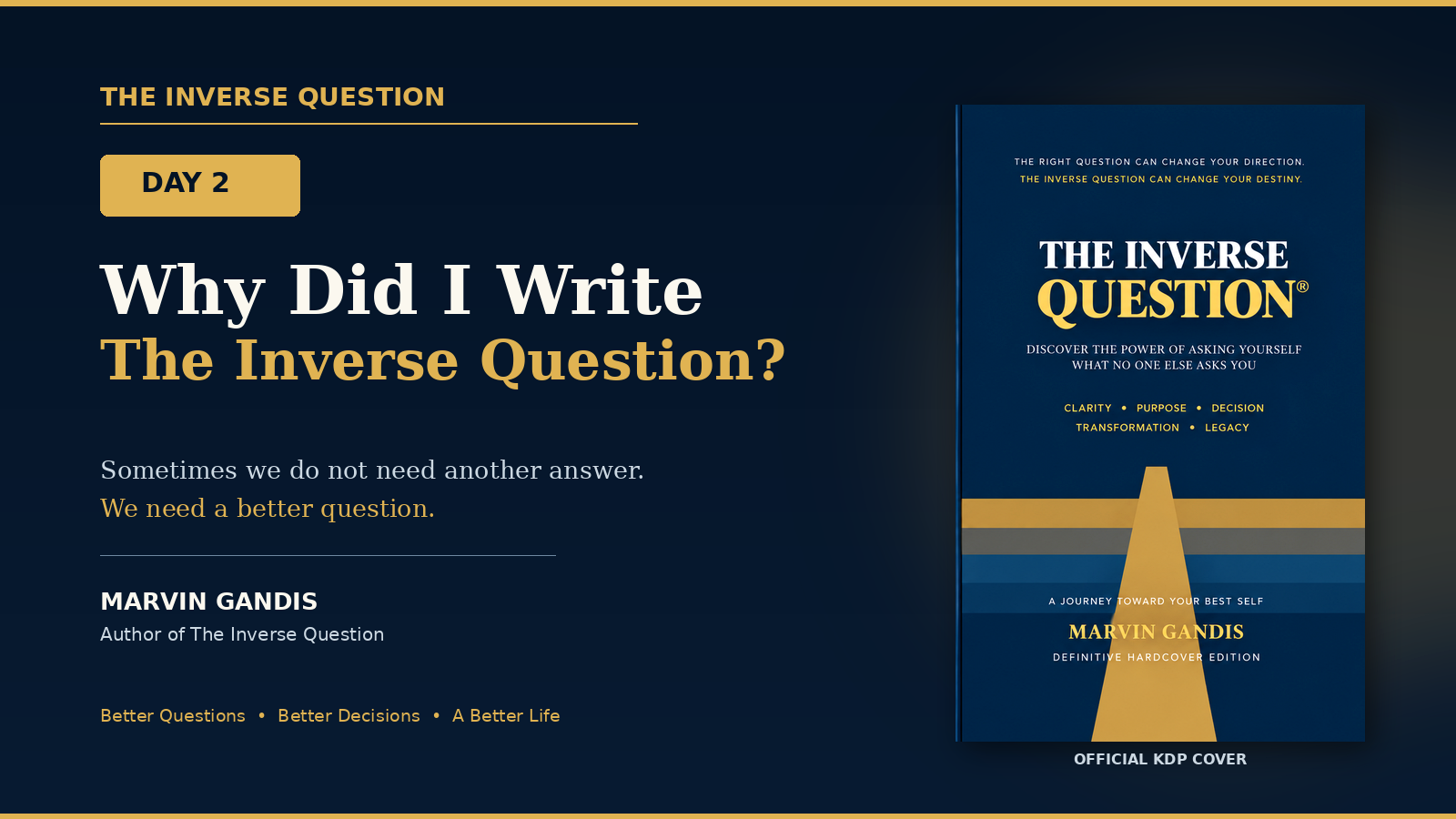
WHY DID I WRITE THE INVERSE QUESTION?

“Sometimes the most important change begins when we stop searching for another answer and finally ask ourselves a better question.”
— Marvin Gandis

There are books we write because we have information to share.

And there are books we write because a question will not leave us alone.

The Inverse Question belongs to the second kind.

I did not begin with the idea of writing a book simply to add another title to a shelf.

I began with a concern.

A pattern I kept seeing.

People working harder but not always moving forward.

People searching for more information while repeating the same habits.

People wanting better results without examining the decisions producing their current ones.

People asking:

  • “What should I do?”

when perhaps another question needed to come first:

“What am I already doing that is creating where I am?”

That question stayed with me.

And eventually, it became a book.


I BEGAN TO NOTICE A DIFFERENT PROBLEM

We live in a culture that constantly gives us answers.

  • How to make more money.
  • How to improve productivity.
  • How to build confidence.
  • How to grow a business.
  • How to become healthier.
  • How to communicate better.
  • How to manage time.
  • How to become successful.

Much of that information is valuable.

But I began asking myself:

Why do people sometimes know what to do and remain stuck?

That question changed everything.

Because the problem is not always lack of knowledge.

Sometimes the problem is repetition.

We know better.

But we repeat what is familiar.

We understand the principle.

But we continue protecting the habit.

We want a different destination.

But we keep following the same road.

That contradiction became one of the foundations of The Inverse Question.


INFORMATION DOES NOT AUTOMATICALLY BECOME TRANSFORMATION

Knowing is important.

But knowing and becoming are not the same thing.

You can know that saving money matters and still spend everything you earn.

You can know that exercise is good for you and remain inactive.

You can know that a relationship needs honest communication and continue avoiding the conversation.

You can know that a project matters and continue postponing it.

You can know that discipline produces results and still wait for motivation.

Knowledge gives us possibilities.

Action gives knowledge consequence.

That distinction mattered to me while writing this book.

I did not want merely to tell readers what they should know.

I wanted to invite them to examine what they repeatedly do.


THE QUESTION THAT CHANGED THE DIRECTION

At some point, I stopped asking only:

  • “What do I want from life?”

and began asking:

“What is my current way of living actually building?”

That was a different question.

It removed the comfort of intention.

It forced me to look at evidence.

  • My choices.
  • My routines.
  • My priorities.
  • My use of time.
  • My financial habits.
  • My discipline.
  • My willingness to finish what I started.
  • My response when things became difficult.
  • My willingness to change.

And that is where the word inverse became important.

The idea was not simply to ask another question.

It was to reverse the direction.

Instead of beginning with the desired result, begin with the behaviors producing results.

Instead of asking only about the fruit, examine the roots.

Instead of asking only what we want tomorrow, examine what we are practicing today.


✦ THE INVERSE QUESTION ✦

For Day 2, consider this question:

What are you asking life to give you that your current habits are not yet prepared to sustain?

Read that again.

You may want more money.

But are your current financial habits prepared to manage more?

You may want greater responsibility.

But are your current habits prepared to carry it?

You may want a stronger relationship.

But are your communication habits supporting trust?

You may want greater visibility.

But are you ready for the criticism that can accompany it?

You may want freedom.

But have you developed the discipline freedom requires?

We often focus on receiving the opportunity.

But perhaps the deeper question is:

Who are we becoming in preparation for it?


WHY I DID NOT WANT TO WRITE A BOOK OF EMPTY MOTIVATION

Motivation can be useful.

Encouragement matters.

There are moments when we need someone to remind us not to give up.

But motivation without examination can become a temporary emotion.

You feel inspired today.

Tomorrow the feeling fades.

Then the old pattern returns.

I wanted The Inverse Question to go deeper.

Not:

  • “Believe harder and everything will work out.”

But:

  • “What are you doing repeatedly?”

Not:

  • “Success is coming.”

But:

  • “Are you building the habits capable of carrying success when it arrives?”

Not:

  • “Think positively.”

But:

  • “Are your thoughts leading to responsible decisions?”

Hope matters.

But hope becomes stronger when it is connected to responsibility.


I WROTE IT BECAUSE RESULTS HAVE ROOTS

One of the central ideas behind this book is simple:

Visible results often come from invisible foundations.

  • A successful project has roots.
  • A strong relationship has roots.
  • Financial stability has roots.
  • Confidence has roots.
  • A reputation has roots.
  • A meaningful life has roots.

Those roots may include:

  • Discipline.
  • Patience.
  • Learning.
  • Integrity.
  • Consistency.
  • Responsibility.
  • Value creation.
  • Self-control.
  • Good systems.
  • Time.

The fruit receives attention.

The roots rarely do.

But the roots usually determine whether the fruit survives.

That is why The Inverse Question continually brings the reader back beneath the surface.


I ALSO WROTE IT BECAUSE BLAME CAN BECOME A PRISON

There are legitimate injustices.

There are unfair circumstances.

There are things that happen to us that we did not choose.

Acknowledging personal responsibility does not mean pretending otherwise.

But there is a danger when everything becomes someone else’s responsibility.

If everyone else is always responsible for where I am, then everyone else also holds the power to determine where I go.

That gives away too much power.

A more useful question can be:

What remains within my responsibility despite what I cannot control?

Perhaps I cannot control the economy.

But I can continue learning.

Perhaps I cannot control another person’s behavior.

But I can decide what boundaries I accept.

Perhaps I cannot control every opportunity.

But I can become more prepared for the next one.

Perhaps I cannot change yesterday.

But I can influence what I repeat today.

That shift from blame to responsibility became another reason for writing the book.


I WROTE IT FOR THE PERSON WHO FEELS STUCK

You may be doing many things correctly.

  • You may be working.
  • Trying.
  • Learning.
  • Praying.
  • Planning.

And still feel as though progress is slow.

This book is not written to accuse you.

It is written to help you investigate.

Sometimes the answer is:

  • Keep going.

Sometimes it is:

  • Change the method.

Sometimes:

  • Stop doing what is clearly not working.

Sometimes:

  • Ask for help.

Sometimes:

  • Be patient.

And sometimes:

  • Tell yourself the truth.

A useful question does not always give us the answer we hoped for.

But it may give us the answer we need.


✦ THE MIRROR ✦

Take a moment and write your answers.

Something I want to change in my life is: __________

The question I normally ask about this problem is: __________

Now reverse it.

A question I may be avoiding is: __________

One habit contributing to my current result may be: __________

One thing outside my control is: __________

One thing still within my responsibility is: __________

One decision I can make differently this week is: __________

Finally:

What would become possible if I stopped asking only why this is happening and also asked what I can do from here?

That is the spirit behind the book.


MONEY WAS PART OF THE PATH — BUT LIFE BECAME THE SUBJECT

Like many people, I have thought deeply about money.

  • Earning.
  • Saving.
  • Opportunity.
  • Business.
  • Financial education.
  • Value creation.

But eventually I realized that money leads to larger questions.

  • What is enough?
  • What is freedom?
  • What is responsibility?
  • What are we willing to sacrifice?
  • What kind of person are we becoming while pursuing success?
  • What happens if we accumulate more but enjoy life less?
  • What happens if achievement becomes our identity?

What happens if we spend our entire life climbing and never ask whether the ladder is leaning against the right wall?

That is when the book became about something bigger.

  • Life.

SUCCESS WITHOUT DIRECTION CAN STILL LEAVE YOU LOST

We often assume progress and direction are the same thing.

  • They are not.

You can move quickly in the wrong direction.

You can become more efficient at something that no longer serves your purpose.

You can earn more and still lose peace.

You can become busy and mistake it for progress.

You can collect achievements and still feel disconnected from meaning.

That is why one of the deepest themes in The Inverse Question is not simply:

  • How do I succeed?

It is:

What kind of success is worth building?

And:

What kind of person do I need to become to build it without losing myself?


I WROTE IT BECAUSE SMALL DECISIONS ARE NOT SMALL FOREVER

One small decision rarely transforms a life immediately.

But repeated decisions accumulate.

One late night may not matter much.

Years of poor sleep may.

One unnecessary purchase may not matter much.

A repeated spending pattern may.

One postponed project may not matter much.

A lifetime of postponement may.

One disciplined morning may not change everything.

But thousands of disciplined mornings can.

Time magnifies repetition.

That is why the ordinary deserves our attention.

The extraordinary future we imagine is often built through very ordinary decisions.


THE BOOK IS A CONVERSATION, NOT A COMMAND

I do not expect every reader to agree with every reflection.

That would defeat part of the purpose.

The goal is not to tell you:

  • “Think exactly as I think.”

The goal is:

Think carefully.

Question assumptions.

Examine patterns.

Separate intention from evidence.

  • Learn.
  • Reflect.
  • Decide.

Take responsibility where responsibility belongs.

And leave room to revise your thinking when new understanding appears.

A good question should not reduce your agency.

It should strengthen it.


MY DEAR READER AND FRIEND

I wrote The Inverse Question because I believe better thinking can improve the quality of our decisions.

And decisions matter.

They become days.

Days become years.

Years become a life.

I cannot know every circumstance you are facing.

I cannot make your decisions for you.

And I should not.

But I can invite you to ask:

  • What am I building?
  • What am I repeating?
  • What am I tolerating?
  • What am I avoiding?
  • What am I becoming?

Those questions may lead different readers to different answers.

That is exactly as it should be.


WHY DID I WRITE THE INVERSE QUESTION?

Because I became convinced that sometimes:

We do not need another motivational speech.

We need a mirror.

We do not need another shortcut.

We need clarity.

We do not need another person to tell us what we want to hear.

We need enough courage to ask what we may not want to answer.

And sometimes we do not need a better answer.

We need a better question.

That is why I wrote The Inverse Question.

With gratitude,

Marvin Gandis
Author of La Pregunta Inversa and The Inverse Question


CONTINUE THE JOURNEY

This is Day 2 of The Inverse Question English series.

Yesterday, we began a new chapter by asking:

  • What part of your future are you already creating through the choices you repeat today?

Today, we explored why this book exists.

Tomorrow, the journey continues with:

Day 3 — The Question That Changed the Way I Think

Because sometimes one question does not simply produce an answer.

It changes the way we see everything that follows.

DISCLAIMER

This article is provided for educational, informational, and personal-reflection purposes only. It is not financial, legal, medical, psychological, mental-health, business, or other professional advice.

The experiences, reflections, and principles discussed are general and may not apply equally to every individual or circumstance. Readers are responsible for evaluating their own situations and making decisions appropriate to their personal needs, values, risks, and responsibilities.

No specific personal, financial, professional, business, health, or life result is promised or guaranteed. When a situation requires specialized guidance, readers should consult an appropriately qualified professional.

The Inverse Question series is intended to encourage thoughtful reflection, personal responsibility, awareness, learning, and independent decision-making.
Publicado en Decision Making, Habits, Intentional Living, Marvin Gandis, Mindset, Personal Development, Personal Growth, The Inverse Question

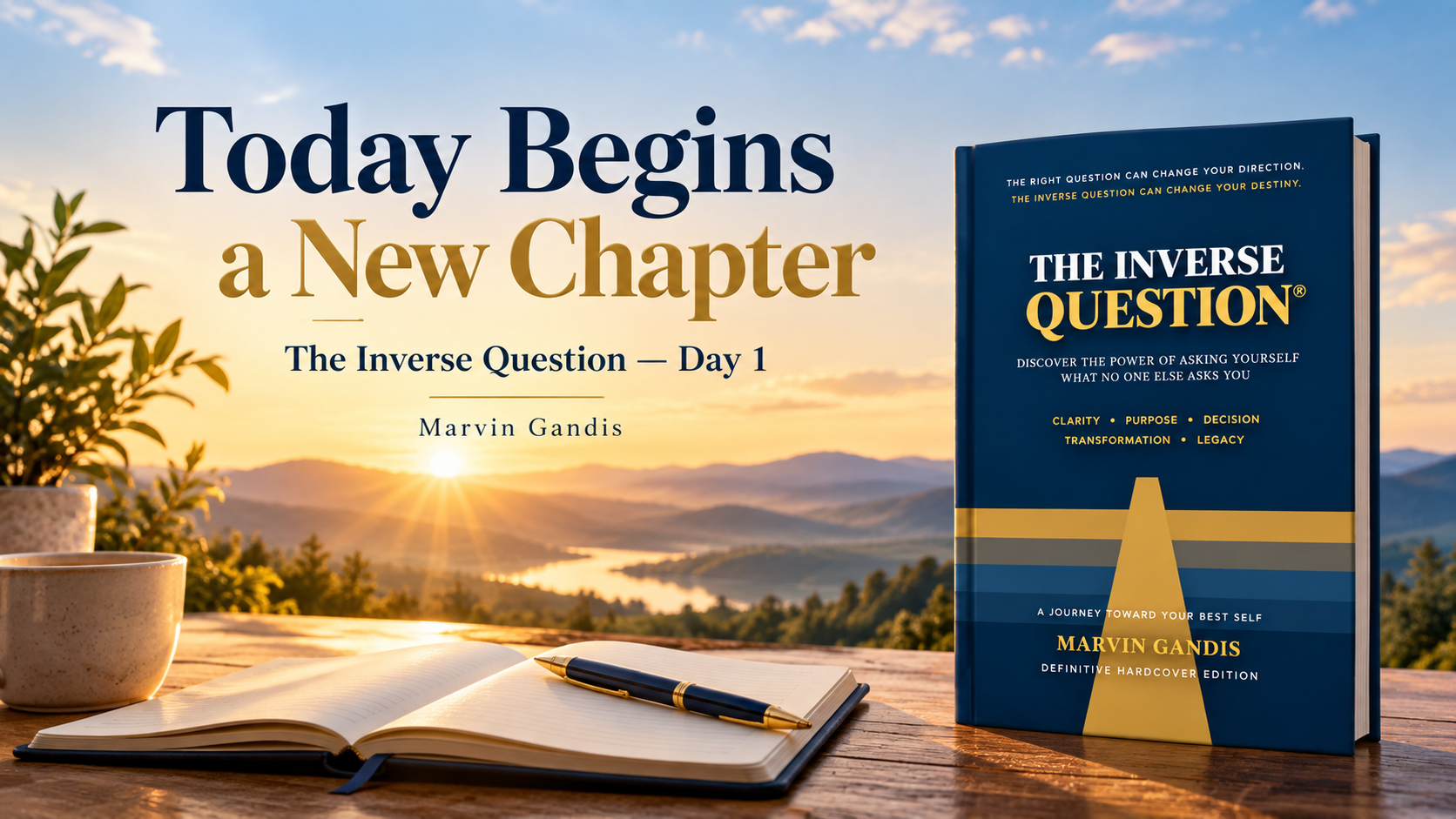
TODAY BEGINS A NEW CHAPTER

“The right question can change your direction. The Inverse Question can change your destiny.”
— Marvin Gandis

Today begins a new chapter.

Not only because The Inverse Question is now available in English.

Not only because a book has crossed from one language into another.

But because a new conversation is beginning.

A conversation about the questions we ask when no one else is listening.

About the choices we repeat.

The habits we tolerate.

The fears we avoid.

The goals we postpone.

The excuses we defend.

And the future we are quietly building through what we do every day.

This series is not meant to give you quick answers.

It is meant to help you ask better questions.

Because sometimes the question we normally ask is not the question we most need to answer.


WE LIVE SURROUNDED BY ANSWERS

We live in an extraordinary time.

Search engines can answer almost anything.

Videos can teach us how to do almost anything.

Books can give us decades of experience condensed into a few hours.

Experts can guide us.

Artificial intelligence can provide explanations within seconds.

And yet, even with more information than any generation before us, many people still feel stuck.

Why?

Because information alone does not automatically create transformation.

You can know what to do and still not do it.

You can understand a principle and still ignore it.

You can hear the right advice and continue making the same decisions.

You can have access to answers and still be asking the wrong questions.

That is why this journey begins here.


THE QUESTION BEHIND THE BOOK

Many people ask:

  • “How can I change my life?”

It is an important question.

But The Inverse Question invites us to go one level deeper.

What am I doing repeatedly that is helping create the life I currently have?

That question changes the direction of the conversation.

It moves us away from only looking outside ourselves.

It invites us to examine:

  • Our habits.
  • Our decisions.
  • Our use of time.
  • Our discipline.
  • Our attention.
  • Our money.
  • Our conversations.
  • Our routines.
  • Our reactions.
  • Our priorities.

And our willingness to accept responsibility for what remains within our control.

This does not mean that everything that happens to us is our fault.

Life contains circumstances we do not choose.

  • Loss.
  • Economic changes.
  • Health challenges.
  • Other people’s decisions.
  • Unexpected events.
  • Unfair situations.

But even when we cannot control every circumstance, we can still ask:

What can I influence from here?

That is a powerful place to begin.


✦ THE INVERSE QUESTION ✦

For Day 1, I want you to consider this:

What part of your future are you already creating through the choices you repeat today?

Do not answer too quickly.

  • Think carefully.

Look at your days.

  • What do you repeatedly give your attention to?
  • What do you repeatedly postpone?
  • What do you repeatedly spend money on?
  • What do you repeatedly say yes to?
  • What do you repeatedly tolerate?
  • What do you repeatedly avoid?
  • What do you repeatedly practice?
  • What do you repeatedly believe about yourself?

Because repetition matters.

  • What we repeat eventually becomes familiar.
  • What becomes familiar can become normal.
  • What becomes normal can become identity.

And identity influences direction.


YOUR FUTURE IS OFTEN HIDING INSIDE YOUR ROUTINE

People often imagine the future as something far away.

But much of the future is already being built in the present.

  • Not dramatically.

Quietly.

  • One morning at a time.

One purchase at a time.

  • One habit at a time.

One conversation at a time.

  • One decision at a time.

One excuse at a time.

  • One disciplined action at a time.

Think about it.

  • A stronger body is built through repeated choices.
  • Financial stability is built through repeated choices.

Trust is built through repeated choices.

  • Knowledge is built through repeated choices.
  • Confidence is built through repeated choices.

A reputation is built through repeated choices.

  • So is regret.
  • So is debt.
  • So is resentment.
  • So is stagnation.

We rarely wake up one morning and suddenly become the result.

  • We usually become it gradually.

THE PROBLEM IS NOT ALWAYS LACK OF DESIRE

Most people want better things.

  • Better finances.
  • Better relationships.
  • Better health.
  • Better opportunities.
  • More peace.
  • More purpose.
  • More confidence.
  • More freedom.

But desire alone does not determine direction.

  • Repeated behavior does.

You can want financial peace and repeatedly spend without a plan.

You can want better health and repeatedly neglect your body.

You can want a stronger relationship and repeatedly avoid honest conversations.

You can want progress and repeatedly choose comfort over discipline.

You can want confidence and repeatedly break promises to yourself.

That gap between what we say we want and what we repeatedly do deserves attention.

  • Not condemnation.
  • Attention.

Because awareness is where change begins.


THE FUTURE DOES NOT ARGUE WITH YOUR HABITS

Your future does not respond to intentions alone.

It responds to what you repeatedly practice.

You may intend to save.

You may intend to exercise.

You may intend to learn.

You may intend to write.

You may intend to forgive.

You may intend to begin.

But intentions that never become action remain possibilities.

Habits, however, produce evidence.

That is why one of the most useful questions you can ask is:

If I continue living exactly as I am today, where is this pattern likely to take me?

That question can be uncomfortable.

  • But it can also be freeing.

Because once you see the direction clearly, you can decide whether you want to continue.


YOU DO NOT NEED TO CHANGE EVERYTHING TODAY

One of the biggest mistakes people make is believing that transformation must be dramatic.

  • It does not.

You do not need to redesign your entire life today.

You do not need to fix every problem.

You do not need to become a completely different person by tomorrow morning.

You need to identify the next responsible step.

That may be:

  • Writing down your expenses.
  • Walking for twenty minutes.
  • Sending one important email.
  • Making one phone call.
  • Reading ten pages.
  • Removing one distraction.
  • Apologizing.
  • Creating one boundary.
  • Starting one savings habit.
  • Finishing one task.
  • Going to bed earlier.

Saying no to something that keeps taking you away from your priorities.

  • Small actions can look insignificant.

But repeated small actions can produce very large outcomes.


✦ THE MIRROR ✦

Take a piece of paper.

Write honestly.

One area of my life I want to improve is: __________

The result I say I want is: __________

The habit I currently repeat is: __________

That habit is moving me toward or away from my goal because: __________

One choice I need to stop repeating is: __________

One choice I need to start repeating is: __________

And finally:

If nothing changes, where will this pattern take me in five years?

Do not use this exercise to attack yourself.

Use it to see clearly.

Clarity is useful.

Clarity gives you a chance to choose.


IDENTITY IS BUILT THROUGH REPETITION

Every repeated action is not only producing a result.

It is also teaching you something about who you are.

When you keep a promise to yourself, you practice reliability.

When you finish what you start, you practice discipline.

When you tell the truth, you practice integrity.

When you learn consistently, you practice growth.

When you save regularly, you practice stewardship.

When you face difficult conversations, you practice courage.

When you keep postponing, you also practice something.

When you repeatedly quit, you practice quitting.

When you repeatedly avoid responsibility, you practice avoidance.

This is why habits matter beyond productivity.

They participate in identity.

And identity influences future decisions.


YOU ARE NOT REQUIRED TO STAY LOYAL TO AN OLD VERSION OF YOURSELF

Sometimes people remain stuck because they feel obligated to continue being who they have always been.

  • “I have always been like this.”
  • “I am not disciplined.”
  • “I am terrible with money.”
  • “I never finish anything.”
  • “I am not confident.”
  • “I am too old.”
  • “I am not that kind of person.”

Be careful with those sentences.

They may describe your past.

But they do not have to become a contract with your future.

You are allowed to learn.

You are allowed to change.

You are allowed to build different habits.

You are allowed to become more disciplined than you used to be.

You are allowed to become more responsible.

You are allowed to become wiser.

You are allowed to make a different decision today than you made yesterday.


CHANGE OFTEN BEGINS BEFORE CONFIDENCE ARRIVES

Many people wait until they feel ready.

Until they feel confident.

Until they feel motivated.

Until fear disappears.

But often confidence comes after action, not before it.

You act.

You learn.

You survive the discomfort.

You improve.

You begin trusting yourself.

Confidence grows.

That is why you do not always need a strong feeling first.

Sometimes you need a responsible action first.


MY DEAR READER AND FRIEND

If you are joining this series today, I want you to know something.

This journey will not be about perfection.

  • It will be about awareness.
  • Responsibility.
  • Growth.
  • Direction.

We will explore questions about:

  • Habits.
  • Mindset.
  • Discipline.
  • Money.
  • Purpose.
  • Fear.
  • Comfort.
  • Attention.
  • Time.
  • Identity.
  • Decision-making.
  • Responsibility.

And legacy.

Some questions may encourage you.

Others may make you uncomfortable.

That is fine.

Useful questions sometimes do.

The goal is not to make you feel judged.

The goal is to help you see what your current direction is building.

Because once you see clearly, you can choose differently.


TODAY BEGINS A NEW CHAPTER

A new chapter does not begin when everything becomes perfect.

It begins when you decide to stop repeating something that no longer serves your future.

It begins when you choose one better habit.

  • One better question.
  • One better decision.
  • One better direction.

You do not need every answer today.

You need enough honesty to see where you are.

Enough humility to admit what needs to change.

And enough courage to take the next step.

That is how new chapters begin.

  • Not with certainty.
  • With decision.

WELCOME TO THE INVERSE QUESTION

If you have followed my work in Spanish…

If you have read La Pregunta Inversa…

If you waited for the English edition…

Or if you are discovering this message for the first time…

  • Welcome.

Take your time with these questions.

Write your answers.

Return to them.

Notice patterns.

Notice resistance.

Notice what becomes clearer.

And most importantly:

Notice what changes when you begin asking yourself better questions.

Because:

Better questions can lead to better decisions.

Better decisions can create a better direction.

And a better direction, followed consistently, can build a better life.

With gratitude,

Marvin Gandis
Author of La Pregunta Inversa and The Inverse Question


CONTINUE THE JOURNEY WITH THE INVERSE QUESTION

This article is the beginning of the English series inspired by The Inverse Question.

Each entry will explore one question designed to help readers examine the habits, decisions, beliefs, and patterns shaping their future.

The goal is not to tell you how to live.

The goal is to help you think more clearly about the life you are already building.

  • Day 1 begins here.

And the first question remains:

What part of your future are you already creating through the choices you repeat today?


DISCLAIMER

This article is intended for educational, informational, and personal-reflection purposes only. It does not constitute financial, legal, medical, psychological, mental health, or other professional advice.

The ideas presented are general in nature and may not apply equally to every person or situation. Individual circumstances, needs, responsibilities, and risks vary. Readers are responsible for evaluating their own circumstances and making decisions appropriate to their personal situation.

No specific personal, financial, professional, health, or life outcome is promised or guaranteed. When specialized guidance is appropriate, readers should consult a qualified professional in the relevant field.

The purpose of The Inverse Question series is to encourage reflection, awareness, personal responsibility, and thoughtful decision-making.

Publicado en Books, Intentional Living, Marvin Gandis, Mindset, Personal Development, Personal Growth, The Inverse Question

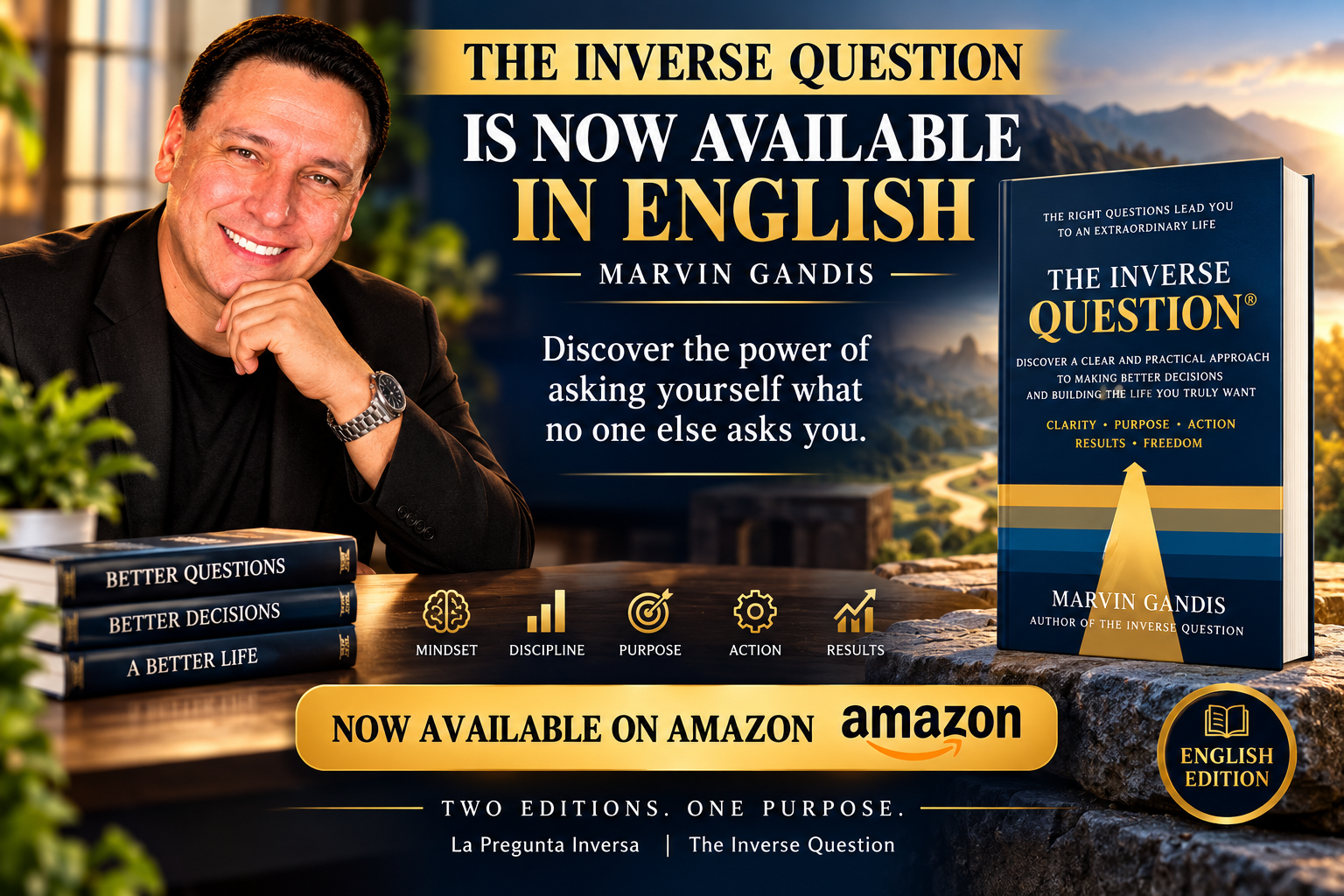
The Inverse Question Is Now Available in English — Official Launch

For some time, one question has continued to come from readers:

“Will the book be available in English too?”

Today, I am grateful to finally say:

Yes. The Inverse Question is now available in English.

What began with the Spanish edition of La Pregunta Inversa has now reached an important new milestone.

English-speaking readers can now experience the ideas, reflections, and questions behind the book in their own language.

For me, this is more than the release of another edition.

It is the expansion of a conversation.

  • A conversation about habits.
  • About decisions.
  • About discipline.
  • About purpose.
  • About responsibility.
  • About the future we are quietly building every day.

And above all, it is a conversation about learning to ask ourselves better questions.

Why I Wrote The Inverse Question

We live in a world filled with answers.

  • Search engines give us answers.
  • Videos give us answers.
  • Books give us answers.
  • Experts give us answers.
  • Artificial intelligence can provide answers within seconds.

But there is something no tool can decide for us:

  • What questions should we be asking about our own lives?

Many meaningful changes begin not with another answer, but with a different question.

Instead of asking:

  • “How can I get more?”

we may need to ask:

  • “What am I becoming while pursuing more?”

Instead of:

  • “Why am I not seeing better results?”

perhaps the deeper question is:

  • “What habits, decisions, and systems are producing the results I currently have?”

Instead of only asking:

  • “What do I want?”

we can ask:

  • “What am I doing today that is quietly building the future I say I want?”

That is the heart of The Inverse Question.

The Question Behind the Book

The central idea is simple:

Sometimes the question we normally ask is not the question we most need to answer.

We naturally focus on visible results.

  • Income.
  • Opportunities.
  • Success.
  • Relationships.
  • Recognition.
  • Progress.

But visible results are often produced by invisible foundations.

  • Our habits.
  • Our mindset.
  • Our discipline.
  • Our decisions.
  • Our use of time.
  • Our ability to create value.
  • Our willingness to accept responsibility.
  • Our consistency when nobody is watching.

The book invites readers to examine those foundations before focusing only on the outcome.

Invisible Roots Come Before Visible Fruit

One of the recurring ideas behind The Inverse Question is that results rarely appear from nowhere.

Think about a tree.

  • Most people admire the fruit.

Few people think about the roots.

  • Yet without healthy roots, the fruit eventually suffers.

Life often works in a similar way.

The visible outcome may be:

  • A stronger financial position.
  • A healthier relationship.
  • A completed project.
  • A successful business.
  • A new career.
  • Greater confidence.
  • A meaningful legacy.

But behind those visible results are usually invisible processes repeated over time.

The book invites us to examine those processes.

Because when we only try to change the fruit without examining the roots, we may temporarily change a result without changing the system that produced it.

Better Questions Can Lead to Better Decisions

A powerful question does not make decisions for us.

It helps us see more clearly.

Consider the difference between:

  • “Why is nothing changing?”

and:

  • “What am I repeating that keeps producing the same result?”

Or:

  • “Why do I never have enough time?”

and:

  • “What receives most of my attention every day?”

Or:

  • “Why have I not reached my goal?”

and:

  • “Which daily behaviors would make that goal more likely?”

The second question in each example moves us closer to personal responsibility and practical action.

That does not mean everything in life is under our control.

  • It is not.

Circumstances matter.

Opportunities matter.

Other people’s decisions matter.

Unexpected events matter.

But even when we cannot control everything around us, we can still examine what remains within our responsibility.

  • And that can be powerful.

This Is Not a Book of Magic Formulas

The Inverse Question does not promise overnight transformation.

It does not promise instant wealth.

It does not pretend that one question can remove every obstacle.

Instead, it offers something more realistic:

A mirror.

An invitation to examine how we think.

  • How we decide.
  • What we tolerate.
  • What we repeat.
  • What we postpone.
  • What receives our energy.
  • What receives our attention.

And what kind of person those repeated choices are gradually creating.

Sometimes the most useful thing a book can do is not tell us what to think.

  • It can help us think more deeply for ourselves.

What You Will Explore in The Inverse Question

Throughout the book, readers are encouraged to think about several interconnected foundations of personal development and intentional living.

Mindset — the beliefs and perspectives through which we interpret our circumstances.

Value Creation — understanding that meaningful progress often begins with becoming useful, solving problems, and contributing something valuable.

Discipline — continuing to act when motivation is inconsistent.

Systems — building processes that make good decisions easier to repeat.

Time — recognizing that the way we use our days eventually becomes the way we use our lives.

Responsibility — identifying what is actually within our control and acting accordingly.

Perseverance — continuing to learn and adjust when results do not arrive immediately.

Legacy — considering what our choices are building beyond today’s immediate rewards.

These ideas are not isolated.

  • They work together.

From La Pregunta Inversa to The Inverse Question

Publishing the Spanish edition was a deeply meaningful milestone for me.

But from the beginning, I knew the message should not remain limited to one language.

Many of my readers, subscribers, friends, and online connections communicate primarily in English.

Some began asking whether an English edition would eventually be available.

I appreciated those questions because they reminded me that the ideas behind the book could reach a wider audience.

Today, that possibility has become reality.

La Pregunta Inversa continues serving Spanish-speaking readers.

And now:

The Inverse Question is available for English-speaking readers.

Two languages.

Two editions.

One central invitation:

Ask better questions about the life you are building.

A Book About More Than Success

Success is often measured by what we accumulate.

  • Money.
  • Titles.
  • Followers.
  • Possessions.
  • Achievements.

There is nothing inherently wrong with progress or prosperity.

But there is a larger question:

Who are we becoming while building those things?

A person can increase possessions and decrease peace.

Increase income and lose direction.

Become busier without becoming more intentional.

Achieve more without understanding why the achievement matters.

That is why the conversation eventually moves beyond money or success.

  • It moves toward life.
  • Purpose.
  • Character.
  • Responsibility.
  • Wisdom.

And legacy.

A Question to Consider Today

Before you even open the book, consider this:

What are you doing repeatedly today that your future self will eventually have to live with?

Not once.

  • Repeatedly.

Your repeated decisions matter because repetition eventually becomes habit.

  • Habit influences character.
  • Character influences decisions.
  • Decisions influence direction.
  • And direction, sustained long enough, becomes destination.

That is why small choices deserve more attention than we often give them.

You Do Not Need Every Answer Today

One of the biggest mistakes we can make is believing that progress requires complete certainty.

  • It rarely does.

Sometimes you simply need enough clarity to identify the next responsible step.

  • Ask one better question.

Recognize one unhelpful habit.

  • Correct one repeated mistake.

Begin one overdue conversation.

  • Learn one new skill.

Change one daily routine.

  • Make one decision you have been postponing.

Small actions may appear insignificant in isolation.

  • But repeated over time, they can redirect an entire life.

To My English-Speaking Readers

If you previously visited my website, followed my articles, or encountered La Pregunta Inversa and wondered whether you would ever be able to read the complete work in English:

This edition is for you.

  • Thank you for your patience.
  • Thank you for asking.
  • Thank you for continuing to follow this journey.

I hope The Inverse Question becomes more than another book on your shelf.

I hope at least one page makes you stop.

  • Think.

Question something you have accepted without examining.

  • Recognize a pattern.
  • Make a decision.
  • Or look at your future differently.

If that happens, then the book has accomplished something meaningful.

Two Editions. One Purpose.

Today I can finally say:

and

are both part of this journey.

Different languages.

The same fundamental purpose:

Better questions.

Better decisions.

A better life.

The Inverse Question — Now Available on Amazon

The Inverse Question: Discover the Power of Asking Yourself What No One Else Asks You

Author: Marvin Gandis
Language: English
Format: Hardcover
List Price: $19.99
ASIN: B0HKMHJ9FP

Amazon:

A Personal Thank You

Every book begins with an idea.

But bringing that idea into the world requires many stages.

  • Writing.
  • Rewriting.
  • Editing.
  • Design.
  • Corrections.
  • Proofs.
  • Mistakes.
  • More corrections.
  • Patience.

And eventually, the moment when you realize:

  • It is no longer only a manuscript.

Someone else can now hold it.

  • Read it.
  • Question it.
  • Learn from it.

And perhaps use one idea from it to make a different decision.

That is the part that matters most to me.

To every person who encouraged me, followed this process, read the articles inspired by the book, asked questions, shared posts, or simply said, “Keep going”:

  • Thank you.

And to my English-speaking readers:

Welcome to The Inverse Question.

The conversation is now yours.

Final Reflection

Before you leave this page, ask yourself one question:

What question have I been avoiding because I already know the answer may require me to change?

Do not rush the answer.

  • Sit with it.
  • Write it down.

And when you are ready, take the next responsible step.

Because:

  • The right question can change your direction.
  • The Inverse Question can change your destiny.

With gratitude,

Marvin Gandis
Author of La Pregunta Inversa and The Inverse Question

The English hardcover edition is now available on Amazon.

If this message speaks to you, I invite you to discover The Inverse Question.

Read it. Reflect on it. Share it. Most importantly, ask yourself better questions.

Amazon:


Disclaimer:
This article and The Inverse Question are intended for educational, informational, and personal-reflection purposes only. The ideas presented are general in nature and are not a substitute for professional financial, legal, medical, psychological, mental health, or other specialized advice.

Individual circumstances vary, and no specific personal, financial, business, health, or life outcome is guaranteed. Readers are responsible for evaluating their own circumstances and making decisions appropriate to their individual needs. When a situation requires specialized guidance, readers should consult a qualified professional in the relevant field.

Any references to personal growth, habits, decision-making, discipline, responsibility, purpose, or financial principles are intended to encourage thoughtful reflection and education, not to promise specific results.