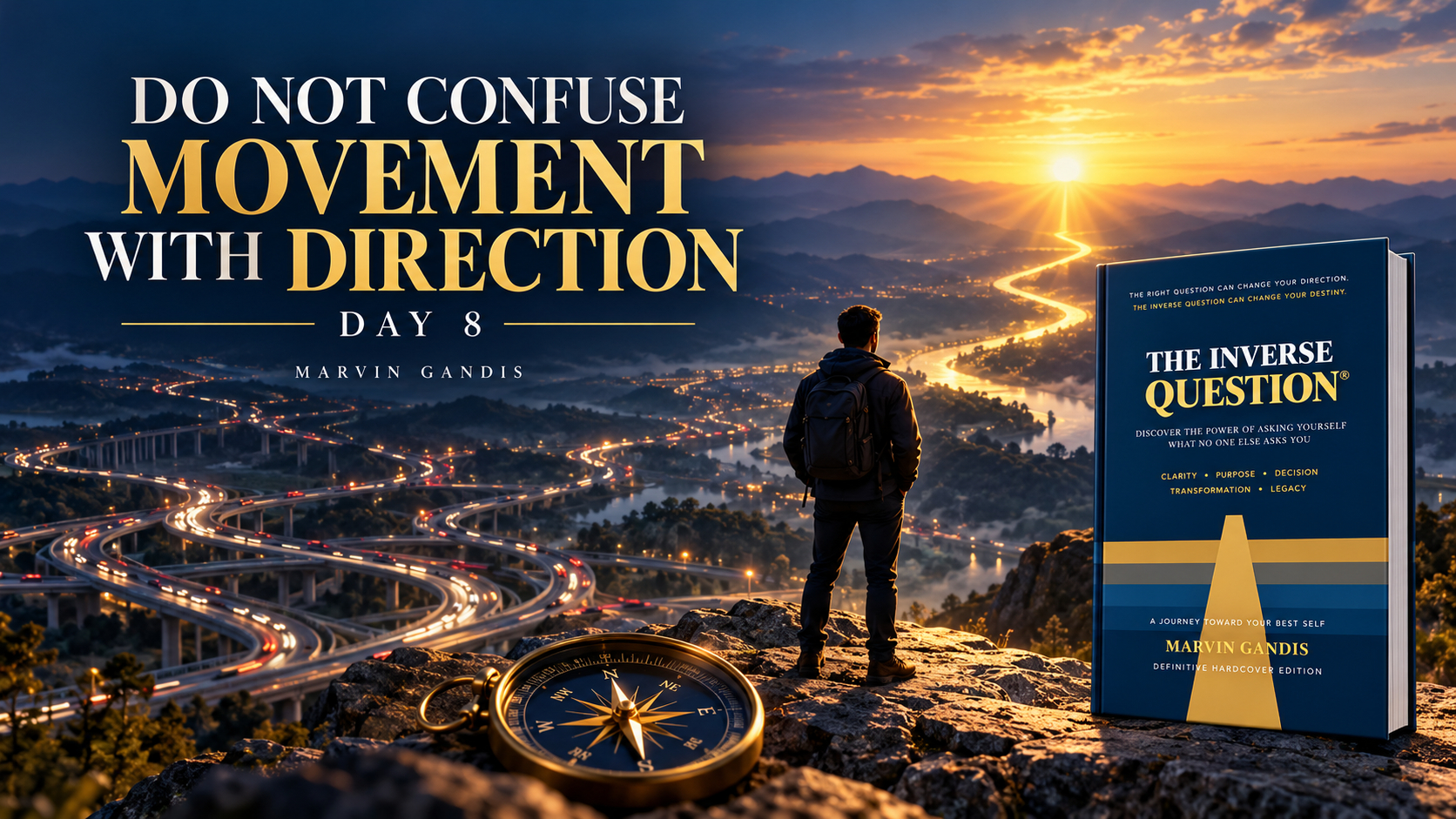
“You can move all day and still end up farther from where you truly wanted to go.”
— Marvin Gandis
Movement feels productive.
It gives us something to point to.
A full schedule.
Completed tasks.
New projects.
More calls.
More messages.
More meetings.
More activity.
And because we are moving, we assume we are progressing.
But movement only answers one question:
- “Am I doing something?”
Direction answers another:
“Is what I am doing taking me where I actually want to go?”
Those questions are not the same.
And confusing them can cost us years.
MOVEMENT CREATES THE ILLUSION OF PROGRESS
It is easy to feel productive when the day is full.
We wake up early.
We answer messages.
We work.
We solve problems.
We react to emergencies.
We jump from one obligation to another.
By evening, we are exhausted.
And exhaustion can feel like proof that something meaningful happened.
But tired is not always the same as productive.
Busy is not always the same as effective.
And motion is not always the same as direction.
The important question is:
What moved forward because of all that activity?
A COMPASS MATTERS MORE THAN SPEED
Imagine walking quickly through a forest.
You move with determination.
Your pace is strong.
You cover a great distance.
But you are heading away from your destination.
Was your speed useful?
No.
It made the problem larger.
Direction must come before acceleration.
The same principle applies to life.
Before asking:
- “How can I do more?”
ask:
“Am I headed toward something I actually want?”
✦ THE INVERSE QUESTION ✦
For Day 8, ask yourself:
Where in my life am I moving constantly without being certain that I am moving in the right direction?
Think about:
Your career.
Your business.
Your finances.
Your relationships.
Your health.
Your time.
Your personal development.
Your spiritual life.
Your goals.
Where are you busy?
And where are you actually headed?
A FULL CALENDAR CAN HIDE AN EMPTY DIRECTION
A calendar can be full and still lack purpose.
Meetings.
Appointments.
Projects.
Calls.
Commitments.
Tasks.
But activity without priorities creates noise.
A better question is:
If I removed everything that does not meaningfully support my priorities, what would remain?
That answer may be uncomfortable.
But it can reveal the difference between a busy life and an intentional one.
WE SOMETIMES MOVE BECAUSE STANDING STILL FEELS SCARY
Reflection requires stillness.
Stillness can be uncomfortable.
When we stop moving, we may begin noticing things we have avoided.
We may realize:
A goal no longer matters.
A strategy is failing.
A relationship needs attention.
A habit is hurting us.
A commitment should end.
A direction needs to change.
Movement can protect us from those realizations.
If we keep moving, we do not have to stop long enough to question the route.
DIRECTION REQUIRES A DEFINITION OF “ENOUGH”
If you never define enough, more becomes the destination.
More money.
More customers.
More followers.
More work.
More possessions.
More recognition.
More growth.
But more is not a direction.
It is simply an increase.
Eventually we must ask:
How much is enough?
What am I trying to protect?
What kind of life am I trying to build?
What am I unwilling to sacrifice?
What matters after the achievement?
Without those answers, success can become endless motion.
BUSINESS ACTIVITY CAN HIDE STRATEGIC CONFUSION
Business owners often work constantly.
Marketing.
Content.
Email.
Sales.
Networking.
Administration.
Technology.
Customer service.
Research.
Learning.
All of it may be necessary.
But not all activities contribute equally.
Imagine spending twenty hours creating content that generates no meaningful engagement while avoiding the two hours needed to improve an offer customers actually want.
That is movement.
But is it direction?
A stronger question is:
Which activities create the results the business actually needs?
Everything else should be evaluated around that.
THE SAME APPLIES TO MARKETING
More traffic does not automatically mean better marketing.
More followers do not automatically mean more trust.
More emails do not automatically mean stronger relationships.
More posts do not automatically mean greater authority.
More clicks do not automatically mean more customers.
Metrics can create the appearance of movement.
But direction requires connecting metrics to meaningful outcomes.
Ask:
- What is this number supposed to accomplish?
If there is no clear answer, the number may simply be noise.
FINANCIAL MOVEMENT CAN ALSO BE DECEPTIVE
You can earn more money and become less financially secure.
How?
Lifestyle grows faster than income.
Debt grows.
Savings disappear.
Expenses expand.
Financial complexity increases.
The numbers are moving.
But the financial direction may be deteriorating.
That is why earning more and becoming financially healthier are related—but not identical.
A better question is:
Is my financial life becoming stronger, or simply larger?
CAREER PROGRESS CAN LEAD AWAY FROM THE LIFE YOU WANT
Promotions are usually celebrated.
More responsibility.
Higher income.
Greater status.
But every promotion changes something.
Time.
Pressure.
Travel.
Responsibilities.
Relationships.
Lifestyle.
Some opportunities are excellent.
Others may lead toward a life you never intended to create.
The question is not simply:
- “Can I advance?”
It is:
“Do I want the life that comes with this advancement?”
PERSONAL GROWTH CAN LOSE DIRECTION TOO
There is an endless amount to learn.
Books.
Courses.
Podcasts.
Videos.
Seminars.
New ideas.
New systems.
Learning is valuable.
But learning without application can become movement without transformation.
Ask yourself:
- What have I actually changed because of what I learned?
If the answer is nothing, perhaps another course is not the next step.
Perhaps practice is.
DIRECTION REQUIRES PRIORITIES
Everything cannot be equally important.
If everything is a priority, nothing is.
Priorities force us to decide.
This matters more than that.
This deserves time.
That can wait.
This opportunity fits.
That one does not.
This relationship deserves attention.
This distraction must be limited.
Direction is built through these decisions.
✦ THE MIRROR ✦
Take one important area of your life.
Write:
My destination is: __________
Now answer:
What am I currently doing to reach it? __________
Which activity moves me closer? __________
Which activity only keeps me busy? __________
What has become a habit without a clear purpose? __________
What should I reduce? __________
What deserves more attention? __________
Now ask the deeper question:
If I continue moving in exactly this direction for the next five years, where will I arrive?
Do not answer quickly.
Visualize it.
That future may tell you whether the current route deserves your next step.
DIRECTION IS OFTEN QUIETER THAN MOVEMENT
Movement makes noise.
Direction often does not.
A thoughtful decision may take five minutes and save five years.
Saying no may free hundreds of future hours.
Changing one habit may influence thousands of future choices.
Ending one ineffective activity may create room for something valuable.
Direction does not always look impressive.
Sometimes it looks like simplification.
THE RIGHT DIRECTION MAY REQUIRE MOVING SLOWER
There is enormous pressure to grow quickly.
Faster business.
Faster money.
Faster results.
Faster learning.
Faster transformation.
But speed creates risk when clarity is weak.
Sometimes slower progress allows better observation.
You learn.
Adjust.
Correct.
Strengthen.
Build sustainably.
Slow does not always mean behind.
Sometimes slow means deliberate.
DO NOT LET MOMENTUM MAKE THE DECISION FOR YOU
Momentum is powerful.
Once something begins moving, continuing becomes easier than stopping.
A project.
A career.
A relationship.
A business model.
A habit.
A lifestyle.
We think:
- “I have been doing this for years.”
But time invested does not automatically prove that the direction remains correct.
Past commitment explains how you arrived here.
It does not decide where you must go next.
ASK WHETHER THE DESTINATION STILL BELONGS TO YOU
Goals can become outdated.
You may still be pursuing something you wanted ten years ago.
But are you the same person?
Are your values the same?
Are your responsibilities the same?
Is the world the same?
Sometimes maturity means admitting:
- “I no longer want the destination I once chose.”
That is not necessarily failure.
It may be clarity.
DIRECTION REQUIRES FEEDBACK
A ship does not reach its destination simply by choosing the correct heading once.
Conditions change.
Wind changes.
Current changes.
Corrections are necessary.
Life is similar.
We need feedback.
Results.
Measurements.
Conversations.
Reflection.
Experience.
Mistakes.
Feedback allows us to ask:
Am I still on course?
Without feedback, consistency can become stubbornness.
THERE IS A DIFFERENCE BETWEEN QUITTING AND CORRECTING
We often fear changing direction because it feels like quitting.
But they are not always the same.
Quitting can mean abandoning something worthwhile because it became difficult.
Correcting means recognizing that the current method or destination is wrong.
Wisdom requires distinguishing between them.
Sometimes courage means continuing.
Sometimes courage means turning.
THE FASTEST PERSON DOES NOT ALWAYS ARRIVE FIRST
Someone may appear far ahead.
Better career.
More money.
Larger audience.
Bigger business.
More recognition.
That can create anxiety.
We begin accelerating.
But what if they are going somewhere you do not want to go?
Then comparison becomes meaningless.
Their speed should not determine your direction.
Your destination should.
YOUR VALUES SHOULD HELP SET THE COMPASS
When choices become complicated, values matter.
What kind of person do you want to be?
What responsibilities matter?
What relationships deserve protection?
What principles will you not sacrifice?
What kind of work feels meaningful?
What kind of future would you respect?
Values help determine direction when opportunities compete.
Without them, the loudest opportunity often wins.
YOU CAN CHANGE DIRECTION WITHOUT HATING THE ROAD BEHIND YOU
Sometimes people stay on the wrong road because changing direction feels like admitting the past was wasted.
But previous experiences may still have value.
They taught you.
Strengthened you.
Introduced people.
Developed skills.
Revealed preferences.
Helped you understand yourself.
You do not have to hate your previous direction in order to choose a new one.
You can appreciate what the road taught you and still turn.
MY DEAR READER AND FRIEND
You may currently be moving faster than ever.
Working.
Learning.
Building.
Trying.
But perhaps today is not about increasing speed.
Perhaps it is about checking the compass.
Ask yourself:
Where am I actually going?
Why am I going there?
What happens if I arrive?
Does this destination fit the person I want to become?
Does my current activity support that destination?
What deserves to stop?
What deserves to continue?
What deserves a new direction?
Sometimes the most valuable progress begins when movement temporarily stops and reflection begins.
DO NOT CONFUSE MOVEMENT WITH DIRECTION
Movement answers:
- “How fast am I going?”
Direction asks:
- “Where am I headed?”
One without the other can become dangerous.
So before taking another hundred steps, ask:
Is this road still taking me somewhere worth reaching?
If yes, continue.
If not, change direction.
Because arriving quickly means very little if you arrive somewhere you never wanted to be.
With gratitude,
Marvin Gandis
Author of La Pregunta Inversa and The Inverse Question
CONTINUE THE JOURNEY
This is Day 8 of The Inverse Question English series.
Day 1: Today Begins a New Chapter
Day 2: Why Did I Write The Inverse Question?
Day 3: The Question That Changed the Way I Think
Day 4: Maybe You Have Been Looking for Answers to the Wrong Question
Day 5: The Roots No One Sees Determine the Fruit Everyone Sees
Day 6: Not Everything That Looks Like Progress Is Moving You Forward
Day 7: What Are You Tolerating Today That Is Building the Future You Do Not Want?
Day 8: Do Not Confuse Movement With Direction
Next:
Day 9 — What Are You Doing Today That Your Future Self Will Thank You For?
Because the future is not only something we enter.
It is something we prepare.
DISCLAIMER
This article is provided for educational, informational, motivational, and personal-reflection purposes only. It does not constitute medical, psychological, mental-health, legal, financial, business, career, relationship, or other professional advice.
The examples and principles discussed are general and may not apply equally to every individual, circumstance, or decision. Major changes involving employment, finances, health, relationships, or other significant responsibilities should be evaluated carefully according to your personal situation and, when appropriate, with qualified professional guidance.
No specific personal, professional, financial, business, relationship, health, or life outcome is promised or guaranteed.
The Inverse Question series is intended to encourage thoughtful reflection, clarity, learning, personal responsibility, intentional decision-making, and independent judgment.
Debe estar conectado para enviar un comentario.