For some time, one question has continued to come from readers:
“Will the book be available in English too?”
Today, I am grateful to finally say:
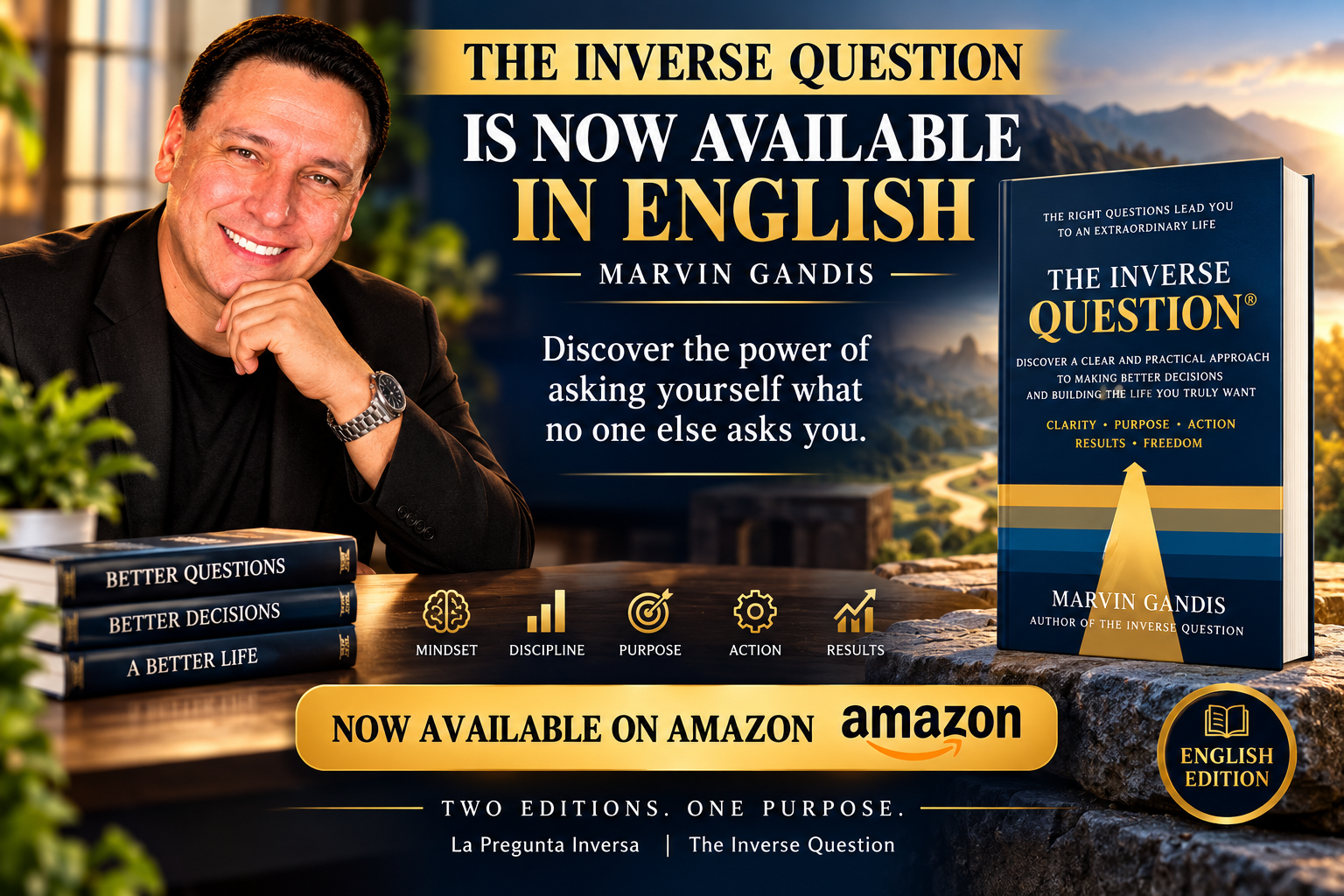
Yes. The Inverse Question is now available in English.
What began with the Spanish edition of La Pregunta Inversa has now reached an important new milestone.
English-speaking readers can now experience the ideas, reflections, and questions behind the book in their own language.
For me, this is more than the release of another edition.
It is the expansion of a conversation.
- A conversation about habits.
- About decisions.
- About discipline.
- About purpose.
- About responsibility.
- About the future we are quietly building every day.
And above all, it is a conversation about learning to ask ourselves better questions.
Why I Wrote The Inverse Question
We live in a world filled with answers.
- Search engines give us answers.
- Videos give us answers.
- Books give us answers.
- Experts give us answers.
- Artificial intelligence can provide answers within seconds.
But there is something no tool can decide for us:
- What questions should we be asking about our own lives?
Many meaningful changes begin not with another answer, but with a different question.
Instead of asking:
- “How can I get more?”
we may need to ask:
- “What am I becoming while pursuing more?”
Instead of:
- “Why am I not seeing better results?”
perhaps the deeper question is:
- “What habits, decisions, and systems are producing the results I currently have?”
Instead of only asking:
- “What do I want?”
we can ask:
- “What am I doing today that is quietly building the future I say I want?”
That is the heart of The Inverse Question.
The Question Behind the Book
The central idea is simple:
Sometimes the question we normally ask is not the question we most need to answer.
We naturally focus on visible results.
- Income.
- Opportunities.
- Success.
- Relationships.
- Recognition.
- Progress.
But visible results are often produced by invisible foundations.
- Our habits.
- Our mindset.
- Our discipline.
- Our decisions.
- Our use of time.
- Our ability to create value.
- Our willingness to accept responsibility.
- Our consistency when nobody is watching.
The book invites readers to examine those foundations before focusing only on the outcome.
Invisible Roots Come Before Visible Fruit
One of the recurring ideas behind The Inverse Question is that results rarely appear from nowhere.
Think about a tree.
- Most people admire the fruit.
Few people think about the roots.
- Yet without healthy roots, the fruit eventually suffers.
Life often works in a similar way.
The visible outcome may be:
- A stronger financial position.
- A healthier relationship.
- A completed project.
- A successful business.
- A new career.
- Greater confidence.
- A meaningful legacy.
But behind those visible results are usually invisible processes repeated over time.
The book invites us to examine those processes.
Because when we only try to change the fruit without examining the roots, we may temporarily change a result without changing the system that produced it.
Better Questions Can Lead to Better Decisions
A powerful question does not make decisions for us.
It helps us see more clearly.
Consider the difference between:
- “Why is nothing changing?”
and:
- “What am I repeating that keeps producing the same result?”
Or:
- “Why do I never have enough time?”
and:
- “What receives most of my attention every day?”
Or:
- “Why have I not reached my goal?”
and:
- “Which daily behaviors would make that goal more likely?”
The second question in each example moves us closer to personal responsibility and practical action.
That does not mean everything in life is under our control.
- It is not.
Circumstances matter.
Opportunities matter.
Other people’s decisions matter.
Unexpected events matter.
But even when we cannot control everything around us, we can still examine what remains within our responsibility.
- And that can be powerful.
This Is Not a Book of Magic Formulas
The Inverse Question does not promise overnight transformation.
It does not promise instant wealth.
It does not pretend that one question can remove every obstacle.
Instead, it offers something more realistic:
A mirror.
An invitation to examine how we think.
- How we decide.
- What we tolerate.
- What we repeat.
- What we postpone.
- What receives our energy.
- What receives our attention.
And what kind of person those repeated choices are gradually creating.
Sometimes the most useful thing a book can do is not tell us what to think.
- It can help us think more deeply for ourselves.
What You Will Explore in The Inverse Question
Throughout the book, readers are encouraged to think about several interconnected foundations of personal development and intentional living.
Mindset — the beliefs and perspectives through which we interpret our circumstances.
Value Creation — understanding that meaningful progress often begins with becoming useful, solving problems, and contributing something valuable.
Discipline — continuing to act when motivation is inconsistent.
Systems — building processes that make good decisions easier to repeat.
Time — recognizing that the way we use our days eventually becomes the way we use our lives.
Responsibility — identifying what is actually within our control and acting accordingly.
Perseverance — continuing to learn and adjust when results do not arrive immediately.
Legacy — considering what our choices are building beyond today’s immediate rewards.
These ideas are not isolated.
- They work together.
From La Pregunta Inversa to The Inverse Question
Publishing the Spanish edition was a deeply meaningful milestone for me.
But from the beginning, I knew the message should not remain limited to one language.
Many of my readers, subscribers, friends, and online connections communicate primarily in English.
Some began asking whether an English edition would eventually be available.
I appreciated those questions because they reminded me that the ideas behind the book could reach a wider audience.
Today, that possibility has become reality.
La Pregunta Inversa continues serving Spanish-speaking readers.
And now:
The Inverse Question is available for English-speaking readers.
Two languages.
Two editions.
One central invitation:
Ask better questions about the life you are building.
A Book About More Than Success
Success is often measured by what we accumulate.
- Money.
- Titles.
- Followers.
- Possessions.
- Achievements.
There is nothing inherently wrong with progress or prosperity.
But there is a larger question:
Who are we becoming while building those things?
A person can increase possessions and decrease peace.
Increase income and lose direction.
Become busier without becoming more intentional.
Achieve more without understanding why the achievement matters.
That is why the conversation eventually moves beyond money or success.
- It moves toward life.
- Purpose.
- Character.
- Responsibility.
- Wisdom.
And legacy.
A Question to Consider Today
Before you even open the book, consider this:
What are you doing repeatedly today that your future self will eventually have to live with?
Not once.
- Repeatedly.
Your repeated decisions matter because repetition eventually becomes habit.
- Habit influences character.
- Character influences decisions.
- Decisions influence direction.
- And direction, sustained long enough, becomes destination.
That is why small choices deserve more attention than we often give them.
You Do Not Need Every Answer Today
One of the biggest mistakes we can make is believing that progress requires complete certainty.
- It rarely does.
Sometimes you simply need enough clarity to identify the next responsible step.
- Ask one better question.
Recognize one unhelpful habit.
- Correct one repeated mistake.
Begin one overdue conversation.
- Learn one new skill.
Change one daily routine.
- Make one decision you have been postponing.
Small actions may appear insignificant in isolation.
- But repeated over time, they can redirect an entire life.
To My English-Speaking Readers
If you previously visited my website, followed my articles, or encountered La Pregunta Inversa and wondered whether you would ever be able to read the complete work in English:
This edition is for you.
- Thank you for your patience.
- Thank you for asking.
- Thank you for continuing to follow this journey.
I hope The Inverse Question becomes more than another book on your shelf.
I hope at least one page makes you stop.
- Think.
Question something you have accepted without examining.
- Recognize a pattern.
- Make a decision.
- Or look at your future differently.
If that happens, then the book has accomplished something meaningful.
Two Editions. One Purpose.
Today I can finally say:
and
are both part of this journey.
Different languages.
The same fundamental purpose:
Better questions.
Better decisions.
A better life.
The Inverse Question — Now Available on Amazon
The Inverse Question: Discover the Power of Asking Yourself What No One Else Asks You
Author: Marvin Gandis
Language: English
Format: Hardcover
List Price: $19.99
ASIN: B0HKMHJ9FP
Amazon:
A Personal Thank You
Every book begins with an idea.
But bringing that idea into the world requires many stages.
- Writing.
- Rewriting.
- Editing.
- Design.
- Corrections.
- Proofs.
- Mistakes.
- More corrections.
- Patience.
And eventually, the moment when you realize:
- It is no longer only a manuscript.
Someone else can now hold it.
- Read it.
- Question it.
- Learn from it.
And perhaps use one idea from it to make a different decision.
That is the part that matters most to me.
To every person who encouraged me, followed this process, read the articles inspired by the book, asked questions, shared posts, or simply said, “Keep going”:
- Thank you.
And to my English-speaking readers:
Welcome to The Inverse Question.
The conversation is now yours.
Final Reflection
Before you leave this page, ask yourself one question:
What question have I been avoiding because I already know the answer may require me to change?
Do not rush the answer.
- Sit with it.
- Write it down.
And when you are ready, take the next responsible step.
Because:
- The right question can change your direction.
- The Inverse Question can change your destiny.
With gratitude,
Marvin Gandis
Author of La Pregunta Inversa and The Inverse Question
The English hardcover edition is now available on Amazon.
If this message speaks to you, I invite you to discover The Inverse Question.
Read it. Reflect on it. Share it. Most importantly, ask yourself better questions.
Amazon:
Disclaimer:
This article and The Inverse Question are intended for educational, informational, and personal-reflection purposes only. The ideas presented are general in nature and are not a substitute for professional financial, legal, medical, psychological, mental health, or other specialized advice.
Individual circumstances vary, and no specific personal, financial, business, health, or life outcome is guaranteed. Readers are responsible for evaluating their own circumstances and making decisions appropriate to their individual needs. When a situation requires specialized guidance, readers should consult a qualified professional in the relevant field.
Any references to personal growth, habits, decision-making, discipline, responsibility, purpose, or financial principles are intended to encourage thoughtful reflection and education, not to promise specific results.


Debe estar conectado para enviar un comentario.