
Publicado en Mindset, Motivation, Personal Development, Personal Growth, Productivity, Self-Improvement, Wellness

I Will Give My Best

Taking Control of Your Mind: Powerful Thoughts to Start Every Day

By Marvin Gandis

Some mornings we wake up with energy, clarity, and enthusiasm. Other mornings, before our feet even touch the floor, our minds are already occupied with problems, unpaid bills, past mistakes, responsibilities, fears, or situations we still do not know how to solve.

That is where a quiet battle can begin.

Not necessarily a battle against the world, but a battle within our own minds.

Every day, our minds process thousands of impressions. We remember conversations, anticipate difficulties, imagine outcomes, react to news, evaluate circumstances, and sometimes create problems in our imagination before anything has actually happened.

If we never learn to direct our thinking intentionally, we can become controlled by whatever negative thought happens to appear.

That is why one of the most important decisions we can make every morning is remarkably simple:

Today, I will give my best.

That does not mean everything will go perfectly.

It does not mean we will never feel afraid, tired, disappointed, or frustrated.

It means that regardless of the circumstances, we will try to respond with our best attitude, judgment, effort, and character.

Your First Thoughts Can Influence Your Day

Imagine your mind as a field.

Every thought is a seed.

Some seeds produce confidence, creativity, gratitude, perseverance, patience, and hope.

Others produce resentment, fear, discouragement, comparison, and paralysis.

We cannot prevent every negative thought from entering our minds. Doubt, worry, and insecurity are part of the human experience.

But we can decide which thoughts we continue feeding.

A negative thought may knock on the door.

We do not have to invite it to live with us.

When we continually tell ourselves:

“Nothing ever works for me.”

“I can’t do this.”

“I’ll never get an opportunity.”

“I’m too old.”

“It’s too late.”

“Nobody helps me.”

“I never get lucky.”

Our minds can begin interpreting life through those assumptions.

But we can train ourselves to think differently:

Today gives me another opportunity.

I may not know the solution yet, but I can look for one.

I can learn something new.

I can move a little farther than yesterday.

I don’t need everything figured out before taking the next step.

That difference may appear small.

Repeated for weeks, months, and years, however, it can transform how we respond to life.

Positive Thinking Does Not Mean Denying Reality

There is an important difference between constructive thinking and wishful thinking.

Positive thinking does not mean looking at an unpaid bill and saying:

“Everything will somehow work out.”

Constructive thinking says:

“I have a financial problem. I need to review my expenses, organize my resources, explore options, and start making decisions.”

It does not mean ignoring an illness.

It means facing the situation, seeking appropriate care, following qualified guidance, and maintaining hope where possible.

It does not mean pretending we never make mistakes.

It means saying:

“I made a mistake. What can I learn from it?”

Constructive thinking does not erase reality.

It helps us face reality more effectively.

Take Control of Your Inner Conversation

There is one conversation you will probably hear more than any other throughout your life:

The conversation you have with yourself.

Pay attention to what you say internally when something goes wrong.

Do you insult yourself?

Do you declare yourself incapable?

Do you constantly replay your mistakes?

Do you compare yourself with everyone else?

Do you turn one temporary failure into a permanent identity?

Many people would never speak to a friend the way they regularly speak to themselves.

Change begins when we correct that internal conversation.

Instead of:

“I am a failure.”

Try:

“That did not work the way I expected. What can I improve?”

Instead of:

“I can’t do anything right.”

Try:

“I am still learning. I need more practice.”

Instead of:

“It’s too late.”

Try:

“Today is the earliest day I still have available to begin.”

Your internal language matters.

Words repeated often enough can become beliefs, and beliefs influence decisions.

The Morning Question: What Will I Plant Today?

Every morning allows us to plant intentional thoughts.

You do not need twenty affirmations.

Begin with a few strong ideas:

Today I will give my best.

Today I will focus on what I can control.

Today I will learn something.

Today I will not allow one problem to define my entire day.

Today I will treat people with respect.

Today I will move forward, even if progress is slow.

Today I will guard my words and decisions.

Today I will look for solutions before feeding complaints.

Repeating these statements does not magically change circumstances.

But they can remind us how we intend to respond to those circumstances.

You Cannot Control Everything

A great deal of stress comes from trying to control things that do not belong to us.

We cannot control:

what other people think,

other people’s decisions,

the past,

the weather,

the global economy,

criticism,

every outcome,

or every unexpected event.

But we can work on:

our preparation,

our attitude,

our words,

our discipline,

our choices,

our willingness to learn,

how we treat other people,

and how we respond when life does not go according to plan.

That is where personal power exists.

Not in controlling the world.

But in learning to govern ourselves.

Thoughts Must Become Action

Thinking well is important.

But thinking without action can become an elegant form of procrastination.

If you say:

“I want to improve my finances,”

create a budget.

If you say:

“I want to find a job,”

update your résumé, submit applications, network, and develop useful skills.

If you say:

“I want to improve my business,”

contact prospects, study marketing, improve your offer, and measure results.

If you say:

“I want to improve my health,”

begin with one concrete step that is appropriate for your circumstances.

If you say:

“I want to repair a relationship,”

perhaps it is time to talk, listen, apologize, forgive, or establish healthy boundaries.

Every constructive thought should eventually answer one question:

What is the next action I can take?

You Do Not Need to Feel Motivated Before You Begin

One common mistake is waiting for motivation.

“I’ll start when I feel like it.”

“I’ll do it when I feel ready.”

“I’ll make the decision when the fear disappears.”

But motivation often appears after we begin.

First, we take a small action.

Then we experience progress.

Progress builds confidence.

Confidence encourages us to continue.

Some days you will have motivation.

Other days you will need discipline.

Discipline is especially valuable because it allows you to continue when emotions change.

Ten Powerful Thoughts to Start Your Day

1. Today Is Another Opportunity

Yesterday can teach you, but it does not have to control you.

You cannot return to change a past decision, but you can make a different decision today.

2. I Can Control My Response

You may not control what happens.

But you can work on how you respond.

3. I Do Not Need to Solve Everything Today

Some problems require time.

Focus on the next correct step.

4. I Can Learn What I Do Not Yet Know

Not knowing something does not mean you are incapable.

It means there is still something to learn.

5. My Progress Does Not Need to Look Like Someone Else’s

Constant comparison can steal clarity.

Work with your circumstances, your resources, and your path.

6. One Mistake Does Not Define My Life

Mistakes can become teachers when we are willing to examine them.

7. My Words Have Consequences

Speak carefully.

Especially to yourself.

8. Small Actions Matter

Five pages read.

One application submitted.

One phone call made.

One dollar saved.

One difficult conversation started.

Little progress is still progress.

9. I Can Begin Again

As long as you retain the ability to make decisions, you retain the possibility of changing direction.

10. Today I Will Give My Best

Not someone else’s best.

Not impossible perfection.

The best you can genuinely offer today.

A Five-Minute Morning Mindset Routine

You can begin your day with this simple practice.

Minute 1: Gratitude

Think of three things you appreciate.

They do not have to be extraordinary.

Being alive.

Having food.

Someone you love.

Another opportunity.

Minute 2: Priority

Ask yourself:

What deserves my attention most today?

Not twenty things.

One.

Minute 3: Thought

Choose one sentence to guide your thinking.

For example:

“Today I will respond calmly and act intentionally.”

Minute 4: Action

Identify one concrete action you can begin immediately.

Minute 5: Silence

Breathe slowly.

Allow yourself a few moments without news, social media, notifications, or outside noise.

Begin the day hearing your own direction before hearing everyone else’s.

Guard What Enters Your Mind

We cannot discuss constructive thinking without considering what we consume.

If the first hours of every day are filled only with:

bad news,

conflict,

criticism,

comparison,

gossip,

alarmist content,

and endless arguments,

it becomes much more difficult to maintain mental clarity.

This does not mean ignoring the world.

It means setting boundaries.

You can remain informed without becoming overwhelmed.

You can use social media without allowing it to determine your self-worth.

You can hear different opinions without allowing every comment to disturb your peace.

Your attention is one of your most valuable resources.

Protect it.

Beware of Toxic Positivity

There is another important truth.

Not every painful situation can be solved by telling someone:

“Just think positive.”

A person may be experiencing grief, unemployment, illness, family conflict, financial loss, or deeply difficult circumstances.

At those times, motivational statements alone may not be enough.

We may need support, professional guidance, treatment, community, planning, practical resources, or assistance from other people.

Being positive does not mean pretending something does not hurt.

Sometimes the healthiest thought is:

“This is difficult. I need help. But I will keep looking for the next step.”

That is strength too.

Your Mind Requires Training

We do not erase years of mental habits in one morning.

The mind needs repetition.

Practice.

Awareness.

Perhaps today you catch ten negative thoughts.

Tomorrow you catch nine.

Eventually you may learn to challenge them much faster.

Over time, you can develop one of the most powerful mental skills available:

You stop automatically believing everything you think.

Because a thought is not always a fact.

“I am going to fail” is a thought.

“Nobody cares about me” is a thought.

“I have no future” is a thought.

“I cannot learn” is a thought.

Before accepting an idea as truth, ask:

Do I have evidence?

Is there another way to interpret this situation?

What advice would I give someone I care about?

What can I do next?

Those questions can redirect your thinking.

Three Seeds to Plant Every Day

The First Seed: Hope

Hope is not a guarantee.

It is the willingness to keep open the possibility that something can improve.

The Second Seed: Responsibility

Ask:

What part of this situation can I work on?

Responsibility gives us back a sense of agency.

The Third Seed: Action

Constructive thinking should eventually create movement.

Even if that movement is small.

Hope without responsibility can become fantasy.

Responsibility without hope can become a burden.

Action without direction can become exhaustion.

When all three work together, we begin moving with intention.

Review Your Day Before Going to Sleep

Mental growth does not end in the morning.

At night, ask yourself three questions:

What did I do well today?

What can I do better tomorrow?

What do I need to release before going to sleep?

Do not use the evening to punish yourself.

Use it to learn.

The day is finished.

Tomorrow offers another beginning.

Conclusion: I Will Give My Best

Your entire life may not change tomorrow.

Your problems may not disappear this week.

Some situations may require months or even years to resolve.

But there is something you can begin changing today:

The way you approach each day.

Every morning, you can choose which thoughts deserve your attention.

You can choose intention instead of constant reaction.

Responsibility instead of endless excuses.

Learning instead of resignation.

Progress instead of waiting for perfect conditions.

You do not need to promise yourself that you will never experience another negative thought.

Make a more realistic promise:

When negative thoughts appear, I will not automatically allow them to control my decisions.

Tomorrow morning, when you open your eyes, before checking your phone, before thinking about every obligation, and before allowing the world to claim your attention, remember:

Today is a new day.

I cannot control everything that will happen, but I can work on how I respond.

I can learn.

I can correct my direction.

I can move forward.

I can plant better thoughts.

And above all:

Today, I Will Give My Best.

Call to Action

Start Today

You do not have to wait until you feel completely ready.

Tomorrow morning, begin with one sentence:

“Today, I will give my best.”

Then identify one concrete action that proves your commitment.

Thoughts can plant the seed.

Your actions build the result.

Frequently Asked Questions

How can I take control of my thoughts?

Begin by becoming aware of your inner dialogue, questioning automatic negative thoughts, and replacing them with more realistic and constructive perspectives, then follow with practical action.

Does positive thinking really work?

Positive thinking can be beneficial when combined with realism, planning, responsibility, and action. It does not eliminate problems, but it can help people approach difficulties more constructively.

How can I start my day with a positive mindset?

Begin with gratitude, identify your top priority, choose one guiding thought, and take one constructive action before letting news, social media, or other distractions dominate your attention.

How do I change negative thinking?

First recognize the thought. Then ask whether it represents a fact or an interpretation. Examine the evidence, consider alternative perspectives, and identify a constructive action you can take.

What thoughts should I repeat every morning?

Useful examples include: “Today I will give my best,” “I can control my response,” “I can learn,” “I do not have to solve everything today,” and “I will move forward one step at a time.”


Disclaimer

This article is provided for educational, motivational, and informational purposes only. It is not intended to replace medical, psychological, therapeutic, or other qualified professional advice. Positive and constructive thinking can support healthier habits and perspectives, but it is not a substitute for professional care when mental health, emotional, or medical concerns are present. Individual circumstances vary, and appropriate professional guidance should be sought when needed.

Publicado en Career Development, Digital Marketing, Financial Education, Personal Finance, Self-Improvement

I Need Money. Now What?

Practical Steps and Real Solutions When You’re Facing Financial Pressure

By Marvin Gandis

There are few sentences more honest than these four words:

«I need money.»

Every day, millions of people wake up carrying that burden. Some have lost their jobs. Others have moved to a new city, are supporting a family, paying medical bills, or simply watching their savings disappear.

When money becomes urgent, desperation can lead to bad decisions. Scammers know this. So do companies that promise «easy money,» «guaranteed income,» or «overnight success.»

The truth is that there is no magic solution.

There are, however, practical steps that can help you regain control.


Step 1: Stay Calm and Think Clearly

Financial stress affects judgment.

Before signing up for anything, borrowing money, or paying for an opportunity, stop and ask yourself:

  • Is this legitimate?
  • Does it require money I can’t afford to lose?
  • Can I verify the company?
  • Is someone promising unrealistic returns?

Avoid making important financial decisions while feeling desperate.


Step 2: Separate Immediate Needs From Long-Term Goals

Ask yourself two questions:

What do I need this week?

Examples:

  • Food
  • Rent
  • Transportation
  • Medicine

What do I need over the next six months?

Examples:

  • Stable employment
  • Better income
  • New skills
  • Savings
  • A second source of income

These require different solutions.


Step 3: Look for Immediate Income

If you need money quickly, focus on work that pays relatively soon.

Examples include:

  • Temporary employment agencies
  • Restaurant and hospitality jobs
  • Retail positions
  • Warehouse work
  • Delivery services
  • Ride-share driving
  • Freelance graphic design
  • Data entry
  • Virtual assistant work
  • Website maintenance
  • Tutoring
  • Local handyman services

None of these are glamorous.

But income solves problems.


Step 4: Use the Skills You Already Have

Many people underestimate what they know.

Ask yourself:

  • Can I design?
  • Can I write?
  • Can I edit videos?
  • Can I build websites?
  • Can I translate?
  • Can I repair computers?
  • Can I teach?
  • Can I manage social media?

Someone may already be willing to pay for those skills.


Step 5: Learn Skills That Are in Demand

The fastest-growing careers often don’t require a four-year degree.

Examples include:

  • Digital marketing
  • AI tools and automation
  • Video editing
  • Search engine optimization (SEO)
  • Email marketing
  • Copywriting
  • Web development
  • Data analysis
  • Cybersecurity
  • Cloud computing

Learning one valuable skill can change your income for years.


Step 6: Build Multiple Income Streams

Many financially secure people do not rely on only one paycheck.

Examples include:

  • Full-time job
  • Freelance services
  • Affiliate marketing
  • Selling digital products
  • Online teaching
  • Consulting
  • Content creation
  • Rental income
  • Investing (after building financial stability)

Diversification reduces financial risk.


Step 7: Avoid Debt Traps

When money is tight, expensive borrowing often makes the situation worse.

Be cautious about:

  • Payday loans
  • Advance-fee scams
  • Fake investment programs
  • Pyramid schemes
  • «Guaranteed income» offers
  • Unlicensed lenders

If something sounds too good to be true, it usually is.


Step 8: Build Relationships

Many opportunities never appear on job boards.

Tell friends and family you’re looking.

Update your LinkedIn profile.

Join local networking events.

Volunteer.

Attend business meetups.

Sometimes your next opportunity comes through a conversation.


Step 9: Create a Simple Financial Plan

Even if your income is small, know exactly where every dollar goes.

Track:

  • Income
  • Bills
  • Food
  • Transportation
  • Debt
  • Savings

A budget doesn’t create money.

It helps protect the money you already have.


Step 10: Think Beyond Today

The goal isn’t simply to survive this month.

The goal is to avoid returning to the same situation next year.

Invest in yourself.

Read books.

Take courses.

Develop skills.

Meet people.

Stay curious.

Small improvements, repeated consistently, often produce remarkable results over time.


A Word of Encouragement

Needing money does not define your worth.

Many successful entrepreneurs, business owners, and professionals have experienced seasons of unemployment, debt, rejection, or financial hardship.

The difference was not luck alone.

It was persistence, learning, adaptation, and refusing to give up.

If you’re reading this while wondering how you’ll pay your next bill, remember this:

One opportunity can change your direction.

One new skill can change your career.

One good decision can begin changing your future.

Keep moving forward.

You are not finished yet.

Final Thoughts

Financial success rarely happens overnight.

But every stable financial future begins with one practical decision followed by another.

Take the next step.

Then take another.

Progress may be slower than you hope—but it is far better than standing still.

Your current situation is temporary.

Your willingness to learn, work, and persevere can create opportunities that seem impossible today.

Start where you are.

Use what you have.

Keep building.


Disclaimer: This article is intended for educational and informational purposes only. It does not constitute financial, legal, investment, or employment advice. Every individual’s financial situation is unique, and readers should evaluate opportunities carefully, conduct independent research, and seek qualified professional advice when appropriate. Mentions of affiliate marketing or online business models are examples of legitimate business approaches that require time, consistent effort, and do not guarantee income.

Publicado en Financial Education, Personal Development, Personal Finance, Self-Improvement, Wealth Mindset

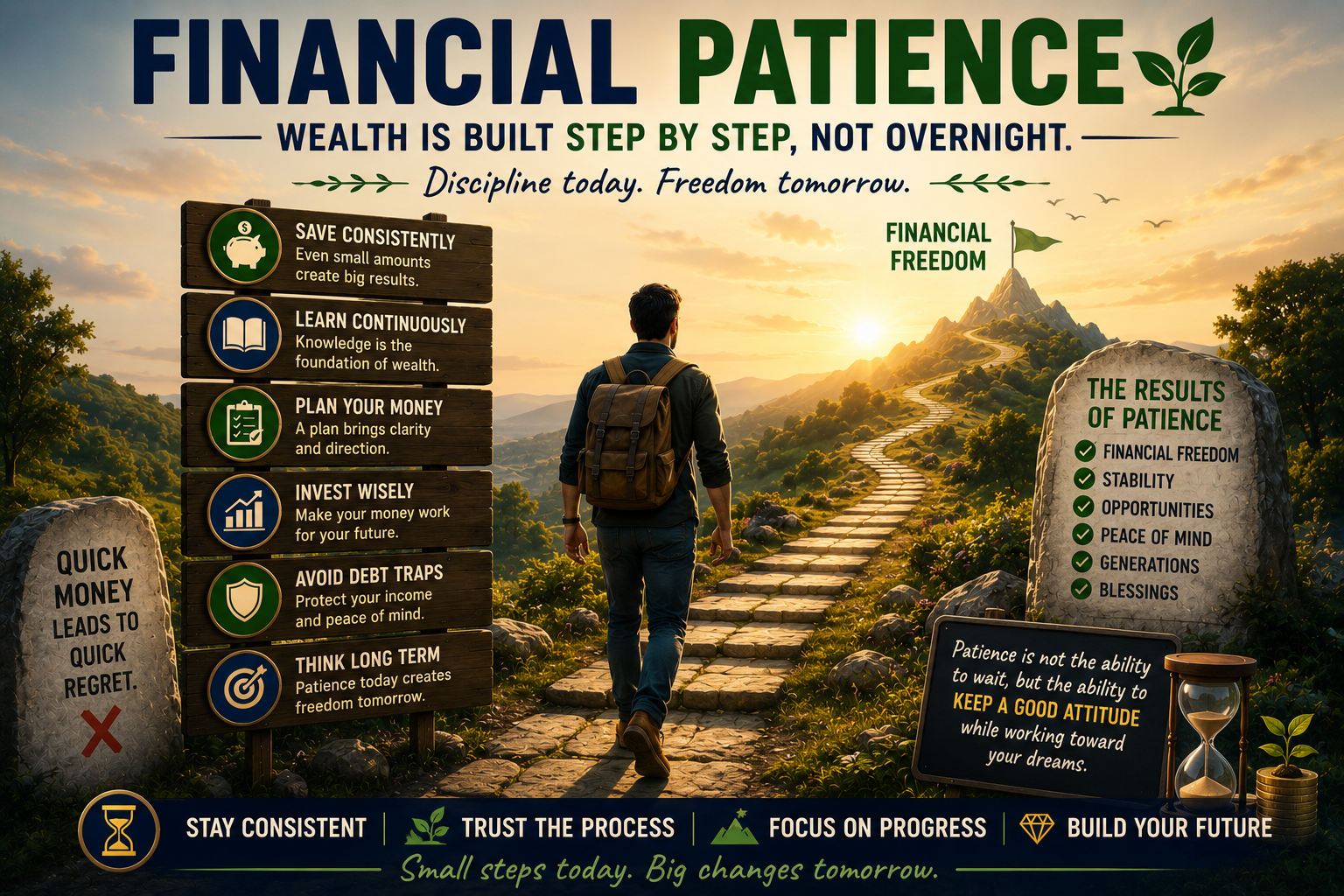
Financial Patience: Building Wealth Without Desperation

By Marvin Gandis

One of the reasons many people make poor financial decisions is desperation.

  • They want quick results.
  • They want immediate money.
  • They want to get out of debt overnight.
  • They want to build wealth without a process.
  • They want to change their lives without waiting, planting, or developing discipline.

But solid wealth rarely comes from desperation. It comes from patience, education, order, consistency, and decisions repeated with wisdom.

In this eleventh part of the series “The Reverse Question,” we will reflect on the importance of financial patience.

  • Not as an excuse to remain inactive.
  • Not as conformity.
  • Not as passivity.

But as a way to build with vision, without allowing anxiety to control our decisions.


Desperation can be expensive

When a person is desperate, they can make decisions that seem good in the moment but create more pain later.

  • They can fall into unnecessary debt.
  • They can invest in false promises.
  • They can buy programs without understanding them.
  • They can abandon a correct process too soon.
  • They can constantly switch opportunities.
  • They can spend out of anxiety.
  • They can sell under pressure.
  • They can accept agreements that are not good for them.

Desperation reduces clarity.

When a person feels they must solve everything immediately, they may lose the ability to analyze, compare, ask questions, wait, and decide with wisdom.

That is why financial patience is not a weakness. It is protection.


Solid wealth needs time

Many people want a harvest without a season of planting.

But life works by principles.

  • First, you learn.
  • First, you organize.
  • First, you plant.
  • First, you practice.
  • First, you correct.
  • First, you remain consistent.

Then, with time, fruit may appear.

True wealth is not built only through one big opportunity. It is built through small repeated habits: saving, learning, investing carefully, reducing debt, creating value, working consistently, and improving money management.

Small actions, repeated with discipline, can become large over time.


Patience does not mean standing still

Some people confuse patience with doing nothing.

But financial patience is not sitting around waiting for life to change. It is acting consistently while results mature.

  • Patience is saving, even if it is a little.
  • Patience is learning, even if you do not see income yet.
  • Patience is paying off debt little by little.
  • Patience is building a business without quitting at the first obstacle.
  • Patience is improving a skill before demanding major results.
  • Patience is reviewing your numbers even when they are uncomfortable.
  • Patience is saying “no” to expenses that destroy your future.
  • True patience is active.
  • It does not quit.
  • It does not rush without thinking.
  • It does not abandon the process because of anxiety.

The long-term mindset

A person with a long-term mindset understands that not every decision must produce an immediate reward.

  • Sometimes saving today protects tomorrow.
  • Sometimes studying today opens doors later.
  • Sometimes investing in a skill today produces income years later.
  • Sometimes rejecting an expense today avoids future debt.
  • Sometimes planting content today builds trust over time.

The short-term mindset asks:

“What can I get now?”

The long-term mindset asks:

“What am I building for tomorrow?”

That difference changes the way a person spends, works, learns, invests, and decides.


The danger of quick money

The desire for quick money can lead to many traps.

Not every opportunity is bad. Not every business is false. Not every tool is useless. But when a person looks for quick money without education, analysis, and patience, they become vulnerable.

  • They may believe any promise.
  • They may trust anyone.
  • They may invest without research.
  • They may go into debt because of emotion.
  • They may chase magical formulas.
  • They may ignore warning signs.

Quick money often attracts quick decisions. And quick decisions, without wisdom, can be expensive.

Before entering an opportunity, a person should ask:

  • Do I understand how this works?
  • Am I making this decision out of anxiety?
  • Can I handle the risk?
  • Have I researched enough?
  • Does this build something real or only promise excitement?
  • Am I looking for a solution or escaping my frustration?

Patience protects your habits

When a person is impatient, they abandon healthy habits because they do not see immediate results.

  • They stop saving because the savings seem small.
  • They stop learning because they do not see quick income.
  • They stop posting because nobody responds at first.
  • They stop investing in themselves because visible changes are slow.
  • They stop budgeting because debts still exist.
  • They stop building because the process feels slow.

But many valuable things begin small.

  • A small saving can become an emergency fund.
  • A small lesson can become a skill.
  • A small improvement can become confidence.
  • A small daily action can become a transformation.

Patience protects what is small until it grows.


Discipline defeats anxiety

Financial anxiety can cause a person to live in reaction mode.

  • They react to bills.
  • They react to debt.
  • They react to emergencies.
  • They react to pressure.
  • They react to fear.
  • They react to what others say.

Discipline helps recover direction.

  • A budget reduces confusion.
  • A debt plan reduces fear.
  • An emergency fund reduces vulnerability.
  • A learning routine increases ability.
  • A follow-up system improves results.
  • A daily action plan reduces improvisation.

Discipline does not eliminate every problem, but it reduces disorder.

And where there is less disorder, there is more peace to make decisions.


Building wealth without comparing yourself

Comparison destroys patience.

  • You see someone buying a house, and you feel left behind.
  • You see someone showing a business, and you feel like a failure.
  • You see someone traveling, and you feel your life is not moving.
  • You see someone appearing successful, and you pressure yourself to run.

But you do not always know the full story behind others.

  • You do not know their debts.
  • You do not know their sacrifices.
  • You do not know their years of process.
  • You do not know their mistakes.
  • You do not know their family reality.
  • You do not know what is behind the image.

Comparing yourself with others can lead you to make decisions to impress, not to build.

Your process needs patience, not constant competition.


Practical steps to develop financial patience

1. Define realistic goals

Do not only say: “I want to be rich.”

Define clear goals:

  • Save a specific amount.
  • Reduce a debt.
  • Create an emergency fund.
  • Learn a skill.
  • Increase income gradually.
  • Organize expenses.
  • Invest in education.
  • Build a long-term project.

Clear goals help reduce anxiety.


2. Divide the process into stages

Not everything has to be solved today.

  • First organize.
  • Then reduce unnecessary expenses.
  • Then create a margin.
  • Then save.
  • Then pay debt strategically.
  • Then learn more.
  • Then invest carefully.
  • Then build new sources of value.

Patience grows when you understand that the path has stages.


3. Celebrate small progress

Do not wait until the end to recognize advancement.

  • If you saved something, you moved forward.
  • If you paid a debt, you moved forward.
  • If you learned a skill, you moved forward.
  • If you avoided an impulsive purchase, you moved forward.
  • If you reviewed your numbers, you moved forward.
  • If you made a wise decision, you moved forward.

Small progress also deserves respect.


4. Learn before investing

Never allow pressure to lead you into investing in something you do not understand.

Before putting in money, invest time in learning.

  • Research.
  • Ask questions.
  • Compare.
  • Read.
  • Consult.
  • Analyze risks.
  • Review whether the opportunity is realistic.
  • Do not confuse emotion with evidence.

Patience before investing can prevent pain later.


5. Build habits, not only desires

Wanting wealth is not enough.

You need habits.

  • A habit of saving.
  • A habit of learning.
  • A habit of measuring.
  • A habit of reducing debt.
  • A habit of creating value.
  • A habit of following up.
  • A habit of reviewing results.
  • A habit of correcting.
  • A habit of continuing.

Desires inspire, but habits build.


Financial patience can also require faith

For many people, building with patience also requires faith.

  • Faith to keep planting when fruit is not visible yet.
  • Faith to correct without quitting.
  • Faith to learn even when it is uncomfortable.
  • Faith to manage a little with wisdom before receiving more.
  • Faith to believe that a life can change step by step.

Faith does not remove responsibility. It strengthens it.

Because mature faith does not only wait. It also works, learns, serves, manages, and perseveres.


Conclusion

Financial patience is not passivity. It is discipline with vision.

It is the ability to build without desperation, decide without anxiety, learn before acting, save before spending, correct before quitting, and think about the future before sacrificing it for an emotion in the present.

My dear reader or friend, do not allow desperation to steal your wisdom. Not everything has to be solved today. Not every fruit appears quickly. Not every seed shows results immediately.

But if you continue learning, managing, correcting, creating value, and walking with consistency, you can begin to build a more stable life.

Solid wealth is not improvised.

  • It is planned.
  • It is learned.
  • It is managed.
  • It is planted.
  • It is protected.
  • It is built.

And many times, it is built slowly, until one day the results begin to show that patience was not wasted time, but preparation.


Disclaimer

This article is for educational, reflective, and informational purposes only. It should not be interpreted as financial, legal, accounting, professional, business, or investment advice. The purpose of this content is to encourage awareness about financial patience, discipline, saving, planning, financial education, and responsible decision-making.

Every person has a different financial reality. Income, expenses, debt, family responsibilities, opportunities, risks, resources, and results can vary widely. Financial patience may help support better decisions, but it does not guarantee wealth, income, business success, profitable investments, or specific results.

Before making important decisions related to money, debt, investments, business, budgeting, career, or personal finances, it is recommended to consult qualified professionals.

The information shared is intended to inspire reflection, preparation, and responsible action.