Publicado en Financial Education, Personal Development, Personal Finance, Self-Improvement, Wealth Mindset

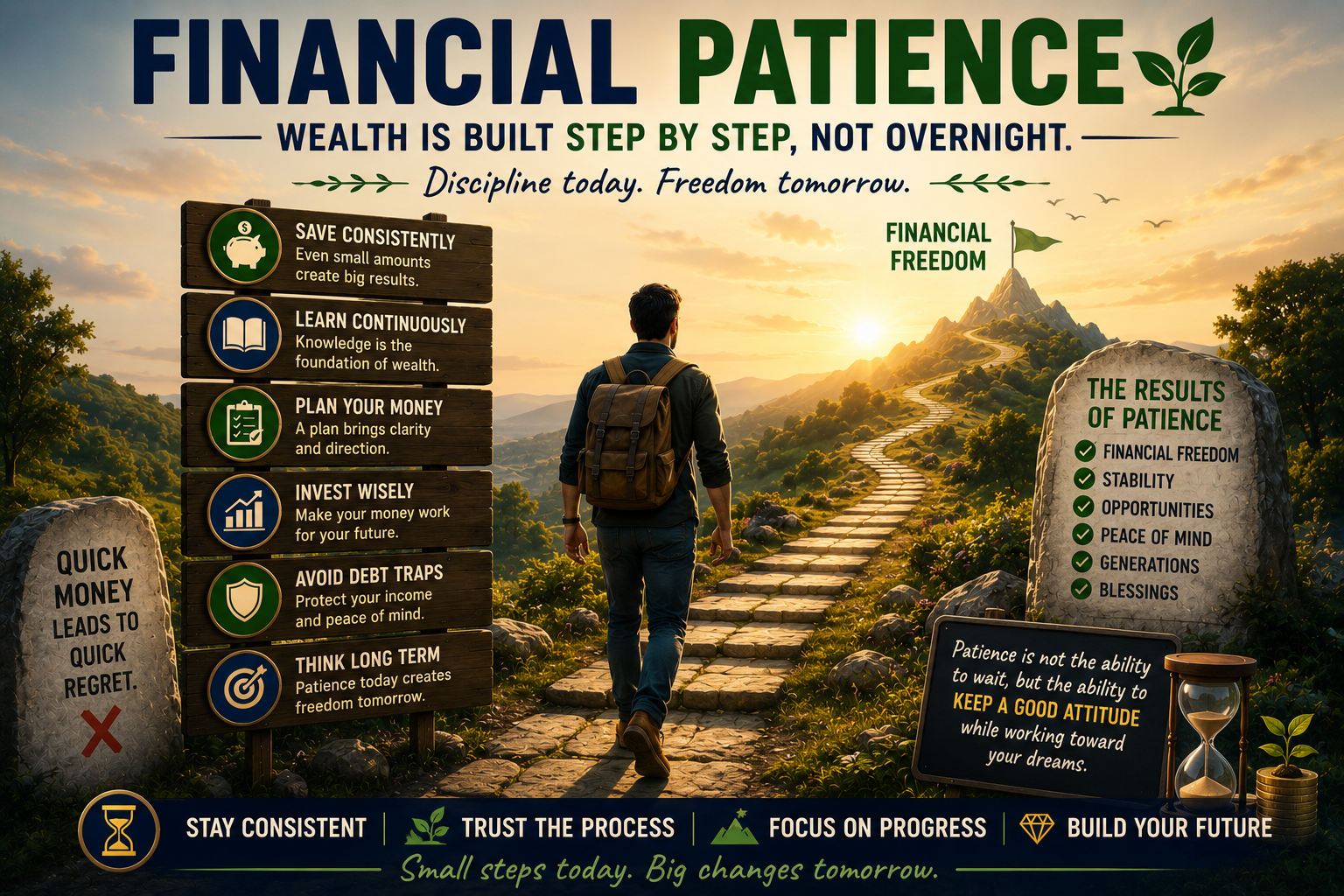
Financial Patience: Building Wealth Without Desperation

By Marvin Gandis

One of the reasons many people make poor financial decisions is desperation.

  • They want quick results.
  • They want immediate money.
  • They want to get out of debt overnight.
  • They want to build wealth without a process.
  • They want to change their lives without waiting, planting, or developing discipline.

But solid wealth rarely comes from desperation. It comes from patience, education, order, consistency, and decisions repeated with wisdom.

In this eleventh part of the series “The Reverse Question,” we will reflect on the importance of financial patience.

  • Not as an excuse to remain inactive.
  • Not as conformity.
  • Not as passivity.

But as a way to build with vision, without allowing anxiety to control our decisions.


Desperation can be expensive

When a person is desperate, they can make decisions that seem good in the moment but create more pain later.

  • They can fall into unnecessary debt.
  • They can invest in false promises.
  • They can buy programs without understanding them.
  • They can abandon a correct process too soon.
  • They can constantly switch opportunities.
  • They can spend out of anxiety.
  • They can sell under pressure.
  • They can accept agreements that are not good for them.

Desperation reduces clarity.

When a person feels they must solve everything immediately, they may lose the ability to analyze, compare, ask questions, wait, and decide with wisdom.

That is why financial patience is not a weakness. It is protection.


Solid wealth needs time

Many people want a harvest without a season of planting.

But life works by principles.

  • First, you learn.
  • First, you organize.
  • First, you plant.
  • First, you practice.
  • First, you correct.
  • First, you remain consistent.

Then, with time, fruit may appear.

True wealth is not built only through one big opportunity. It is built through small repeated habits: saving, learning, investing carefully, reducing debt, creating value, working consistently, and improving money management.

Small actions, repeated with discipline, can become large over time.


Patience does not mean standing still

Some people confuse patience with doing nothing.

But financial patience is not sitting around waiting for life to change. It is acting consistently while results mature.

  • Patience is saving, even if it is a little.
  • Patience is learning, even if you do not see income yet.
  • Patience is paying off debt little by little.
  • Patience is building a business without quitting at the first obstacle.
  • Patience is improving a skill before demanding major results.
  • Patience is reviewing your numbers even when they are uncomfortable.
  • Patience is saying “no” to expenses that destroy your future.
  • True patience is active.
  • It does not quit.
  • It does not rush without thinking.
  • It does not abandon the process because of anxiety.

The long-term mindset

A person with a long-term mindset understands that not every decision must produce an immediate reward.

  • Sometimes saving today protects tomorrow.
  • Sometimes studying today opens doors later.
  • Sometimes investing in a skill today produces income years later.
  • Sometimes rejecting an expense today avoids future debt.
  • Sometimes planting content today builds trust over time.

The short-term mindset asks:

“What can I get now?”

The long-term mindset asks:

“What am I building for tomorrow?”

That difference changes the way a person spends, works, learns, invests, and decides.


The danger of quick money

The desire for quick money can lead to many traps.

Not every opportunity is bad. Not every business is false. Not every tool is useless. But when a person looks for quick money without education, analysis, and patience, they become vulnerable.

  • They may believe any promise.
  • They may trust anyone.
  • They may invest without research.
  • They may go into debt because of emotion.
  • They may chase magical formulas.
  • They may ignore warning signs.

Quick money often attracts quick decisions. And quick decisions, without wisdom, can be expensive.

Before entering an opportunity, a person should ask:

  • Do I understand how this works?
  • Am I making this decision out of anxiety?
  • Can I handle the risk?
  • Have I researched enough?
  • Does this build something real or only promise excitement?
  • Am I looking for a solution or escaping my frustration?

Patience protects your habits

When a person is impatient, they abandon healthy habits because they do not see immediate results.

  • They stop saving because the savings seem small.
  • They stop learning because they do not see quick income.
  • They stop posting because nobody responds at first.
  • They stop investing in themselves because visible changes are slow.
  • They stop budgeting because debts still exist.
  • They stop building because the process feels slow.

But many valuable things begin small.

  • A small saving can become an emergency fund.
  • A small lesson can become a skill.
  • A small improvement can become confidence.
  • A small daily action can become a transformation.

Patience protects what is small until it grows.


Discipline defeats anxiety

Financial anxiety can cause a person to live in reaction mode.

  • They react to bills.
  • They react to debt.
  • They react to emergencies.
  • They react to pressure.
  • They react to fear.
  • They react to what others say.

Discipline helps recover direction.

  • A budget reduces confusion.
  • A debt plan reduces fear.
  • An emergency fund reduces vulnerability.
  • A learning routine increases ability.
  • A follow-up system improves results.
  • A daily action plan reduces improvisation.

Discipline does not eliminate every problem, but it reduces disorder.

And where there is less disorder, there is more peace to make decisions.


Building wealth without comparing yourself

Comparison destroys patience.

  • You see someone buying a house, and you feel left behind.
  • You see someone showing a business, and you feel like a failure.
  • You see someone traveling, and you feel your life is not moving.
  • You see someone appearing successful, and you pressure yourself to run.

But you do not always know the full story behind others.

  • You do not know their debts.
  • You do not know their sacrifices.
  • You do not know their years of process.
  • You do not know their mistakes.
  • You do not know their family reality.
  • You do not know what is behind the image.

Comparing yourself with others can lead you to make decisions to impress, not to build.

Your process needs patience, not constant competition.


Practical steps to develop financial patience

1. Define realistic goals

Do not only say: “I want to be rich.”

Define clear goals:

  • Save a specific amount.
  • Reduce a debt.
  • Create an emergency fund.
  • Learn a skill.
  • Increase income gradually.
  • Organize expenses.
  • Invest in education.
  • Build a long-term project.

Clear goals help reduce anxiety.


2. Divide the process into stages

Not everything has to be solved today.

  • First organize.
  • Then reduce unnecessary expenses.
  • Then create a margin.
  • Then save.
  • Then pay debt strategically.
  • Then learn more.
  • Then invest carefully.
  • Then build new sources of value.

Patience grows when you understand that the path has stages.


3. Celebrate small progress

Do not wait until the end to recognize advancement.

  • If you saved something, you moved forward.
  • If you paid a debt, you moved forward.
  • If you learned a skill, you moved forward.
  • If you avoided an impulsive purchase, you moved forward.
  • If you reviewed your numbers, you moved forward.
  • If you made a wise decision, you moved forward.

Small progress also deserves respect.


4. Learn before investing

Never allow pressure to lead you into investing in something you do not understand.

Before putting in money, invest time in learning.

  • Research.
  • Ask questions.
  • Compare.
  • Read.
  • Consult.
  • Analyze risks.
  • Review whether the opportunity is realistic.
  • Do not confuse emotion with evidence.

Patience before investing can prevent pain later.


5. Build habits, not only desires

Wanting wealth is not enough.

You need habits.

  • A habit of saving.
  • A habit of learning.
  • A habit of measuring.
  • A habit of reducing debt.
  • A habit of creating value.
  • A habit of following up.
  • A habit of reviewing results.
  • A habit of correcting.
  • A habit of continuing.

Desires inspire, but habits build.


Financial patience can also require faith

For many people, building with patience also requires faith.

  • Faith to keep planting when fruit is not visible yet.
  • Faith to correct without quitting.
  • Faith to learn even when it is uncomfortable.
  • Faith to manage a little with wisdom before receiving more.
  • Faith to believe that a life can change step by step.

Faith does not remove responsibility. It strengthens it.

Because mature faith does not only wait. It also works, learns, serves, manages, and perseveres.


Conclusion

Financial patience is not passivity. It is discipline with vision.

It is the ability to build without desperation, decide without anxiety, learn before acting, save before spending, correct before quitting, and think about the future before sacrificing it for an emotion in the present.

My dear reader or friend, do not allow desperation to steal your wisdom. Not everything has to be solved today. Not every fruit appears quickly. Not every seed shows results immediately.

But if you continue learning, managing, correcting, creating value, and walking with consistency, you can begin to build a more stable life.

Solid wealth is not improvised.

  • It is planned.
  • It is learned.
  • It is managed.
  • It is planted.
  • It is protected.
  • It is built.

And many times, it is built slowly, until one day the results begin to show that patience was not wasted time, but preparation.


Disclaimer

This article is for educational, reflective, and informational purposes only. It should not be interpreted as financial, legal, accounting, professional, business, or investment advice. The purpose of this content is to encourage awareness about financial patience, discipline, saving, planning, financial education, and responsible decision-making.

Every person has a different financial reality. Income, expenses, debt, family responsibilities, opportunities, risks, resources, and results can vary widely. Financial patience may help support better decisions, but it does not guarantee wealth, income, business success, profitable investments, or specific results.

Before making important decisions related to money, debt, investments, business, budgeting, career, or personal finances, it is recommended to consult qualified professionals.

The information shared is intended to inspire reflection, preparation, and responsible action.

Publicado en Entrepreneurship, Personal Development, Productivity, Self-Improvement, Wealth Mindset

Confusing Movement with Progress: Being Busy Does Not Mean Moving Forward

By Marvin Gandis

A person can be busy all day and still not be moving forward.

They can check messages, open apps, post on social media, watch videos, reply to comments, share links, take notes, make plans, change ideas, start tasks, and end the day tired… but without producing a real result.

That is one of the most common mistakes in modern life: confusing movement with progress.

In this ninth part of the series “The Reverse Question,” we will reflect on the difference between being active and actually moving forward. Because not everything that consumes time produces growth. Not every effort has direction. Not every activity creates results.

  • This is not about doing more just to do more.
  • It is about doing better what truly matters.

Being busy can feel productive

Being busy often creates a feeling of importance. We feel like we are doing something, staying active, trying, and moving.

But activity does not always mean progress.

  • A person can spend hours organizing ideas without executing any of them.
  • They can consume educational content without applying anything.
  • They can post every day without a strategy.
  • They can talk about projects without finishing them.
  • They can review tools without mastering any.
  • They can jump from one task to another without completing what matters most.

The problem is not movement. The problem is movement without direction.


Progress needs a clear goal

To know whether you are moving forward, you first need to know where you are going.

Without a clear goal, any activity can seem useful. But when you have direction, you can better evaluate whether what you are doing is moving you closer or farther away.

The question should not only be:

“What did I do today?”

The more important question is:

“Did what I did today move me closer to a real goal?”

A clear goal helps separate what is important from what is urgent, what is productive from what is distracting, and what is necessary from what is unnecessary.


The trap of activity without strategy

Many people work hard, but they do not have a strategy.

In the digital world, for example, someone may post content every day without understanding their audience. They may send messages without follow-up. They may share links without educating the prospect. They may buy tools without a system. They may create pages without measuring results.

Then they become tired, frustrated, and believe that nothing works.

But maybe effort was not missing. Maybe the direction was missing.

Effort without strategy can exhaust more than it builds.


Movement is action; progress is measurable advancement

Movement can be any activity. Progress, however, creates advancement.

Movement is opening a notebook.
Progress is writing the plan.

Movement is watching a video.
Progress is applying one idea.

Movement is posting just to post.
Progress is communicating a clear message.

Movement is reviewing your finances.
Progress is reducing an expense, paying debt, or saving something.

Movement is talking about change.
Progress is taking concrete action.

The difference is found in the result, the intention, and the direction.


Busyness can hide fear

Sometimes a person stays busy to avoid what they really need to do.

  • They over-organize because they are afraid to begin.
  • They study without applying because they are afraid to make mistakes.
  • They plan without executing because they fear failure.
  • They change small details because they are afraid to be seen.
  • They consume information because they are afraid to make decisions.

Busyness can become an elegant form of procrastination.

It looks like discipline, but in reality, it is avoidance.

That is why we must ask honestly:

Am I working on what matters, or am I avoiding what is difficult?


Important tasks are not always comfortable

Many times, the activities that produce progress are the ones we avoid the most.

  • Making a call.
  • Correcting an offer.
  • Reviewing the numbers.
  • Asking for help.
  • Creating content with intention.
  • Closing a debt.
  • Learning a difficult skill.
  • Following up.
  • Measuring results.
  • Making a decision.

These tasks may feel uncomfortable, but they often produce clarity and growth.

Progress almost always requires facing something that comfort wants to avoid.


Not all effort has the same value

Some efforts keep a person busy, but do not change their reality.

Spending hours on social media may feel like work if the goal is marketing, but without a strategy, message, and measurement, it may simply be a distraction.

Reading about personal finance is useful, but if you never create a budget, the knowledge does not transform anything.

Listening to motivation can encourage you, but if you do not take action, the emotion fades.

Effort must be connected to an action that builds something.


How to know if you are truly moving forward

1. Your actions are connected to a goal

If an action is not connected to a goal, it may be noise.

Ask yourself:

  • Why am I doing this?
  • What result am I looking for?
  • How does this move me closer to where I want to go?

2. You can measure some kind of change

Progress leaves signs.

  • More clarity.
  • More discipline.
  • Less debt.
  • More savings.
  • Better communication.
  • More consistency.
  • Better content.
  • More applied learning.
  • More useful conversations.
  • More order.

Not all progress is immediate, but there should be some evidence of improvement.


3. You finish important things

Starting many things can create excitement. Finishing important things creates movement forward.

  • A completed article.
  • A published page.
  • A finished budget.
  • A reduced debt.
  • A practiced skill.
  • A sent message.
  • A completed routine.
  • A decision made.

Progress needs completion, not only intention.


4. You learn from the results

A person who progresses does not only act; they also review.

  • What worked?
  • What did not work?
  • What must I correct?
  • What should I repeat?
  • What should I stop doing?
  • What is the data teaching me?

Without review, activity can repeat without improvement.


5. You do what matters before what is comfortable

Progress requires priority.

If you always do what is easy, comfortable, or urgent first, what is important remains abandoned.

A daily question can be:

What is the most important action I must complete today to move forward?

Do that action first, even if it is small.


The rule of one key action per day

A simple way to stop confusing movement with progress is to choose one key action each day.

One action that, if completed, moves you closer to a real goal.

It may be:

  • Writing one page.
  • Recording a video.
  • Reviewing your expenses.
  • Creating an offer.
  • Sending a follow-up.
  • Learning a lesson.
  • Practicing sales.
  • Organizing a debt.
  • Publishing educational content.
  • Measuring results.

You do not need to do one hundred things. You need to do the right thing consistently.


Clarity reduces exhaustion

Many people are tired not only because they work hard, but also because they work without clarity.

When there is no direction, everything feels urgent. Everything seems important. Everything competes for attention.

But when you know what matters, you can say no to what distracts you.

Clarity protects your energy.

  • It helps you focus.
  • It helps you prioritize.
  • It helps you measure.
  • It helps you correct.
  • It helps you rest without guilt.
  • It helps you continue with purpose.

Progress does not always mean speed

Sometimes a person is moving forward, just not as fast as they would like.

That is also important to recognize.

  • Progress can be slow and still be progress.
  • Progress can be small and still be valuable.
  • Progress can be quiet and still be real.

What matters is that there is direction, learning, and continuity.

You do not need to run every day. But you do need to avoid walking in circles.


Conclusion

Confusing movement with progress can cause a person to live tired, busy, and frustrated, but without clear results.

My dear reader or friend, this is not about doing more things. It is about doing the right things with direction, intention, and consistency.

Do not measure your day only by how much you did. Measure it also by how much you moved forward.

Ask yourself:

  • What am I building?
  • What am I finishing?
  • What am I learning?
  • What am I correcting?
  • What am I measuring?
  • What action moves me closer to my goal?

Being busy may fill your schedule, but true progress transforms your direction.

Do not only seek movement. Seek advancement.


Disclaimer

This article is for educational, reflective, and informational purposes only. It should not be interpreted as financial, legal, professional, psychological, medical, business, or investment advice. The purpose of this content is to encourage awareness about productivity, focus, time management, discipline, measuring results, and personal growth.

Every person’s circumstances are different. The ability to organize time, work, start a business, study, create content, or measure results can vary depending on health, family responsibilities, resources, employment, environment, knowledge, and personal situation.

This content is not intended to judge, blame, or shame anyone who feels tired, stuck, or overwhelmed. Before making important decisions related to business, work, emotional health, finances, studies, productivity, or life changes, it is recommended to consult qualified professionals.

The information shared is intended to inspire reflection, clarity, and responsible action, but it does not guarantee specific results.

Publicado en Entrepreneurship, Personal Development, Productivity, Self-Improvement, Wealth Mindset

Quitting Too Soon: The Invisible Enemy of Progress

By Marvin Gandis

Many people do not fail because they lack talent. They fail because they quit too soon.

They begin with enthusiasm, but abandon the process when results do not come quickly. They start a project, but become discouraged at the first obstacle. They publish content for a few days, but feel frustrated because nobody responds. They try to sell, learn, save, improve, or start a business, but leave the process before it has time to mature.

In this eighth part of the series “The Reverse Question,” we will reflect on a silent enemy of growth: quitting too soon.

  • This is not about blindly continuing something that does not work.
  • This is not about ignoring real warning signs.
  • This is not about suffering without correction.

It is about understanding that many seeds need time before they show fruit.


The problem with expecting immediate results

We live in a culture of speed.

  • Fast messages.
  • Fast food.
  • Fast videos.
  • Fast shopping.
  • Fast replies.
  • Fast results.

That is why many people bring the same mindset into their goals. They want quick wealth, quick success, quick sales, quick followers, quick change, and quick recognition.

But life does not always work that way.

What is valuable almost always requires a process. Learning a skill takes time. Building trust takes time. Creating an audience takes time. Healing takes time. Organizing finances takes time. Forming discipline takes time.

Impatience can cause a person to abandon the process just when they were beginning to learn.


Quitting too soon can seem logical

Sometimes quitting appears to make sense.

  • “I don’t see results.”
  • “Nobody supports me.”
  • “This is too slow.”
  • “Maybe I am not good at this.”
  • “Others are moving faster.”
  • “I already tried.”
  • “I am not lucky.”

But many times, these phrases appear before the process has had enough time, practice, and correction.

A person may be closer to understanding the path than they realize, but they quit because they confuse slowness with failure.

Not everything slow is dead. Sometimes what is slow is developing roots.


The difference between quitting and correcting

It is important to clarify this: not every decision to stop is a lack of character. There are moments when a person needs to change strategy, adjust a goal, leave something toxic, or recognize that a certain path is not right.

But correcting is not the same as quitting.

Quitting says:
“Nothing works.”

Correcting says:
“What part needs to improve?”

Quitting abandons everything.
Correcting reviews the process.

Quitting is controlled by frustration.
Correcting learns from reality.

A wise person does not insist on error, but they also do not abandon purpose at the first problem.


Comparison speeds up quitting

One of the reasons many people quit is because they constantly compare themselves to others.

They see someone else’s results, but not their years of work. They see their sales, but not their rejections. They see their audience, but not their ignored posts. They see their success, but not their losses, doubts, mistakes, and long hours of effort.

Comparing your beginning with someone else’s advanced result can destroy your motivation.

Comparison makes you feel behind. Clarity reminds you that every process has its own time.

You do not need to copy someone else’s pace. You need to be faithful to the right process for your current stage.


The early stages are almost always quiet

When a person begins something new, often nobody applauds.

  • Nobody comments.
  • Nobody buys.
  • Nobody replies.
  • Nobody congratulates.
  • Nobody seems to notice the effort.

But that does not mean nothing is happening.

In the early stages, you are learning. You are practicing. You are correcting. You are discovering what works and what does not. You are developing endurance. You are forming an identity.

Silence does not always mean failure. Sometimes it means formation.

Many people quit because they want fruit before they have roots.


Consistency produces experience

When a person remains in a process with humility, they begin to gain something that cannot easily be purchased: experience.

  • Experience teaches what to improve.
  • Experience teaches what to avoid.
  • Experience teaches how to communicate better.
  • Experience teaches where to adjust.
  • Experience teaches how to recognize patterns.
  • Experience teaches patience.

The person who quits too soon never accumulates enough experience to improve truly.

Every attempt can teach you something, but only if you do not quit before learning the lesson.


Rejection does not always mean failure

In business, marketing, sales, leadership, and life, rejection is part of the process.

  • A “no” does not always mean you are not capable.
  • A “no” does not always mean your idea is bad.
  • A “no” does not always mean you should quit.

Sometimes it means you need to improve your message, find another audience, explain the value more clearly, practice more, follow up, or wait for the right time.

The person who interprets every rejection as a sentence quits quickly. The person who interprets rejection as information learns and improves.


Discipline sustains what emotion begins

Enthusiasm is useful, but it does not last every day.

At first, there is excitement. There is energy. There is hope. But then normal days arrive: tiredness, doubt, responsibilities, problems, distractions, and lack of replies.

That is where discipline matters.

Discipline does not depend on feeling inspired. Discipline says:

  • “Today I will take the small step in front of me.”
  • “Today I will learn something.”
  • “Today I will correct something.”
  • “Today I will continue even if I do not see everything clearly.”

Emotion can begin the path, but discipline sustains it.


How to avoid quitting too soon

1. Define a minimum commitment period

Before abandoning a goal, decide to work on it for a reasonable period of time.

Do not evaluate everything after three days. Do not declare failure after one week. Do not abandon a serious process without applying it consistently.

Define 30, 60, or 90 days of commitment, depending on the goal.


2. Measure the right kind of progress

Do not measure only final results. Also measure internal progress.

  • Am I learning?
  • Am I becoming more consistent?
  • Am I improving my message?
  • Am I reducing mistakes?
  • Am I creating better habits?
  • Am I understanding the process more clearly?

Sometimes your capacity changes before your results change.


3. Correct one thing at a time

When something does not work, do not change everything out of desperation.

Review one part of the process.

  • The message.
  • The audience.
  • The habit.
  • The offer.
  • The follow-up.
  • The routine.
  • The discipline.
  • The use of time.

Small corrections can create big differences over time.


4. Celebrate small progress

Do not wait for a major victory to recognize progress.

Celebrating a step is not settling. It is emotional fuel.

  • You finished a task.
  • You learned something new.
  • You saved a little.
  • You posted consistently.
  • You made a call.
  • You improved your message.
  • You did not quit.

That also counts.


5. Remember why you started

When the process becomes difficult, purpose must speak louder than frustration.

  • Why did you begin?
  • What life are you trying to build?
  • Who do you want to help?
  • What do you want to change?
  • What future are you trying to protect?

A clear purpose can sustain you when results have not appeared yet.


Remaining does not mean staying the same

Being consistent does not mean repeating the same thing without thinking. True consistency combines perseverance with learning.

  • Remain, but learn.
  • Remain, but measure.
  • Remain, but correct.
  • Remain, but improve.
  • Remain, but listen to reality.

This is not about being stubborn. It is about being faithful to growth.


Conclusion

Quitting too soon can destroy dreams, projects, businesses, habits, and opportunities that were only beginning to grow.

My dear reader or friend, maybe you are not failing. Maybe you are in the stage where you are still learning, planting, and forming roots.

  • Do not confuse silence with defeat.
  • Do not confuse slowness with failure.
  • Do not confuse correction with quitting.
  • Do not confuse tiredness with inability.

Rest if necessary. Correct if necessary. Learn if necessary. But do not abandon a valuable purpose only because you cannot yet see all the fruit.

Many times, the difference between the person who moves forward and the person who remains stuck is not talent, luck, or resources. It is the decision to continue long enough to learn, improve, and grow.

Consistency may not look impressive at first, but over time, it can become one of the most powerful forces in your life.


Disclaimer

This article is for educational, reflective, and informational purposes only. It should not be interpreted as financial, legal, professional, psychological, medical, business, or investment advice. The purpose of this content is to encourage awareness about consistency, patience, discipline, correcting mistakes, and personal growth.

The recommendation not to quit too soon does not mean staying in harmful, abusive, illegal, dangerous, or emotionally destructive situations. Every person should evaluate their reality with wisdom and seek professional help when necessary.

Results in personal projects, business, marketing, finances, professional development, or personal growth can vary depending on each person’s situation, resources, skills, health, support, market, decisions, and consistency. This content does not guarantee income, success, emotional recovery, or specific results.

Before making important decisions related to business, money, emotional health, relationships, work, studies, or life changes, it is recommended to consult qualified professionals.