By Marvin Gandis
Artificial intelligence is no longer something reserved for large corporations, software companies, or technology experts.
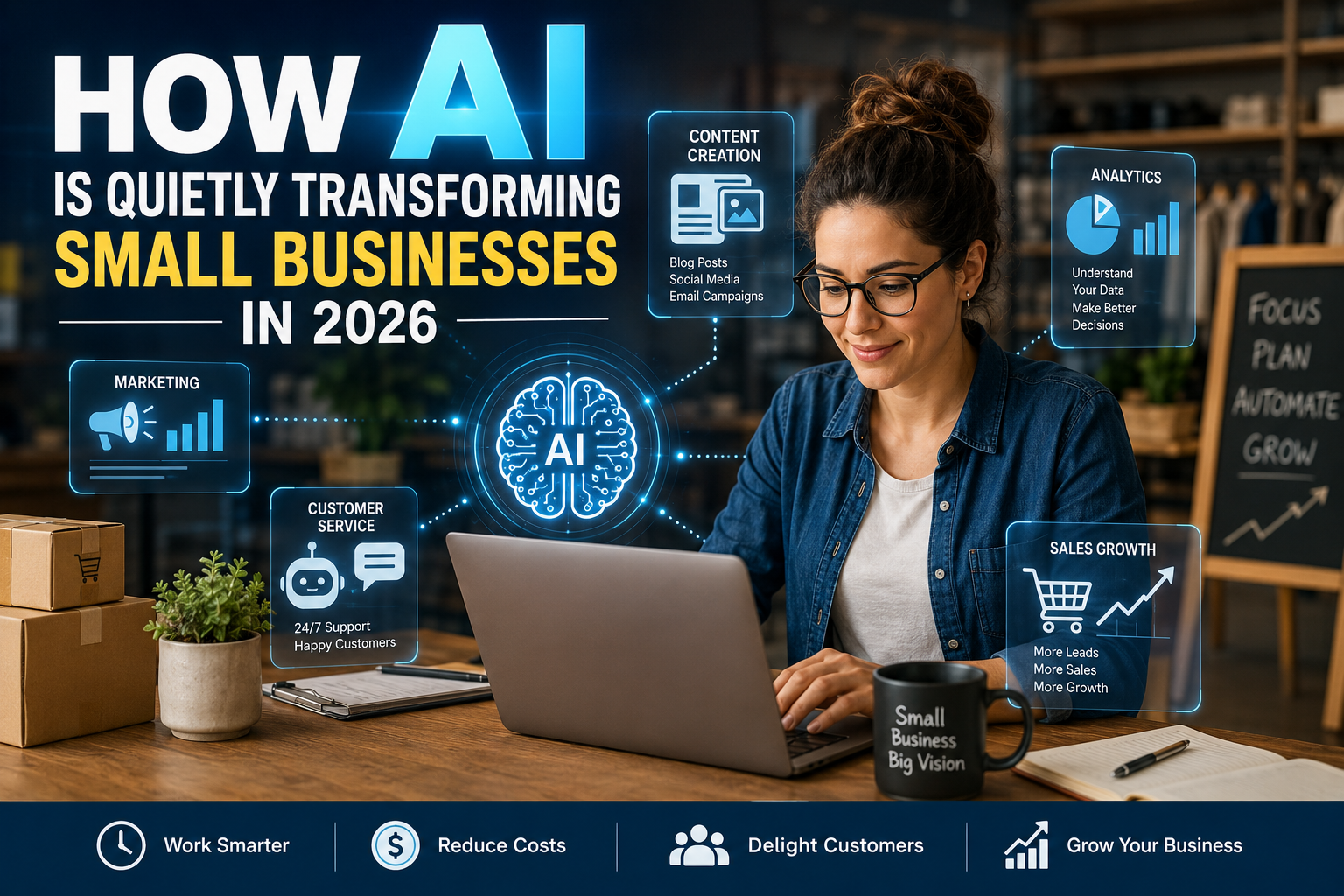
In 2026, AI is quietly becoming part of small businesses’ everyday operations.
It is answering customer questions.
It is helping write emails.
It is preparing social media content.
It is organizing schedules.
It is analyzing customer information.
It is helping business owners generate ideas, improve advertisements, create images, summarize documents, and automate repetitive tasks.
And in many cases, customers may never even realize that AI helped make those experiences possible.
This is one of the most important business changes taking place today.
The transformation is not always dramatic.
There may be no robot standing behind the counter.
There may be no complicated computer laboratory.
Instead, AI is becoming embedded inside the ordinary tools entrepreneurs already use.
That quiet integration may ultimately matter more than the spectacular demonstrations of artificial intelligence that get most of the headlines.
AI Has Moved From Experiment to Everyday Business Tool
For years, artificial intelligence sounded futuristic.
Today, small businesses are increasingly treating it as practical infrastructure.
Recent research illustrates how quickly adoption is growing. The U.S. Chamber of Commerce reported that 58% of small businesses were using generative AI in 2025, up from 40% in 2024 and 23% in 2023. Other 2026 small-business research has found that many companies are now investing in AI as part of their regular operations rather than treating it simply as an experiment.
The significance is not merely that more businesses are trying AI.
The bigger change is how they are using it.
AI is moving from:
“Let me see what this technology can do.”
to:
“How can this technology help me run my business better?”
That is a major transition.
Small Businesses Are Becoming More Productive Without Becoming Much Larger
One of the biggest advantages AI gives small companies is leverage.
A business that once needed several people to perform certain administrative, marketing, or communication tasks may now accomplish some of those tasks with a smaller team.
That does not necessarily mean eliminating employees.
It often means allowing existing employees to accomplish more.
A business owner can use AI to help:
- Draft customer emails.
- Create first versions of proposals.
- Summarize meetings.
- Generate advertising ideas.
- Organize notes.
- Produce product descriptions.
- Research common customer questions.
- Prepare social media calendars.
- Build checklists.
- Analyze spreadsheets.
- Create customer-service responses.
- Turn long documents into summaries.
A task that previously consumed two hours might sometimes be reduced to twenty or thirty minutes.
Multiply that across an entire year and the productivity difference becomes substantial.
For small companies with limited employees, that additional capacity can be extremely valuable.
Marketing Is Becoming Faster and More Accessible
Marketing has traditionally been difficult for many small-business owners.
They may understand their products very well but struggle with:
- Copywriting.
- Social media.
- Email campaigns.
- SEO.
- Graphic concepts.
- Video scripts.
- Advertising.
- Customer segmentation.
- Lead nurturing.
AI is reducing some of those barriers.
An entrepreneur can now begin with a simple instruction such as:
“Create five email subject lines for customers who abandoned their shopping carts.”
Or:
“Give me ten educational video ideas based on the questions my customers ask most often.”
Or:
“Turn this product description into a Facebook post, an email, and a short video script.”
The entrepreneur still needs judgment.
But AI can dramatically accelerate the first draft.
This matters because small businesses often lose marketing opportunities simply because the owner does not have enough time to create the necessary material.
AI does not eliminate the need for strategy.
It reduces the friction involved in executing that strategy.
Customer Service Is Becoming Available Around the Clock
Customers increasingly expect fast answers.
They want to know:
Where is my order?
What are your hours?
Do you offer refunds?
Can I make an appointment?
Do you ship internationally?
Which product is right for me?
A human employee does not need to answer every repetitive question manually.
AI-powered chat systems and automated assistants can increasingly handle simple questions, guide visitors through websites, collect information, and route more complicated issues to a person.
This creates an important opportunity for small companies.
Historically, larger corporations had an advantage because they could afford large customer-service departments.
AI can narrow part of that gap.
A small business may now provide faster responses without maintaining a massive support staff.
However, automation should not become an excuse for poor customer service.
Customers still need access to a real person when the situation requires judgment, empathy, or problem-solving.
The strongest model is not:
AI instead of people.
It is:
AI for routine matters, people for important matters.
AI Is Helping Businesses Understand Their Customers
Small companies accumulate enormous amounts of information.
Website visits.
Purchases.
Email engagement.
Customer questions.
Reviews.
Sales records.
Advertising results.
Support requests.
Historically, much of this information remained unused because the business owner lacked the time or technical knowledge required to analyze it.
AI is making analysis more accessible.
A business owner may increasingly be able to ask questions such as:
“Which products are selling fastest?”
“Which customers are most likely to buy again?”
“What complaints appear most often?”
“Which email topics generate the highest response?”
“Which advertising campaign produced the best-quality leads?”
The ability to ask business questions in ordinary language could become one of AI’s most valuable contributions.
Entrepreneurs do not necessarily need to become data scientists.
They need to learn how to ask better questions.
Personalization Is No Longer Reserved for Large Companies
Large corporations have used sophisticated customer-data systems for years.
Small companies often could not afford them.
AI is changing that.
Businesses can increasingly personalize:
- Emails.
- Product recommendations.
- Offers.
- Customer follow-up.
- Website experiences.
- Advertising messages.
- Educational content.
Instead of sending everyone the same message, businesses can communicate according to the customer’s interests, history, or stage in the buying process.
This matters because modern customers are surrounded by generic marketing.
Relevant communication gets attention.
Generic communication gets ignored.
However, personalization must be handled responsibly.
Businesses should respect privacy and avoid creating the impression that they know more about customers than customers reasonably expect.
AI Is Changing Search and Content Discovery
Another transformation is happening outside the business itself.
Consumers are increasingly obtaining answers from AI-powered search systems, recommendation engines, conversational assistants, and personalized feeds.
That means businesses must think beyond traditional search engine optimization.
For years, companies asked:
“How do we rank on Google?”
Now they must also ask:
“Will AI systems understand what our business does?”
“Is our information accurate and clearly structured?”
“Does our website provide genuinely useful answers?”
“Does our brand have enough credibility to be referenced by recommendation systems?”
The businesses that publish clear, useful, trustworthy information may gain an advantage as AI becomes more involved in how consumers discover products and services.
Small Businesses Are Beginning to Use AI Agents
One of the more important developments in 2026 is the rise of AI agents.
Traditional AI generally waits for instructions.
An AI agent may be designed to complete several connected actions toward a goal.
For example, an agent might:
- Identify a new sales lead.
- Research the company.
- Prepare a personalized introduction.
- Create a draft follow-up email.
- Update a CRM record.
- Recommend the next action.
The technology is still developing, and businesses should be careful about giving automated systems unrestricted authority.
But the direction is important.
AI is gradually moving from generating information to helping perform workflows.
That could have enormous consequences for small companies.
The Greatest Advantage May Be Speed
Small businesses often cannot compete with corporations in advertising budgets, staffing, or purchasing power.
But they can sometimes compete in speed.
A small entrepreneur may be able to recognize an opportunity in the morning, build a campaign by afternoon, and launch it in the evening.
AI strengthens that advantage.
Ideas can move more quickly from:
Observation
to
Research
to
Draft
to
Campaign
to
Testing.
The entrepreneur who combines good judgment with AI assistance may be able to respond much faster than a larger organization burdened by multiple approval layers.
But AI Also Creates Serious Risks
AI should not be treated as magic.
It can produce incorrect information.
It can misunderstand instructions.
It can create misleading statistics.
It can imitate patterns without understanding context.
It can produce content that sounds authoritative while being completely wrong.
Businesses must therefore establish safeguards.
Never assume that something is true simply because an AI system produced it confidently.
Human review remains essential.
Privacy and Confidential Information Matter
Business owners should be especially careful when entering information into AI systems.
Sensitive information may include:
- Customer records.
- Financial information.
- Passwords.
- Medical information.
- Confidential contracts.
- Employee records.
- Proprietary business information.
- Personally identifiable information.
Before using an AI platform for confidential business work, entrepreneurs should understand the platform’s privacy, security, retention, and data-use policies.
Convenience should never replace basic security.
Do Not Automate Your Reputation
A business reputation may take years to build and minutes to damage.
That means entrepreneurs should be cautious about allowing AI systems to independently publish:
- Legal claims.
- Medical claims.
- Financial promises.
- Public accusations.
- Pricing commitments.
- Customer disputes.
- Sensitive announcements.
AI can prepare a draft.
A responsible person should approve important communications.
AI Does Not Replace Business Fundamentals
An entrepreneur can have excellent AI tools and still fail.
Why?
Because AI cannot rescue a fundamentally weak offer.
It cannot permanently compensate for bad customer service.
It cannot create trust where a company repeatedly breaks promises.
It cannot transform a product nobody wants into a great business simply by creating more advertisements.
The fundamentals still matter:
A real problem.
A valuable solution.
A defined customer.
A credible offer.
Strong communication.
Consistent follow-up.
Good service.
Financial discipline.
Trust.
AI amplifies what already exists.
If the business is well organized, AI may amplify efficiency.
If the business is chaotic, AI may simply help produce chaos faster.
What Entrepreneurs Should Do Now
The worst approach is to panic.
The second-worst approach is to ignore AI completely.
A better approach is controlled adoption.
Step 1: Identify Repetitive Work
Write down the activities that consume time every week.
Look for tasks such as:
- Email drafting.
- Research.
- Meeting summaries.
- Scheduling.
- Social posts.
- Product descriptions.
- Customer FAQs.
- Data entry.
- Lead follow-up.
- Reporting.
These are often good candidates for AI assistance.
Step 2: Choose One Workflow
Do not try to automate your entire company in one weekend.
Choose one area.
For example:
“AI will help us create first drafts of our weekly marketing emails.”
Use that workflow repeatedly.
Measure the results.
Improve the process.
Then expand.
Step 3: Measure Actual Value
Ask:
How much time did we save?
Did quality improve?
Did customers respond better?
Did sales increase?
Did errors decrease?
Did employees become more productive?
AI should produce measurable business value.
If a tool creates more work than it eliminates, reconsider how you are using it.
Step 4: Build an AI-Assisted Workflow
The most effective process may look like this:
Human goal → AI assistance → Human review → Execution → Measurement
That model keeps people responsible while allowing machines to accelerate routine work.
Step 5: Create Your Own Prompt Library
If a prompt works well, save it.
Create categories such as:
Marketing prompts.
Customer-service prompts.
Research prompts.
Sales prompts.
Email prompts.
Analysis prompts.
Content prompts.
Over time, these instructions become intellectual assets for the business.
Step 6: Train Employees
Technology without training creates frustration.
Employees should understand:
What AI is allowed to do.
What information should never be entered.
Which outputs require verification.
Which decisions require human approval.
How the company expects AI to be used.
AI literacy will increasingly become a basic workplace skill.
Step 7: Protect Human Relationships
Businesses should automate processes without automating humanity.
Customers still value:
Listening.
Empathy.
Honesty.
Personal attention.
Responsibility.
Trust.
AI should give people more time for those activities—not eliminate them.
A Simple 30-Day AI Plan for a Small Business
Week 1 — Observe
Identify the ten most repetitive activities in your business.
Choose one that is low risk and time-consuming.
Week 2 — Experiment
Use AI to assist with that task.
Record how long the task takes before and after AI.
Week 3 — Standardize
Create a repeatable prompt or procedure.
Document the process.
Week 4 — Measure
Evaluate:
Time saved.
Quality.
Customer response.
Revenue impact.
Errors.
Employee satisfaction.
If the results are positive, select the next workflow.
This approach is much safer than buying dozens of AI tools simply because they are popular.
The Entrepreneur’s New Competitive Advantage
For decades, business success depended heavily on access to:
Capital.
Employees.
Technology.
Distribution.
Advertising.
Those things still matter.
But another advantage is emerging:
The ability to use intelligence effectively.
An entrepreneur with a small team but strong AI skills may increasingly accomplish work that once required a much larger organization.
The question is therefore changing.
It is no longer:
“Should I use artificial intelligence?”
A better question is:
“Where can artificial intelligence improve my business without compromising quality, security, trust, or human judgment?”
That is the question entrepreneurs should begin answering now.
Conclusion
Artificial intelligence is not quietly transforming small businesses because machines are suddenly replacing entrepreneurs.
It is transforming them because ordinary entrepreneurs are discovering hundreds of small ways to work faster, communicate better, understand customers, create more efficiently, and make better-informed decisions.
That transformation will continue.
Some businesses will chase every new tool.
Others will refuse to change.
The strongest businesses will probably do neither.
They will experiment carefully.
They will measure results.
They will protect customer trust.
They will keep humans responsible.
And they will use AI where it genuinely makes the company better.
The goal is not to build an artificial business.
The goal is to build a better business with intelligent assistance.
That distinction may become one of the defining competitive advantages of the small-business economy in 2026 and beyond.
Disclaimer: This article is provided for general educational and informational purposes only. It does not constitute legal, financial, cybersecurity, employment, tax, or professional business advice. Artificial intelligence technologies, platform capabilities, laws, privacy requirements, and industry practices may change rapidly. Business owners should independently verify AI-generated information, review the privacy and security policies of any technology they use, protect confidential and customer data, and consult qualified professionals when decisions involve legal, financial, regulatory, cybersecurity, or other specialized matters. No specific business results, savings, productivity gains, revenue increases, or financial outcomes are guaranteed.


Debe estar conectado para enviar un comentario.