Publicado en Artificial Intelligence, Automation, Business Technology, Digital Marketing, Entrepreneurship, Online Business, Productivity, Small Business

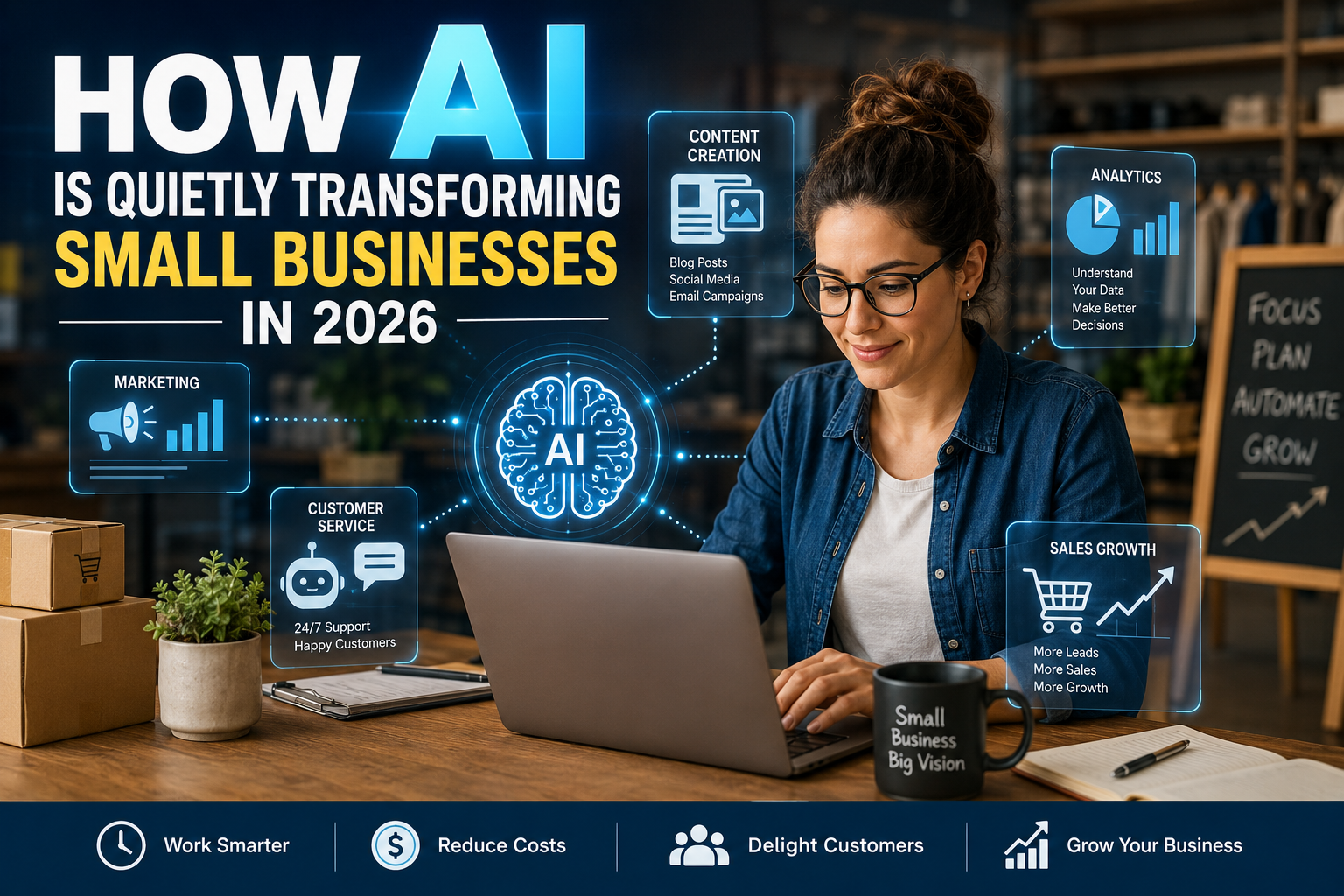
How AI Is Quietly Transforming Small Businesses in 2026 — And What Entrepreneurs Should Do Now

By Marvin Gandis

Artificial intelligence is no longer something reserved for large corporations, software companies, or technology experts.

In 2026, AI is quietly becoming part of small businesses’ everyday operations.

It is answering customer questions.

It is helping write emails.

It is preparing social media content.

It is organizing schedules.

It is analyzing customer information.

It is helping business owners generate ideas, improve advertisements, create images, summarize documents, and automate repetitive tasks.

And in many cases, customers may never even realize that AI helped make those experiences possible.

This is one of the most important business changes taking place today.

The transformation is not always dramatic.

There may be no robot standing behind the counter.

There may be no complicated computer laboratory.

Instead, AI is becoming embedded inside the ordinary tools entrepreneurs already use.

That quiet integration may ultimately matter more than the spectacular demonstrations of artificial intelligence that get most of the headlines.

AI Has Moved From Experiment to Everyday Business Tool

For years, artificial intelligence sounded futuristic.

Today, small businesses are increasingly treating it as practical infrastructure.

Recent research illustrates how quickly adoption is growing. The U.S. Chamber of Commerce reported that 58% of small businesses were using generative AI in 2025, up from 40% in 2024 and 23% in 2023. Other 2026 small-business research has found that many companies are now investing in AI as part of their regular operations rather than treating it simply as an experiment.

The significance is not merely that more businesses are trying AI.

The bigger change is how they are using it.

AI is moving from:

“Let me see what this technology can do.”

to:

“How can this technology help me run my business better?”

That is a major transition.

Small Businesses Are Becoming More Productive Without Becoming Much Larger

One of the biggest advantages AI gives small companies is leverage.

A business that once needed several people to perform certain administrative, marketing, or communication tasks may now accomplish some of those tasks with a smaller team.

That does not necessarily mean eliminating employees.

It often means allowing existing employees to accomplish more.

A business owner can use AI to help:

  • Draft customer emails.
  • Create first versions of proposals.
  • Summarize meetings.
  • Generate advertising ideas.
  • Organize notes.
  • Produce product descriptions.
  • Research common customer questions.
  • Prepare social media calendars.
  • Build checklists.
  • Analyze spreadsheets.
  • Create customer-service responses.
  • Turn long documents into summaries.

A task that previously consumed two hours might sometimes be reduced to twenty or thirty minutes.

Multiply that across an entire year and the productivity difference becomes substantial.

For small companies with limited employees, that additional capacity can be extremely valuable.

Marketing Is Becoming Faster and More Accessible

Marketing has traditionally been difficult for many small-business owners.

They may understand their products very well but struggle with:

  • Copywriting.
  • Social media.
  • Email campaigns.
  • SEO.
  • Graphic concepts.
  • Video scripts.
  • Advertising.
  • Customer segmentation.
  • Lead nurturing.

AI is reducing some of those barriers.

An entrepreneur can now begin with a simple instruction such as:

“Create five email subject lines for customers who abandoned their shopping carts.”

Or:

“Give me ten educational video ideas based on the questions my customers ask most often.”

Or:

“Turn this product description into a Facebook post, an email, and a short video script.”

The entrepreneur still needs judgment.

But AI can dramatically accelerate the first draft.

This matters because small businesses often lose marketing opportunities simply because the owner does not have enough time to create the necessary material.

AI does not eliminate the need for strategy.

It reduces the friction involved in executing that strategy.

Customer Service Is Becoming Available Around the Clock

Customers increasingly expect fast answers.

They want to know:

Where is my order?

What are your hours?

Do you offer refunds?

Can I make an appointment?

Do you ship internationally?

Which product is right for me?

A human employee does not need to answer every repetitive question manually.

AI-powered chat systems and automated assistants can increasingly handle simple questions, guide visitors through websites, collect information, and route more complicated issues to a person.

This creates an important opportunity for small companies.

Historically, larger corporations had an advantage because they could afford large customer-service departments.

AI can narrow part of that gap.

A small business may now provide faster responses without maintaining a massive support staff.

However, automation should not become an excuse for poor customer service.

Customers still need access to a real person when the situation requires judgment, empathy, or problem-solving.

The strongest model is not:

AI instead of people.

It is:

AI for routine matters, people for important matters.

AI Is Helping Businesses Understand Their Customers

Small companies accumulate enormous amounts of information.

Website visits.

Purchases.

Email engagement.

Customer questions.

Reviews.

Sales records.

Advertising results.

Support requests.

Historically, much of this information remained unused because the business owner lacked the time or technical knowledge required to analyze it.

AI is making analysis more accessible.

A business owner may increasingly be able to ask questions such as:

“Which products are selling fastest?”

“Which customers are most likely to buy again?”

“What complaints appear most often?”

“Which email topics generate the highest response?”

“Which advertising campaign produced the best-quality leads?”

The ability to ask business questions in ordinary language could become one of AI’s most valuable contributions.

Entrepreneurs do not necessarily need to become data scientists.

They need to learn how to ask better questions.

Personalization Is No Longer Reserved for Large Companies

Large corporations have used sophisticated customer-data systems for years.

Small companies often could not afford them.

AI is changing that.

Businesses can increasingly personalize:

  • Emails.
  • Product recommendations.
  • Offers.
  • Customer follow-up.
  • Website experiences.
  • Advertising messages.
  • Educational content.

Instead of sending everyone the same message, businesses can communicate according to the customer’s interests, history, or stage in the buying process.

This matters because modern customers are surrounded by generic marketing.

Relevant communication gets attention.

Generic communication gets ignored.

However, personalization must be handled responsibly.

Businesses should respect privacy and avoid creating the impression that they know more about customers than customers reasonably expect.

AI Is Changing Search and Content Discovery

Another transformation is happening outside the business itself.

Consumers are increasingly obtaining answers from AI-powered search systems, recommendation engines, conversational assistants, and personalized feeds.

That means businesses must think beyond traditional search engine optimization.

For years, companies asked:

“How do we rank on Google?”

Now they must also ask:

“Will AI systems understand what our business does?”

“Is our information accurate and clearly structured?”

“Does our website provide genuinely useful answers?”

“Does our brand have enough credibility to be referenced by recommendation systems?”

The businesses that publish clear, useful, trustworthy information may gain an advantage as AI becomes more involved in how consumers discover products and services.

Small Businesses Are Beginning to Use AI Agents

One of the more important developments in 2026 is the rise of AI agents.

Traditional AI generally waits for instructions.

An AI agent may be designed to complete several connected actions toward a goal.

For example, an agent might:

  1. Identify a new sales lead.
  2. Research the company.
  3. Prepare a personalized introduction.
  4. Create a draft follow-up email.
  5. Update a CRM record.
  6. Recommend the next action.

The technology is still developing, and businesses should be careful about giving automated systems unrestricted authority.

But the direction is important.

AI is gradually moving from generating information to helping perform workflows.

That could have enormous consequences for small companies.

The Greatest Advantage May Be Speed

Small businesses often cannot compete with corporations in advertising budgets, staffing, or purchasing power.

But they can sometimes compete in speed.

A small entrepreneur may be able to recognize an opportunity in the morning, build a campaign by afternoon, and launch it in the evening.

AI strengthens that advantage.

Ideas can move more quickly from:

Observation

to

Research

to

Draft

to

Campaign

to

Testing.

The entrepreneur who combines good judgment with AI assistance may be able to respond much faster than a larger organization burdened by multiple approval layers.

But AI Also Creates Serious Risks

AI should not be treated as magic.

It can produce incorrect information.

It can misunderstand instructions.

It can create misleading statistics.

It can imitate patterns without understanding context.

It can produce content that sounds authoritative while being completely wrong.

Businesses must therefore establish safeguards.

Never assume that something is true simply because an AI system produced it confidently.

Human review remains essential.

Privacy and Confidential Information Matter

Business owners should be especially careful when entering information into AI systems.

Sensitive information may include:

  • Customer records.
  • Financial information.
  • Passwords.
  • Medical information.
  • Confidential contracts.
  • Employee records.
  • Proprietary business information.
  • Personally identifiable information.

Before using an AI platform for confidential business work, entrepreneurs should understand the platform’s privacy, security, retention, and data-use policies.

Convenience should never replace basic security.

Do Not Automate Your Reputation

A business reputation may take years to build and minutes to damage.

That means entrepreneurs should be cautious about allowing AI systems to independently publish:

  • Legal claims.
  • Medical claims.
  • Financial promises.
  • Public accusations.
  • Pricing commitments.
  • Customer disputes.
  • Sensitive announcements.

AI can prepare a draft.

A responsible person should approve important communications.

AI Does Not Replace Business Fundamentals

An entrepreneur can have excellent AI tools and still fail.

Why?

Because AI cannot rescue a fundamentally weak offer.

It cannot permanently compensate for bad customer service.

It cannot create trust where a company repeatedly breaks promises.

It cannot transform a product nobody wants into a great business simply by creating more advertisements.

The fundamentals still matter:

A real problem.

A valuable solution.

A defined customer.

A credible offer.

Strong communication.

Consistent follow-up.

Good service.

Financial discipline.

Trust.

AI amplifies what already exists.

If the business is well organized, AI may amplify efficiency.

If the business is chaotic, AI may simply help produce chaos faster.

What Entrepreneurs Should Do Now

The worst approach is to panic.

The second-worst approach is to ignore AI completely.

A better approach is controlled adoption.

Step 1: Identify Repetitive Work

Write down the activities that consume time every week.

Look for tasks such as:

  • Email drafting.
  • Research.
  • Meeting summaries.
  • Scheduling.
  • Social posts.
  • Product descriptions.
  • Customer FAQs.
  • Data entry.
  • Lead follow-up.
  • Reporting.

These are often good candidates for AI assistance.

Step 2: Choose One Workflow

Do not try to automate your entire company in one weekend.

Choose one area.

For example:

“AI will help us create first drafts of our weekly marketing emails.”

Use that workflow repeatedly.

Measure the results.

Improve the process.

Then expand.

Step 3: Measure Actual Value

Ask:

How much time did we save?

Did quality improve?

Did customers respond better?

Did sales increase?

Did errors decrease?

Did employees become more productive?

AI should produce measurable business value.

If a tool creates more work than it eliminates, reconsider how you are using it.

Step 4: Build an AI-Assisted Workflow

The most effective process may look like this:

Human goal → AI assistance → Human review → Execution → Measurement

That model keeps people responsible while allowing machines to accelerate routine work.

Step 5: Create Your Own Prompt Library

If a prompt works well, save it.

Create categories such as:

Marketing prompts.

Customer-service prompts.

Research prompts.

Sales prompts.

Email prompts.

Analysis prompts.

Content prompts.

Over time, these instructions become intellectual assets for the business.

Step 6: Train Employees

Technology without training creates frustration.

Employees should understand:

What AI is allowed to do.

What information should never be entered.

Which outputs require verification.

Which decisions require human approval.

How the company expects AI to be used.

AI literacy will increasingly become a basic workplace skill.

Step 7: Protect Human Relationships

Businesses should automate processes without automating humanity.

Customers still value:

Listening.

Empathy.

Honesty.

Personal attention.

Responsibility.

Trust.

AI should give people more time for those activities—not eliminate them.

A Simple 30-Day AI Plan for a Small Business

Week 1 — Observe

Identify the ten most repetitive activities in your business.

Choose one that is low risk and time-consuming.

Week 2 — Experiment

Use AI to assist with that task.

Record how long the task takes before and after AI.

Week 3 — Standardize

Create a repeatable prompt or procedure.

Document the process.

Week 4 — Measure

Evaluate:

Time saved.

Quality.

Customer response.

Revenue impact.

Errors.

Employee satisfaction.

If the results are positive, select the next workflow.

This approach is much safer than buying dozens of AI tools simply because they are popular.

The Entrepreneur’s New Competitive Advantage

For decades, business success depended heavily on access to:

Capital.

Employees.

Technology.

Distribution.

Advertising.

Those things still matter.

But another advantage is emerging:

The ability to use intelligence effectively.

An entrepreneur with a small team but strong AI skills may increasingly accomplish work that once required a much larger organization.

The question is therefore changing.

It is no longer:

“Should I use artificial intelligence?”

A better question is:

“Where can artificial intelligence improve my business without compromising quality, security, trust, or human judgment?”

That is the question entrepreneurs should begin answering now.

Conclusion

Artificial intelligence is not quietly transforming small businesses because machines are suddenly replacing entrepreneurs.

It is transforming them because ordinary entrepreneurs are discovering hundreds of small ways to work faster, communicate better, understand customers, create more efficiently, and make better-informed decisions.

That transformation will continue.

Some businesses will chase every new tool.

Others will refuse to change.

The strongest businesses will probably do neither.

They will experiment carefully.

They will measure results.

They will protect customer trust.

They will keep humans responsible.

And they will use AI where it genuinely makes the company better.

The goal is not to build an artificial business.

The goal is to build a better business with intelligent assistance.

That distinction may become one of the defining competitive advantages of the small-business economy in 2026 and beyond.


Disclaimer: This article is provided for general educational and informational purposes only. It does not constitute legal, financial, cybersecurity, employment, tax, or professional business advice. Artificial intelligence technologies, platform capabilities, laws, privacy requirements, and industry practices may change rapidly. Business owners should independently verify AI-generated information, review the privacy and security policies of any technology they use, protect confidential and customer data, and consult qualified professionals when decisions involve legal, financial, regulatory, cybersecurity, or other specialized matters. No specific business results, savings, productivity gains, revenue increases, or financial outcomes are guaranteed.
Publicado en Affiliate Marketing, Digital Entrepreneurship, Digital Marketing, Email Marketing, Lead Generation, Marketing Strategies, Online Business

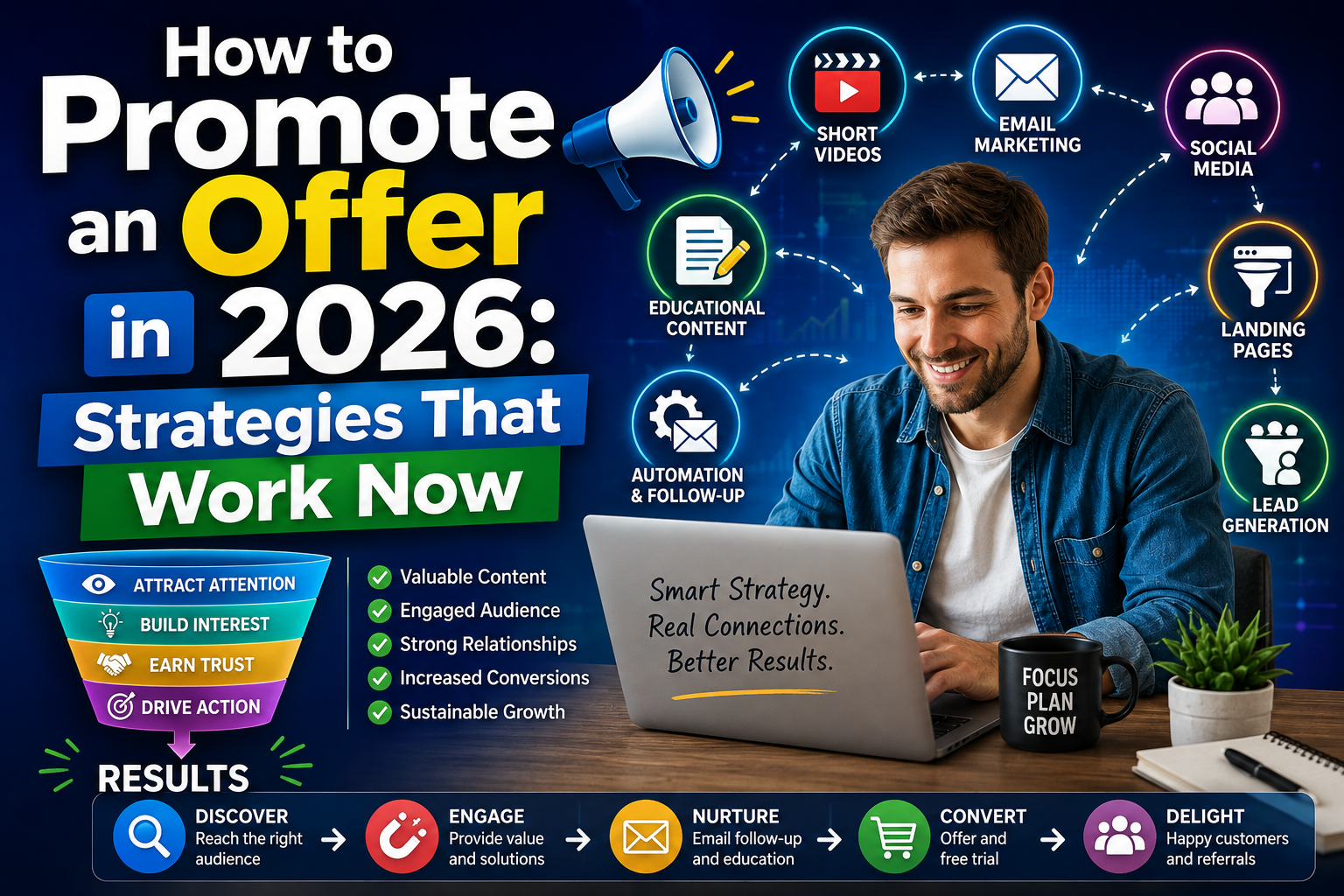
How to Promote an Offer in 2026: Strategies That Are Working Now

By Marvin Gandis

Promoting an offer online is no longer simply about posting a link repeatedly and hoping somebody buys.

Consumer behavior has changed.

People compare, research, watch, ask questions, and most importantly, look for signs of trust before making a decision.

That is why the strategies working best today combine education, useful content, demonstrations, follow-up, and relationships.

This applies especially to digital offers, affiliate programs, subscription services, data-protection tools, courses, memberships, and online business opportunities.

The right question is no longer:

“Where can I post my link?”

The better question is:

“How can I move someone from discovery to trust, and from trust to action?”


Promote the Problem Before the Product

One of the most common marketing mistakes is talking about the product too early.

The prospect may not know you yet.

They may not even understand why they need what you are offering.

That is why it often makes more sense to begin with the problem.

For example, if you promote a digital backup service, you could ask:

What would happen if you lost your phone today?

How many important photos exist on only one device?

Which documents would be difficult to replace if your computer stopped working?

These questions connect with a real concern.

When the prospect understands the problem, the solution begins to make sense.


Use Short Videos to Capture Attention

Short-form video continues to be one of the strongest ways to capture attention quickly.

Facebook Reels, Instagram Reels, YouTube Shorts, and similar platforms can help you reach people who do not know you yet.

The goal does not always have to be selling.

It can simply be teaching one useful idea.

Examples:

  • Three files you should back up today.
  • One mistake that could cost you your photos.
  • The difference between storage and backup.
  • What to do before replacing your phone.
  • How to protect important family documents.

A thirty-second video can create enough curiosity for someone to want more information.

Your call to action can be simple:

“If you want to see a practical way to protect your files, check the information below.”

You do not need to turn every video into a sales presentation.

First, earn attention.

Then build trust.


Build an Email List

One of the smartest decisions in digital marketing is building your own contact list.

Social media can help you gain visibility.

But the platform controls your reach.

Your email list gives you a direct way to continue communicating with people who voluntarily asked for more information.

A simple system could be:

Content → Landing Page → Email → Follow-Up → Offer

For example, you could offer:

Free Checklist: 7 Things You Should Protect Before Losing Your Files

The visitor enters a name and email address to receive it.

Then an automated sequence begins.

Now that visitor is no longer just a click.

They have become a prospect.


Educate Before You Sell

Educational marketing works because it lowers resistance.

Instead of saying:

“Buy this.”

You can say:

“Let me explain the problem and show you the available options.”

An educational series could cover:

  • What cloud backup is.
  • What redundancy means.
  • Which files families should protect.
  • How to reduce the risk of digital loss.
  • How to organize important documents.
  • The difference between storage and backup.
  • How data recovery works.

At the end of each piece, you can introduce your recommendation naturally.

The sale becomes a possible result of education rather than pressure.


Demonstrate the Product

One of the strongest forms of marketing is showing instead of merely telling.

Many people hesitate because they do not understand how a service works.

A demonstration can remove that barrier.

You could record your screen while showing:

  1. How to create an account.
  2. How to choose files.
  3. How to begin a backup.
  4. How to restore a document.
  5. How to share files.
  6. How to manage the service.

A demonstration provides something that traditional advertising often lacks:

credibility.

When people see the service working, they can imagine themselves using it.


Turn One Piece of Content Into Many

You do not need to invent completely new material every day.

One strong article can become:

  • A long-form video.
  • Five short videos.
  • Three Facebook posts.
  • An email.
  • An infographic.
  • A LinkedIn post.
  • A frequently asked questions section.
  • A message for an email list.

This is called content repurposing.

The advantage is significant.

You create one strong piece of content and distribute it through several channels.

That reduces workload while keeping your message consistent.


Use Real Stories

People often remember stories better than technical features.

A story might begin:

“Many families keep years of photos on one phone without ever thinking about what would happen if that device disappeared.”

Then you can explain the problem, reflection, and solution.

You can also tell your own reason for using or recommending a service.

You do not need to invent a disaster.

Authenticity is more persuasive.

Your story could simply be:

“I started taking file protection more seriously when I realized how much important information depended on one device.”

Stories create emotional connection.

Facts help justify the decision.

Both matter.


Participate in Communities Without Spamming

Groups and online communities can create excellent conversations.

But there is a major difference between participating and spamming.

A poor approach would be:

“Buy here.”

A better approach would be responding to a genuine question.

For example:

“A good practice is keeping more than one copy of important files. I use a backup solution for this myself. If you want, I can explain how I set mine up.”

That answer helps first.

Then it opens a conversation.

Permission-based selling generally feels far more natural than aggressive promotion.


Improve Your Facebook Strategy

Posting only promotional graphics can exhaust your audience.

A healthier mix might be:

60% education

20% conversation and stories

20% offers or invitations

Sample week:

Monday: Educational tip.

Tuesday: Question or poll.

Wednesday: Short video.

Thursday: Article.

Friday: Story or practical example.

Saturday: Invitation to explore the offer.

Sunday: Human, community, or inspirational content.

This allows your page to build relationships instead of looking like a nonstop sales board.


Use YouTube for Searchable Education

Short videos are excellent for discovery.

Longer educational videos work well when someone is actively looking for an answer.

Possible titles include:

How to Automatically Back Up Your Files

What Is Cloud Backup?

Where Should You Store Important Family Photos?

How to Avoid Losing Digital Documents

Cloud Storage vs. Cloud Backup

Searchable educational videos can continue attracting visitors for weeks, months, or longer.

That makes them digital assets rather than temporary posts.


Use Safelists More Intelligently

Safelists can still be used as additional traffic sources.

But instead of sending visitors directly to a long business presentation, it may be better to send them first to a simple landing page.

For example:

Safelist → Landing Page → Free Resource → Emails → Offer

Why?

Because many people who click are not yet ready to buy.

But they may be willing to download a useful guide.

Once you have permission to continue communicating with them, you can educate them over time.


Build a Follow-Up Sequence

Many sales do not happen during the first contact.

That is why follow-up matters.

A simple sequence could look like this:

Email 1 — Welcome

Deliver the free resource.

Email 2 — The Problem

Explain why relying on one copy can be risky.

Email 3 — Education

Explain what backup means.

Email 4 — Common Mistake

Discuss false confidence around digital storage.

Email 5 — Solution

Introduce the tool you use.

Email 6 — Demonstration

Show how it works.

Email 7 — Invitation

Invite the reader to try the service.

Once configured, that system can work automatically.


Promote the Trial Before the Sale

If the offer includes a free trial, it can often be easier to promote the experience rather than asking for an immediate purchase.

Instead of:

“Buy now.”

You can say:

“Try it and decide whether it is useful for you.”

Psychologically, that is a much smaller commitment.

Once the prospect experiences the product, they may understand its value more clearly.


Use Referral Marketing

A satisfied customer can become a source of new customers.

Instead of asking:

“Do you know anyone who wants a business opportunity?”

ask:

“Do you know someone else who would want to protect important photos or documents?”

The second question is based on a real need.

Not a financial pitch.

That often creates a much more natural conversation.


Separate the Product From the Business Opportunity

When an offer includes both a product and an income opportunity, avoid trying to explain everything at once.

That can overwhelm the prospect.

A cleaner strategy is to use two paths.

Customer Path

Problem → Education → Product → Trial → Customer

Business Path

Product → Experience → Recommendation → Referral Program → Opportunity

First, allow the person to understand the product.

Then, if there is interest, introduce the possibility of earning through referrals.

This reduces confusion.


Use a Landing Page With One Objective

A good landing page does not need to explain twenty things.

It should quickly answer:

What is this?

Why should I care?

What should I do next?

Example:

Protect Your Photos and Documents Before It Is Too Late

Discover a simple way to keep important digital files backed up.

Button:

See How It Works

Or:

Start the Trial

The clearer the objective, the less distraction you create.


Turn Frequently Asked Questions Into Content

Questions from prospects are an excellent source of marketing material.

Examples:

Do I need technical experience?

What types of files can I back up?

How much storage do I need?

What happens when I replace my computer?

Can my family use it?

Every question can become:

  • A video.
  • A post.
  • An email.
  • An article section.
  • A website page.

Your audience can tell you what content to create if you listen carefully.


Build Content Around Objections

Objections can also become content.

If someone says:

“I already use cloud storage.”

Create:

Cloud Storage and Backup: Are They the Same Thing?

If someone says:

“Nothing has ever happened to my files.”

Create:

Why Waiting Until You Lose Your Files May Be Too Late

If someone says:

“I am not good with technology.”

Create:

How to Start Backing Up Your Files Even If You Are Not Tech-Savvy

Every objection contains an educational opportunity.


Avoid Exaggerated Promises

This is particularly important when an offer includes an income opportunity.

Avoid claims such as:

“Guaranteed income.”

“Automatic money for everyone.”

“Get rich quickly.”

“Do nothing and get paid.”

A professional presentation should make it clear that results depend on many factors, including skill, consistency, effort, traffic, follow-up, and demand.

Credibility is more valuable than hype.


The Complete System

A modern promotional system can look like this:

Attention

Short videos, posts, articles, and referrals.

Interest

Educational content and questions.

Capture

Landing page.

Relationship

Email.

Education

Follow-up sequence.

Demonstration

Video or presentation.

Offer

Free trial or purchase.

Experience

Product usage.

Referrals

Recommendations.

Opportunity

Affiliate or business presentation for interested people.

This is far more powerful than depending entirely on sending traffic straight to an affiliate link.


Conclusion: Promote Better, Not Simply More

The future of marketing does not necessarily belong to the person who publishes the most advertisements.

It belongs to the person who builds the smarter system.

People first need attention.

Then information.

Then trust.

Only after that are they truly prepared to make a decision.

That is why a strong strategy combines:

Content.

Education.

Video.

Email.

Demonstration.

Follow-Up.

Relationships.

Referrals.

The best promotion does not always look like advertising.

Often, it looks like a useful answer to a real problem.

When you accomplish that, you stop chasing people.

You create a path for the right people to discover your solution.

And that difference can completely change your marketing results.


Disclaimer

This article is provided for educational and informational purposes only. The marketing strategies discussed do not guarantee sales, income, or specific results. Outcomes may vary depending on the offer, audience, market conditions, content quality, investment, experience, and consistency. If you promote products through affiliate links, clearly disclose your commercial relationship and comply with applicable laws, advertising policies, and platform requirements.

Publicado en Affiliate Marketing, Artificial Intelligence, Digital Marketing, Email Marketing, Lead Generation, List Building, Marketing Automation, Network Marketing, Online Business

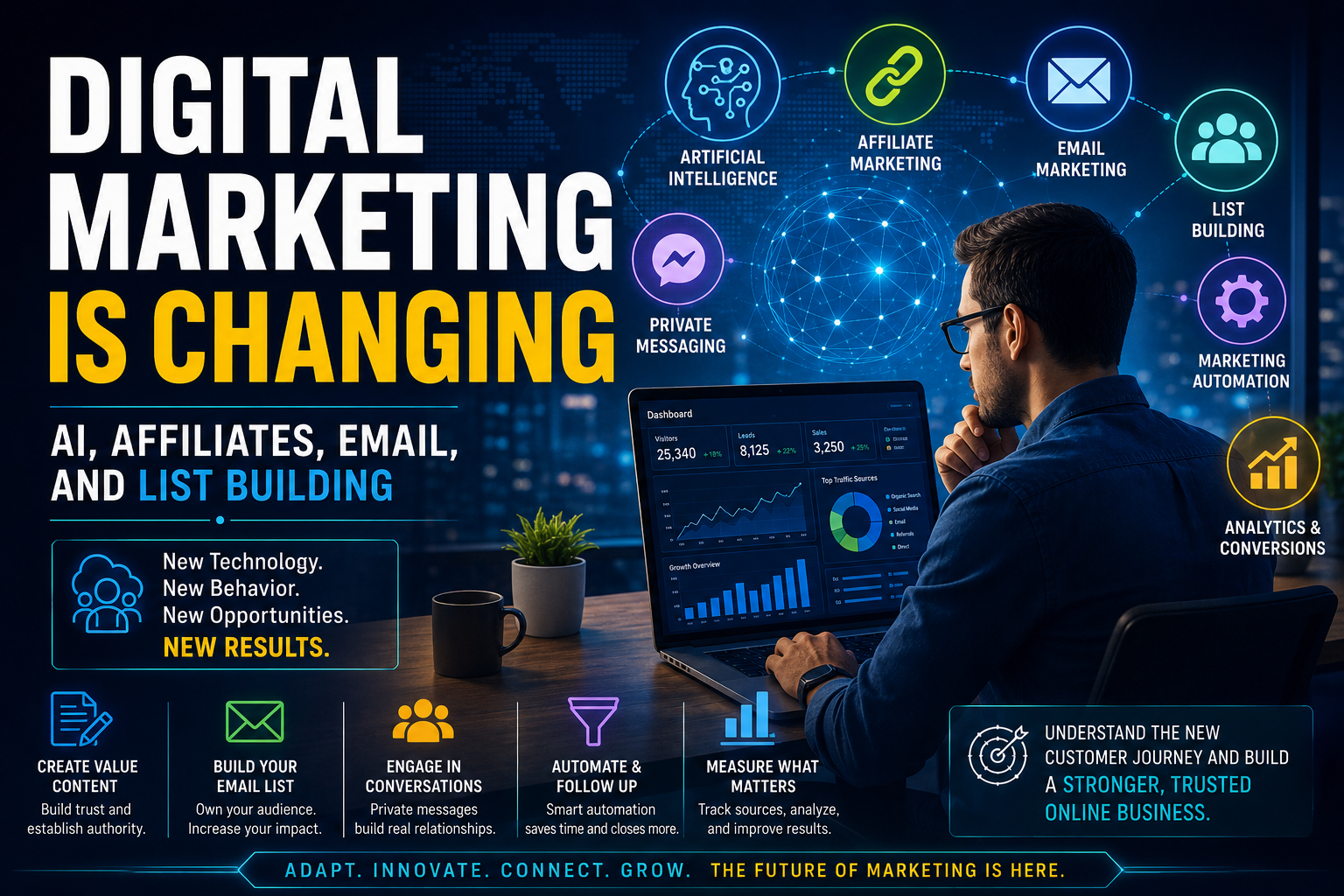
Digital Marketing Is Changing: Artificial Intelligence, Affiliate Tracking, Email, and List Building

By Marvin Gandis

Internet marketing is undergoing a major transformation. For years, many strategies depended on a relatively simple process: publish an advertisement, generate a click, send the visitor to a page, and attribute the sale to the last link used.

That model still exists, but it no longer fully represents how people discover products, research opportunities, and make decisions.

A prospect may now read an article, hear a recommendation, watch a video, consult an artificial intelligence tool, receive a private message, and return directly to a website several days later. When the person finally registers or makes a purchase, the tracking system may not correctly recognize the source of influence.

This change has significant consequences for people involved in digital marketing, affiliate marketing, list building, and network marketing.

Generating more clicks is no longer enough. Marketers must build authority, protect email deliverability, measure the customer journey more accurately, follow disclosure rules, and create content valuable enough to be discovered by both people and artificial intelligence systems.

This article examines the most important changes and presents practical actions for adapting to them.


1. Product Discovery No Longer Depends Only on the Click

In traditional affiliate marketing, the click was at the center of attribution.

A prospect found a post, clicked an affiliate link, visited the product page, and made a purchase. The system placed a cookie and assigned the commission to the appropriate affiliate.

Today, the journey is far more complicated.

A person may:

  • Discover a brand through an AI-generated answer.
  • See a post on Facebook.
  • Hear a recommendation from a friend.
  • Read a review several days later.
  • Search directly for the company’s name.
  • Register from another device.
  • Complete the purchase without using the original affiliate link again.

In this situation, the affiliate may have played a decisive role, but a last-click system may not recognize it.

Why it matters

Affiliate reports may show less influence than actually exists.

An educational campaign may be generating awareness, trust, and indirect sales even when the affiliate dashboard does not reflect all those results.

Affiliate links are still useful, but they should be supplemented with other measurement methods.

Practical action

Add a simple question to registration, contact, or free-trial forms:

How did you first hear about our service?

Possible options include:

  • Google
  • Facebook
  • YouTube
  • Email
  • An artificial intelligence tool
  • A friend or family member
  • Another source

Store this information in GetResponse, a tracking worksheet, or a contact-management system.

Over time, compare prospect responses with click and conversion statistics.


2. Tracking Failures Can Reduce Affiliate Commissions

A commission can be lost even when the sale is legitimate.

This may happen because:

  • The prospect uses an ad blocker.
  • The affiliate cookie expires.
  • The tracking link does not function properly.
  • The person moves from a phone to a computer.
  • Registration occurs several days after the initial click.
  • The prospect returns directly to the website.
  • Referral information is not preserved during a free trial.
  • A contact is entered manually without retaining the source.

This issue is especially important for programs that offer free trials.

The first click may happen on Monday, registration on Wednesday, and paid conversion the following week. When the system fails to preserve referral information throughout the journey, the affiliate may not receive credit.

Why it matters

Sending more traffic without testing the tracking process may increase visitors without increasing commissions.

A small technical failure can affect hundreds of visits without the promoter realizing it.

Practical action

Test every major funnel from beginning to end.

  1. Open the affiliate link on a mobile phone.
  2. Complete the form with a test email address.
  3. Confirm that the registration appears correctly.
  4. Verify that the referral source is preserved.
  5. Review the follow-up sequence.
  6. Repeat the test on a computer.
  7. Repeat it in a private browser window.
  8. Take screenshots and record the date.

When a discrepancy appears, document it and contact the company before investing additional money or effort in traffic.


3. Artificial Intelligence Is Changing Content Visibility

Articles are no longer written only for Google, Facebook, or email subscribers.

They may also be used as sources by artificial intelligence tools.

When someone asks:

  • How can I protect my personal files?
  • Is cloud storage worth paying for?
  • How do I build an email list?
  • How can I sell without applying pressure?
  • What should I know before joining a network-marketing opportunity?

An AI system may look for reliable, clear, and well-organized information when preparing its response.

This creates a major opportunity for educational content creators.

Content that may lose visibility

Shallow content will have a harder time standing out.

Weak formats include:

  • Articles created only to insert links.
  • Pages that copy promotional descriptions.
  • Posts without an identifiable author.
  • Exaggerated or unsupported content.
  • Text that is too general.
  • Reviews that offer no real analysis.
  • Mass-produced content without human experience.

Content that may gain authority

Useful, specific, and well-structured content has a better chance of being discovered and recommended.

A strong article should include:

  • A direct answer to a specific question.
  • Clear examples.
  • Benefits and limitations.
  • Frequently asked questions.
  • Author information.
  • Publication or update date.
  • Reliable sources when needed.
  • A clear affiliate disclosure.
  • An honest call to action.

Practical action

Publish articles that answer specific questions instead of covering only broad subjects.

For example:

What Happens to Your Family Photos and Documents When a Computer Fails?

This title addresses a real concern and creates space to explain the risk, available solutions, and the importance of backups without beginning with a sales presentation.


4. Private Messaging Is Becoming More Important

Many business conversations begin publicly but end privately.

A person may discover a post on Facebook or Instagram, but ask serious questions through Messenger or WhatsApp.

Private messaging offers:

  • More personal responses.
  • Greater privacy.
  • Immediate communication.
  • Less public pressure.
  • Easy sharing of links and instructions.
  • Continuity across different stages of the process.

For network marketing, this can be highly effective when used respectfully.

The right approach

Messaging should begin with consent and usefulness.

A proper sequence may look like this:

Educational post → request for information → private message → resource delivery → follow-up question → permission to present the opportunity

Deliver what was promised first. Begin the conversation afterward.

The wrong approach

Messaging becomes harmful when it is used to:

  • Send unsolicited mass promotions.
  • Copy the same message to dozens of people.
  • Immediately introduce an income opportunity.
  • Pressure the prospect.
  • Use exaggerated claims.
  • Continue messaging after the person has shown no interest.

Practical action

Create one consent-based path.

For example:

“I am preparing a free guide about protecting important files and family photographs. Reply GUIDE, and I will send it to you privately.”

After delivering the guide, ask:

“Which type of information are you most concerned about losing: photographs, documents, work files, or family records?”

That question begins a real conversation and helps identify the prospect’s need before introducing a solution.


5. Email Deliverability Remains Essential

Email continues to be one of the most valuable assets in digital marketing.

Social-media algorithms can change. Accounts can lose reach. Platforms can restrict content. A properly managed email list, however, provides a more direct relationship with subscribers.

That advantage depends on deliverability.

A message that does not reach the inbox cannot educate, build trust, or produce a sale.

Factors affecting deliverability

Important factors include:

  • SPF authentication.
  • DKIM signing.
  • DMARC policy.
  • Domain reputation.
  • Spam complaints.
  • Old or purchased lists.
  • Inactive contacts.
  • Sudden sending-volume increases.
  • Misleading subject lines.
  • Excessive links.
  • Poor-reputation domains included in messages.
  • Missing or unclear unsubscribe options.

Why it matters

Using GetResponse, AWeber, or another service does not automatically guarantee strong deliverability.

The platform may send the message, but domain reputation and list quality remain the campaign owner’s responsibility.

Practical action

Perform a basic audit:

  1. Confirm that the domain has SPF.
  2. Activate DKIM.
  3. Publish DMARC.
  4. Review sender-domain alignment.
  5. Test the unsubscribe link.
  6. Remove invalid addresses.
  7. Separate active and inactive subscribers.
  8. Reduce mailings to people who never open.
  9. Monitor bounce and complaint rates.
  10. Avoid sudden changes in sending volume.

6. Building a List Is Still More Important Than Accumulating Followers

A social-media follower is not the same as an email subscriber.

The platform controls reach, algorithms, and visibility. An owned list provides greater control, although it also requires greater responsibility.

List building should not depend only on offering a generic gift. The resource should solve a real problem and attract the kind of person who may later benefit from the marketer’s services.

Examples of strong lead magnets

  • A digital-file protection checklist.
  • A guide to starting an email list.
  • A follow-up plan for affiliate marketers.
  • A welcome-message template for new prospects.
  • A report on avoiding aggressive sales tactics.
  • A beginner’s network-marketing guide.
  • A simple deliverability audit.

What happens after registration

A common mistake is focusing only on collecting the email address.

The real value is created through the follow-up sequence.

A strong welcome sequence may include:

  1. Immediate resource delivery.
  2. A brief introduction to the author.
  3. An explanation of the main problem.
  4. One practical tip.
  5. A story or personal experience.
  6. An invitation to reply.
  7. A moderate introduction to the solution.
  8. Ongoing educational follow-up.

Practical action

Review the primary lead magnet and ask:

  • Does it solve a specific problem?
  • Does it attract the right prospect?
  • Is it delivered immediately?
  • Does the first week of follow-up provide value?
  • Is there a natural transition to the product?
  • Does the subscriber understand why future emails will arrive?

7. Affiliate Disclosures Must Be Clear

Transparency should not be viewed as an obstacle to selling.

A clear disclosure may strengthen trust because it demonstrates honesty.

Readers should understand that the promoter may receive compensation when they register or purchase through certain links.

A proper disclosure should be

  • Visible.
  • Easy to understand.
  • Located near the recommendation.
  • Written in the same language as the content.
  • Presented before the reader clicks.
  • Free of unnecessarily complicated legal language.

Example

“This article contains affiliate links. I may receive compensation if you enroll or make a purchase through one of these links, at no additional cost to you.”

Testimonials and results

Testimonials also require care.

They should not:

  • Guarantee results.
  • Present unusual earnings as typical.
  • Hide business relationships.
  • Invent experiences.
  • Edit statements misleadingly.
  • Use screenshots without context.

Practical action

Review articles, emails, landing pages, and social posts. Place the disclosure before or near the first commercial link and confirm that all testimonials are genuine, authorized, and presented in the proper context.


8. Educational Content Should Lead to a Next Step

Educational content should not become an endless collection of information without direction.

Every article, email, or video should help the prospect take an appropriate next step.

That step does not always have to be a purchase.

It may be:

  • Downloading a guide.
  • Answering a question.
  • Subscribing.
  • Watching a demonstration.
  • Trying a service.
  • Requesting more information.
  • Attending a presentation.
  • Comparing alternatives.
  • Reading a related article.

Why it works

People feel less pressure when the next step is small, clear, and logical.

Instead of requesting a major decision immediately, content can guide the prospect gradually.

Practical action

Use one primary call to action per article.

For example:

“Download the free checklist for protecting your photographs, documents, and important files.”

Avoid presenting too many competing choices.


9. Automation Should Support Human Relationships

Automation can deliver messages, classify contacts, and provide follow-up without depending entirely on manual work.

It should not pretend that a personal relationship exists when it does not.

Automation should be used to:

  • Deliver resources.
  • Confirm registrations.
  • Educate.
  • Remind.
  • Segment.
  • Identify interest.
  • Prepare a human conversation.

It should not be used to:

  • Invent urgency.
  • Send falsely personal messages.
  • Apply constant pressure.
  • Repeat the same promotion indefinitely.
  • Hide the fact that communication is automated.
  • Completely replace human attention.

Practical action

Review all automated responses and identify the exact moment when an interested prospect should receive personal attention.

Examples include when a person:

  • Replies to an email.
  • Clicks several times.
  • Completes a free trial.
  • Requests pricing.
  • Asks about the opportunity.
  • Repeatedly visits an important page.

10. The Strongest Strategy Combines Authority, a List, and Follow-Up

Sustainable digital marketing does not depend on a single platform.

A more resilient strategy combines:

  • Educational content.
  • Search visibility.
  • Artificial-intelligence visibility.
  • Social media.
  • Private messaging.
  • Lead-capture forms.
  • Email.
  • Personal follow-up.
  • Source measurement.
  • Transparent disclosures.

Each element has a purpose.

Content attracts.

The list preserves the relationship.

Email educates.

Messaging answers questions.

Follow-up converts.

Measurement reveals what is working.

Transparency protects trust.


Seven-Day Action Plan

Day 1: Review every link

Test each affiliate link, lead-capture page, and form.

Day 2: Audit email deliverability

Check SPF, DKIM, DMARC, bounces, and unsubscribe functions.

Day 3: Add the attribution question

Ask prospects how they first heard about the service.

Day 4: Improve the lead magnet

Make sure it solves a specific need.

Day 5: Review the welcome sequence

Confirm that it educates before selling.

Day 6: Publish an authority article

Answer one real and specific question.

Day 7: Create a path to conversation

Connect the article, form, email, and personal follow-up.


Conclusion

The future of digital marketing will not necessarily belong to the person who publishes the most, sends the most messages, or purchases the most traffic.

It will belong to the marketer who best understands the prospect’s journey.

People now discover opportunities through search engines, articles, videos, private conversations, personal recommendations, and artificial intelligence systems. This makes the process less visible, but it also creates new opportunities for those who consistently build trust.

The priorities are clear:

  • Create useful content.
  • Measure beyond the click.
  • Protect deliverability.
  • Verify tracking.
  • Build an owned list.
  • Obtain consent.
  • Disclose commercial relationships.
  • Automate without losing the human element.

Technology will continue to change.

The principles of trust, clarity, usefulness, and responsible follow-up will remain essential.


Disclaimer

This article is provided for educational and informational purposes only. It does not constitute legal, financial, or business advice. Email-provider rules, advertising-platform policies, and affiliate-program terms may change. Always review the official terms of each service and consult a qualified professional when necessary. Marketing, traffic, lead-generation, and commission results will vary.