By Marvin Gandis
A Clear, Step-by-Step Email Marketing Guide for Complete Beginners
You have probably heard the phrase “the money is in the list” more times than you can remember.
But if building an email list is so important, why is your subscriber count still sitting at zero?
Perhaps you do not know where to begin. Maybe email marketing sounds too technical. You may believe that you need a large website, expensive software, professional writing skills, or thousands of social media followers before anyone will subscribe.
You do not.
You need a clear offer, a simple system, a useful message, and the discipline to follow a proven process.
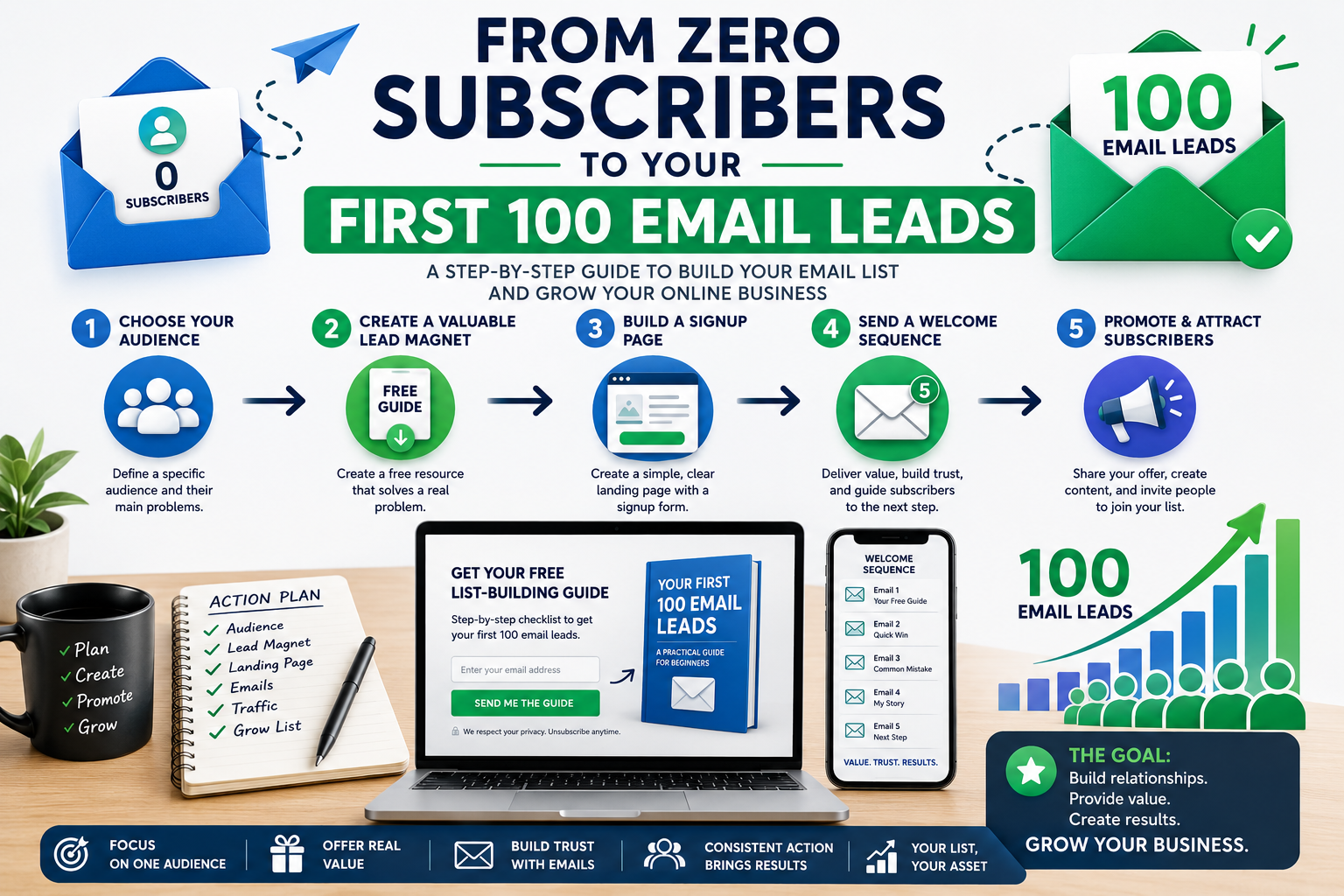
This guide will walk you through the complete beginner journey—from having no subscribers and no email marketing experience to building your first list of 100 real email leads.
You can read it in one sitting or complete it section by section.
The objective is not to collect random email addresses. The objective is to begin building a trusted audience of people who have voluntarily asked to hear from you.
Part One: Understand What an Email List Really Is
An email list is a group of people who have permitted you to communicate with them by email.
They may have subscribed because they wanted:
- A free guide
- A checklist
- A discount
- A tutorial
- A newsletter
- Access to a training
- Information about a specific subject
- Updates about a product or service
The important word is permission.
A legitimate email list is not a collection of addresses copied from websites, purchased from a third party, scraped from social media, or added without consent.
A real list is built when people knowingly choose to subscribe.
That distinction matters because permission creates the foundation for trust, engagement, and long-term communication.
Why Email Marketing Still Matters
Social media can help you attract attention, but you do not control the platform.
Algorithms change. Accounts can be restricted. Organic reach can decline. A platform can reduce the number of people who see your content without warning.
An email list gives you a more direct channel for communication.
You can use it to:
- Educate your audience
- Share new articles
- Announce products or services
- Invite people to webinars
- Promote affiliate offers responsibly
- Build relationships over time
- Follow up with interested prospects
- Send reminders and important updates
- Turn occasional visitors into returning readers
Your email list is not a guaranteed source of income. It is a communication asset.
Its value depends on the quality of the subscribers, the usefulness of your messages, the trust you develop, and the relevance of the offers you eventually present.
Phase One: Build the Foundation
Before searching for subscribers, you need to answer five essential questions.
Step 1: Choose One Specific Audience
Do not begin by trying to attract everyone.
A message created for everyone usually feels relevant to no one.
Choose a specific group of people you understand or would like to serve.
Examples include:
- Beginners learning affiliate marketing
- Retired adults starting an online business
- Small-business owners who need better follow-up
- Parents who want to protect family photos and documents
- Bloggers trying to increase website traffic
- Job seekers improving their professional skills
- People learning how to create videos for social media
- New entrepreneurs building their first digital audience
Your audience does not need to be extremely narrow, but it should be specific enough that you can understand its problems.
Complete this sentence:
I help __________ accomplish __________ without __________.
Example:
I help beginning online marketers build their first email list without complicated technology or aggressive selling.
This simple sentence gives direction to your lead magnet, landing page, emails, and promotions.
Step 2: Identify One Immediate Problem
People rarely subscribe because they want “more information.”
They subscribe because they want help with a specific problem, desire, fear, or goal.
Ask:
- What is frustrating my audience right now?
- What are they trying to accomplish?
- What mistake are they afraid of making?
- What small result could I help them achieve quickly?
- What question do they repeatedly ask?
For a beginner interested in email marketing, common problems may include:
- Not knowing which email platform to use
- Having no subscribers
- Not knowing what to offer
- Feeling afraid to write emails
- Not understanding landing pages
- Struggling to attract traffic
- Sending promotions without building trust
- Having no follow-up system
Choose one primary problem for your first campaign.
Do not attempt to solve an entire industry in one free resource.
Step 3: Create a Simple Lead Magnet
A lead magnet is a useful resource that someone receives in exchange for voluntarily joining your email list.
It should offer a specific result or help the reader take a specific next step.
Good beginner lead magnets include:
- A checklist
- A short PDF guide
- A template
- A resource list
- A mini-course
- A worksheet
- A comparison chart
- A quick-start plan
- A seven-day challenge
- A short video tutorial
Your first lead magnet does not need to be fifty pages long.
A focused five-page guide that solves one real problem can be more useful than a fifty-page ebook filled with general information.
A practical lead-magnet formula
Create a resource that helps the reader:
- Understand the problem
- Avoid the most common mistakes
- Complete a small action
- Experience a quick result
- Know what to do next
Example
Title:
“Your First 100 Email Leads: A Beginner’s Checklist”
Promise:
“A practical checklist to help you choose your audience, create a free offer, publish a signup page, and begin attracting your first subscribers.”
The title is clear. The benefit is easy to understand. The promise is realistic.
Step 4: Select an Email Marketing Platform
An email marketing platform allows you to:
- Store subscriber information
- Create signup forms
- Build landing pages
- Send newsletters
- Set up automated emails
- Organize subscribers
- Track basic performance
- Provide unsubscribe options
When choosing a platform, consider:
- Ease of use
- Price
- Subscriber limits
- Automation features
- Landing-page tools
- Form options
- Customer support
- Deliverability practices
- Integration with your website
- Reporting and analytics
Do not spend weeks searching for a perfect platform.
Choose a reputable service that fits your present needs and learn how to use its basic functions.
At the beginning, you mainly need:
- One contact list
- One signup form or landing page
- One confirmation process
- One automated welcome email
- The ability to send regular emails
Advanced funnels can wait.
Step 5: Create a Professional Sender Identity
Before sending emails, establish a recognizable sender name and address.
Your sender name might be:
- Your real name
- Your business name
- Your name plus your brand
- Your publication or newsletter name
Examples:
- Maria Lopez
- Carlos from Digital Growth Weekly
- Beginner Marketing Academy
- The Simple Business Newsletter
Use a professional email address when possible.
A domain-based address can improve credibility, such as:
Your readers should immediately understand who sent the message.
Avoid mysterious sender names, excessive symbols, or misleading identities.
Phase Two: Build the Subscriber Journey
Your subscriber journey is the path a person follows from discovering your offer to receiving your emails.
The basic journey looks like this:
Traffic source → Landing page → Signup form → Confirmation → Thank-you page → Lead magnet → Welcome emails
Let us build each part.
Step 6: Create a Clear Landing Page
A landing page is a focused webpage designed to encourage one action.
For list building, that action is subscribing.
A beginner landing page does not need complicated graphics or long sales copy.
It needs five essential elements.
1. A benefit-focused headline
The headline should tell visitors what they will receive or accomplish.
Example:
- Build Your First Email List—One Simple Step at a Time
2. A supporting sentence
Explain who the resource is for and why it matters.
Example:
Download the beginner-friendly checklist that shows you how to choose your audience, create a simple free offer, and begin attracting your first 100 subscribers.
3. A few specific benefits
Tell the reader what the resource includes.
For example:
- How to choose a profitable and relevant audience
- How to create a simple lead magnet
- What to include on your signup page
- Where to find your first subscribers
- What to send after someone joins
4. A simple form
Ask only for the information you genuinely need.
For many beginner campaigns, a first name and email address are sufficient.
Every extra field can create friction.
5. A clear call to action
Your button should describe the next step.
Examples:
- Send Me the Guide
- Get the Free Checklist
- Start Building My List
- Download the Beginner’s Guide
- Show Me the Steps
“Submit” is functional but not persuasive or descriptive.
Step 7: Write a Strong Signup Message
Your signup message should answer four questions quickly:
- What will I receive?
- Who is it for?
- How will it help me?
- What happens after I subscribe?
Example:
Get the free step-by-step guide for complete beginners who want to build an email list without complicated technology. Enter your email below, confirm your subscription, and the guide will be sent directly to your inbox.
This creates clarity and reduces uncertainty.
Step 8: Use a Thank-You Page
After someone subscribes, do not leave them staring at an empty screen.
Send them to a thank-you page.
Your thank-you page can:
- Confirm that the form was submitted
- Tell them to check their inbox
- Explain how to confirm their subscription
- Remind them to check spam or promotions folders
- Tell them what email address or sender name to look for
- Introduce your website or best article
- Invite them to follow one social channel
- Set expectations for future messages
Example:
Thank you for joining. Please check your inbox for a confirmation message from Beginner Marketing Academy. After confirming, you will receive your free guide. If you do not see the message within a few minutes, check your spam or promotions folder.
Do not overwhelm new subscribers with five different offers immediately.
First, help them complete the subscription process.
Step 9: Deliver the Lead Magnet Immediately
When someone subscribes, give them what you promised.
Do not make the subscriber search through several emails or wait unnecessarily.
Your delivery email should include:
- A welcoming introduction
- A clear link or access button
- A reminder of what the resource will help them accomplish
- One simple instruction
- An invitation to reply if they need help
Example:
Subject: Your Email List Guide Is Ready
Hello,
Thank you for joining.
Your guide, “Your First 100 Email Leads,” is ready.
Access it here:
[Download the Guide]
Begin with the first section and complete one step at a time. You do not need to build everything today.
Tomorrow, I will send you a simple lesson about choosing the right lead magnet.
Best,
Your Name
Phase Three: Write Your First Welcome Sequence
A welcome sequence is a series of automated emails sent after a person subscribes.
Its purpose is not to pressure the subscriber into buying immediately.
Its purpose is to deliver value, introduce your perspective, establish expectations, and help the reader take action.
A simple beginner sequence can contain five emails.
Email 1: Deliver the Resource
Goal: Fulfill your promise immediately.
Include:
- A warm welcome
- The lead-magnet link
- One quick instruction
- What the subscriber should expect next
Email 2: Help Them Get a Small Win
Goal: Encourage the subscriber to use the resource.
Explain one simple action they can complete today.
Example:
Before choosing software or designing a landing page, write one sentence describing exactly who you want to help.
Ask them to reply with their sentence.
Replies can create engagement and provide valuable audience insights.
Email 3: Correct a Common Mistake
Goal: Demonstrate expertise through useful guidance.
Possible subject:
The Mistake That Keeps Beginner Lists Empty
You might explain that many beginners create a generic newsletter invitation rather than offering a specific benefit.
Then show them how to improve it.
Weak:
Join my newsletter for updates.
Stronger:
Get the weekly beginner marketing lesson that helps you attract leads, write better emails, and build your online business one step at a time.
Email 4: Share a Useful Story or Lesson
Goal: Build connection.
The story does not need to be dramatic.
You can explain:
- Why you became interested in the subject
- A mistake you made
- What you misunderstood as a beginner
- A lesson that changed your approach
- Why you created the free resource
Keep the story relevant to the reader’s journey.
The reader should be able to see a lesson for themselves.
Email 5: Present the Next Step
Goal: Guide the subscriber forward.
The next step could be:
- Reading an article
- Watching a tutorial
- Joining a webinar
- Downloading another resource
- Trying a tool
- Booking a consultation
- Reviewing a relevant product or service
When presenting an offer, explain:
- Who it is for
- What problem it addresses
- What it includes
- Any cost or important condition
- What results should not be assumed
- Why you believe it may help
A responsible offer gives the reader enough information to make an informed decision.
Phase Four: Learn to Write Marketing Emails
You do not need to be a professional copywriter.
You need to communicate clearly.
A useful beginner email usually contains five parts.
1. The Subject Line
The subject line creates a reason to open the email.
Good subject lines are:
- Clear
- Relevant
- Specific
- Honest
- Easy to understand
Examples:
- Your Guide Is Ready
- Start Here: The First List-Building Step
- Why Your Signup Page Is Not Converting
- Three Lead-Magnet Ideas for Beginners
- What Should You Email Your Subscribers?
- Your First 100 Leads: This Week’s Action
Avoid misleading claims, false urgency, or dramatic promises that the email cannot support.
2. The Opening
The first lines should connect the subject to the content.
Example:
Many beginners spend hours choosing an email platform but never decide what they will offer in exchange for a subscription.
This immediately introduces the problem.
3. The Main Lesson
Focus on one idea per email.
Do not try to explain ten unrelated concepts.
A focused email is easier to read and more likely to inspire action.
4. The Call to Action
Tell the reader what to do next.
Examples:
- Read the article
- Download the checklist
- Reply with your answer
- Watch the tutorial
- Visit the signup page
- Complete today’s exercise
- Review the recommended tool
Use one primary call to action whenever possible.
5. The Signature
End with a real person or recognizable brand.
Example:
Best,
Maria Lopez
Founder, Beginner Business Weekly
A simple signature builds familiarity.
Phase Five: Find Your First 100 Subscribers
Creating a landing page is not enough.
You must intentionally send relevant people to it.
Your first 100 subscribers will usually come from consistent, direct promotion—not from waiting for strangers to discover your page.
Here are ten practical methods.
Method 1: Invite People You Already Know
You may tell friends, colleagues, customers, or professional contacts about your new free resource.
Do not automatically add them to your list.
Invite them to visit the signup page and decide for themselves.
Example:
I created a free beginner’s guide about building an email list from zero. I thought it might be useful to you. Here is the page if you would like to receive it.
Personal invitations can help you gain your first subscribers and receive early feedback.
Method 2: Publish a Helpful Article
Write an article that solves part of the same problem as your lead magnet.
At the beginning, middle, or end, invite readers to download the complete resource.
For example:
Article:
Seven Reasons Beginners Struggle to Build an Email List
Call to action:
Download the complete First 100 Email Leads Checklist.
The article creates interest. The lead magnet provides the next step.
Method 3: Add Signup Forms to Your Website
Place signup opportunities in relevant locations:
- Homepage
- Blog sidebar
- Article endings
- About page
- Resource page
- Exit-intent form
- Footer
- Dedicated landing page
Do not cover every part of your website with aggressive popups.
The goal is visibility without creating frustration.
Method 4: Share Educational Social Posts
Do not promote the same link with the same sentence every day.
Teach something useful first.
A simple content structure is:
- Identify a problem
- Share one practical lesson
- Explain the next step
- Invite the reader to get the free resource
Example:
Most beginners do not need a more advanced email platform. They need a more specific reason for people to subscribe.
“Join my newsletter” is vague.
“Get a five-step plan for reaching your first 100 email leads” is specific.
I created a free guide that explains the complete process. You can get it here: [Link]
Method 5: Create Short Videos
Record brief videos answering common beginner questions.
Possible topics:
- What is an email list?
- What is a lead magnet?
- Do you need a website?
- What should your first email say?
- How often should you email subscribers?
- What is a landing page?
- Why are people not subscribing?
End each video with a natural invitation to your free guide.
Method 6: Participate in Relevant Communities
Join online communities where your audience already gathers.
This may include:
- Facebook groups
- Professional forums
- LinkedIn groups
- Online communities
- Local business groups
- Educational platforms
- Industry-specific discussion boards
Follow each community’s rules.
Answer questions genuinely. Do not enter every conversation only to post your link.
Trust grows when you contribute before promoting.
Method 7: Collaborate With Small Creators
You do not need to partner with a celebrity.
Find creators, bloggers, newsletter publishers, or business owners serving a similar audience.
Possible collaborations include:
- Guest articles
- Newsletter mentions
- Joint livestreams
- Interviews
- Resource exchanges
- Webinars
- Podcast appearances
- Social-media discussions
A small but engaged audience can be more valuable than a large and uninterested one.
Method 8: Use a Referral Invitation
Encourage existing subscribers to share the guide with someone who may benefit.
Example:
Do you know someone trying to build an email list? Forward this email or send them the signup page. Please do not enter their email address for them—they should subscribe directly.
This protects permission and encourages organic growth.
Method 9: Improve Existing Traffic
Perhaps you already receive visitors but do not have a clear signup invitation.
Review:
- Your most popular articles
- Your profile descriptions
- Your video descriptions
- Your social-media bio
- Your email signature
- Your resource pages
- Your thank-you pages
- Your online presentations
Add a relevant invitation where it naturally belongs.
Method 10: Consider Paid Traffic Carefully
Paid advertising can accelerate testing, but it does not repair a weak offer.
Before spending money, confirm that:
- The audience is clearly defined
- The lead magnet is relevant
- The landing page is understandable
- The signup process works
- The welcome emails are active
- The mobile experience is functional
- You can track signups and costs
- You have defined a spending limit
Begin with a controlled test.
Do not assume that buying traffic will automatically create customers or profits.
Your First 100-Subscriber Action Plan
Instead of thinking about 100 subscribers as one large target, divide it into smaller stages.
Subscribers 1–10: Validate the Idea
Focus on people you know, direct invitations, and personal feedback.
Ask:
- Was the headline clear?
- Did the signup form work?
- Was the guide easy to access?
- Was the content useful?
- What question remains unanswered?
Do not become discouraged if the first version needs improvement.
That is the purpose of testing.
Subscribers 11–25: Publish Consistently
Create useful content around the main problem.
Publish:
- Two educational articles
- Three short videos
- Several social posts
- One personal story
- One frequently asked question
Every piece of content should naturally point toward the lead magnet.
Subscribers 26–50: Improve Conversion
Review your landing-page results.
Ask:
- Are people visiting but not subscribing?
- Is the headline too vague?
- Is the benefit clear?
- Does the form request too much information?
- Does the page work on mobile devices?
- Does the design look trustworthy?
- Is the resource relevant to the traffic source?
Change one major element at a time so you can understand what improves performance.
Subscribers 51–75: Increase Distribution
Begin reaching audiences beyond your immediate circle.
Try:
- A guest article
- A small collaboration
- A community presentation
- A live educational session
- A newsletter exchange
- A downloadable worksheet
- A new traffic source
Do not abandon the methods that are already working.
Expand gradually.
Subscribers 76–100: Strengthen the Relationship
By this point, your focus should not be limited to acquisition.
Review how subscribers are responding.
Look at:
- Opens
- Clicks
- Replies
- Unsubscribes
- Questions
- Frequently visited links
- Most useful topics
Metrics do not tell the entire story, but they can help identify patterns.
Send a simple survey asking:
What is your biggest challenge with email marketing right now?
The answers can guide your future articles, lead magnets, emails, products, and services.
A Practical 30-Day Beginner Schedule
Days 1–3: Define the Foundation
- Choose your audience
- Identify one urgent problem
- Write your positioning sentence
- Choose your lead-magnet topic
Days 4–7: Create the Lead Magnet
- Write the outline
- Create the content
- Proofread it
- Add a practical checklist or exercise
- Export or publish the resource
Days 8–10: Prepare the Platform
- Create your list
- Configure your sender identity
- Build the signup form
- Review consent language
- Set up the unsubscribe process
Days 11–13: Build the Landing Page
- Write the headline
- Add the supporting text
- List the benefits
- Add the form
- Test the page on desktop and mobile
Days 14–17: Write the Welcome Sequence
- Email 1: Delivery
- Email 2: Quick win
- Email 3: Common mistake
- Email 4: Relevant story
- Email 5: Next step
Days 18–20: Test Everything
Subscribe using your own test address.
Confirm that:
- The form submits correctly
- Confirmation messages arrive
- Links work
- The lead magnet opens
- Automated emails arrive in order
- The unsubscribe link works
- The pages display properly on mobile
Days 21–30: Promote and Improve
Each day, complete at least one list-building activity:
- Publish a post
- Share a video
- Invite a relevant contact
- Answer a community question
- Improve the landing page
- Contact a potential collaborator
- Add the signup link to an existing asset
- Review subscriber feedback
Ten days of consistent action can teach you more than months of planning without publishing.
What Should You Send After the Welcome Sequence?
Many beginners collect subscribers and then disappear.
That weakens trust.
Choose a realistic schedule you can maintain.
You might send:
- One email each week
- Two emails each week
- A weekly newsletter
- A weekly lesson and an occasional promotion
Your regular content can include:
- Tutorials
- Checklists
- Answers to common questions
- Personal lessons
- Case studies
- Industry observations
- Recommended resources
- Product reviews
- Invitations
- Promotional offers
A useful guideline is to ask:
Does this email educate, help, clarify, encourage, or guide the reader toward a relevant solution?
Not every email needs to sell.
However, you should not be afraid to present a relevant offer when it genuinely fits the subscriber’s needs.
Common Beginner Mistakes
Mistake 1: Waiting for Perfection
Your first lead magnet will not be your final lead magnet.
Your first landing page will improve.
Your early emails may feel uncomfortable.
Publish a responsible, useful first version and improve it through feedback.
Mistake 2: Offering Something Too General
“Business Tips” is broad.
“A Seven-Day Plan to Get Your First Ten Email Subscribers” is specific.
Specific offers are easier to understand and promote.
Mistake 3: Collecting Email Addresses Without Permission
Never add people merely because you know them, have their business card, or found their address online.
Invite them to subscribe.
Permission protects the relationship.
Mistake 4: Promoting Constantly Without Teaching
If every email asks the reader to buy something, subscribers may stop paying attention.
Educate, explain, and help.
Then present offers that are relevant to the problems you have been discussing.
Mistake 5: Never Making an Offer
The opposite mistake is providing information indefinitely without ever presenting a next step.
Your subscribers may appreciate your free content and still need a product, service, tool, training, or consultation.
A clear and ethical offer can be part of good service.
Mistake 6: Sending Unrelated Promotions
Subscribers joined for a reason.
If they subscribed for email-marketing education and suddenly receive unrelated promotions every day, trust can disappear quickly.
Maintain relevance.
Mistake 7: Ignoring Mobile Readers
Many subscribers will read your emails on a phone.
Use:
- Short paragraphs
- Clear headings
- Readable text
- Simple buttons
- Limited visual clutter
- Links that are easy to select
Always test your emails on a mobile device.
Mistake 8: Focusing Only on List Size
A list of 100 interested subscribers can be more valuable than a list of 10,000 people who do not remember joining.
Pay attention to:
- Relevance
- Engagement
- Trust
- Replies
- Clicks
- Retention
- Subscriber questions
Quality and relationship matter.
Basic Email Marketing Responsibility
Email marketing should be based on honesty and permission.
Use these general practices:
- Explain what people are subscribing to
- Deliver what you promised
- Identify yourself clearly
- Include a working unsubscribe option
- Honor unsubscribe requests
- Avoid deceptive subject lines
- Protect subscriber information
- Do not purchase questionable lists
- Do not make unsupported income claims
- Disclose affiliate relationships when applicable
- Review the rules that apply to your business and location
This guide provides general educational information and is not legal advice. Email, privacy, advertising, and data-protection requirements can vary by jurisdiction and business activity.
The Simple Formula
Your first 100 subscribers do not require a mysterious secret.
They require a working system:
Specific audience + Immediate problem + Useful lead magnet + Clear landing page + Permission-based signup + Helpful welcome emails + Consistent promotion + Ongoing improvement
You do not need to master everything today.
Begin with one audience.
Solve one problem.
Create one useful resource.
Build one landing page.
Write one welcome sequence.
Invite one person at a time.
The first subscriber proves the system works.
The first ten provide feedback.
The first fifty reveal patterns.
The first one hundred give you the foundation of a real audience.
The money is not simply “in the list.”
The opportunity is in the relationship you build with the people on that list.
Treat subscribers like human beings—not numbers.
Respect their attention.
Keep your promises.
Teach what you know.
Recommend only what you can explain responsibly.
And continue improving one email at a time.
Final Beginner Checklist
Before launching, confirm that you have:
- Defined one specific audience
- Identified one immediate problem
- Created one useful lead magnet
- Selected an email platform
- Established a recognizable sender identity
- Built a clear landing page
- Created a permission-based signup form
- Prepared a thank-you page
- Wrote a delivery email
- Created a five-email welcome sequence
- Tested every link and form
- Checked the mobile experience
- Included an unsubscribe option
- Created a 30-day promotion plan
- Chosen a realistic email schedule
- Prepared to listen to subscriber feedback
Your list does not need to remain at zero.
Your next step is not to build a massive funnel.
Your next step is to choose the one person you want to help—and create something useful enough that they willingly ask to hear from you again.
Educational Disclaimer
This article is provided for general educational and informational purposes. It does not guarantee subscriber growth, sales, income, deliverability, or business results. Outcomes depend on many factors, including your audience, offer, content quality, traffic, consistency, reputation, market conditions, and compliance practices. Review the laws, regulations, platform policies, and professional requirements applicable to your location and business before launching an email marketing campaign.

Debe estar conectado para enviar un comentario.