
Publicado en Crecimiento Personal, Desarrollo Personal, Inteligencia Artificial, Mentalidad

¿Qué Puedo Crear que Mejore la Vida de Millones de Personas y se Convierta en un Negocio Extraordinario?

🌐 Disponible también en inglés: Read this article in English.

El verdadero secreto de la mentalidad millonaria: aprender a identificar problemas, crear soluciones y transformar el valor en oportunidades.

La pregunta que puede cambiar nuestra manera de pensar

¿Alguna vez te has preguntado qué diferencia a las personas que construyen empresas extraordinarias de aquellas que pasan toda su vida esperando una gran oportunidad?

Cuando escuchamos nombres como Bill Gates, Steve Jobs, Elon Musk o Jeff Bezos, generalmente pensamos en sus fortunas, sus empresas y sus impresionantes logros empresariales.

Pero existe una pregunta mucho más interesante que cuánto dinero han acumulado:

¿Qué fueron capaces de imaginar, desarrollar y ofrecer al mundo para crear semejante valor económico?

La respuesta no se encuentra exclusivamente en el dinero, la educación universitaria, los contactos o una inteligencia excepcional.

Muchas empresas exitosas comenzaron cuando alguien observó un problema, cuestionó una práctica establecida o reconoció una necesidad que otros habían pasado por alto.

Sin embargo, también debemos reconocer que las circunstancias económicas, el acceso al capital, las relaciones profesionales, la oportunidad histórica y la suerte influyen considerablemente en los resultados.

No existe una fórmula garantizada para convertirse en millonario.

Lo que sí podemos desarrollar es una manera diferente de pensar, aprender y actuar.

Y todo comienza con una pregunta:

¿Qué puedo crear que mejore la vida de tantas personas que, como consecuencia de ese valor, pueda convertirse en un negocio extraordinario?

El error de perseguir el dinero antes de comprender el valor

Vivimos rodeados de mensajes que prometen riqueza rápida.

En las redes sociales encontramos supuestos expertos que aseguran conocer secretos para generar miles de dólares mediante inversiones, inteligencia artificial, comercio electrónico o negocios automatizados.

Muchos venden la ilusión de que basta con descubrir una fórmula y reproducirla.

Pero construir un negocio sostenible requiere algo mucho más importante: comprender qué necesitan las personas y cómo podemos ayudarlas.

Imaginemos dos emprendedores.

El primero se pregunta:

«¿Qué producto puedo vender para ganar $10,000 este mes?».

El segundo se pregunta:

«¿Qué problema experimentan miles de personas que yo podría resolver de manera más sencilla, económica o efectiva?».

Ambos desean obtener ingresos, pero sus prioridades son diferentes.

El primero comienza concentrándose en lo que quiere recibir.

El segundo comienza investigando lo que puede ofrecer.

Esta diferencia puede transformar completamente una estrategia empresarial.

El dinero no aparece automáticamente por ayudar a otros. Es necesario contar con clientes dispuestos a pagar, controlar los costos y desarrollar un modelo rentable.

No obstante, crear valor real es una base mucho más sólida que perseguir oportunidades sin comprenderlas.

¿Cuál fue realmente el secreto de los grandes innovadores?

Bill Gates reconoció la importancia que tendría el software durante la expansión de las computadoras personales.

Steve Jobs comprendió que la tecnología podía resultar mucho más poderosa cuando combinaba funcionalidad, diseño y facilidad de uso.

Jeff Bezos identificó oportunidades comerciales en el crecimiento de Internet y desarrolló una empresa que comenzó vendiendo libros.

Elon Musk participó en iniciativas empresariales que cuestionaron aspectos tradicionales de industrias como los vehículos eléctricos y los lanzamientos espaciales.

Sus trayectorias son diferentes. También lo son sus errores, privilegios, decisiones y circunstancias.

Sin embargo, podemos aprender varios principios:

  • Observar cambios antes de que resulten evidentes para todos.
  • Cuestionar soluciones que parecen definitivas.
  • Aprender constantemente.
  • Reunir conocimientos y colaboradores.
  • Convertir las ideas en proyectos concretos.
  • Adaptarse a la información que ofrece el mercado.
  • Construir sistemas capaces de crecer.

La lección no consiste en imitarlos.

Consiste en aprender a desarrollar nuestra propia capacidad creadora.

No necesitamos convertirnos en el próximo Bill Gates.

Necesitamos descubrir qué problema podemos resolver mejor que las alternativas disponibles para un grupo concreto de personas.

La mentalidad millonaria no comienza en el banco

¿Qué significa realmente desarrollar una mentalidad millonaria?

No significa imaginar diariamente una mansión, un automóvil de lujo o una cuenta bancaria llena de dinero.

Tampoco significa convencernos de que el universo está obligado a recompensar nuestros pensamientos positivos.

Una mentalidad emprendedora sólida se desarrolla mediante hábitos observables.

Curiosidad

Preguntar constantemente por qué las cosas funcionan de determinada manera.

Creatividad

Imaginar soluciones que todavía no hemos explorado.

Disciplina

Trabajar incluso cuando desaparece el entusiasmo inicial.

Humildad intelectual

Reconocer nuestros errores y aceptar información que contradiga nuestras expectativas.

Perseverancia inteligente

Continuar aprendiendo, pero también abandonar estrategias que han demostrado ser ineficaces.

Integridad

Construir relaciones comerciales basadas en la confianza, la honestidad y el cumplimiento de nuestras promesas.

Visión a largo plazo

Comprender que los negocios duraderos normalmente requieren tiempo, experimentación y mejoras constantes.

La verdadera transformación ocurre cuando dejamos de depender exclusivamente de la motivación y comenzamos a desarrollar capacidades.

El mundo está lleno de problemas que esperan soluciones

Las oportunidades empresariales no siempre se encuentran en inventos revolucionarios.

A veces están escondidas en dificultades cotidianas.

Pensemos en algunos ejemplos.

Personas mayores y tecnología

Millones de adultos necesitan comprender herramientas digitales, proteger su información y comunicarse con familiares.

¿Podría desarrollarse un servicio sencillo que les enseñe estas habilidades?

Pequeños comerciantes

Muchos propietarios de negocios tienen dificultades para organizar clientes, responder consultas y mantener una presencia digital.

¿Podría crearse una herramienta accesible que les ayude a administrar esas tareas?

Familias y administración económica

Numerosos hogares necesitan instrumentos sencillos para organizar gastos, comparar precios y evitar compras innecesarias.

¿Podría desarrollarse una solución educativa que facilite mejores decisiones?

Emprendedores principiantes

Muchas personas desean comenzar un negocio, pero se sienten confundidas por la abundancia de información y las promesas exageradas.

¿Podría ofrecerse un programa práctico, honesto y asequible que las acompañe desde la idea inicial hasta sus primeras pruebas comerciales?

Estas son hipótesis, no oportunidades comerciales demostradas.

Antes de invertir dinero, habría que investigar la demanda, conversar con los posibles usuarios y comprobar si estarían dispuestos a utilizar o pagar por la solución.

La próxima gran idea podría comenzar con un problema aparentemente pequeño.

El método de las cinco preguntas

Antes de invertir tiempo o dinero en una idea empresarial, conviene responder cinco preguntas fundamentales.

Primera: ¿Qué problema específico estoy resolviendo?

Una descripción demasiado amplia dificulta desarrollar una solución.

No es suficiente decir que deseamos ayudar a los emprendedores.

Es preferible identificar una dificultad concreta, como ayudar a pequeños negocios a responder consultas de clientes sin perder horas de trabajo.

Segunda: ¿Quién experimenta ese problema?

Una buena solución necesita un público claramente definido.

Cuanto mejor comprendamos sus circunstancias, más posibilidades tendremos de ofrecer algo útil.

Tercera: ¿Cómo resuelven actualmente esa necesidad?

Debemos investigar si utilizan herramientas gratuitas, servicios profesionales, métodos manuales u otras alternativas.

Nuestros competidores también pueden enseñarnos qué valoran los clientes.

Cuarta: ¿Qué mejora concreta podemos ofrecer?

Puede tratarse de ahorrar tiempo, reducir costos, simplificar procesos, proporcionar mayor seguridad o mejorar una experiencia.

Quinta: ¿Existe una forma sostenible de financiar la solución?

Una idea puede ser admirable y, aun así, no constituir un negocio rentable.

Es indispensable evaluar precios, costos, demanda, gastos operativos y posibilidades de crecimiento.

Estas cinco preguntas ayudan a convertir una inspiración en una propuesta que podemos investigar.

Del pensamiento a la realidad: un experimento de 30 días

No es necesario invertir miles de dólares para comenzar a explorar una idea.

Podemos iniciar mediante un proceso de aprendizaje estructurado.

Primera semana: observar

Durante siete días, anota tres problemas que observes diariamente.

Presta atención a las dificultades que las personas mencionan repetidamente.

Al finalizar la semana, tendrás hasta 21 observaciones.

Segunda semana: investigar

Selecciona tres problemas.

Investiga las soluciones existentes y conversa con personas que experimenten esas dificultades.

Evita preguntar únicamente si les gusta tu idea.

Es más útil preguntar cómo resuelven actualmente el problema y cuánto tiempo o dinero les cuesta.

Tercera semana: diseñar

Escoge la oportunidad más prometedora.

Desarrolla una propuesta sencilla.

No necesitas construir una plataforma completa.

Puedes comenzar con una explicación del servicio, un prototipo, una demostración o una pequeña prueba manual.

Cuarta semana: validar

Presenta tu solución a posibles usuarios.

Observa si la utilizan, solicitan una demostración, regresan o muestran disposición real a pagar.

Recoge sus comentarios.

Si la respuesta es negativa, investiga por qué y modifica la propuesta.

El objetivo de los primeros 30 días no es convertirse en millonario. Es descubrir si existe un problema real y una solución con posibilidades comerciales.

Ese aprendizaje puede ahorrar meses de trabajo y gastos innecesarios.

La inteligencia artificial: una oportunidad para crear, no solamente consumir

La inteligencia artificial está ampliando las posibilidades de personas y pequeñas empresas.

Hoy podemos utilizarla para organizar información, analizar alternativas, preparar materiales educativos, desarrollar prototipos y automatizar determinadas tareas.

Pero existe una diferencia importante entre utilizar una herramienta y construir un negocio valioso.

Usar inteligencia artificial para producir cientos de publicaciones no garantiza que alguien quiera leerlas.

Generar imágenes automáticamente no significa haber creado una marca.

Y desarrollar una aplicación no demuestra que exista demanda.

El valor aparece cuando la tecnología ayuda a resolver un problema específico.

Por ejemplo, un emprendedor podría investigar las dificultades que enfrentan pequeños negocios al atender consultas frecuentes.

Posteriormente, podría diseñar un asistente digital sencillo, comprobar su funcionamiento y ofrecerlo como servicio.

Naturalmente, tendría que cuidar la privacidad de los usuarios, la precisión de las respuestas y los costos de mantenimiento.

La oportunidad no está simplemente en utilizar inteligencia artificial.

Está en combinar tecnología, conocimiento humano y necesidades reales.

Una idea extraordinaria necesita un modelo económico sostenible

Imaginemos una herramienta digital que cuesta $20 mensuales.

Si consiguiera 1,000 clientes que permanecieran suscritos durante un mes, generaría $20,000 de ingresos brutos mensuales.

Pero esos $20,000 no serían beneficios.

Habría que descontar tecnología, personal, publicidad, comisiones, impuestos aplicables y otros gastos.

Además, conseguir y conservar 1,000 clientes puede ser difícil y costoso.

Por eso debemos distinguir entre cuatro conceptos:

  • Valor: el beneficio que recibe el cliente.
  • Ingresos: el dinero que paga por la solución.
  • Beneficio: lo que permanece después de los costos y gastos correspondientes.
  • Escalabilidad: la posibilidad de atender a más clientes sin que los costos aumenten en la misma proporción.

Un negocio extraordinario necesita algo más que una idea atractiva.

Necesita satisfacer a sus clientes, conservarlos y mantener una estructura financiera saludable.

¿Es demasiado tarde para comenzar?

Esta pregunta merece especial atención.

Muchas personas creen que las grandes oportunidades pertenecen exclusivamente a los jóvenes con títulos universitarios, recursos tecnológicos y abundante capital.

Pero la experiencia también representa una ventaja.

Una persona que ha trabajado durante décadas puede reconocer problemas que alguien más joven todavía no comprende.

Quien ha criado una familia conoce necesidades que no siempre aparecen en los estudios de mercado.

Quien ha enfrentado dificultades económicas puede comprender las frustraciones de otras personas en situaciones similares.

Y quien ha dedicado años a servir a los demás puede desarrollar una sensibilidad especial para identificar necesidades humanas.

La edad no garantiza el éxito, pero tampoco elimina nuestra capacidad de aprender y crear.

Nunca debemos confundir haber recorrido muchos años con haber agotado nuestras posibilidades.

La dimensión espiritual: prosperidad con propósito

Existe una enseñanza bíblica especialmente relevante:

«Los pensamientos del diligente ciertamente tienden a la abundancia». — Proverbios 21:5, Reina-Valera 1960.

Este principio nos invita a reflexionar sobre la importancia de la planificación, el esfuerzo y la constancia.

Sin embargo, sería equivocado interpretar la fe como una garantía de riqueza material.

No todas las personas diligentes se convierten en millonarias.

Tampoco debemos medir la bendición, la dignidad o el valor humano por el tamaño de una cuenta bancaria.

Desde una perspectiva cristiana, nuestras capacidades pueden utilizarse para servir, contribuir y actuar con responsabilidad.

Una empresa que trata justamente a sus colaboradores, respeta a sus clientes y proporciona soluciones honestas puede representar una contribución positiva a la sociedad.

La ambición económica puede coexistir con la generosidad cuando existe una conciencia clara de nuestros principios.

La pregunta entonces adquiere una dimensión más profunda:

¿Qué puedo crear que no solamente produzca ingresos, sino que también deje una huella positiva en la vida de otras personas?

El verdadero comienzo de una mentalidad extraordinaria

No necesitamos esperar una inspiración sobrenatural, una fortuna inesperada o una oportunidad perfecta.

Podemos comenzar prestando atención.

Escuchar a quienes enfrentan dificultades.

Estudiar problemas que todavía no comprendemos.

Desarrollar conocimientos.

Experimentar con humildad.

Aprender de los resultados.

Y perseverar en aquello que demuestre tener valor.

La creatividad no es un privilegio exclusivo de los grandes empresarios.

Es una capacidad humana que podemos fortalecer.

Quizás nuestro primer intento fracase.

Quizás descubramos que la idea inicial no era viable.

Quizás necesitemos cambiar de dirección varias veces.

Nada de eso significa necesariamente que hayamos desperdiciado nuestro esfuerzo.

Cuando aprendemos de manera sistemática, incluso los intentos que no funcionan pueden mejorar nuestras decisiones futuras.

La pregunta que debemos hacernos mañana

Durante demasiado tiempo hemos aprendido a admirar la riqueza de quienes construyeron grandes empresas.

Tal vez sea momento de estudiar con mayor profundidad los problemas que resolvieron, las decisiones que tomaron y las necesidades humanas que lograron atender.

El futuro no está reservado exclusivamente para quienes disponen de millones de dólares.

También pertenece a quienes tienen la disposición de observar, aprender, colaborar y construir.

No todos crearemos empresas multimillonarias.

Pero podemos desarrollar habilidades, generar oportunidades económicas y aportar valor real a nuestras comunidades.

Y quizá, con una combinación de trabajo inteligente, demanda auténtica, recursos adecuados y circunstancias favorables, alguna de esas ideas pueda convertirse en un negocio extraordinario.

Por eso, mañana, antes de preguntarte cuánto dinero deseas ganar, hazte una pregunta diferente:

¿Qué problema puedo resolver hoy que haga la vida de alguien un poco mejor?

Porque una gran transformación puede comenzar con una idea sencilla.

Y una idea sencilla, cuando encuentra una necesidad real y se ejecuta correctamente, puede llegar mucho más lejos de lo que imaginamos.


Una invitación a nuestros lectores

En Ir de Compras Online creemos que el emprendimiento comienza con la educación, el pensamiento independiente y la creación de valor.

Te invitamos a participar en esta reflexión:

Si pudieras resolver un solo problema que afecta a miles de personas, ¿cuál escogerías y por qué?

Comparte tu respuesta en los comentarios. Tu observación podría inspirar una conversación, una colaboración o una nueva oportunidad.

Continúa explorando nuestros contenidos sobre emprendimiento, inteligencia artificial, marketing digital y desarrollo personal.

Una idea puede comenzar en una sola mente, pero su verdadero valor aparece cuando mejora la vida de otras personas.

📖 La Pregunta Inversa: Un libro que invita a pensar de manera diferente

¿Y si el problema no fuera que todavía no has encontrado la respuesta, sino que necesitas formular una pregunta diferente?

Soy Marvin Gandis, autor de La Pregunta Inversa: Descubre el poder de preguntarte a ti mismo lo que nadie más te pregunta.

Escribí este libro para invitarte a reflexionar sobre las decisiones, los hábitos, las responsabilidades y las creencias que influyen en la dirección de nuestra vida.

Si este artículo despertó tu curiosidad sobre la mentalidad emprendedora, la creación de valor y el crecimiento personal, te invito a continuar esa reflexión a través de mi obra.

Adquiere tu ejemplar y apoya a un autor independiente.

También puedes contribuir a que estas ideas lleguen a otras personas:

  • Compra un ejemplar para tu biblioteca personal.
  • Regala el libro a alguien que esté comenzando una nueva etapa.
  • Patrocina la adquisición de ejemplares para jóvenes, estudiantes o emprendedores que podrían beneficiarse de su lectura.
  • Comparte esta obra con familiares, amigos y comunidades interesadas en el desarrollo personal.

La pregunta correcta puede cambiar tu dirección. La Pregunta Inversa puede cambiar la manera en que construyes tu futuro.

Con gratitud,

Marvin Gandis
Autor de La Pregunta Inversa
Fundador de Ir de Compras Online

La Pregunta Inversa

Edición en español · Tapa dura · Amazon


Aviso importante: Este artículo tiene fines educativos, informativos y motivacionales. No constituye asesoramiento financiero, legal ni profesional individualizado. Los ejemplos numéricos son hipotéticos y no representan promesas de ingresos. Todo emprendimiento implica riesgos y sus resultados dependen de múltiples factores.

Publicado en Artificial Intelligence, Entrepreneurship, Mindset, Personal Development, Personal Growth

What Can I Create That Improves Millions of Lives and Becomes an Extraordinary Business?

🌐 Also available in Spanish: Leer este artículo en español.

The real secret behind a millionaire mindset: learning to identify problems, develop meaningful solutions, and transform value into opportunity.

The Question That Could Change Everything

Have you ever wondered what separates people who build extraordinary companies from those who spend their lives waiting for the perfect opportunity?

When we hear names like Bill Gates, Steve Jobs, Elon Musk, or Jeff Bezos, we often think about their fortunes, companies, and remarkable business achievements.

But there is a far more interesting question than how much money they have accumulated:

What were they able to imagine, develop, and offer the world that created such tremendous economic value?

The answer cannot be reduced to money, university education, personal connections, or exceptional intelligence.

Many successful businesses began when someone recognized a problem, questioned an established practice, or identified an unmet need.

Of course, we must also acknowledge the importance of timing, access to capital, professional networks, economic conditions, and luck.

There is no guaranteed formula for becoming a millionaire.

However, there are ways of thinking, learning, and working that we can deliberately develop.

And everything begins with one question:

What can I create that improves so many people’s lives that, as a result of that value, it could become an extraordinary business?

The Mistake of Chasing Money Before Understanding Value

We live in a world filled with promises of financial success.

Social media is crowded with advertisements promoting supposedly effortless ways to generate thousands of dollars through investments, artificial intelligence, online stores, or automated businesses.

Many of these messages suggest that wealth is simply a matter of discovering the right formula.

But sustainable business success requires something more fundamental: understanding what people need and finding meaningful ways to help them.

Consider two aspiring entrepreneurs.

The first asks:

“How can I make $10,000 this month?”

The second asks:

“What problem do thousands of people face that I could solve more efficiently, affordably, or effectively?”

Both individuals want to generate income.

But their starting points are different.

The first focuses on what they hope to receive.

The second begins by investigating what they might contribute.

That distinction can influence everything from product development to marketing and customer relationships.

Helping people does not automatically generate income. Customers must be willing to pay, expenses must be controlled, and the business model must work.

Nevertheless, building around genuine customer value creates a stronger foundation than endlessly chasing the latest money-making opportunity.

What Did the Great Innovators Actually Understand?

Bill Gates recognized the growing commercial importance of software during the development of the personal computer industry.

Steve Jobs understood that technology could become far more appealing when functionality, design, and user experience worked together.

Jeff Bezos recognized opportunities in the growth of the Internet and launched a company that initially focused on selling books.

Elon Musk became involved in ventures that challenged conventional approaches to industries such as electric transportation and space launches.

Their journeys were different.

So were their decisions, resources, mistakes, advantages, and circumstances.

Yet their experiences reveal several useful principles:

  • Recognize emerging changes.
  • Question familiar assumptions.
  • Learn continuously.
  • Bring together knowledge and capable people.
  • Turn ideas into products and services.
  • Respond to evidence from customers and markets.
  • Build systems that can support growth.

The lesson is not to imitate their personalities or lifestyles.

The lesson is to develop our own ability to identify opportunities and create useful solutions.

We do not need to become the next Bill Gates.

We need to discover a problem we can solve better than the existing alternatives for a specific group of people.

A Millionaire Mindset Does Not Begin With a Bank Account

What does it really mean to develop a millionaire mindset?

It does not mean spending every day imagining luxury cars, enormous houses, or overflowing bank accounts.

Nor does it mean believing that positive thinking alone obligates the universe to reward us.

A practical entrepreneurial mindset involves several abilities.

Curiosity

Asking why things work the way they do and whether better alternatives might exist.

Creativity

Exploring possibilities that have not yet been tested.

Discipline

Continuing to work when the initial excitement disappears.

Intellectual Humility

Recognizing mistakes and learning from evidence that challenges our beliefs.

Intelligent Persistence

Continuing to improve while being willing to abandon approaches that repeatedly fail.

Integrity

Building relationships through honesty, reliability, and respect.

Long-Term Thinking

Understanding that lasting businesses generally require experimentation, patience, and continuous improvement.

Real transformation begins when we stop relying entirely on motivation and start developing practical capabilities.

The World Is Full of Problems Waiting for Better Solutions

Business opportunities do not always require revolutionary inventions.

Sometimes they are hidden in ordinary frustrations.

Consider a few examples.

Older Adults and Technology

Many older adults need help understanding digital tools, protecting personal information, and communicating with loved ones.

Could someone develop a simple, affordable service that helps them learn these skills?

Small Businesses

Small business owners frequently struggle to manage customer inquiries, organize contacts, and maintain an online presence.

Could a practical tool help them complete those tasks more efficiently?

Families and Household Finances

Many families need clearer ways to organize expenses, compare prices, and make informed purchasing decisions.

Could an educational product help them navigate these challenges?

Beginning Entrepreneurs

Countless people want to start a business but feel overwhelmed by confusing information and unrealistic income promises.

Could someone develop an honest, affordable learning program that guides beginners from an initial idea to their first real business experiment?

These examples are possible opportunities, not proven business models.

Before committing substantial resources, entrepreneurs should investigate customer needs, existing alternatives, and willingness to pay.

A potentially valuable idea may begin with a seemingly ordinary problem.

Five Questions That Can Turn an Idea Into an Opportunity

Before investing significant time or money in a business idea, consider five essential questions.

Question One: What specific problem am I solving?

Broad ambitions are difficult to translate into useful products.

Instead of saying, “I want to help entrepreneurs,” identify a concrete challenge.

For example, helping small businesses manage recurring customer questions without spending hours responding manually.

Question Two: Who experiences this problem?

A clearly defined audience makes it easier to understand what people need.

Question Three: How do people solve the problem today?

Investigate existing products, services, free tools, and manual workarounds.

Competitors can reveal what customers already value.

Question Four: What meaningful improvement can I offer?

The answer might involve saving time, lowering costs, reducing confusion, improving safety, or delivering a better experience.

Question Five: Can this solution support a sustainable business?

A useful idea is not necessarily profitable.

Entrepreneurs must evaluate pricing, demand, operating expenses, customer acquisition, and long-term viability.

These questions help transform enthusiasm into something that can be investigated and tested.

A 30-Day Experiment to Develop Your Entrepreneurial Thinking

You do not need thousands of dollars to begin exploring a business idea.

Start with a structured learning experiment.

Week One: Observe

For seven days, write down three problems you notice each day.

Pay particular attention to frustrations people repeatedly mention.

By the end of the week, you could have 21 observations.

Week Two: Investigate

Select three problems worth exploring.

Research existing solutions and speak with people who experience those difficulties.

Avoid simply asking whether they like your idea.

Ask how they currently handle the problem, what frustrates them, and how much time or money it costs.

Week Three: Design

Choose the most promising opportunity.

Create a simple proposal or prototype.

You do not need a complete application or an expensive website.

A basic demonstration, sample service, or manual process may be enough to begin learning.

Week Four: Validate

Introduce your proposed solution to potential users.

Observe whether they try it, request more information, return, recommend it, or demonstrate a genuine willingness to pay.

Collect feedback.

If your assumptions prove incorrect, revise the concept.

The purpose of the first 30 days is not to become a millionaire. It is to discover whether a real problem and a potentially viable solution exist.

That knowledge may prevent months of unnecessary work and spending.

Artificial Intelligence: An Opportunity to Create, Not Just Consume

Artificial intelligence is expanding what individuals and small businesses can accomplish.

It can help organize information, explore ideas, analyze alternatives, prepare educational materials, develop prototypes, and automate certain tasks.

But using a powerful tool is not the same as building a valuable business.

Producing hundreds of AI-generated articles does not guarantee that anyone will read them.

Automatically generating images does not mean a meaningful brand has been created.

And building an application does not prove that customers need it.

Value emerges when technology helps solve a specific problem.

For example, an entrepreneur might discover that independent businesses spend too much time answering repetitive customer questions.

They could develop a simple digital assistant, test its reliability, and offer it as a service.

Such a business would need to address customer privacy, response accuracy, ongoing maintenance, and operating costs.

The opportunity is not merely to use artificial intelligence.

It is to combine technology, human understanding, and genuine market needs.

Extraordinary Ideas Still Need Sustainable Economics

Imagine a digital service charging $20 per month.

If 1,000 customers maintained active subscriptions for a month, the business would generate $20,000 in gross monthly revenue.

However, revenue is not profit.

The company would still need to pay for technology, staff, marketing, transaction fees, applicable taxes, and other operating expenses.

Acquiring and retaining 1,000 paying customers could also be challenging and expensive.

This is why four concepts matter.

Value: The benefit customers receive.

Revenue: The money customers pay.

Profit: What remains after the relevant costs and expenses.

Scalability: The ability to serve additional customers without increasing costs at the same rate.

A remarkable business needs more than an attractive idea.

It needs satisfied customers, healthy finances, and a model that can remain sustainable as it grows.

Is It Too Late to Start Something Extraordinary?

Many people assume major entrepreneurial opportunities belong exclusively to young technology experts with advanced degrees and substantial financial resources.

But life experience can also create advantages.

Someone who has worked for decades may recognize problems that younger entrepreneurs have never encountered.

A person who has raised a family may understand needs that are frequently overlooked.

Someone who has struggled financially may recognize frustrations experienced by millions of other households.

And a person who has devoted years to helping others may have developed a strong understanding of human needs.

Age does not guarantee business success.

But it does not eliminate our capacity to learn, innovate, or contribute.

Having lived many years does not mean we have exhausted our possibilities.

A meaningful new chapter can begin with an honest question and a willingness to act.

The Spiritual Dimension: Prosperity With Purpose

The Bible offers a principle worth reflecting upon:

“The thoughts of the diligent tend only to plenteousness.” — Proverbs 21:5, King James Version.

This verse invites us to consider the importance of diligence, planning, and responsible effort.

However, faith should never be presented as a guarantee of financial wealth.

Not everyone who works diligently becomes rich.

And a person’s dignity, spiritual worth, or blessings should never be measured by a bank balance.

From a Christian perspective, creativity and business knowledge can become ways to serve others.

A company that treats employees fairly, respects customers, and delivers honest solutions can make a meaningful contribution.

Financial ambition and generosity can coexist when guided by sound principles.

The question then becomes more profound:

What can I create that not only generates income but also leaves a positive impact on other people’s lives?

The Beginning of an Extraordinary Mindset

We do not have to wait for supernatural inspiration, unexpected wealth, or a perfect opportunity.

We can begin by paying attention.

Listen to people who experience difficulties.

Study problems we do not yet understand.

Develop useful skills.

Experiment with humility.

Learn from actual results.

And continue improving what proves valuable.

Creativity is not reserved for famous billionaires.

It is a human capacity that can be strengthened through practice.

Our first attempt may fail.

Our initial assumptions may be wrong.

We may need to change direction repeatedly.

But these experiences do not automatically mean that our efforts were wasted.

When we learn systematically, even unsuccessful experiments can improve future decisions.

The Question We Should Ask Tomorrow

For years, society has encouraged us to admire the extraordinary fortunes accumulated by successful entrepreneurs.

Perhaps it is time to pay closer attention to the problems they addressed, the solutions they developed, and the needs they managed to serve.

The future does not belong exclusively to people who already possess millions of dollars.

It also offers possibilities to those willing to observe, learn, collaborate, and create.

Not everyone will build a billion-dollar company.

But many people can develop valuable skills, discover economic opportunities, and make meaningful contributions to their communities.

And under favorable conditions, with strong execution, genuine customer demand, and sound financial management, an idea may eventually become an extraordinary business.

So tomorrow, before asking how much money you want to make, ask yourself something different:

What problem can I solve today that would make someone’s life a little better?

Because a remarkable transformation can begin with one simple idea.

And when an idea addresses a real need and is executed effectively, its impact may extend far beyond what its creator originally imagined.


An Invitation to Our Readers

At Ir de Compras Online, we believe entrepreneurship begins with education, independent thinking, and meaningful value creation.

We invite you to reflect on one question:

If you could solve one problem affecting thousands of people, what would it be, and why would you choose it?

Share your thoughts in the comments.

Your observation might inspire a conversation, a collaboration, or a completely new opportunity.

Continue exploring our educational content on entrepreneurship, artificial intelligence, digital marketing, and personal development.

An idea may begin in one person’s mind, but its greatest value emerges when it improves the lives of others.

Discover The Inverse Question: A Book That Challenges the Way We Think

What if the problem is not that you haven’t found the answer, but that you have been asking the wrong question?

My name is Marvin Gandis, author of The Inverse Question: Discover the Power of Asking Yourself What No One Else Asks You.

I wrote this book to encourage readers to examine the decisions, habits, responsibilities, and assumptions that shape their lives.

If this article inspired you to think differently about entrepreneurship, creating value, and personal growth, I invite you to continue that journey through my book.

Get your copy and support an independent author.

You can also help bring these ideas to others:

  • Purchase a copy for yourself.
  • Give the book to someone beginning a new chapter.
  • Sponsor copies for students, aspiring entrepreneurs, or community learning initiatives.
  • Share the book with friends, family members, and others interested in meaningful personal growth.

The right question can change your direction. The Inverse Question can change the way you build your future.

With gratitude,

Marvin Gandis
Author of The Inverse Question
Founder of Ir de Compras Online

The Inverse Question — English Edition


Disclaimer: This article is intended for educational, informational, and motivational purposes only. It does not constitute individualized financial, legal, or professional advice. Numerical examples are hypothetical and do not represent income guarantees. Entrepreneurship involves risk, and outcomes depend on multiple factors.

Publicado en Change, Decision Making, Habits, Marvin Gandis, Mindset, Personal Development, Personal Growth, Self Reflection, The Inverse Question

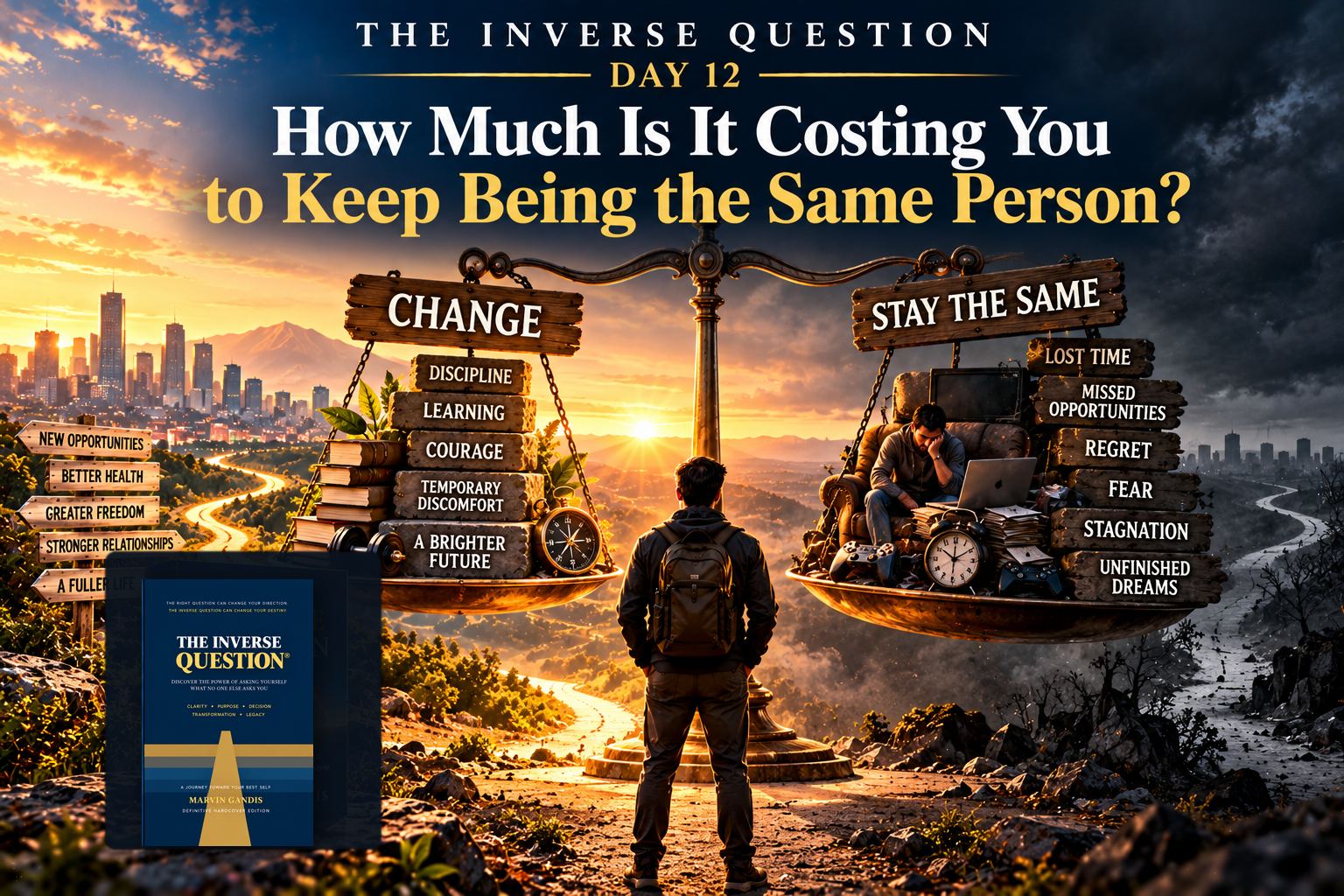
HOW MUCH IS IT COSTING YOU TO KEEP BEING THE SAME PERSON?

“Sometimes the greatest cost in life is not what change demands from us, but what staying the same quietly takes away.”
— Marvin Gandis

Change has a price.

It may require discipline.

It may require discomfort.

It may require admitting something isn’t working.

It may require learning something new.

It may require leaving familiar routines.

It may require saying no.

It may require starting over.

Because of that, we often focus on the cost of change.

But we rarely calculate another cost.

The cost of staying the same.

The opportunities we miss.

The habits we continue.

The relationships we neglect.

The financial patterns we tolerate.

The health decisions we postpone.

The projects we never begin.

The confidence we never build.

The person we never become.

That is why Day 12 of The Inverse Question asks:

How much is it costing you to keep being the same person?


WE USUALLY CALCULATE THE PRICE OF CHANGE

Suppose you want to improve your financial life.

You immediately notice the cost.

You may need to spend less.

Save more.

Track expenses.

Learn.

Delay purchases.

Change habits.

That feels like sacrifice.

Suppose you want to become healthier.

You notice the cost again.

Time.

Exercise.

Planning.

Better food choices.

Consistency.

Discomfort.

Suppose you want to build a business.

More cost.

Learning.

Risk.

Patience.

Rejection.

Uncertainty.

Effort.

We see those prices clearly.

What we often fail to calculate is:

What will it cost if nothing changes?

That question can completely alter the decision.


THE COST OF STAYING THE SAME IS OFTEN DELAYED

Immediate costs are easy to notice.

Delayed costs are more dangerous.

You buy something today.

The pleasure is immediate.

The financial consequence may appear later.

You avoid exercise today.

Comfort is immediate.

The physical consequence may take years.

You postpone a difficult conversation.

Relief is immediate.

Distance may grow slowly.

You avoid learning a new skill.

There is no immediate penalty.

But future opportunities may shrink.

Because delayed consequences arrive quietly, we underestimate them.


✦ THE INVERSE QUESTION ✦

For Day 12, ask yourself:

If I continue exactly as I am for the next five years, what will this pattern cost me?

Think carefully.

Not only financially.

Ask about:

Time.

Health.

Energy.

Relationships.

Opportunities.

Confidence.

Peace.

Reputation.

Skills.

Freedom.

Purpose.

What is the future price of remaining unchanged?


FAMILIAR DOES NOT MEAN FREE

We stay with familiar patterns because they feel comfortable.

But comfort is not the same as absence of cost.

A familiar financial habit may cost money.

A familiar relationship pattern may cost peace.

A familiar work routine may cost opportunity.

A familiar fear may cost growth.

A familiar excuse may cost years.

The fact that something feels normal does not make it harmless.

That is an important distinction.


THE COST OF PROCRASTINATION IS NOT ONLY TIME

We often describe procrastination as delay.

But delay has secondary costs.

Every postponed task remains mentally open.

It takes space.

Creates pressure.

Builds guilt.

Reduces confidence.

Limits options.

Makes future work more urgent.

The cost is not merely:

  • “I lost two hours.”

It may be:

  • “I trained myself again to avoid what matters.”

That is a much higher cost.


THE COST OF POOR FINANCIAL HABITS COMPOUNDS

Small financial habits become powerful through repetition.

One unnecessary purchase may not matter.

Hundreds can.

One month without saving may not change your future.

Years might.

One fee ignored may seem minor.

Repeated fees become expensive.

One decision to delay financial education may feel harmless.

A decade of avoidance can become costly.

The question becomes:

How much future freedom am I exchanging for present convenience?

That is worth calculating honestly.


THE COST OF STAYING UNHEALTHY IS NOT ONLY MEDICAL

Health influences more than the body.

It influences energy.

Mood.

Mobility.

Independence.

Productivity.

Relationships.

Confidence.

The ability to enjoy what we build.

Again, no one controls every health outcome.

Many factors are beyond personal choice.

But where choices do matter, postponement still has a cost.

The question is not:

  • “Can I guarantee perfect health?”

Of course not.

It is:

“Am I doing what is reasonably within my control?”


THE COST OF AVOIDING DIFFICULT CONVERSATIONS

Silence can feel peaceful.

But unresolved tension continues working underneath.

We postpone the conversation because we want to avoid conflict.

Yet avoidance can produce:

Resentment.

Confusion.

Distance.

Assumptions.

Loss of trust.

Emotional exhaustion.

The conversation we refuse to have today may become a larger problem tomorrow.

Sometimes honesty is expensive.

But prolonged avoidance can be more expensive.


THE COST OF STAYING IN THE WRONG DIRECTION

Day 8 asked us not to confuse movement with direction.

Day 12 asks something deeper.

What if you already know the direction is wrong?

How long will you keep traveling because turning feels uncomfortable?

Every additional mile creates more distance to correct.

This applies to:

Careers.

Businesses.

Relationships.

Habits.

Financial strategies.

Goals.

Commitments.

The longer we stay only because we have already invested time, the more expensive the correction may become.


✦ THE MIRROR ✦

Choose one area of your life where you know change is needed.

Complete these sentences:

The pattern I keep repeating is: __________

I continue because: __________

The immediate comfort I receive is: __________

The long-term cost may be: __________

If this continues for five years, I may lose: __________

If I begin changing now, I may gain: __________

The first uncomfortable action I need to take is: __________

Now ask:

Which is more expensive: the discomfort of changing, or the cost of remaining the same?

That is the central question of Day 12.


CHANGE DOES NOT ALWAYS REQUIRE A DRAMATIC DECISION

We often imagine change as something enormous.

Quit everything.

Move somewhere else.

Transform overnight.

Start over completely.

But meaningful change can begin much smaller.

Save twenty dollars.

Walk ten minutes.

Read five pages.

Make one phone call.

Say one honest sentence.

Apply for one opportunity.

Remove one distraction.

Create one boundary.

Complete one unfinished task.

Change is often less about one dramatic leap and more about changing repeated direction.


STAYING THE SAME CAN DAMAGE SELF-TRUST

There is another hidden cost.

Every time we repeatedly tell ourselves:

  • “I will change.”

and then do nothing, something happens.

We begin believing our own promises less.

That reduces self-trust.

Then future goals feel harder because part of us expects another abandonment.

Rebuilding self-trust begins by keeping smaller promises.

Not impressive promises.

Reliable ones.


THE COST OF FEAR IS OFTEN INVISIBLE

Fear protects us from risk.

That can be useful.

But fear can also become expensive when it prevents appropriate action.

Fear may cost:

A conversation.

A business idea.

A job application.

A relationship.

A creative project.

A new skill.

A necessary boundary.

A chance to begin again.

We often ask:

  • “What if I fail?”

But another question deserves equal attention:

“What if I never try?”

Both outcomes have consequences.


THE COST OF COMPARISON

Comparison can consume enormous energy.

Watching other people’s progress.

Income.

Audience.

Lifestyle.

Career.

Relationships.

Success.

Meanwhile, your own work waits.

The cost is not only emotional.

It is practical.

Attention given to comparison is attention not given to creation.

Ask:

What could I build with the energy I currently spend comparing?

That can be a powerful redirection.


THE COST OF CONSTANT DISTRACTION

A few minutes here.

A few minutes there.

Notifications.

Scrolling.

Videos.

Random browsing.

Individually, they seem harmless.

But attention is cumulative.

Imagine losing ninety minutes per day.

That is more than ten hours per week.

Hundreds of hours per year.

The cost of distraction is rarely felt in the moment.

It is felt in the work that never gets done.


THE COST OF REFUSING TO LEARN

The world changes.

Technology changes.

Markets change.

Industries change.

Skills lose value.

New opportunities appear.

Refusing to learn may feel comfortable today.

But comfort can become vulnerability tomorrow.

Learning requires effort.

Not learning can eventually require much more.


THE COST OF PRIDE

Pride can be expensive.

It keeps us from admitting:

I was wrong.

I need help.

I do not understand.

My strategy failed.

Someone else knows more.

I need to apologize.

I need to change.

Humility may feel uncomfortable.

But pride can cost relationships, money, time, and opportunity.

Sometimes the cheapest sentence in life is:

  • “I was wrong.”

THE COST OF WEAK BOUNDARIES

Saying yes feels easier than disappointing someone.

But repeated yeses create costs.

Lost time.

Resentment.

Stress.

Exhaustion.

Reduced focus.

Neglected priorities.

A boundary may create temporary discomfort.

The absence of boundaries may create permanent disorder.


THE COST OF NOT FINISHING

Starting feels exciting.

Finishing is different.

Finishing requires persistence after novelty disappears.

Unfinished projects carry costs.

Money spent.

Time invested.

Mental clutter.

Lost confidence.

Missed opportunity.

Sometimes completing one old commitment creates more progress than starting five new ones.


STAYING THE SAME CAN BECOME AN IDENTITY

This is where Day 12 connects directly with Days 10 and 11.

You repeat the same behavior.

Then you say:

“That is just how I am.”

Now behavior becomes identity.

Once that happens, change feels like betrayal of self.

But “how I am” may simply mean:

  • “What I have practiced for a long time.”

Practice can change.

Patterns can change.

Identity can evolve.


THE PRICE OF CHANGE OFTEN DECREASES WHEN WE BEGIN EARLY

Problems rarely become cheaper through neglect.

Debt grows.

Skills become outdated.

Relationships deteriorate.

Health problems may become more difficult.

Opportunities pass.

Projects accumulate.

Changing early may be uncomfortable.

Changing late may be much harder.

That is why awareness is valuable.

It allows intervention before crisis.


YOU ARE ALREADY PAYING A PRICE

This is one of the most important ideas in Day 12.

Sometimes we act as though there are two options:

Change and pay a price.

Or stay the same for free.

But often that is not the real choice.

The real choice is:

Which price are you willing to pay?

The cost of discipline?

Or the cost of regret?

The cost of learning?

Or the cost of being unprepared?

The cost of boundaries?

Or the cost of resentment?

The cost of saving?

Or the cost of financial vulnerability?

The cost of difficult truth?

Or the cost of prolonged denial?

Every path has a price.

Choose consciously.


WHAT IS STAYING THE SAME PREVENTING YOU FROM BECOMING?

There is another type of cost.

Opportunity cost.

Every hour spent on one thing cannot also be spent somewhere else.

Every identity we protect can prevent another one from emerging.

If you remain:

The person who never takes risks,

you may never discover what courage could build.

If you remain:

The person who avoids money,

you may never develop financial confidence.

If you remain:

The person who never finishes,

you may never experience the identity of a finisher.

Staying the same does not only preserve the present.

It can block the future.


MY DEAR READER AND FRIEND

Perhaps there is something you already know.

You know what habit needs attention.

You know what conversation needs to happen.

You know what skill you should learn.

You know what financial behavior needs correction.

You know what project you need to finish.

You know where you are making excuses.

The question may no longer be:

  • “Should I change?”

It may be:

“How much longer am I willing to pay for not changing?”

That answer belongs to you.

But it deserves honesty.


HOW MUCH IS IT COSTING YOU TO KEEP BEING THE SAME PERSON?

Change has a price.

But so does avoidance.

Growth has a price.

But so does stagnation.

Discipline has a price.

But so does regret.

Courage has a price.

But so does fear.

Do not calculate only what change will cost you.

Calculate what staying the same has already cost.

Then ask:

What will another year of this pattern cost me?

Sometimes that question makes the next decision much clearer.

With gratitude,

Marvin Gandis
Author of La Pregunta Inversa and The Inverse Question


CONTINUE THE JOURNEY

This is Day 12 of The Inverse Question English series.

Day 1: Today Begins a New Chapter
Day 2: Why Did I Write The Inverse Question?
Day 3: The Question That Changed the Way I Think
Day 4: Maybe You Have Been Looking for Answers to the Wrong Question
Day 5: The Roots No One Sees Determine the Fruit Everyone Sees
Day 6: Not Everything That Looks Like Progress Is Moving You Forward
Day 7: What Are You Tolerating Today That Is Building the Future You Do Not Want?
Day 8: Do Not Confuse Movement With Direction
Day 9: What Are You Doing Today That Your Future Self Will Thank You For?
Day 10: Who Are You Becoming Through the Choices You Repeat Every Day?
Day 11: What Are You Rehearsing Every Day That Is Quietly Becoming Your Identity?
Day 12: How Much Is It Costing You to Keep Being the Same Person?

Next:

Day 13 — What Part of Your Future Are You Trading Away for Today’s Comfort?

Because comfort feels inexpensive in the moment, but sometimes its real price is paid much later.

DISCLAIMER

This article is provided for educational, informational, motivational, and personal-reflection purposes only. It does not constitute medical, psychological, mental-health, legal, financial, investment, business, career, relationship, or other professional advice.

The examples regarding habits, finances, health, relationships, fear, career decisions, personal growth, and change are general and may not apply equally to every person or circumstance.

Significant personal, health, financial, legal, employment, relationship, or psychological decisions should be evaluated carefully according to your circumstances and, when appropriate, with qualified professional guidance.

No specific personal, professional, financial, business, relationship, health, or life outcome is promised or guaranteed.

The Inverse Question series is intended to encourage thoughtful reflection, awareness, responsible decision-making, learning, intentional growth, and independent judgment.