
🌐 Also available in Spanish: Leer este artículo en español.
The real secret behind a millionaire mindset: learning to identify problems, develop meaningful solutions, and transform value into opportunity.
The Question That Could Change Everything
Have you ever wondered what separates people who build extraordinary companies from those who spend their lives waiting for the perfect opportunity?
When we hear names like Bill Gates, Steve Jobs, Elon Musk, or Jeff Bezos, we often think about their fortunes, companies, and remarkable business achievements.
But there is a far more interesting question than how much money they have accumulated:
What were they able to imagine, develop, and offer the world that created such tremendous economic value?
The answer cannot be reduced to money, university education, personal connections, or exceptional intelligence.
Many successful businesses began when someone recognized a problem, questioned an established practice, or identified an unmet need.
Of course, we must also acknowledge the importance of timing, access to capital, professional networks, economic conditions, and luck.
There is no guaranteed formula for becoming a millionaire.
However, there are ways of thinking, learning, and working that we can deliberately develop.
And everything begins with one question:
What can I create that improves so many people’s lives that, as a result of that value, it could become an extraordinary business?
The Mistake of Chasing Money Before Understanding Value
We live in a world filled with promises of financial success.
Social media is crowded with advertisements promoting supposedly effortless ways to generate thousands of dollars through investments, artificial intelligence, online stores, or automated businesses.
Many of these messages suggest that wealth is simply a matter of discovering the right formula.
But sustainable business success requires something more fundamental: understanding what people need and finding meaningful ways to help them.
Consider two aspiring entrepreneurs.
The first asks:
“How can I make $10,000 this month?”
The second asks:
“What problem do thousands of people face that I could solve more efficiently, affordably, or effectively?”
Both individuals want to generate income.
But their starting points are different.
The first focuses on what they hope to receive.
The second begins by investigating what they might contribute.
That distinction can influence everything from product development to marketing and customer relationships.
Helping people does not automatically generate income. Customers must be willing to pay, expenses must be controlled, and the business model must work.
Nevertheless, building around genuine customer value creates a stronger foundation than endlessly chasing the latest money-making opportunity.
What Did the Great Innovators Actually Understand?
Bill Gates recognized the growing commercial importance of software during the development of the personal computer industry.
Steve Jobs understood that technology could become far more appealing when functionality, design, and user experience worked together.
Jeff Bezos recognized opportunities in the growth of the Internet and launched a company that initially focused on selling books.
Elon Musk became involved in ventures that challenged conventional approaches to industries such as electric transportation and space launches.
Their journeys were different.
So were their decisions, resources, mistakes, advantages, and circumstances.
Yet their experiences reveal several useful principles:
- Recognize emerging changes.
- Question familiar assumptions.
- Learn continuously.
- Bring together knowledge and capable people.
- Turn ideas into products and services.
- Respond to evidence from customers and markets.
- Build systems that can support growth.
The lesson is not to imitate their personalities or lifestyles.
The lesson is to develop our own ability to identify opportunities and create useful solutions.
We do not need to become the next Bill Gates.
We need to discover a problem we can solve better than the existing alternatives for a specific group of people.
A Millionaire Mindset Does Not Begin With a Bank Account
What does it really mean to develop a millionaire mindset?
It does not mean spending every day imagining luxury cars, enormous houses, or overflowing bank accounts.
Nor does it mean believing that positive thinking alone obligates the universe to reward us.
A practical entrepreneurial mindset involves several abilities.
Curiosity
Asking why things work the way they do and whether better alternatives might exist.
Creativity
Exploring possibilities that have not yet been tested.
Discipline
Continuing to work when the initial excitement disappears.
Intellectual Humility
Recognizing mistakes and learning from evidence that challenges our beliefs.
Intelligent Persistence
Continuing to improve while being willing to abandon approaches that repeatedly fail.
Integrity
Building relationships through honesty, reliability, and respect.
Long-Term Thinking
Understanding that lasting businesses generally require experimentation, patience, and continuous improvement.
Real transformation begins when we stop relying entirely on motivation and start developing practical capabilities.
The World Is Full of Problems Waiting for Better Solutions
Business opportunities do not always require revolutionary inventions.
Sometimes they are hidden in ordinary frustrations.
Consider a few examples.
Older Adults and Technology
Many older adults need help understanding digital tools, protecting personal information, and communicating with loved ones.
Could someone develop a simple, affordable service that helps them learn these skills?
Small Businesses
Small business owners frequently struggle to manage customer inquiries, organize contacts, and maintain an online presence.
Could a practical tool help them complete those tasks more efficiently?
Families and Household Finances
Many families need clearer ways to organize expenses, compare prices, and make informed purchasing decisions.
Could an educational product help them navigate these challenges?
Beginning Entrepreneurs
Countless people want to start a business but feel overwhelmed by confusing information and unrealistic income promises.
Could someone develop an honest, affordable learning program that guides beginners from an initial idea to their first real business experiment?
These examples are possible opportunities, not proven business models.
Before committing substantial resources, entrepreneurs should investigate customer needs, existing alternatives, and willingness to pay.
A potentially valuable idea may begin with a seemingly ordinary problem.
Five Questions That Can Turn an Idea Into an Opportunity
Before investing significant time or money in a business idea, consider five essential questions.
Question One: What specific problem am I solving?
Broad ambitions are difficult to translate into useful products.
Instead of saying, “I want to help entrepreneurs,” identify a concrete challenge.
For example, helping small businesses manage recurring customer questions without spending hours responding manually.
Question Two: Who experiences this problem?
A clearly defined audience makes it easier to understand what people need.
Question Three: How do people solve the problem today?
Investigate existing products, services, free tools, and manual workarounds.
Competitors can reveal what customers already value.
Question Four: What meaningful improvement can I offer?
The answer might involve saving time, lowering costs, reducing confusion, improving safety, or delivering a better experience.
Question Five: Can this solution support a sustainable business?
A useful idea is not necessarily profitable.
Entrepreneurs must evaluate pricing, demand, operating expenses, customer acquisition, and long-term viability.
These questions help transform enthusiasm into something that can be investigated and tested.
A 30-Day Experiment to Develop Your Entrepreneurial Thinking
You do not need thousands of dollars to begin exploring a business idea.
Start with a structured learning experiment.
Week One: Observe
For seven days, write down three problems you notice each day.
Pay particular attention to frustrations people repeatedly mention.
By the end of the week, you could have 21 observations.
Week Two: Investigate
Select three problems worth exploring.
Research existing solutions and speak with people who experience those difficulties.
Avoid simply asking whether they like your idea.
Ask how they currently handle the problem, what frustrates them, and how much time or money it costs.
Week Three: Design
Choose the most promising opportunity.
Create a simple proposal or prototype.
You do not need a complete application or an expensive website.
A basic demonstration, sample service, or manual process may be enough to begin learning.
Week Four: Validate
Introduce your proposed solution to potential users.
Observe whether they try it, request more information, return, recommend it, or demonstrate a genuine willingness to pay.
Collect feedback.
If your assumptions prove incorrect, revise the concept.
The purpose of the first 30 days is not to become a millionaire. It is to discover whether a real problem and a potentially viable solution exist.
That knowledge may prevent months of unnecessary work and spending.
Artificial Intelligence: An Opportunity to Create, Not Just Consume
Artificial intelligence is expanding what individuals and small businesses can accomplish.
It can help organize information, explore ideas, analyze alternatives, prepare educational materials, develop prototypes, and automate certain tasks.
But using a powerful tool is not the same as building a valuable business.
Producing hundreds of AI-generated articles does not guarantee that anyone will read them.
Automatically generating images does not mean a meaningful brand has been created.
And building an application does not prove that customers need it.
Value emerges when technology helps solve a specific problem.
For example, an entrepreneur might discover that independent businesses spend too much time answering repetitive customer questions.
They could develop a simple digital assistant, test its reliability, and offer it as a service.
Such a business would need to address customer privacy, response accuracy, ongoing maintenance, and operating costs.
The opportunity is not merely to use artificial intelligence.
It is to combine technology, human understanding, and genuine market needs.
Extraordinary Ideas Still Need Sustainable Economics
Imagine a digital service charging $20 per month.
If 1,000 customers maintained active subscriptions for a month, the business would generate $20,000 in gross monthly revenue.
However, revenue is not profit.
The company would still need to pay for technology, staff, marketing, transaction fees, applicable taxes, and other operating expenses.
Acquiring and retaining 1,000 paying customers could also be challenging and expensive.
This is why four concepts matter.
Value: The benefit customers receive.
Revenue: The money customers pay.
Profit: What remains after the relevant costs and expenses.
Scalability: The ability to serve additional customers without increasing costs at the same rate.
A remarkable business needs more than an attractive idea.
It needs satisfied customers, healthy finances, and a model that can remain sustainable as it grows.
Is It Too Late to Start Something Extraordinary?
Many people assume major entrepreneurial opportunities belong exclusively to young technology experts with advanced degrees and substantial financial resources.
But life experience can also create advantages.
Someone who has worked for decades may recognize problems that younger entrepreneurs have never encountered.
A person who has raised a family may understand needs that are frequently overlooked.
Someone who has struggled financially may recognize frustrations experienced by millions of other households.
And a person who has devoted years to helping others may have developed a strong understanding of human needs.
Age does not guarantee business success.
But it does not eliminate our capacity to learn, innovate, or contribute.
Having lived many years does not mean we have exhausted our possibilities.
A meaningful new chapter can begin with an honest question and a willingness to act.
The Spiritual Dimension: Prosperity With Purpose
The Bible offers a principle worth reflecting upon:
“The thoughts of the diligent tend only to plenteousness.” — Proverbs 21:5, King James Version.
This verse invites us to consider the importance of diligence, planning, and responsible effort.
However, faith should never be presented as a guarantee of financial wealth.
Not everyone who works diligently becomes rich.
And a person’s dignity, spiritual worth, or blessings should never be measured by a bank balance.
From a Christian perspective, creativity and business knowledge can become ways to serve others.
A company that treats employees fairly, respects customers, and delivers honest solutions can make a meaningful contribution.
Financial ambition and generosity can coexist when guided by sound principles.
The question then becomes more profound:
What can I create that not only generates income but also leaves a positive impact on other people’s lives?
The Beginning of an Extraordinary Mindset
We do not have to wait for supernatural inspiration, unexpected wealth, or a perfect opportunity.
We can begin by paying attention.
Listen to people who experience difficulties.
Study problems we do not yet understand.
Develop useful skills.
Experiment with humility.
Learn from actual results.
And continue improving what proves valuable.
Creativity is not reserved for famous billionaires.
It is a human capacity that can be strengthened through practice.
Our first attempt may fail.
Our initial assumptions may be wrong.
We may need to change direction repeatedly.
But these experiences do not automatically mean that our efforts were wasted.
When we learn systematically, even unsuccessful experiments can improve future decisions.
The Question We Should Ask Tomorrow
For years, society has encouraged us to admire the extraordinary fortunes accumulated by successful entrepreneurs.
Perhaps it is time to pay closer attention to the problems they addressed, the solutions they developed, and the needs they managed to serve.
The future does not belong exclusively to people who already possess millions of dollars.
It also offers possibilities to those willing to observe, learn, collaborate, and create.
Not everyone will build a billion-dollar company.
But many people can develop valuable skills, discover economic opportunities, and make meaningful contributions to their communities.
And under favorable conditions, with strong execution, genuine customer demand, and sound financial management, an idea may eventually become an extraordinary business.
So tomorrow, before asking how much money you want to make, ask yourself something different:
What problem can I solve today that would make someone’s life a little better?
Because a remarkable transformation can begin with one simple idea.
And when an idea addresses a real need and is executed effectively, its impact may extend far beyond what its creator originally imagined.
An Invitation to Our Readers
At Ir de Compras Online, we believe entrepreneurship begins with education, independent thinking, and meaningful value creation.
We invite you to reflect on one question:
If you could solve one problem affecting thousands of people, what would it be, and why would you choose it?
Share your thoughts in the comments.
Your observation might inspire a conversation, a collaboration, or a completely new opportunity.
Continue exploring our educational content on entrepreneurship, artificial intelligence, digital marketing, and personal development.
An idea may begin in one person’s mind, but its greatest value emerges when it improves the lives of others.
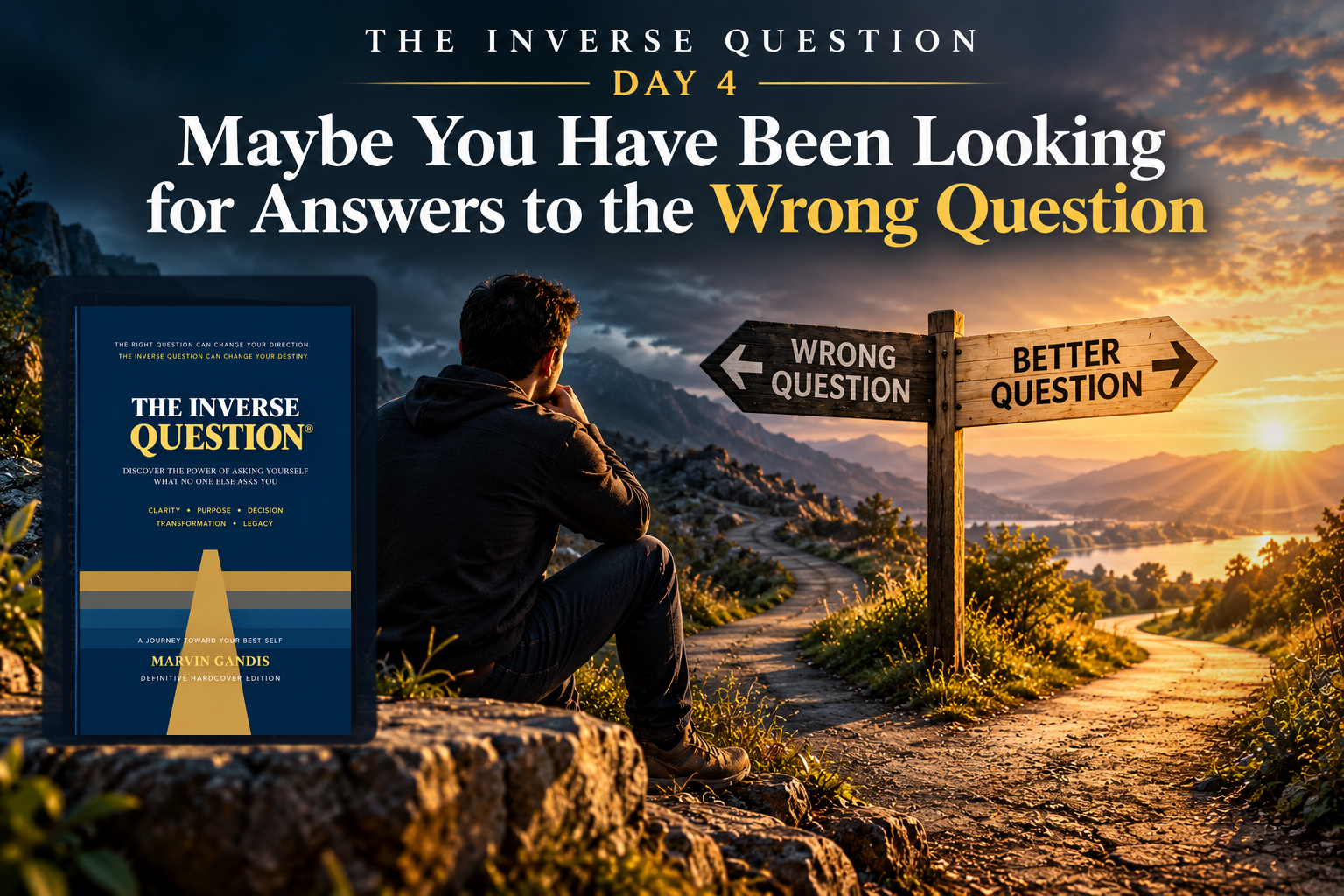
Discover The Inverse Question: A Book That Challenges the Way We Think
What if the problem is not that you haven’t found the answer, but that you have been asking the wrong question?
My name is Marvin Gandis, author of The Inverse Question: Discover the Power of Asking Yourself What No One Else Asks You.
I wrote this book to encourage readers to examine the decisions, habits, responsibilities, and assumptions that shape their lives.
If this article inspired you to think differently about entrepreneurship, creating value, and personal growth, I invite you to continue that journey through my book.
Get your copy and support an independent author.
You can also help bring these ideas to others:
- Purchase a copy for yourself.
- Give the book to someone beginning a new chapter.
- Sponsor copies for students, aspiring entrepreneurs, or community learning initiatives.
- Share the book with friends, family members, and others interested in meaningful personal growth.
The right question can change your direction. The Inverse Question can change the way you build your future.
With gratitude,
Marvin Gandis
Author of The Inverse Question
Founder of Ir de Compras Online
The Inverse Question — English Edition
Disclaimer: This article is intended for educational, informational, and motivational purposes only. It does not constitute individualized financial, legal, or professional advice. Numerical examples are hypothetical and do not represent income guarantees. Entrepreneurship involves risk, and outcomes depend on multiple factors.
Debe estar conectado para enviar un comentario.