
Publicado en Faith and Spirituality, Life Reflections, Personal Development, Personal Growth, Values and Principles

The Legacy We Leave Behind: Are We Living a Life Worth Remembering?

It is not about achieving perfection. It is about living with integrity, acknowledging our mistakes, and leaving a positive impact on the people whose lives intersect with ours.

By Marvin Gandis | Ir de Compras Online

Introduction: The Question We Should All Ask Ourselves

My Dear Reader and Friend,

There are questions that emerge when we begin looking beyond our daily responsibilities, financial ambitions, personal commitments, and the goals we still hope to accomplish.

One of those questions deserves particular attention:

What will remain of us when we are no longer here to explain our intentions, defend our decisions, or tell our own story?

Perhaps we have spent many years working, developing businesses, raising families, helping others, or sharing knowledge.

  • But is that enough to build a truly meaningful legacy?

Society often measures success through wealth, recognition, possessions, professional titles, and popularity.

Yet there is another way to evaluate the significance of our lives.

A quieter and more meaningful approach begins by asking how our presence affects other people.

Because our legacy does not begin when our lives end.

  • Our legacy begins with how we choose to live today.

Legacy Is Not What We Accumulate, but What We Plant

When we hear the word legacy, we often imagine material inheritance.

A home, a savings account, a family business, or property passed from one generation to the next.

But some forms of inheritance cannot be measured in money.

  • The values we demonstrate.
  • The trust we inspire.
  • The honesty with which we treat others.
  • The hope we help restore when someone is struggling.

A person may accumulate considerable wealth yet leave behind few affectionate memories.

Another individual may live modestly and be remembered for generations because of kindness, wisdom, and generosity.

This does not mean material achievements are unimportant.

It means that the possessions we leave behind and the meaning of our lives are not the same thing.

Money can create opportunities. Education can open doors. Hard work can provide stability.

But character influences how we use those resources.

  • Reflection: Are we investing as much energy in developing our character as we invest in improving our financial circumstances?

Being Busy Does Not Always Mean Moving Forward

We live in an age when constant activity is often mistaken for productivity.

We launch businesses, develop projects, publish content, learn new technologies, and continuously search for the next opportunity.

  • Initiative is valuable.
  • Perseverance matters.

But there is a significant difference between being in motion and moving in the right direction.

We can maintain a full schedule while neglecting what matters most.

We can communicate with hundreds of people online while failing to listen to those closest to us.

We can spend hours teaching others about personal growth while overlooking those same principles during our own difficulties.

We may even continue pursuing goals that no longer reflect our deepest values.

That is why examining our priorities is essential.

Not every opportunity deserves our time.

Not every disagreement requires our participation.

Not every project must become a permanent commitment.

Maturity includes knowing when to stop, reconsider, and make a different choice.

  • Sometimes progress means doing fewer things with greater intention.

Our Credibility Depends on the Distance Between Our Words and Actions

Everyone has opinions.

We also share recommendations, advice, personal experiences, and knowledge that we believe may benefit others.

  • But speaking about integrity is different from practicing it.

We may publicly defend honesty while avoiding an uncomfortable conversation after making a mistake.

We may encourage generosity while overlooking the needs of someone close to us.

We may speak about humility while remaining unwilling to accept criticism.

  • These contradictions are part of the human struggle.

The essential question is not whether we have ever been inconsistent.

It is what we do when we recognize that inconsistency.

  • Do we justify it?
  • Do we hide it?
  • Do we blame someone else?

Or do we acknowledge that change is necessary?

Credibility grows when our behavior aligns with our principles.

It also grows when we dare to correct ourselves publicly, especially when our words or actions may have affected others.

We do not need to pretend that we are always right. We need to demonstrate that truth matters more than pride.

Mistakes Do Not Necessarily Destroy a Meaningful Legacy

No human life is free from mistakes.

At some point, we may trust the wrong person, make a careless decision, defend an incorrect belief, or say something that causes pain.

  • Some consequences will be temporary.
  • Others may follow us for years.

But there is an important difference between making a mistake and refusing to learn from it.

Acknowledging wrongdoing requires humility.

Apologizing requires courage.

Repairing harm may require sacrifice.

And changing behavior demands perseverance.

We will not always have the opportunity to reverse the consequences of our decisions.

Nor can we demand immediate forgiveness from those we have hurt.

What we can do is accept responsibility and choose a different way forward.

A worthy legacy does not necessarily describe someone who never fell.

It may tell the story of someone who, after falling, found the courage to stand again, acknowledge wrongdoing, and change.

Perfection is not the measure of integrity. Taking responsibility for our actions is one of its most important tests.

The Responsibility That Comes With Influencing Others

Today, almost anyone can reach a substantial audience.

Digital platforms allow us to share opinions, business recommendations, educational content, religious reflections, and personal experiences with people around the world.

  • This creates extraordinary opportunities.
  • But it also creates responsibility.

When recommending an economic opportunity, we should make reasonable efforts to verify the information and explain the risks.

When teaching, we should distinguish verified facts from personal experience and opinion.

When sharing messages of hope, we should avoid suggesting that every hardship can be overcome through positive thinking alone.

And when discussing faith, we should respect the dignity and circumstances of those who listen.

Influence should never become a means of exploiting someone else’s trust.

  • It should become an opportunity to inform, guide, and serve.

Before sharing a message, we might ask ourselves:

Am I sharing this because it may genuinely benefit someone, or because I want attention, approval, or recognition?

  • That question can help us use our voices more responsibly.

Our Legacy Begins at Home and in Our Closest Relationships

It is possible to receive professional recognition while neglecting personal relationships.

It is equally possible to have limited resources or little public visibility while leaving an extraordinary impact on family and community.

This is why popularity should never be confused with lasting significance.

Our loved ones will not remember only our accomplishments.

They will also remember whether we listened.

How we responded to disagreements.

How patient we were during difficult times.

Whether we were present when they needed support.

And perhaps the occasions when we were absent.

This does not mean we should live entirely according to other people’s expectations.

It means our relationships deserve deliberate attention.

Sometimes the most important decision of the day has nothing to do with accepting a new business opportunity.

It involves listening without interrupting.

Recognizing that someone needs our presence.

Keeping a simple promise.

  • Or sincerely saying, «I was wrong. I’m sorry.»

Our public legacy may reach thousands, but our private legacy reveals how we treated those who shared their lives with us.

Faith Should Be Reflected in Our Conduct

For those of us who find spiritual guidance in Christian teachings, legacy also carries a dimension of faith.

Scripture does not measure human worth solely through possessions or public recognition.

Micah 6:8 in the King James Version offers this guidance:

«…to do justly, and to love mercy, and to walk humbly with thy God.»

These are brief words with demanding implications.

Doing justly encourages us to act fairly and honestly.

Loving mercy reminds us that other people experience weakness, failure, and suffering too.

Walking humbly before God reminds us that our knowledge, judgments, and actions are not perfect.

Spirituality should not become a justification for claiming moral superiority over others.

  • It should inspire humble service.

Speaking about love means little if our everyday behavior consistently contradicts the message.

Encouraging forgiveness loses credibility when we refuse to acknowledge our own mistakes.

The faith we hope to share becomes more meaningful when our decisions reflect compassion, justice, and responsibility.

The Danger of Living Only to Be Remembered

Wanting to leave behind good memories is understandable.

Most of us hope our existence will have mattered.

But there is a danger in making other people’s future approval our central purpose.

We may become overly concerned with protecting our image.

We may feel pressured to constantly demonstrate success.

We might even conceal our failures to preserve a favorable reputation.

Yet a carefully managed public image does not necessarily represent a life of integrity.

  • We cannot control how everyone will remember us.

Some people will appreciate our efforts.

Others will interpret our decisions differently.

And some may remember our failures more clearly than our achievements.

This is why our lives need a foundation stronger than public approval.

It is better to live with integrity, even when not everyone understands us, than to spend our lives manufacturing an image of perfection.

It Is Never Too Late to Reconsider Our Direction

One of life’s greatest opportunities is the ability to reconsider our decisions while we still have time to act.

We do not need to experience a crisis before examining our priorities.

Nor must we reach a particular age before questioning our purpose.

  • We can begin today.

Perhaps we need to spend more time with family.

Maybe we should reconsider a belief we have defended for years.

It might be necessary to step away from a project that consumes our energy without contributing to our well-being.

Or perhaps we need the courage to speak with someone we have hurt.

We may also discover that our experiences can help others avoid mistakes or find a better direction.

Genuine transformation does not always require dramatic decisions.

Often, it begins with small, repeated actions.

Listening more carefully.

Making fewer promises and keeping more of them.

Acknowledging our limitations.

Sharing knowledge honestly.

Giving credit where it is due.

Practicing gratitude.

Treating people with dignity, even when they have nothing to offer us in return.

These everyday choices are also writing our life stories.

A Personal Exercise: Five Questions About Your Legacy

Before concluding, I invite you to spend a few quiet moments considering these questions. You do not need to share your answers publicly.

  1. What values do I claim to defend, and which ones are genuinely reflected in my actions?
  2. Is there someone I need to apologize to, listen to more carefully, or make an effort to repair harm with?
  3. Do my projects and commitments reflect my deepest priorities, or do they simply keep me busy?
  4. Am I using my knowledge and influence responsibly, even when doing so offers no immediate personal benefit?
  5. If my possessions, titles, and recognition disappeared, what human memories would I hope to leave with those who knew me?
  • There are no perfect answers.

What matters is having the courage to answer sincerely and allowing those answers to influence how we live.

Let Our Lives Speak for Us

One day, our daily activities will come to an end.

Businesses will change ownership.

Technologies we consider essential today will eventually be replaced.

Many of our publications will stop attracting attention.

Some achievements that now seem extraordinary will lose their importance as time passes.

But the effects of our actions may remain.

A lesson shared with humility.

An opportunity offered with honesty.

Someone who regained hope because we cared enough to be present.

A child, relative, or friend who learned integrity by watching our example.

A mistake acknowledged before it caused further harm.

A reconciliation that once seemed impossible.

Perhaps these are among the most meaningful things we can leave behind.

  • We do not know how much time lies ahead.

But we can decide what to do with the time we have today.

We do not need to live obsessed with being remembered.

We need to strive to make our presence a positive influence while we are here.

Because the most meaningful legacy is not making people remember our name, but helping make their lives better because they knew us.

And before we conclude, my dear reader and friend, consider one final question:

If tomorrow no one remembered your possessions, businesses, publications, or achievements, but the people who knew you remembered how you treated them, would you be satisfied with that legacy?

Perhaps your answer will mark the beginning of a transformation that is still possible today.


Editorial Disclaimer: This article is intended for educational purposes, personal reflection, and inspiration. Its ideas encourage readers to examine their values, decisions, and influence on others. Biblical references are presented from a Christian perspective and are not intended to impose religious beliefs or replace psychological, professional, or spiritual guidance when such support may be needed.
Publicado en Change, Decision Making, Habits, Marvin Gandis, Mindset, Personal Development, Personal Growth, Self Reflection, The Inverse Question

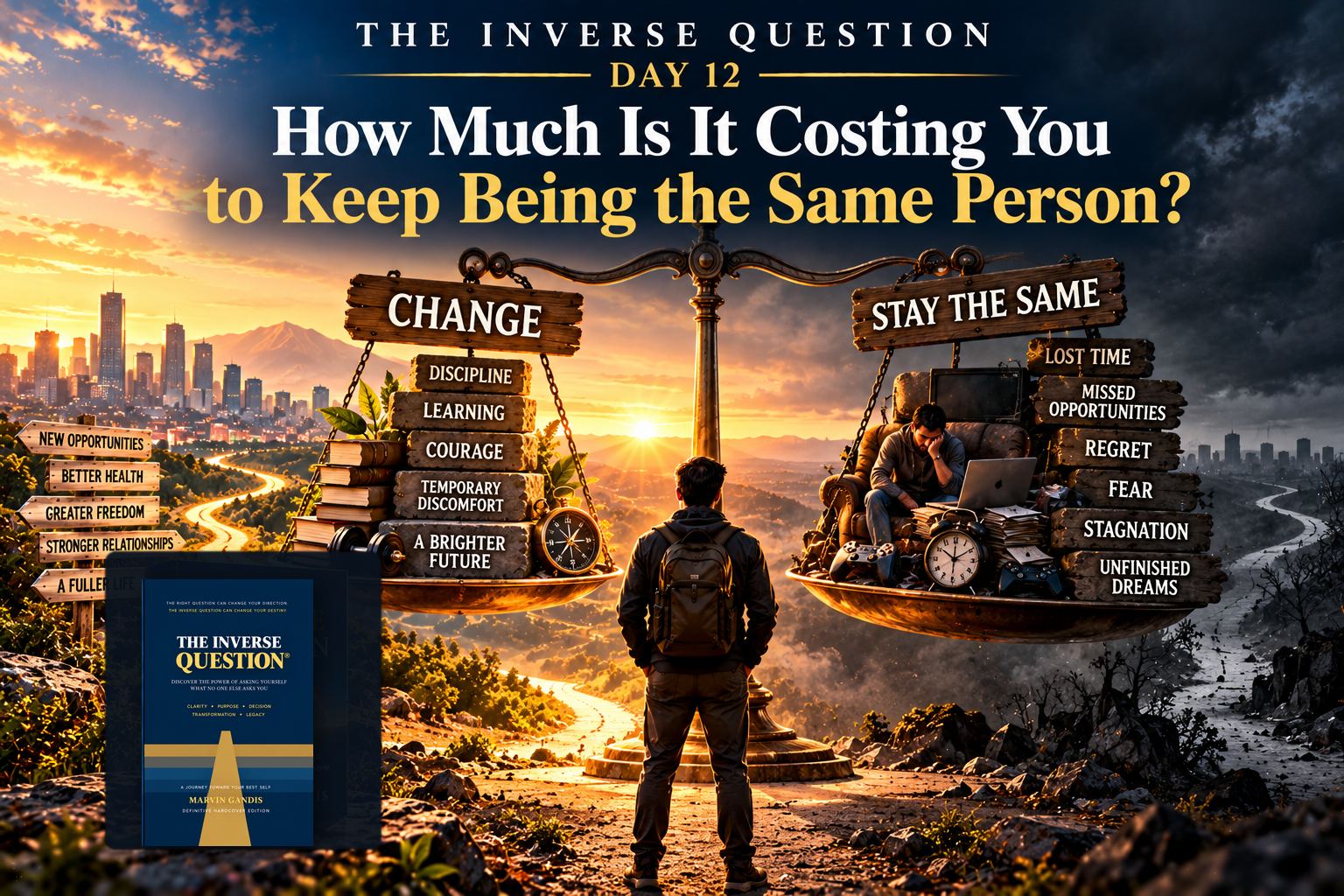
HOW MUCH IS IT COSTING YOU TO KEEP BEING THE SAME PERSON?

“Sometimes the greatest cost in life is not what change demands from us, but what staying the same quietly takes away.”
— Marvin Gandis

Change has a price.

It may require discipline.

It may require discomfort.

It may require admitting something isn’t working.

It may require learning something new.

It may require leaving familiar routines.

It may require saying no.

It may require starting over.

Because of that, we often focus on the cost of change.

But we rarely calculate another cost.

The cost of staying the same.

The opportunities we miss.

The habits we continue.

The relationships we neglect.

The financial patterns we tolerate.

The health decisions we postpone.

The projects we never begin.

The confidence we never build.

The person we never become.

That is why Day 12 of The Inverse Question asks:

How much is it costing you to keep being the same person?


WE USUALLY CALCULATE THE PRICE OF CHANGE

Suppose you want to improve your financial life.

You immediately notice the cost.

You may need to spend less.

Save more.

Track expenses.

Learn.

Delay purchases.

Change habits.

That feels like sacrifice.

Suppose you want to become healthier.

You notice the cost again.

Time.

Exercise.

Planning.

Better food choices.

Consistency.

Discomfort.

Suppose you want to build a business.

More cost.

Learning.

Risk.

Patience.

Rejection.

Uncertainty.

Effort.

We see those prices clearly.

What we often fail to calculate is:

What will it cost if nothing changes?

That question can completely alter the decision.


THE COST OF STAYING THE SAME IS OFTEN DELAYED

Immediate costs are easy to notice.

Delayed costs are more dangerous.

You buy something today.

The pleasure is immediate.

The financial consequence may appear later.

You avoid exercise today.

Comfort is immediate.

The physical consequence may take years.

You postpone a difficult conversation.

Relief is immediate.

Distance may grow slowly.

You avoid learning a new skill.

There is no immediate penalty.

But future opportunities may shrink.

Because delayed consequences arrive quietly, we underestimate them.


✦ THE INVERSE QUESTION ✦

For Day 12, ask yourself:

If I continue exactly as I am for the next five years, what will this pattern cost me?

Think carefully.

Not only financially.

Ask about:

Time.

Health.

Energy.

Relationships.

Opportunities.

Confidence.

Peace.

Reputation.

Skills.

Freedom.

Purpose.

What is the future price of remaining unchanged?


FAMILIAR DOES NOT MEAN FREE

We stay with familiar patterns because they feel comfortable.

But comfort is not the same as absence of cost.

A familiar financial habit may cost money.

A familiar relationship pattern may cost peace.

A familiar work routine may cost opportunity.

A familiar fear may cost growth.

A familiar excuse may cost years.

The fact that something feels normal does not make it harmless.

That is an important distinction.


THE COST OF PROCRASTINATION IS NOT ONLY TIME

We often describe procrastination as delay.

But delay has secondary costs.

Every postponed task remains mentally open.

It takes space.

Creates pressure.

Builds guilt.

Reduces confidence.

Limits options.

Makes future work more urgent.

The cost is not merely:

  • “I lost two hours.”

It may be:

  • “I trained myself again to avoid what matters.”

That is a much higher cost.


THE COST OF POOR FINANCIAL HABITS COMPOUNDS

Small financial habits become powerful through repetition.

One unnecessary purchase may not matter.

Hundreds can.

One month without saving may not change your future.

Years might.

One fee ignored may seem minor.

Repeated fees become expensive.

One decision to delay financial education may feel harmless.

A decade of avoidance can become costly.

The question becomes:

How much future freedom am I exchanging for present convenience?

That is worth calculating honestly.


THE COST OF STAYING UNHEALTHY IS NOT ONLY MEDICAL

Health influences more than the body.

It influences energy.

Mood.

Mobility.

Independence.

Productivity.

Relationships.

Confidence.

The ability to enjoy what we build.

Again, no one controls every health outcome.

Many factors are beyond personal choice.

But where choices do matter, postponement still has a cost.

The question is not:

  • “Can I guarantee perfect health?”

Of course not.

It is:

“Am I doing what is reasonably within my control?”


THE COST OF AVOIDING DIFFICULT CONVERSATIONS

Silence can feel peaceful.

But unresolved tension continues working underneath.

We postpone the conversation because we want to avoid conflict.

Yet avoidance can produce:

Resentment.

Confusion.

Distance.

Assumptions.

Loss of trust.

Emotional exhaustion.

The conversation we refuse to have today may become a larger problem tomorrow.

Sometimes honesty is expensive.

But prolonged avoidance can be more expensive.


THE COST OF STAYING IN THE WRONG DIRECTION

Day 8 asked us not to confuse movement with direction.

Day 12 asks something deeper.

What if you already know the direction is wrong?

How long will you keep traveling because turning feels uncomfortable?

Every additional mile creates more distance to correct.

This applies to:

Careers.

Businesses.

Relationships.

Habits.

Financial strategies.

Goals.

Commitments.

The longer we stay only because we have already invested time, the more expensive the correction may become.


✦ THE MIRROR ✦

Choose one area of your life where you know change is needed.

Complete these sentences:

The pattern I keep repeating is: __________

I continue because: __________

The immediate comfort I receive is: __________

The long-term cost may be: __________

If this continues for five years, I may lose: __________

If I begin changing now, I may gain: __________

The first uncomfortable action I need to take is: __________

Now ask:

Which is more expensive: the discomfort of changing, or the cost of remaining the same?

That is the central question of Day 12.


CHANGE DOES NOT ALWAYS REQUIRE A DRAMATIC DECISION

We often imagine change as something enormous.

Quit everything.

Move somewhere else.

Transform overnight.

Start over completely.

But meaningful change can begin much smaller.

Save twenty dollars.

Walk ten minutes.

Read five pages.

Make one phone call.

Say one honest sentence.

Apply for one opportunity.

Remove one distraction.

Create one boundary.

Complete one unfinished task.

Change is often less about one dramatic leap and more about changing repeated direction.


STAYING THE SAME CAN DAMAGE SELF-TRUST

There is another hidden cost.

Every time we repeatedly tell ourselves:

  • “I will change.”

and then do nothing, something happens.

We begin believing our own promises less.

That reduces self-trust.

Then future goals feel harder because part of us expects another abandonment.

Rebuilding self-trust begins by keeping smaller promises.

Not impressive promises.

Reliable ones.


THE COST OF FEAR IS OFTEN INVISIBLE

Fear protects us from risk.

That can be useful.

But fear can also become expensive when it prevents appropriate action.

Fear may cost:

A conversation.

A business idea.

A job application.

A relationship.

A creative project.

A new skill.

A necessary boundary.

A chance to begin again.

We often ask:

  • “What if I fail?”

But another question deserves equal attention:

“What if I never try?”

Both outcomes have consequences.


THE COST OF COMPARISON

Comparison can consume enormous energy.

Watching other people’s progress.

Income.

Audience.

Lifestyle.

Career.

Relationships.

Success.

Meanwhile, your own work waits.

The cost is not only emotional.

It is practical.

Attention given to comparison is attention not given to creation.

Ask:

What could I build with the energy I currently spend comparing?

That can be a powerful redirection.


THE COST OF CONSTANT DISTRACTION

A few minutes here.

A few minutes there.

Notifications.

Scrolling.

Videos.

Random browsing.

Individually, they seem harmless.

But attention is cumulative.

Imagine losing ninety minutes per day.

That is more than ten hours per week.

Hundreds of hours per year.

The cost of distraction is rarely felt in the moment.

It is felt in the work that never gets done.


THE COST OF REFUSING TO LEARN

The world changes.

Technology changes.

Markets change.

Industries change.

Skills lose value.

New opportunities appear.

Refusing to learn may feel comfortable today.

But comfort can become vulnerability tomorrow.

Learning requires effort.

Not learning can eventually require much more.


THE COST OF PRIDE

Pride can be expensive.

It keeps us from admitting:

I was wrong.

I need help.

I do not understand.

My strategy failed.

Someone else knows more.

I need to apologize.

I need to change.

Humility may feel uncomfortable.

But pride can cost relationships, money, time, and opportunity.

Sometimes the cheapest sentence in life is:

  • “I was wrong.”

THE COST OF WEAK BOUNDARIES

Saying yes feels easier than disappointing someone.

But repeated yeses create costs.

Lost time.

Resentment.

Stress.

Exhaustion.

Reduced focus.

Neglected priorities.

A boundary may create temporary discomfort.

The absence of boundaries may create permanent disorder.


THE COST OF NOT FINISHING

Starting feels exciting.

Finishing is different.

Finishing requires persistence after novelty disappears.

Unfinished projects carry costs.

Money spent.

Time invested.

Mental clutter.

Lost confidence.

Missed opportunity.

Sometimes completing one old commitment creates more progress than starting five new ones.


STAYING THE SAME CAN BECOME AN IDENTITY

This is where Day 12 connects directly with Days 10 and 11.

You repeat the same behavior.

Then you say:

“That is just how I am.”

Now behavior becomes identity.

Once that happens, change feels like betrayal of self.

But “how I am” may simply mean:

  • “What I have practiced for a long time.”

Practice can change.

Patterns can change.

Identity can evolve.


THE PRICE OF CHANGE OFTEN DECREASES WHEN WE BEGIN EARLY

Problems rarely become cheaper through neglect.

Debt grows.

Skills become outdated.

Relationships deteriorate.

Health problems may become more difficult.

Opportunities pass.

Projects accumulate.

Changing early may be uncomfortable.

Changing late may be much harder.

That is why awareness is valuable.

It allows intervention before crisis.


YOU ARE ALREADY PAYING A PRICE

This is one of the most important ideas in Day 12.

Sometimes we act as though there are two options:

Change and pay a price.

Or stay the same for free.

But often that is not the real choice.

The real choice is:

Which price are you willing to pay?

The cost of discipline?

Or the cost of regret?

The cost of learning?

Or the cost of being unprepared?

The cost of boundaries?

Or the cost of resentment?

The cost of saving?

Or the cost of financial vulnerability?

The cost of difficult truth?

Or the cost of prolonged denial?

Every path has a price.

Choose consciously.


WHAT IS STAYING THE SAME PREVENTING YOU FROM BECOMING?

There is another type of cost.

Opportunity cost.

Every hour spent on one thing cannot also be spent somewhere else.

Every identity we protect can prevent another one from emerging.

If you remain:

The person who never takes risks,

you may never discover what courage could build.

If you remain:

The person who avoids money,

you may never develop financial confidence.

If you remain:

The person who never finishes,

you may never experience the identity of a finisher.

Staying the same does not only preserve the present.

It can block the future.


MY DEAR READER AND FRIEND

Perhaps there is something you already know.

You know what habit needs attention.

You know what conversation needs to happen.

You know what skill you should learn.

You know what financial behavior needs correction.

You know what project you need to finish.

You know where you are making excuses.

The question may no longer be:

  • “Should I change?”

It may be:

“How much longer am I willing to pay for not changing?”

That answer belongs to you.

But it deserves honesty.


HOW MUCH IS IT COSTING YOU TO KEEP BEING THE SAME PERSON?

Change has a price.

But so does avoidance.

Growth has a price.

But so does stagnation.

Discipline has a price.

But so does regret.

Courage has a price.

But so does fear.

Do not calculate only what change will cost you.

Calculate what staying the same has already cost.

Then ask:

What will another year of this pattern cost me?

Sometimes that question makes the next decision much clearer.

With gratitude,

Marvin Gandis
Author of La Pregunta Inversa and The Inverse Question


CONTINUE THE JOURNEY

This is Day 12 of The Inverse Question English series.

Day 1: Today Begins a New Chapter
Day 2: Why Did I Write The Inverse Question?
Day 3: The Question That Changed the Way I Think
Day 4: Maybe You Have Been Looking for Answers to the Wrong Question
Day 5: The Roots No One Sees Determine the Fruit Everyone Sees
Day 6: Not Everything That Looks Like Progress Is Moving You Forward
Day 7: What Are You Tolerating Today That Is Building the Future You Do Not Want?
Day 8: Do Not Confuse Movement With Direction
Day 9: What Are You Doing Today That Your Future Self Will Thank You For?
Day 10: Who Are You Becoming Through the Choices You Repeat Every Day?
Day 11: What Are You Rehearsing Every Day That Is Quietly Becoming Your Identity?
Day 12: How Much Is It Costing You to Keep Being the Same Person?

Next:

Day 13 — What Part of Your Future Are You Trading Away for Today’s Comfort?

Because comfort feels inexpensive in the moment, but sometimes its real price is paid much later.

DISCLAIMER

This article is provided for educational, informational, motivational, and personal-reflection purposes only. It does not constitute medical, psychological, mental-health, legal, financial, investment, business, career, relationship, or other professional advice.

The examples regarding habits, finances, health, relationships, fear, career decisions, personal growth, and change are general and may not apply equally to every person or circumstance.

Significant personal, health, financial, legal, employment, relationship, or psychological decisions should be evaluated carefully according to your circumstances and, when appropriate, with qualified professional guidance.

No specific personal, professional, financial, business, relationship, health, or life outcome is promised or guaranteed.

The Inverse Question series is intended to encourage thoughtful reflection, awareness, responsible decision-making, learning, intentional growth, and independent judgment.

Publicado en Decision Making, Discipline, Future Planning, Habits, Intentional Living, Marvin Gandis, Personal Development, Personal Growth, The Inverse Question

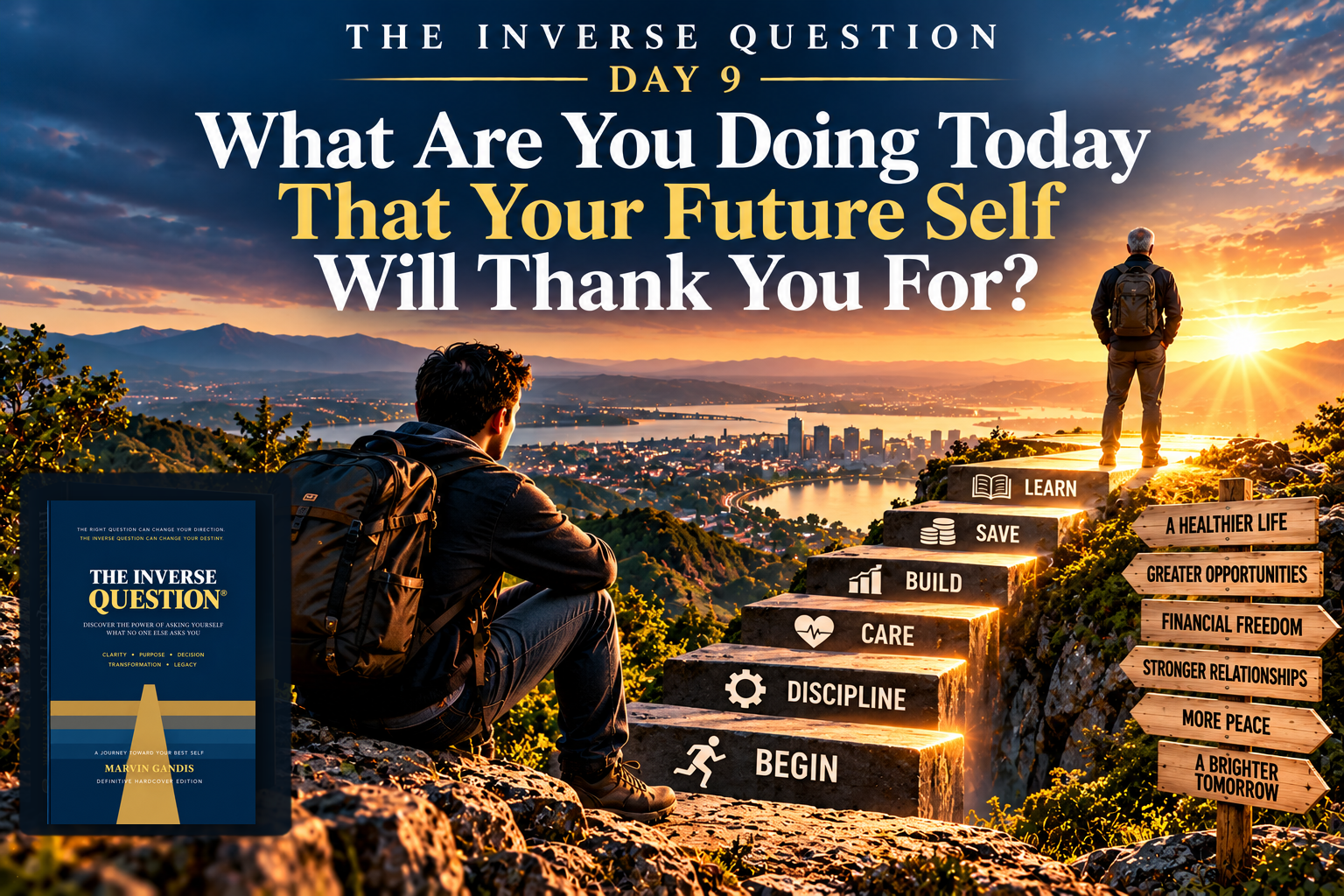
WHAT ARE YOU DOING TODAY THAT YOUR FUTURE SELF WILL THANK YOU FOR?

“Your future is not built in one dramatic moment. It is built through the decisions you repeat before anyone sees the result.”
— Marvin Gandis

We often think about the future as something waiting for us.

A destination.

A season that will eventually arrive.

A better year.

A stronger financial position.

A healthier body.

A more peaceful life.

A completed project.

A successful business.

A deeper relationship.

But the future is not only something we enter.

It is something we build.

And much of that construction happens quietly.

Through ordinary decisions.

Through habits nobody notices.

Through sacrifices that do not receive applause.

Through preparation that seems small today but becomes valuable tomorrow.

That is why Day 9 of The Inverse Question asks:

What are you doing today that your future self will thank you for?


YOUR FUTURE SELF IS LIVING WITH TODAY’S DECISIONS

Every day creates consequences.

Some immediate.

Some delayed.

You spend today.

Your future finances respond.

You exercise today.

Your future health responds.

You learn today.

Your future opportunities respond.

You avoid a problem today.

Your future circumstances may become harder.

You build discipline today.

Your future choices may become easier.

The future may feel distant.

But it is already being shaped.


THE FUTURE RARELY SENDS A WARNING IN ADVANCE

Most long-term consequences do not feel urgent at the beginning.

One skipped workout does not feel serious.

One unnecessary purchase does not feel dangerous.

One postponed project does not feel costly.

One ignored conversation does not seem devastating.

One hour wasted does not appear important.

But repetition changes scale.

What feels small today can become significant later.

That is why the question is not only:

  • “What happens if I do this once?”

It is:

“What happens if this becomes my pattern?”


✦ THE INVERSE QUESTION ✦

For Day 9, ask yourself:

If your future self could speak to you today, what would they ask you to begin, continue, or stop?

Would they ask you to save more?

Learn something?

Take care of your health?

Finish the project?

Spend more time with someone you love?

Stop delaying?

Take a risk?

Set a boundary?

Leave a harmful habit?

Begin creating something meaningful?

What would tomorrow’s version of you wish today’s version had taken seriously?

That question can change priorities quickly.


FUTURE GRATITUDE IS OFTEN BUILT THROUGH PRESENT DISCOMFORT

Many of the choices our future selves appreciate are not the easiest ones today.

Saving instead of spending.

Exercising instead of remaining comfortable.

Studying instead of scrolling.

Having the difficult conversation.

Saying no.

Starting before feeling ready.

Practicing when nobody is watching.

Choosing discipline over impulse.

Present discomfort can become future freedom.

Present convenience can become future cost.

That does not mean every difficult choice is automatically good.

But many meaningful choices require some immediate sacrifice.


MONEY IS ONE OF THE CLEAREST EXAMPLES

Imagine two versions of yourself.

One says:

  • “I will start saving later.”

The other begins today, even with a small amount.

One ignores financial education.

The other starts learning.

One spends every increase in income.

The other creates margin.

Years later, the difference may be dramatic.

Not because one decision was enormous.

But because time multiplied the pattern.

Your future finances often depend less on one perfect decision and more on repeated behavior.


THE SAME IS TRUE OF HEALTH

Health rarely changes because of one meal.

One walk.

One night of sleep.

One workout.

But habits accumulate.

The body keeps a record.

So ask:

What am I doing today that my future body will either thank me for or struggle because of?

Again, the goal is not perfection.

It is direction.


FUTURE YOU WILL REMEMBER WHAT PRESENT YOU KEEPS POSTPONING

There are projects we delay because they feel difficult.

Writing the book.

Starting the business.

Learning the skill.

Updating the résumé.

Creating the website.

Building the savings plan.

Making the appointment.

Repairing the relationship.

The longer we delay, the more emotional weight the task often gains.

Sometimes the best gift you can give your future self is simply:

Begin.

Not finish.

Begin.


DISCIPLINE IS A FORM OF RESPECT FOR YOUR FUTURE

Discipline is often described as restriction.

But it can also be understood as protection.

You protect future time.

Future money.

Future health.

Future opportunities.

Future peace.

When you make a disciplined choice, you are often saying:

  • “What happens later matters enough to influence what I choose now.”

That is not punishment.

It is stewardship.


YOUR FUTURE SELF DOES NOT NEED YOUR PERFECTION

This matters.

You do not need to get everything right today.

You will make mistakes.

Plans will change.

Priorities will shift.

Unexpected events will happen.

The future does not require perfect preparation.

It requires useful preparation.

Small progress.

Better decisions.

Consistent adjustment.

Humility.

Learning.

You do not have to control tomorrow.

You can still prepare for it.


✦ THE MIRROR ✦

Complete these sentences:

One thing my future self would thank me for starting today is: __________

One habit my future self would thank me for continuing is: __________

One habit my future self would thank me for stopping is: __________

One financial decision that would help my future is: __________

One relationship that deserves more attention is: __________

One skill worth developing is: __________

One difficult conversation I should stop avoiding is: __________

Now ask:

What is one action I can take today that would make tomorrow easier, stronger, or more meaningful?

Make it specific.

Make it small enough to begin.


FUTURE PROGRESS IS OFTEN INVISIBLE AT FIRST

The first week of saving may not look impressive.

The first month of learning may feel slow.

The first workouts may not create dramatic change.

The first pages may not feel like a book.

The first customers may not feel like a business.

The early stage is often unimpressive.

That does not make it unimportant.

Beginnings are supposed to look small.


DO NOT UNDERESTIMATE COMPOUNDING

Compounding applies to more than money.

Knowledge compounds.

Relationships compound.

Reputation compounds.

Health habits compound.

Writing compounds.

Experience compounds.

Discipline compounds.

Small improvements repeated over time can become difficult to recognize from day to day and impossible to ignore over years.

The reverse is also true.

Small neglect compounds too.

That is why today’s choices matter.


YOUR FUTURE SELF WILL THANK YOU FOR LEARNING BEFORE YOU NEED THE LESSON

There is enormous value in preparation.

Learn financial basics before a crisis.

Learn communication before conflict becomes severe.

Learn new skills before your current ones become obsolete.

Learn about health before symptoms force your attention.

Learn how to manage stress before burnout.

Preparation creates options.

Waiting until something becomes urgent reduces them.


BUILD MARGIN BEFORE YOU NEED IT

Margin means space.

Financial margin.

Time margin.

Emotional margin.

Energy margin.

When every resource is fully consumed, even small problems become emergencies.

Saving creates financial margin.

Planning creates time margin.

Rest creates energy margin.

Healthy boundaries create emotional margin.

Your future self may not remember every sacrifice used to create margin.

But they will appreciate having it when life becomes difficult.


SOME OF THE BEST FUTURE GIFTS ARE THINGS YOU REMOVE

We often think improvement means adding.

Another habit.

Another tool.

Another goal.

Another commitment.

But future gratitude may come from subtraction.

Removing debt.

Removing clutter.

Removing an unhealthy commitment.

Removing unnecessary expenses.

Removing distractions.

Removing repeated excuses.

Sometimes less creates a better future than more.


TAKE CARE OF RELATIONSHIPS BEFORE REGRET TEACHES THE LESSON

There are messages we assume we can send later.

Visits we postpone.

Thank-yous we delay.

Apologies we avoid.

Conversations we put off.

But time is uncertain.

One of the most important future questions may be:

If I lost the opportunity tomorrow, what would I wish I had said or done today?

That does not mean living anxiously.

It means valuing what matters while it is still available.


YOUR FUTURE SELF WILL THANK YOU FOR SAYING NO TO SOME THINGS

Every yes consumes something.

Time.

Money.

Attention.

Energy.

Opportunity.

If you say yes to everything, your priorities receive whatever remains.

A thoughtful no can protect an important yes.

No to distraction.

No to unnecessary debt.

No to commitments that do not fit.

No to pressure that violates your values.

No to patterns that consume your future.

Saying no can be an investment.


FUTURE YOU MAY CARE LESS ABOUT THINGS THAT FEEL URGENT TODAY

Think about worries from five years ago.

How many still matter?

Some undoubtedly do.

Many probably do not.

We give enormous emotional energy to things that eventually disappear.

The future can help provide perspective.

Ask:

Will this matter in five years?

If yes, give it appropriate attention.

If no, perhaps it does not deserve all of today’s peace.


DELAYED REWARDS REQUIRE TRUST

When you save money, you trust that future security matters.

When you study, you trust that future competence matters.

When you exercise, you trust that future health matters.

When you build something patiently, you trust that today’s unseen work has value.

Delayed rewards require belief in a future you cannot yet see.

That can be difficult.

But many worthwhile outcomes depend on it.


BUILD FOR THE PERSON YOU ARE BECOMING

Sometimes our current environment reflects who we were.

Old habits.

Old friendships.

Old routines.

Old expectations.

Old limits.

But growth requires us to ask:

What will the next version of me need?

Different skills?

Better habits?

Stronger boundaries?

A new environment?

More discipline?

A different network?

Greater courage?

Preparing for your future identity is part of becoming it.


YOU ARE ALWAYS LEAVING SOMETHING FOR YOUR FUTURE SELF

Every decision leaves a gift or a burden.

A saved dollar.

Or debt.

A strengthened relationship.

Or unresolved resentment.

A completed task.

Or unfinished pressure.

A healthy habit.

Or accumulated neglect.

You cannot eliminate every future difficulty.

But you can decide whether today’s behavior is helping or harming the person who will eventually have to live with it.


MY DEAR READER AND FRIEND

Imagine yourself five years from today.

Not as a fantasy.

As a real person.

Older.

More experienced.

Living with the consequences of thousands of decisions you are making now.

What would that person say?

Would they thank you for starting?

For stopping?

For saving?

For learning?

For protecting your health?

For taking the risk?

For staying patient?

For leaving something harmful?

For spending more time with people who mattered?

For finally believing that the future deserved preparation?

Listen carefully.

That future voice may already be telling you what matters.


WHAT ARE YOU DOING TODAY THAT YOUR FUTURE SELF WILL THANK YOU FOR?

You do not need to transform your entire life today.

Choose one thing.

One deposit.

One page.

One conversation.

One walk.

One boundary.

One hour of study.

One decision.

One beginning.

Then repeat it.

Because your future self is not waiting for one dramatic act.

They are waiting for the accumulated benefit of the choices you make while the future still feels far away.

So ask:

What can I do today that will make tomorrow stronger?

Then give your future self something worth thanking you for.

With gratitude,

Marvin Gandis
Author of La Pregunta Inversa and The Inverse Question


CONTINUE THE JOURNEY

This is Day 9 of The Inverse Question English series.

Day 1: Today Begins a New Chapter
Day 2: Why Did I Write The Inverse Question?
Day 3: The Question That Changed the Way I Think
Day 4: Maybe You Have Been Looking for Answers to the Wrong Question
Day 5: The Roots No One Sees Determine the Fruit Everyone Sees
Day 6: Not Everything That Looks Like Progress Is Moving You Forward
Day 7: What Are You Tolerating Today That Is Building the Future You Do Not Want?
Day 8: Do Not Confuse Movement With Direction
Day 9: What Are You Doing Today That Your Future Self Will Thank You For?

Next:

Day 10 — Who Are You Becoming Through the Choices You Repeat Every Day?

Because the most important result of your habits may not be what they produce.

It may be who they are turning you into.

DISCLAIMER

This article is provided for educational, informational, motivational, and personal-reflection purposes only. It does not constitute medical, psychological, mental-health, legal, financial, investment, business, career, relationship, or other professional advice.

The examples and principles discussed are general and may not apply equally to every individual or circumstance. Decisions involving finances, health, employment, relationships, or other significant matters should be evaluated according to your personal situation and, when appropriate, with guidance from qualified professionals.

No specific personal, professional, financial, investment, business, relationship, health, or life outcome is promised or guaranteed.

The Inverse Question series is intended to encourage reflection, preparation, responsible decision-making, learning, intentional living, and independent judgment.