
Publicado en Character, Discipline, Habits, Identity, Marvin Gandis, Mindset, Personal Development, Personal Growth, The Inverse Question

WHO ARE YOU BECOMING THROUGH THE CHOICES YOU REPEAT EVERY DAY?

“Your habits do more than shape your results. They quietly shape the person you are becoming.”
— Marvin Gandis

We often judge our choices by what they produce.

Did this help me earn more?

Did this move the project forward?

Did this improve my health?

Did this make life easier?

Those are reasonable questions.

But there is another question that may be even more important:

Who am I becoming through the choices I repeat every day?

Because habits do not only create outcomes.

They create identity.

The things we do repeatedly begin to influence what feels normal.

What feels natural.

What we expect from ourselves.

What we tolerate.

What we believe we are capable of.

Over time, repeated choices become evidence.

And that evidence begins to answer one of the deepest questions in life:

What kind of person am I becoming?


RESULTS MATTER, BUT IDENTITY MATTERS TOO

Imagine two people who reach the same goal.

Both become successful.

Both earn more.

Both complete the project.

Both gain recognition.

But one becomes more disciplined, patient, generous, and grounded in the process.

The other becomes anxious, arrogant, exhausted, and disconnected from everything that once mattered.

Did they achieve the same result?

On paper, perhaps.

In reality, no.

Because success is not only about what you achieve.

It is also about what the process turns you into.


EVERY HABIT CASTS A VOTE

Every repeated behavior is a small vote for an identity.

When you keep a promise to yourself, you cast a vote for reliability.

When you study consistently, you cast a vote for discipline.

When you tell the truth when dishonesty would be easier, you cast a vote for integrity.

When you procrastinate repeatedly, you cast a vote for avoidance.

When you overspend repeatedly, you cast a vote for financial disorder.

When you complain without acting, you cast a vote for helplessness.

One vote does not define you.

But repeated votes begin to build a pattern.

And patterns become identity.


✦ THE INVERSE QUESTION ✦

For Day 10, ask yourself:

If someone observed my repeated choices for the next year, what kind of person would they say I am becoming?

Do not answer based on intention.

Answer based on evidence.

Your schedule.

Your spending.

Your words.

Your habits.

Your reactions.

Your priorities.

Your follow-through.

Your treatment of others.

Your willingness to learn.

Your response to difficulty.

That evidence may reveal more than your goals do.


IDENTITY IS BUILT IN ORDINARY MOMENTS

We often imagine identity being shaped through dramatic experiences.

And sometimes it is.

But most identity is built quietly.

You wake up when you said you would.

Or you do not.

You complete the task.

Or delay it.

You speak respectfully.

Or react impulsively.

You save.

Or spend.

You practice.

Or avoid.

You apologize.

Or defend your ego.

You listen.

Or interrupt.

These moments seem small.

But they are training.

Everyday choices teach you who you are willing to be.


THE PERSON YOU PRACTICE BECOMES EASIER TO BE

Repetition reduces friction.

The first disciplined decision may feel difficult.

The tenth may feel easier.

The hundredth may begin to feel normal.

The same is true for poor habits.

The more often we repeat something, the less resistance we feel.

That means habits are not neutral.

They are rehearsal.

You are practicing a version of yourself.

The question is:

Which version?


YOU CAN BECOME SUCCESSFUL AND STILL BECOME SOMEONE YOU DO NOT LIKE

This is worth saying plainly.

Achievement does not automatically improve character.

Money can expose poor judgment.

Recognition can expose insecurity.

Power can expose ego.

Pressure can expose impatience.

Success can magnify what already exists.

That is why personal growth should not focus only on capacity.

It should also focus on character.

Ask:

If I receive more responsibility, who will I become under that pressure?

That question matters before success arrives.


DISCIPLINE CHANGES MORE THAN YOUR SCHEDULE

Discipline is not merely time management.

It changes self-perception.

When you repeatedly do what you said you would do, you begin trusting yourself more.

You stop needing constant motivation.

You rely less on mood.

You become more dependable.

That becomes part of your identity.

You begin thinking:

  • I am someone who follows through.

That belief was not created through affirmation alone.

It was built through evidence.


THE SAME IS TRUE OF INTEGRITY

Integrity grows through repetition.

You tell the truth when nobody would know otherwise.

You keep promises that are inconvenient.

You refuse shortcuts that violate your values.

You admit mistakes.

You correct them.

These decisions build something invisible.

Character.

And eventually, other people can feel it.

Trust is often the visible fruit of invisible integrity.


WHAT YOU TOLERATE FROM YOURSELF ALSO SHAPES IDENTITY

We often think identity is created only by what we do.

It is also influenced by what we allow.

If you tolerate chronic lateness from yourself, you begin normalizing unreliability.

If you excuse repeated procrastination, delay becomes part of your self-story.

If you accept poor preparation, you lower your internal standard.

If you continually abandon goals, you may begin believing:

  • “I never finish anything.”

That belief then influences future behavior.

The cycle reinforces itself.


✦ THE MIRROR ✦

Complete these sentences:

One habit that is helping shape me into the person I want to become is: __________

One repeated choice that is moving me away from that person is: __________

One standard I need to raise is: __________

One behavior I need to stop excusing is: __________

One quality I want to strengthen is: __________

One action that would give me evidence of that quality is: __________

Now ask:

What identity am I reinforcing through the choices I repeat most often?

That is the heart of Day 10.


YOUR LANGUAGE ABOUT YOURSELF MATTERS

We often reinforce identity through language.

“I am terrible with money.”

“I am not disciplined.”

“I always procrastinate.”

“I am bad at relationships.”

“I cannot stay consistent.”

Those statements feel descriptive.

But repeated often enough, they can become instructions.

A healthier approach is not pretending the problem does not exist.

It is separating identity from behavior.

Instead of:

  • “I am undisciplined.”

Try:

  • “I have been inconsistent, and I am building better habits.”

Instead of:

  • “I am bad with money.”

Try:

  • “My current financial habits need improvement.”

Behavior can change.

Identity should not become a prison built from old evidence.


YOUR FUTURE IDENTITY NEEDS CURRENT EVIDENCE

You cannot become confident only by saying:

  • “I am confident.”

Confidence grows when you collect evidence.

You speak.

You practice.

You fail.

You recover.

You improve.

You survive uncomfortable situations.

Evidence changes belief.

If you want to become disciplined, create evidence of discipline.

If you want to become reliable, create evidence of reliability.

If you want to become generous, practice generosity.

If you want to become courageous, take small courageous actions.

Identity grows from repeated proof.


THE GOAL IS NOT TO PERFORM FOR OTHERS

There is a danger here.

We can become obsessed with appearing disciplined.

Appearing successful.

Appearing wise.

Appearing generous.

But appearance and identity are not the same thing.

Social media rewards visible performance.

Character is often built when nobody is watching.

The question is not:

  • “What do people think I am becoming?”

It is:

“Who am I becoming when there is no audience?”

That answer is often more honest.


WHAT YOU DO UNDER PRESSURE REVEALS TRAINING

Pressure does not always create character.

Often it reveals it.

When stressed, what do you default to?

Patience?

Anger?

Planning?

Avoidance?

Honesty?

Blame?

Discipline?

Impulse?

We tend to fall back on what we have practiced.

That is why daily choices matter before the crisis.

You are training your responses.


YOUR ENVIRONMENT PARTICIPATES IN YOUR IDENTITY

The people around you influence what seems normal.

If everyone around you avoids responsibility, responsibility can feel unusual.

If everyone around you is learning, growth can feel normal.

If your environment rewards distraction, distraction becomes easier.

If your environment rewards discipline, discipline becomes easier.

Ask:

What kind of person does my environment make easier to become?

That question deserves attention.


IDENTITY CAN CHANGE WITHOUT DENYING YOUR PAST

You are not required to remain loyal to an old version of yourself.

You may have been inconsistent.

You can become consistent.

You may have been financially careless.

You can become thoughtful.

You may have avoided difficult conversations.

You can learn to face them.

You may have quit before.

You can finish now.

Growth does not require pretending the past did not happen.

It requires refusing to let the past permanently define what happens next.


YOU BECOME WHAT YOU REHEARSE

Think of habits as rehearsal.

Every day you practice something.

Focus.

Distraction.

Patience.

Impatience.

Courage.

Avoidance.

Generosity.

Selfishness.

Responsibility.

Excuses.

Rehearsal matters because repetition makes behavior easier to access.

Eventually, the practiced response becomes the natural response.

That is how identity becomes automatic.


WHAT YOU REPEAT IN PRIVATE EVENTUALLY APPEARS IN PUBLIC

Private preparation becomes public competence.

Private discipline becomes public reliability.

Private study becomes public expertise.

Private financial habits become public stability.

Private character becomes public reputation.

The visible version is often the delayed result of invisible repetition.

That is why no private choice is completely insignificant.


YOUR GOALS SHOULD ASK FOR A PERSON, NOT ONLY A RESULT

Instead of asking only:

  • “What do I want to achieve?”

also ask:

  • “Who must I become to sustain it?”

A business may require discipline.

A healthy relationship may require patience.

Financial stability may require self-control.

Leadership may require humility.

A creative career may require persistence.

Achievement asks for action.

Sustainable achievement often asks for identity.


BECOMING TAKES TIME

Identity does not change instantly.

You may make one disciplined choice and still feel undisciplined.

That is normal.

The old identity has accumulated more evidence.

Keep creating new evidence.

One decision.

Then another.

Then another.

Eventually the balance begins to change.

You do not become a new person through one declaration.

You become through repeated behavior.


BE CAREFUL WHAT YOU REWARD

Behavior that receives reward tends to repeat.

If procrastination allows you to escape discomfort, procrastination gets rewarded.

If complaining earns attention, complaining may repeat.

If discipline produces satisfaction, discipline strengthens.

If generosity deepens connection, generosity strengthens.

Pay attention to the rewards hidden inside your habits.

Sometimes an unhealthy pattern continues because it is providing an immediate benefit.

Even when the long-term cost is high.


IDENTITY GROWS STRONGER WHEN VALUES AND ACTION ALIGN

There is peace in alignment.

When your actions match what you say matters.

When your spending reflects your priorities.

When your schedule reflects your values.

When your relationships reflect your standards.

When your habits support your goals.

Misalignment creates internal tension.

Alignment builds integrity.

That may be one of the clearest signs that you are becoming the person you intend to be.


MY DEAR READER AND FRIEND

You are becoming someone.

The process is already happening.

The question is not whether identity is being shaped.

It is whether it is being shaped intentionally.

Do not wait for a dramatic transformation.

Look at today.

What did you practice?

What did you reinforce?

What did you excuse?

What did you choose?

What did you repeat?

Then ask:

Is this the person I want to keep becoming?

If yes, continue.

If not, change one vote.

One habit.

One decision.

One repeated choice.

That is how identity begins to move.


WHO ARE YOU BECOMING THROUGH THE CHOICES YOU REPEAT EVERY DAY?

You are not only building a future.

You are building the person who will live in it.

That may be the most important project of all.

So ask yourself:

If I continue practicing today’s habits, will I respect the person they eventually create?

Your answer does not require shame.

It requires honesty.

And if something needs to change, the next vote can begin today.

With gratitude,

Marvin Gandis
Author of La Pregunta Inversa and The Inverse Question


CONTINUE THE JOURNEY

This is Day 10 of The Inverse Question English series.

Day 1: Today Begins a New Chapter
Day 2: Why Did I Write The Inverse Question?
Day 3: The Question That Changed the Way I Think
Day 4: Maybe You Have Been Looking for Answers to the Wrong Question
Day 5: The Roots No One Sees Determine the Fruit Everyone Sees
Day 6: Not Everything That Looks Like Progress Is Moving You Forward
Day 7: What Are You Tolerating Today That Is Building the Future You Do Not Want?
Day 8: Do Not Confuse Movement With Direction
Day 9: What Are You Doing Today That Your Future Self Will Thank You For?
Day 10: Who Are You Becoming Through the Choices You Repeat Every Day?

Next:

Day 11 — What Are You Rehearsing Every Day That Is Quietly Becoming Your Identity?

Because repetition does not only improve behavior.

It turns behavior into something that begins to feel like you.

DISCLAIMER

This article is provided for educational, informational, motivational, and personal-reflection purposes only. It does not constitute medical, psychological, mental-health, legal, financial, business, career, relationship, or other professional advice.

The ideas presented about habits, identity, discipline, character, and personal growth are general and may not apply equally to every person or circumstance. People experiencing significant emotional, behavioral, psychological, medical, financial, or other difficulties should seek appropriately qualified professional guidance when needed.

No specific personal, professional, financial, relationship, business, health, or life outcome is promised or guaranteed.

The Inverse Question series is intended to encourage thoughtful reflection, learning, responsible decision-making, personal awareness, intentional growth, and independent judgment.

Publicado en Discipline, Habits, Intentional Living, Marvin Gandis, Mindset, Personal Development, Personal Growth, Success, The Inverse Question

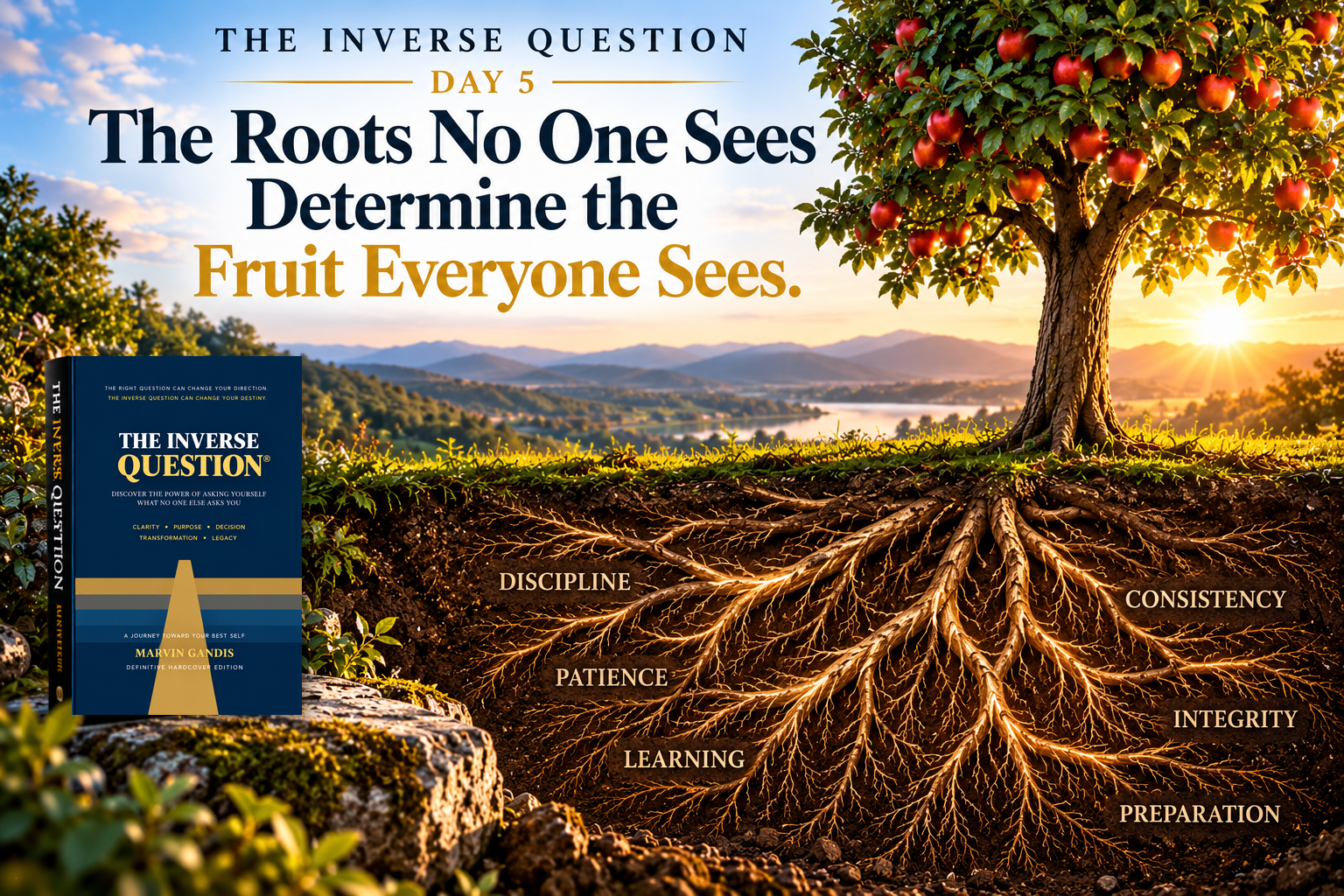
THE ROOTS NO ONE SEES DETERMINE THE FRUIT EVERYONE SEES

“What becomes visible in your life is often the result of what you have been building quietly for a long time.”
— Marvin Gandis

We live in a world that notices the fruit.

The promotion.

The income.

The finished book.

The successful business.

The transformation.

The confidence.

The recognition.

The result.

But very few people see the roots.

The early mornings.

The repeated practice.

The mistakes.

The private decisions.

The discipline.

The learning.

The patience.

The sacrifices.

The seasons when nothing seemed to be happening.

And yet those invisible things often determine what eventually becomes visible.

That is the lesson behind Day 5 of The Inverse Question.

Sometimes the question is not:

“Why am I not seeing results yet?”

A better question may be:

“What roots am I growing while no one is watching?”


WE ARE ATTRACTED TO VISIBLE RESULTS

Human beings naturally notice outcomes.

We see the person who succeeded.

But we do not see the years of preparation.

We see the business that grew.

But we do not see the hundreds of small adjustments.

We see the confident speaker.

But we do not see the hours of practice.

We see the published author.

But we do not see the drafts, revisions, corrections, doubts, and persistence.

We see the fruit because fruit is visible.

Roots are not.

But the invisible often makes the visible possible.


THE DANGER OF WANTING FRUIT WITHOUT ROOTS

We want results quickly.

That is understandable.

We want evidence that our effort is working.

We want progress we can measure.

We want confirmation.

But growth does not always happen where we can see it.

A tree can spend a long time developing below the surface before producing what appears above it.

Human development can work the same way.

You may be learning discipline before the results appear.

You may be developing patience.

You may be improving judgment.

You may be building skills.

You may be strengthening your character.

You may be learning how to manage disappointment.

You may be becoming more consistent.

Those things may not look dramatic.

But they are roots.


✦ THE INVERSE QUESTION ✦

For Day 5, ask yourself:

What visible result do you want, and what invisible foundation would be required to sustain it?

If you want financial stability:

What habits support it?

If you want a successful business:

What skills, systems, and relationships support it?

If you want better health:

What daily behaviors support it?

If you want a stronger relationship:

What communication, patience, and integrity support it?

If you want greater confidence:

What repeated actions build it?

If you want peace:

What boundaries and decisions protect it?

The fruit gives us something to desire.

The roots give us something to build.


RESULTS WITHOUT FOUNDATION CAN BE TEMPORARY

Sometimes people receive the fruit before the roots are ready.

More money.

More visibility.

More responsibility.

More customers.

More influence.

More opportunity.

But if the foundation is weak, the result can become difficult to sustain.

More income without financial discipline may create bigger problems.

More customers without systems may create chaos.

More responsibility without maturity may create pressure.

More visibility without emotional preparation may become overwhelming.

Growth increases what the foundation must carry.

That is why preparation matters.


QUIET WORK IS STILL REAL WORK

One of the hardest parts of growth is doing important work before there is recognition.

You study.

No one notices.

You practice.

No one applauds.

You improve your habits.

No one congratulates you.

You save money.

No one sees it.

You learn a new skill.

No one knows.

You rewrite the article.

You correct the manuscript.

You improve the system.

You keep your promise.

You show up again.

There may be no audience.

But the work still counts.

The roots do not need applause to grow.


SOME SEASONS ARE FOR BUILDING BELOW THE SURFACE

Not every season produces visible fruit.

That does not mean nothing is happening.

Some seasons are for learning.

Some are for recovering.

Some are for rebuilding.

Some are for preparation.

Some are for correction.

Some are for strengthening what was weak.

We can become frustrated because we compare a season of preparation to someone else’s season of harvest.

That comparison can be misleading.

You may be looking at their fruit while living through your root-building season.

Those are not the same stage.


THE ROOTS OF FINANCIAL STABILITY

Financial stability rarely begins with a dramatic event.

It often begins with small habits.

Knowing where your money goes.

Spending intentionally.

Avoiding unnecessary debt where possible.

Building savings gradually.

Learning.

Increasing useful skills.

Thinking beyond the next paycheck.

Creating value.

Making better decisions repeatedly.

People often notice financial success.

They rarely notice the quiet habits that made it possible.

The root system matters.


THE ROOTS OF CONFIDENCE

Confidence is often misunderstood.

We sometimes think confident people simply feel less fear.

But confidence can come from evidence.

You said you would do something.

And you did it.

You practiced.

You improved.

You survived difficulty.

You kept going.

You learned from mistakes.

You became more capable.

That history becomes evidence.

And evidence builds confidence.

The visible confidence may appear later.

The roots were built through action.


THE ROOTS OF A STRONG REPUTATION

Reputation is also a form of fruit.

People may describe someone as reliable.

Trustworthy.

Professional.

Consistent.

Helpful.

Prepared.

But those words are usually the result of repeated behavior.

One promise kept.

Then another.

One honest decision.

Then another.

One useful contribution.

Then another.

Reputation grows slowly.

And it can be damaged quickly.

That is why the invisible habits of integrity matter.


THE ROOTS OF GOOD DECISIONS

Good decisions do not appear from nowhere.

They often come from:

Experience.

Reflection.

Humility.

Research.

Patience.

Listening.

Learning from mistakes.

Recognizing patterns.

Understanding consequences.

People may admire the decision.

But they may not see the years of learning behind it.

Wisdom is often accumulated quietly.


THE ROOTS OF PURPOSE

Purpose is not always discovered in one dramatic moment.

Sometimes it develops gradually.

You notice what matters to you.

You recognize the problems you care about.

You discover what you are willing to work for.

You begin serving.

You learn.

You adjust.

You understand yourself better.

Purpose can grow from attention.

And attention grows through reflection.


✦ THE MIRROR ✦

Choose one result you want in your life.

Write it down:

The fruit I want is: __________

Now ask:

What roots would make that result sustainable? __________

Continue:

What skill do I need to strengthen? __________

What habit do I need to build? __________

What habit may need to stop? __________

What system would support consistency? __________

What relationship should I strengthen? __________

What responsibility have I been avoiding? __________

And finally:

If no one could see my progress for the next six months, would I still be willing to build the foundation?

That question reveals a great deal.


INVISIBLE PROGRESS CAN FEEL LIKE NO PROGRESS

This is where many people quit.

They do the work.

But the result is slow.

They publish.

Few people respond.

They exercise.

The change is gradual.

They save.

The amount feels small.

They learn.

They still feel inexperienced.

They build.

Nothing seems to happen.

And then they conclude:

“This is not working.”

Sometimes that conclusion is correct.

Strategies should be evaluated.

But sometimes progress is simply happening below the surface.

The challenge is learning the difference.


PATIENCE DOES NOT MEAN DOING NOTHING

Patience is often misunderstood.

Patience is not passive waiting.

Useful patience continues working while allowing time for results.

You keep learning.

You keep improving.

You keep measuring.

You keep adjusting.

You keep building.

You remain willing to change the method while protecting the goal.

That is very different from waiting without action.


ROOTS NEED THE RIGHT ENVIRONMENT

Even strong potential needs the right conditions.

A seed needs soil.

Water.

Light.

Time.

Protection.

People also need environments that support growth.

That may mean:

Reducing distractions.

Changing routines.

Finding better information.

Spending time with constructive people.

Seeking mentorship.

Creating boundaries.

Improving your workspace.

Protecting time for important work.

Sometimes the question is not:

“Why am I not disciplined?”

It may be:

“What environment am I repeatedly placing myself in?”

Environment influences behavior.


SOME ROOTS MUST BE REMOVED

Not every root is good.

We can also develop roots of:

Fear.

Avoidance.

Resentment.

Poor financial habits.

Procrastination.

Excuses.

Unhealthy comparison.

Negative self-talk.

Disorganization.

Dependency on motivation.

Repeated avoidance becomes a root.

And eventually it produces fruit too.

That is why Day 5 is not only about building better foundations.

It is also about identifying foundations that no longer serve us.


WHAT ARE YOU FEEDING?

Whatever we repeatedly feed tends to grow.

Feed discipline.

It grows.

Feed distraction.

It grows.

Feed learning.

It grows.

Feed resentment.

It grows.

Feed courage.

It grows.

Feed avoidance.

It grows.

This is one of the quiet truths of personal development:

Repetition is nourishment.

The question is:

What are you feeding every day?


THE HARVEST OF SMALL DECISIONS

Large results are often collections of small decisions.

One page written.

One dollar saved.

One walk completed.

One difficult conversation handled honestly.

One skill practiced.

One temptation resisted.

One promise kept.

One improvement made.

No single action may look important.

But repetition changes the scale.

Small decisions accumulate.

That accumulation becomes the harvest.


DO NOT DESPISE SMALL BEGINNINGS

People often overlook small progress because it does not feel impressive.

But almost everything meaningful begins small.

The first subscriber.

The first customer.

The first chapter.

The first workout.

The first savings deposit.

The first honest conversation.

The first day of a new habit.

The beginning may not resemble the final result.

That is normal.

Roots do not look like fruit.


THE QUESTION IS NOT ONLY “WHEN?”

We often ask:

“When will I see results?”

But another question may be more useful:

“Who am I becoming while I wait?”

Are you becoming more disciplined?

More skilled?

More patient?

More thoughtful?

More resilient?

More responsible?

More prepared?

If the process is improving you, something valuable is already happening.


SUCCESS THAT LASTS USUALLY HAS DEPTH

Fast growth can be exciting.

But sustainable growth needs depth.

The deeper the roots, the more the structure can endure.

That principle applies to:

Business.

Relationships.

Finances.

Character.

Leadership.

Health.

Faith.

Knowledge.

Purpose.

Whatever you hope to build, ask:

What must become stronger beneath the surface?


MY DEAR READER AND FRIEND

You may be in a season where very little seems visible.

Do not automatically assume that nothing is happening.

Examine the roots.

Are they growing?

Are your habits improving?

Are you learning?

Are you becoming more consistent?

Are you handling difficulty better?

Are you thinking more clearly?

Are you making better decisions?

If the answer is yes, then something important is happening.

Maybe the fruit is simply not ready yet.

And if the roots are weak, that is useful information too.

You now know where the work belongs.


THE ROOTS NO ONE SEES DETERMINE THE FRUIT EVERYONE SEES

The world may eventually notice the result.

But you will know what came before it.

The quiet mornings.

The discipline.

The corrections.

The learning.

The patience.

The moments when quitting would have been easier.

The decisions nobody applauded.

The roots.

So today, do not ask only:

“Where is the fruit?”

Ask:

“What am I growing underneath the surface?”

Because the quality of tomorrow’s harvest is often being decided by what you repeatedly nurture today.

With gratitude,

Marvin Gandis
Author of La Pregunta Inversa and The Inverse Question


CONTINUE THE JOURNEY

This is Day 5 of The Inverse Question English series.

Day 1: Today Begins a New Chapter
Day 2: Why Did I Write The Inverse Question?
Day 3: The Question That Changed the Way I Think
Day 4: Maybe You Have Been Looking for Answers to the Wrong Question
Day 5: The Roots No One Sees Determine the Fruit Everyone Sees

Next:

Day 6 — Not Everything That Looks Like Progress Is Moving You Forward

Because movement and direction are not the same thing.

DISCLAIMER

This article is provided for educational, informational, motivational, and personal-reflection purposes only. It is not financial, legal, medical, psychological, mental-health, business, or other professional advice.

The principles and examples discussed are general and may not apply equally to every individual, circumstance, or goal. Results vary according to many factors, including personal circumstances, decisions, resources, opportunities, timing, and external conditions.

No specific personal, financial, professional, health, business, or life outcome is promised or guaranteed.

Readers should evaluate their own circumstances carefully and seek appropriately qualified professional guidance when necessary. The Inverse Question series is intended to encourage reflection, learning, responsible decision-making, personal growth, and independent judgment.

Publicado en Critical Thinking, Decision Making, Marvin Gandis, Mindset, Personal Development, Personal Growth, Self Reflection, The Inverse Question

MAYBE YOU HAVE BEEN LOOKING FOR ANSWERS TO THE WRONG QUESTION

“Sometimes the problem is not that you cannot find an answer. Sometimes you have been asking the wrong question.”
— Marvin Gandis

We are taught to search for answers.

We search online.

We ask friends.

We watch videos.

We read books.

We listen to experts.

We compare opinions.

We collect advice.

And sometimes, after all of that, we still feel stuck.

Why?

Because an answer can only be as useful as the question that created it.

If the question is incomplete, the answer may be incomplete.

If the question is misleading, the answer may send us in the wrong direction.

And if we keep asking the wrong question, we can spend years becoming very efficient at solving the wrong problem.

That realization is one of the reasons The Inverse Question exists.


WE NATURALLY FOCUS ON WHAT IS MOST VISIBLE

Suppose someone says:

  • “Why am I not making enough money?”

That sounds like a financial question.

And perhaps it is.

But maybe the deeper question is:

  • “What skills am I building that the market is willing to reward?”

Or:

  • “How well am I managing the money I already earn?”

Or:

  • “Am I depending on one source of income without developing alternatives?”

Or:

  • “Am I solving a problem people are actually willing to pay to solve?”

The first question looks at the symptom.

The better question may reveal the structure underneath it.

That difference matters.


THE FIRST QUESTION IS NOT ALWAYS THE BEST QUESTION

We often ask the question that comes most naturally.

  • Why is this happening?
  • Why is this taking so long?
  • Why do people not support me?
  • Why am I not getting results?
  • Why do I keep failing?
  • Why can’t I stay motivated?

Those questions are understandable.

But some of them keep our attention focused on the frustration rather than the mechanism.

A stronger question may be:

  • What pattern keeps producing this result?
  • What assumption am I making?
  • What am I avoiding?
  • What am I repeating?
  • What skill am I missing?
  • What information do I not yet have?

What part of the problem am I treating as permanent when it may actually be adjustable?

The moment the question changes, the direction of thought changes too.


A WRONG QUESTION CAN CREATE A WRONG PLAN

Imagine spending months asking:

  • “How can I get more followers?”

You may learn algorithms.

Posting times.

Hashtags.

Trends.

Content formats.

Engagement techniques.

But perhaps the better question was:

“How can I become more useful to the people I already reach?”

That changes the strategy.

Instead of chasing numbers, you begin improving value.

Instead of asking only how to attract attention, you ask how to deserve it.

Instead of measuring success only through reach, you begin considering trust, relevance, usefulness, and relationships.

  • Same situation.
  • Different question.
  • Different plan.

✦ THE INVERSE QUESTION ✦

For Day 4, ask yourself:

What question have you been repeating that may be keeping you focused on the symptom instead of the cause?

Do not rush to answer.

  • Think carefully.

Sometimes the question we repeat has been with us for years.

  • It may sound reasonable.
  • It may even sound intelligent.

But if it keeps producing the same frustration, it deserves examination.

Try this:

The question I keep asking is: __________

Now ask:

What assumption is hidden inside that question? __________

Then:

What would I ask if I looked at the situation from the opposite direction? __________

That reversal may reveal something important.


FROM “HOW DO I GET?” TO “WHAT DO I CREATE?”

This is one of the most powerful reversals.

We often ask:

  • How do I get more customers?
  • How do I get more money?
  • How do I get more opportunities?
  • How do I get more recognition?
  • How do I get more support?

There is nothing inherently wrong with those questions.

But now reverse them.

  • What value am I creating?
  • What problem am I solving?
  • What trust am I building?
  • What reason am I giving people to choose me?
  • What contribution am I making?

That shift from getting to creating can change how we approach work, business, relationships, and life.


FROM “WHY AM I NOT MOTIVATED?” TO “WHAT SYSTEM AM I MISSING?”

Motivation is unreliable.

  • It rises.
  • It falls.

Some mornings we feel ready.

Other mornings we do not.

If the entire plan depends on motivation, the plan becomes fragile.

So instead of asking:

  • “How do I stay motivated every day?”

Try:

“What system can help me act even when motivation is low?”

That question leads somewhere practical.

  • A schedule.
  • A checklist.
  • A deadline.
  • A routine.
  • A smaller task.
  • A prepared environment.
  • Accountability.
  • Automation.

A system reduces the amount of emotion required to act.

Sometimes what looks like a motivation problem is actually a system problem.


FROM “WHY DO I KEEP FAILING?” TO “WHAT IS THIS PATTERN TEACHING ME?”

The word failure can become too heavy.

It can make one unsuccessful attempt feel like an identity.

But an unsuccessful attempt is information.

Maybe the offer was wrong.

Maybe the timing was wrong.

Maybe the execution was weak.

Maybe the audience was wrong.

Maybe the expectation was unrealistic.

Maybe more practice is needed.

Maybe the strategy simply does not work.

Asking “Why do I keep failing?” can become discouraging.

Asking:

“What is this repeated result trying to teach me?”

creates a different mental posture.

Now you are investigating.

Not condemning yourself.


FROM “WHY DOES NO ONE SUPPORT ME?” TO “AM I BUILDING THE RIGHT CONNECTIONS?”

This question can be uncomfortable.

We may expect support from people who do not understand our goals.

We may wait for encouragement from people who are not interested in the same journey.

We may assume everyone close to us should automatically become part of what we are building.

But perhaps a better question is:

  • Who understands this kind of work?
  • Where are people with similar goals?
  • Who can I learn from?
  • Who can I support?
  • What relationships should I cultivate intentionally?

Sometimes we do not need more approval.

  • We need better alignment.

FROM “HOW DO I BECOME SUCCESSFUL?” TO “WHAT KIND OF LIFE AM I ACTUALLY TRYING TO BUILD?”

Success is one of those words that sounds clear until you try to define it.

  • Money?
  • Freedom?
  • Recognition?
  • Peace?
  • Purpose?
  • Time?
  • Influence?
  • Family?
  • Contribution?
  • Security?

Without defining success, we can spend years pursuing someone else’s version of it.

That is why the better question may not be:

  • “How do I become successful?”

But:

“What would a meaningful, sustainable, responsible life actually look like for me?”

Only then can the plan become personal.


THE WRONG QUESTION CAN MAKE YOU CHASE THE WRONG METRIC

We live in a world full of measurements.

  • Views.
  • Followers.
  • Income.
  • Likes.
  • Subscribers.
  • Revenue.
  • Rankings.
  • Clicks.
  • Sales.
  • Hours worked.

All of them can be useful.

  • But they can also become distracting.

Suppose a business owner asks:

  • “How can I get more website traffic?”

Traffic increases.

But sales do not.

Perhaps the better question was:

“How can I attract the right people and help them understand the value I offer?”

More traffic is not always better traffic.

More activity is not always more progress.

More attention is not always more trust.

  • The metric matters only if it is connected to the right objective.

SOME QUESTIONS ARE DESIGNED TO PROTECT OUR EGO

  • This is difficult to admit.

Sometimes we choose questions that allow us to avoid uncomfortable answers.

For example:

  • “Why is the market so difficult?”

may be easier than:

  • “Is my offer actually competitive?”
  • “Why do people not understand me?”

may be easier than:

  • “Am I communicating clearly?”
  • “Why does nobody read my work?”

May be easier than:

  • “Am I creating something people find useful enough to return to?”
  • “Why am I always too busy?”

may be easier than:

  • “What am I refusing to stop doing?”

Better questions can challenge our ego.

But that challenge can be productive.


✦ THE MIRROR ✦

Choose one area of your life where you feel stuck.

Write the question you normally ask:

My usual question is: __________

Now identify the result it produces:

When I ask that question, I usually feel or do: __________

Next:

What part of the situation does this question ignore? __________

Then reverse it.

If you usually ask:

  • “Why are people not choosing me?”

ask:

  • “What can I improve about the value I offer?”

If you ask:

  • “Why am I always behind?”

ask:

  • “What am I repeatedly giving priority to?”

If you ask:

  • “Why can’t I change?”

ask:

  • “What small change am I willing to repeat long enough for it to become normal?”

Finally:

What better question could lead me toward a more useful next step?

Write it down.

Keep it visible.


BETTER QUESTIONS CREATE BETTER SEARCHES

The mind searches for what we ask it to find.

Ask:

  • “Why is everything going wrong?”

and you will probably notice more evidence of what is wrong.

Ask:

  • “What is still working?”

and you begin noticing stability.

Ask:

  • “What did I lose?”

and your attention goes backward.

Ask:

  • “What can I build from what remains?”

and your attention begins moving forward.

This does not mean ignoring problems.

It means choosing questions that help you understand them more completely.


SOME QUESTIONS NEED TO BE REPLACED ENTIRELY

There are questions that keep us trapped.

  • “What will people think?”

Replace it with:

  • “What decision aligns with my values and responsibilities?”
  • “What if I fail?”

Replace it with:

  • “What will I learn if this does not work?”
  • “Why am I not as far ahead as someone else?”

Replace it with:

  • “Am I making meaningful progress from where I began?”
  • “When will everything become easier?”

Replace it with:

  • “What can I become stronger at handling?”

That does not guarantee easy answers.

It creates more useful ones.


THE RIGHT QUESTION MAY NOT MAKE YOU COMFORTABLE

A powerful question often disrupts us.

It may reveal:

  • A habit we need to change.
  • A relationship we need to reconsider.
  • A responsibility we have avoided.
  • A goal we no longer truly want.
  • A system that is not working.
  • A story we have been telling ourselves.
  • An assumption we never questioned.

Comfort is not always evidence that a question is good.

Sometimes discomfort means the question has reached something important.


ASKING BETTER QUESTIONS REQUIRES HUMILITY

To ask a better question, we must be willing to admit:

  • I may not understand everything yet.
  • My first interpretation may be incomplete.
  • My preferred explanation may not be the only one.
  • I may have contributed to this result.
  • I may need help.
  • I may need to learn.
  • I may need to change my mind.

That is not weakness.

It is intellectual honesty.

And intellectual honesty is one of the foundations of growth.


DO NOT CONFUSE A BETTER QUESTION WITH A GUARANTEED ANSWER

A better question does not guarantee immediate clarity.

  • Some answers take time.
  • Some require experience.
  • Some require research.
  • Some require professional guidance.
  • Some require difficult conversations.
  • Some require patience.

The purpose of a better question is not to make life simple.

It is to help us investigate reality more accurately.


SOMETIMES THE ANSWER IS ALREADY PRESENT

We often keep searching because we do not like the answer we already have.

We know the habit is hurting us.

We know the project needs consistent effort.

We know the relationship needs an honest conversation.

We know spending needs to change.

We know we need to learn something new.

We know we need to stop postponing.

But instead of acting, we search for another explanation.

Sometimes the better question is:

Am I truly confused, or am I avoiding an answer I already know?

That question deserves honesty.


CLARITY OFTEN COMES AFTER ACTION

We sometimes think we need complete certainty before moving.

But certainty is rare.

Sometimes you understand the next step only after taking the current one.

  • You test.
  • You observe.
  • You adjust.
  • You learn.
  • You continue.

A better question does not always give you the entire road.

Sometimes it only shows you the next ten feet.

That may be enough.


MY DEAR READER AND FRIEND

Perhaps you have been searching for answers for a long time.

Perhaps you have listened to many voices.

Perhaps you have tried different strategies.

Perhaps you are tired of starting over.

Before searching for one more answer, consider something else.

Examine the question.

Ask whether it is helping you understand the real problem.

Ask whether it is focused only on what you want to receive instead of what you need to build.

Ask whether it protects you from an uncomfortable truth.

Ask whether another question might lead somewhere more useful.

Sometimes the answer is not missing.

Sometimes the question needs to change.


MAYBE YOU HAVE BEEN LOOKING FOR ANSWERS TO THE WRONG QUESTION

You may not need:

  • More advice.
  • More motivation.
  • More information.
  • More opinions.
  • More activity.

You may need clarity.

And clarity sometimes begins by asking:

What is the real question I should be asking right now?

That single question can redirect everything that follows.

With gratitude,

Marvin Gandis
Author of La Pregunta Inversa and The Inverse Question


CONTINUE THE JOURNEY

This is Day 4 of The Inverse Question English series.

Day 1: Today Begins a New Chapter
Day 2: Why Did I Write The Inverse Question?
Day 3: The Question That Changed the Way I Think
Day 4: Maybe You Have Been Looking for Answers to the Wrong Question

Next:

Day 5 — The Roots No One Sees Determine the Fruit Everyone Sees

Because what eventually becomes visible in our lives often began long before anyone could see it.

DISCLAIMER

This article is provided for educational, informational, motivational, and personal-reflection purposes only. It is not intended as medical, psychological, mental-health, legal, financial, business, or other professional advice.

The reflections and examples presented are general and may not apply to every individual or circumstance. Readers should evaluate their own situation carefully and seek appropriately qualified professional guidance when necessary.

No specific personal, professional, financial, business, health, or life outcome is promised or guaranteed.

The Inverse Question series is designed to encourage thoughtful reflection, critical thinking, personal responsibility, learning, awareness, and independent decision-making.