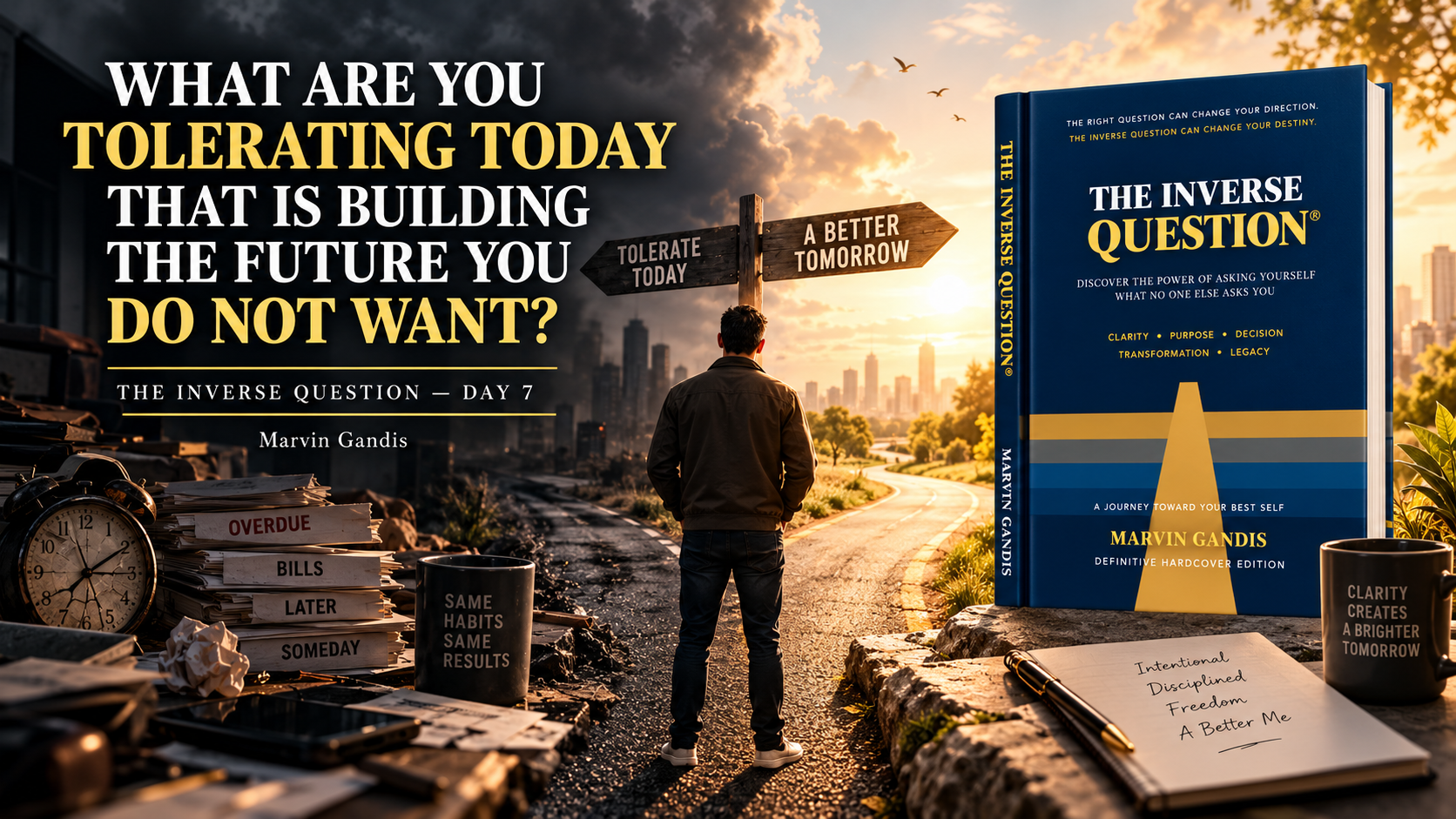
“What you repeatedly tolerate can quietly become part of the future you eventually inherit.”
— Marvin Gandis
Not every problem enters our life dramatically.
Some arrive slowly.
A habit we excuse.
A boundary we fail to establish.
A pattern we know is unhealthy.
A conversation we keep postponing.
A financial decision we continue repeating.
A level of disorder we accept.
A situation we keep telling ourselves we will fix later.
At first, it may seem small.
Manageable.
Temporary.
But what we tolerate repeatedly can become normal.
And what becomes normal can eventually become part of our identity, our environment, our relationships, our finances, our health, and our future.
That is why Day 7 of The Inverse Question asks something uncomfortable but necessary:
What are you accepting today that your future self may eventually have to pay for?
TOLERANCE IS NOT ALWAYS KINDNESS
We are often taught that tolerance is a virtue.
And in many situations, it is.
Patience matters.
Understanding matters.
Compassion matters.
Grace matters.
But there is a difference between being patient with people and becoming passive toward patterns that repeatedly harm us.
There is a difference between forgiveness and the absence of boundaries.
There is a difference between endurance and unnecessary self-neglect.
There is a difference between understanding a problem and allowing it to continue indefinitely.
Sometimes what we call patience is avoidance.
Sometimes what we call peace is fear of confrontation.
Sometimes what we call loyalty is refusal to admit that something must change.
WHAT WE ACCEPT TEACHES OTHERS WHAT TO EXPECT
Our boundaries communicate.
When we repeatedly accept disrespect without consequence, we may unintentionally teach people that disrespect has no cost.
When we allow deadlines to be ignored, we teach people that our time is flexible.
When we repeatedly rescue someone from responsibilities they refuse to carry, we may help preserve the very behavior we want them to change.
This does not mean becoming harsh.
It means becoming clear.
Healthy boundaries are not punishment.
They are information.
They communicate:
This is acceptable.
This is not.
This is what I am responsible for.
This is what belongs to you.
Clarity can protect relationships better than silent resentment.
✦ THE INVERSE QUESTION ✦
For Day 7, ask yourself:
What are you tolerating today that is quietly building a future you already know you do not want?
Do not answer only with something dramatic.
Look at the ordinary.
What happens repeatedly?
What have you normalized?
What bothers you, but not enough to change?
What do you complain about while continuing to participate in it?
What consequence are you postponing?
What behavior are you rewarding with silence?
What habit are you protecting with excuses?
What are you telling yourself is temporary even though it has been happening for months or years?
That is where this question becomes powerful.
SMALL TOLERANCES CAN CREATE LARGE CONSEQUENCES
A small spending habit may seem insignificant.
Repeated for years, it can become financial instability.
A small health warning may seem easy to ignore.
Repeated neglect can become a larger problem.
A small delay in an important project may feel harmless.
Repeated postponement can become a lost opportunity.
A small communication problem may seem easier to avoid.
Repeated avoidance can create emotional distance.
A small compromise with integrity may seem private.
Repeated compromise can reshape character.
The danger is not always the size of the first decision.
The danger is repetition.
WE OFTEN TOLERATE WHAT WE FEAR CHANGING
Why do we remain in situations we dislike?
Sometimes because change has a cost.
We may fear:
Conflict.
Rejection.
Financial uncertainty.
Loneliness.
Failure.
Embarrassment.
Criticism.
Starting over.
Disappointing someone.
Admitting we were wrong.
So we choose the familiar discomfort over the unfamiliar possibility.
That is human.
But familiar pain is still pain.
And avoiding short-term discomfort can sometimes create long-term consequences.
TEMPORARY DISCOMFORT CAN PROTECT YOUR FUTURE
Some of the best decisions feel uncomfortable at first.
Saying no.
Ending an unhealthy commitment.
Creating a budget.
Setting a boundary.
Apologizing.
Leaving a destructive pattern.
Asking for help.
Admitting that a strategy is not working.
Removing a distraction.
Having the conversation you have avoided.
The discomfort may be temporary.
The benefit may last much longer.
The reverse is also true.
Temporary comfort can create long-term difficulty.
TOLERANCE AND MONEY
Financial problems rarely begin with one dramatic purchase.
They often begin with repeated permissions.
“I deserve this.”
“I will deal with it later.”
“It is only a small amount.”
“I will start saving next month.”
“I can always earn more.”
Individually, those thoughts may seem harmless.
Repeated often enough, they become a financial philosophy.
A better question is:
What financial behavior am I tolerating today that could become expensive tomorrow?
That may involve spending.
Debt.
Lack of savings.
Failure to track money.
Ignoring fees.
Avoiding financial education.
Depending on one source of income.
The goal is not guilt.
It is awareness.
TOLERANCE AND TIME
Time disappears differently from money.
Money can sometimes be recovered.
Time cannot.
Yet many people protect money more carefully than time.
We tolerate:
Endless scrolling.
Meetings without purpose.
Constant interruptions.
Unnecessary obligations.
Repeated procrastination.
Hours of entertainment we did not consciously choose.
We say:
“I do not have time.”
But sometimes the better question is:
“What am I allowing to consume the time I already have?”
That question may reveal more than the clock ever will.
TOLERANCE AND RELATIONSHIPS
Relationships require patience.
People make mistakes.
We all need grace.
But healthy relationships also require truth.
If resentment grows because something important is never discussed, silence is not peace.
If one person repeatedly violates trust and nothing changes, tolerance alone may not repair the relationship.
If one person carries every responsibility while the other refuses accountability, imbalance can become normal.
A healthier question may be:
What conversation have I avoided because I am afraid of what honesty may require?
Some relationships improve through honest boundaries.
Others reveal their true condition when boundaries finally appear.
Either way, clarity matters.
TOLERANCE AND SELF-RESPECT
We often think self-respect is about confidence.
It is also about standards.
What do you allow yourself to repeatedly do?
How do you speak to yourself?
What promises do you continually break to yourself?
What excuses do you keep accepting?
What environment do you keep returning to?
What behavior do you know is beneath the person you want to become?
Self-respect grows when your choices begin to reflect what you claim matters.
✦ THE MIRROR ✦
Choose one area of your life.
Complete these sentences honestly:
Something I keep tolerating is: __________
I have tolerated it because: __________
The immediate comfort I receive from not changing it is: __________
The long-term cost may be: __________
The boundary or decision I know I need is: __________
The first action I can take is: __________
Now ask:
If nothing changed for the next three years, would I be willing to live with the result?
If the answer is no, the situation deserves attention now.
YOUR FUTURE IS BEING TRAINED BY YOUR PRESENT STANDARDS
Standards become habits.
Habits become patterns.
Patterns become outcomes.
You do not need perfection.
But you do need awareness.
Every time you say:
“This is good enough.”
you are defining something.
Every time you say:
“I will deal with it later.”
you are also making a decision.
Later is built from today.
Future consequences are often the accumulation of present permissions.
NOT EVERYTHING SHOULD BE FIXED IMMEDIATELY
This is important.
Some problems require patience.
Some need professional help.
Some require planning.
Some involve financial limitations.
Some involve safety considerations.
Some need careful timing.
Some cannot be solved quickly.
The lesson is not:
“Change everything today.”
The lesson is:
Stop pretending that something is acceptable when you already know it is not.
Recognition comes before strategy.
Clarity comes before change.
ACCEPTANCE OF REALITY IS DIFFERENT FROM ACCEPTANCE OF DEFEAT
There are things we cannot control.
Aging.
Past events.
Other people’s choices.
Economic conditions.
Unexpected loss.
Natural limitations.
Acceptance can be healthy when it means acknowledging reality.
But acceptance becomes dangerous when it becomes resignation toward something we can still influence.
The question is:
What must I accept?
and separately:
What must I stop accepting?
Wisdom lives in knowing the difference.
THE FUTURE IS OFTEN BUILT QUIETLY
Most futures are not created by one dramatic decision.
They are built through ordinary repetition.
What you eat repeatedly.
What you spend repeatedly.
What you say repeatedly.
What you avoid repeatedly.
What you tolerate repeatedly.
What you practice repeatedly.
That is why small decisions deserve respect.
They may be small today.
They may not remain small forever.
YOU DO NOT HAVE TO WAIT FOR A CRISIS
Many people change only when pain becomes unbearable.
Financial crisis.
Health scare.
Relationship breakdown.
Burnout.
Lost opportunity.
Major failure.
But crisis does not have to be the first teacher.
Awareness can teach earlier.
You are allowed to respond to the warning before it becomes an emergency.
That is maturity.
THE COST OF “JUST THIS ONCE”
Almost every repeated pattern began once.
Just this once.
I will skip it today.
I will buy it this time.
I will ignore it again.
I will delay it until tomorrow.
I will let this slide.
One decision may not define you.
But repeated permission can.
That is why we should examine what follows the phrase:
“Just this once.”
Sometimes it becomes a doorway.
YOUR ENVIRONMENT ALSO TRAINS YOUR TOLERANCE
What surrounds you influences what begins to feel normal.
If everyone around you complains constantly, complaining can feel normal.
If everyone overspends, overspending can feel normal.
If everyone ignores commitments, unreliability can feel normal.
If everyone grows, learns, and takes responsibility, that can also feel normal.
Environment changes standards.
Ask:
What has my environment trained me to accept?
That question can reveal invisible influences.
SAYING “NO” CAN BE AN ACT OF STEWARDSHIP
Every yes costs something.
Time.
Energy.
Attention.
Money.
Focus.
Opportunity.
That means saying no is not always rejection.
Sometimes it is stewardship.
No to distraction.
No to unnecessary commitments.
No to unhealthy pressure.
No to manipulation.
No to a pattern that repeatedly damages your future.
Protecting what matters requires limits.
THE HARDEST TOLERANCE TO RECOGNIZE MAY BE YOUR OWN
It is easy to identify what others should change.
Harder to identify what we tolerate from ourselves.
We excuse our own procrastination.
Our inconsistency.
Our poor planning.
Our avoidance.
Our lack of preparation.
Our broken promises.
Our repeated distractions.
We may demand standards from the world that we do not require from ourselves.
That deserves reflection.
PERSONAL RESPONSIBILITY DOES NOT REQUIRE SELF-CONDENMATION
There is a difference between accountability and self-attack.
Accountability says:
“This needs to change.”
Self-condemnation says:
“I am a failure.”
Those are not the same message.
A behavior can be wrong without your entire identity becoming wrong.
A decision can be corrected.
A habit can be replaced.
A boundary can be established.
A new pattern can begin.
The purpose of reflection is not punishment.
It is direction.
THE STANDARD YOU KEEP BECOMES THE LIFE YOU BUILD
Think carefully about that.
Your standards affect:
Your finances.
Your work.
Your relationships.
Your health.
Your time.
Your integrity.
Your home.
Your business.
Your future.
Raise a standard, and behavior begins to change.
Change behavior consistently, and results begin to change.
The process may take time.
But the direction has changed.
MY DEAR READER AND FRIEND
There may be something in your life right now that you already know needs attention.
You have thought about it.
Complained about it.
Prayed about it.
Delayed it.
Explained it.
Maybe even promised yourself you would address it.
Do not begin with everything.
Choose one thing.
One tolerated pattern.
One unnecessary compromise.
One boundary.
One habit.
One conversation.
One responsibility.
Ask:
What would respecting my future require me to do differently today?
Then begin there.
WHAT ARE YOU TOLERATING TODAY THAT IS BUILDING THE FUTURE YOU DO NOT WANT?
You do not have to become harsh.
You do not have to become impatient.
You do not need to control everything.
But you should become intentional about what you repeatedly permit.
Because tolerance is not neutral.
It teaches.
It reinforces.
It normalizes.
It builds.
So ask yourself:
If this continues unchanged, where will it eventually lead me?
If you do not like that destination, today’s decision matters.
With gratitude,
Marvin Gandis
Author of La Pregunta Inversa and The Inverse Question
CONTINUE THE JOURNEY
This is Day 7 of The Inverse Question English series.
Day 1: Today Begins a New Chapter
Day 2: Why Did I Write The Inverse Question?
Day 3: The Question That Changed the Way I Think
Day 4: Maybe You Have Been Looking for Answers to the Wrong Question
Day 5: The Roots No One Sees Determine the Fruit Everyone Sees
Day 6: Not Everything That Looks Like Progress Is Moving You Forward
Day 7: What Are You Tolerating Today That Is Building the Future You Do Not Want?
Next:
Day 8 — Do Not Confuse Movement With Direction
Because moving constantly is not the same as moving intentionally.
DISCLAIMER
This article is provided for educational, informational, motivational, and personal-reflection purposes only. It does not constitute medical, psychological, mental-health, legal, financial, relationship, business, or other professional advice.
The discussion of boundaries, habits, relationships, finances, health, and personal responsibility is general and may not apply to every circumstance. Some situations, especially those involving personal safety, abuse, serious health concerns, financial hardship, or legal issues, may require qualified professional support.
No specific personal, financial, professional, relationship, health, business, or life outcome is promised or guaranteed.
Readers should evaluate their individual circumstances carefully and obtain appropriate professional guidance when necessary. The Inverse Question series is intended to encourage reflection, awareness, responsible decision-making, personal growth, and independent judgment.

Debe estar conectado para enviar un comentario.