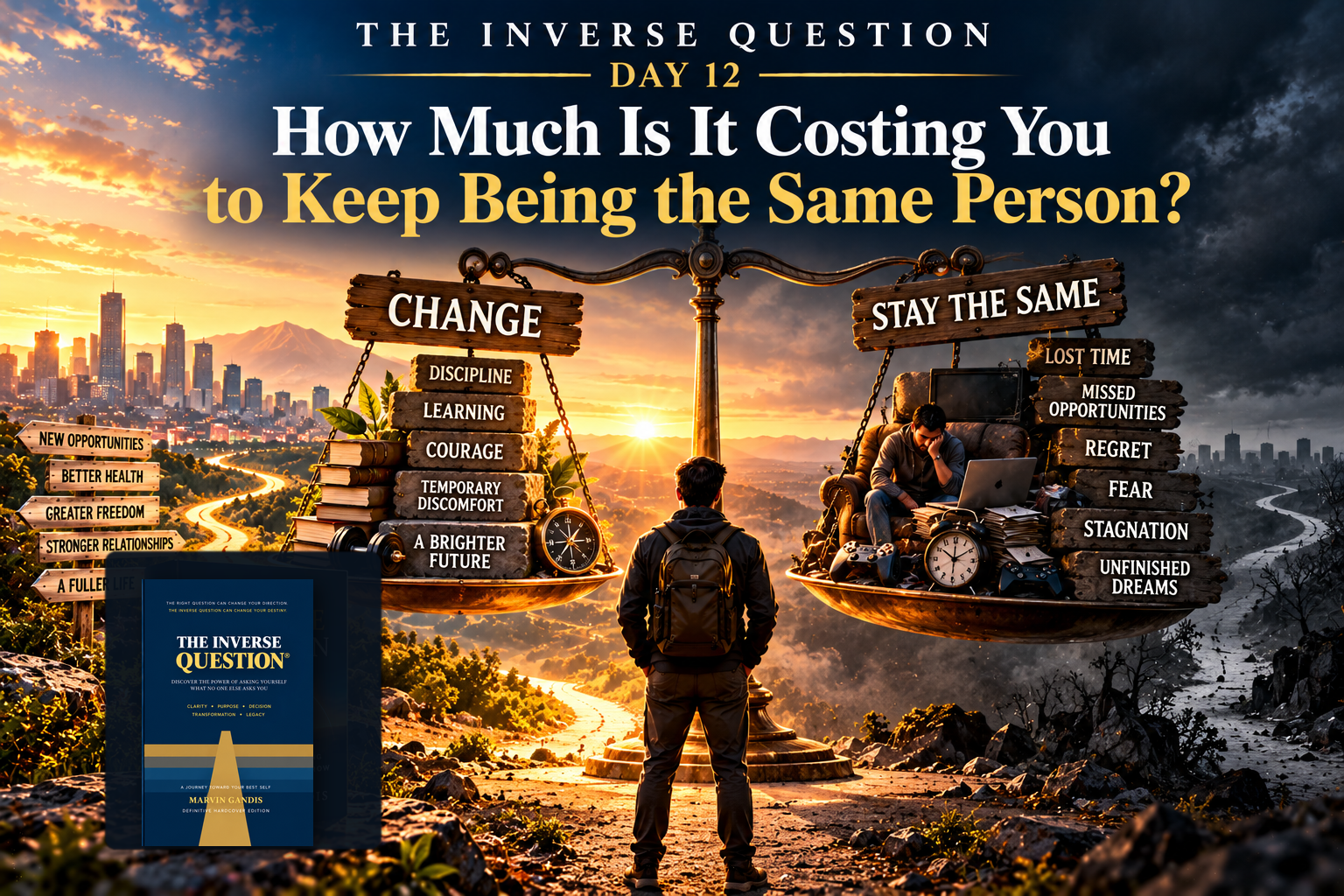
“Sometimes the greatest cost in life is not what change demands from us, but what staying the same quietly takes away.”
— Marvin Gandis
Change has a price.
It may require discipline.
It may require discomfort.
It may require admitting something isn’t working.
It may require learning something new.
It may require leaving familiar routines.
It may require saying no.
It may require starting over.
Because of that, we often focus on the cost of change.
But we rarely calculate another cost.
The cost of staying the same.
The opportunities we miss.
The habits we continue.
The relationships we neglect.
The financial patterns we tolerate.
The health decisions we postpone.
The projects we never begin.
The confidence we never build.
The person we never become.
That is why Day 12 of The Inverse Question asks:
How much is it costing you to keep being the same person?
WE USUALLY CALCULATE THE PRICE OF CHANGE
Suppose you want to improve your financial life.
You immediately notice the cost.
You may need to spend less.
Save more.
Track expenses.
Learn.
Delay purchases.
Change habits.
That feels like sacrifice.
Suppose you want to become healthier.
You notice the cost again.
Time.
Exercise.
Planning.
Better food choices.
Consistency.
Discomfort.
Suppose you want to build a business.
More cost.
Learning.
Risk.
Patience.
Rejection.
Uncertainty.
Effort.
We see those prices clearly.
What we often fail to calculate is:
What will it cost if nothing changes?
That question can completely alter the decision.
THE COST OF STAYING THE SAME IS OFTEN DELAYED
Immediate costs are easy to notice.
Delayed costs are more dangerous.
You buy something today.
The pleasure is immediate.
The financial consequence may appear later.
You avoid exercise today.
Comfort is immediate.
The physical consequence may take years.
You postpone a difficult conversation.
Relief is immediate.
Distance may grow slowly.
You avoid learning a new skill.
There is no immediate penalty.
But future opportunities may shrink.
Because delayed consequences arrive quietly, we underestimate them.
✦ THE INVERSE QUESTION ✦
For Day 12, ask yourself:
If I continue exactly as I am for the next five years, what will this pattern cost me?
Think carefully.
Not only financially.
Ask about:
Time.
Health.
Energy.
Relationships.
Opportunities.
Confidence.
Peace.
Reputation.
Skills.
Freedom.
Purpose.
What is the future price of remaining unchanged?
FAMILIAR DOES NOT MEAN FREE
We stay with familiar patterns because they feel comfortable.
But comfort is not the same as absence of cost.
A familiar financial habit may cost money.
A familiar relationship pattern may cost peace.
A familiar work routine may cost opportunity.
A familiar fear may cost growth.
A familiar excuse may cost years.
The fact that something feels normal does not make it harmless.
That is an important distinction.
THE COST OF PROCRASTINATION IS NOT ONLY TIME
We often describe procrastination as delay.
But delay has secondary costs.
Every postponed task remains mentally open.
It takes space.
Creates pressure.
Builds guilt.
Reduces confidence.
Limits options.
Makes future work more urgent.
The cost is not merely:
- “I lost two hours.”
It may be:
- “I trained myself again to avoid what matters.”
That is a much higher cost.
THE COST OF POOR FINANCIAL HABITS COMPOUNDS
Small financial habits become powerful through repetition.
One unnecessary purchase may not matter.
Hundreds can.
One month without saving may not change your future.
Years might.
One fee ignored may seem minor.
Repeated fees become expensive.
One decision to delay financial education may feel harmless.
A decade of avoidance can become costly.
The question becomes:
How much future freedom am I exchanging for present convenience?
That is worth calculating honestly.
THE COST OF STAYING UNHEALTHY IS NOT ONLY MEDICAL
Health influences more than the body.
It influences energy.
Mood.
Mobility.
Independence.
Productivity.
Relationships.
Confidence.
The ability to enjoy what we build.
Again, no one controls every health outcome.
Many factors are beyond personal choice.
But where choices do matter, postponement still has a cost.
The question is not:
- “Can I guarantee perfect health?”
Of course not.
It is:
“Am I doing what is reasonably within my control?”
THE COST OF AVOIDING DIFFICULT CONVERSATIONS
Silence can feel peaceful.
But unresolved tension continues working underneath.
We postpone the conversation because we want to avoid conflict.
Yet avoidance can produce:
Resentment.
Confusion.
Distance.
Assumptions.
Loss of trust.
Emotional exhaustion.
The conversation we refuse to have today may become a larger problem tomorrow.
Sometimes honesty is expensive.
But prolonged avoidance can be more expensive.
THE COST OF STAYING IN THE WRONG DIRECTION
Day 8 asked us not to confuse movement with direction.
Day 12 asks something deeper.
What if you already know the direction is wrong?
How long will you keep traveling because turning feels uncomfortable?
Every additional mile creates more distance to correct.
This applies to:
Careers.
Businesses.
Relationships.
Habits.
Financial strategies.
Goals.
Commitments.
The longer we stay only because we have already invested time, the more expensive the correction may become.
✦ THE MIRROR ✦
Choose one area of your life where you know change is needed.
Complete these sentences:
The pattern I keep repeating is: __________
I continue because: __________
The immediate comfort I receive is: __________
The long-term cost may be: __________
If this continues for five years, I may lose: __________
If I begin changing now, I may gain: __________
The first uncomfortable action I need to take is: __________
Now ask:
Which is more expensive: the discomfort of changing, or the cost of remaining the same?
That is the central question of Day 12.
CHANGE DOES NOT ALWAYS REQUIRE A DRAMATIC DECISION
We often imagine change as something enormous.
Quit everything.
Move somewhere else.
Transform overnight.
Start over completely.
But meaningful change can begin much smaller.
Save twenty dollars.
Walk ten minutes.
Read five pages.
Make one phone call.
Say one honest sentence.
Apply for one opportunity.
Remove one distraction.
Create one boundary.
Complete one unfinished task.
Change is often less about one dramatic leap and more about changing repeated direction.
STAYING THE SAME CAN DAMAGE SELF-TRUST
There is another hidden cost.
Every time we repeatedly tell ourselves:
- “I will change.”
and then do nothing, something happens.
We begin believing our own promises less.
That reduces self-trust.
Then future goals feel harder because part of us expects another abandonment.
Rebuilding self-trust begins by keeping smaller promises.
Not impressive promises.
Reliable ones.
THE COST OF FEAR IS OFTEN INVISIBLE
Fear protects us from risk.
That can be useful.
But fear can also become expensive when it prevents appropriate action.
Fear may cost:
A conversation.
A business idea.
A job application.
A relationship.
A creative project.
A new skill.
A necessary boundary.
A chance to begin again.
We often ask:
- “What if I fail?”
But another question deserves equal attention:
“What if I never try?”
Both outcomes have consequences.
THE COST OF COMPARISON
Comparison can consume enormous energy.
Watching other people’s progress.
Income.
Audience.
Lifestyle.
Career.
Relationships.
Success.
Meanwhile, your own work waits.
The cost is not only emotional.
It is practical.
Attention given to comparison is attention not given to creation.
Ask:
What could I build with the energy I currently spend comparing?
That can be a powerful redirection.
THE COST OF CONSTANT DISTRACTION
A few minutes here.
A few minutes there.
Notifications.
Scrolling.
Videos.
Random browsing.
Individually, they seem harmless.
But attention is cumulative.
Imagine losing ninety minutes per day.
That is more than ten hours per week.
Hundreds of hours per year.
The cost of distraction is rarely felt in the moment.
It is felt in the work that never gets done.
THE COST OF REFUSING TO LEARN
The world changes.
Technology changes.
Markets change.
Industries change.
Skills lose value.
New opportunities appear.
Refusing to learn may feel comfortable today.
But comfort can become vulnerability tomorrow.
Learning requires effort.
Not learning can eventually require much more.
THE COST OF PRIDE
Pride can be expensive.
It keeps us from admitting:
I was wrong.
I need help.
I do not understand.
My strategy failed.
Someone else knows more.
I need to apologize.
I need to change.
Humility may feel uncomfortable.
But pride can cost relationships, money, time, and opportunity.
Sometimes the cheapest sentence in life is:
- “I was wrong.”
THE COST OF WEAK BOUNDARIES
Saying yes feels easier than disappointing someone.
But repeated yeses create costs.
Lost time.
Resentment.
Stress.
Exhaustion.
Reduced focus.
Neglected priorities.
A boundary may create temporary discomfort.
The absence of boundaries may create permanent disorder.
THE COST OF NOT FINISHING
Starting feels exciting.
Finishing is different.
Finishing requires persistence after novelty disappears.
Unfinished projects carry costs.
Money spent.
Time invested.
Mental clutter.
Lost confidence.
Missed opportunity.
Sometimes completing one old commitment creates more progress than starting five new ones.
STAYING THE SAME CAN BECOME AN IDENTITY
This is where Day 12 connects directly with Days 10 and 11.
You repeat the same behavior.
Then you say:
“That is just how I am.”
Now behavior becomes identity.
Once that happens, change feels like betrayal of self.
But “how I am” may simply mean:
- “What I have practiced for a long time.”
Practice can change.
Patterns can change.
Identity can evolve.
THE PRICE OF CHANGE OFTEN DECREASES WHEN WE BEGIN EARLY
Problems rarely become cheaper through neglect.
Debt grows.
Skills become outdated.
Relationships deteriorate.
Health problems may become more difficult.
Opportunities pass.
Projects accumulate.
Changing early may be uncomfortable.
Changing late may be much harder.
That is why awareness is valuable.
It allows intervention before crisis.
YOU ARE ALREADY PAYING A PRICE
This is one of the most important ideas in Day 12.
Sometimes we act as though there are two options:
Change and pay a price.
Or stay the same for free.
But often that is not the real choice.
The real choice is:
Which price are you willing to pay?
The cost of discipline?
Or the cost of regret?
The cost of learning?
Or the cost of being unprepared?
The cost of boundaries?
Or the cost of resentment?
The cost of saving?
Or the cost of financial vulnerability?
The cost of difficult truth?
Or the cost of prolonged denial?
Every path has a price.
Choose consciously.
WHAT IS STAYING THE SAME PREVENTING YOU FROM BECOMING?
There is another type of cost.
Opportunity cost.
Every hour spent on one thing cannot also be spent somewhere else.
Every identity we protect can prevent another one from emerging.
If you remain:
The person who never takes risks,
you may never discover what courage could build.
If you remain:
The person who avoids money,
you may never develop financial confidence.
If you remain:
The person who never finishes,
you may never experience the identity of a finisher.
Staying the same does not only preserve the present.
It can block the future.
MY DEAR READER AND FRIEND
Perhaps there is something you already know.
You know what habit needs attention.
You know what conversation needs to happen.
You know what skill you should learn.
You know what financial behavior needs correction.
You know what project you need to finish.
You know where you are making excuses.
The question may no longer be:
- “Should I change?”
It may be:
“How much longer am I willing to pay for not changing?”
That answer belongs to you.
But it deserves honesty.
HOW MUCH IS IT COSTING YOU TO KEEP BEING THE SAME PERSON?
Change has a price.
But so does avoidance.
Growth has a price.
But so does stagnation.
Discipline has a price.
But so does regret.
Courage has a price.
But so does fear.
Do not calculate only what change will cost you.
Calculate what staying the same has already cost.
Then ask:
What will another year of this pattern cost me?
Sometimes that question makes the next decision much clearer.
With gratitude,
Marvin Gandis
Author of La Pregunta Inversa and The Inverse Question
CONTINUE THE JOURNEY
This is Day 12 of The Inverse Question English series.
Day 1: Today Begins a New Chapter
Day 2: Why Did I Write The Inverse Question?
Day 3: The Question That Changed the Way I Think
Day 4: Maybe You Have Been Looking for Answers to the Wrong Question
Day 5: The Roots No One Sees Determine the Fruit Everyone Sees
Day 6: Not Everything That Looks Like Progress Is Moving You Forward
Day 7: What Are You Tolerating Today That Is Building the Future You Do Not Want?
Day 8: Do Not Confuse Movement With Direction
Day 9: What Are You Doing Today That Your Future Self Will Thank You For?
Day 10: Who Are You Becoming Through the Choices You Repeat Every Day?
Day 11: What Are You Rehearsing Every Day That Is Quietly Becoming Your Identity?
Day 12: How Much Is It Costing You to Keep Being the Same Person?
Next:
Day 13 — What Part of Your Future Are You Trading Away for Today’s Comfort?
Because comfort feels inexpensive in the moment, but sometimes its real price is paid much later.
DISCLAIMER
This article is provided for educational, informational, motivational, and personal-reflection purposes only. It does not constitute medical, psychological, mental-health, legal, financial, investment, business, career, relationship, or other professional advice.
The examples regarding habits, finances, health, relationships, fear, career decisions, personal growth, and change are general and may not apply equally to every person or circumstance.
Significant personal, health, financial, legal, employment, relationship, or psychological decisions should be evaluated carefully according to your circumstances and, when appropriate, with qualified professional guidance.
No specific personal, professional, financial, business, relationship, health, or life outcome is promised or guaranteed.
The Inverse Question series is intended to encourage thoughtful reflection, awareness, responsible decision-making, learning, intentional growth, and independent judgment.

Debe estar conectado para enviar un comentario.