Publicado en Emotional Intelligence, Faith, Mindset, Personal Development, Personal Growth, Productivity

The Danger of Living in Reaction to Everything

By Marvin Gandis

When Your Life Becomes a Constant Response

Some people do not live with direction. They live in reaction.

  • They react to problems.
  • They react to the news.
  • They react to comments.
  • They react to criticism.
  • They react to fear.
  • They react to debt.
  • They react to emotions.
  • They react to what others do, say, or post.

Little by little, their lives stop being guided by purpose and start being controlled by pressure.

The problem is not responding when something important happens. Life requires attention, responsibility, and action. The problem begins when everything outside you starts deciding your mood, your focus, your decisions, and your peace.

The person who lives reacting to everything eventually loses authority over their own life.

And recovering that authority is one of the most important decisions for living with clarity, faith, and purpose.


Reacting Is Not the Same as Responding

Reacting is acting from impulse.

Responding is acting from wisdom.

Reaction is usually fast, emotional, and poorly considered. Response requires pause, discernment, and direction.

Reaction says:
“I feel attacked, so I will attack.”

Response says:
“I will think before I speak.”

Reaction says:
“I am afraid, so I will make a desperate decision.”

Response says:
“I will evaluate the situation calmly.”

Reaction says:
“Someone ignored me, so I will give up.”

Response says:
“I will not measure my value by an external reaction.”

Maturity does not mean you do not feel. It means you do not allow every emotion to take the wheel.


The World Is Designed to Provoke Reactions

Many digital platforms live by capturing your attention.

  • The more you react, the longer you stay connected.
  • The more upset you become, the more you keep watching.
  • The more fear you feel, the more content you consume.
  • The more you compare, the more you keep checking.
  • Urgent news.
  • Alarming headlines.
  • Offensive comments.
  • Pressure-based offers.
  • Perfect-looking posts.
  • Endless debates.
  • Exaggerated promises.

Everything seems to shout: “React now!”

But not everything deserves your immediate response.

Some things only want your energy, not your growth.

That is why a wise person learns to ask:

“Does this deserve my attention, or is it only trying to steal my peace?”


Living in Reaction Exhausts the Mind

When you react to everything, your mind never rests.

  • One message upsets you.
  • One news story worries you.
  • One comparison discourages you.
  • One criticism consumes you.
  • One debt makes you desperate.
  • One problem paralyzes you.

Then you live in a constant state of alert.

An exhausted mind makes worse decisions.

  • It decides from fear.
  • It speaks from frustration.
  • It buys under pressure.
  • It posts from anxiety.
  • It quits from exhaustion.
  • It promises from emotion.

Mental exhaustion does not always come from working too much. Sometimes it comes from allowing too many things to control your inner life.


Reaction Makes You Lose Direction

When you live in reaction, your priorities become disordered.

  • Today, you follow a plan.
  • Tomorrow you change because you saw something new.
  • Then you quit because someone criticized you.
  • Then you get distracted because others seem to be moving faster.
  • Later, you become desperate because the results are taking time.

This turns your life into a series of movements without direction.

But a life with purpose cannot depend on every emotion of the day.

You need a center.

  • A vision.
  • Faith.
  • A plan.
  • A set of values.
  • A clear reason to continue.

Direction does not remove problems, but it prevents every problem from dragging you away.


Not Every Urgency Is Important

One of the modern traps is confusing urgency with importance.

Something can feel urgent and still not be valuable.

  • A notification can wait.
  • Someone’s opinion can wait.
  • An argument can wait.
  • A comparison can be ignored.
  • A pressure-based offer can be evaluated.
  • A negative comment may not deserve a response.

Important things do not always shout.

Sometimes the important things are quiet:

  • Your health.
  • Your family.
  • Your faith.
  • Your discipline.
  • Your learning.
  • Your rest.
  • Your strategy.
  • Your character.
  • Your relationship with God.
  • Your purpose.

If you only respond to what feels urgent, you may neglect what is truly important.


Emotions Are Signals, Not Rulers

Emotions have value.

  • Fear can alert you.
  • Sadness can show you a wound.
  • Frustration can reveal something that needs attention.
  • Joy can confirm something good.
  • Uneasiness can invite you to review.

But emotions should not rule every decision.

  • Feeling fear does not always mean you should stop.
  • Feeling tired does not always mean you should quit.
  • Feeling angry does not always mean you should speak.
  • Feeling doubt does not always mean you should abandon.
  • Feeling pressure does not always mean you should act quickly.

Emotions should be heard, but not always obeyed.

Wisdom means recognizing what you feel without becoming a slave to what you feel.


The Pause Can Save Your Decisions

One of the most powerful tools for stopping reaction-based living is learning to pause.

  • Pause before answering a difficult message.
  • Pause before making a financial decision.
  • Pause before posting from anger.
  • Pause before quitting.
  • Pause before believing a news story.
  • Pause before comparing yourself.
  • Pause before saying something you cannot take back.

The pause is not a weakness. It is self-control.

A pause can give you time to pray, think, breathe, review, and decide with more clarity.

Many bad decisions are born from emotion without pause.

Many wise decisions are born from a purposeful pause.


Living With Direction Requires Deciding What You Will Not Allow

It is not enough to know what you want. You must also know what you will not allow to control your life.

  • I will not allow every criticism to define my identity.
  • I will not allow every news story to steal my peace.
  • I will not allow every comparison to destroy my gratitude.
  • I will not allow every emotion to rule my decisions.
  • I will not allow every distraction to hijack my purpose.
  • I will not allow fear to decide my future.

This is not arrogance. It is a responsibility.

Your peace needs boundaries.

Your focus needs protection.

Your purpose needs direction.


How to Stop Living in Reaction

First, identify your triggers.

What makes you lose your calm? Criticism? Silence? Comparison? Money? News? Lack of results?

Second, create space before acting.

Breathe. Pray. Walk. Write. Wait. Not everything needs an immediate response.

Third, define your priorities.

When you know what matters, it becomes easier to ignore what distracts.

Fourth, reduce unnecessary noise.

You do not have to consume everything. You do not have to respond to everything. You do not have to know everything.

Fifth, practice self-control.

Self-control does not mean you do not feel. It means you wisely choose how to act.

Sixth, return to your purpose.

When the world gets loud, remember who you are, what you are building, and why you started.


Peace Is Not the Absence of Problems, It Is Inner Government

Many people wait to have peace until everything calms down.

But mature peace may not depend on everything being perfect.

Mature peace is learning not to surrender control of your inner life to every external situation.

  • You can have problems and still think clearly.
  • You can receive criticism and still keep your identity.
  • You can face delays and continue.
  • You can feel fear and still act with faith.
  • You can live in a noisy world and still keep your center.

This kind of peace does not happen by accident.

It is cultivated through faith, discipline, wisdom, boundaries, and direction.


Do Not Hand Over the Wheel of Your Life

My dear reader and friend, not everything happening around you deserves to control what happens inside you.

  • You do not have to react to every comment.
  • You do not have to chase every trend.
  • You do not have to absorb every news story.
  • You do not have to compare yourself with every person.
  • You do not have to respond to every emotion.
  • You can pause.
  • You can think.
  • You can pray.
  • You can choose.
  • You can respond with wisdom.

Living with direction does not mean ignoring reality. It means facing reality without allowing it to destroy your peace, focus, and purpose.

  • Do not live as a constant reaction.
  • Live as a person with center, values, and direction.

Because the person who learns to respond with wisdom recovers authority over their life.


Disclaimer:


This article is provided for educational, motivational, inspirational, and informational purposes only. It is intended to encourage reflection, emotional awareness, self-control, personal growth, faith, mental clarity, and responsible decision-making.

The content should not be interpreted as financial, legal, medical, psychological, spiritual counseling, business, or professional advice. Any examples related to emotional intelligence, personal development, faith, mindset, discipline, productivity, leadership, communication, or life improvement are not guarantees of specific results.

Individual outcomes may vary depending on personal circumstances, effort, consistency, emotional readiness, environment, available resources, support systems, timing, discipline, and other factors beyond our control.

Readers are encouraged to use their own judgment, conduct their own research, and seek qualified professional guidance when necessary. The purpose of this content is to inspire and educate, not to promise instant results or replace professional advice.
Publicado en Communication, Emotional Intelligence, Human Relationships, Motivation, Personal Development, Reflection

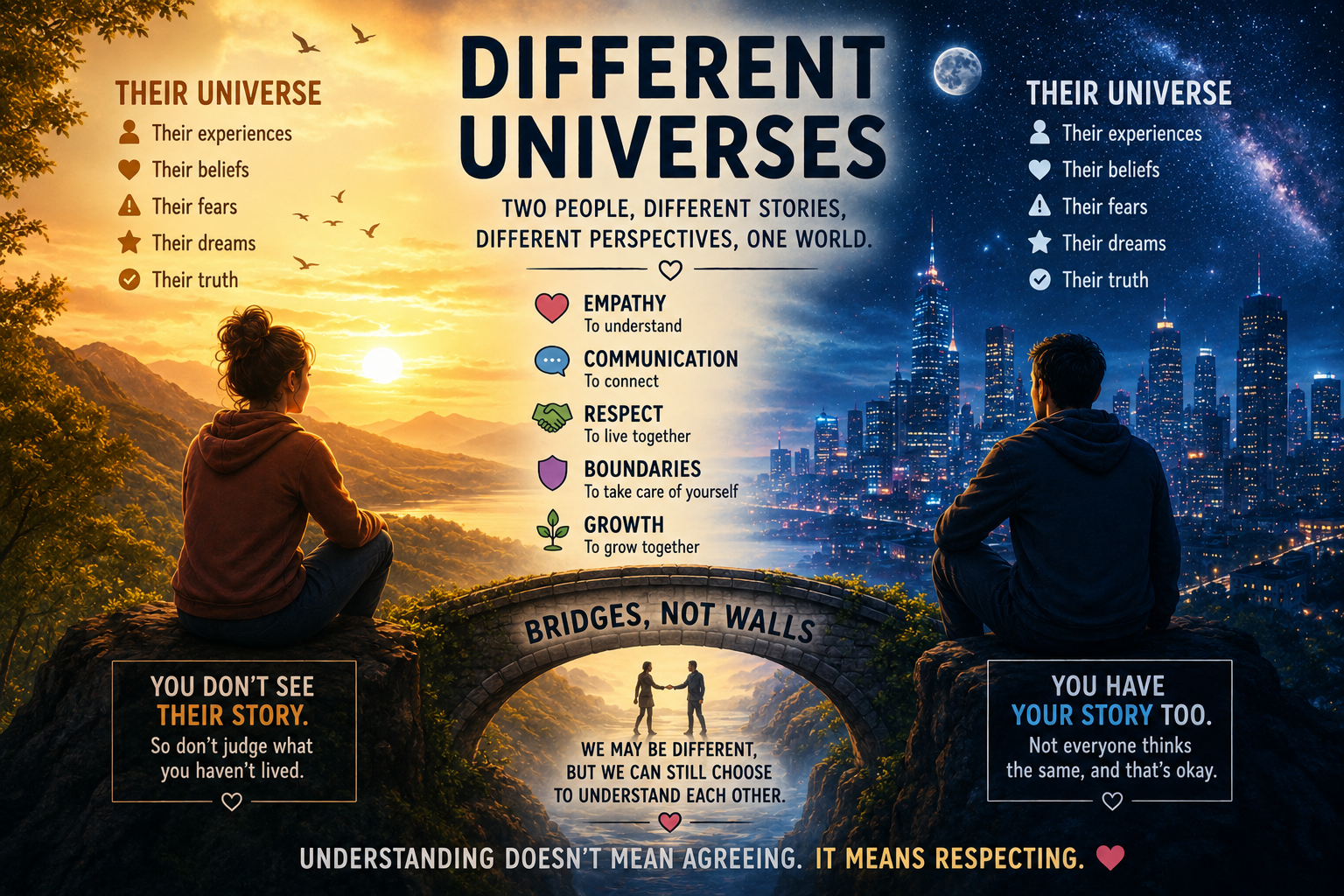
Different Universes: When Two People See Life from Completely Different Worlds

por Marvin Gandis

Introduction: Not Everyone Lives in the Same World

We may walk under the same sky, live on the same planet, and share the same moments in time, but the truth is this: not everyone lives in the same emotional, mental, or spiritual universe.

Some people see opportunity where others see problems. Some people experience silence as peace, while others feel it as rejection. Some people dream big, while others are simply trying to survive the day. Some love openly. Others love carefully because life taught them to protect their hearts.

That is why we can say that every person carries a different universe within.

These are not distant planets or invisible galaxies. These are the experiences, wounds, beliefs, values, dreams, fears, and memories that shape how each human being interprets life.

Many conflicts do not happen because someone is bad. They happen because two people are looking at the same situation from completely different universes.


Every Person Carries an Inner Universe

Every human being is a collection of stories.

What someone believes today did not appear out of nowhere. Their opinions, reactions, boundaries, insecurities, and decisions come from a path you may not fully know.

  • A person who has been betrayed may take longer to trust.
  • A person who grew up with scarcity may fear spending money.
  • A person who has been rejected may interpret correction as criticism.
  • A person who has failed many times may be afraid to try again.

This does not mean every behavior should be excused. But it does mean we should learn to look deeper than the surface.

Sometimes we judge a reaction without knowing the story that created it.

Every person lives inside a universe shaped by experience. When we understand this, we stop reacting with harshness and begin responding with wisdom.


The Problem Is Not Always Difference, But Lack of Understanding

Differences do not destroy relationships. The inability to understand them does.

Two people can think differently and still respect each other. They can disagree and still communicate with maturity. They can have different goals and still support one another.

The problem begins when we believe our universe is the only valid one.

Statements like these create distance:

  • “I am right.”
  • “You are wrong.”
  • “If you don’t think like me, you don’t understand.”
  • “Your way of seeing life makes no sense.”

But maturity begins when we can say:

  • “I don’t see it the same way, but I want to understand you.”
  • “I don’t share your opinion, but I respect your experience.”
  • “I don’t know your pain, but I am willing to listen.”
  • “We have not lived the same life, but we can still learn from each other.”

That attitude changes conversations. It heals wounds. It builds bridges where walls once stood.


Two People Can Look at the Same Thing and See Different Realities

Imagine two people looking at heavy rain.

One says:


“What a sad day.”

The other says:


“What a blessing for the earth.”

They are looking at the same rain, but they are not seeing the same reality.

Why? Because we do not only react to what happens. We react according to what it means to us.

  • For one person, starting over may feel exciting. For another, it may feel terrifying.
  • For one person, being alone may feel peaceful. For another, it may feel painful.
  • For one person, criticism may feel like growth. For another, it may feel like rejection.
  • For one person, change may feel like freedom. For another, it may feel like a loss.

The outside world may be the same, but the inner world changes the interpretation.

That is why, before saying, “You are overreacting,” maybe we should ask:


“What does this mean to you?”

That question can open a door that judgment never could.


Empathy Is the Bridge Between Different Universes

Empathy does not mean agreeing with everything. It means trying to understand where the other person is speaking from.

It is not saying:


“I would do the same thing.”

It is saying:


“I may not experience this the same way, but I understand that it matters to you.”

Empathy is a bridge. It connects worlds that seem far apart.

When a person feels heard, their defenses begin to lower. When they feel respected, they become more open. When they feel understood, they stop fighting so hard for validation.

Many arguments are not truly about finding an immediate solution. They are about being seen, heard, and acknowledged.

Sometimes people do not need you to win a debate. They need to feel that they are not alone in their pain, confusion, or struggle.


Not Everyone Is at the Same Level of Awareness

One of life’s greatest lessons is understanding that not everyone is at the same stage of growth.

  • Some people are awakening.
  • Some are healing.
  • Some are still trapped in old wounds.
  • Some are learning to forgive.
  • Some still do not know how to express what they feel.

You cannot always expect a mature response from someone who is still operating from pain. You cannot force someone to see a truth they are not ready to face.

This does not mean you should allow abuse, manipulation, or disrespect. It means you can set boundaries without hatred.

You can say:

  • “I respect you, but I cannot allow this behavior.”
  • “I understand that you are hurt, but that does not justify hurting me.”
  • “I wish you well, but I need to protect my peace.”
  • “We can think differently, but we cannot treat each other with contempt.”

Maturity is not tolerating everything. Maturity is knowing how to love, understand, and set limits when necessary.


Social Media Has Multiplied Different Universes

Today we are more connected than ever, but not always more united.

Social media allows us to see the thoughts, beliefs, emotions, and opinions of thousands of people. But it has also created echo chambers where each group believes its view is the only correct one.

  • Online, many people do not communicate to understand. They communicate to win.
  • They do not listen to learn. They listen to respond.
  • They do not always seek the truth. They seek applause.

That is why we see so many digital conflicts: cultural, political, religious, personal, and emotional.

But behind every comment is a person. Behind every opinion is a story. Behind every reaction is an inner universe we may not know.

  • Before attacking, we can pause.
  • Before mocking, we can think.
  • Before responding with anger, we can ask ourselves:
    “Am I building a bridge or starting a fire?”

Loving Someone Also Means Learning Their Universe

In personal, family, professional, or romantic relationships, love does not mean the other person thinks exactly like us.

Love also means learning their emotional language.

  • Some people express love with words.
  • Others with actions.
  • Others with time.
  • Others with service.
  • Others with protection.
  • Others with silence because they never learned how to say what they feel.

The mistake is believing everyone loves in the same way.

Sometimes someone does care, but they do not know how to show it in the way you expect. Sometimes, someone is fighting an inner battle while you believe they simply do not care.

That is why communication matters.

  • It is not enough to assume. We must ask.
  • It is not enough to wait. We must express.
  • It is not enough to love. We must learn to love in a way that the other person can recognize.

You Must Also Respect Your Own Universe

Understanding others does not mean abandoning yourself.

Your universe matters too. Your emotions, boundaries, dreams, values, and peace also deserve respect.

Sometimes we try so hard to understand others that we end up justifying what damages us. That is not empathy. That is self-abandonment.

  • You can be understanding without allowing yourself to be destroyed.
  • You can be patient without losing your dignity.
  • You can love without begging.
  • You can listen without carrying responsibilities that do not belong to you.

Respecting your own universe means recognizing:

  • “This affects me.”
  • “This is not healthy for me.”
  • “I need space.”
  • “I also deserve peace.”
  • “My way of feeling is valid too.”

True connection should never require you to disappear so someone else can feel comfortable.


Wisdom Is Learning Without Losing Yourself

Life brings us across people who are very different from us. Some inspire us. Others challenge us. Some heal us. Others teach us boundaries.

Every person can be a teacher, even when the lesson is painful.

  • Some teach you patience.
  • Others teach you discernment.
  • Others teach you not to trust too quickly.
  • Others teach you to open your heart again.
  • Others teach you to choose yourself.

Different universes are not always meant to stay together. Sometimes they cross paths only to teach each other something.

And that is okay.

Not every connection is meant to become permanent. Some people arrive as chapters, not entire books.

Wisdom is learning the lesson without remaining trapped in the pain.


How to Connect with People Who Live in Different Universes

Here are some practical keys:

Listen before responding

Do not listen only to defend yourself. Listen to discover what is behind the words.

Ask honest questions

Questions like “Why is this important to you?” can reveal more than an hour of arguing.

Do not immediately assume negative intention

Sometimes people are not trying to hurt you. They simply do not know how to communicate better.

Communicate your boundaries clearly

Understanding does not remove the need for respect.

Learn to release useless arguments

Not every discussion deserves your energy.

Practice humility

Your way of seeing life may be valid, but it is not the only one.

Protect your peace

You can love people from a distance if their universe has become destructive to yours.


We Can Be Different Without Becoming Enemies

Living in different universes does not have to separate us. It can teach us.

It teaches us that life is bigger than our opinion. That every person carries invisible battles. That empathy can open doors. That respect can heal conversations. That boundaries are also a form of self-love.

We do not have to think the same way to treat each other with dignity. We do not have to share the same story to listen with respect. We do not have to live in the same universe to build a bridge.

Maybe true growth begins when we stop demanding that everyone sees life the way we do and start asking:

  • “What does the world look like from where you are standing?”

Because when we learn to see from another universe, we do not lose our own. We expand it.


Today, before judging someone for thinking differently, pause.

Listen deeper. Ask with humility. Respond with wisdom.

And remember:

A true connection is not born when everyone thinks the same.

It is born when we learn to respect one another,

even when we see life from different universes.


Disclaimer

This article is for educational, motivational, and reflective purposes only. It does not replace professional psychological, medical, legal, spiritual, or personal counseling. Every person and situation is different. If you are experiencing deep emotional conflict, abusive relationships, or situations that affect your well-being, seek qualified professional support.