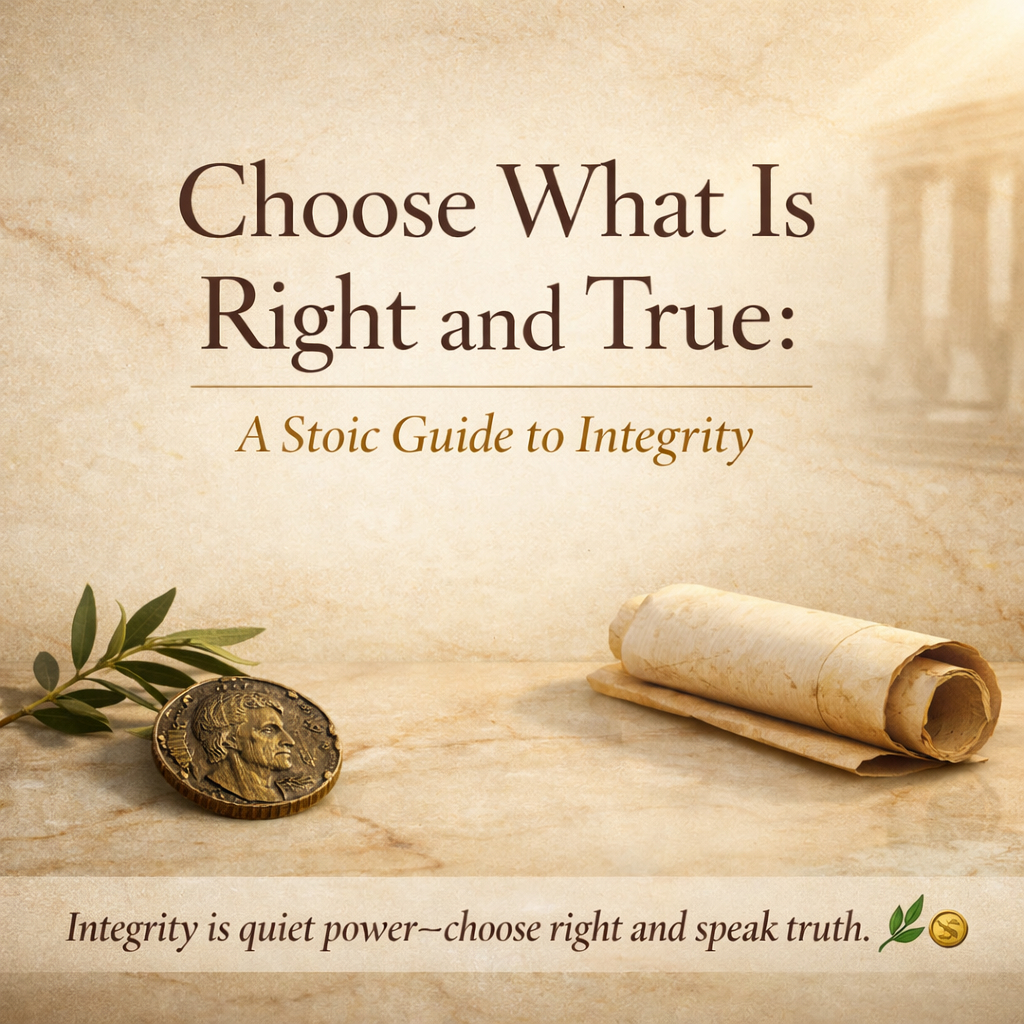
By Marvin Gandis
A Stoic Guide to Integrity, Self-Mastery, and Quiet Power
Stoic reminder: “If it is not right, do not do it; if it is not true, do not say it.” (often attributed to Marcus Aurelius)
Introduction: Why integrity is the real advantage
In a world where people chase attention, speed, and approval, integrity can feel “slow.”
But Stoicism teaches that integrity is not a weakness—it’s a form of quiet power.
Because when your actions and words align with what is right and true, you gain something most people never develop:
- self-respect
- inner stability
- credibility
- peace that doesn’t depend on praise
- clarity under pressure
Integrity is the anchor that keeps your life from drifting with every mood, trend, or opinion.
1) The Stoic meaning of “right” and “true”
For Stoics, “right” isn’t just legality or popularity—it’s virtue.
And “true” isn’t just factual accuracy—it’s truth spoken with wisdom and good intent.
Stoicism emphasizes four core virtues:
- Wisdom – clear thinking and right judgment
- Justice – fairness, honesty, and respect
- Temperance – self-control and restraint
- Courage – the strength to do what’s right even when it costs you
So when the Stoic says, “If it is not right, do not do it,” they mean:
Don’t act against virtue to gain comfort, approval, or advantage.
And when they say: “If it is not true, do not say it,” they mean:
Don’t speak falsehood—or careless half-truths—just to win, impress, or vent.
2) Why most people compromise—and how Stoicism prevents it
People usually compromise integrity for three reasons:
A) Fear
Fear of rejection, conflict, loss, or being misunderstood.
B) Desire
Desire for money, status, attention, or quick reward.
C) Emotional impulse
Anger, pride, resentment, the need to be “right,” or the urge to punish someone with words.
Stoicism trains you to notice those pressures and regain control:
- Pause before reacting
- Identify the temptation (fear, desire, impulse)
- Choose the response that aligns with virtue
✅ Stoic principle:
If you can govern your impulses, you can govern your life.
3) “Truth” without wisdom becomes a weapon
Stoicism doesn’t teach bluntness for its own sake.
You can say something technically true—and still be unwise, cruel, or unnecessary.
A Stoic asks:
- Is it true?
- Is it necessary?
- Is it kind (or at least fair)?
- Is it the right time?
Truth spoken without wisdom becomes ego.
Truth spoken with wisdom becomes leadership.
✅ Stoic takeaway:
Speak truth in service of virtue, not in service of winning.
4) Integrity is how you stay free
Here’s a Stoic paradox:
When you chase approval, you become controlled by it.
When you protect integrity, you become free.
Because integrity means:
- You don’t need to lie to feel safe
- You don’t need to exaggerate to feel important
- You don’t need to betray yourself to belong
The more your decisions depend on what others think, the more you become a prisoner of their opinions.
But when your standard is internal (virtue), you stand on solid ground.
✅ Stoic takeaway:
Freedom is self-government.
5) Practical Stoic tools for daily integrity
Tool 1: The 10-second pause
Before speaking or acting, pause and ask:
“Is this right? Is this true? Is this necessary?”
Tool 2: The “future self” test
Ask:
“Will my future self respect this choice?”
Tool 3: The cost of compromise
Remind yourself:
- a lie buys comfort today, but debt tomorrow
- a wrong action may win fast, but it weakens identity
- a careless word may release emotion, but it damages trust
Tool 4: Replace ego with duty
When tempted to react, say:
“My duty is to be just—not to be loud.”
6) Real-life examples (where this philosophy saves you)
Work / Business
- Don’t promise what you can’t deliver
- Don’t manipulate; communicate clearly
- Don’t cut corners that damage trust
Integrity builds something better than a sale: reputation.
Relationships
- Don’t weaponize truth to punish
- Don’t lie to avoid discomfort
- Speak honestly with calm timing and respect
Personal growth
- Don’t make promises you won’t keep
- Don’t tell yourself stories that excuse quitting
- Tell yourself the truth, then act on it
7) A simple daily practice
At night, write 3 lines:
- Where did I act with integrity today?
- Where did I drift from what is right or true?
- What will I do differently tomorrow?
This is Stoic training: honest reflection without self-hate.
Conclusion: Quiet integrity is the strongest kind of power
You don’t need to win every argument.
You don’t need to impress everyone.
You don’t need to move fast to be effective.
You need alignment.
If it is not right, do not do it.
If it is not true, do not say it.
When your life is built on that foundation, your confidence becomes unshakable—because it’s earned.
Disclaimer
This article is for educational and informational purposes only and does not constitute financial, legal, medical, or professional advice. Results vary based on effort, experience, and circumstances. Always do your own research and consult qualified professionals when needed.
Debe estar conectado para enviar un comentario.