
Publicado en Discipline, Education, Leadership, Motivation, Personal Development, Personal Growth, Self-Improvement, Success Mindset

Preparation Often Creates the Opportunities Others Call Luck 📚

By Marvin Gandis

“Luck” often has a hidden story

Many people look at someone else’s success and say, “They were lucky.” But they rarely see the invisible hours, the quiet sacrifices, the corrected mistakes, the late nights of learning, the difficult decisions, and the discipline that came before the opportunity appeared.

The truth is simple but powerful: preparation often creates the opportunities others call luck.

What looks like a coincidence to some people is often the result of someone being ready. The door opened, yes — but that person already had the key because they had prepared in advance.

Luck may knock once. Preparation helps you recognize it, use it, and multiply it.


Luck favors the prepared

Opportunities may pass in front of many people, but not everyone is able to take advantage of them. Why? Because not everyone is ready.

  • A prepared person sees possibilities where others see problems.
  • A prepared person takes action while others hesitate.
  • A prepared person does not wait for perfect conditions; they use what they have and begin.

For example, two people may receive the same invitation to learn a new skill. One says, “I don’t have time.” The other sets aside 30 minutes a day, studies, practices, and improves. Months later, a job opportunity, project, client, or business idea appears. From the outside, many may say, “They got lucky.” But the truth is that the person was prepared when nobody was watching.

The opportunity was not magic. It was the result of readiness.


Preparation builds confidence

Real confidence does not come only from repeating positive phrases. It comes from knowing you have done the work.

When you study, practice, organize your thoughts, learn from your mistakes, and improve daily, your mind begins to say, “I am ready for this.”

Preparation reduces fear because it gives you direction. It does not remove every nervous feeling, but it allows you to move forward with more certainty.

Fear asks, “What if I fail?”


Preparation answers, “If I fail, I will learn and adjust.”

That mindset changes everything. When an opportunity appears, the prepared person does not freeze. They breathe, think, and act.


Many opportunities arrive disguised as problems

Sometimes we expect opportunities to arrive as something comfortable, beautiful, and easy. But many times, they come as challenges.

  • A family problem can teach responsibility.
  • A financial loss can push you to learn about money.
  • A business failure can teach sales, discipline, and patience.
  • A closed door can force you to build a better door.

Preparation does not mean you will never face difficulty. It means you will have more tools to face it.

An unprepared person may see an obstacle and quit.


A prepared person may see the same obstacle and ask, “What can I learn here?”

That question can open a new path.


Discipline creates a quiet advantage

Preparation does not always look exciting. Sometimes it looks repetitive, slow, and even boring. But that is where the advantage is built.

  • Reading while others waste time.
  • Practicing while others are distracted.
  • Saving while others spend without thinking.
  • Training while others settle.
  • Getting back up after failure while others quit.

Those small actions may seem insignificant in the moment, but over time they create a major difference.

Discipline is a quiet investment. At first, nobody applauds it. Later, everyone notices the results.


Being prepared helps you recognize opportunity

It is not enough for an opportunity to exist. You must also know how to identify it.

Many people miss opportunities because they lack clarity. They do not know what they want, what they are looking for, or how to tell the difference between a distraction and a real possibility.

Preparation gives you vision. It helps you ask better questions:

  • Does this align with my values?
  • Can this help me grow?
  • Does this solve a real problem?
  • Am I willing to learn what is required?
  • Is this an opportunity or just a temporary emotion?

When you are prepared, you do not chase everything. You choose better. And choosing better is part of success.


Preparation turns talent into results

Talent is valuable, but talent alone is not enough.

Some talented people never move forward because they lack discipline. Others may not start with extraordinary skills, but they prepare so consistently that they eventually surpass many others.

  • Talent may give you a starting advantage.
  • Preparation keeps you growing.
  • Consistency takes you further.

In business, education, leadership, communication, faith, family, and daily life, preparation makes a powerful difference.

It is not about being perfect. It is about being willing to improve.


Preparation is also character development

Preparation is not only about learning techniques or strategies. It is also about becoming the kind of person who can handle the opportunity.

  • Preparation means learning patience.
  • Preparation means accepting correction.
  • Preparation means recognizing mistakes.
  • Preparation means controlling emotions.
  • Preparation means speaking with respect.
  • Preparation means honoring commitments.
  • Preparation means developing humility.

Many people want big opportunities, but they have not built the character needed to sustain them.

A big opportunity can become a heavy burden if it arrives too early. That is why some waiting seasons are not punishment; they are training.


Do not confuse waiting with wasted time

Sometimes it feels like nothing is happening. You are learning, practicing, planting, creating, trying — but the results do not arrive quickly.

However, preparation is never wasted time.

  • Every skill you learn may serve you later.
  • Every corrected mistake makes you stronger.
  • Every conversation teaches you something.
  • Every attempt gives you experience.
  • Every small improvement matters.

Preparation works beneath the surface, like the roots of a tree. Nobody sees them, but when the storm comes, the roots are what keep everything standing.


Opportunity arrives, but you must act

Preparation does not mean waiting forever. You must also move.

Some people study too much, plan too much, and never begin. That is not healthy preparation; that can become fear disguised as perfectionism.

Preparation should lead to action.

  • Learn, but apply.
  • Plan, but execute.
  • Dream, but work.
  • Pray, but walk.
  • Research, but decide.

An opportunity without action becomes a memory.


An opportunity with preparation and action can become a transformation.


How to prepare better starting today

You do not need to wait for the perfect moment. You can begin preparing right now with simple steps:

1. Define what you want to improve

You cannot prepare for everything at once. Choose one area: finances, business, health, communication, leadership, spirituality, marketing, education, or personal growth.

2. Create a small routine

You do not need five hours a day. Start with 20 or 30 minutes daily. Consistency is more powerful than occasional intensity.

3. Learn from experienced people

Look for mentors, books, courses, articles, educational videos, or communities that help you grow.

4. Practice what you learn

Information without practice is easily forgotten. Practice turns knowledge into skill.

5. Evaluate your results

Ask yourself: What worked? What should I change? What can I do better next time?

6. Stay humble

The person who believes they already know everything stops growing. Humility keeps the door open to learning.


When opportunity arrives, be ready

Life does not always announce when an opportunity is coming. It may arrive through a conversation, a phone call, an invitation, a crisis, a new contact, an idea, a market need, or a door that opens unexpectedly.

That is why you must prepare before it arrives.

  • Prepare mentally.
  • Prepare emotionally.
  • Prepare spiritually.
  • Prepare professionally.
  • Prepare financially.
  • Prepare with discipline and vision.

Because when opportunity arrives, others may say, “You were lucky.”


But you will know the truth: it was not only luck; it was preparation meeting the right moment.


Luck is often built before it is seen

Preparation does not guarantee that everything will be easy, but it increases your ability to respond wisely when life presents an opportunity.

Do not wait until you feel completely ready. Start preparing today. Every book you read, every skill you practice, every mistake you correct, every positive habit you build, and every responsible decision you make is shaping the person who can handle what is coming.

Opportunity may appear suddenly, but many times it answers consistent preparation.

So keep learning. Keep growing. Keep planting. Keep improving.

Because what others may call luck tomorrow could be the fruit of your preparation today. 📚


Dear reader, do not wait for life to surprise you without tools

Choose one area of your life and begin preparing today. Take one small but firm step. Learn something new, organize your goals, practice a skill, and stay ready.

Opportunity favors the prepared.


Disclaimer

This article is for educational and motivational purposes only. It does not guarantee specific results in business, finances, personal development, or any other area. Every person is responsible for their own decisions, actions, and outcomes. Preparation can increase the possibility of recognizing and using opportunities, but it does not remove risk or replace personal, professional, or financial judgment.
Publicado en Affiliate Marketing, Duplication, Leadership, Marketing Strategy, Network Marketing, Online Business, Personal Development, Team Building

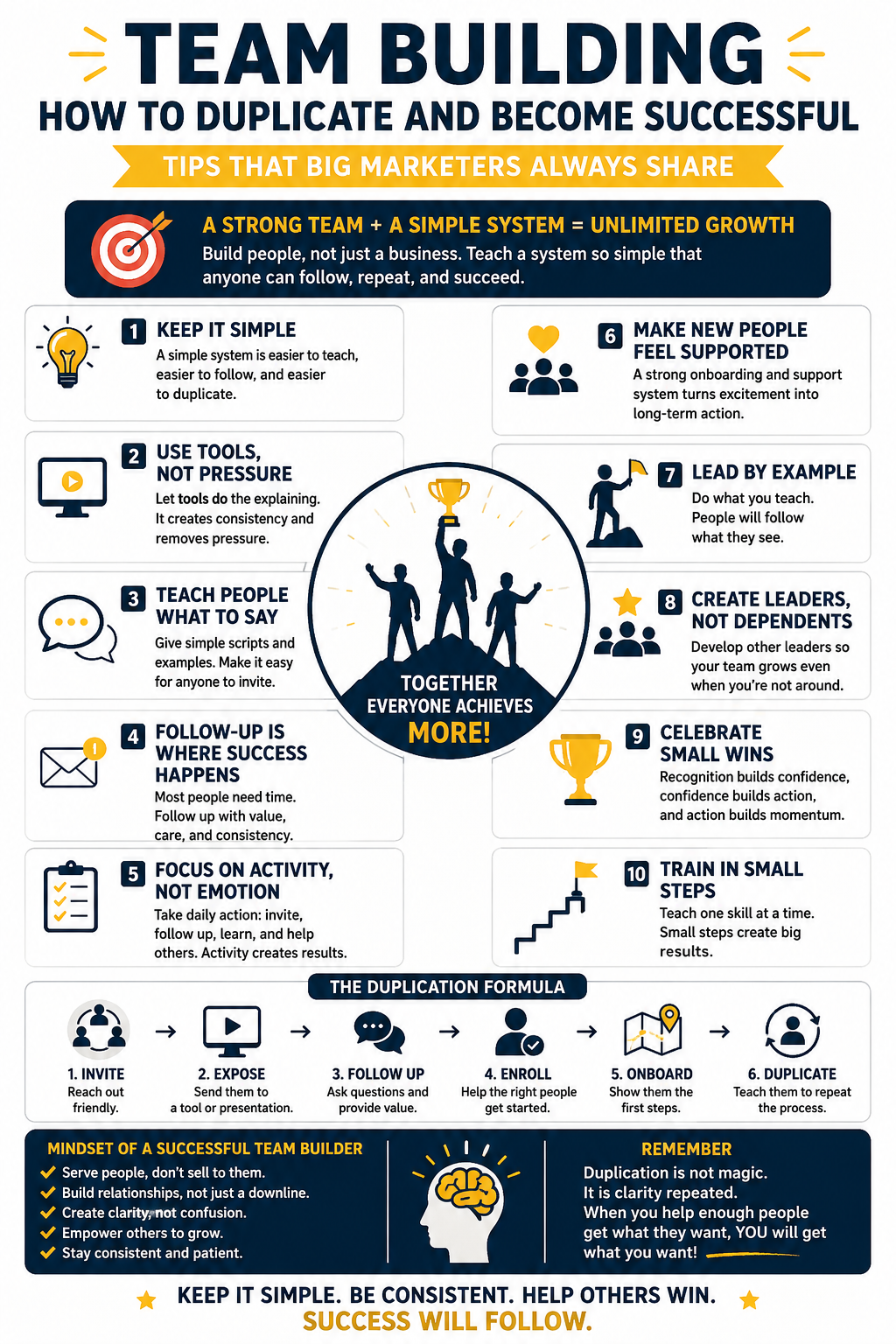
Team Building: How to Duplicate and Become Successful

By Marvin Gandis

The Tips Big Marketers Always Share

Building a successful team is not only about recruiting people. It is about creating a simple path that ordinary people can follow, repeat, and teach to others.

  • That is the real power of duplication.

Many beginners believe success comes from having the perfect words, the biggest personality, the most advanced technology, or the most expensive advertising budget. But experienced marketers know something different: long-term success comes from simple actions repeated consistently by many people.

A team grows stronger when the system is easy to understand, easy to explain, and easy to duplicate.

You do not need to be a superstar to build a successful team. You need clarity, consistency, leadership, follow-up, and a process that your team can copy without confusion.


What Does Duplication Really Mean?

Duplication means teaching people to do what works in a simple and repeatable way.

It is not about creating complicated strategies that only one expert can perform. It is about building a process so clear that a new person can say:

  • “I understand this. I can do this. I can show someone else how to do this, too.”

That is duplication.

In team building, duplication may include:

Simple invitation methods, basic follow-up messages, clear training steps, easy product explanations, daily action plans, and a supportive team culture.

When your team members can repeat the same success habits, your business begins to grow beyond your personal effort.


Why Most Teams Fail to Duplicate

Many teams do not fail because the product is bad or the opportunity is weak. They fail because the process is confusing.

A new person joins, gets excited, and then asks:

  • “What do I do now?”

If there is no clear answer, excitement fades.

This is where many leaders make a mistake. They overwhelm new people with too much information too soon. They give them videos, links, scripts, compensation details, product features, social media advice, and advertising strategies all at once.

The result?

  • The new person feels lost.

Big marketers understand that a confused mind does not take action. That is why they simplify everything.

The easier the system, the faster people move.


The First Secret: Keep the System Simple

The best duplication systems are simple.

A beginner should not need weeks of training before taking the first step. They should know exactly what to do today, tomorrow, and this week.

A simple duplication system may look like this:

  1. Learn the basic story.
  2. Invite people to see the information.
  3. Follow up with those who show interest.
  4. Help new people get started.
  5. Repeat the process daily.

That is it.

The system should not depend on personality. It should not depend on hype. It should not depend on complicated sales techniques.

It should be simple enough for a quiet person, a beginner, a busy parent, a retired person, or a part-time entrepreneur to follow.


The Second Secret: Use Tools, Not Pressure

Big marketers do not try to explain everything themselves.

  • They use tools.

A tool can be a video, a presentation, a landing page, a webinar, a PDF guide, an email sequence, a product demo, or a simple website.

Why are tools important?

  • Because tools create consistency.

When every person explains the business differently, the message becomes messy. But when the team uses the same tool, the prospect receives a clear and professional message.

This also removes pressure from the new person.

Instead of saying, “I have to convince someone,” they can say:

“Take a look at this short presentation and tell me what you think.”

That is duplication.

The tool does the explaining. The person simply invites and follows up.


The Third Secret: Teach People What to Say

Many people are afraid to invite because they do not know what to say.

This is why leaders should provide simple scripts and examples.

A good invitation message does not need to be aggressive. It can be friendly, short, and curiosity-based.

Example:

“Hey, I came across something that may help people protect their digital files and also learn about an online income option. Would you be open to taking a quick look?”

Another example:

“I’m working with a simple online system and thought of you. No pressure at all, but would you like me to send you the information?”

  • The goal is not to convince. The goal is to invite.

Big marketers often say:

Do not chase. Do not pressure. Do not overexplain. Just invite, expose, follow up, and repeat.


The Fourth Secret: Follow-Up Is Where Success Happens

Most people do not make decisions immediately.

They need time. They need reminders. They need clarity. They need trust.

That is why follow-up is one of the most important parts of team building.

Many beginners make one invitation, get no response, and quit. But professionals understand that follow-up is not bothering people when done correctly. Follow-up is a service.

A simple follow-up message can be:

  • “Did you get a chance to look at the information I sent?”

Or:

  • “What part made the most sense to you?”

Or:

  • “Do you have any questions before deciding if this is a fit for you?”

The fortune is often in the follow-up because many people are interested, but they are busy, distracted, or unsure.

Consistent follow-up shows professionalism.


The Fifth Secret: Focus on Activity, Not Emotion

Emotions change every day.

Some days, people feel motivated. Other days, they feel discouraged. If a team depends only on emotion, it will not last.

Successful leaders teach activity.

Activity creates results.

Important daily activities may include:

Sending invitations, following up with prospects, learning the product, attending training, supporting new members, posting valuable content, and staying connected with the team.

You cannot control who says yes today. But you can control how many people you invite, how well you follow up, and how consistently you show up.

Big marketers focus on controllable actions.

That is how momentum is created.


The Sixth Secret: Make New People Feel Supported

People do not only join a company. They join a culture.

If a new team member feels alone, they may disappear quickly. But if they feel welcomed, guided, and encouraged, they are more likely to stay active.

A strong onboarding process is essential.

When someone joins, they should immediately know:

Where to start, what tool to use, who to contact for help, what daily actions to take, how to invite, how to follow up, and how to help their first person get started.

  • The first 24 to 72 hours are very important.

That is when excitement is highest. A good leader helps new people turn excitement into action.


The Seventh Secret: Lead by Example

Duplication starts with leadership.

People do what they see more than what they hear.

If the leader invites, follows up, attends training, uses the tools, stays positive, and remains consistent, the team is more likely to copy those habits.

But if the leader only talks and does not take action, the team will notice.

Leadership is not about being perfect. It is about being visible, consistent, teachable, and responsible.

A strong leader can say:

  • “Watch what I do. Then do the same. Then teach someone else.”

That is how duplication spreads.


The Eighth Secret: Do Not Build Around One Superstar

One of the biggest mistakes in team building is creating a business that depends on one powerful personality.

If only one person can present, sell, train, or motivate the team, duplication becomes weak.

A true duplication system allows many people to participate.

The goal is not to create followers who depend on the leader forever. The goal is to develop new leaders.

A healthy team produces more leaders, not more spectators.

This happens when people are trusted, trained, encouraged, and given opportunities to grow.


The Ninth Secret: Celebrate Small Wins

Recognition is powerful.

People need encouragement. They need to know their effort matters.

Celebrate small wins such as:

A first invitation, a first follow-up, a first presentation watched, a first new customer, a first team member, a first commission, or a first training attended.

Small wins create confidence.

Confidence creates action.

Action creates momentum.

Momentum creates duplication.

Recognition does not have to be complicated. A simple message in the group chat, a shoutout on a call, or a personal congratulations can make someone feel seen and appreciated.


The Tenth Secret: Train in Small Pieces

Big marketers know that people learn better in small steps.

Do not try to teach everything at once.

Teach one skill at a time.

For example:

  • Week 1: How to invite.
  • Week 2: How to follow up.
  • Week 3: How to use the tools.
  • Week 4: How to help a new person start.
  • Week 5: How to create daily consistency.

Simple training creates better duplication.

When training is too advanced, people become spectators. When training is simple, people take action.


The Eleventh Secret: Build Trust Before You Promote

People follow people they trust.

Before someone joins your team, they are often asking silent questions:

  • Can I trust this person?
  • Is this real?
  • Will I get help?
  • Is this simple enough for me?
  • Is this worth my time?
  • Will I be pressured?
  • Can I see myself doing this?

Your content, messages, and follow-up should answer those questions.

This is why educational marketing works so well.

Instead of only saying “join now,” teach people something valuable. Help them understand the problem, the solution, the system, and the benefit.

Trust creates better prospects.

Better prospects create better teams.


The Twelfth Secret: Use Stories

Facts inform, but stories connect.

People remember stories better than features.

Instead of only explaining what your business does, share stories about why it matters.

Stories can include:

How someone started with no experience, how a product solved a real problem, how a beginner overcame fear, how consistency created results, or how a simple system helped someone take action.

Stories make the opportunity feel human.

People may forget details, but they remember how the story made them feel.


The Thirteenth Secret: Help People Win Fast

A new person needs an early win.

It does not have to be a big financial result. It can be a confidence win.

Examples of early wins:

Sending the first message, watching the first training, setting up the first profile, sharing the first link, inviting the first prospect, or understanding the simple presentation.

When people experience progress early, they are more likely to continue.

Success builds belief.

Belief builds consistency.

Consistency builds duplication.


The Fourteenth Secret: Protect the Team Culture

Culture is the invisible force inside a team.

A strong culture is positive, honest, supportive, action-focused, and respectful.

A weak culture is full of confusion, negativity, excuses, drama, and hype.

The leader must protect the culture.

This means:

Encouraging action, correcting misinformation, avoiding unrealistic promises, supporting beginners, recognizing effort, and keeping the message honest.

A good team culture makes people feel safe to learn and grow.


The Fifteenth Secret: Teach Long-Term Thinking

Many people quit too soon because they expect instant results.

Big marketers teach that team building is a long-term process.

  • It takes time to build trust.
  • It takes time to develop a skill.
  • It takes time to create leaders.
  • It takes time to build momentum.

The people who succeed are usually not the ones who never struggle. They are the ones who keep learning and keep showing up.

Team building rewards consistency.


A Simple Duplication Formula

Here is a simple formula any team can use:

1. Invite

Reach out to people in a friendly way.

2. Expose

Send them to a tool, presentation, webinar, or page.

3. Follow Up

Ask what they thought and answer questions.

4. Enroll

Help the right people get started.

5. Onboard

Show them their first steps.

6. Duplicate

Teach them to do the same process.

This formula is powerful because it is simple.

Simple duplicates.

Complicated breaks.


Common Mistakes to Avoid

Avoid trying to convince everyone.

Avoid arguing with skeptical people.

Avoid sending too much information too soon.

Avoid depending only on motivation.

Avoid ignoring new members after they join.

Avoid making unrealistic income promises.

Avoid using pressure or hype.

Avoid changing the system every week.

Avoid training people without giving them action steps.

Avoid building a team without follow-up.

The goal is not to impress people with complexity. The goal is to help people take action with clarity.


The Mindset of a Successful Team Builder

A successful team builder thinks differently.

They do not ask:

“How can I get people to join me?”

They ask:

  • “How can I help people understand this clearly?”

They do not ask:

“How can I pressure someone to say yes?”

They ask:

  • “How can I serve the right person with the right information?”

They do not ask:

“How can I do everything myself?”

They ask:

  • “How can I create a system others can duplicate?”

This mindset changes everything.

Team building is not about control. It is about empowerment.


Team Building Is One Of The Most Powerful Skills In Business Because It Multiplies Effort

One person can only do so much alone. But a team with a simple system, strong leadership, consistent training, and a supportive culture can grow far beyond one person’s capacity.

The tips big marketers share are not always complicated. In fact, the most powerful tips are often the simplest:

  • Keep it simple.
  • Use tools.
  • Teach people what to say.
  • Follow up consistently.
  • Lead by example.
  • Recognize effort.
  • Train in small steps.
  • Build trust.
  • Create leaders.
  • Stay consistent.

Duplication is not magic.

Duplication is clarity repeated.

When people know what to do, believe they can do it, and feel supported while doing it, success becomes more possible.


Are You Building Alone, Or Are You Building A System Others Can Follow?

Start today by simplifying your process. Create one clear invitation, one simple follow-up message, one useful tool, and one basic action plan your team can copy.

Success becomes easier when the path is simple enough to duplicate.


Disclaimer

This article is for educational and informational purposes only. Results in team building, affiliate marketing, network marketing, or any business opportunity are not guaranteed. Individual outcomes depend on personal effort, consistency, skills, market conditions, training, leadership, and other factors. Always review any business opportunity carefully and make decisions based on your own research and judgment.

Publicado en Leadership, Mental Clarity, Mindset, Motivation, Personal Development, Productivity, Self-Improvement

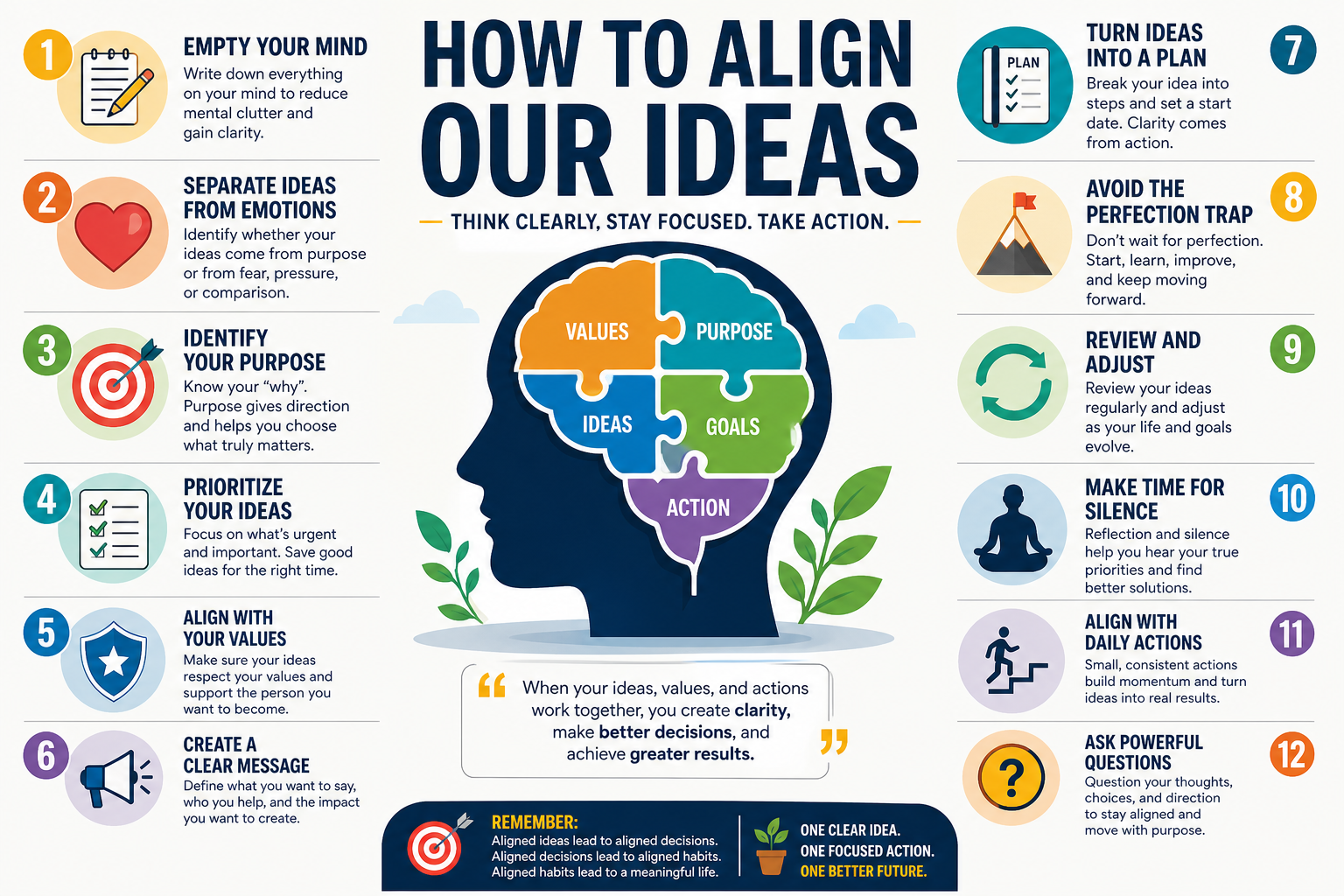
A Practical Guide to Think Clearly, Act with Purpose, and Create Better Results

Por Marvin Gandis

When Ideas Are Not Aligned, Life Feels Heavy

We all experience moments when the mind feels like a messy room: too many ideas, too many plans, too many worries, and not enough clarity.

  • We want to move forward, but we do not know where to begin.
  • We want to make decisions, but doubt gets in the way.
  • We want to create something meaningful, but our ideas seem to compete against each other.

The truth is simple: a scattered mind often creates scattered actions. But an aligned mind can turn confusion into direction, fear into decision, and loose ideas into real progress.

Aligning our ideas does not mean having everything perfect. It means learning how to organize what we think, understand what we truly want, and act according to our values, goals, and purpose.


What Does It Mean to Align Our Ideas?

Aligning our ideas means bringing our thoughts, goals, emotions, values, and actions into the same direction.

Many people live with conflicting ideas:

  • They want change, but keep repeating old habits.
  • They want peace, but feed worry every day.
  • They want success, but constantly doubt themselves.
  • They want to help others, but cannot organize their message.
  • They want progress, but never define priorities.

When our ideas are not aligned, we lose energy. When they are aligned, we gain clarity, confidence, and direction.

Alignment begins with one honest question:

Are my thoughts, words, and actions working together,

Or are they contradicting each other?


The First Step: Empty the Mind

Before we organize our ideas, we need to get them out of our heads.

Many times, we think we have a motivation problem when, in reality, we have a mental overload problem.

Take a notebook, a sheet of paper, or a digital note and write down everything on your mind:

  • Business ideas.
  • Concerns.
  • Unfinished goals.
  • Tasks.
  • Dreams.
  • Frustrations.
  • Projects.
  • Decisions you have been avoiding.

Do not judge anything at first. Just write. This exercise is powerful because it turns mental noise into visible information.

When an idea lives only in the mind, it may feel overwhelming. But once you write it down, you can look at it, evaluate it, and decide what to do with it.


Separate Ideas from Emotions

Not every idea that appears in your mind is in the right direction. Some ideas are born from inspiration, but others are born from fear, pressure, comparison, or frustration.

That is why it is important to ask:

  • Is this idea coming from purpose or anxiety?
  • Am I deciding from clarity or desperation?
  • Am I building something real or reacting to a temporary emotion?
  • Does this idea bring me closer to my values or pull me away from them?

Emotions matter, but they should not always drive the vehicle. An aligned idea may challenge you, but it should not destroy your inner peace.


Identify the Central Purpose

An idea without purpose becomes a distraction. An idea with purpose can become a mission.

Before you act, ask yourself:

Why do I want to do this?

It is not enough to say, “I want to make more money,” “I want to publish more content,” “I want to start a project,” or “I want to change my life.”

Go deeper:

  • I want to help my family.
  • I want to educate others.
  • I want to create freedom.
  • I want to use my experience to serve.
  • I want to leave a legacy.
  • I want to live with more peace and discipline.

When you understand the purpose behind your ideas, it becomes easier to decide which ideas deserve your energy and which ones are only distractions.


Prioritize: Not Every Idea Deserves Immediate Action

One reason many people do not move forward is that they try to do too much at once.

Having many ideas is not the problem. The problem is not knowing which idea should come first.

You can divide your ideas into four groups:

  • Urgent ideas: they need attention soon.
  • Important ideas: they support your main goals.
  • Future ideas: they are good, but not for this season.
  • Distracting ideas: they sound interesting, but pull you away from your path.

Mental maturity means understanding that not every good idea is an idea for today.

Sometimes saying “not yet” is a powerful way to protect your focus.


Align Ideas with Values

Your ideas must respect your values. If an idea promises results but requires you to betray your principles, it is not aligned.

Ask yourself:

  • Does this idea reflect who I want to become?
  • Can I execute it with honesty?
  • Does it help others or take advantage of them?
  • Will it give me peace or create inner conflict?
  • Is it sustainable long-term?

The most powerful ideas are not only profitable or attractive. They are ideas you can stand behind with integrity.

True alignment happens when your ambition does not destroy your character.


Create a Clear Message

Many people have good ideas, but they struggle to communicate them. And an idea that is not communicated clearly may lose its impact.

To clarify your message, answer these questions:

  • What do I want to say?
  • Who do I want to help?
  • What problem does this idea solve?
  • What transformation does it offer?
  • Why should the listener care?
  • What action do I want them to take?

An aligned idea should be easy to explain. If you need to make it too complicated, it may not be clear yet.

Clarity is not the absence of depth. Clarity is depth, well-organized.


Turn Ideas into a Plan

An idea without action remains a wish. To produce results, an idea must become a plan.

A simple plan may include:

  • Main objective.
  • Reason behind the objective.
  • Necessary steps.
  • Available resources.
  • Start date.
  • Weekly time commitment.
  • Expected result.
  • Way to measure progress.

You do not need every detail to be perfect. You need the next step to be clear.

Many people wait for complete clarity before they begin, but often clarity appears while we are already moving.


Avoid the Perfection Trap

Perfection is one of fear’s most elegant disguises. It makes us think we are preparing, when in reality we are avoiding action.

An aligned idea does not need to launch perfectly. It needs to launch with intention, structure, and honesty.

  • Publish.
  • Test.
  • Learn.
  • Correct.
  • Improve.
  • Repeat.

Imperfect action with direction is more valuable

than perfect intention without movement.


Review and Adjust Regularly

Aligning ideas is not something you do once. It is an ongoing process.

Life changes. Priorities change. Opportunities change. Your mindset must be reviewed, too.

Every week or every month, ask yourself:

  • Which ideas are still important?
  • What should I release?
  • What am I avoiding?
  • What is working?
  • What needs adjustment?
  • What action should I take now?

Alignment does not mean rigidity. It means direction with the ability to adjust.


The Importance of Silence and Reflection

We live in a noisy world. Social media, opinions, news, comparisons, messages, urgency, and distractions all compete for our attention.

That is why aligning our ideas requires moments of silence.

Silence reveals what noise hides.

In silence, you can hear your true priorities. You can distinguish between an authentic idea and external pressure. You can discover whether you are walking by conviction or comparison.

Do not underestimate the power of being still, thinking, praying, meditating, writing, or simply breathing.

Many great decisions are born in calm moments.


Align Ideas with Daily Action

The real test of an idea is not how beautiful it sounds, but how it shows up in your daily habits.

  • If you say you want to write, write.
  • If you say you want to serve, serve.
  • If you say you want to learn, study.
  • If you say you want to improve, practice.
  • If you say you want to grow, leave your comfort zone.

Alignment is proven through small, repeated actions.

You do not need to change your entire life in one day.

You need to begin living with more consistency each day.


Powerful Questions to Align Your Ideas

Use these questions when you feel confused:

  • What am I really trying to accomplish?
  • Why does this matter to me?
  • Which idea deserves my attention right now?
  • What should I save for later?
  • What thought is stealing my clarity?
  • What small action can I take today?
  • Is this decision aligned with my values?
  • Am I acting from purpose or pressure?
  • Am I building something that truly matters?

These questions do more than organize the mind. They awaken responsibility.


Clarity Does Not Happen by Accident

Aligning our ideas is an act of discipline, honesty, and purpose.

It is not about having a perfect mind. It is about learning how to direct your thoughts toward what truly matters.

When your ideas are aligned, your decisions become stronger. Your actions become more consistent. Your message becomes clearer. Your life begins to move with intention.

Remember this:

  • An idea aligned with purpose can change a decision.
  • An aligned decision can change a habit.
  • An aligned habit can change a life.

You do not need to have everything figured out today.

You only need to take the next step with clarity.


Today, take 15 minutes to write down your main ideas.

Then choose one idea that aligns with your values, your purpose, and your next season of growth.

Do not try to do everything. Begin with one clear idea, one honest action, and one firm commitment.

Your clarity begins when you decide to organize your mind and move with purpose.


Disclaimer

This article is for educational, informational, and motivational purposes only. It does not constitute professional, psychological, financial, legal, or medical advice. Every individual should evaluate their own situation, make responsible decisions, and seek professional guidance when necessary. Personal results may vary depending on discipline, circumstances, resources, decisions, and individual actions.