Publicado en Education, Entrepreneurship, Leadership, Mindset, Personal Development, Technology

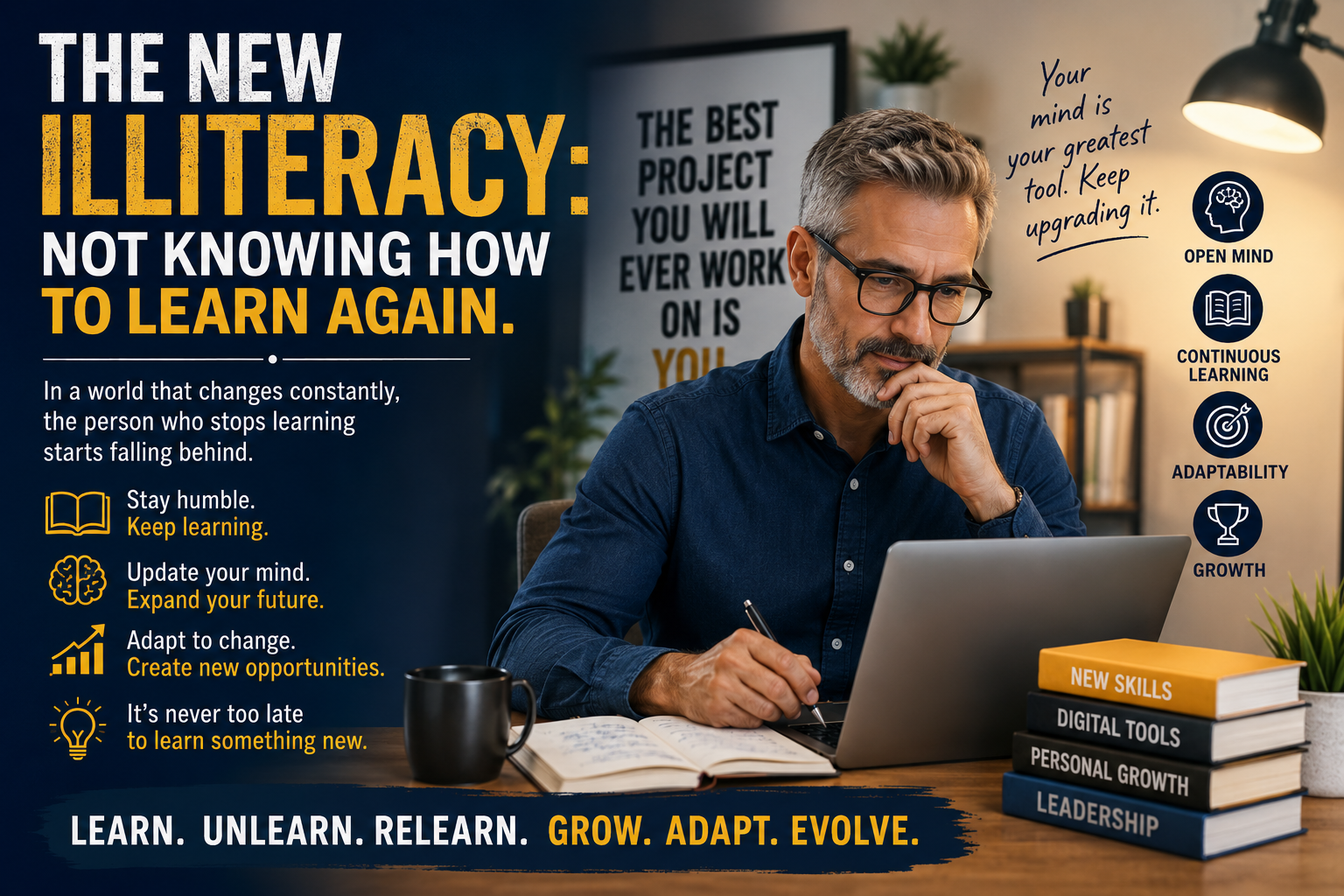
The New Illiteracy: Not Knowing How to Learn Again

By Marvin Gandis

The Problem Is No Longer Just Not Knowing

For a long time, when people talked about illiteracy, they thought about someone who could not read or write. But in today’s world, there is a new and dangerous form of illiteracy:

  • Not knowing how to learn again.

Today, a person may know how to read, write, use a phone, send messages, and browse the internet, yet still fall behind because they refuse to keep up.

The problem is not always a lack of intelligence. Many times, it is resistance to change.

We live in a time when tools, jobs, businesses, technology, the economy, and the way we communicate change.

That is why one of the most dangerous phrases a person can say is:

  • “I already know enough.”

Because in a constantly changing world, believing that you no longer need to learn can become a silent trap.


Knowing Yesterday Does Not Guarantee Understanding Today

Experience is valuable. No one should despise the years lived, the lessons learned, or the knowledge earned through effort.

But experience can become a limitation when we stop updating it.

  • What worked before may not work the same way today.
  • The way people sell has changed.
  • The way people communicate has changed.
  • The way people learn has changed.
  • The way people build trust has changed.
  • The way people work has changed.

This does not mean everything old is useless. It means we must learn how to combine wisdom with updating.

A wise person does not reject experience, but they also do not use it as an excuse to reject what is new.


Pride Is the Enemy of Learning

One of the biggest obstacles to learning again is pride.

Pride says:

  • “That is not for me.”
  • “I do not need to learn that.”
  • “That is for young people.”
  • “I have always done it this way.”
  • “That will not work.”
  • “I am too old to start.”

But humility says:

  • “I can learn.”
  • “I can improve.”
  • “I can ask for help.”
  • “I can start slowly.”
  • “I can update myself without losing my identity.”

Learning requires humility because it forces us to recognize that we do not know everything.

And that is not shame. That is wisdom.

The person who can learn again, even with experience, stays mentally alive.


Technology Does Not Wait Until We Feel Ready

Many people wait until they feel ready before learning something new.

But technology does not wait.

  • Platforms change.
  • Digital tools evolve.
  • Artificial intelligence advances.
  • Businesses become automated.
  • Consumers change their habits.
  • Audiences move into new spaces.

The person who waits too long may end up depending on others for everything.

This is not about becoming an expert overnight. It is about maintaining an attitude of constant learning.

  • Learn a new tool.
  • Understand a new concept.
  • Try a new strategy.
  • Read a guide.
  • Watch a tutorial.
  • Practice a little every day.

Technological ignorance does not always arrive suddenly. Sometimes it builds slowly through years of resistance.


Learning Again Does Not Mean Starting From Zero

Many people are afraid to learn something new because they feel it invalidates everything they already know.

But learning again does not erase your past.

It improves it.

  • Your experience is still valuable.
  • Your story still matters.
  • Your mistakes still teach.
  • Your character still counts.
  • Your wisdom still has weight.

The difference is that now you need to use all of it in a new context.

  • A teacher can learn digital tools.
  • A salesperson can learn online marketing.
  • A leader can learn modern communication.
  • An entrepreneur can learn automation.
  • An older person can learn technology step by step.

You are not starting from zero. You are building on what you already are.


The Person Who Learns Becomes Harder to Defeat

When a person decides to keep learning, they develop a quiet advantage.

  • They can adapt better.
  • They can recover faster.
  • They can understand new opportunities.
  • They can avoid repeated mistakes.
  • They can communicate with new generations.
  • They can find solutions where they once saw obstacles.

Learning does not guarantee an easy life, but it increases your ability to respond to life with intelligence.

The person who learns does not remain trapped in one version of themselves.

They can evolve.

And in times of change, evolving is a form of survival.


Learning Is Also a Personal Responsibility

It is easy to blame the world.

  • “The economy is difficult.”
  • “Technology is moving too fast.”
  • “People do not listen anymore.”
  • “Social media has changed.”
  • “Business is not like it used to be.”

There may be truth in those phrases. But we also need to ask ourselves:

  • What am I learning?
  • What am I avoiding learning?
  • What skill have I delayed for too long?
  • What tool intimidates me?
  • What part of my mindset needs to be updated?

Personal responsibility does not mean blaming yourself for everything. It means recognizing that you still have power to grow.

You cannot control every change in the world, but you can decide how you will respond to those changes.


Learning Requires Patience

One of the biggest mistakes is wanting to learn something new without going through the discomfort of the beginning.

Every learning process has an awkward stage.

  • At first, you may feel slow.
  • You may make mistakes.
  • You may get confused.
  • You may need help.
  • You may feel frustrated.

That is normal.

No one masters something important without going through a learning stage.

Patience helps you avoid quitting too soon.

  • Do not say, “I am not good at this.”
  • Say, “I am still learning.”

That small difference changes your mindset.


Education No Longer Ends With a Diploma

In the past, many people thought education was one stage of life.

You studied, you worked, and then you repeated what you learned for years.

But today, learning must be continuous.

  • It does not matter your age.
  • It does not matter what your profession is.
  • It does not matter your experience.
  • It does not matter what your current level is.

There is always something to learn.

  • Communication.
  • Technology.
  • Finances.
  • Marketing.
  • Leadership.
  • Emotional intelligence.
  • Digital security.
  • Content creation.
  • Human relationships.
  • Critical thinking.

Modern education does not end. It renews itself.


How to Overcome the New Illiteracy

First, accept that not knowing something is not shameful.

The shame is not in not knowing. The real loss is refusing to learn.

Second, choose one skill at a time.

Do not try to learn everything at once. Choose one important thing and begin.

Third, practice in small steps.

Dedicate 15 or 20 minutes a day to learning or practicing something new.

Fourth, ask without fear.

Asking for help does not make you less capable. It makes you wiser.

Fifth, apply what you learn.

Knowledge that is not used is forgotten. Learn, practice, adjust, and repeat.

Sixth, keep a flexible mind.

Not every change is a threat. Some changes are opportunities in disguise.


The Future Favors Learners

The future will not be kind to those who refuse to grow.

But it will offer opportunities to those willing to learn, unlearn, and learn again.

  • You do not need to know everything.
  • You do not need to master everything today.
  • You do not need to compete with experts immediately.

You only need to maintain a humble and active attitude:

  • “I can learn something new.”
  • “I can improve step by step.”
  • “I can update my mind.”
  • “I can adapt without losing my essence.”

That attitude can change your life.


It Is Never Too Late to Learn Again

My dear reader and friend, the new illiteracy is not the inability to read. It is the refusal to keep learning in a world that keeps changing.

Do not allow pride, fear, age, comfort, or frustration to steal your opportunity to grow.

  • Learning again does not make you weak.
  • It makes you flexible.
  • It makes you wise.
  • It makes you useful.
  • It keeps you relevant.
  • It makes you better prepared.

The world will keep changing.

The question is:

  • Will you also change with wisdom?

You do not have to do everything perfectly. Just begin.

  • Learn something new.
  • Ask a question.
  • Read a guide.
  • Practice a tool.
  • Improve a skill.
  • Update your mind.

Because in the modern world, the person who stops learning begins to fall behind.

But the person who learns again opens new doors.


Disclaimer:


This article is provided for educational, motivational, inspirational, and informational purposes only. It is intended to encourage reflection, continuous learning, personal growth, digital awareness, adaptability, and responsible decision-making.

The content should not be interpreted as financial, legal, medical, psychological, technological, educational, or professional advice. Any examples related to personal development, technology, digital tools, business, entrepreneurship, leadership, online learning, or success are not guarantees of specific results.

Individual outcomes may vary depending on effort, consistency, experience, access to resources, personal discipline, market conditions, technological changes, learning ability, and other factors beyond our control.

Readers are encouraged to use their own judgment, conduct their own research, and seek qualified professional guidance when necessary. The purpose of this content is to inspire and educate, not to promise instant results or replace professional advice.
Publicado en Faith and Hope, Inner Growth, Inspiration, Life Purpose, Personal Development, Personal Motivation, Positive Mindset, Self-Improvement

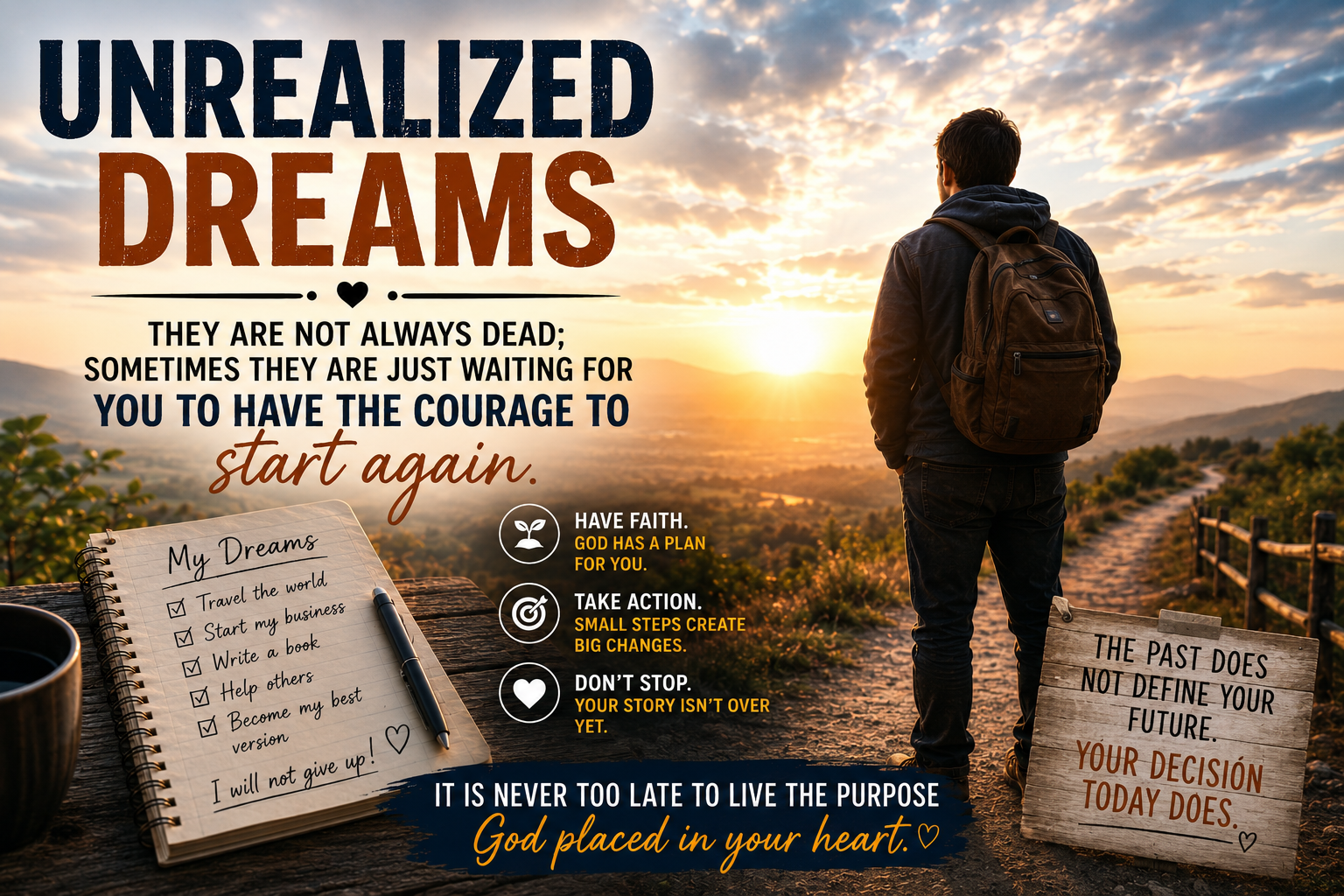
Unrealized Dreams

When Life Reminds You There Is Still Something Inside You

By Marvin Gandis

We all carry dreams hidden somewhere in the heart. Some were born when we were young, full of hope, imagination, and energy. Others appeared after a crisis, a loss, a need, or a conversation that awakened something deep within us. But as time passed, many of those dreams remained waiting.

  • Not because they were impossible.
  • Not because we had no talent.
  • Not because God forgot about us.

Many times, dreams remain unrealized because life hurt us, fear stopped us, people discouraged us, we made poor decisions, we lacked direction, or we simply became used to surviving instead of moving forward.

But an unrealized dream is not always a dead dream. Sometimes it is a sleeping seed waiting for the right moment, the right mindset, and the right decision.


What Are Unrealized Dreams?

Unrealized dreams are the goals, visions, ideas, talents, or deep desires that once set our hearts on fire but, for some reason, never became reality.

It may be:

  • A business you never started.
  • A book you never wrote.
  • A career you walked away from.
  • A family relationship you wanted to heal.
  • A trip you never took.
  • A stronger spiritual life you never developed.
  • A version of yourself you always imagined but have not yet become.

Unrealized dreams hurt because they remind us of something important: we know we could have done more.

But they also give us an opportunity: we can still wake up.


The Pain of Looking Back

There are moments in life when we stop and think:

  • “What would have happened if I had started earlier?”
  • “Where would I be today if I had not given up?”
  • “Why did I allow fear to stop me?”
  • “Is it too late to try?”

These questions can hurt, but they can also be a sign of awareness. You are not dead inside. You still feel. You still dream. There is still something in you that wants to rise.

The problem is not looking back. The problem is staying trapped there.

Looking back should help you learn, not destroy you. Your mistakes can become teachers. Your delays can become lessons. Your falls can become testimony.


Why Many Dreams Are Left Behind

Not every dream is lost because of a lack of ability. Many are lost because of a lack of decision, discipline, or faith.

Fear

Fear of failure stops more people than failure itself. Many prefer not to try because they want to avoid criticism, rejection, or embarrassment.

But not trying also has a price: the lifelong pain of wondering what could have happened.

Comfort

Sometimes we do not pursue our dreams because we become used to a safe life, even if it is not the life we truly desire. Comfort may look like peace, but many times it is a decorated cage.

The Opinions Of Others

Some people abandon their dreams because someone told them, “That is not for you,” “You are too old,” “That will never work,” or “Be realistic.”

But the truth is this: many people who criticize your dreams never dared to pursue their own.

Lack Of Direction

A dream without a plan can become frustration. Inspiration is powerful, but without organized action, the dream remains floating in imagination.

Emotional Wounds

Some people stop dreaming because they were disappointed, betrayed, humiliated, or wounded by life. When the heart is hurt, even hope can feel dangerous.

But healing is also part of the path toward purpose.


Not Every Lost Dream Is Canceled

Some dreams may not come true exactly as you once imagined. Maybe time has changed. Maybe your age has changed. Maybe your responsibilities changed. Maybe your situation changed. But that does not mean everything is over.

  • Sometimes the dream needs to mature.
  • Sometimes it needs to take another form.
  • Sometimes it needs to start small.
  • Sometimes it needs to move from fantasy to project.
  • Sometimes God does not remove the dream; He transforms it.
  • Maybe you did not write the book at 25, but you can write it now.
  • Maybe you did not start the business 10 years ago, but you can begin with what you have today.
  • Maybe you could not help others before, but your current experience can become a guide for someone else.

Lost time cannot always be recovered, but it can be redeemed with purpose.


The Danger of Living Only with Excuses

It is easy to say:

  • “I do not have time.”
  • “I do not have money.”
  • “I do not have support.”
  • “I am not an expert.”
  • “I do not know where to start.”
  • “It is too late.”

Some excuses may sound reasonable, but if we repeat them too often, they become chains.

The truth is that many people started with no money, no support, no experience, and no perfect conditions. The difference was that they decided to begin anyway.

You do not need to have everything figured out to take the first step.
You need enough humility to learn and enough courage to begin.


How to Revive an Unrealized Dream

First: identify the dream clearly

It is not enough to say, “I want something better.” Ask yourself:

  • What dream keeps coming back to my mind?
  • What desire have I tried to ignore, but it does not disappear?
  • What talent am I not using?
  • What project would bring me peace if I at least tried?

Clarity is the first act of courage.

Second: accept your reality without hiding from it

Do not deny your mistakes. Do not ignore your limitations. Do not blame everyone else for what you did not do. Accept where you are, but do not use your situation as an excuse to stay there.

Honesty heals. Denial delays.

Third: start small

A big dream can feel intimidating. But one small action can open the road.

  • One page written.
  • One call made.
  • One post shared.
  • One class taken.
  • One debt organized.
  • One habit changed.
  • One sincere prayer.
  • One 30-day plan.

Dreams are rebuilt through small actions repeated with faith and discipline.

Fourth: surround yourself with the right people

Not everyone will understand your process. Not everyone will celebrate your growth. Not everyone deserves access to your dreams.

Look for people who inspire you, correct you with love, challenge you to grow, and remind you who you are when you forget.

Fifth: stop waiting for perfect motivation

Motivation rises and falls. Discipline remains.

  • There will be days when you do not feel like it. Do something small anyway.
  • There will be days when no one applauds. Continue anyway.
  • There will be days when results do not appear. Learn and adjust anyway.

Consistency turns sleeping dreams into living testimonies.


When the Dream Changes Shape

Sometimes maturity means recognizing that a dream needs to evolve. Maybe what you wanted before no longer represents who you are now. That is not failure; it may be growth.

Do not hold on to an old version of your dream if God, life, or experience is showing you a wiser direction.

  • A transformed dream is not a lost dream.
  • It may become a deeper, more useful, and more purpose-driven dream.

Faith Also Works

Believing does not mean sitting still and waiting for everything to fall from the sky. True faith walks, learns, builds, knocks on doors, and rises after falling.

  • Pray, but also work.
  • Dream, but also plan.
  • Believe, but also act.
  • Wait on God, but do not use waiting as an excuse for passivity.

Faith does not remove effort; it gives effort direction.


It Is Never Too Late to Begin Again

Maybe you cannot change what happened, but you can decide what you will do with what remains.

  • You are not too old to learn.
  • You are not too broken to heal.
  • You have not failed too much to rise.
  • You have not arrived too late to begin.

As long as you have life, you still have an opportunity. And even if the road is not easy, it can still be meaningful.

Your dream does not need to impress the world to have value. Sometimes it is enough for it to give you hope, dignity, discipline, and the peace of knowing you tried.


Questions for Reflection

  • What dream have I abandoned because of fear or exhaustion?
  • What excuse have I repeated for too long?
  • What small step can I take this week?
  • What do I need to learn to move forward?
  • Who do I need to stop listening to?
  • What kind of person do I need to become to live that dream responsibly?

Honest answers can open a new season in your life.


Your Dream Can Still Breathe

Unrealized dreams should not be a sentence. They should be an invitation.

  • An invitation to wake up.
  • An invitation to heal.
  • An invitation to act.
  • An invitation to stop postponing life.
  • An invitation to turn regret into movement.

Do not allow the past to become stronger than your purpose. Do not allow age, criticism, fear, or mistakes to completely extinguish what can still be born within you.

Maybe you cannot do everything today, but you can begin today.

And sometimes, beginning again is the most powerful act of faith, humility, and courage.


Call to Action

My dear reader and friend, if this message touched your heart, do not ignore it. Write down the dream that still lives inside you. Then write one small action you can take within the next 24 hours.

  • Do not wait for the perfect moment.
  • Do not wait until you feel completely ready.
  • Do not wait until everyone believes in you.

Start with what you have, from where you are, and allow each step to bring you closer to the life you once imagined.

Your dream may be sleeping, but it is not necessarily dead.


Disclaimer

This article is for educational, motivational, and personal reflection purposes only. It does not replace professional financial, psychological, medical, legal, spiritual, or personal advice. Each reader is responsible for evaluating their own situation, making wise decisions, and seeking professional help when necessary.

Publicado en Life Reflection, Motivation, Personal Development, Relationships, Spiritual Growth

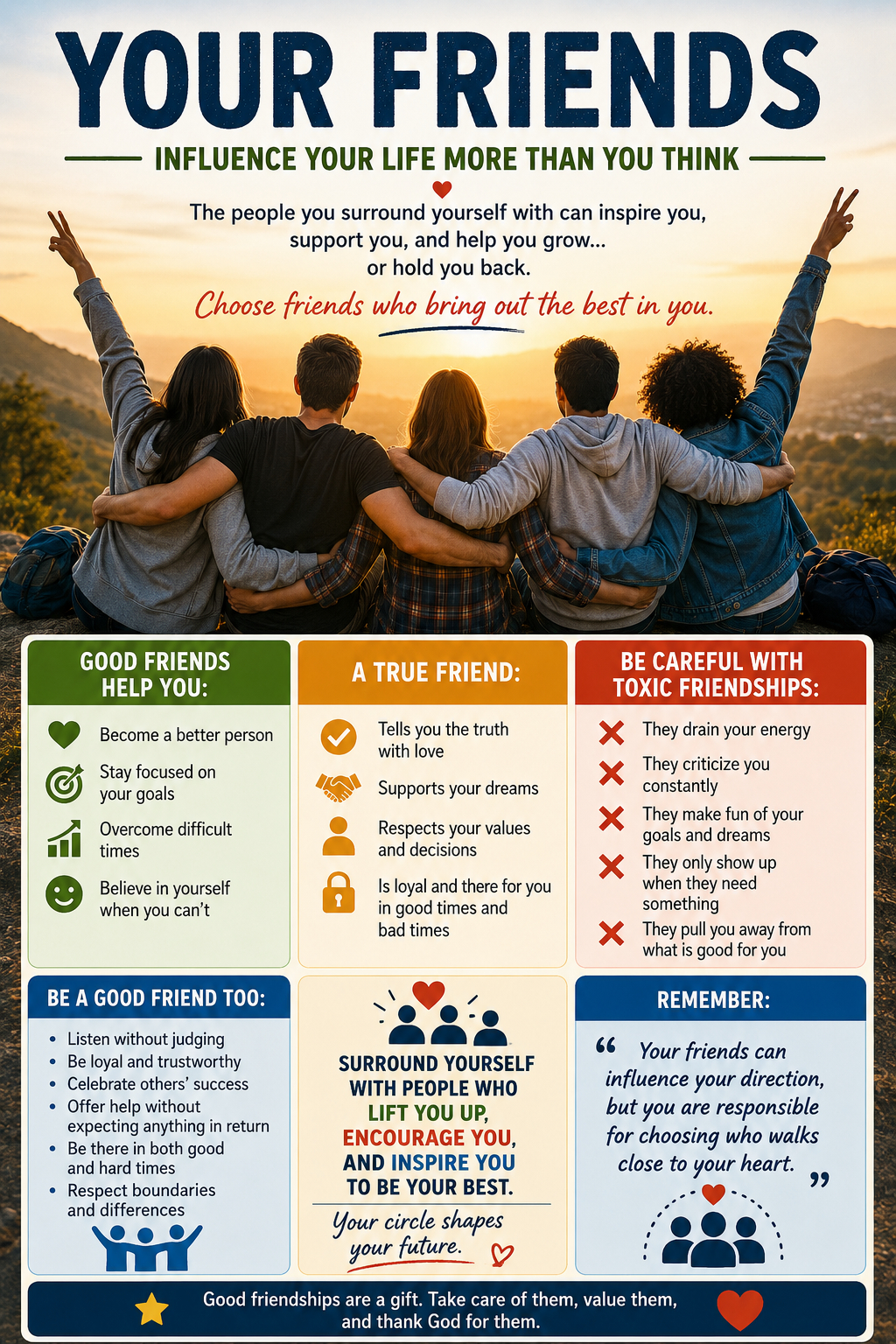
Your Friends: The Silent Mirror of Your Life

Por Marvin Gandis

Your friends are not just people you talk to, laugh with, or share special moments with. Your friends can also become a powerful influence on the way you think, act, decide, and move forward in life.

Many people believe friendship is simple: someone you talk to, spend time with, or share interests with. But the truth goes deeper. Friendships can inspire you, motivate you, correct you, support you, and help you grow. However, they can also distract you, discourage you, confuse you, or hold you back if you do not choose carefully who you allow into your closest circle.

  • The question is not only: Do you have friends?
  • The more important question is: What kind of friends do you have?

The Value of a True Friendship

A true friend is not someone who always tells you what you want to hear. A true friend is someone who dares to tell you the truth with respect, even when that truth makes you uncomfortable.

Real friends do not celebrate your mistakes. They help you recognize them. They do not laugh at your dreams. They encourage you to work for them. They do not rejoice when you fall. They reach out a hand to help you rise again.

A true friendship is recognized by loyalty, honesty, and presence. That person may not always be physically close, but when you truly need them, they show up with a word, a prayer, advice, or a gesture of support.

True friends do not compete with you. They walk with you.


Your Friends Influence Your Mindset

Even when you do not notice it, the people you spend the most time with influence the way you think. If your friends always complain, sooner or later, you may start seeing life through complaints. If your friends always criticize, you may begin to live with a negative mindset. If your friends do not believe in growth, your dreams may start to look impossible.

But when you surround yourself with people who pray, work, study, build, serve, respect, and want to improve, your mind begins to rise.

That is why it is important to observe your circle.

Ask yourself:

  • Do my friends bring me closer to my purpose or pull me away from it?
  • Do they inspire me to become better or keep me stuck?
  • Do they speak truth to me or only feed my excuses?
  • Do they celebrate my progress or feel uncomfortable when I move forward?

Not everyone around you is prepared to walk with you toward your destiny.


Not Every Friend Is for Every Season

Some friendships arrive for a season. Others remain for years. Some teach lessons. Others leave wounds. Some appear to walk with you through a specific process, but they are not necessarily meant to stay for a lifetime.

Accepting this requires maturity.

Sometimes we try to hold on to friendships that are no longer walking in the same direction. Not because they are bad people, but because their values, priorities, or decisions are no longer aligned with the path you are trying to build.

Letting go of a friendship does not always mean hatred, pride, or rejection. Sometimes it means growth, peace, and wisdom.

Not everyone can walk with you when you decide to become better.


Friends Who Love You Also Correct You

We live in a time when many people confuse love with absolute approval. They believe a true friend should support everything they do, even when they are making poor decisions.

But that is not friendship. That can become complicity.

A true friend does not help you destroy your life. A true friend does not encourage you to lie, deceive, abandon your responsibilities, or act without conscience. A true friend reminds you who you are when you forget it yourself.

Correction with love is a sign of mature friendship.

Sometimes God uses a good friend to open your eyes, stop you before a bad decision, remind you of your value, or push you to rise again when you are losing faith.


Be Careful with Toxic Friendships

Not every friendship is healthy. Some people look like friends, but they drain your energy, your time, your peace, and your confidence.

A toxic friendship may appear in many ways:

  • They make you feel guilty for growing.
  • They minimize your dreams.
  • They laugh at your goals.
  • They only show up when they need something.
  • They manipulate you emotionally.
  • They pull you away from your values.
  • They secretly celebrate your falls.
  • They never truly rejoice in your achievements.

You should have a noble heart, but also an awakened mind. Loving people does not mean giving everyone unlimited access to your life.

Peace must also be protected with boundaries.


Become a Good Friend Too

It is easy to analyze what kind of friends we have, but we must also ask ourselves what kind of friend we are.

  • Are you trustworthy?
  • Do you know how to listen without judging?
  • Do you celebrate the achievements of others without envy?
  • Do you advise with love instead of superiority?
  • Are you present when your friends go through difficult moments?
  • Do you respect the boundaries of others?

Friendship is not only about receiving. It is also about sowing.

  • If you want sincere friends, practice sincerity.
  • If you want loyal friends, practice loyalty.
  • If you want friends who pray for you, pray for them too.
  • If you want friends who support you, learn to support without waiting for applause.

The quality of your friendships is also connected to the quality of person you are willing to become.


Friends, Purpose, and Growth

When you are trying to grow, build a business, heal, change habits, or improve your spiritual life, your friendships can become either a blessing or a distraction.

A good friend does not have to understand all your dreams, but they should respect them. They do not have to agree with every step you take, but they should not sabotage your progress.

The right friends remind you that you can still make it. They help you keep your feet on the ground, but they also encourage you to look higher.

The wrong friends feel uncomfortable when you stop living like before.

That is why, when you decide to change, some friendships also change. Some become stronger. Others become weaker. And some simply disappear.

Do not fear losing people who were only connected to your most limited version.


Solitude Can Be Better Than Bad Company

Many people keep harmful friendships because they are afraid of being alone. But being alone for a season can be healthier than being surrounded by people who destroy your peace.

Well-managed solitude can become a place of reflection, healing, prayer, and clarity. Bad company, on the other hand, can lead you to decisions you may later regret.

Do not fill your life with people just to avoid silence.

  • Sometimes silence shows you who you are.
  • Sometimes solitude prepares you for better connections.
  • Sometimes losing certain friendships creates space for healthier relationships.

Conclusion

Your friends matter. Not because you should judge everyone, but because you must protect your heart, your mind, your purpose, and your peace.

Surround yourself with people who inspire you to grow, speak truth with respect, honor your values, and celebrate your progress without envy.

Also, work on becoming that kind of friend yourself: loyal, sincere, respectful, present, and willing to love with maturity.

Because in the end, true friends do not only walk with you on easy days. They also remain when life becomes difficult, when tears appear, when dreams seem far away, and when you need a voice that says:

“Do not give up. You can still rise again.”


Final Quote

Your friends can influence your direction, but you are responsible for choosing who walks close to your heart.


Disclaimer

This article is for educational, motivational, and personal reflection purposes only. It does not replace professional, psychological, spiritual, legal, or medical advice. Every person should evaluate their relationships with wisdom, respect, and responsibility.