
Publicado en Discipline, Education, Leadership, Motivation, Personal Development, Personal Growth, Self-Improvement, Success Mindset

Preparation Often Creates the Opportunities Others Call Luck 📚

By Marvin Gandis

“Luck” often has a hidden story

Many people look at someone else’s success and say, “They were lucky.” But they rarely see the invisible hours, the quiet sacrifices, the corrected mistakes, the late nights of learning, the difficult decisions, and the discipline that came before the opportunity appeared.

The truth is simple but powerful: preparation often creates the opportunities others call luck.

What looks like a coincidence to some people is often the result of someone being ready. The door opened, yes — but that person already had the key because they had prepared in advance.

Luck may knock once. Preparation helps you recognize it, use it, and multiply it.


Luck favors the prepared

Opportunities may pass in front of many people, but not everyone is able to take advantage of them. Why? Because not everyone is ready.

  • A prepared person sees possibilities where others see problems.
  • A prepared person takes action while others hesitate.
  • A prepared person does not wait for perfect conditions; they use what they have and begin.

For example, two people may receive the same invitation to learn a new skill. One says, “I don’t have time.” The other sets aside 30 minutes a day, studies, practices, and improves. Months later, a job opportunity, project, client, or business idea appears. From the outside, many may say, “They got lucky.” But the truth is that the person was prepared when nobody was watching.

The opportunity was not magic. It was the result of readiness.


Preparation builds confidence

Real confidence does not come only from repeating positive phrases. It comes from knowing you have done the work.

When you study, practice, organize your thoughts, learn from your mistakes, and improve daily, your mind begins to say, “I am ready for this.”

Preparation reduces fear because it gives you direction. It does not remove every nervous feeling, but it allows you to move forward with more certainty.

Fear asks, “What if I fail?”


Preparation answers, “If I fail, I will learn and adjust.”

That mindset changes everything. When an opportunity appears, the prepared person does not freeze. They breathe, think, and act.


Many opportunities arrive disguised as problems

Sometimes we expect opportunities to arrive as something comfortable, beautiful, and easy. But many times, they come as challenges.

  • A family problem can teach responsibility.
  • A financial loss can push you to learn about money.
  • A business failure can teach sales, discipline, and patience.
  • A closed door can force you to build a better door.

Preparation does not mean you will never face difficulty. It means you will have more tools to face it.

An unprepared person may see an obstacle and quit.


A prepared person may see the same obstacle and ask, “What can I learn here?”

That question can open a new path.


Discipline creates a quiet advantage

Preparation does not always look exciting. Sometimes it looks repetitive, slow, and even boring. But that is where the advantage is built.

  • Reading while others waste time.
  • Practicing while others are distracted.
  • Saving while others spend without thinking.
  • Training while others settle.
  • Getting back up after failure while others quit.

Those small actions may seem insignificant in the moment, but over time they create a major difference.

Discipline is a quiet investment. At first, nobody applauds it. Later, everyone notices the results.


Being prepared helps you recognize opportunity

It is not enough for an opportunity to exist. You must also know how to identify it.

Many people miss opportunities because they lack clarity. They do not know what they want, what they are looking for, or how to tell the difference between a distraction and a real possibility.

Preparation gives you vision. It helps you ask better questions:

  • Does this align with my values?
  • Can this help me grow?
  • Does this solve a real problem?
  • Am I willing to learn what is required?
  • Is this an opportunity or just a temporary emotion?

When you are prepared, you do not chase everything. You choose better. And choosing better is part of success.


Preparation turns talent into results

Talent is valuable, but talent alone is not enough.

Some talented people never move forward because they lack discipline. Others may not start with extraordinary skills, but they prepare so consistently that they eventually surpass many others.

  • Talent may give you a starting advantage.
  • Preparation keeps you growing.
  • Consistency takes you further.

In business, education, leadership, communication, faith, family, and daily life, preparation makes a powerful difference.

It is not about being perfect. It is about being willing to improve.


Preparation is also character development

Preparation is not only about learning techniques or strategies. It is also about becoming the kind of person who can handle the opportunity.

  • Preparation means learning patience.
  • Preparation means accepting correction.
  • Preparation means recognizing mistakes.
  • Preparation means controlling emotions.
  • Preparation means speaking with respect.
  • Preparation means honoring commitments.
  • Preparation means developing humility.

Many people want big opportunities, but they have not built the character needed to sustain them.

A big opportunity can become a heavy burden if it arrives too early. That is why some waiting seasons are not punishment; they are training.


Do not confuse waiting with wasted time

Sometimes it feels like nothing is happening. You are learning, practicing, planting, creating, trying — but the results do not arrive quickly.

However, preparation is never wasted time.

  • Every skill you learn may serve you later.
  • Every corrected mistake makes you stronger.
  • Every conversation teaches you something.
  • Every attempt gives you experience.
  • Every small improvement matters.

Preparation works beneath the surface, like the roots of a tree. Nobody sees them, but when the storm comes, the roots are what keep everything standing.


Opportunity arrives, but you must act

Preparation does not mean waiting forever. You must also move.

Some people study too much, plan too much, and never begin. That is not healthy preparation; that can become fear disguised as perfectionism.

Preparation should lead to action.

  • Learn, but apply.
  • Plan, but execute.
  • Dream, but work.
  • Pray, but walk.
  • Research, but decide.

An opportunity without action becomes a memory.


An opportunity with preparation and action can become a transformation.


How to prepare better starting today

You do not need to wait for the perfect moment. You can begin preparing right now with simple steps:

1. Define what you want to improve

You cannot prepare for everything at once. Choose one area: finances, business, health, communication, leadership, spirituality, marketing, education, or personal growth.

2. Create a small routine

You do not need five hours a day. Start with 20 or 30 minutes daily. Consistency is more powerful than occasional intensity.

3. Learn from experienced people

Look for mentors, books, courses, articles, educational videos, or communities that help you grow.

4. Practice what you learn

Information without practice is easily forgotten. Practice turns knowledge into skill.

5. Evaluate your results

Ask yourself: What worked? What should I change? What can I do better next time?

6. Stay humble

The person who believes they already know everything stops growing. Humility keeps the door open to learning.


When opportunity arrives, be ready

Life does not always announce when an opportunity is coming. It may arrive through a conversation, a phone call, an invitation, a crisis, a new contact, an idea, a market need, or a door that opens unexpectedly.

That is why you must prepare before it arrives.

  • Prepare mentally.
  • Prepare emotionally.
  • Prepare spiritually.
  • Prepare professionally.
  • Prepare financially.
  • Prepare with discipline and vision.

Because when opportunity arrives, others may say, “You were lucky.”


But you will know the truth: it was not only luck; it was preparation meeting the right moment.


Luck is often built before it is seen

Preparation does not guarantee that everything will be easy, but it increases your ability to respond wisely when life presents an opportunity.

Do not wait until you feel completely ready. Start preparing today. Every book you read, every skill you practice, every mistake you correct, every positive habit you build, and every responsible decision you make is shaping the person who can handle what is coming.

Opportunity may appear suddenly, but many times it answers consistent preparation.

So keep learning. Keep growing. Keep planting. Keep improving.

Because what others may call luck tomorrow could be the fruit of your preparation today. 📚


Dear reader, do not wait for life to surprise you without tools

Choose one area of your life and begin preparing today. Take one small but firm step. Learn something new, organize your goals, practice a skill, and stay ready.

Opportunity favors the prepared.


Disclaimer

This article is for educational and motivational purposes only. It does not guarantee specific results in business, finances, personal development, or any other area. Every person is responsible for their own decisions, actions, and outcomes. Preparation can increase the possibility of recognizing and using opportunities, but it does not remove risk or replace personal, professional, or financial judgment.
Publicado en Inner Growth, Mindset, Motivation, Personal Development, Self-Improvement

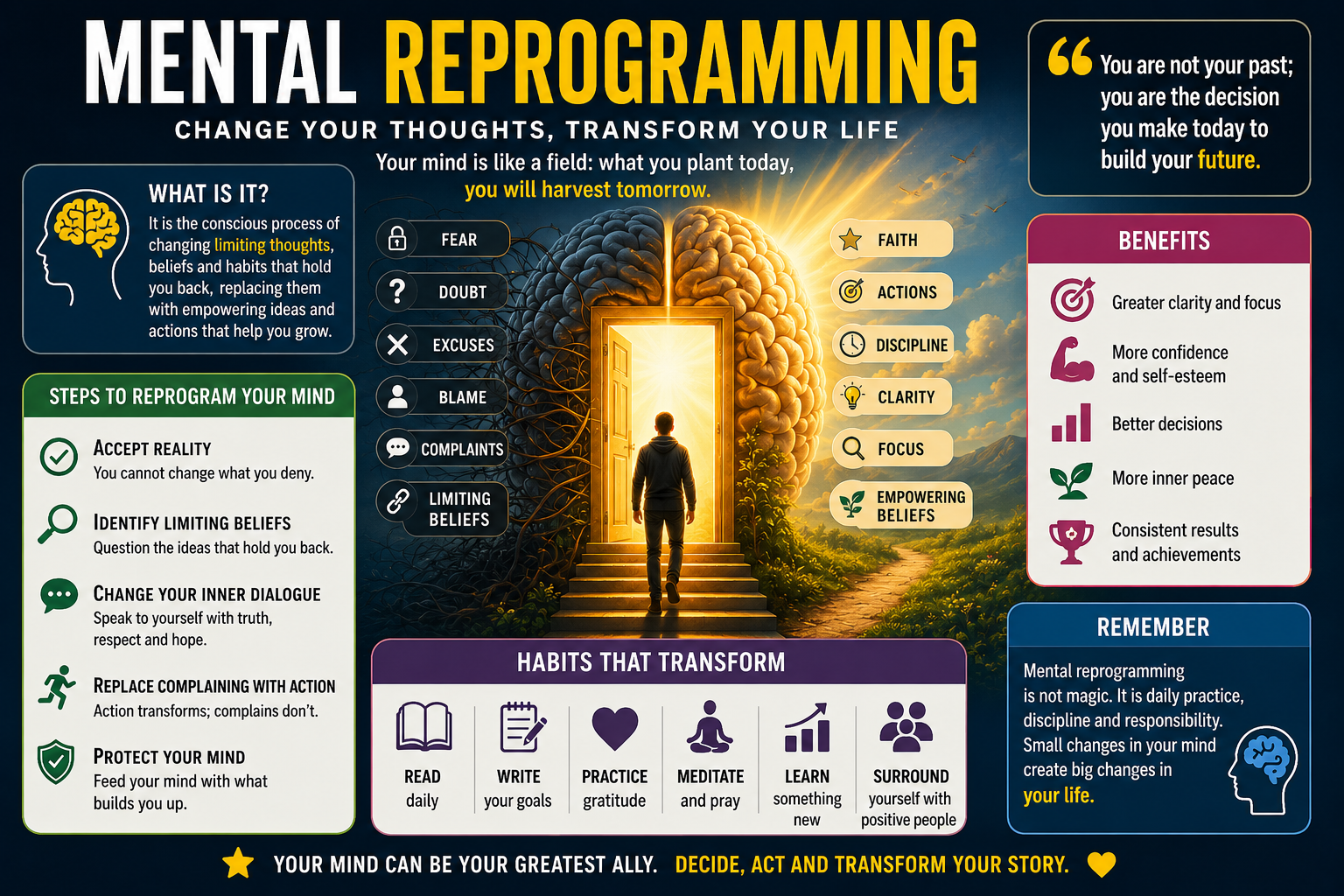
Mental Reprogramming: How to Renew Your Thoughts and Transform Your Life

By Marvin Gandis

Your Mind Can Be Your Prison or Your Bridge

My dear reader, many people want to change their lives, but very few start in the right place: the mind.

We want better results, better relationships, more money, more peace, more discipline, and more success, yet we continue thinking the same way, reacting the same way, and repeating the same habits that keep us stuck.

Here is the truth:

  • You cannot build a new life with an old mental program.

Mental reprogramming does not mean denying reality, living in fantasy, or repeating beautiful phrases without action. It means learning to observe your thoughts, identify the patterns that limit you, and replace them with beliefs, habits, and decisions that help you move forward.

Your mind is like a field. If you plant fear, complaints, blame, and excuses, you will eventually harvest frustration. But if you plant responsibility, faith, discipline, clarity, and action, you begin to build a different life.


What Is Mental Reprogramming?

Mental reprogramming is the process of consciously changing the thoughts, beliefs, emotional habits, and inner patterns that influence your daily behavior.

We have all been programmed in some way.

Since childhood, many people have heard phrases such as:

  • “That is too hard.”
  • “We were not born for that.”
  • “Money is bad.”
  • “I cannot do it.”
  • “I always fail.”
  • “Life is unfair.”
  • “Nobody supports me.”
  • “It is too late.”

Many of those phrases enter the mind like seeds. At first, they seem small, but over time, they become beliefs. Those beliefs become decisions. And those decisions eventually create results.

That is why many people do not fail because they lack ability. They fail because they live under a mental program that tells them they cannot.


The Subconscious Mind: The Hidden File That Directs Much of Your Life

The subconscious mind stores memories, emotions, experiences, fears, wounds, habits, and automatic responses.

For example, a person may want to start a business, but if deep inside they believe that “selling is bothering people,” they will be afraid to offer their product or service.

Another person may want to save money, but if they grew up hearing that “money never lasts,” they may live with financial anxiety even when opportunities appear.

Another person may want to speak in public, but if they were embarrassed in the past, they may avoid being seen because of fear of rejection.

We do not always act according to what we want. Many times, we act according to what we deeply believe.

That is why mental reprogramming is so important. It is not just about feeling motivated for one day. It is about working on the root.


Signs That You Need to Reprogram Your Mindset

You may need to renew your mindset if you often:

  • Feel like you want to move forward, but something inside stops you.
  • Start projects but do not finish them.
  • Fear rejection, failure, or criticism.
  • Compare yourself too much with others.
  • Self-sabotage when things begin to improve.
  • Say “that is just who I am” as an excuse not to change.
  • Always blame other people for your results.
  • Struggle to take responsibility for your decisions.
  • Wait for motivation, but avoid discipline.
  • Have big dreams but small actions.

The good news is that no mental program has to be permanent. What was learned can be unlearned. What is negative can be replaced. The mind can be trained.


Step 1: Accept Reality Without Covering It Up

The first step toward true mental reprogramming is accepting reality.

You cannot change what you deny.

Many people want to improve, but they do not want to recognize their mistakes. They prefer to blame the government, the economy, their family, their past, their boss, their partner, their friends, or their circumstances.

  • Yes, life can be difficult.
  • Yes, injustice exists.
  • Yes, inequality is real.
  • Yes, many people face serious obstacles.

But it is also true that many of our results are connected to our decisions, habits, thoughts, and lack of action.

Accepting this is not about punishing yourself. It is about freeing yourself.

Because when you accept responsibility, you recover power.

The victim asks: “Why is this happening to me?”

  • The responsible person asks: “What can I learn, and what can I do now?”

Step 2: Identify Your Limiting Beliefs

A limiting belief is an idea you accepted as truth, even though it is holding back your growth.

Examples:

  • “I am not smart enough.”
  • “I do not have time.”
  • “I do not have talent.”
  • “I am too old.”
  • “Everything goes wrong for me.”
  • “Success is only for other people.”
  • “I was not born to build a business.”
  • “I do not deserve better.”

The important question is: Who told you that?

  • Was it an experience?
  • Was it a person?
  • Was it a failure?
  • Was it a comparison?
  • Was it fear?

Many limiting beliefs are not truths. They are wounds speaking.

To reprogram your mind, you must question those ideas.

Instead of saying: “I cannot.”

  • You can begin saying: “I am still learning.”

Instead of saying: “I always fail.”

  • You can say: “Every mistake is showing me what I need to improve.”

Instead of saying: “I have no opportunity.”

  • You can say: “I will look for a way, a tool, a guide, or a new path.”

Step 3: Change Your Inner Dialogue

Your inner conversation creates your mental environment.

If every day you tell yourself:

  • “I am a mess.”
  • “I am not good enough.”
  • “I will never make it.”
  • “Everything is lost.”
  • “Nobody understands me.”

Your mind will begin to obey those emotional instructions.

But if you begin speaking to yourself with more responsibility, faith, and direction, your behavior will also begin to change.

This is not about lying to yourself. It is about speaking truth with hope.

You can practice phrases like:

  • “I am improving every day.”
  • “My mistakes do not define my future.”
  • “I can learn what I do not know.”
  • “I will act even when I feel afraid.”
  • “My discipline will become stronger than my excuses.”
  • “I am building a new version of myself.”

Inner dialogue does not change everything by itself, but it prepares the mind to take better action.


Step 4: Replace Complaining With Action

Complaining can become an emotional addiction.

It makes us feel like we are doing something when, in reality, we are only repeating the problem.

  • Complaining about the economy does not change your economy.
  • Complaining about a lack of opportunities does not create opportunities.
  • Complaining about past mistakes does not correct the present.
  • Complaining about a lack of support does not build discipline.

Action transforms.

  • If you lack knowledge, study.
  • If you lack contacts, begin connecting.
  • If you lack discipline, create a routine.
  • If you lack money, learn skills that can produce income.
  • If you lack clarity, write your goals and organize your priorities.

Mental reprogramming is not passive. It is practical.

A new mind requires new actions.


Step 5: Protect What Enters Your Mind

Your mind is fed by what you watch, hear, read, and repeat.

If every day you consume fear, drama, gossip, negative news, vulgar content, comparisons, and toxic conversations, your mind will eventually become filled with anxiety, anger, and confusion.

Not everything deserves your attention.

Your attention is a seed. Wherever you place it, something grows.

So ask yourself:

  • What am I watching daily?
  • What am I listening to?
  • Who am I talking to?
  • What ideas am I allowing into my mind?
  • What type of content is shaping my view of life?

You cannot feed your mind with garbage and expect clarity, peace, and purpose.

Protect your mind the way you protect your home.


Step 6: Create New Mental Habits

The mind is reprogrammed through repetition.

It is not enough to read something inspiring once. You need daily habits that reinforce your new mindset.

Powerful habits include:

  • Reading educational or spiritual content daily.
  • Write your goals in the morning.
  • Practicing gratitude.
  • Meditating or spending time in silence.
  • Praying, if that is part of your faith.
  • Listening to positive audio.
  • Learning new skills.
  • Surround yourself with growth-minded people.
  • Reviewing your progress weekly.
  • Celebrating small wins.

Transformation does not happen overnight. It happens when you repeat the right decisions until they become part of your identity.


Step 7: Stop Using the Past as a Prison

We have all made mistakes. We have all failed. We have all made poor decisions. We all have stories that could become excuses.

But the past should be a teacher, not a prison.

  • A poor decision can teach you.
  • A fall can awaken you.
  • A loss can mature you.
  • A betrayal can give you discernment.
  • A failure can reveal a new strategy.

But if you turn your past into your identity, you will remain trapped in what has already happened.

  • You are not only what you suffered.
  • You are not only what you lost.
  • You are not only what you did wrong.
  • You can still learn.
  • You can still change.
  • You can still begin again.

Step 8: Use Visualization Responsibly

Visualization is not fantasy without work.

Visualization means training your mind to see a clear direction and then acting with intention.

You can visualize yourself:

  • Speaking with more confidence.
  • Finishing a project.
  • Take better care of your health.
  • Managing your finances with discipline.
  • Building a business.
  • Overcoming a fear.
  • Responding calmly instead of reacting with anger.

But after visualization, you must act.

  • Vision without action becomes illusion.
  • Action without vision becomes disorder.
  • When you combine vision and action, you begin to move with purpose.

Step 9: Surround Yourself With People Who Elevate Your Mindset

Not everyone should have deep access to your mind.

Some people constantly criticize, mock, discourage, manipulate, or plant fear. If you spend too much time with them, sooner or later, you may begin to think like them.

  • Look for people who healthily challenge you.
  • People who inspire you.
  • People who are growing.
  • People who speak the truth with respect.
  • People who do not feed your excuses.
  • People who celebrate your progress.

Your environment influences your mindset.

You do not need to hate anyone, but you do need to protect your circle.


Step 10: Act Even When You Do Not Feel Ready

Many people wait until they feel ready to begin. But confidence does not always appear before action. Many times, it appears after the action.

Do not wait for everything to be perfect.

  • Start with what you have.
  • Learn as you move.
  • Correct as you grow.
  • Accept that progress will be imperfect.

The mind is reprogrammed when you prove through action that a new life is possible.

Every time you act despite fear, you teach your mind:

  • “I am not a slave to my emotions.”

Every time you choose discipline over excuses, you teach your mind:

  • “I can trust myself.”

Every time you rise after falling, you teach your mind:

  • “My story is not over.”

Mental Reprogramming Also Requires Humility

Humility is essential because many people do not change, believing they already know everything.

But a person who wants to grow must be willing to recognize:

  • “I was wrong.”
  • “I need to learn.”
  • “I need to improve.”
  • “I need to apologize.”
  • “I need to change my attitude.”
  • “I need to stop blaming others.”

Humility does not make you weak. It makes you teachable.

And a teachable person always has more opportunity to grow than a proud person trapped in excuses.


Practical Mental Reprogramming Exercise

Take a sheet of paper and create three columns.

Column 1: Limiting Thought

  • Example: “I am not good at selling.”

Column 2: New Truth

  • Example: “I can learn to communicate the value of what I offer.”

Column 3: Daily Action

  • Example: “I will study communication for 20 minutes a day and practice with one person.”

Do this with your main negative thoughts.

It is not enough to change phrases. You must connect each new belief with an action.


Powerful Phrases to Reprogram Your Mind

  • “I am not my past; I am the decision I make today.”
  • “My mistakes can teach me, but they do not have permission to rule me.”
  • “I can start small and grow with discipline.”
  • “Clarity comes when I stop running and start acting.”
  • “I do not need to have everything figured out to take the first step.”
  • “My mind becomes stronger when I choose truth, responsibility, and action.”
  • “Today I will not feed excuses; I will build solutions.”

Change Your Mind, Change Your Direction

My dear reader, mental reprogramming is not magic. It is a daily responsibility.

It is decided that you will no longer live under the control of thoughts that destroy your confidence. It refuses to justify what keeps you stuck. It is accepting your mistakes without hating yourself. It is looking at reality without covering it up. It is taking action even when fear is still present.

You do not need to become a perfect person. You need to become an honest, disciplined, and teachable person.

  • Your mind can be renewed.
  • Your story can take a new direction.
  • Your habits can improve.
  • Your character can become stronger.
  • Your future can be different.

But it all begins with one decision:

Stop obeying the old programming and start building a new mindset.


If This Message Spoke To Your Life

Share it with someone who needs to remember that they can still change, rise, and begin again.

Sometimes, The Right Word At The Right Moment Can Awaken A New Direction.


Disclaimers

Educational disclaimer: This article is for educational, motivational, and personal reflection purposes only. It does not replace professional medical, psychological, financial, legal, or therapeutic advice. If you are dealing with severe anxiety, depression, trauma, emotional crisis, or any mental health condition, please seek help from a qualified professional.

Results disclaimer: Mental reprogramming requires practice, consistency, and personal responsibility. Results may vary depending on each person’s situation, commitment, and actions.

Publicado en Leadership, Mental Clarity, Mindset, Motivation, Personal Development, Productivity, Self-Improvement

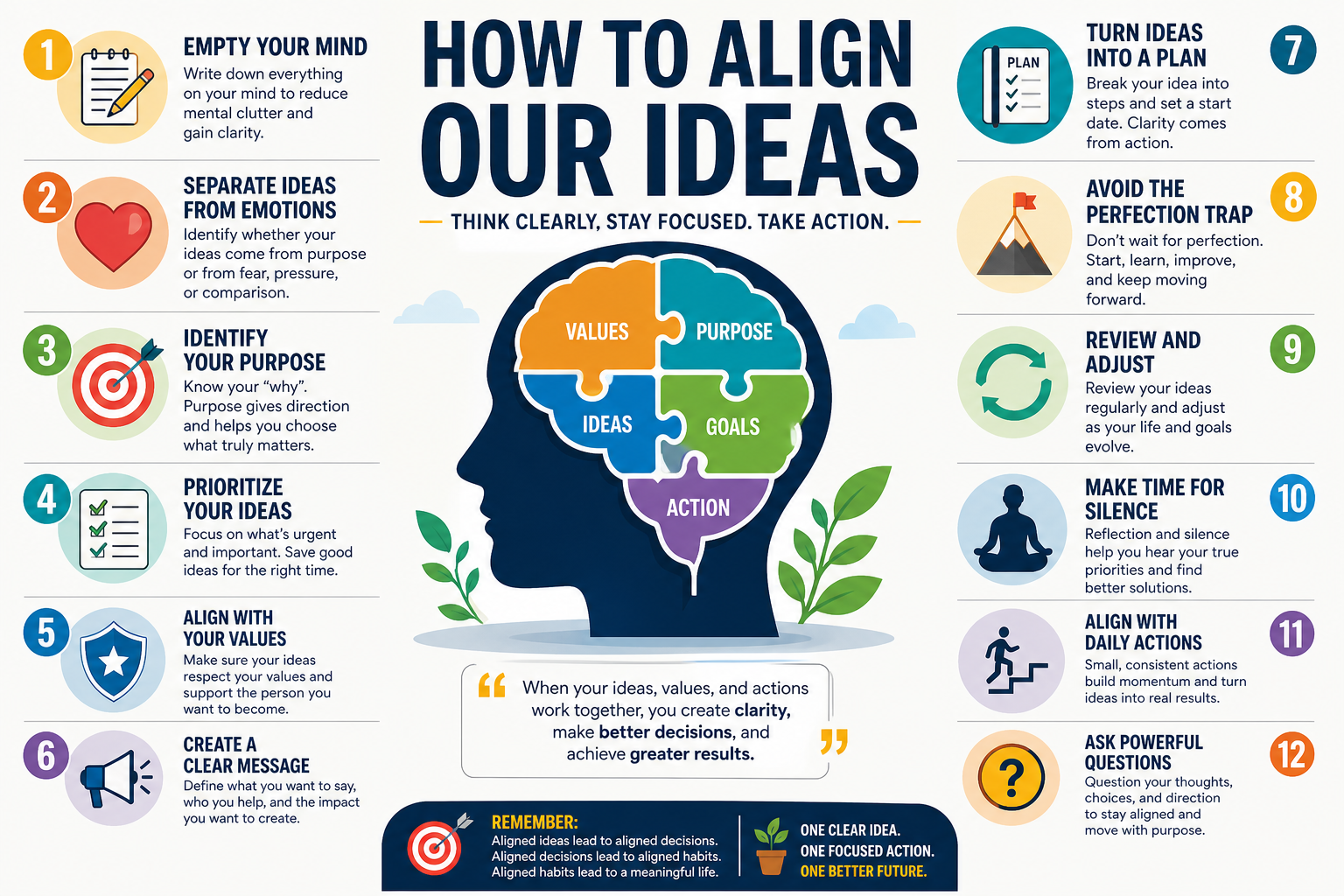
A Practical Guide to Think Clearly, Act with Purpose, and Create Better Results

Por Marvin Gandis

When Ideas Are Not Aligned, Life Feels Heavy

We all experience moments when the mind feels like a messy room: too many ideas, too many plans, too many worries, and not enough clarity.

  • We want to move forward, but we do not know where to begin.
  • We want to make decisions, but doubt gets in the way.
  • We want to create something meaningful, but our ideas seem to compete against each other.

The truth is simple: a scattered mind often creates scattered actions. But an aligned mind can turn confusion into direction, fear into decision, and loose ideas into real progress.

Aligning our ideas does not mean having everything perfect. It means learning how to organize what we think, understand what we truly want, and act according to our values, goals, and purpose.


What Does It Mean to Align Our Ideas?

Aligning our ideas means bringing our thoughts, goals, emotions, values, and actions into the same direction.

Many people live with conflicting ideas:

  • They want change, but keep repeating old habits.
  • They want peace, but feed worry every day.
  • They want success, but constantly doubt themselves.
  • They want to help others, but cannot organize their message.
  • They want progress, but never define priorities.

When our ideas are not aligned, we lose energy. When they are aligned, we gain clarity, confidence, and direction.

Alignment begins with one honest question:

Are my thoughts, words, and actions working together,

Or are they contradicting each other?


The First Step: Empty the Mind

Before we organize our ideas, we need to get them out of our heads.

Many times, we think we have a motivation problem when, in reality, we have a mental overload problem.

Take a notebook, a sheet of paper, or a digital note and write down everything on your mind:

  • Business ideas.
  • Concerns.
  • Unfinished goals.
  • Tasks.
  • Dreams.
  • Frustrations.
  • Projects.
  • Decisions you have been avoiding.

Do not judge anything at first. Just write. This exercise is powerful because it turns mental noise into visible information.

When an idea lives only in the mind, it may feel overwhelming. But once you write it down, you can look at it, evaluate it, and decide what to do with it.


Separate Ideas from Emotions

Not every idea that appears in your mind is in the right direction. Some ideas are born from inspiration, but others are born from fear, pressure, comparison, or frustration.

That is why it is important to ask:

  • Is this idea coming from purpose or anxiety?
  • Am I deciding from clarity or desperation?
  • Am I building something real or reacting to a temporary emotion?
  • Does this idea bring me closer to my values or pull me away from them?

Emotions matter, but they should not always drive the vehicle. An aligned idea may challenge you, but it should not destroy your inner peace.


Identify the Central Purpose

An idea without purpose becomes a distraction. An idea with purpose can become a mission.

Before you act, ask yourself:

Why do I want to do this?

It is not enough to say, “I want to make more money,” “I want to publish more content,” “I want to start a project,” or “I want to change my life.”

Go deeper:

  • I want to help my family.
  • I want to educate others.
  • I want to create freedom.
  • I want to use my experience to serve.
  • I want to leave a legacy.
  • I want to live with more peace and discipline.

When you understand the purpose behind your ideas, it becomes easier to decide which ideas deserve your energy and which ones are only distractions.


Prioritize: Not Every Idea Deserves Immediate Action

One reason many people do not move forward is that they try to do too much at once.

Having many ideas is not the problem. The problem is not knowing which idea should come first.

You can divide your ideas into four groups:

  • Urgent ideas: they need attention soon.
  • Important ideas: they support your main goals.
  • Future ideas: they are good, but not for this season.
  • Distracting ideas: they sound interesting, but pull you away from your path.

Mental maturity means understanding that not every good idea is an idea for today.

Sometimes saying “not yet” is a powerful way to protect your focus.


Align Ideas with Values

Your ideas must respect your values. If an idea promises results but requires you to betray your principles, it is not aligned.

Ask yourself:

  • Does this idea reflect who I want to become?
  • Can I execute it with honesty?
  • Does it help others or take advantage of them?
  • Will it give me peace or create inner conflict?
  • Is it sustainable long-term?

The most powerful ideas are not only profitable or attractive. They are ideas you can stand behind with integrity.

True alignment happens when your ambition does not destroy your character.


Create a Clear Message

Many people have good ideas, but they struggle to communicate them. And an idea that is not communicated clearly may lose its impact.

To clarify your message, answer these questions:

  • What do I want to say?
  • Who do I want to help?
  • What problem does this idea solve?
  • What transformation does it offer?
  • Why should the listener care?
  • What action do I want them to take?

An aligned idea should be easy to explain. If you need to make it too complicated, it may not be clear yet.

Clarity is not the absence of depth. Clarity is depth, well-organized.


Turn Ideas into a Plan

An idea without action remains a wish. To produce results, an idea must become a plan.

A simple plan may include:

  • Main objective.
  • Reason behind the objective.
  • Necessary steps.
  • Available resources.
  • Start date.
  • Weekly time commitment.
  • Expected result.
  • Way to measure progress.

You do not need every detail to be perfect. You need the next step to be clear.

Many people wait for complete clarity before they begin, but often clarity appears while we are already moving.


Avoid the Perfection Trap

Perfection is one of fear’s most elegant disguises. It makes us think we are preparing, when in reality we are avoiding action.

An aligned idea does not need to launch perfectly. It needs to launch with intention, structure, and honesty.

  • Publish.
  • Test.
  • Learn.
  • Correct.
  • Improve.
  • Repeat.

Imperfect action with direction is more valuable

than perfect intention without movement.


Review and Adjust Regularly

Aligning ideas is not something you do once. It is an ongoing process.

Life changes. Priorities change. Opportunities change. Your mindset must be reviewed, too.

Every week or every month, ask yourself:

  • Which ideas are still important?
  • What should I release?
  • What am I avoiding?
  • What is working?
  • What needs adjustment?
  • What action should I take now?

Alignment does not mean rigidity. It means direction with the ability to adjust.


The Importance of Silence and Reflection

We live in a noisy world. Social media, opinions, news, comparisons, messages, urgency, and distractions all compete for our attention.

That is why aligning our ideas requires moments of silence.

Silence reveals what noise hides.

In silence, you can hear your true priorities. You can distinguish between an authentic idea and external pressure. You can discover whether you are walking by conviction or comparison.

Do not underestimate the power of being still, thinking, praying, meditating, writing, or simply breathing.

Many great decisions are born in calm moments.


Align Ideas with Daily Action

The real test of an idea is not how beautiful it sounds, but how it shows up in your daily habits.

  • If you say you want to write, write.
  • If you say you want to serve, serve.
  • If you say you want to learn, study.
  • If you say you want to improve, practice.
  • If you say you want to grow, leave your comfort zone.

Alignment is proven through small, repeated actions.

You do not need to change your entire life in one day.

You need to begin living with more consistency each day.


Powerful Questions to Align Your Ideas

Use these questions when you feel confused:

  • What am I really trying to accomplish?
  • Why does this matter to me?
  • Which idea deserves my attention right now?
  • What should I save for later?
  • What thought is stealing my clarity?
  • What small action can I take today?
  • Is this decision aligned with my values?
  • Am I acting from purpose or pressure?
  • Am I building something that truly matters?

These questions do more than organize the mind. They awaken responsibility.


Clarity Does Not Happen by Accident

Aligning our ideas is an act of discipline, honesty, and purpose.

It is not about having a perfect mind. It is about learning how to direct your thoughts toward what truly matters.

When your ideas are aligned, your decisions become stronger. Your actions become more consistent. Your message becomes clearer. Your life begins to move with intention.

Remember this:

  • An idea aligned with purpose can change a decision.
  • An aligned decision can change a habit.
  • An aligned habit can change a life.

You do not need to have everything figured out today.

You only need to take the next step with clarity.


Today, take 15 minutes to write down your main ideas.

Then choose one idea that aligns with your values, your purpose, and your next season of growth.

Do not try to do everything. Begin with one clear idea, one honest action, and one firm commitment.

Your clarity begins when you decide to organize your mind and move with purpose.


Disclaimer

This article is for educational, informational, and motivational purposes only. It does not constitute professional, psychological, financial, legal, or medical advice. Every individual should evaluate their own situation, make responsible decisions, and seek professional guidance when necessary. Personal results may vary depending on discipline, circumstances, resources, decisions, and individual actions.