Publicado en Faith and Hope, Inner Growth, Inspiration, Life Purpose, Personal Development, Personal Motivation, Positive Mindset, Self-Improvement

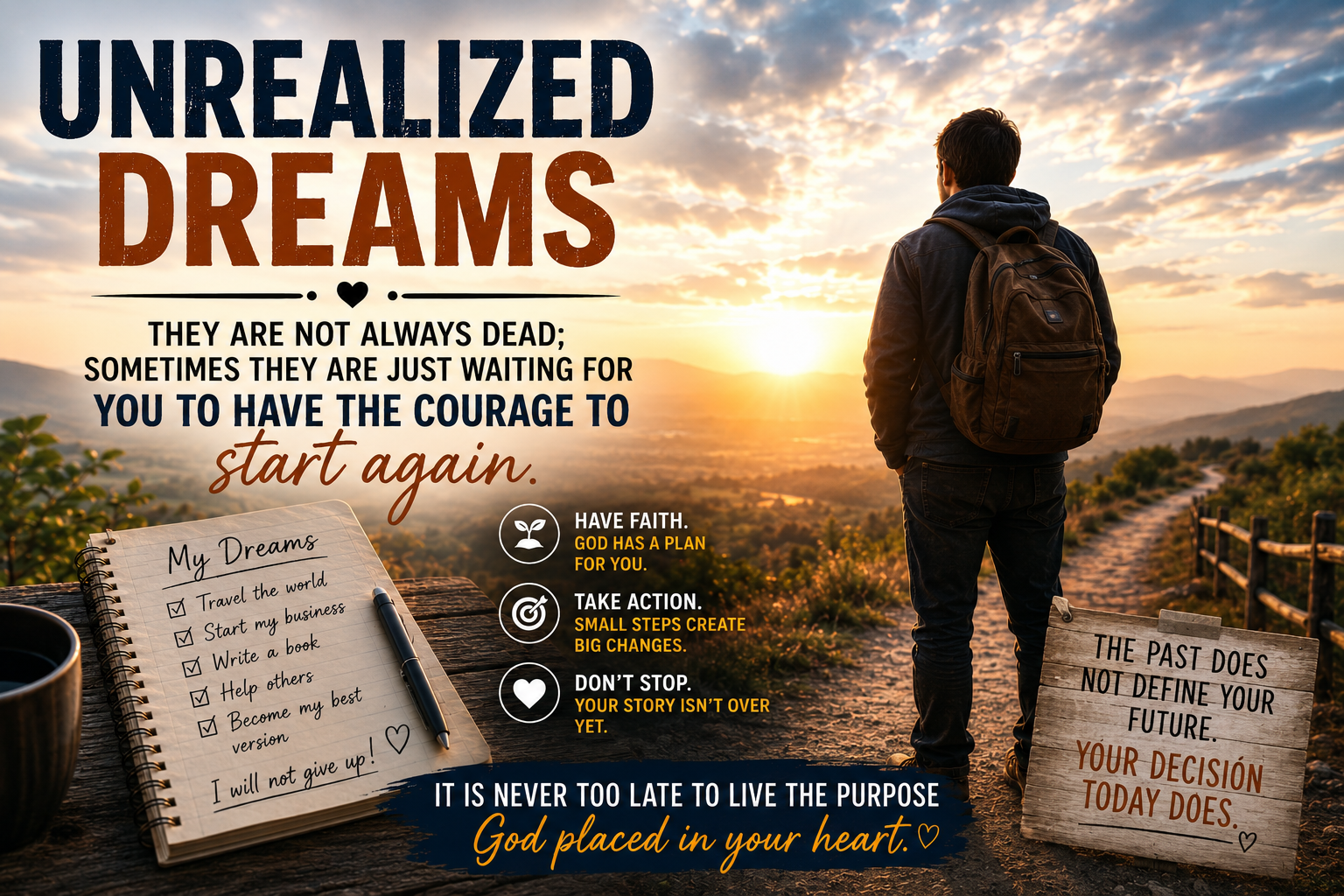
Unrealized Dreams

When Life Reminds You There Is Still Something Inside You

By Marvin Gandis

We all carry dreams hidden somewhere in the heart. Some were born when we were young, full of hope, imagination, and energy. Others appeared after a crisis, a loss, a need, or a conversation that awakened something deep within us. But as time passed, many of those dreams remained waiting.

  • Not because they were impossible.
  • Not because we had no talent.
  • Not because God forgot about us.

Many times, dreams remain unrealized because life hurt us, fear stopped us, people discouraged us, we made poor decisions, we lacked direction, or we simply became used to surviving instead of moving forward.

But an unrealized dream is not always a dead dream. Sometimes it is a sleeping seed waiting for the right moment, the right mindset, and the right decision.


What Are Unrealized Dreams?

Unrealized dreams are the goals, visions, ideas, talents, or deep desires that once set our hearts on fire but, for some reason, never became reality.

It may be:

  • A business you never started.
  • A book you never wrote.
  • A career you walked away from.
  • A family relationship you wanted to heal.
  • A trip you never took.
  • A stronger spiritual life you never developed.
  • A version of yourself you always imagined but have not yet become.

Unrealized dreams hurt because they remind us of something important: we know we could have done more.

But they also give us an opportunity: we can still wake up.


The Pain of Looking Back

There are moments in life when we stop and think:

  • “What would have happened if I had started earlier?”
  • “Where would I be today if I had not given up?”
  • “Why did I allow fear to stop me?”
  • “Is it too late to try?”

These questions can hurt, but they can also be a sign of awareness. You are not dead inside. You still feel. You still dream. There is still something in you that wants to rise.

The problem is not looking back. The problem is staying trapped there.

Looking back should help you learn, not destroy you. Your mistakes can become teachers. Your delays can become lessons. Your falls can become testimony.


Why Many Dreams Are Left Behind

Not every dream is lost because of a lack of ability. Many are lost because of a lack of decision, discipline, or faith.

Fear

Fear of failure stops more people than failure itself. Many prefer not to try because they want to avoid criticism, rejection, or embarrassment.

But not trying also has a price: the lifelong pain of wondering what could have happened.

Comfort

Sometimes we do not pursue our dreams because we become used to a safe life, even if it is not the life we truly desire. Comfort may look like peace, but many times it is a decorated cage.

The Opinions Of Others

Some people abandon their dreams because someone told them, “That is not for you,” “You are too old,” “That will never work,” or “Be realistic.”

But the truth is this: many people who criticize your dreams never dared to pursue their own.

Lack Of Direction

A dream without a plan can become frustration. Inspiration is powerful, but without organized action, the dream remains floating in imagination.

Emotional Wounds

Some people stop dreaming because they were disappointed, betrayed, humiliated, or wounded by life. When the heart is hurt, even hope can feel dangerous.

But healing is also part of the path toward purpose.


Not Every Lost Dream Is Canceled

Some dreams may not come true exactly as you once imagined. Maybe time has changed. Maybe your age has changed. Maybe your responsibilities changed. Maybe your situation changed. But that does not mean everything is over.

  • Sometimes the dream needs to mature.
  • Sometimes it needs to take another form.
  • Sometimes it needs to start small.
  • Sometimes it needs to move from fantasy to project.
  • Sometimes God does not remove the dream; He transforms it.
  • Maybe you did not write the book at 25, but you can write it now.
  • Maybe you did not start the business 10 years ago, but you can begin with what you have today.
  • Maybe you could not help others before, but your current experience can become a guide for someone else.

Lost time cannot always be recovered, but it can be redeemed with purpose.


The Danger of Living Only with Excuses

It is easy to say:

  • “I do not have time.”
  • “I do not have money.”
  • “I do not have support.”
  • “I am not an expert.”
  • “I do not know where to start.”
  • “It is too late.”

Some excuses may sound reasonable, but if we repeat them too often, they become chains.

The truth is that many people started with no money, no support, no experience, and no perfect conditions. The difference was that they decided to begin anyway.

You do not need to have everything figured out to take the first step.
You need enough humility to learn and enough courage to begin.


How to Revive an Unrealized Dream

First: identify the dream clearly

It is not enough to say, “I want something better.” Ask yourself:

  • What dream keeps coming back to my mind?
  • What desire have I tried to ignore, but it does not disappear?
  • What talent am I not using?
  • What project would bring me peace if I at least tried?

Clarity is the first act of courage.

Second: accept your reality without hiding from it

Do not deny your mistakes. Do not ignore your limitations. Do not blame everyone else for what you did not do. Accept where you are, but do not use your situation as an excuse to stay there.

Honesty heals. Denial delays.

Third: start small

A big dream can feel intimidating. But one small action can open the road.

  • One page written.
  • One call made.
  • One post shared.
  • One class taken.
  • One debt organized.
  • One habit changed.
  • One sincere prayer.
  • One 30-day plan.

Dreams are rebuilt through small actions repeated with faith and discipline.

Fourth: surround yourself with the right people

Not everyone will understand your process. Not everyone will celebrate your growth. Not everyone deserves access to your dreams.

Look for people who inspire you, correct you with love, challenge you to grow, and remind you who you are when you forget.

Fifth: stop waiting for perfect motivation

Motivation rises and falls. Discipline remains.

  • There will be days when you do not feel like it. Do something small anyway.
  • There will be days when no one applauds. Continue anyway.
  • There will be days when results do not appear. Learn and adjust anyway.

Consistency turns sleeping dreams into living testimonies.


When the Dream Changes Shape

Sometimes maturity means recognizing that a dream needs to evolve. Maybe what you wanted before no longer represents who you are now. That is not failure; it may be growth.

Do not hold on to an old version of your dream if God, life, or experience is showing you a wiser direction.

  • A transformed dream is not a lost dream.
  • It may become a deeper, more useful, and more purpose-driven dream.

Faith Also Works

Believing does not mean sitting still and waiting for everything to fall from the sky. True faith walks, learns, builds, knocks on doors, and rises after falling.

  • Pray, but also work.
  • Dream, but also plan.
  • Believe, but also act.
  • Wait on God, but do not use waiting as an excuse for passivity.

Faith does not remove effort; it gives effort direction.


It Is Never Too Late to Begin Again

Maybe you cannot change what happened, but you can decide what you will do with what remains.

  • You are not too old to learn.
  • You are not too broken to heal.
  • You have not failed too much to rise.
  • You have not arrived too late to begin.

As long as you have life, you still have an opportunity. And even if the road is not easy, it can still be meaningful.

Your dream does not need to impress the world to have value. Sometimes it is enough for it to give you hope, dignity, discipline, and the peace of knowing you tried.


Questions for Reflection

  • What dream have I abandoned because of fear or exhaustion?
  • What excuse have I repeated for too long?
  • What small step can I take this week?
  • What do I need to learn to move forward?
  • Who do I need to stop listening to?
  • What kind of person do I need to become to live that dream responsibly?

Honest answers can open a new season in your life.


Your Dream Can Still Breathe

Unrealized dreams should not be a sentence. They should be an invitation.

  • An invitation to wake up.
  • An invitation to heal.
  • An invitation to act.
  • An invitation to stop postponing life.
  • An invitation to turn regret into movement.

Do not allow the past to become stronger than your purpose. Do not allow age, criticism, fear, or mistakes to completely extinguish what can still be born within you.

Maybe you cannot do everything today, but you can begin today.

And sometimes, beginning again is the most powerful act of faith, humility, and courage.


Call to Action

My dear reader and friend, if this message touched your heart, do not ignore it. Write down the dream that still lives inside you. Then write one small action you can take within the next 24 hours.

  • Do not wait for the perfect moment.
  • Do not wait until you feel completely ready.
  • Do not wait until everyone believes in you.

Start with what you have, from where you are, and allow each step to bring you closer to the life you once imagined.

Your dream may be sleeping, but it is not necessarily dead.


Disclaimer

This article is for educational, motivational, and personal reflection purposes only. It does not replace professional financial, psychological, medical, legal, spiritual, or personal advice. Each reader is responsible for evaluating their own situation, making wise decisions, and seeking professional help when necessary.

Publicado en Christian Reflection, Faith and Hope, Family Support, Health and Wellness, Overcoming Challenges, Personal Motivation

In the Midst of Illness: When the Body Hurts, But the Soul Can Still Rise

By Marvin Gandis

Illness is one of those experiences nobody wants, yet it often arrives without asking permission. It can appear suddenly, change our plans, interrupt our routine, affect our mood, test our faith, and force us to look at life from a completely different perspective.

In the midst of illness, the body may feel weak, the mind may fill with questions, and the heart may experience fear, frustration, or sadness. However, it is also in those moments that we discover something deep: even when the body goes through pain, the spirit can still find strength, hope, and direction.

Illness does not only touch the body; it also touches emotions, family, finances, dreams, and the way we see the future. But not everything is lost. Even in the most difficult process, a new awareness, a new gratitude, and a new way of living can be born.


Illness Reminds Us That We Are Human

Many times, we live as if we were invincible. We run, work, solve problems, carry responsibilities, and keep moving forward without stopping. But when illness comes, the body speaks loudly.

  • It reminds us that we need rest.
  • It reminds us that we cannot control everything.
  • It reminds us that life is fragile.
  • It reminds us that we must value what we once took for granted.

An ordinary day can become a gift when health is affected. Walking without pain, breathing peacefully, sleeping well, eating with appetite, or simply getting out of bed can become blessings we may not have fully appreciated before.

Illness should not be seen only as punishment or defeat. Sometimes, it can also become a necessary pause to examine how we are living.


Pain Also Has a Voice

Pain speaks. Sometimes it shouts. Sometimes it whispers. But it always tries to tell us something.

It may say:

  • “You need to take better care of yourself.”
  • “You need to rest.”
  • “You need to ask for help.”
  • “You need to forgive.”
  • “You need to change your pace of life.”
  • “You need to return to what truly matters.”

In the midst of illness, many people discover they have been carrying too much: stress, worries, resentment, emotional exhaustion, anxiety, or habits that slowly weakened their well-being.

Not every pain has an easy explanation, and not every illness has an immediate answer. But one thing is true: when the body stops, the soul has the opportunity to speak.


Faith in the Midst of Illness

When a person faces illness, faith can become a refuge. Not necessarily because it immediately removes the problem, but because it sustains the heart while the answer comes.

  • Faith does not mean denying reality.
  • Faith does not mean pretending there is no pain.
  • Faith does not mean rejecting medical help.
  • Faith means believing that, even in the middle of the process, we are not alone.

There are moments when we do not have the strength to pray long prayers. Sometimes a simple prayer is enough:

  • “God, help me.”
  • “Give me strength for this day.”
  • “Do not let me go.”
  • “Guide the doctors.”
  • “Bring peace to my mind.”
  • “Teach me to trust.”

In the midst of illness, faith does not always shout victory. Sometimes it simply breathes and says: “Today I am still here, and that is also a blessing.”


Do Not Blame Yourself for Feeling Tired

Some people feel guilty for being sad, weak, or discouraged during illness. They think they should be strong all the time. But the truth is that illness affects a person deeply.

  • It is okay to cry.
  • It is okay to feel tired.
  • It is okay to need company.
  • It is okay to have difficult days.
  • It is okay to say, “Today I cannot handle everything.”

Being strong does not mean feeling no pain. Being strong means continuing to look for light even when the day seems dark.

Do not punish yourself for having human emotions. Exhaustion does not make you weak. Sadness does not make you less brave. Fear does not mean you lack faith. It means you are a person going through a difficult situation and you need love, patience, and support.


The Family Also Goes Through the Process

When someone becomes ill, the sick person is not the only one who suffers. Those who love, care, accompany, and wait for good news also suffer.

Family members may feel powerless. Children may worry. A spouse may carry stress. Friends may not know what to say. And many times, those who care for others also need to be cared for.

That is why communication is important in the midst of illness. We do not always have to hide what we feel. Sometimes saying “I need help” is an act of courage.

Illness can unite a family when there is love, understanding, and patience. It can also teach us to value presence, time, and small gestures: a phone call, a visit, a prayer, a prepared meal, a word of encouragement, or simply sitting beside someone in silence.


Hope Is Not Denying Reality

To hope does not mean closing our eyes to the truth. True hope looks reality in the face but refuses to surrender to despair.

Hope says:

  • “This is difficult, but I am not alone.”
  • “I do not have all the answers, but I can still move forward.”
  • “My body is fighting, but my spirit is not defeated.”
  • “Today may be hard, but tomorrow may bring relief.”
  • “This process does not define my entire worth.”

Illness can change plans, but it does not have to destroy a person’s identity. You are not only a diagnosis. You are not only a symptom. You are not only a bed, a medicine, or a medical appointment.

You are a life with history, value, purpose, memories, dreams, and dignity.


Learn to Live One Day at a Time

In the midst of illness, thinking too much about the future can create anxiety. Questions like “What will happen?”, “How long will this last?” “Will I recover?” “How will I pay for this?” or “What will happen to my family?” can fill the mind with worry.

That is why one of the best ways to remain emotionally strong is to live one day at a time.

  • Today, breathe.
  • Today, rest.
  • Today, take your treatment according to medical instructions.
  • Today, nourish yourself as best as possible.
  • Today, speak with someone who brings you peace.
  • Today, avoid thoughts that destroy you.
  • Today, pray, meditate, or seek silence.
  • Today, celebrate one small improvement.

You do not have to solve your entire life in one day. You only need to face the present day with as much peace as possible.


Illness Can Teach Us Gratitude

Although it may seem contradictory, many people discover a deeper gratitude during illness.

  • They learn to be thankful for a morning with less pain.
  • For good medical news.
  • For an unexpected call.
  • For a person who stayed.
  • For medicine that helps.
  • For a night of rest.
  • For a simple meal.
  • For a sincere prayer.
  • For still being alive.

Gratitude does not erase suffering, but it changes the way we go through it. It helps us see that even in the middle of the trial, there are still signs of love, care, and hope.


Care for Your Mind While Caring for Your Body

Illness does not only require physical attention. It also requires mental and emotional care.

Avoid feeding your mind with catastrophic thoughts all day long. Seek responsible information, but do not destroy yourself by consuming fear constantly. Speak with health professionals. Listen to your body. Surround yourself with people who lift you, not people who fill you with more anxiety.

Some practices may help you emotionally:

  • Breathe slowly for a few minutes.
  • Write down what you feel.
  • Listen to peaceful music.
  • Read messages of hope.
  • Pray or meditate.
  • Talk to someone you trust.
  • Take small breaks from news or social media.
  • Write down three things you are grateful for each day.

The mind also needs medicine: peace, companionship, truth, rest, and hope.


Do Not Lose Your Dignity

Illness can make a person depend on others. It can bring physical changes, limitations, or uncomfortable moments. But no illness takes away your dignity.

  • Your value does not depend on your productivity.
  • Your value does not depend on your physical strength.
  • Your value does not depend on how much you can do for others.
  • Your value does not disappear because you now need help.
  • There is dignity in resting.
  • There is dignity in receiving care.
  • There is dignity in asking for support.
  • There is dignity in fighting silently.
  • There is dignity in continuing to believe.

Do not allow illness to steal the most important truth: you are still a valuable person.


When You Do Not Understand the Process

There are moments when we do not understand why certain things happen. Illness can bring deep questions: “Why me?” “Why now?” “What did I do wrong?” “Where is God in this?”

There are not always immediate answers. And sometimes, trying to explain everything only increases the pain.

Some processes are not yet understood. They are walked through with patience, support, and faith. Sometimes, the purpose is not revealed at the beginning. Sometimes, the lesson appears later. Sometimes, the strength we did not know we had is discovered in the middle of the battle.

You do not have to understand everything to keep going. Sometimes it is enough to take the next breath, take the next step, and trust that this chapter is not the end of your story.


Healing Can Also Be Internal

When we speak about healing, we often think only of the body. But there are forms of healing that also happen in the soul.

  • Healing from resentment.
  • Healing from guilt.
  • Healing from anxiety.
  • Healing from family wounds.
  • Healing from self-sufficiency.
  • Healing from indifference.
  • Healing from a life lived in a hurry and without purpose.

Sometimes illness opens conversations that were once avoided. Sometimes it brings distant people closer. Sometimes it helps us value what truly matters. Sometimes it leads us to forgive, ask for forgiveness, or express love before it is too late.

Physical healing is important. But the healing of the soul can also deeply transform life.


Words for the Person Who Is Sick Today

My dear reader or friend, if you are going through illness, I want to say this to you with respect and care:

  • You are not alone.
  • Your pain matters.
  • Your life has value.
  • Your process deserves patience.
  • You do not have to pretend everything is okay.
  • Allow yourself to receive help.
  • Follow medical recommendations.
  • Protect your mind.
  • Rest without guilt.
  • Pray if you have faith.
  • Cry if you need to cry.
  • But do not give up.

Maybe today you do not have all the answers. Maybe your body is tired. Maybe your heart feels sensitive. But there is still hope. There is still love. There are still reasons to keep going.

A difficult day does not mean a defeated life.


Words for the Person Caring for Someone Who Is Sick

If you are caring for someone who is ill, you also need strength. Caring for someone can be beautiful, but it can also be exhausting. You are not a machine. You also need rest, support, and understanding.

Accompanying someone through illness requires love, patience, and presence. Sometimes you will not have the perfect words. But your presence can be emotional medicine.

Do not minimize the pain of the person who is sick. Do not demand strength from them all the time. Listen. Pray. Help. Be patient. And seek support for yourself as well.

The caregiver also needs care.


Illness Does Not Have the Final Word

Illness can write a difficult chapter, but it does not necessarily write the ending. Pain does not always have the final word. The diagnosis does not always have the final word. Fear does not always have the final word.

  • Some people come out of illness with a new vision of life.
  • Some people learn to love better.
  • Some people discover their faith.
  • Some people change their priorities.
  • Some people begin to live with more purpose.
  • Some people become a testimony for others.

Illness can be a storm, but even in the storm, direction can be found. Sometimes we cannot control the wind, but we can seek shelter, hold on to hope, and allow others to help us cross through it.


Conclusion

In the midst of illness, life becomes more sensitive, more fragile, and more profound. The superficial loses strength. What is essential becomes clear. Health, family, faith, love, rest, and peace take on a new meaning.

Illness is not easy. It should not be romanticized or minimized. It hurts, worries us, and changes many things. But even in the middle of that process, the human being can find strength, purpose, and hope.

Today, if you are sick or accompanying someone who is sick, remember this:

  • You do not have to walk alone.
  • You do not have to be strong all the time.
  • You do not have to have all the answers.
  • You only need to continue one day at a time, caring for your body, protecting your mind, and feeding your hope.

Because even in the midst of illness, there can still be light.

  • There can still be love.
  • There can still be faith.
  • There can still be a new beginning.

Final Reflection Quote

“In the midst of illness, the body may feel weak, but the soul can learn to breathe hope, embrace faith, and discover that there are still reasons to keep living with purpose.”


Disclaimer

This article is for educational, reflective, and motivational purposes only. It does not replace diagnosis, treatment, or advice from a physician, psychologist, therapist, or other health professional. If you are facing an illness, persistent symptoms, intense pain, anxiety, depression, or a medical emergency, seek professional help immediately. Faith, hope, and emotional support can accompany the process, but they should not replace proper medical care.