When Our Faith Is Placed in Christ, Not in People
By Marvin Gandis
There is a truth every believer needs to remember, especially after being disappointed, criticized, rejected, or hurt by people within a congregation:
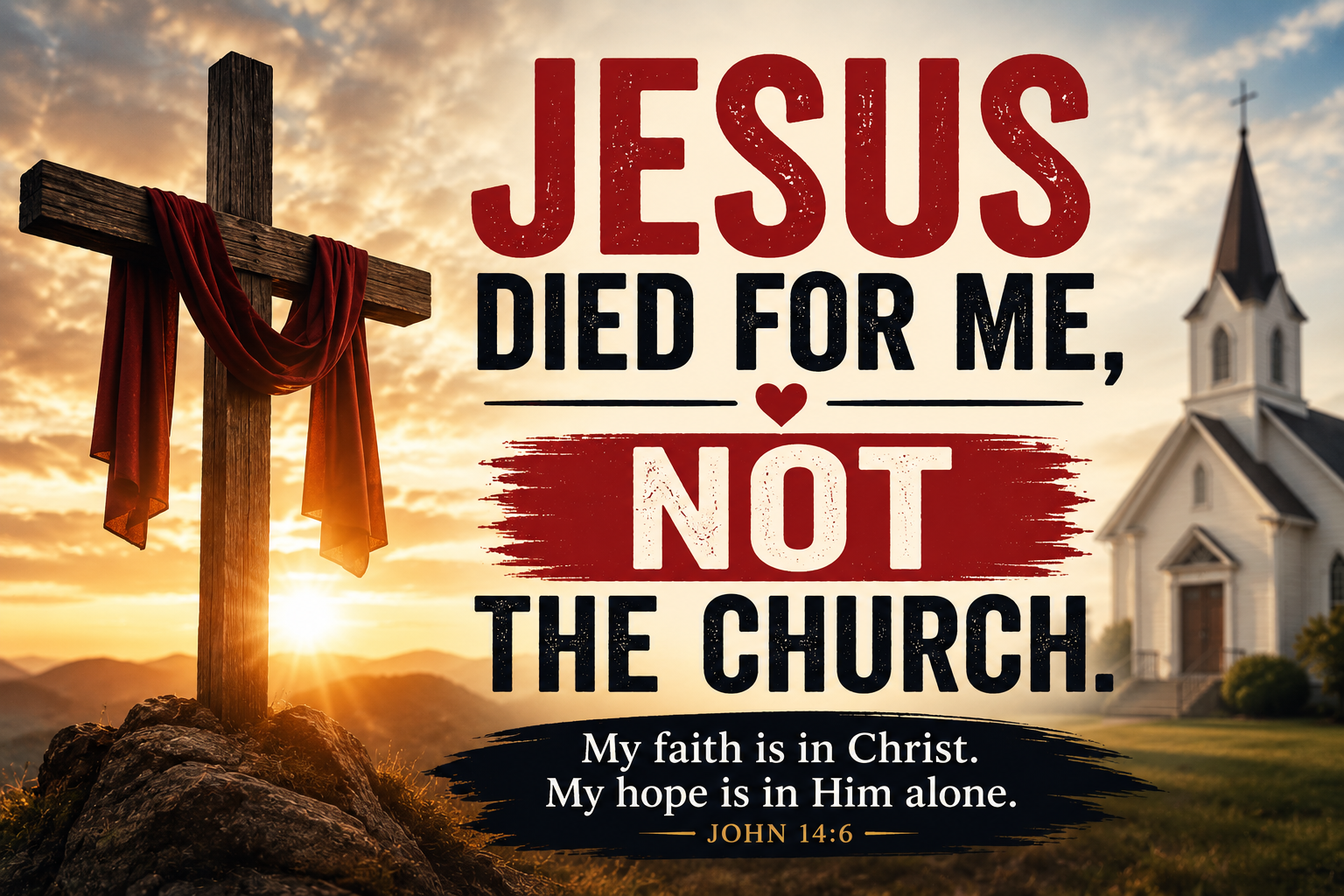
Jesus died for me. The church did not.
This statement is not meant to belittle the Church or promote an isolated Christian life. The Church has an important place in God’s purpose. We are called to gather, serve one another, grow together, and function as the body of Christ.
But there is a fundamental distinction we must never forget:
The Church is not our Savior. Jesus is.
No pastor died on the cross for our sins. No religious leader paid the price for our redemption. No denomination can grant salvation. No congregation can replace a personal relationship with Jesus Christ.
Jesus carried our sins.
Jesus shed His blood.
Jesus conquered death.
Jesus opened the way to the Father.
That is why our faith must be rooted first and foremost in Christ, not in people.
When We Confuse Jesus with the Church
One of the problems many people face is that they connect their entire experience with God to their experience with a congregation.
If the pastor fails, they feel that God failed them.
If a brother or sister disappoints them, they feel that Christianity disappointed them.
If someone judges them, they assume Jesus is rejecting them too.
If a church makes serious mistakes, they begin questioning their entire faith.
But we must learn to distinguish between a perfect Christ and imperfect human beings.
The Church is made up of people who are still growing, learning, and being transformed.
That means we will find sincere and spiritually mature believers within congregations, but we may also encounter immature, wounded, mistaken, or even hypocritical people whose behavior does not accurately reflect the Gospel.
Jesus never instructed us to place absolute trust in human beings.
Scripture points us to Him.
“Looking unto Jesus, the author and finisher of our faith.”
— Hebrews 12:2
Our primary focus must remain on Christ.
Jesus Is the One Who Died for Us
The center of the Gospel is not an institution.
The center of the Gospel is Jesus Christ.
Romans 5:8 says:
“But God commendeth his love toward us, in that, while we were yet sinners, Christ died for us.”
Notice what it says:
Christ died for us.
When we were lost, Jesus came.
When we needed reconciliation with God, Jesus paid the price.
When sin separated us from God, Christ took our guilt upon Himself.
The cross represents God’s love revealed personally through Jesus Christ.
Paul also wrote:
“For there is one God, and one mediator between God and men, the man Christ Jesus.”
— 1 Timothy 2:5
There are not many mediators.
There is one.
Jesus Christ.
No Pastor Can Replace Christ
We should love, respect, and honor those who faithfully serve in ministry.
Pastors can teach.
Leaders can guide.
Brothers and sisters can walk beside us.
Teachers can help us understand Scripture.
But none of them can occupy the place that belongs exclusively to Jesus.
The problem begins when we become more spiritually dependent on a person than on Christ.
Some believers know exactly what their pastor says but rarely study what Jesus Himself taught.
Others build their faith around a personality, ministry, denomination, or organization.
That can become spiritually dangerous.
Paul had to correct something similar in the church at Corinth.
Some said:
“I follow Paul.”
Others said:
“I follow Apollos.”
Others said:
“I follow Cephas.”
Then Paul asked a powerful question:
“Is Christ divided? was Paul crucified for you?”
— 1 Corinthians 1:13
The answer is obvious.
Paul did not die for them. Christ did.
The same principle still applies today.
Your pastor may be a blessing.
Your congregation may be wonderful.
Your denomination may have a long and meaningful history.
But none of them were crucified for you.
Jesus was.
When the Church Disappoints You
Many people walk away from faith entirely because of a painful experience inside a church.
Maybe they were ignored.
Perhaps they were judged unfairly.
Someone may have spoken badly about them.
They may have witnessed hypocrisy.
A leader may have abused authority.
Or perhaps they expected to find perfect people and discovered that the Church is also made up of flawed human beings.
The pain can be real.
It should not be minimized.
But we must not allow the failures of other people to separate us from Christ.
Do not give another person the power to destroy your relationship with Jesus.
The person who hurt you did not die for you.
The person who criticized you did not die for you.
The person who disappointed you did not die for you.
Jesus died for you.
And He has not changed.
“Jesus Christ the same yesterday, and to day, and for ever.”
— Hebrews 13:8
People change.
Congregations change.
Leaders change.
Denominations change.
Christ remains.
But This Does Not Mean We Should Despise the Church
Balance is important.
Saying “Jesus died for me, not the Church” does not mean:
“I do not need to gather with other believers.”
“I do not need Christian brothers and sisters.”
“I do not need correction.”
“I do not need community.”
“I do not need to listen to anyone.”
That would not be biblical either.
Jesus loves His Church.
Ephesians 5:25 says:
“Christ also loved the church, and gave himself for it.”
Believers are also called to walk together.
Hebrews 10:25 encourages us not to forsake assembling together.
The biblical Church serves important purposes:
- Teaching the Word of God.
- Building fellowship among believers.
- Serving those in need.
- Discipling new believers.
- Praying for one another.
- Sharing the Gospel.
- Encouraging one another in difficult times.
- Correcting one another in love.
- Worshiping God together.
So we do not have to choose between Jesus or the Church.
The proper order is:
Jesus first.
And because we follow Jesus, we also learn to love His Church properly.
Christ Is the Head of the Church
The Bible never presents a pastor as the supreme head of the Church.
Christ is the Head.
Colossians 1:18 says:
“And he is the head of the body, the church.”
That changes our perspective.
The Church belongs to Christ.
It does not belong to the pastor.
It does not belong to the founder.
It does not belong to a family.
It does not belong to an organization.
It does not belong to a denomination.
It belongs to Jesus.
Leaders are stewards and servants within God’s work.
Christ remains Lord.
Do Not Turn a Denomination into Your Identity
Denominations can help organize doctrine and administration, but our spiritual identity must be found in Christ.
Before saying:
“I am Baptist.”
“I am Pentecostal.”
“I am Methodist.”
“I am Presbyterian.”
“I am Catholic.”
“I am Evangelical.”
“I belong to this ministry.”
The more important question should be:
Am I truly a disciple of Jesus Christ?
Because one day, no religious label will have the power to save us.
Salvation is in Christ.
Acts 4:12 says:
“Neither is there salvation in any other.”
Our denomination does not save.
Our membership does not save.
Our ministry title does not save.
Our church attendance record does not save.
Christ saves.
When Someone Leaves a Congregation
We must also avoid another mistake.
Leaving one particular congregation does not necessarily mean abandoning God.
There are circumstances where a person may need to find another healthy Christian community.
For example, when there is:
- spiritual abuse,
- manipulation,
- serious doctrinal distortion,
- ongoing corruption,
- unhealthy control,
- lack of accountability,
- financial exploitation,
- or an environment where healthy spiritual growth is no longer possible.
Such decisions should be made with prayer, wisdom, and maturity.
We should not jump from church to church simply because someone corrected us or because everything did not go our way.
But neither should we believe that remaining under any leadership, no matter what happens, is an absolute spiritual obligation.
Our highest loyalty belongs to Christ.
Do Not Follow a Person More Than You Follow Jesus
John the Baptist understood this principle clearly.
When some people became concerned that crowds were beginning to follow Jesus, John responded:
“He must increase, but I must decrease.”
— John 3:30
That should also be the spirit of every true Christian leader.
A healthy pastor does not try to create personal followers.
He or she seeks to form disciples of Jesus.
A healthy teacher does not say:
“Depend on me.”
The message is:
“Know Christ.”
A genuine ministry does not turn the leader into the star.
It continually points people toward Jesus.
Learn to Know Christ Personally
One of the greatest protections against spiritual deception is developing a deep relationship with God and knowing His Word.
Do not live only on sermons.
Read the Bible.
Do not live only on Christian videos.
Pray personally.
Do not depend entirely on other people’s interpretations.
Study Scripture.
Do not allow another person to become a permanent spiritual intermediary between you and God.
Jesus opened the way for us to approach the Father.
Develop these habits:
Prayer.
Speak honestly with God.
Bible reading.
Learn what Scripture actually teaches.
Obedience.
Knowing the Word is not enough; we are called to live it.
Discernment.
Compare every teaching with Scripture.
Christian fellowship.
Surround yourself with believers who encourage you to draw closer to Christ.
Service.
Mature faith also seeks to bless others.
If a Leader Fails Someday
Remember something important:
Your faith was never supposed to depend completely on that leader.
Leaders can fall.
Ministries can disappear.
Organizations can divide.
People we admire can disappoint us.
But our hope is not built on them.
Paul wrote:
“For other foundation can no man lay than that is laid, which is Jesus Christ.”
— 1 Corinthians 3:11
That is the foundation.
Jesus Christ.
When our spiritual house is built on Christ, human failures can hurt us, but they do not have to destroy our faith.
The Church Needs to Remember This Too
This message is not only for members of congregations.
It is also for leaders.
Pastors, evangelists, teachers, bishops, ministers, and Christian leaders must remember:
People do not belong to us.
They belong to Christ.
Our responsibility is not to make people permanently dependent on us.
Our responsibility is to help them grow until they walk more closely with Jesus.
John 10:27 says:
“My sheep hear my voice, and I know them, and they follow me.”
Notice:
They follow Him.
When You Understand Who Died for You, Your Perspective Changes
When we truly understand the cross, we stop turning people into spiritual idols.
We can love our church without idolizing it.
We can respect our pastor without treating that person as infallible.
We can belong to a denomination without believing we are spiritually superior to everyone else.
We can receive teaching without surrendering our responsibility to discern.
We can serve faithfully without forgetting who our true Lord is.
Our faith begins to mature.
We stop saying:
“I believe because my pastor believes.”
Instead, we say:
“I believe because I have come to know Christ.”
We stop saying:
“I serve only because the church needs me.”
Instead:
“I serve because I love the Lord.”
We stop saying:
“If someone disappoints me, I will walk away from Jesus.”
Instead:
“Even when people fail, Christ remains faithful.”
Jesus Died for Me
When no one else could pay the price, Jesus paid it.
When no one else could carry away our sin, Jesus carried it.
When no one could reconcile us to God, Jesus opened the way.
When death appeared to have the final word, Jesus rose again.
That is why our hope is not placed primarily in buildings, organizations, titles, denominations, or religious personalities.
Our hope is in a Person:
Jesus Christ.
Love the Church.
Gather with other believers.
Serve.
Honor those who faithfully teach the Word.
Help your brothers and sisters.
Allow others to help you.
But never forget the proper order:
Jesus first.
When everyone else fails, He remains.
When others walk away, He remains.
When institutions change, He remains.
When people disappoint you, He remains.
When you walk through the valley, He remains.
And when we reach the end of our earthly journey, it will not be a denomination that receives us into eternity.
It will be Christ.
That is why we can say with gratitude, conviction, and humility:
Jesus died for me. The Church did not.
And precisely because Jesus died for me, I want to learn to love His Church without ever placing it in the position that belongs to Him alone.
Final Reflection
Ask yourself:
Is my faith truly founded on Jesus Christ, or does it depend too heavily on people, leaders, organizations, or denominations?
If a negative church experience has damaged your relationship with God, it may be time to separate the two.
People may have failed you.
Jesus was not the one who committed that wrong.
People may have hurt you.
Christ still extends His arms toward you.
People may have abandoned you.
Jesus still says:
“I will never leave thee, nor forsake thee.”
— Hebrews 13:5
Return to the foundation.
Return to the Word.
Return to prayer.
Return to Christ.
The Church can walk beside you, but only Jesus is Savior, the Way, the Truth, and the Life.
“I am the way, the truth, and the life: no man cometh unto the Father, but by me.”
— John 14:6
Christ first. Christ at the center. Christ to the end.
Disclaimer: This content is provided for educational, devotional, and Christian reflection purposes. It is not intended to attack, discredit, or make broad judgments about churches, denominations, pastors, ministers, or religious leaders. Situations involving spiritual abuse, manipulation, misconduct, or serious conflict within a congregation should be considered individually, and appropriate pastoral guidance, professional support, or legal advice should be sought when necessary. Biblical references are included to encourage personal study of Scripture and a deeper relationship with Jesus Christ.


Debe estar conectado para enviar un comentario.