Publicado en Entrepreneurship, Financial Education, Personal Development, Self-Improvement, Wealth Mindset

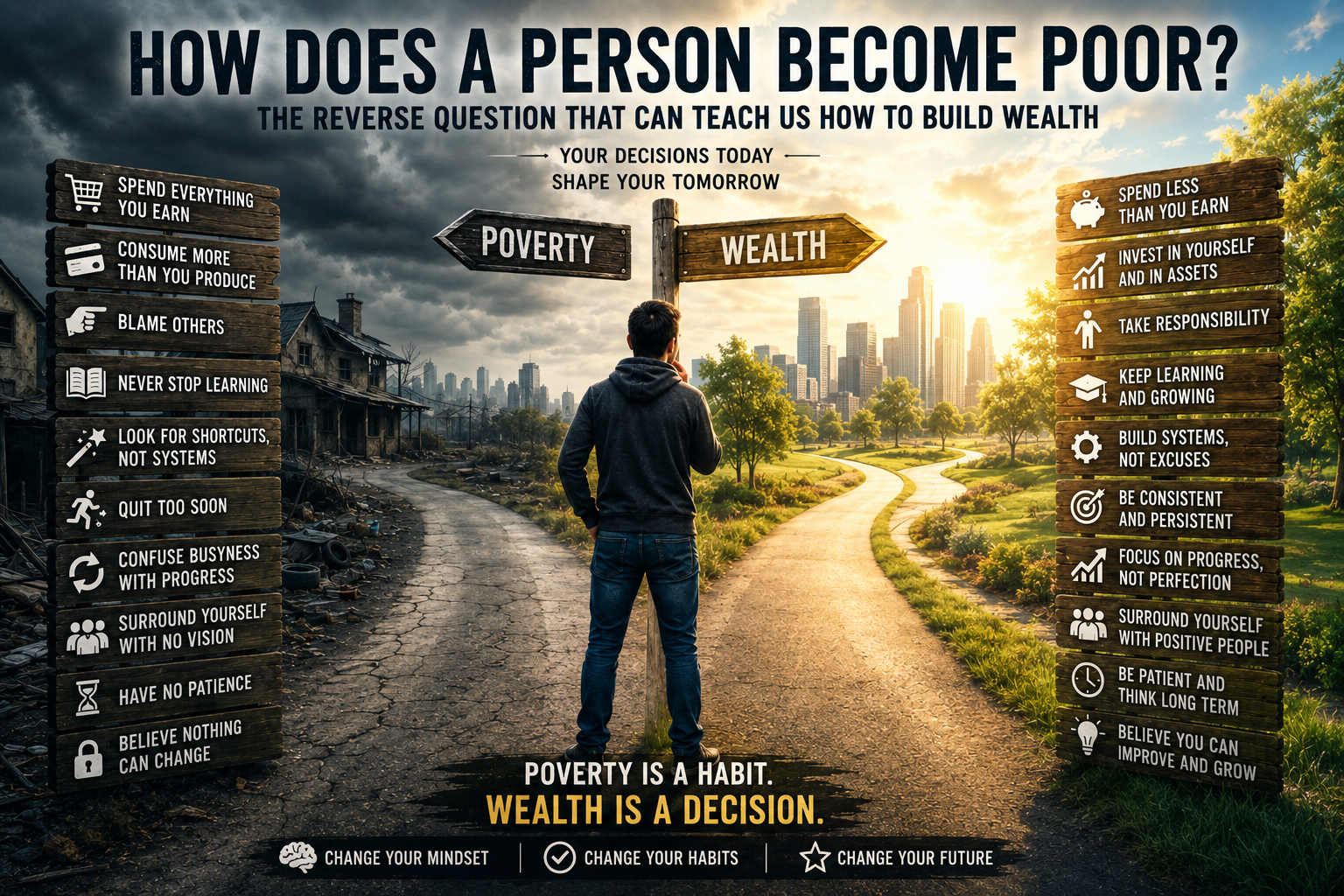
How Does a Person Become Poor? The Reverse Question That Can Teach Us How to Build Wealth

By Marvin Gandis

Most people want to know how to become rich. Every day, we see thousands of posts, videos, courses, motivational quotes, and advice about wealth, success, financial freedom, and abundance.

But even with so much information available, many people remain trapped in the same problems: debt, confusion, lack of direction, poor habits, frustration, excuses, fear, and repeated decisions that never produce different results.

So perhaps we should ask a different question:

What if instead of asking how to become rich, we asked how a person becomes poor?

  • Not as an insult.
  • Not as a cruel judgment.
  • Not to shame anyone.

But as an honest way to examine the habits, decisions, and mindsets that often prevent people from moving forward.

Because maybe, by studying what keeps a person stuck, we can understand more clearly what needs to change in order to build a wiser, more disciplined, and more abundant life.


Wealth does not begin only with money

Many people believe wealth begins when more money arrives. But the truth is that money often magnifies what already exists inside a person.

  • If someone cannot manage a little, they may not manage a lot.
  • If someone lacks discipline with a small income, they may lose a larger income.
  • If someone lives without direction, more money will not automatically create purpose.
  • If someone cannot control their habits, they may destroy valuable opportunities.

True wealth begins long before a large amount of money appears in a bank account. It begins in the mind, in behavior, in responsibility, and in the ability to make better decisions.

Being rich is not only about having more. It is also about thinking better, acting better, managing better, and serving better.


So, how does a person become poor?

A person does not always become poor overnight. Many times, it happens gradually through a series of small decisions that seem harmless at the moment.

  • An unnecessary purchase.
  • An ignored opportunity.
  • A skill never learned.
  • An excuse repeated too often.
  • A fear that controls action.
  • A debt is accepted as normal.
  • A negative environment.
  • A lack of vision that becomes a habit.

Not all poverty comes from personal mistakes. That would be unfair to say. There are difficult circumstances, injustice, illness, family crises, unemployment, weak economies, and situations that people cannot always control.

But there is also a truth we should not ignore: while we may not always choose our circumstances, we often choose our responses.

And repeated responses become our path.


Habits that keep a person poor

1. Spending everything they earn

One of the most common mistakes is living as if every dollar earned must be spent immediately.

When a person does not set money aside for savings, emergencies, investment, or growth, they remain vulnerable. Any problem can become a crisis because there is no margin.

Poverty often becomes stronger when money comes in, but it is never organized.


2. Consuming more than they produce

We live in a society that constantly promotes consumption. Buying, upgrading, showing off, impressing others, and spending have become part of many people’s identity.

But a life built only on consumption becomes fragile.

Wealth is built when a person learns to produce value through skills, services, solutions, knowledge, creativity, business, honest work, and discipline.

  • The person who only consumes depends.
  • The person who produces value begins to create options.

3. Always blaming others

Indeed, unfair systems, poor opportunities, economic crises, and harmful people exist. But living in constant blame can become a mental prison.

When a person always blames the government, the economy, the family, luck, the boss, the competition, or the past, they give away their power.

Responsibility does not mean denying reality. It means asking:

“Even if this is difficult, what can I do now?”

That question can change a life.


4. Refusing to learn new skills

The world changes. Technology changes. Business changes. The way people work changes.

But many people want better results with the same skills they had ten or twenty years ago.

Education does not end in school. Today, learning digital marketing, sales, communication, artificial intelligence, personal finance, leadership, writing, technology, or entrepreneurship can open doors that did not exist before.

A person who stops learning begins to limit their future.


5. Looking for shortcuts instead of systems

Many people want quick results, but they do not want a process. They want money, but not discipline. They want freedom, but not structure.

That is why they fall for empty promises, questionable schemes, magical ideas, or motivation without action.

Wealth is not built with emotional impulses. It is built with systems.

  • A system to manage money.
  • A system to learn.
  • A system to work.
  • A system to sell.
  • A system to save.
  • A system to measure results.
  • A system to improve every week.

Shortcuts excite people.
Systems transform people.


6. Quitting too soon

Many people start with excitement, but they quit when they do not see immediate results.

  • They post for a few days and get discouraged.
  • They try to sell and become frustrated.
  • They start a project and abandon it.
  • They begin learning something new and get tired.
  • They compare their beginning with someone else’s results.

But almost everything valuable requires time.

Poor results often do not come because a person lacks talent. They come because the person did not stay long enough with the right process.


7. Confusing movement with progress

Being busy does not mean moving forward.

A person can spend all day checking social media, watching videos, sharing posts, replying to messages, and feeling active, while still producing no real results.

Progress requires direction.

It is not enough to do many things. You must do the right things, measure results, correct mistakes, and improve.

The question is not only:

“Am I busy?”

The better question is:

“Is what I am doing moving me closer to a better life?”


8. Surrounding themselves with people who have no vision

The people around us influence our mindset, conversations, decisions, and expectations.

If a person surrounds themselves with negative, careless, irresponsible, mocking, or directionless people, that influence eventually affects the way they think.

This does not mean rejecting people arrogantly. It means protecting the mind, the environment, and the direction of your life.

A person who wants to grow needs conversations that elevate, relationships that healthily challenge them, and examples that inspire responsibility.


9. Having no patience

Impatience causes many people to make poor decisions.

  • They want quick money.
  • They want results without process.
  • They want success without training.
  • They want to harvest without planting.

But life operates by principles. First you plant, then you nurture, then you wait, then you harvest.

Patience is not passivity. It is discipline with vision.


10. Believing that nothing can change

This may be one of the deepest forms of poverty: poverty of hope.

When a person believes nothing can improve, they stop trying. And when they stop trying, they confirm their own belief.

But many lives begin to change when a person decides to start again, even with small steps.

  • You do not need to have everything figured out to begin.
  • You need to begin with what you have, where you are, and with a willingness to learn.

Mental poverty can be more dangerous than financial poverty

A person can have little money and still have a mindset of growth, faith, discipline, humility, and vision.

But a person can also have money and still live with a poor mind: fear, selfishness, disorder, irresponsibility, appearance, pride, and lack of purpose.

That is why this article is not about judging people who have less. It is about bringing awareness to the habits that destroy opportunities.

  • Financial poverty can be temporary.
  • Mental poverty can become a prison if it is never confronted.

What is the real formula for building wealth?

Maybe the formula is not as mysterious as it seems. Perhaps it is not a hidden secret, but a set of principles repeated with patience.

  • Keep learning.
  • Spend less than you earn.
  • Save with intention.
  • Invest with wisdom.
  • Serve others better.
  • Create value.
  • Develop skills.
  • Avoid destructive debt.
  • Take responsibility.
  • Think long term.
  • Persist when others quit.
  • Measure results and correct mistakes.
  • Surround yourself with better influences.
  • Build systems, not only desires.

Wealth does not appear simply because someone wants it. It is built when a person changes their daily decisions.


The question that can change everything

Maybe the right question is not:

“How do I become rich?”

Maybe the better question is:

“What habits must I stop repeating so I do not continue living poor?”

That question is more honest. More practical. More powerful.

Because when we identify what is making us poor, we begin to discover what can set us free.

  • Sometimes we do not need more information. We need more applications.
  • We do not need more motivation. We need more discipline.
  • We do not need more excuses. We need more responsibility.
  • We do not need to look rich. We need to build foundations.

Conclusion

Most people want to learn how to become rich, but few are willing to honestly study what keeps them poor.

This reflection is not meant to condemn anyone. On the contrary, it is meant to open a door.

Because if a person can recognize the habits that keep them stuck, they can begin to change them. If they can change their mindset, they can change their decisions. If they change their decisions, they can change their direction. And if they change their direction, with time, discipline, and faith, they can change their life.

True wealth does not begin with a full bank account. It begins with an awakened mind, a humble heart, a responsible attitude, and small actions repeated with wisdom.

Perhaps learning how a person remains poor is one of the clearest ways to discover how a person can begin to build wealth.


Disclaimer

This article is for educational, reflective, and informational purposes only. It should not be interpreted as financial, legal, accounting, professional, or investment advice. Every person’s situation is different, and financial results may vary depending on decisions, habits, knowledge, resources, environment, and opportunities.

This content is not intended to judge, shame, or generalize anyone who may be facing financial hardship. Poverty can be influenced by many personal, family, social, economic, and structural factors. The purpose of this reflection is to encourage responsibility, learning, discipline, financial awareness, and personal growth.

Before making important decisions related to money, investments, debt, business, or personal finances, it is recommended to consult with a qualified professional.

Publicado en Entrepreneurship, Financial Education, History and Society, Mindset, Personal Development, Prosperity

The Secret Money Code: The Truth Behind the “Secret” and the Real Principles of Prosperity

By Marvin Gandis

For many years, people have talked about the “secret money code” as if there were a hidden formula known only by certain families, communities, wealthy people, or powerful groups. Many people want quick answers: how to become rich, how to multiply money, how to think like the wealthy, or how to discover the supposed secret behind prosperity.

But the truth is deeper and more responsible than that.

Money does not obey magic, race, religion, or conspiracy. Money responds to principles: knowledge, discipline, value, management, patience, reputation, community, and long-term thinking.

That is why, when people say that certain groups, including Jewish communities or other prosperous communities, “know something others do not know,” we must be careful. We should never turn the success of a people or community into suspicion or prejudice. The right approach is to study history, learn principles, and reject stereotypes.

The real “secret money code” is not hidden inside an elite group. It is hidden inside habits that most people ignore.


The great confusion: Is there really a hidden secret?

Yes and No.

There is no magical, exclusive, mysterious secret that belongs to one race, religion, or closed group. But there are principles that many people do not practice, even though they are available to everyone.

The problem is that many people seek money before they seek understanding. They want results without financial education. They want abundance without discipline. They want freedom without order. They want prosperity without changing their habits.

That is the real secret: we do not lack information; we lack formation.

Information says: “Save, invest, learn, work, manage.”
Formation says: “Do it every day, even when you do not feel like it.”

That is where the difference begins.


The history behind the myth

Historically, some Jewish communities were connected to trade, credit, education, writing, accounting, and strong family networks. However, this should not be interpreted as a “secret plan.” It is the result of a complex history.

During certain periods in European history, Jews were excluded from many professions, land ownership, public positions, and trade guilds. In some places, they were pushed into limited economic activities, including trade and lending. Over time, this historical reality was distorted by prejudice, propaganda, and false theories.

That is how one of the most harmful errors was born: the idea that an entire group “controls money” or possesses hidden knowledge to dominate others.

That is not education. That is prejudice.

The correct historical lesson is different: many communities that have suffered exclusion develop habits of survival, education, cooperation, and financial management. Some families teach their children to study, save, build businesses, negotiate, and protect their reputation. That is not an ethnic secret; it is culture, discipline, and the transmission of values.


What prosperous people really know

Prosperous people are not always those who earn the most. Many times, they are the ones who manage better, learn better, and make better decisions.

The real code is made of simple principles that are difficult to practice consistently.

1. Money is a tool, not a god

When money becomes a god, it destroys. When it becomes a tool, it serves.

Money can feed a family, protect a home, build a business, support a cause, pay for education, and open opportunities. But if a person lives only to accumulate, they may lose peace, purpose, and humanity.

True prosperity does not begin in the pocket. It begins in the conscience.


2. Financial education changes destiny

Many people work hard their entire lives but never learn how money works. They know how to earn, but not how to manage. They know how to spend, but not how to invest. They know how to complain, but not how to create value.

Financial education teaches important questions:

  • What do I do with what I earn?
  • How much am I spending without thinking?
  • Which debts are enslaving me?
  • Which skills can increase my value?
  • What assets can I build?
  • How can I protect my family?

Financial ignorance is expensive. Financial education is an investment.


3. Control the outflow before increasing the income

Many people believe the main problem is that they do not earn enough. Sometimes that is true. But many times, the problem is a lack of control.

If a person earns more but also spends more, they do not progress. They simply move to a higher level of pressure.

Before seeking more income, we must honestly ask:

  • Where is my money going?
  • Which expenses are impulsive?
  • What am I buying to impress others?
  • What can I reduce?
  • What can I organize better?

Prosperity begins when money stops escaping without direction.


4. Value produces money

Money follows value. If you want to earn more, you need to create more value.

Value can be a skill, service, product, solution, idea, connection, tool, or experience that helps others.

The question should not only be: “How can I make more money?”
The better question is: “How can I serve better, solve better, or contribute more value?”

Those who increase their personal and professional value increase their economic possibilities.


5. Reputation is invisible capital

Some people have money but no trust. Others may have less money, but their reputation is so strong that doors open.

Reputation is built through small actions:

  • Keeping your word.
  • Being on time.
  • Paying what you owe.
  • Being honest.
  • Avoiding deception.
  • Avoiding manipulation.
  • Not promising what you cannot deliver.

Money can buy advertising, but it cannot buy true trust. Trust must be earned.


6. Community multiplies opportunities

An isolated person learns more slowly, falls harder, and rises with greater difficulty. A healthy community shares information, contacts, advice, encouragement, and opportunities.

This does not mean depending on others. It means understanding that prosperity is also built through relationships.

Strong families, mentors, churches, educational groups, professional associations, teams, and entrepreneurial communities can help a person think better and act with more direction.

The right community does not drain you; it lifts you.


7. Patience is part of the code

We live in a time when everyone wants immediate results. Fast money. Fast success. Fast fame. Fast business. But what comes fast often falls fast.

Real prosperity is often boring in the beginning. It requires saving, learning, repeating, correcting, waiting, reinvesting, and improving.

  • A tree does not bear fruit the same day it is planted.
  • A business does not mature in its first month.
  • A mind does not change after one reading.
  • Wealth is not built by impulses, but by processes.

Patience is not passivity. It is sustained discipline.


The real secret money code

We can summarize it this way:

  • Learn before you spend.
  • Manage before you ask for more.
  • Create value before you demand reward.
  • Save before you show off.
  • Invest before you waste.
  • Serve before you sell.
  • Build a reputation before you seek fame.
  • Think in generations, not only in the next paycheck.

That is the code.

It is not hidden.
It is written in the habits of those who practice responsibility.


What we can learn from prosperous communities without falling into prejudice

We can learn from many communities: Jewish, Asian, Christian, Muslim, immigrant, merchant, farming, business, craft, and working families.

Some common characteristics include:

  • Education is a priority.
  • Respect for work.
  • Family support.
  • Discipline with spending.
  • Long-term thinking.
  • Reputation as value.
  • Ability to adapt.
  • Communication between generations.
  • Entrepreneurship as a tool for freedom.
  • Faith, identity, and purpose.

The mistake is saying: “They have a secret and are hiding it.”
The truth is saying: “They practice principles that I can also learn.”


Money and the Bible: prosperity with responsibility

From a biblical perspective, prosperity should never be separated from character. The Bible does not condemn money itself; it warns against the disordered love of money, greed, injustice, and oppression.

Money can be a blessing when managed with wisdom. But it can become a trap when it rules the heart.

True prosperity includes:

  • Inner peace.
  • Honesty.
  • Generosity.
  • Dignified work.
  • A cared-for family.
  • Controlled debt.
  • Wise decisions.
  • Service to others.
  • Dependence on God, not on money.

Prosperity is not only about having more. It is living better, deciding better, and serving better.


How to learn and share this knowledge

If you want to learn and share this topic correctly, you must do it with responsibility.

  • Do not teach hatred.
  • Do not repeat conspiracy theories.
  • Do not blame one group for the world’s economic problems.
  • Do not sell fantasies of quick wealth.
  • Do not promise impossible results.

Teach principles.

You can share the message from an educational angle:

“The money code does not belong to an elite. It belongs to anyone willing to learn, organize their life, create value, manage with discipline, and think long term.”

That message builds. That message does not divide. That message helps.


Practical application: 10 steps to begin

1. Write down your real income and expenses

You cannot correct what you refuse to look at. Financial clarity begins with numbers.

2. Reduce unnecessary expenses

This is not about living miserably. It is about stopping waste.

3. Create an emergency fund

A lack of reserve can turn a small problem into a crisis.

4. Learn a high-value skill

Sales, marketing, technology, writing, communication, finance, leadership, or a specialized trade.

5. Avoid toxic debt

Not all debt is bad, but impulsive debt can destroy peace.

6. Build a second source of income

Do not depend only on one financial source.

7. Invest in education

Books, courses, mentorship, practice, and experience.

8. Protect your reputation

Your name is part of your wealth.

9. Surround yourself with people of direction

Conversations shape mindset.

10. Think about legacy

Do not live only to survive this month. Learn to build for tomorrow.


Conclusion

The secret money code is not hidden behind a religion, race, or mysterious elite. It is hidden inside principles that many people know but few practice.

True prosperity begins when a person decides to learn, manage, serve, save, invest, improve character, and think beyond the present moment.

The history behind the code should not lead us to prejudice. It should lead us to education.

  • Do not ask: “Who is hiding the secret from me?”
  • Ask instead: “Which principle have I been ignoring?”

Because many times, the door to prosperity is not locked.
We simply have not learned the key.


Disclaimer

This article is for educational and reflective purposes only. It does not promote hatred, prejudice, antisemitism, conspiracy theories, or generalizations against any religious, ethnic, or cultural group. References to prosperous communities are presented from a historical and educational perspective, not as accusations or claims of superiority. The financial information shared does not constitute financial, legal, or professional advice. Each reader should evaluate their personal situation and consult qualified professionals before making important financial decisions.

Publicado en Affiliate Marketing, Digital Marketing, Entrepreneurship, Financial Education, Online Business, Passive Income

Earning Money While You Sleep: The Smart Way to Build Income Beyond Your Working Hours

By Marvin Gandis

The Dream Everyone Talks About

“Earning money while you sleep” is one of the most attractive phrases in the world of business, investing, and online marketing.

  • It sounds powerful.
  • It sounds freeing.
  • It sounds like the kind of life many people dream about.

But let’s be honest: it is also one of the most misunderstood ideas.

Some people hear that phrase and think it means doing nothing, pressing a magic button, and watching money appear overnight. That is not reality. True income that continues after your working hours is not built by luck. It is built by strategy, systems, assets, consistency, and patience.

The goal is not to avoid work. The goal is to build something that keeps working even when you are not actively present.

That is the real meaning of earning money while you sleep.


What Does “Earning Money While You Sleep” Really Mean?

Earning money while you sleep means creating income-producing assets or systems that can continue operating without your constant physical presence.

In a traditional job, your income is usually tied directly to your time. You work one hour, you get paid for one hour. When you stop working, the income stops.

But with smart income systems, the model changes.

Instead of only trading time for money, you begin creating assets such as:

  • Digital products
  • Affiliate marketing systems
  • Email follow-up sequences
  • Online content
  • Memberships
  • Automated sales funnels
  • Investments
  • Referral-based income opportunities
  • Educational resources
  • Software or service recommendations

These assets can continue helping people, educating prospects, generating leads, and producing commissions even after you close your laptop for the day.

That is not laziness. That is leverage.


The Difference Between Active Income and System-Based Income

To understand the power of earning while you sleep, you must understand the difference between active income and system-based income.

Active Income

Active income requires your direct participation. Examples include:

  • A job
  • Freelance work
  • Consulting by the hour
  • Manual services
  • One-on-one appointments
  • Daily labor

There is nothing wrong with active income. It pays bills and provides stability. But it has one major limitation: your time is limited.

You only have 24 hours in a day.

System-Based Income

System-based income comes from assets that can continue working after they are created. Examples include:

  • A blog article that attracts readers
  • A video that educates people daily
  • An email sequence that follows up automatically
  • An affiliate link inside a helpful resource
  • A product page that accepts orders anytime
  • A digital guide that can be downloaded automatically

This type of income may still require work, maintenance, testing, and improvement. But the work is different. You are not only working for today. You are building something that can serve tomorrow.


Why Most People Fail at Passive Income

Many beginners fail because they misunderstand the process.

They want the reward without building the foundation. They want the results without learning the skill. They want income without creating value.

The truth is simple:

  • You do not get paid just because you want money.


You get paid when you solve problems, provide value, help people, or connect people with something they need.

Most people fail because they:

  • Jump from one opportunity to another
  • Quit before the system has time to grow
  • Promote without educating
  • Send traffic without follow-up
  • Ignore email marketing
  • Focus only on quick money
  • Do not build trust
  • Do not understand their audience
  • Expect overnight success

Earning money while you sleep is possible, but it is not accidental. It requires a system.


The Foundation: Build an Asset, Not Just an Activity

The biggest shift happens when you stop asking, “How can I make money today?” and start asking, “What can I build today that can keep working tomorrow?”

That is the mindset of an asset builder.

An asset is something that can keep producing value. For example:

  • A helpful article can become an asset.
  • A landing page can become an asset.
  • An email list can become an asset.
  • A digital product can become an asset.
  • A YouTube video can become an asset.
  • A training guide can become an asset.
  • A simple automated funnel can become an asset.

The more useful assets you create, the more opportunities you have to generate income beyond your active working hours.


The Role of Automation

Automation is one of the most important parts of earning money while you sleep.

Automation does not replace effort. It multiplies effort.

For example, imagine someone visits your page at 2:00 AM. You are asleep. But your system can still:

  • Capture the visitor’s email
  • Deliver a free guide
  • Send a welcome message
  • Explain the offer
  • Follow up the next day
  • Share testimonials or benefits
  • Invite the person to take action

That is the power of automation.

Without automation, many opportunities disappear. A visitor comes, looks around, leaves, and forgets about you. But with automation, the conversation continues.

This is why email marketing is so powerful. Social media can get attention, but email follow-up builds relationships.


The Email List: Your Digital Income Engine

If you want to build income beyond your working hours, your email list is one of your most valuable assets.

Why?

Because most people do not buy the first time they see an offer.

  • They need time.
  • They need trust.
  • They need education.
  • They need reminders.
  • They need a reason to believe.

An email list allows you to stay connected with your audience. Instead of losing visitors forever, you can continue serving them with useful content.

A good email sequence can:

  • Welcome new subscribers
  • Share your story
  • Educate readers
  • Explain the problem
  • Present a solution
  • Build trust
  • Answer objections
  • Invite action

This is where many beginners miss the opportunity. They send traffic directly to an offer and hope for a sale. But smart marketers capture the lead first, then follow up.

Traffic without follow-up is like filling a bucket with holes.


Affiliate Marketing: A Beginner-Friendly Path

Affiliate marketing is one of the most popular ways to start earning online because you do not need to create your own product.

You recommend a product, service, or platform. When someone buys through your referral link, you may earn a commission.

But the best affiliate marketers do not simply throw links everywhere. They educate first.

They create helpful content such as:

  • Reviews
  • Tutorials
  • Comparison articles
  • Problem-solving guides
  • Email sequences
  • Social media posts
  • Case studies
  • Beginner-friendly explanations

The goal is not just to sell. The goal is to help the right person make a better decision.

When done properly, affiliate marketing can become a system. Your content can attract people. Your landing page can capture leads. Your emails can follow up. Your offer can be available 24/7.

That is how affiliate marketing can support the idea of earning while you sleep.


Residual Income: The Powerful Long-Term Model

Some income is one-time. You make a sale once, and the transaction ends.

Residual income is different.

Residual income can continue when a customer remains subscribed to a service, membership, or recurring product. This is why many online entrepreneurs like recurring services, software tools, memberships, and subscription-based offers.

Instead of constantly needing brand-new sales every day, residual models can help build more stable long-term income.

Examples may include:

  • Software subscriptions
  • Membership programs
  • Cloud services
  • Digital tools
  • Monthly education platforms
  • Marketing services
  • Backup and storage solutions

This is why service-based affiliate offers can be attractive. When the product solves an ongoing need, people may continue using it.

A good example is digital protection, cloud backup, or online business tools. These are not just “nice to have.” For many people, they are practical necessities.


The Real Formula: Value + System + Follow-Up

If we simplify the process, earning money while you sleep comes down to this formula:

Valuable Offer + Targeted Traffic + Lead Capture + Automated Follow-Up + Trust = Income Opportunity

Let’s break that down.

1. Valuable Offer

You need something that solves a real problem or fulfills a real desire.

2. Targeted Traffic

You need the right people to see your message. Not everyone is your audience.

3. Lead Capture

You need a way to collect contact information, usually through a landing page.

4. Automated Follow-Up

You need emails that continue the conversation after the first visit.

5. Trust

People buy from those they trust. Trust is built through education, honesty, consistency, and value.

When these pieces work together, your online business becomes more than a link. It becomes a system.


Why Content Matters

Content is one of the greatest tools for building income while you sleep.

A single article can work for you for months or even years.

A helpful video can keep educating people long after you publish it.

A social media post can start conversations.

A free guide can build your list.

A tutorial can answer questions before a prospect even asks them.

Content gives people a reason to pay attention to you.

But the best content does not scream, “Buy now!”

The best content says:

  • “I understand your problem.”
  • “Here is what you need to know.”
  • “Here is a better way.”
  • “Here is a solution that may help you.”

That kind of content builds authority.


The Mindset Shift: Stop Chasing, Start Building

Many people online are chasing quick results. They chase trends, shortcuts, secret systems, and overnight promises.

But serious builders think differently.

They ask:

  • What problem can I solve?
  • What audience can I serve?
  • What system can I build?
  • What content can I create?
  • What follow-up can I improve?
  • What offer truly helps people?

This mindset separates beginners who quit from entrepreneurs who grow.

Earning while you sleep is not about escaping work. It is about doing the right work once and allowing it to keep producing value.


Practical Steps to Start Building Income While You Sleep

Step 1: Choose a Problem to Solve

Do not begin with the money. Begin with the problem.

Ask yourself:

  • What do people need help with?
  • What are they struggling to understand?
  • What product or service could make their life easier?
  • What tool could save them time, money, stress, or confusion?

Income follows value.


Step 2: Choose a Simple Offer

Start with one offer. Do not promote ten things at once.

Choose something that is:

  • Useful
  • Easy to explain
  • Relevant to your audience
  • Connected to a real need
  • Supported by a clear sales page or presentation
  • Capable of being promoted through education

The clearer the offer, the easier it is to build a system around it.


Step 3: Create a Lead Capture Page

Before sending people directly to an offer, create a simple landing page.

Your landing page should offer something valuable, such as:

  • A free guide
  • A checklist
  • A short training
  • A helpful resource
  • A beginner’s explanation
  • A discount or invitation

The goal is to capture the lead so you can follow up.


Step 4: Build an Email Follow-Up Sequence

Your email sequence should not only sell. It should educate.

A simple sequence may include:

  1. Welcome email
  2. Problem awareness email
  3. Educational value email
  4. Story or example email
  5. Solution introduction email
  6. Objection-handling email
  7. Call-to-action email

This sequence can work while you sleep, while you are busy, or while you are building your next asset.


Step 5: Send Traffic Consistently

No system works without visitors.

Traffic can come from:

  • Blog articles
  • Social media
  • Safelists
  • Paid ads
  • YouTube
  • Pinterest
  • Facebook groups
  • Email swaps
  • SEO
  • Short-form videos
  • Affiliate communities

The key is consistency. One day of traffic is not a business. Repeated exposure builds momentum.


Step 6: Track, Improve, Repeat

Smart entrepreneurs do not guess forever. They test.

Watch your numbers:

  • How many people visit the page?
  • How many subscribe?
  • How many open emails?
  • How many clicks?
  • How many take action?

Then improve your headlines, emails, calls to action, and landing pages.

Small improvements can create big long-term results.


The Truth About “Passive” Income

Passive income is not completely passive in the beginning.

Usually, it requires active effort first.

You may need to:

  • Learn the market
  • Create content
  • Build pages
  • Write emails
  • Test traffic
  • Improve your message
  • Follow up with leads
  • Stay consistent

But once the foundation is built, the system can begin working with less daily pressure.

That is the reward.

You do the work once, improve it over time, and allow the system to keep serving people.


Common Mistakes to Avoid

Mistake 1: Promoting Without Educating

People are tired of being sold to. Teach first.

Mistake 2: Sending Traffic Directly to a Sales Page

Capture the lead first whenever possible.

Mistake 3: Quitting Too Soon

Systems need time to collect data and improve.

Mistake 4: Promoting Too Many Offers

Focus creates clarity. Clarity improves conversions.

Mistake 5: Ignoring Trust

Without trust, automation feels cold. Add personality, value, and honesty.

Mistake 6: Expecting Instant Results

Real online income is built, not wished into existence.


Best Types of Offers for Earning While You Sleep

Some offers are better suited for automated systems than others.

Strong options include:

  • Digital products
  • Affiliate programs
  • Recurring services
  • Software tools
  • Online courses
  • Memberships
  • Email marketing tools
  • Cloud backup services
  • Lead generation systems
  • Business training platforms

The best offers solve problems people already care about.


A Simple Example

Imagine this:

  • A person reads your article about protecting digital files.
  • They click on your free guide.
  • They enter their email.
  • Your automated system sends them helpful tips.
  • One email explains the risk of losing photos, business files, or personal documents.
  • Another email introduces a backup solution.
  • Another email explains how the service can also offer a referral opportunity.
  • The person clicks, watches the presentation, and decides to join.

You were not manually explaining everything at midnight.

Your system did the educating.

That is how earning while you sleep begins.


The Bigger Picture: Freedom Through Systems

The real goal is not just money.

The real goal is freedom.

  • Freedom to spend more time with family.
  • Freedom to build something meaningful.
  • Freedom to stop depending only on one paycheck.
  • Freedom to create options.
  • Freedom to help others while building your own future.

Earning money while you sleep is not about greed. It is about building smarter.

When you create valuable systems, everyone can benefit:

  • The reader gets education
  • The customer gets a solution
  • The business gets a sale
  • The affiliate earns a commission
  • The system keeps working

That is the beauty of digital leverage.


Do not wait for the perfect moment to begin.

Start simple.

  • Choose one valuable offer.
  • Build one landing page.
  • Create one email sequence.
  • Drive traffic consistently.
  • Improve your system every week.

The dream of earning money while you sleep starts with the decision to build something while you are awake.

  • Your future income is not created by wishing.
  • Systems, service, consistency, and action create it.

Ready to Build Smarter Online Income?

If you are serious about creating an online system that educates prospects, captures leads, and introduces people to useful digital solutions, start by learning how simple automated funnels and referral-based offers work.

  • The key is not chasing hype.
  • The key is building a system that works with you and for you.

Start with one offer. Build one funnel. Follow up consistently. Improve daily.


Disclaimer / Affiliate Disclosure

This article is for educational and informational purposes only. It does not guarantee income, financial results, or business success. Any online business, affiliate program, or income opportunity requires effort, learning, consistency, testing, and risk. Results vary from person to person. Some links or recommendations may be affiliate-related, meaning the publisher may earn a commission if a purchase or sign-up is made through those links, at no additional cost to the reader.