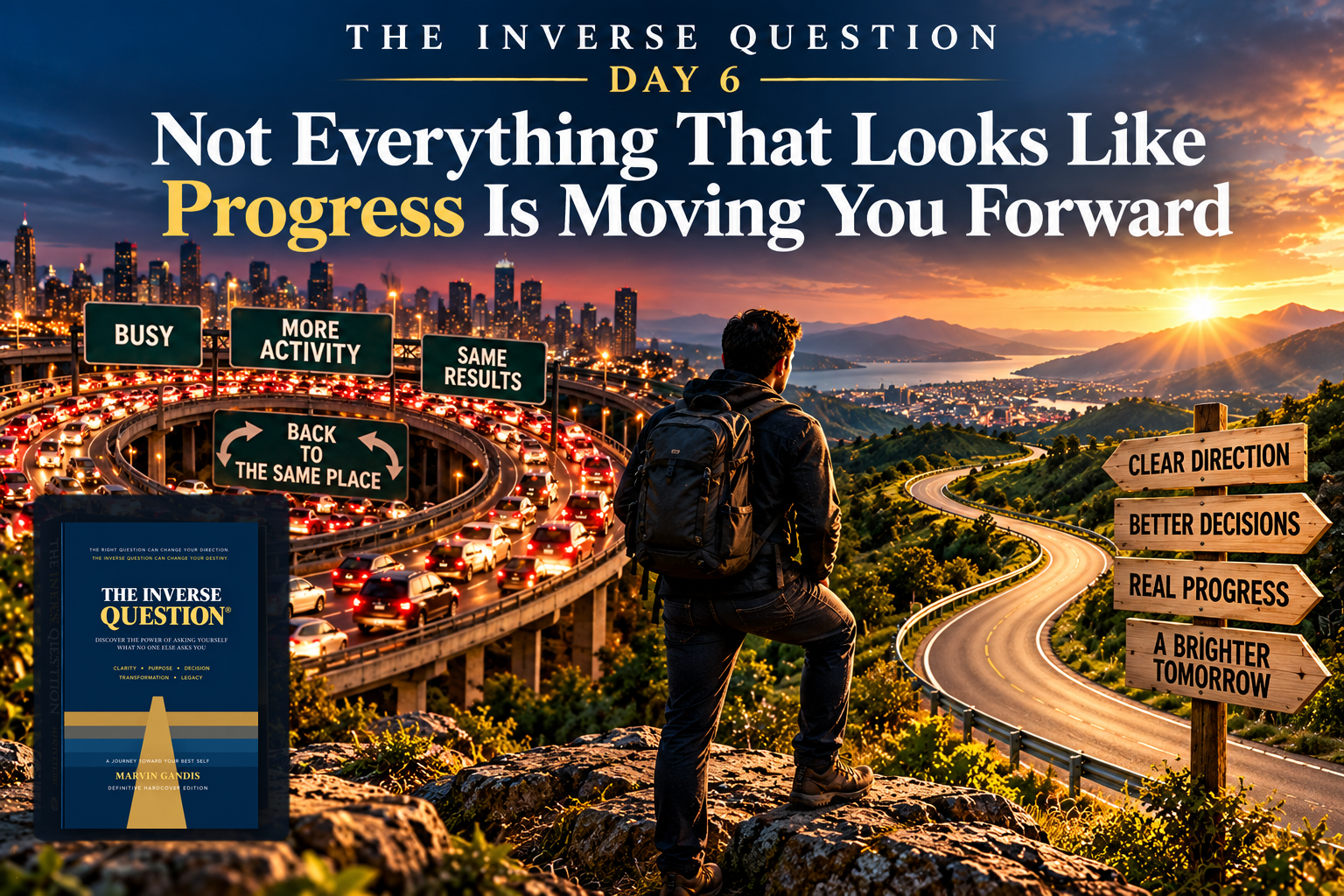
“Movement can make you feel productive. Direction is what determines whether you are actually getting somewhere.”
— Marvin Gandis
We live in a culture that rewards movement.
- Stay busy.
- Answer messages.
- Start projects.
- Attend meetings.
- Post content.
- Make calls.
- Study more.
- Work longer.
- Keep moving.
And because activity is visible, we often assume activity means progress.
But movement and progress are not the same thing.
You can walk quickly in the wrong direction.
You can work harder on a strategy that should have been changed months ago.
You can fill every hour of the day and still neglect the one thing that matters most.
You can become extremely efficient at doing something that no longer deserves your time.
That is why Day 6 of The Inverse Question asks us to examine something uncomfortable:
Is what you call progress actually moving you toward the life you want?
BUSYNESS CAN FEEL LIKE ACHIEVEMENT
Busyness gives us evidence.
- A full calendar.
- A long task list.
- Unread emails.
- Several projects underway.
- Notifications arriving constantly.
At the end of the day, we can say:
- “I was busy.”
But there is another question:
What actually moved forward?
Those are not always the same answer.
Activity measures motion.
Progress measures direction.
THE PROBLEM WITH MEASURING THE WRONG THING
Imagine someone building an online business.
- They publish constantly.
- They redesign their website.
- They change logos.
- They join new platforms.
- They watch training videos.
- They download tools.
- They test new software.
- Every week is full.
But they rarely speak to potential customers.
- They do not improve the offer.
- They do not follow up.
- They do not measure conversions.
They do not learn why people buy.
They are active.
- But are they progressing?
Sometimes what looks like productivity is simply organized avoidance.
✦ THE INVERSE QUESTION ✦
For Day 6, ask yourself:
What are you doing repeatedly because it feels productive, even though it may not be producing meaningful progress?
That question can apply to almost anything.
- Business.
- Money.
- Relationships.
- Health.
- Education.
- Personal development.
- Faith.
- Creative work.
Ask:
- What am I doing?
Then:
- What result is this activity supposed to create?
And finally:
Is it actually creating that result?
That third question changes everything.
MORE EFFORT DOES NOT ALWAYS SOLVE THE PROBLEM
We often respond to weak results by increasing effort.
- Work harder.
- Spend more time.
- Post more.
- Send more.
- Try again.
Sometimes that is exactly what is needed.
But sometimes more effort applied to the wrong method produces only more exhaustion.
If a door is locked, pushing harder may not open it.
You may need a key.
If a strategy is ineffective, doubling the activity may simply double the waste.
- Effort matters.
- But effort needs direction.
PRODUCTIVITY IS NOT THE SAME AS EFFECTIVENESS
Productivity asks:
- “How much did I do?”
Effectiveness asks:
- “Did I do what mattered?”
Those questions produce different behaviors.
You can answer fifty emails and avoid the one difficult conversation.
You can organize your files instead of finishing the proposal.
You can research endlessly instead of publishing.
You can keep preparing instead of beginning.
You can spend hours making something perfect that did not need perfection.
Productivity is valuable.
But only when it serves a meaningful objective.
SOMETIMES WE USE ACTIVITY TO AVOID DECISIONS
Decisions create responsibility.
Activity can delay it.
Instead of deciding whether a project still makes sense, we keep working on it.
Instead of deciding whether to change direction, we collect more information.
Instead of deciding whether to leave an unhealthy pattern, we stay busy managing its consequences.
Instead of deciding what matters most, we try to do everything.
Movement can become a hiding place.
That is why sometimes the most productive action is not doing more.
It is making a decision.
THE SUNK-COST TRAP
One reason we continue moving in the wrong direction is simple:
We have already invested too much.
- Time.
- Money.
- Energy.
- Emotion.
- Reputation.
We think:
- “I have come this far. I cannot stop now.”
But past investment does not automatically justify future investment.
A better question is:
If I were starting today with what I now know, would I choose this direction again?
If the answer is no, that deserves attention.
Stopping is not always failure.
Sometimes stopping is wisdom.
PROGRESS REQUIRES A DESTINATION
Imagine entering a car and driving quickly without knowing where you are going.
Speed would not solve the problem.
Before asking:
- “How can I go faster?”
you need to ask:
- “Where am I going?”
Life can work the same way.
We pursue:
- More income.
- More followers.
- More customers.
- More recognition.
- More possessions.
- More responsibilities.
- More opportunities.
But eventually we should ask:
Toward what?
What is all this activity supposed to create?
Without that clarity, growth itself can become confusing.
MONEY CAN GROW WHILE LIFE SHRINKS
Consider financial progress.
Suppose income increases.
That seems positive.
But what if:
- Stress doubles.
- Health declines.
- Relationships disappear.
- Debt increases faster than income.
- Lifestyle expenses absorb every raise.
There is no time to enjoy what was built.
- Is that progress?
Maybe.
Maybe not.
The number alone cannot answer the question.
Progress must be evaluated in context.
A BUSINESS CAN GROW IN THE WRONG DIRECTION
More customers are usually considered good.
- But what if they are the wrong customers?
More traffic sounds good.
- But what if nobody converts?
More products sound good.
- But what if complexity destroys profitability?
More employees can signal growth.
- But what if systems cannot support them?
More sales can look impressive.
- But what if margins are disappearing?
Sometimes growth creates evidence that something is moving.
It does not automatically prove it is moving well.
PERSONAL DEVELOPMENT CAN BECOME ANOTHER FORM OF PROCRASTINATION
This may be uncomfortable.
We read another book.
Take another course.
Watch another seminar.
Save another motivational video.
Learn another system.
And we feel productive.
But eventually:
Knowledge has to become behavior.
If the learning never becomes action, personal development can become intellectual entertainment.
At some point we must ask:
What have I changed because of what I learned?
That is where information becomes transformation.
✦ THE MIRROR ✦
Choose one important area of your life.
Write:
My goal is: __________
Then:
The activities I currently call progress are: __________
Now examine them.
Which activity produces the strongest result? __________
Which activity consumes time but produces very little? __________
What am I doing because I have always done it? __________
What am I avoiding because it feels difficult? __________
What should I stop doing? __________
What deserves more attention? __________
And finally:
If I removed half of my current activity, which half would I keep because it truly moves me forward?
That question can reveal priorities quickly.
THE POWER OF STOPPING
We talk often about starting.
- Start the business.
- Start exercising.
- Start saving.
- Start learning.
- Start writing.
But successful progress also requires stopping.
- Stop wasting time.
- Stop repeating ineffective methods.
- Stop saying yes automatically.
- Stop protecting habits that produce poor results.
- Stop pursuing goals that no longer belong to you.
- Stop confusing familiarity with usefulness.
Sometimes removing something produces more progress than adding something.
DIRECTION REQUIRES REVIEW
Even a good plan needs review.
Why?
Because conditions change.
- You change.
- Technology changes.
- Markets change.
- Priorities change.
- Responsibilities change.
What worked last year may not work today.
That does not mean the original strategy was foolish.
It means strategies have a lifespan.
Periodic review helps us ask:
- Is this still working?
- Does this still matter?
- What has changed?
- What should be adjusted?
- Where are the results?
Those questions prevent momentum from becoming blindness.
DO NOT WORSHIP CONSISTENCY
Consistency is powerful.
But consistency applied to something ineffective becomes persistent inefficiency.
There is a difference between:
- giving up too early
and
- refusing to change something that clearly is not working.
Wisdom requires knowing which situation you are in.
- Sometimes you need more patience.
- Sometimes you need a different strategy.
- Sometimes you need to continue.
- Sometimes you need to pivot.
The answer comes from evidence, not pride.
THE RIGHT METRIC CAN CHANGE THE DECISION
What are you measuring?
- Hours worked?
Or meaningful output?
- Followers?
Or engaged readers?
- Website traffic?
Or conversions?
- Income?
Or net financial health?
- Weight?
Or overall health indicators?
- Tasks completed?
Or important outcomes achieved?
Measurements shape behavior.
If you measure the wrong thing, you can improve the number while damaging the goal.
PROGRESS SOMETIMES LOOKS SLOWER
An interesting thing happens when people begin prioritizing correctly.
They may appear less busy.
- Fewer projects.
- Fewer meetings.
- Fewer commitments.
- Fewer distractions.
But the remaining work becomes more important.
- They protect time.
Focus increases.
Decisions improve.
Quality rises.
Real progress may look quieter than busyness.
YOU DO NOT NEED TO WIN EVERY RACE
Some races should never have been entered.
We can become so focused on outperforming others that we forget to ask whether their destination is ours.
- Someone else earns more.
- Someone else grows faster.
- Someone else has more followers.
- Someone else publishes more.
- Someone else appears farther ahead.
But if you are traveling toward different destinations, the comparison has limited value.
- Do not measure your direction using someone else’s map.
SPEED MAGNIFIES DIRECTION
Speed is useful when direction is correct.
- But dangerous when it is not.
The faster you travel in the wrong direction, the farther you must eventually return.
That is why clarity should come before acceleration.
Before asking:
- “How can I grow faster?”
ask:
“Do I want more of what this direction is currently producing?”
That may be one of the most important questions in this entire series.
SOMETIMES THE COURAGEOUS DECISION IS TO TURN AROUND
Changing direction can feel embarrassing.
People may ask questions.
You may have publicly committed.
You may feel that changing your mind means admitting failure.
But changing your mind after receiving better information is not necessarily inconsistency.
It can be maturity.
The purpose is not to prove that every previous decision was correct.
The purpose is to make the best next decision available to you now.
MY DEAR READER AND FRIEND
Perhaps you are exhausted.
Not because you are lazy.
But because you have been moving constantly.
Maybe the answer is not more effort.
Maybe it is evaluation.
Where are you going?
What is working?
What is not?
What deserves your energy?
What is consuming it without producing anything meaningful?
And most importantly:
Does your current direction still deserve your future?
You are allowed to examine the road.
You are allowed to adjust.
You are allowed to simplify.
You are allowed to stop.
You are allowed to choose again.
NOT EVERYTHING THAT LOOKS LIKE PROGRESS IS MOVING YOU FORWARD
Movement is easy to see.
Direction requires reflection.
So before celebrating how far you have traveled, ask:
Am I closer to where I actually want to be?
If yes, continue.
If not, don’t just move faster.
Look at the map.
Question the route.
Change direction if necessary.
Because a slower step in the right direction can be more valuable than a thousand hurried steps toward the wrong destination.
With gratitude,
Marvin Gandis
Author of La Pregunta Inversa and The Inverse Question
CONTINUE THE JOURNEY
This is Day 6 of The Inverse Question English series.
Day 1: Today Begins a New Chapter
Day 2: Why Did I Write The Inverse Question?
Day 3: The Question That Changed the Way I Think
Day 4: Maybe You Have Been Looking for Answers to the Wrong Question
Day 5: The Roots No One Sees Determine the Fruit Everyone Sees
Day 6: Not Everything That Looks Like Progress Is Moving You Forward
Next:
Day 7 — What Are You Tolerating Today That Is Building the Future You Do Not Want?
Because what we repeatedly accept can quietly become part of the life we eventually inherit.
DISCLAIMER
This article is provided for educational, informational, motivational, and personal-reflection purposes only. It is not medical, psychological, mental-health, financial, legal, business, or other professional advice.
The examples and concepts discussed are general and may not apply equally to every individual, circumstance, business, career, relationship, or personal goal. Changing direction, stopping an activity, or making significant personal or professional decisions should be evaluated according to your own circumstances, responsibilities, risks, and available information.
No specific personal, professional, financial, business, health, or life outcome is promised or guaranteed.
Readers should seek appropriately qualified professional guidance when circumstances require specialized advice. The Inverse Question series is intended to encourage thoughtful reflection, evaluation, learning, personal responsibility, and independent decision-making.
