Publicado en Decision Making, Direction, Intentional Living, Marvin Gandis, Mindset, Personal Development, Personal Growth, Productivity, The Inverse Question

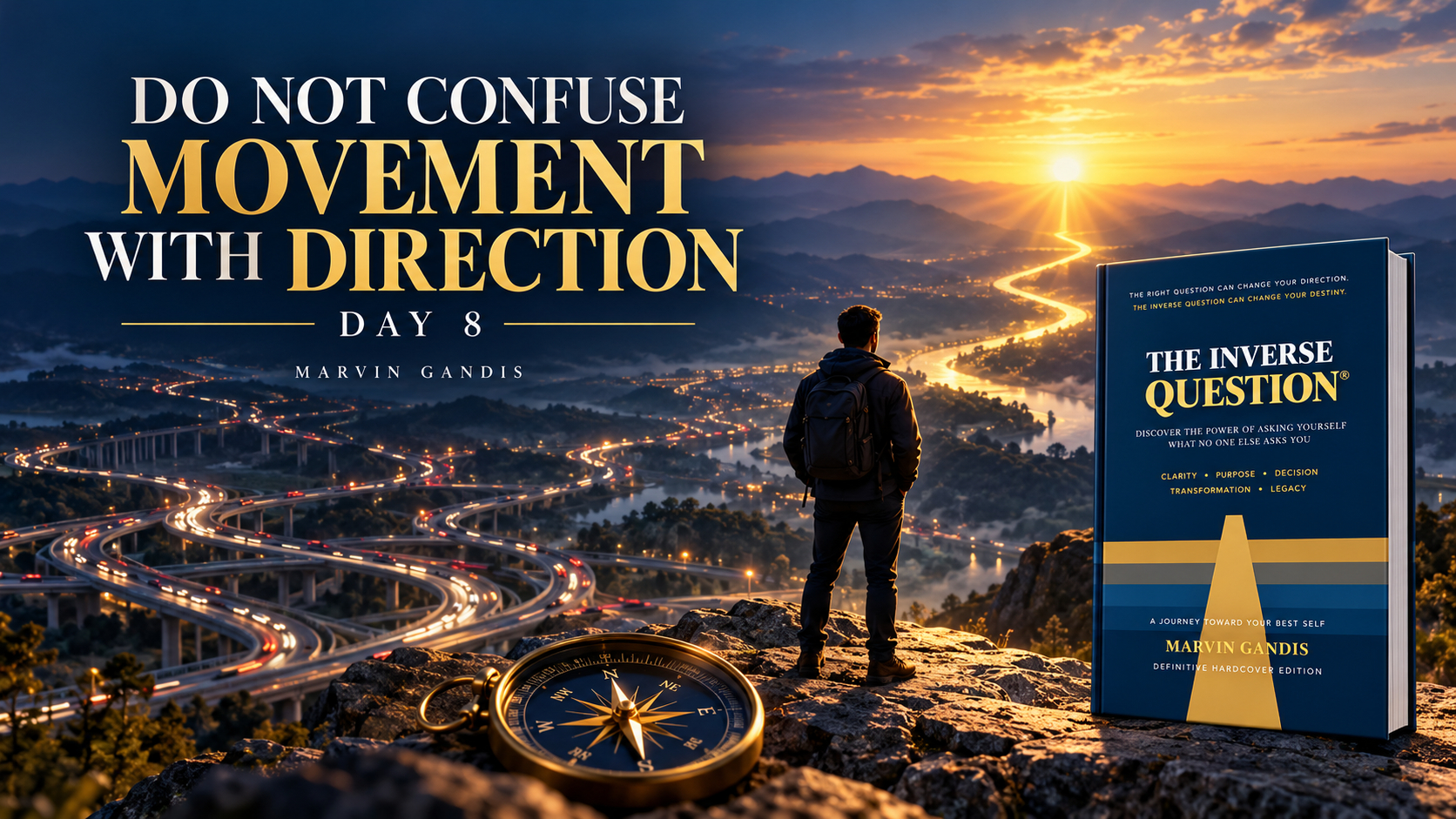
DO NOT CONFUSE MOVEMENT WITH DIRECTION

“You can move all day and still end up farther from where you truly wanted to go.”
— Marvin Gandis

Movement feels productive.

It gives us something to point to.

A full schedule.

Completed tasks.

New projects.

More calls.

More messages.

More meetings.

More activity.

And because we are moving, we assume we are progressing.

But movement only answers one question:

  • “Am I doing something?”

Direction answers another:

“Is what I am doing taking me where I actually want to go?”

Those questions are not the same.

And confusing them can cost us years.


MOVEMENT CREATES THE ILLUSION OF PROGRESS

It is easy to feel productive when the day is full.

We wake up early.

We answer messages.

We work.

We solve problems.

We react to emergencies.

We jump from one obligation to another.

By evening, we are exhausted.

And exhaustion can feel like proof that something meaningful happened.

But tired is not always the same as productive.

Busy is not always the same as effective.

And motion is not always the same as direction.

The important question is:

What moved forward because of all that activity?


A COMPASS MATTERS MORE THAN SPEED

Imagine walking quickly through a forest.

You move with determination.

Your pace is strong.

You cover a great distance.

But you are heading away from your destination.

Was your speed useful?

No.

It made the problem larger.

Direction must come before acceleration.

The same principle applies to life.

Before asking:

  • “How can I do more?”

ask:

“Am I headed toward something I actually want?”


✦ THE INVERSE QUESTION ✦

For Day 8, ask yourself:

Where in my life am I moving constantly without being certain that I am moving in the right direction?

Think about:

Your career.

Your business.

Your finances.

Your relationships.

Your health.

Your time.

Your personal development.

Your spiritual life.

Your goals.

Where are you busy?

And where are you actually headed?


A FULL CALENDAR CAN HIDE AN EMPTY DIRECTION

A calendar can be full and still lack purpose.

Meetings.

Appointments.

Projects.

Calls.

Commitments.

Tasks.

But activity without priorities creates noise.

A better question is:

If I removed everything that does not meaningfully support my priorities, what would remain?

That answer may be uncomfortable.

But it can reveal the difference between a busy life and an intentional one.


WE SOMETIMES MOVE BECAUSE STANDING STILL FEELS SCARY

Reflection requires stillness.

Stillness can be uncomfortable.

When we stop moving, we may begin noticing things we have avoided.

We may realize:

A goal no longer matters.

A strategy is failing.

A relationship needs attention.

A habit is hurting us.

A commitment should end.

A direction needs to change.

Movement can protect us from those realizations.

If we keep moving, we do not have to stop long enough to question the route.


DIRECTION REQUIRES A DEFINITION OF “ENOUGH”

If you never define enough, more becomes the destination.

More money.

More customers.

More followers.

More work.

More possessions.

More recognition.

More growth.

But more is not a direction.

It is simply an increase.

Eventually we must ask:

How much is enough?

What am I trying to protect?

What kind of life am I trying to build?

What am I unwilling to sacrifice?

What matters after the achievement?

Without those answers, success can become endless motion.


BUSINESS ACTIVITY CAN HIDE STRATEGIC CONFUSION

Business owners often work constantly.

Marketing.

Content.

Email.

Sales.

Networking.

Administration.

Technology.

Customer service.

Research.

Learning.

All of it may be necessary.

But not all activities contribute equally.

Imagine spending twenty hours creating content that generates no meaningful engagement while avoiding the two hours needed to improve an offer customers actually want.

That is movement.

But is it direction?

A stronger question is:

Which activities create the results the business actually needs?

Everything else should be evaluated around that.


THE SAME APPLIES TO MARKETING

More traffic does not automatically mean better marketing.

More followers do not automatically mean more trust.

More emails do not automatically mean stronger relationships.

More posts do not automatically mean greater authority.

More clicks do not automatically mean more customers.

Metrics can create the appearance of movement.

But direction requires connecting metrics to meaningful outcomes.

Ask:

  • What is this number supposed to accomplish?

If there is no clear answer, the number may simply be noise.


FINANCIAL MOVEMENT CAN ALSO BE DECEPTIVE

You can earn more money and become less financially secure.

How?

Lifestyle grows faster than income.

Debt grows.

Savings disappear.

Expenses expand.

Financial complexity increases.

The numbers are moving.

But the financial direction may be deteriorating.

That is why earning more and becoming financially healthier are related—but not identical.

A better question is:

Is my financial life becoming stronger, or simply larger?


CAREER PROGRESS CAN LEAD AWAY FROM THE LIFE YOU WANT

Promotions are usually celebrated.

More responsibility.

Higher income.

Greater status.

But every promotion changes something.

Time.

Pressure.

Travel.

Responsibilities.

Relationships.

Lifestyle.

Some opportunities are excellent.

Others may lead toward a life you never intended to create.

The question is not simply:

  • “Can I advance?”

It is:

“Do I want the life that comes with this advancement?”


PERSONAL GROWTH CAN LOSE DIRECTION TOO

There is an endless amount to learn.

Books.

Courses.

Podcasts.

Videos.

Seminars.

New ideas.

New systems.

Learning is valuable.

But learning without application can become movement without transformation.

Ask yourself:

  • What have I actually changed because of what I learned?

If the answer is nothing, perhaps another course is not the next step.

Perhaps practice is.


DIRECTION REQUIRES PRIORITIES

Everything cannot be equally important.

If everything is a priority, nothing is.

Priorities force us to decide.

This matters more than that.

This deserves time.

That can wait.

This opportunity fits.

That one does not.

This relationship deserves attention.

This distraction must be limited.

Direction is built through these decisions.


✦ THE MIRROR ✦

Take one important area of your life.

Write:

My destination is: __________

Now answer:

What am I currently doing to reach it? __________

Which activity moves me closer? __________

Which activity only keeps me busy? __________

What has become a habit without a clear purpose? __________

What should I reduce? __________

What deserves more attention? __________

Now ask the deeper question:

If I continue moving in exactly this direction for the next five years, where will I arrive?

Do not answer quickly.

Visualize it.

That future may tell you whether the current route deserves your next step.


DIRECTION IS OFTEN QUIETER THAN MOVEMENT

Movement makes noise.

Direction often does not.

A thoughtful decision may take five minutes and save five years.

Saying no may free hundreds of future hours.

Changing one habit may influence thousands of future choices.

Ending one ineffective activity may create room for something valuable.

Direction does not always look impressive.

Sometimes it looks like simplification.


THE RIGHT DIRECTION MAY REQUIRE MOVING SLOWER

There is enormous pressure to grow quickly.

Faster business.

Faster money.

Faster results.

Faster learning.

Faster transformation.

But speed creates risk when clarity is weak.

Sometimes slower progress allows better observation.

You learn.

Adjust.

Correct.

Strengthen.

Build sustainably.

Slow does not always mean behind.

Sometimes slow means deliberate.


DO NOT LET MOMENTUM MAKE THE DECISION FOR YOU

Momentum is powerful.

Once something begins moving, continuing becomes easier than stopping.

A project.

A career.

A relationship.

A business model.

A habit.

A lifestyle.

We think:

  • “I have been doing this for years.”

But time invested does not automatically prove that the direction remains correct.

Past commitment explains how you arrived here.

It does not decide where you must go next.


ASK WHETHER THE DESTINATION STILL BELONGS TO YOU

Goals can become outdated.

You may still be pursuing something you wanted ten years ago.

But are you the same person?

Are your values the same?

Are your responsibilities the same?

Is the world the same?

Sometimes maturity means admitting:

  • “I no longer want the destination I once chose.”

That is not necessarily failure.

It may be clarity.


DIRECTION REQUIRES FEEDBACK

A ship does not reach its destination simply by choosing the correct heading once.

Conditions change.

Wind changes.

Current changes.

Corrections are necessary.

Life is similar.

We need feedback.

Results.

Measurements.

Conversations.

Reflection.

Experience.

Mistakes.

Feedback allows us to ask:

Am I still on course?

Without feedback, consistency can become stubbornness.


THERE IS A DIFFERENCE BETWEEN QUITTING AND CORRECTING

We often fear changing direction because it feels like quitting.

But they are not always the same.

Quitting can mean abandoning something worthwhile because it became difficult.

Correcting means recognizing that the current method or destination is wrong.

Wisdom requires distinguishing between them.

Sometimes courage means continuing.

Sometimes courage means turning.


THE FASTEST PERSON DOES NOT ALWAYS ARRIVE FIRST

Someone may appear far ahead.

Better career.

More money.

Larger audience.

Bigger business.

More recognition.

That can create anxiety.

We begin accelerating.

But what if they are going somewhere you do not want to go?

Then comparison becomes meaningless.

Their speed should not determine your direction.

Your destination should.


YOUR VALUES SHOULD HELP SET THE COMPASS

When choices become complicated, values matter.

What kind of person do you want to be?

What responsibilities matter?

What relationships deserve protection?

What principles will you not sacrifice?

What kind of work feels meaningful?

What kind of future would you respect?

Values help determine direction when opportunities compete.

Without them, the loudest opportunity often wins.


YOU CAN CHANGE DIRECTION WITHOUT HATING THE ROAD BEHIND YOU

Sometimes people stay on the wrong road because changing direction feels like admitting the past was wasted.

But previous experiences may still have value.

They taught you.

Strengthened you.

Introduced people.

Developed skills.

Revealed preferences.

Helped you understand yourself.

You do not have to hate your previous direction in order to choose a new one.

You can appreciate what the road taught you and still turn.


MY DEAR READER AND FRIEND

You may currently be moving faster than ever.

Working.

Learning.

Building.

Trying.

But perhaps today is not about increasing speed.

Perhaps it is about checking the compass.

Ask yourself:

Where am I actually going?

Why am I going there?

What happens if I arrive?

Does this destination fit the person I want to become?

Does my current activity support that destination?

What deserves to stop?

What deserves to continue?

What deserves a new direction?

Sometimes the most valuable progress begins when movement temporarily stops and reflection begins.


DO NOT CONFUSE MOVEMENT WITH DIRECTION

Movement answers:

  • “How fast am I going?”

Direction asks:

  • “Where am I headed?”

One without the other can become dangerous.

So before taking another hundred steps, ask:

Is this road still taking me somewhere worth reaching?

If yes, continue.

If not, change direction.

Because arriving quickly means very little if you arrive somewhere you never wanted to be.

With gratitude,

Marvin Gandis
Author of La Pregunta Inversa and The Inverse Question


CONTINUE THE JOURNEY

This is Day 8 of The Inverse Question English series.

Day 1: Today Begins a New Chapter
Day 2: Why Did I Write The Inverse Question?
Day 3: The Question That Changed the Way I Think
Day 4: Maybe You Have Been Looking for Answers to the Wrong Question
Day 5: The Roots No One Sees Determine the Fruit Everyone Sees
Day 6: Not Everything That Looks Like Progress Is Moving You Forward
Day 7: What Are You Tolerating Today That Is Building the Future You Do Not Want?
Day 8: Do Not Confuse Movement With Direction

Next:

Day 9 — What Are You Doing Today That Your Future Self Will Thank You For?

Because the future is not only something we enter.

It is something we prepare.

DISCLAIMER

This article is provided for educational, informational, motivational, and personal-reflection purposes only. It does not constitute medical, psychological, mental-health, legal, financial, business, career, relationship, or other professional advice.

The examples and principles discussed are general and may not apply equally to every individual, circumstance, or decision. Major changes involving employment, finances, health, relationships, or other significant responsibilities should be evaluated carefully according to your personal situation and, when appropriate, with qualified professional guidance.

No specific personal, professional, financial, business, relationship, health, or life outcome is promised or guaranteed.

The Inverse Question series is intended to encourage thoughtful reflection, clarity, learning, personal responsibility, intentional decision-making, and independent judgment.
Publicado en Decision Making, Focus, Intentional Living, Marvin Gandis, Mindset, Personal Development, Personal Growth, Productivity, The Inverse Question

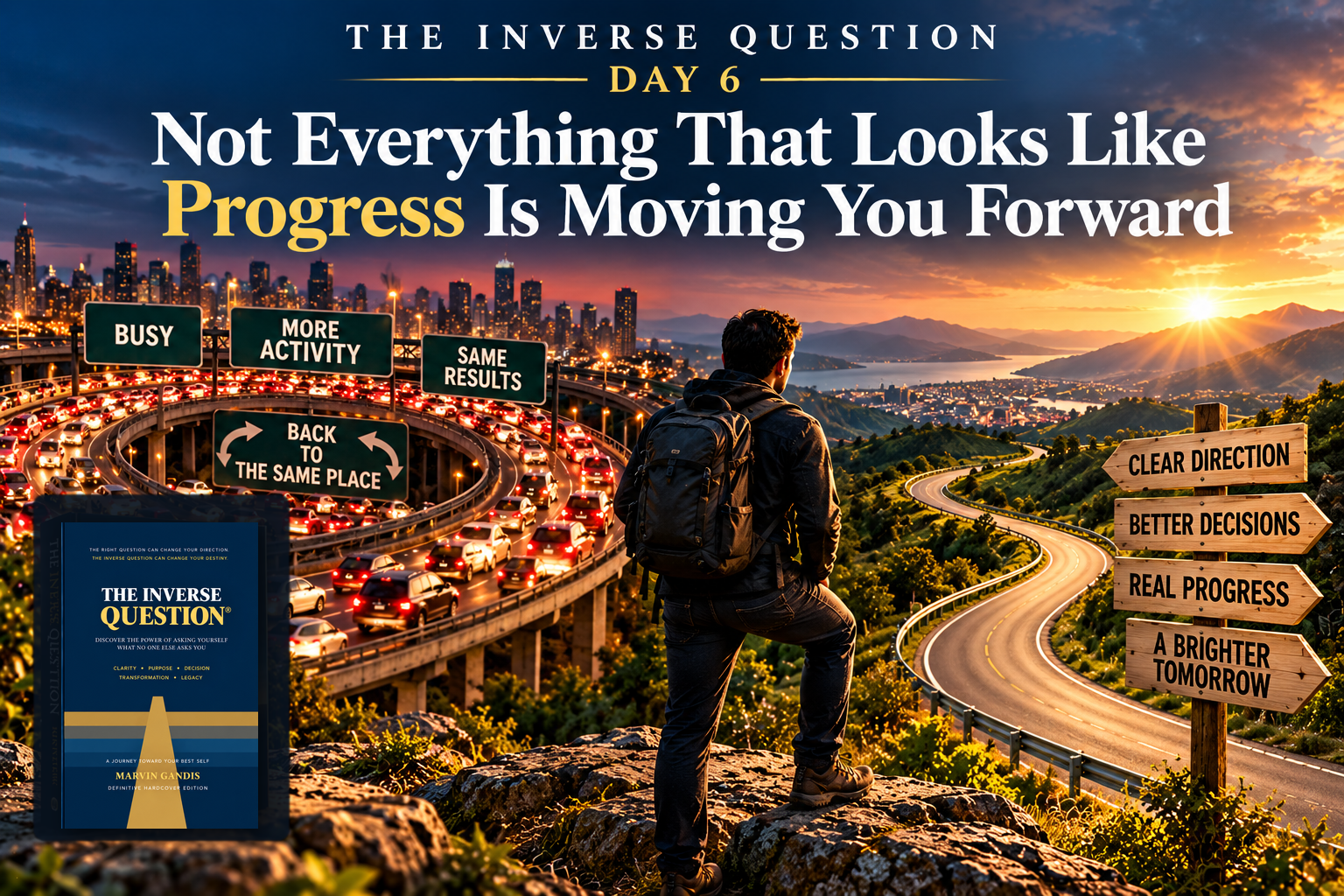
NOT EVERYTHING THAT LOOKS LIKE PROGRESS IS MOVING YOU FORWARD

“Movement can make you feel productive. Direction is what determines whether you are actually getting somewhere.”
— Marvin Gandis

We live in a culture that rewards movement.

  • Stay busy.
  • Answer messages.
  • Start projects.
  • Attend meetings.
  • Post content.
  • Make calls.
  • Study more.
  • Work longer.
  • Keep moving.

And because activity is visible, we often assume activity means progress.

But movement and progress are not the same thing.

You can walk quickly in the wrong direction.

You can work harder on a strategy that should have been changed months ago.

You can fill every hour of the day and still neglect the one thing that matters most.

You can become extremely efficient at doing something that no longer deserves your time.

That is why Day 6 of The Inverse Question asks us to examine something uncomfortable:

Is what you call progress actually moving you toward the life you want?


BUSYNESS CAN FEEL LIKE ACHIEVEMENT

Busyness gives us evidence.

  • A full calendar.
  • A long task list.
  • Unread emails.
  • Several projects underway.
  • Notifications arriving constantly.

At the end of the day, we can say:

  • “I was busy.”

But there is another question:

What actually moved forward?

Those are not always the same answer.

Activity measures motion.

Progress measures direction.


THE PROBLEM WITH MEASURING THE WRONG THING

Imagine someone building an online business.

  • They publish constantly.
  • They redesign their website.
  • They change logos.
  • They join new platforms.
  • They watch training videos.
  • They download tools.
  • They test new software.
  • Every week is full.

But they rarely speak to potential customers.

  • They do not improve the offer.
  • They do not follow up.
  • They do not measure conversions.

They do not learn why people buy.

They are active.

  • But are they progressing?

Sometimes what looks like productivity is simply organized avoidance.


✦ THE INVERSE QUESTION ✦

For Day 6, ask yourself:

What are you doing repeatedly because it feels productive, even though it may not be producing meaningful progress?

That question can apply to almost anything.

  • Business.
  • Money.
  • Relationships.
  • Health.
  • Education.
  • Personal development.
  • Faith.
  • Creative work.

Ask:

  • What am I doing?

Then:

  • What result is this activity supposed to create?

And finally:

Is it actually creating that result?

That third question changes everything.


MORE EFFORT DOES NOT ALWAYS SOLVE THE PROBLEM

We often respond to weak results by increasing effort.

  • Work harder.
  • Spend more time.
  • Post more.
  • Send more.
  • Try again.

Sometimes that is exactly what is needed.

But sometimes more effort applied to the wrong method produces only more exhaustion.

If a door is locked, pushing harder may not open it.

You may need a key.

If a strategy is ineffective, doubling the activity may simply double the waste.

  • Effort matters.
  • But effort needs direction.

PRODUCTIVITY IS NOT THE SAME AS EFFECTIVENESS

Productivity asks:

  • “How much did I do?”

Effectiveness asks:

  • “Did I do what mattered?”

Those questions produce different behaviors.

You can answer fifty emails and avoid the one difficult conversation.

You can organize your files instead of finishing the proposal.

You can research endlessly instead of publishing.

You can keep preparing instead of beginning.

You can spend hours making something perfect that did not need perfection.

Productivity is valuable.

But only when it serves a meaningful objective.


SOMETIMES WE USE ACTIVITY TO AVOID DECISIONS

Decisions create responsibility.

Activity can delay it.

Instead of deciding whether a project still makes sense, we keep working on it.

Instead of deciding whether to change direction, we collect more information.

Instead of deciding whether to leave an unhealthy pattern, we stay busy managing its consequences.

Instead of deciding what matters most, we try to do everything.

Movement can become a hiding place.

That is why sometimes the most productive action is not doing more.

It is making a decision.


THE SUNK-COST TRAP

One reason we continue moving in the wrong direction is simple:

We have already invested too much.

  • Time.
  • Money.
  • Energy.
  • Emotion.
  • Reputation.

We think:

  • “I have come this far. I cannot stop now.”

But past investment does not automatically justify future investment.

A better question is:

If I were starting today with what I now know, would I choose this direction again?

If the answer is no, that deserves attention.

Stopping is not always failure.

Sometimes stopping is wisdom.


PROGRESS REQUIRES A DESTINATION

Imagine entering a car and driving quickly without knowing where you are going.

Speed would not solve the problem.

Before asking:

  • “How can I go faster?”

you need to ask:

  • “Where am I going?”

Life can work the same way.

We pursue:

  • More income.
  • More followers.
  • More customers.
  • More recognition.
  • More possessions.
  • More responsibilities.
  • More opportunities.

But eventually we should ask:

Toward what?

What is all this activity supposed to create?

Without that clarity, growth itself can become confusing.


MONEY CAN GROW WHILE LIFE SHRINKS

Consider financial progress.

Suppose income increases.

That seems positive.

But what if:

  • Stress doubles.
  • Health declines.
  • Relationships disappear.
  • Debt increases faster than income.
  • Lifestyle expenses absorb every raise.

There is no time to enjoy what was built.

  • Is that progress?

Maybe.

Maybe not.

The number alone cannot answer the question.

Progress must be evaluated in context.


A BUSINESS CAN GROW IN THE WRONG DIRECTION

More customers are usually considered good.

  • But what if they are the wrong customers?

More traffic sounds good.

  • But what if nobody converts?

More products sound good.

  • But what if complexity destroys profitability?

More employees can signal growth.

  • But what if systems cannot support them?

More sales can look impressive.

  • But what if margins are disappearing?

Sometimes growth creates evidence that something is moving.

It does not automatically prove it is moving well.


PERSONAL DEVELOPMENT CAN BECOME ANOTHER FORM OF PROCRASTINATION

This may be uncomfortable.

We read another book.

Take another course.

Watch another seminar.

Save another motivational video.

Learn another system.

And we feel productive.

But eventually:

Knowledge has to become behavior.

If the learning never becomes action, personal development can become intellectual entertainment.

At some point we must ask:

What have I changed because of what I learned?

That is where information becomes transformation.


✦ THE MIRROR ✦

Choose one important area of your life.

Write:

My goal is: __________

Then:

The activities I currently call progress are: __________

Now examine them.

Which activity produces the strongest result? __________

Which activity consumes time but produces very little? __________

What am I doing because I have always done it? __________

What am I avoiding because it feels difficult? __________

What should I stop doing? __________

What deserves more attention? __________

And finally:

If I removed half of my current activity, which half would I keep because it truly moves me forward?

That question can reveal priorities quickly.


THE POWER OF STOPPING

We talk often about starting.

  • Start the business.
  • Start exercising.
  • Start saving.
  • Start learning.
  • Start writing.

But successful progress also requires stopping.

  • Stop wasting time.
  • Stop repeating ineffective methods.
  • Stop saying yes automatically.
  • Stop protecting habits that produce poor results.
  • Stop pursuing goals that no longer belong to you.
  • Stop confusing familiarity with usefulness.

Sometimes removing something produces more progress than adding something.


DIRECTION REQUIRES REVIEW

Even a good plan needs review.

Why?

Because conditions change.

  • You change.
  • Technology changes.
  • Markets change.
  • Priorities change.
  • Responsibilities change.

What worked last year may not work today.

That does not mean the original strategy was foolish.

It means strategies have a lifespan.

Periodic review helps us ask:

  • Is this still working?
  • Does this still matter?
  • What has changed?
  • What should be adjusted?
  • Where are the results?

Those questions prevent momentum from becoming blindness.


DO NOT WORSHIP CONSISTENCY

Consistency is powerful.

But consistency applied to something ineffective becomes persistent inefficiency.

There is a difference between:

  • giving up too early

and

  • refusing to change something that clearly is not working.

Wisdom requires knowing which situation you are in.

  • Sometimes you need more patience.
  • Sometimes you need a different strategy.
  • Sometimes you need to continue.
  • Sometimes you need to pivot.

The answer comes from evidence, not pride.


THE RIGHT METRIC CAN CHANGE THE DECISION

What are you measuring?

  • Hours worked?

Or meaningful output?

  • Followers?

Or engaged readers?

  • Website traffic?

Or conversions?

  • Income?

Or net financial health?

  • Weight?

Or overall health indicators?

  • Tasks completed?

Or important outcomes achieved?

Measurements shape behavior.

If you measure the wrong thing, you can improve the number while damaging the goal.


PROGRESS SOMETIMES LOOKS SLOWER

An interesting thing happens when people begin prioritizing correctly.

They may appear less busy.

  • Fewer projects.
  • Fewer meetings.
  • Fewer commitments.
  • Fewer distractions.

But the remaining work becomes more important.

  • They protect time.

Focus increases.

Decisions improve.

Quality rises.

Real progress may look quieter than busyness.


YOU DO NOT NEED TO WIN EVERY RACE

Some races should never have been entered.

We can become so focused on outperforming others that we forget to ask whether their destination is ours.

  • Someone else earns more.
  • Someone else grows faster.
  • Someone else has more followers.
  • Someone else publishes more.
  • Someone else appears farther ahead.

But if you are traveling toward different destinations, the comparison has limited value.

  • Do not measure your direction using someone else’s map.

SPEED MAGNIFIES DIRECTION

Speed is useful when direction is correct.

  • But dangerous when it is not.

The faster you travel in the wrong direction, the farther you must eventually return.

That is why clarity should come before acceleration.

Before asking:

  • “How can I grow faster?”

ask:

“Do I want more of what this direction is currently producing?”

That may be one of the most important questions in this entire series.


SOMETIMES THE COURAGEOUS DECISION IS TO TURN AROUND

Changing direction can feel embarrassing.

People may ask questions.

You may have publicly committed.

You may feel that changing your mind means admitting failure.

But changing your mind after receiving better information is not necessarily inconsistency.

It can be maturity.

The purpose is not to prove that every previous decision was correct.

The purpose is to make the best next decision available to you now.


MY DEAR READER AND FRIEND

Perhaps you are exhausted.

Not because you are lazy.

But because you have been moving constantly.

Maybe the answer is not more effort.

Maybe it is evaluation.

Where are you going?

What is working?

What is not?

What deserves your energy?

What is consuming it without producing anything meaningful?

And most importantly:

Does your current direction still deserve your future?

You are allowed to examine the road.

You are allowed to adjust.

You are allowed to simplify.

You are allowed to stop.

You are allowed to choose again.


NOT EVERYTHING THAT LOOKS LIKE PROGRESS IS MOVING YOU FORWARD

Movement is easy to see.

Direction requires reflection.

So before celebrating how far you have traveled, ask:

Am I closer to where I actually want to be?

If yes, continue.

If not, don’t just move faster.

Look at the map.

Question the route.

Change direction if necessary.

Because a slower step in the right direction can be more valuable than a thousand hurried steps toward the wrong destination.

With gratitude,

Marvin Gandis
Author of La Pregunta Inversa and The Inverse Question


CONTINUE THE JOURNEY

This is Day 6 of The Inverse Question English series.

Day 1: Today Begins a New Chapter
Day 2: Why Did I Write The Inverse Question?
Day 3: The Question That Changed the Way I Think
Day 4: Maybe You Have Been Looking for Answers to the Wrong Question
Day 5: The Roots No One Sees Determine the Fruit Everyone Sees
Day 6: Not Everything That Looks Like Progress Is Moving You Forward

Next:

Day 7 — What Are You Tolerating Today That Is Building the Future You Do Not Want?

Because what we repeatedly accept can quietly become part of the life we eventually inherit.

DISCLAIMER

This article is provided for educational, informational, motivational, and personal-reflection purposes only. It is not medical, psychological, mental-health, financial, legal, business, or other professional advice.

The examples and concepts discussed are general and may not apply equally to every individual, circumstance, business, career, relationship, or personal goal. Changing direction, stopping an activity, or making significant personal or professional decisions should be evaluated according to your own circumstances, responsibilities, risks, and available information.

No specific personal, professional, financial, business, health, or life outcome is promised or guaranteed.

Readers should seek appropriately qualified professional guidance when circumstances require specialized advice. The Inverse Question series is intended to encourage thoughtful reflection, evaluation, learning, personal responsibility, and independent decision-making.

Publicado en Digital Marketing, Entrepreneurship, Personal Development, Productivity, Wealth Mindset

Looking for Shortcuts Instead of Systems: Why Many People Fail Online and in Life

By Marvin Gandis

Many people want fast results, but they do not want processes.

They want quick money, quick success, quick followers, quick sales, quick freedom, and immediate change. But when they discover that everything valuable requires time, structure, discipline, and consistency, they become discouraged or look for an easier path.

That is one of the great mistakes that keeps many people stuck: looking for shortcuts instead of building systems.

In this seventh part of the series “The Reverse Question,” we will reflect on why shortcuts often create excitement but rarely create transformation, and why systems, although they may seem slower, can build stronger and more lasting results.

  • This is not about rejecting modern tools.
  • This is not about working harder without intelligence.
  • This is not about making simple things complicated.

It is about understanding that a better life is not built only with wishes, impulses, or quick promises. It is built with habits, structure, measurement, learning, and repeated action.


The promise of the shortcut

The shortcut always sounds attractive.

  • “Make money without effort.”
  • “Get rich in a few days.”
  • “Change your life without discipline.”
  • “Get results without learning.”
  • “Automate everything and forget the work.”
  • “Copy this, and you will succeed immediately.”

These promises attract attention because they touch a real need: many people are tired, frustrated, in debt, or desperate for change.

But desperation can lead to poor decisions.

When a person looks for results without a process, they can easily fall into false expectations, impulsive purchases, abandoned projects, misunderstood programs, or strategies that never become sustainable.

  • Shortcuts sell emotion.
  • Systems build direction.

The problem is not wanting to move faster

Wanting to move faster is not wrong. We all want to save time, avoid mistakes, and improve results.

The problem is not seeking efficiency. The problem is trying to skip the foundations.

There is a difference between using a tool to improve a system and using a promise to avoid discipline.

  • A tool can help you create content faster.
  • But you still need a message, strategy, and consistency.
  • A platform can help you attract prospects.
  • But you still need follow-up and trust.
  • Automation can help you save time.
  • But you still need clarity, review, and improvement.
  • A mentor can guide you.
  • But you still have to apply.

Speed without foundations can become chaos.


What is a system?

A system is an organized way of doing something repeatable, measurable, and improvable.

  • A system does not depend only on motivation.
  • It does not depend on emotions.
  • It does not depend on luck.
  • It does not depend on doing random things.

A system has clear steps.

For example:

  • A system for managing money.
  • A system for saving.
  • A system for learning.
  • A system for selling.
  • A system for creating content.
  • A system for following up.
  • A system for measuring results.
  • A system for correcting mistakes.
  • A system for improving habits.

When a person has a system, they no longer live by improvising every day. They have direction.


Why do many people fail online

Many people enter the digital world looking for immediate results.

  • They open a page.
  • They share links.
  • They publish offers.
  • They join programs.
  • They buy tools.
  • They send messages.
  • They change strategies every week.

But they do not have a system.

  • They do not know who their audience is.
  • They do not have a clear message.
  • They do not have an effective capture page.
  • They do not follow up.
  • They do not measure results.
  • They do not educate the prospect.
  • They do not build trust.
  • They do not correct what is not working.

Then, when they do not see quick results, they say:

  • “This does not work.”
  • “Nobody buys.”
  • “Nobody supports me.”
  • “The market is difficult.”
  • “I already tried.”

But many times, the opportunity did not fail. The system failed.


The difference between activity and a system

A person can do many activities without having a system.

  • Posting is not always a system.
  • Sending messages is not always a system.
  • Sharing links is not always a system.
  • Buying traffic is not always a system.
  • Creating content is not always a system.
  • Being busy is not always a system.

A system connects the parts.

For example, in digital marketing, a system may include:

  • A clear message.
  • A defined audience.
  • A specific offer.
  • A capture page.
  • A follow-up sequence.
  • Educational content.
  • Measurement of clicks, sign-ups, and conversions.
  • Adjustments based on results.

Without a connection between the parts, the person is only doing scattered movements.

And scattered movements rarely produce consistent results.


Shortcuts feed impatience

When a person becomes used to looking for shortcuts, they lose patience for building.

  • They start something and abandon it.
  • They buy a tool and never learn how to use it.
  • They join a program and do not follow the training.
  • They post for a few days and become discouraged.
  • They send messages without a strategy and become frustrated.
  • They change opportunities before mastering the previous one.

Impatience destroys processes that have not had time to mature.

Many seeds do not fail because they are bad. They fail because the person abandons them before caring for them.


Systems create confidence

A well-worked system creates confidence because it allows you to repeat, measure, and improve.

When you have a system, you can say:

  • “This worked.”
  • “This did not work.”
  • “This needs adjustment.”
  • “This message attracted more interest.”
  • “This page converted better.”
  • “This follow-up produced a response.”
  • “This habit helped me save.”
  • “This routine improved my productivity.”
  • Without a system, everything feels confusing.
  • With a system, you can learn from results.

Clarity reduces frustration.


Systems for life, not only for business

Systems are not only for companies or marketing. They are also necessary for daily life.

A person can have:

  • A system for waking up early.
  • A system for reading and learning.
  • A system for taking care of health.
  • A system for organizing the week.
  • A system for paying debt.
  • A system for saving.
  • A system for praying or reflecting.
  • A system for producing content.
  • A system for improving a skill.
  • A system for reviewing goals.

A life without systems depends too much on the mood of the day.

And moods change. But a good system helps you continue even when you do not feel like it.


How to begin building simple systems

You do not need to create something complicated. A system can begin simply.

1. Define a clear goal

Do not only say: “I want to improve.”

Better say:

  • “I want to save $500.”
  • “I want to publish three articles per month.”
  • “I want to study sales for 30 days.”
  • “I want to reduce one debt.”
  • “I want to attract more qualified prospects.”
  • “I want to improve my follow-up.”

A clear goal helps create a clear system.


2. Break the goal into small steps

Every large goal needs daily or weekly steps.

  • If you want to learn a skill, define what you will study each day.
  • If you want to save, define how much you will set aside and when.
  • If you want to sell, define how many conversations you will start.
  • If you want to create content, define topics, days, and formats.
  • If you want to improve your health, define a simple routine.

Small steps reduce confusion.


3. Measure what you do

What is not measured is often not improved.

  • Measure your expenses.
  • Measure your income.
  • Measure your posts.
  • Measure your clicks.
  • Measure your sign-ups.
  • Measure your replies.
  • Measure your habits.
  • Measure your progress.

Measuring is not an obsession. It is learning from reality.


4. Correct without quitting

A system is not born perfect. It improves through use.

If something does not work, do not abandon everything immediately. Ask:

  • What part failed?
  • What can I adjust?
  • What must I learn?
  • What message can I improve?
  • What habit must I change?
  • What is the data telling me?

Correction is part of the system.


5. Repeat with consistency

Responsible repetition creates results.

  • Doing it once is not enough.
  • Trying for one week is not enough.
  • Getting excited at the beginning is not enough.

Systems need time.

Consistency turns small actions into visible progress.


Systems defeat temporary motivation

Motivation helps, but it is not always present.

  • There are days of tiredness.
  • Days of doubt.
  • Days with no replies.
  • Days of frustration.
  • Days with little energy.
  • Days when it feels like nothing is moving.

If you depend only on motivation, you stop. But if you have a system, you can continue with a minimum of steps.

A system tells you what to do even when you do not feel like doing it.

That is why discipline is not the enemy of freedom. Discipline is the bridge toward more ordered freedom.


Real success is not magic

Many people see the final result of others and think it was luck.

But behind many results, there are years of practice, mistakes, adjustments, learning, investment, patience, consistency, and systems.

What looks fast from the outside was often slow on the inside.

Visible success usually has invisible roots.

That is why we should not chase only the appearance of success. We should build the foundations that support it.


Conclusion

Looking for shortcuts instead of systems can keep a person trapped in temporary excitement, frustration, and constant quitting.

Shortcuts promise speed, but they often do not build character, skill, or stability. Systems, on the other hand, teach order, patience, measurement, correction, and consistency.

My dear reader or friend, you do not need a magical formula. You need a clear path. You do not need to change everything at once. You need to build a simple system and follow it with discipline.

  • A system to learn.
  • A system to manage.
  • A system to create value.
  • A system to sell.
  • A system to grow.
  • A system to correct.
  • A system to continue.

Because shortcuts may excite you for a moment, but systems can transform your future.


Disclaimer

This article is for educational, reflective, and informational purposes only. It should not be interpreted as financial, legal, professional, business, psychological, or investment advice. The purpose of this content is to encourage awareness about building systems, developing discipline, measuring results, learning from mistakes, and acting responsibly.

Every person’s circumstances are different. Results in business, digital marketing, personal finance, professional development, or personal growth can vary based on each person’s experience, resources, skills, available time, market, decisions, and consistency.

This content is not intended to guarantee income, quick success, specific results, or immediate growth. Before making important decisions related to business, investments, debt, digital tools, training programs, marketing strategies, or professional changes, it is recommended to consult qualified professionals.

The information shared is intended to inspire reflection, preparation, and responsible action.