Publicado en Business Growth, Education, Leadership, Mindset, Personal Development, Success

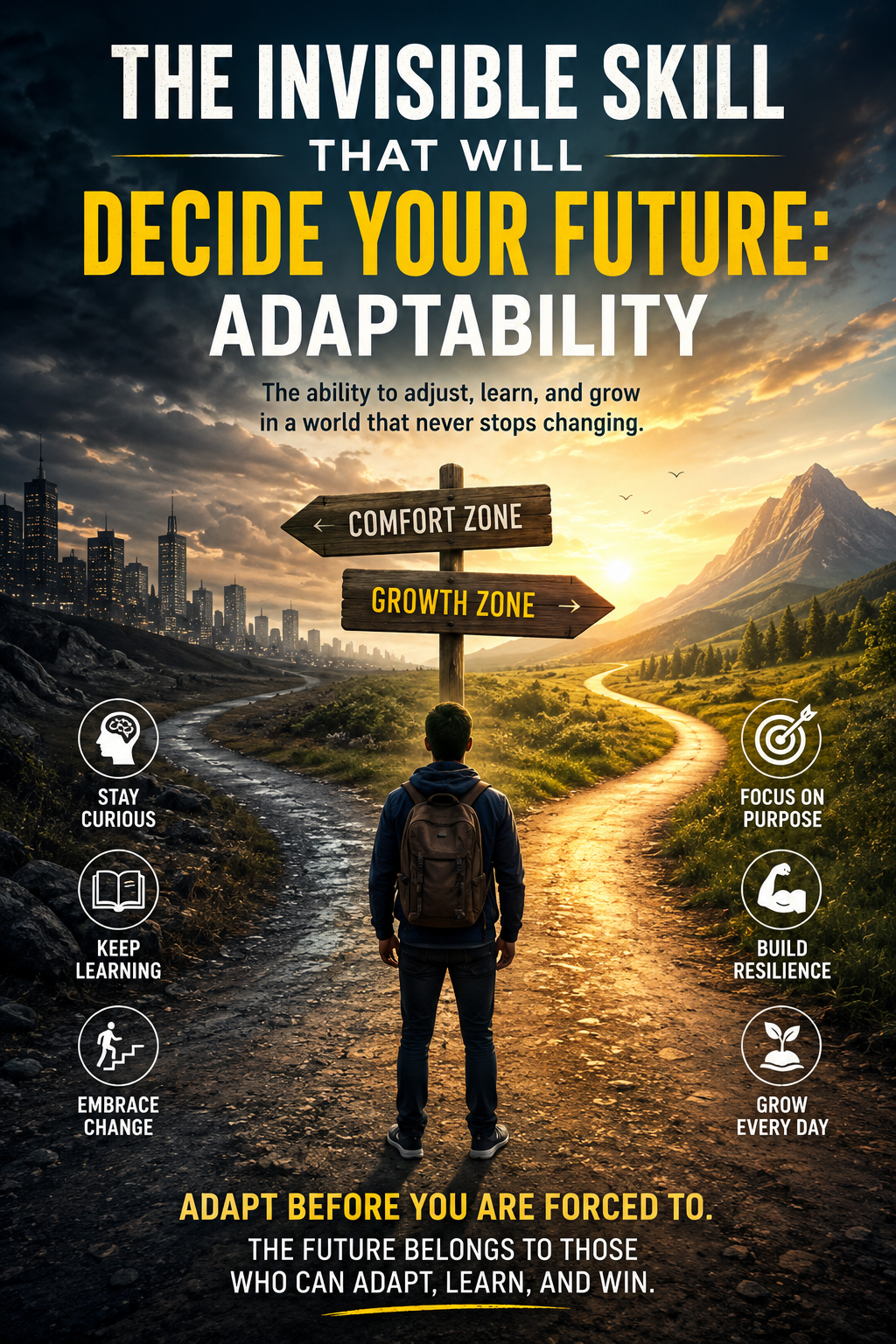
The Invisible Skill That Will Decide Your Future: Learning How to Adapt Before Life Forces You To

By Marvin Gandis

The World Is Not Waiting for Anyone

There is a quiet truth many people ignore until life becomes uncomfortable:

The future does not belong only to the strongest, the smartest, or even the most talented. The future belongs to those who know how to adapt.

We live in a time where everything changes quickly. Technology changes. Jobs change. Businesses change. Relationships change. The economy changes. Even the way people communicate, buy, learn, work, and trust others is changing.

Yet many people are still trying to succeed with the same mindset they had five, ten, or twenty years ago.

They are waiting for things to return to normal.

But what if “normal” is not coming back?

What if the new advantage in life is not simply having more money, more education, or more contacts—but having the ability to adjust, learn, improve, and move forward when the world changes around you?

That skill has a name:

Adaptability.

And in the coming years, it may become one of the most valuable skills a person can develop.


Adaptability Is Not Weakness — It Is Intelligence in Motion

Many people confuse adaptation with surrender.

They think adapting means giving up your values, changing your identity, or accepting defeat. But true adaptation is not about becoming someone else. It is about becoming strong enough to respond wisely to new circumstances.

A tree that refuses to bend in a storm may break. But a tree that bends without losing its roots survives.

That is adaptability.

It means you keep your principles, but you change your methods.

You keep your purpose, but you adjust your strategy.

You keep your dream, but you improve your plan.

The person who adapts is not unstable. The person who adapts is awake.


The Most Dangerous Phrase Is: “I Have Always Done It This Way”

There is nothing wrong with experience. Experience is valuable. But experience becomes dangerous when it turns into resistance.

Many people fail not because they lack ability, but because they become emotionally attached to old methods.

They say:

  • “I have always done it this way.”
  • “That will never work.”
  • “I don’t need to learn that.”
  • “This new generation doesn’t understand.”
  • “Things were better before.”

Maybe some things were better before. But life does not move backward to comfort us. Life moves forward and asks us to grow.

In business, this can destroy progress.

A person may have a good product, a good message, or a good opportunity, but if they refuse to learn new tools, new platforms, new ways to communicate, and new ways to build trust, they slowly become invisible.

Not because they are bad.

Not because they have nothing to offer.

But because they stopped adapting.


The Marketplace Rewards Those Who Pay Attention

The marketplace is always speaking.

People’s habits tell us what they care about. Their questions reveal their fears. Their silence reveals confusion. Their clicks reveal curiosity. Their complaints reveal problems waiting for solutions.

The wise person pays attention.

Instead of saying, “Why is nobody listening to me?” they ask:

  • “What are people actually struggling with?”
  • “How can I explain this more clearly?”
  • “Is my message helping, teaching, or only selling?”
  • “Am I building trust before asking for action?”
  • “Am I using the tools people actually use today?”

Adaptability begins when we stop blaming the audience and start studying the audience.

This does not mean blindly chasing trends. It means understanding people deeply.

Trends change, but human needs remain: security, hope, clarity, belonging, progress, peace, confidence, and opportunity.

The adaptable person learns how to connect timeless human needs with modern communication.

That is powerful.


Adaptability Requires Humility

One of the hardest parts of adapting is admitting that we still need to learn.

This is difficult because the ego wants to appear finished, polished, and certain. But growth requires honesty.

A beginner who knows they are learning is often more dangerous than an expert who thinks they already know everything.

Humility says:

  • “I can improve.”
  • “I can ask better questions.”
  • “I can study what is working.”
  • “I can correct my mistakes.”
  • “I can learn from younger people.”
  • “I can learn from failure without becoming failure.”

This kind of humility is not weakness. It is maturity.

A humble person can be corrected without being destroyed. They can receive feedback without feeling attacked. They can change direction without feeling ashamed.

That is why humility and adaptability go hand in hand.

You cannot adapt while pretending you already know everything.


The Future Will Punish Passive People

This may sound strong, but it is necessary:

The future will not be kind to passive people.

Passive people wait too long.

They wait for perfect timing.

They wait until they feel ready.

They wait until someone explains everything.

They wait until success is guaranteed.

They wait until fear disappears.

But fear does not disappear before action. Fear usually gets smaller after action.

The adaptable person does not need perfect confidence to begin. They begin, observe, learn, adjust, and continue.

That is how progress is built.

Not in one dramatic moment.

Not in one lucky opportunity.

Not in one viral post.

Progress is built through repeated adjustment.

You try. You learn. You improve. You try again.

That cycle is one of the greatest secrets of successful people.


Adaptability Does Not Mean Following Every Trend

There is a difference between being adaptable and being distracted.

Some people jump from idea to idea, tool to tool, business to business, and strategy to strategy. They call it adaptation, but it is really confusion.

True adaptability is not panic.

It is an intelligent adjustment.

You do not need to follow every trend. You do not need to use every platform. You do not need to copy everyone who seems successful.

You need to know your mission, understand your audience, and improve your method.

The question is not:

  • “What is everyone doing?”

The better question is:

“What change would make my message clearer, my service better, and my results stronger?”

That is focused adaptation.


The Person Who Learns Faster Has the Advantage

In the past, people often competed based on resources: money, location, connections, or formal education.

Those things still matter, but today there is another advantage:

  • learning speed.

The person who learns faster can recover faster.

They can test ideas faster.

They can understand tools faster.

They can recognize mistakes faster.

They can improve communication faster.

They can respond to change faster.

This is why continuous learning is not optional anymore. It is survival.

But learning does not only mean taking courses or reading books. It also means paying attention to your own life.

  • Every failure is data.
  • Every rejection is information.
  • Every delay is a lesson.
  • Every mistake is a mirror.

The question is: are you learning from what happens to you, or are you only suffering through it?

The adaptable person turns experience into education.


Emotional Adaptability May Be Even More Important

Adapting is not only about technology, business, or strategy. It is also emotional.

  • Can you stay calm when things change?
  • Can you think clearly when plans fail?
  • Can you keep moving when results are slow?
  • Can you receive criticism without losing your identity?
  • Can you adjust without becoming bitter?

Many people are mentally capable but emotionally fragile. They know what to do, but frustration controls them. They have ideas, but disappointment paralyzes them.

This is why emotional adaptability matters.

It teaches you to say:

  • “This did not work, but I am not finished.”
  • “This season is difficult, but I can still grow.”
  • “This result disappointed me, but it can teach me.”
  • “I may need a new strategy, but I do not need to quit my purpose.”

That kind of emotional strength is rare.

And rare things have value.


How to Build Adaptability in Your Daily Life

Adaptability is not built in theory. It is built in practice.

Here are simple ways to develop it:

Ask better questions

Instead of asking, “Why is this happening to me?” ask, “What can this teach me?”

Instead of asking, “Why don’t people support me?” ask, “How can I communicate with more clarity and value?”

Update your skills regularly

Do not wait until you are forced to learn. Learn before pressure arrives.

Study communication, digital tools, financial habits, leadership, emotional discipline, and problem-solving.

Detach from one method

Your goal may remain the same, but your path may need to change.

Do not worship the method. Respect the mission.

Review your results honestly

If something is not working, do not pretend it is. Look at the facts. Adjust with wisdom.

Honesty saves time.

Stay rooted in values

Adaptability without values becomes compromise. Values without adaptability can become rigidity.

You need both: strong roots and flexible branches.


The Real Winners Will Be the Ones Who Can Reinvent Without Losing Themselves

Life will ask every person to reinvent something.

Maybe your career.

Maybe your business.

Maybe your habits.

Maybe your mindset.

Maybe your communication.

Maybe your relationship with money.

Maybe your relationship with yourself.

Reinvention does not mean your past was wasted. It means your past prepared you for a new level.

The lessons you learned still matter. The pain you survived still matters. The skills you developed still matter. The wisdom you gained still matters.

But now you may need to use them in a new way.

That is not failure.

That is evolution.

The person who can reinvent without losing their soul becomes very difficult to defeat.


Adapt Before You Are Forced To

The greatest mistake is waiting until life gives you no choice.

Do not wait until your job disappears to learn new skills.

Do not wait until your business fails to improve your message.

Do not wait until your audience ignores you to study communication.

Do not wait until your confidence is broken to develop emotional strength.

Do not wait until the storm arrives to strengthen your roots.

  • Adapt now.
  • Learn now.
  • Adjust now.
  • Grow now.

The future is not asking you to be perfect.

It is asking you to be awake.

And those who are awake, humble, flexible, and willing to grow will always have a chance to rise again.

Because the world may change, but the adaptable person does not disappear. The adaptable person transforms.


Disclaimer:


The articles and content ideas provided are for educational, inspirational, and informational purposes only. They are designed to encourage reflection, personal growth, digital awareness, and responsible decision-making. They should not be considered financial, legal, medical, psychological, or professional advice.

Any business, marketing, personal development, or income-related examples mentioned are not guarantees of results. Individual outcomes may vary depending on effort, consistency, experience, market conditions, personal discipline, and other factors beyond our control.

Readers are encouraged to do their own research, seek qualified professional guidance when necessary, and make decisions based on their own situation, values, and responsibilities.
Publicado en Discipline, Education, Leadership, Motivation, Personal Development, Personal Growth, Self-Improvement, Success Mindset

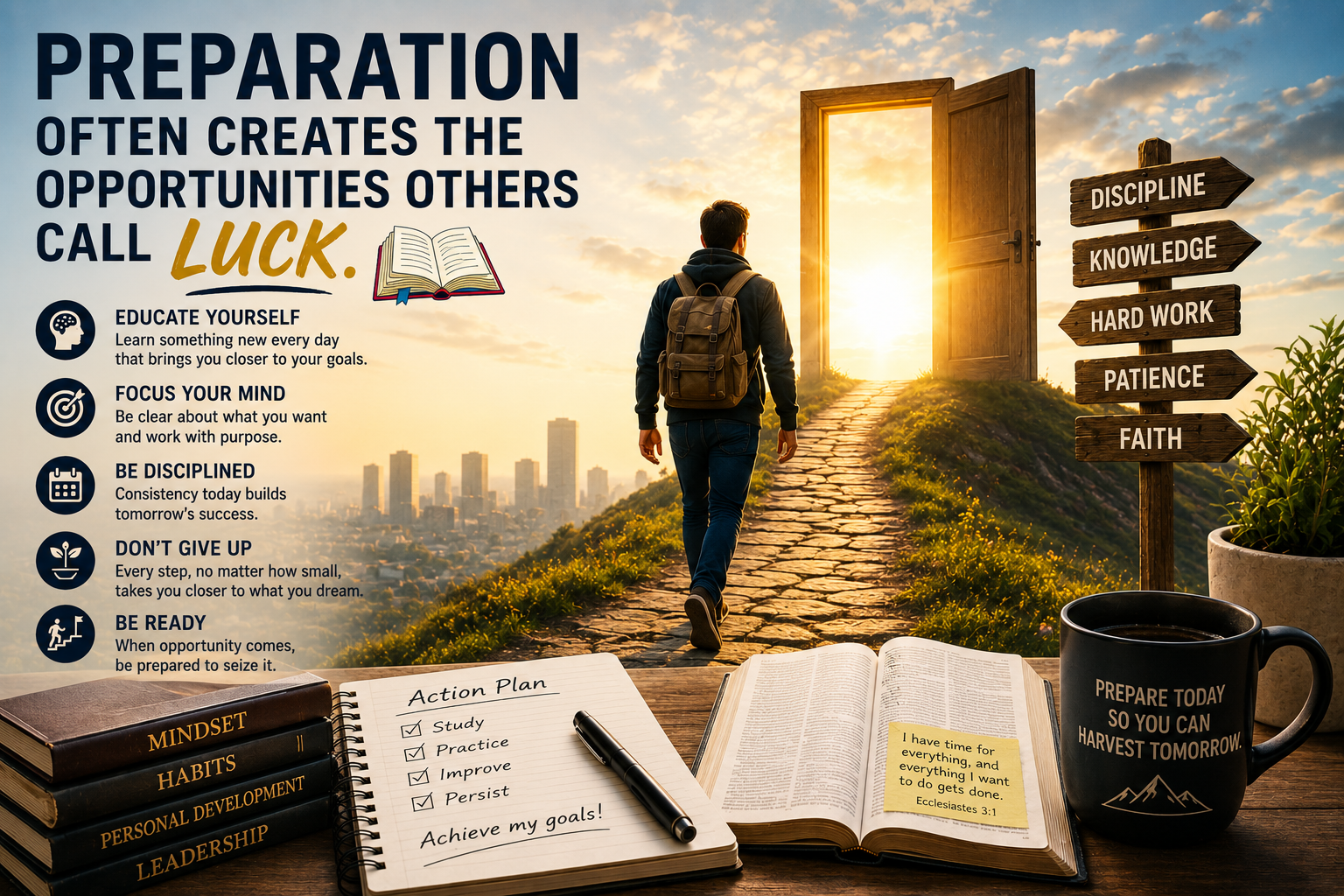
Preparation Often Creates the Opportunities Others Call Luck 📚

By Marvin Gandis

“Luck” often has a hidden story

Many people look at someone else’s success and say, “They were lucky.” But they rarely see the invisible hours, the quiet sacrifices, the corrected mistakes, the late nights of learning, the difficult decisions, and the discipline that came before the opportunity appeared.

The truth is simple but powerful: preparation often creates the opportunities others call luck.

What looks like a coincidence to some people is often the result of someone being ready. The door opened, yes — but that person already had the key because they had prepared in advance.

Luck may knock once. Preparation helps you recognize it, use it, and multiply it.


Luck favors the prepared

Opportunities may pass in front of many people, but not everyone is able to take advantage of them. Why? Because not everyone is ready.

  • A prepared person sees possibilities where others see problems.
  • A prepared person takes action while others hesitate.
  • A prepared person does not wait for perfect conditions; they use what they have and begin.

For example, two people may receive the same invitation to learn a new skill. One says, “I don’t have time.” The other sets aside 30 minutes a day, studies, practices, and improves. Months later, a job opportunity, project, client, or business idea appears. From the outside, many may say, “They got lucky.” But the truth is that the person was prepared when nobody was watching.

The opportunity was not magic. It was the result of readiness.


Preparation builds confidence

Real confidence does not come only from repeating positive phrases. It comes from knowing you have done the work.

When you study, practice, organize your thoughts, learn from your mistakes, and improve daily, your mind begins to say, “I am ready for this.”

Preparation reduces fear because it gives you direction. It does not remove every nervous feeling, but it allows you to move forward with more certainty.

Fear asks, “What if I fail?”


Preparation answers, “If I fail, I will learn and adjust.”

That mindset changes everything. When an opportunity appears, the prepared person does not freeze. They breathe, think, and act.


Many opportunities arrive disguised as problems

Sometimes we expect opportunities to arrive as something comfortable, beautiful, and easy. But many times, they come as challenges.

  • A family problem can teach responsibility.
  • A financial loss can push you to learn about money.
  • A business failure can teach sales, discipline, and patience.
  • A closed door can force you to build a better door.

Preparation does not mean you will never face difficulty. It means you will have more tools to face it.

An unprepared person may see an obstacle and quit.


A prepared person may see the same obstacle and ask, “What can I learn here?”

That question can open a new path.


Discipline creates a quiet advantage

Preparation does not always look exciting. Sometimes it looks repetitive, slow, and even boring. But that is where the advantage is built.

  • Reading while others waste time.
  • Practicing while others are distracted.
  • Saving while others spend without thinking.
  • Training while others settle.
  • Getting back up after failure while others quit.

Those small actions may seem insignificant in the moment, but over time they create a major difference.

Discipline is a quiet investment. At first, nobody applauds it. Later, everyone notices the results.


Being prepared helps you recognize opportunity

It is not enough for an opportunity to exist. You must also know how to identify it.

Many people miss opportunities because they lack clarity. They do not know what they want, what they are looking for, or how to tell the difference between a distraction and a real possibility.

Preparation gives you vision. It helps you ask better questions:

  • Does this align with my values?
  • Can this help me grow?
  • Does this solve a real problem?
  • Am I willing to learn what is required?
  • Is this an opportunity or just a temporary emotion?

When you are prepared, you do not chase everything. You choose better. And choosing better is part of success.


Preparation turns talent into results

Talent is valuable, but talent alone is not enough.

Some talented people never move forward because they lack discipline. Others may not start with extraordinary skills, but they prepare so consistently that they eventually surpass many others.

  • Talent may give you a starting advantage.
  • Preparation keeps you growing.
  • Consistency takes you further.

In business, education, leadership, communication, faith, family, and daily life, preparation makes a powerful difference.

It is not about being perfect. It is about being willing to improve.


Preparation is also character development

Preparation is not only about learning techniques or strategies. It is also about becoming the kind of person who can handle the opportunity.

  • Preparation means learning patience.
  • Preparation means accepting correction.
  • Preparation means recognizing mistakes.
  • Preparation means controlling emotions.
  • Preparation means speaking with respect.
  • Preparation means honoring commitments.
  • Preparation means developing humility.

Many people want big opportunities, but they have not built the character needed to sustain them.

A big opportunity can become a heavy burden if it arrives too early. That is why some waiting seasons are not punishment; they are training.


Do not confuse waiting with wasted time

Sometimes it feels like nothing is happening. You are learning, practicing, planting, creating, trying — but the results do not arrive quickly.

However, preparation is never wasted time.

  • Every skill you learn may serve you later.
  • Every corrected mistake makes you stronger.
  • Every conversation teaches you something.
  • Every attempt gives you experience.
  • Every small improvement matters.

Preparation works beneath the surface, like the roots of a tree. Nobody sees them, but when the storm comes, the roots are what keep everything standing.


Opportunity arrives, but you must act

Preparation does not mean waiting forever. You must also move.

Some people study too much, plan too much, and never begin. That is not healthy preparation; that can become fear disguised as perfectionism.

Preparation should lead to action.

  • Learn, but apply.
  • Plan, but execute.
  • Dream, but work.
  • Pray, but walk.
  • Research, but decide.

An opportunity without action becomes a memory.


An opportunity with preparation and action can become a transformation.


How to prepare better starting today

You do not need to wait for the perfect moment. You can begin preparing right now with simple steps:

1. Define what you want to improve

You cannot prepare for everything at once. Choose one area: finances, business, health, communication, leadership, spirituality, marketing, education, or personal growth.

2. Create a small routine

You do not need five hours a day. Start with 20 or 30 minutes daily. Consistency is more powerful than occasional intensity.

3. Learn from experienced people

Look for mentors, books, courses, articles, educational videos, or communities that help you grow.

4. Practice what you learn

Information without practice is easily forgotten. Practice turns knowledge into skill.

5. Evaluate your results

Ask yourself: What worked? What should I change? What can I do better next time?

6. Stay humble

The person who believes they already know everything stops growing. Humility keeps the door open to learning.


When opportunity arrives, be ready

Life does not always announce when an opportunity is coming. It may arrive through a conversation, a phone call, an invitation, a crisis, a new contact, an idea, a market need, or a door that opens unexpectedly.

That is why you must prepare before it arrives.

  • Prepare mentally.
  • Prepare emotionally.
  • Prepare spiritually.
  • Prepare professionally.
  • Prepare financially.
  • Prepare with discipline and vision.

Because when opportunity arrives, others may say, “You were lucky.”


But you will know the truth: it was not only luck; it was preparation meeting the right moment.


Luck is often built before it is seen

Preparation does not guarantee that everything will be easy, but it increases your ability to respond wisely when life presents an opportunity.

Do not wait until you feel completely ready. Start preparing today. Every book you read, every skill you practice, every mistake you correct, every positive habit you build, and every responsible decision you make is shaping the person who can handle what is coming.

Opportunity may appear suddenly, but many times it answers consistent preparation.

So keep learning. Keep growing. Keep planting. Keep improving.

Because what others may call luck tomorrow could be the fruit of your preparation today. 📚


Dear reader, do not wait for life to surprise you without tools

Choose one area of your life and begin preparing today. Take one small but firm step. Learn something new, organize your goals, practice a skill, and stay ready.

Opportunity favors the prepared.


Disclaimer

This article is for educational and motivational purposes only. It does not guarantee specific results in business, finances, personal development, or any other area. Every person is responsible for their own decisions, actions, and outcomes. Preparation can increase the possibility of recognizing and using opportunities, but it does not remove risk or replace personal, professional, or financial judgment.

Publicado en Faith, Motivation, Personal Development, Positive Mindset, Self-Improvement

Good Things Are Coming Now: How to Keep Faith When You Don’t See Results Yet

By Marvin Gandis

There are seasons in life when everything feels delayed. You work, pray, learn, help, plant seeds, and keep trying… but the results seem slow. In that silence, many people begin to wonder:

“Is anything good still coming for me?”

The answer is yes.

Good things are coming now, even if you cannot see them yet. Sometimes what feels like a delay is actually preparation. What looks like a loss may be redirection. What feels like an ending may be the beginning of a better chapter.

This article is a reminder not to quit right before the blessing, opportunity, answer, or breakthrough you have been waiting for.


Good Things Don’t Always Arrive When We Want, But They Arrive When We Are Ready

We live in a world that wants everything fast: fast success, fast money, fast answers, fast recognition. But the most valuable things in life usually require time, maturity, patience, and preparation.

A seed does not become a tree overnight. First, it is buried. Then it breaks. Then it grows quietly. Later, it produces fruit.

The same is true for you.

Maybe you are in a season where nobody sees your effort. Nobody understands your tears. Nobody recognizes your discipline. But that does not mean nothing is happening. Many powerful changes begin in invisible places.

What looks small today can become powerful tomorrow.


Hope Is Not Fantasy: It Is Fuel

Having hope does not mean ignoring reality. It means facing reality with a stronger attitude than fear.

Hope says:

“I can still rise.”
“I can still learn.”
“I can still begin again.”
“There are doors I have not seen yet.”
“There are opportunities still ahead of me.”

When a person loses hope, they stop too early. But when they believe something good is coming, they begin to move differently.

Hope keeps you walking when motivation disappears. It helps you make better decisions. It reminds you that your story does not end in a difficult season.


Do Not Confuse Silence With Absence

Sometimes we feel like nothing is changing because we cannot see visible signs. But silence does not always mean absence.

Think about a house under construction. Before you see beautiful walls, modern windows, and elegant decoration, there is dust, noise, tools, cement, and disorder. The process may look messy, but something solid is being built.

The same thing can happen in your life.

Maybe you are in a construction season. Not everything looks beautiful. Not everything feels organized. Not everything makes sense yet. But something is being formed inside you: character, wisdom, patience, strength, and clarity.

Do not reject the process just because it does not look like the final result yet.


Good Things Require a New Mindset

You cannot enter a new season with an old mindset.

If you want to move forward, you must begin to think differently. You cannot keep repeating:

“I can’t.”
“Nothing good ever happens to me.”
“I always fail.”
“This is not for me.”
“It is too late.”

Those words can become invisible chains. That is why you must begin speaking to yourself with faith, responsibility, and hope.

Change your language:

“I am learning.”
“I am growing.”
“I am preparing.”
“I am open to new opportunities.”
“My current situation does not define my destiny.”
“Good things are coming now.”

Your mind needs to hear a new direction before your life begins to move toward it.


Sometimes Good Things Arrive Disguised as Change

Many people pray for a blessing but resist the change that comes with it.

They ask for a new opportunity but want to keep doing everything the same way. They ask for growth but do not want to leave their comfort zone. They ask for success but do not want to learn new skills.

Good things often arrive in the form of a challenge.

They may come through a difficult conversation.
They may come through a closed door.
They may come up with a new idea.
They may come through a person who inspires you.
They may come through an opportunity that requires more discipline.

Not everything good feels comfortable at first. Sometimes good things come to stretch you, wake you up, and push you into a stronger version of yourself.


Your Current Season Is Not Your Final Destination

It is important to remember this: a difficult season does not mean a defeated life.

Everyone goes through seasons of uncertainty, exhaustion, frustration, and doubt. But one hard season does not have the authority to define your entire story.

You are not your mistakes.
You are not your failures.
You are not your delays.
You are not your losses.
You are not what others said about you.

You are a person in progress, capable of rising, learning, growing, and starting again.

Just because something did not work before does not mean nothing will work later.


Prepare for Good Things With Action, Not Just Desire

Saying “good things are coming now” does not mean sitting and waiting without action. Faith is also expressed through movement.

If you want better results, begin making better decisions.

Organize your day.
Protect your mind.
Learn a new skill.
Improve your communication.
Surround yourself with positive people.
Read, study, practice, and act.
Finish what you start.
Stay consistent, even when progress feels slow.

Opportunities often find people who are already moving.

You do not need everything to be perfect before you begin. You only need to take the next right step.


Learn to Celebrate Small Signs

Sometimes we wait for a huge miracle and miss the small signs of progress.

A positive conversation.
A new idea.
An important connection.
A small open door.
An improvement in your attitude.
A brave decision.
A day when you did not give up.

All of that matters.

Do not despise small beginnings. Many great transformations start with simple, almost invisible steps.

Celebrate progress, even when it is not perfect yet. Every right step proves that you are moving toward something better.


Good Things Can Also Begin Inside You

Many times, we ask for circumstances to change, but the first change we need happens inside us.

Peace.
Clarity.
Discipline.
Forgiveness.
Patience.
Courage.
Confidence.
Gratitude.

These are good things too.

Sometimes, before we receive a new external opportunity, we need to develop new internal strength. Because when you are stronger inside, you can face outside challenges with greater wisdom.


Declare a New Season Over Your Life

There is power in the words you repeat with conviction. Not as magic, but as mental, emotional, and spiritual direction.

You can declare:

“I am entering a season of clarity.”
“I am ready to learn and grow.”
“I am open to new opportunities.”
“My past does not control my future.”
“I am planting with faith and discipline.”
“Good things are coming now.”

Repeat these words not only when life feels easy, but especially when life becomes difficult. Faith grows stronger in the soil of testing.


Good Things Are Coming Now

My dear reader, not because life is perfect or free from challenges, but because every new day allows us to begin again, grow with wisdom, heal with patience, and move forward with faith toward a better version of ourselves.

Do not quit in the middle of the process. Do not allow a difficult season to convince you to abandon your vision. Do not confuse delay with denial. Do not confuse silence with absence. Do not confuse preparation with punishment.

Keep walking. Keep believing. Keep planting. Keep improving.

Because many times, right when it feels like nothing is changing, something new is about to be born.

Good things are coming now. Prepare yourself, because your next season may be greater than your last struggle.


If This Message Encouraged You

Share it with someone who needs hope today. Sometimes one word of encouragement can help a person stand up, breathe again, and keep going.

Today Can Be The Beginning Of A New Season.


Disclaimer

This article is for educational, reflective, and motivational purposes only. It does not guarantee specific financial, personal, spiritual, or professional results. Every person is responsible for their own decisions, actions, and process. If you are facing a difficult emotional, financial, or personal situation, consider seeking professional, spiritual, or community support you trust.