Por Marvin Gandis
When Ideas Are Not Aligned, Life Feels Heavy
We all experience moments when the mind feels like a messy room: too many ideas, too many plans, too many worries, and not enough clarity.
- We want to move forward, but we do not know where to begin.
- We want to make decisions, but doubt gets in the way.
- We want to create something meaningful, but our ideas seem to compete against each other.
The truth is simple: a scattered mind often creates scattered actions. But an aligned mind can turn confusion into direction, fear into decision, and loose ideas into real progress.
Aligning our ideas does not mean having everything perfect. It means learning how to organize what we think, understand what we truly want, and act according to our values, goals, and purpose.
What Does It Mean to Align Our Ideas?
Aligning our ideas means bringing our thoughts, goals, emotions, values, and actions into the same direction.
Many people live with conflicting ideas:
- They want change, but keep repeating old habits.
- They want peace, but feed worry every day.
- They want success, but constantly doubt themselves.
- They want to help others, but cannot organize their message.
- They want progress, but never define priorities.
When our ideas are not aligned, we lose energy. When they are aligned, we gain clarity, confidence, and direction.
Alignment begins with one honest question:
Are my thoughts, words, and actions working together,
Or are they contradicting each other?
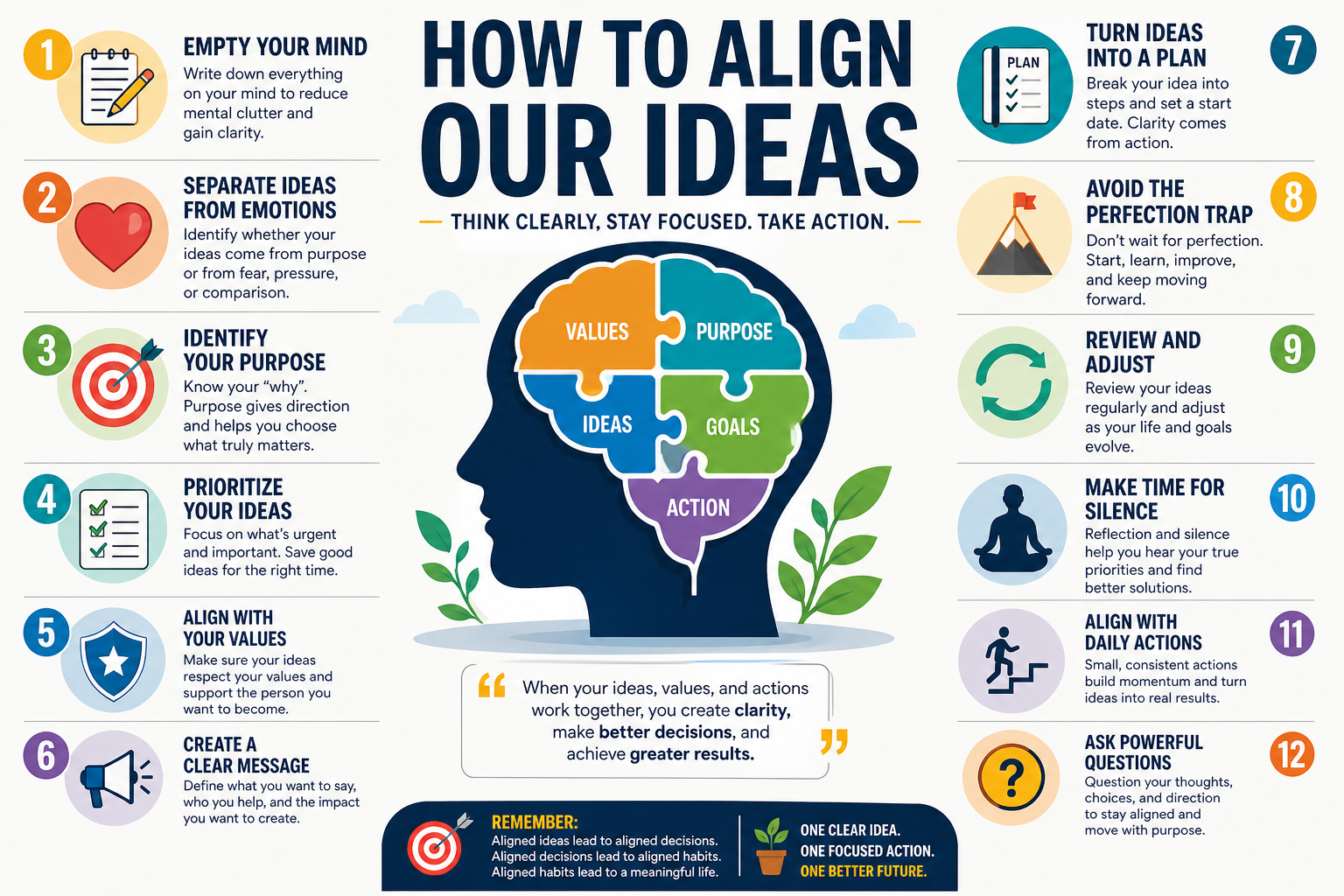
The First Step: Empty the Mind
Before we organize our ideas, we need to get them out of our heads.
Many times, we think we have a motivation problem when, in reality, we have a mental overload problem.
Take a notebook, a sheet of paper, or a digital note and write down everything on your mind:
- Business ideas.
- Concerns.
- Unfinished goals.
- Tasks.
- Dreams.
- Frustrations.
- Projects.
- Decisions you have been avoiding.
Do not judge anything at first. Just write. This exercise is powerful because it turns mental noise into visible information.
When an idea lives only in the mind, it may feel overwhelming. But once you write it down, you can look at it, evaluate it, and decide what to do with it.
Separate Ideas from Emotions
Not every idea that appears in your mind is in the right direction. Some ideas are born from inspiration, but others are born from fear, pressure, comparison, or frustration.
That is why it is important to ask:
- Is this idea coming from purpose or anxiety?
- Am I deciding from clarity or desperation?
- Am I building something real or reacting to a temporary emotion?
- Does this idea bring me closer to my values or pull me away from them?
Emotions matter, but they should not always drive the vehicle. An aligned idea may challenge you, but it should not destroy your inner peace.
Identify the Central Purpose
An idea without purpose becomes a distraction. An idea with purpose can become a mission.
Before you act, ask yourself:
Why do I want to do this?
It is not enough to say, “I want to make more money,” “I want to publish more content,” “I want to start a project,” or “I want to change my life.”
Go deeper:
- I want to help my family.
- I want to educate others.
- I want to create freedom.
- I want to use my experience to serve.
- I want to leave a legacy.
- I want to live with more peace and discipline.
When you understand the purpose behind your ideas, it becomes easier to decide which ideas deserve your energy and which ones are only distractions.
Prioritize: Not Every Idea Deserves Immediate Action
One reason many people do not move forward is that they try to do too much at once.
Having many ideas is not the problem. The problem is not knowing which idea should come first.
You can divide your ideas into four groups:
- Urgent ideas: they need attention soon.
- Important ideas: they support your main goals.
- Future ideas: they are good, but not for this season.
- Distracting ideas: they sound interesting, but pull you away from your path.
Mental maturity means understanding that not every good idea is an idea for today.
Sometimes saying “not yet” is a powerful way to protect your focus.
Align Ideas with Values
Your ideas must respect your values. If an idea promises results but requires you to betray your principles, it is not aligned.
Ask yourself:
- Does this idea reflect who I want to become?
- Can I execute it with honesty?
- Does it help others or take advantage of them?
- Will it give me peace or create inner conflict?
- Is it sustainable long-term?
The most powerful ideas are not only profitable or attractive. They are ideas you can stand behind with integrity.
True alignment happens when your ambition does not destroy your character.
Create a Clear Message
Many people have good ideas, but they struggle to communicate them. And an idea that is not communicated clearly may lose its impact.
To clarify your message, answer these questions:
- What do I want to say?
- Who do I want to help?
- What problem does this idea solve?
- What transformation does it offer?
- Why should the listener care?
- What action do I want them to take?
An aligned idea should be easy to explain. If you need to make it too complicated, it may not be clear yet.
Clarity is not the absence of depth. Clarity is depth, well-organized.
Turn Ideas into a Plan
An idea without action remains a wish. To produce results, an idea must become a plan.
A simple plan may include:
- Main objective.
- Reason behind the objective.
- Necessary steps.
- Available resources.
- Start date.
- Weekly time commitment.
- Expected result.
- Way to measure progress.
You do not need every detail to be perfect. You need the next step to be clear.
Many people wait for complete clarity before they begin, but often clarity appears while we are already moving.
Avoid the Perfection Trap
Perfection is one of fear’s most elegant disguises. It makes us think we are preparing, when in reality we are avoiding action.
An aligned idea does not need to launch perfectly. It needs to launch with intention, structure, and honesty.
- Publish.
- Test.
- Learn.
- Correct.
- Improve.
- Repeat.
Imperfect action with direction is more valuable
than perfect intention without movement.
Review and Adjust Regularly
Aligning ideas is not something you do once. It is an ongoing process.
Life changes. Priorities change. Opportunities change. Your mindset must be reviewed, too.
Every week or every month, ask yourself:
- Which ideas are still important?
- What should I release?
- What am I avoiding?
- What is working?
- What needs adjustment?
- What action should I take now?
Alignment does not mean rigidity. It means direction with the ability to adjust.
The Importance of Silence and Reflection
We live in a noisy world. Social media, opinions, news, comparisons, messages, urgency, and distractions all compete for our attention.
That is why aligning our ideas requires moments of silence.
Silence reveals what noise hides.
In silence, you can hear your true priorities. You can distinguish between an authentic idea and external pressure. You can discover whether you are walking by conviction or comparison.
Do not underestimate the power of being still, thinking, praying, meditating, writing, or simply breathing.
Many great decisions are born in calm moments.
Align Ideas with Daily Action
The real test of an idea is not how beautiful it sounds, but how it shows up in your daily habits.
- If you say you want to write, write.
- If you say you want to serve, serve.
- If you say you want to learn, study.
- If you say you want to improve, practice.
- If you say you want to grow, leave your comfort zone.
Alignment is proven through small, repeated actions.
You do not need to change your entire life in one day.
You need to begin living with more consistency each day.
Powerful Questions to Align Your Ideas
Use these questions when you feel confused:
- What am I really trying to accomplish?
- Why does this matter to me?
- Which idea deserves my attention right now?
- What should I save for later?
- What thought is stealing my clarity?
- What small action can I take today?
- Is this decision aligned with my values?
- Am I acting from purpose or pressure?
- Am I building something that truly matters?
These questions do more than organize the mind. They awaken responsibility.
Clarity Does Not Happen by Accident
Aligning our ideas is an act of discipline, honesty, and purpose.
It is not about having a perfect mind. It is about learning how to direct your thoughts toward what truly matters.
When your ideas are aligned, your decisions become stronger. Your actions become more consistent. Your message becomes clearer. Your life begins to move with intention.
Remember this:
- An idea aligned with purpose can change a decision.
- An aligned decision can change a habit.
- An aligned habit can change a life.
You do not need to have everything figured out today.
You only need to take the next step with clarity.
Today, take 15 minutes to write down your main ideas.
Then choose one idea that aligns with your values, your purpose, and your next season of growth.
Do not try to do everything. Begin with one clear idea, one honest action, and one firm commitment.
Your clarity begins when you decide to organize your mind and move with purpose.
Disclaimer
This article is for educational, informational, and motivational purposes only. It does not constitute professional, psychological, financial, legal, or medical advice. Every individual should evaluate their own situation, make responsible decisions, and seek professional guidance when necessary. Personal results may vary depending on discipline, circumstances, resources, decisions, and individual actions.



Debe estar conectado para enviar un comentario.