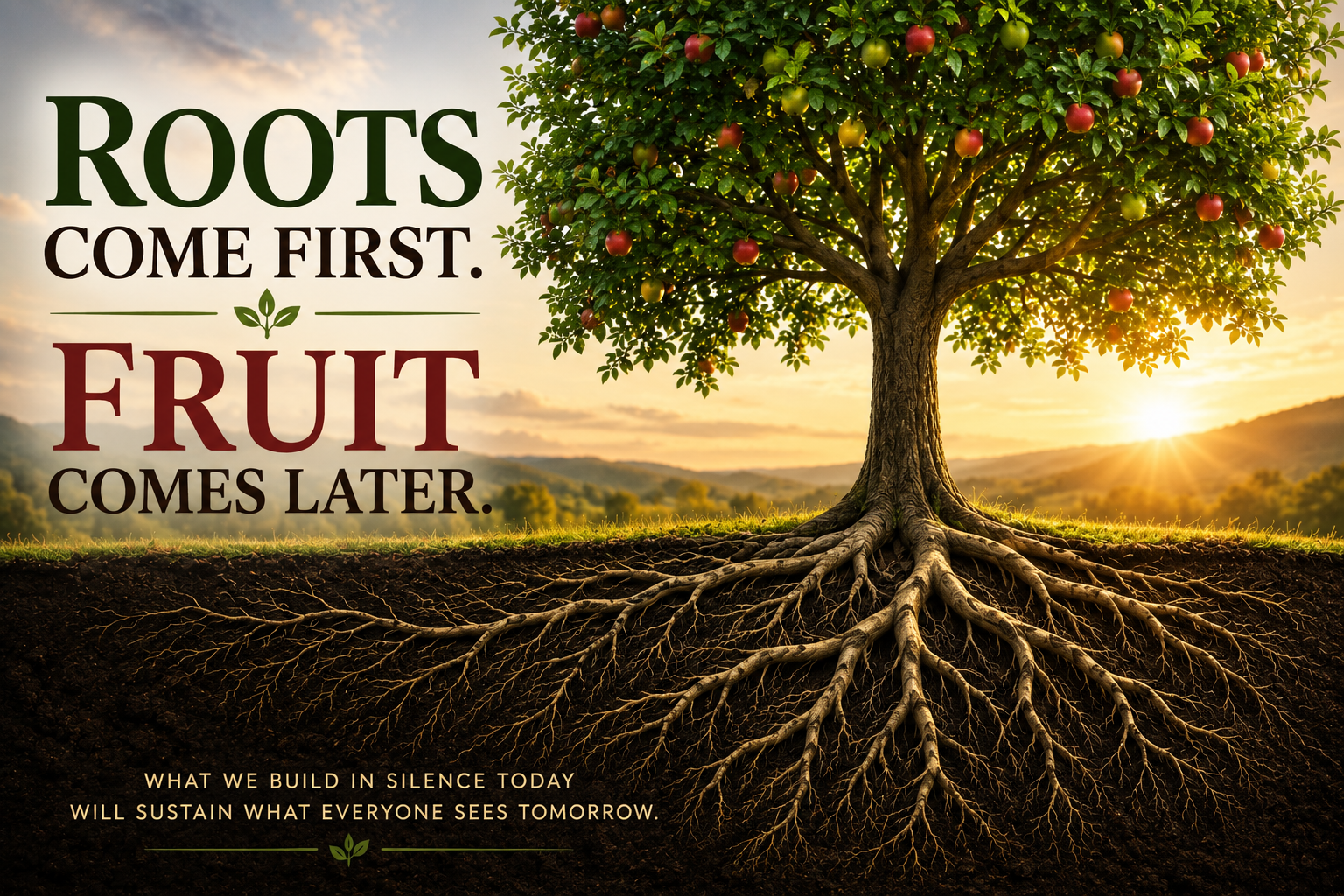
What No One Sees Determines What Everyone May Eventually See
By Marvin Gandis
We live in a world obsessed with results.
We want fast growth, fast income, recognition, successful businesses, healthy relationships, financial stability, emotional peace, and immediate answers.
We want the fruit.
But we rarely talk about the roots.
A tree does not begin by producing fruit. It develops roots first. It anchors itself in the soil. It searches for water. It absorbs nutrients. It survives difficult seasons. It grows quietly where no one can see it.
Only later does everyone admire what appears above the ground.
Life works much the same way.
Roots come first. Fruit comes later.
This simple truth can transform the way we understand success, faith, money, relationships, work, and personal growth.
The world celebrates fruit but rarely notices roots
When we see a successful person, we usually see the outcome.
We see the business.
The house.
The knowledge.
The confidence.
The audience.
The ministry.
The stability.
The accomplishments.
What we do not easily see are the years of preparation, mistakes, difficult nights, uncomfortable decisions, opportunities they turned down, skills they developed, quiet prayers, and all the times they had to begin again.
We are looking at fruit without having witnessed the roots.
That is one of the dangers of comparison.
We compare our invisible process with someone else’s visible results.
Then we assume we are behind.
Perhaps we are not.
Perhaps we are simply in a season of growing roots.
The most important growth often happens where nobody can see it
When a seed is placed underground, it seems to disappear.
For a while there is no tree.
No flowers.
No fruit.
From above the ground, nothing appears to be happening.
Yet underneath the soil, an extraordinary transformation has begun.
The seed is changing.
Roots are developing.
Life is preparing itself.
The same thing can happen to us.
There are seasons when we study, and nobody notices.
We work, and nobody applauds.
We save money, and nobody celebrates.
We pray and still do not see an answer.
We publish content, and almost nobody responds.
We build something while the results seem insignificant.
We learn new skills while others appear to move much faster.
Do not confuse lack of visibility with lack of progress.
Some of life’s most important stages happen beneath the surface.
Roots represent what sustains our lives
Our roots may be invisible, but they determine our ability to stand.
Those roots include:
character, discipline, knowledge, faith, principles, habits, patience, integrity, education, experience, healthy relationships, stewardship, and perseverance.
Fruit represents the results that can eventually grow from those roots:
opportunity, influence, stability, prosperity, leadership, confidence, strong relationships, and lasting achievement.
Problems arise when we try to obtain the fruit without developing what must support it.
Fruit without roots can become a blessing too heavy to carry
Not all rapid growth is healthy growth.
Imagine receiving ten times more money today without having learned how to manage it.
Or gaining thousands of customers without systems capable of serving them.
Or receiving a leadership position without developing character.
Or suddenly gaining a massive audience without knowing what you stand for.
What looked like a blessing can quickly become a burden.
Sometimes preparation must come before opportunity because capacity must grow alongside opportunity.
Before asking for greater fruit, perhaps we should ask:
Can my roots support it?
Financial roots before financial prosperity
This principle is especially important with money.
Many people want more income.
That is understandable.
But increasing income without improving financial habits does not necessarily create stability.
Financial roots include budgeting, saving, responsibly reducing debt, financial education, prudent investing, developing valuable skills, reasonable income diversification, and learning to distinguish wants from needs.
Money tends to amplify behavior.
Someone who poorly manages $1,000 does not automatically become an excellent money manager after earning $10,000.
Real prosperity therefore begins before the money arrives.
It begins with knowledge and behavior.
Stewardship first. Expansion later.
Roots before results in business
The internet can make building a business look incredibly fast.
We see advertisements promising extraordinary results.
But behind sustainable businesses are usually less glamorous foundations:
understanding customers, communicating value, developing useful offers, earning trust, building an audience, learning marketing, creating systems, measuring results, and continually improving.
These activities may appear small.
But they are roots.
An advertising campaign may generate sales.
An audience that trusts you can generate opportunities for years.
There is an enormous difference.
Roots before influence
Today anyone can publish content.
But publishing does not automatically create influence.
Real influence grows from trust.
And trust usually requires time.
Every useful article is a root.
Every email that genuinely helps a reader is a root.
Every respectful response is a root.
Every promise kept is a root.
Every time we choose to educate rather than pressure people is a root.
Eventually, those small actions can become a reputation.
And reputation can become influence.
Spiritual roots before the storm
Jesus repeatedly used seeds, trees, vines, roots, and fruit to communicate spiritual truths.
In the parable of the sower, He described seed that initially grew but could not endure because “it had no root” (Matthew 13:5–6, 20–21).
Initial growth was not enough.
Depth mattered.
The principle remains relevant.
Faith should not be developed only after the storm arrives.
Prayer, Scripture, fellowship with God, obedience, gratitude, and service are spiritual roots developed through everyday life.
When difficult seasons arrive, we discover how deeply those roots have grown.
Jeremiah 17:7–8 describes the person who trusts in the Lord as a tree planted by water, extending its roots toward the stream and continuing to bear fruit even through difficult conditions.
Visible strength begins with invisible roots.
God often works beneath the surface first
Joseph received dreams before receiving authority.
David was anointed before sitting on the throne.
Moses spent years in the wilderness before leading Israel.
The disciples walked with Jesus and learned before carrying the Gospel to other nations.
Between calling and fulfillment came preparation.
Between seed and fruit came roots.
A season of waiting does not necessarily mean abandonment.
It may be a season of formation.
Perhaps things we cannot yet see are developing exactly the capacity we will need tomorrow.
Stop digging up the seed to see whether it is growing
Imagine planting a seed today.
Tomorrow we dig it up to see whether anything happened.
Then we plant it again.
Two days later, we repeat the process.
The seed never receives enough uninterrupted time to establish itself.
We often do something similar with our lives.
We begin a project.
Two weeks later, we switch.
We try another strategy.
We abandon it.
We buy another course.
We start another business.
Then we change again.
We are constantly planting but never staying long enough to develop roots.
Patience does not mean remaining forever with something that clearly does not work.
We should measure, learn, and adjust.
But there is an important difference between intelligent adaptation and constant abandonment.
Storms reveal the depth of our roots
A strong tree does not demonstrate its full strength on a calm afternoon.
The storm reveals it.
The same is true of us.
Difficulty exposes our roots.
When an opportunity disappears.
When a project fails.
When someone rejects us.
When income falls.
When our plans change.
When we have to begin again.
Those moments reveal what we have built inside ourselves.
Success may display our fruit.
Adversity reveals our roots.
Not every root produces good fruit
We must also examine what we are cultivating.
A root of resentment can produce bitterness.
A root of fear can produce paralysis.
A root of pride can prevent learning.
A root of comparison can steal contentment.
A root of irresponsibility can produce financial problems.
Having roots is not enough.
We need healthy roots.
We should regularly ask ourselves:
What thoughts am I feeding?
What habits am I strengthening?
Who is influencing me?
What am I learning?
What am I repeatedly practicing?
Where am I placing my trust?
Because what we feed beneath the surface will eventually appear above it.
Harvest requires time
There is a truth our instant-gratification culture does not enjoy hearing:
Some important things simply take time.
We cannot artificially accelerate every process.
Reputation takes time.
Relationships take time.
Experience takes time.
Trust takes time.
Wisdom takes time.
A sustainable business usually takes time.
Spiritual maturity takes time.
We can work intelligently.
We can learn faster.
We can use better tools.
We can avoid unnecessary mistakes.
But a fundamental principle remains:
plant, cultivate, wait, harvest.
What should you do when the fruit has not appeared yet?
When results take longer than expected, we should not simply wait passively.
We can work on the roots.
Learn another skill.
Read.
Study.
Improve our message.
Organize our finances.
Strengthen our health and relationships.
Correct destructive habits.
Build systems.
Serve people better.
Listen more carefully.
Pray.
Study our results.
Remove what does not work.
Continue planting what demonstrates genuine value.
A season without visible fruit can become an extraordinary season of preparation.
The question that changes everything
Instead of only asking:
“Why am I not seeing results yet?”
begin asking:
“What roots must I develop to sustain the results I want?”
That question changes everything.
If we want stronger finances, we need stronger financial roots.
If we want better relationships, we need roots of communication, respect, and patience.
If we want a larger business, we need stronger systems.
If we want influence, we need credibility.
If we want leadership, we need character.
If we want to remain strong through adversity, we need spiritual depth.
Fruit tells us what we hope to achieve.
Roots tell us who we need to become.
Roots Come First
My Dear Reader or Friend:
Perhaps you are working, and nobody recognizes it yet.
Perhaps you are learning but cannot show impressive results yet.
Perhaps you are planting while everyone around you seems to be harvesting.
Do not measure your entire life only by what you can display today.
Pay attention to what you are building within yourself.
Because one day the roots nobody saw may support the fruit everyone can see.
Do not chase fruit alone.
Build roots capable of carrying it.
Go deeper before expanding.
Learn before teaching.
Manage before multiplying.
Serve before seeking recognition.
Develop character before pursuing influence.
Strengthen your faith before the storm arrives.
And remember:
The seed is not ashamed because it does not look like a tree yet.
It is doing exactly what it needs to do.
It is growing roots.
And when those roots become deep, healthy, and strong, the fruit has somewhere to remain.
Roots come first.
Fruit comes later.
Final Reflection
Do not ask only:
Where is my fruit?
Also ask:
How are my roots?
Because often the future we desire does not begin with what we receive.
It begins with who we are becoming.
Disclaimer
This article is provided for educational, informational, motivational, and reflective purposes. References to personal growth, business, finances, success, or prosperity do not constitute financial, professional, legal, or investment advice and do not guarantee specific results. Individual outcomes may vary according to circumstances, decisions, preparation, effort, and other factors. Biblical and spiritual references are presented for Christian reflection and educational purposes. Readers should carefully evaluate financial, business, and personal decisions and consult qualified professionals when appropriate.

Debe estar conectado para enviar un comentario.