Publicado en Financial Education, Personal Development, Personal Growth, Self-Improvement, Wealth Mindset

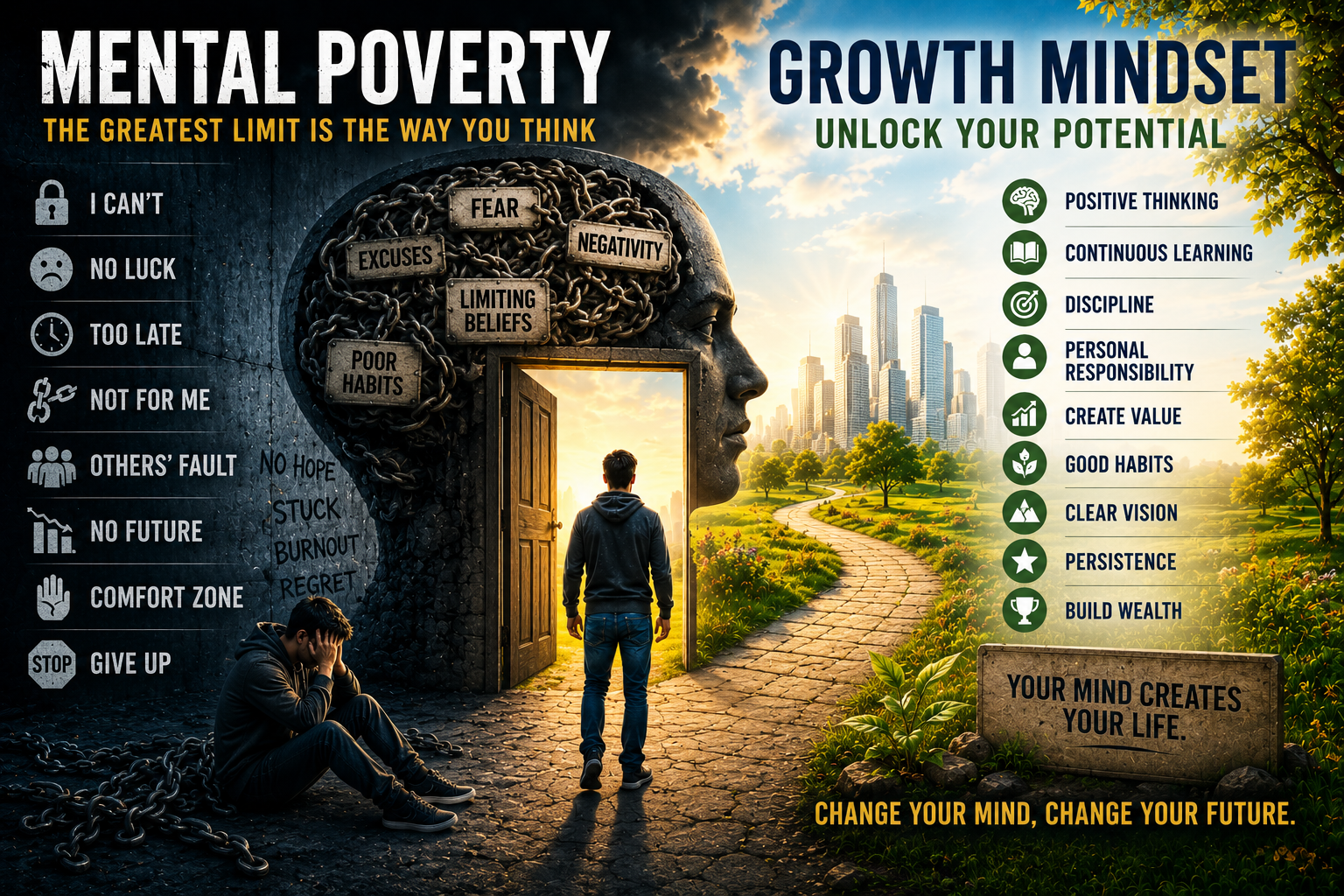
Mental Poverty: When the Greatest Limit Is the Way You Think

By Marvin Gandis

Before a person can change their financial situation, they often need to change the way they think.

Poverty does not always begin in the pocket. Many times, it begins in the mind: in beliefs, fears, excuses, lack of vision, the habit of expecting little from life, and the idea that nothing can change.

A person can have little money and still possess a rich mindset: faith, discipline, humility, willingness to learn, responsibility, and vision for the future.

But a person can also have money and still live with a poor mind: fear, disorder, pride, dependency, appearance, conformity, and lack of purpose.

That is why, in this second part of the series “The Reverse Question,” we will reflect on one of the most dangerous forms of poverty: mental poverty.

Not to judge anyone, but to awaken awareness.

Because many times, the greatest limit is not what a person has, but what they believe is possible.


What is mental poverty?

Mental poverty is a way of thinking that limits a person’s growth.

It is when someone believes they cannot learn, cannot improve, cannot begin again, cannot change their story, and cannot build something different.

Mental poverty appears in thoughts such as:

  • “I can’t.”
  • “That is not for me.”
  • “It is too late.”
  • “People like me never get ahead.”
  • “I am not lucky.”
  • “Others can do it, but I can’t.”
  • “Why try if nothing changes?”

These thoughts may seem small, but over time they become invisible chains.

A person who thinks this way can have opportunities in front of them and not see them. They can receive advice and reject it. They can have talent and never use it. They can have time and waste it. They can have an idea and never execute it.

Mental poverty does not always shout. Sometimes it hides behind resignation.


The danger of getting used to thinking small

One of the greatest dangers of mental poverty is that a person begins to settle for less than what they could become.

  • Not because they are incapable.
  • Not because they have no value.
  • Not because they have no talent.

But because they have become used to thinking small.

Thinking small does not mean living with humility. Humility is good. Thinking small means living limited by fear, excuses, and lack of vision.

A person may say they are being realistic when they are actually protecting their fear. They may say they do not need more when they are actually afraid to try. They may say they are waiting for the right moment when they are actually avoiding the beginning.

Mental poverty turns comfort into a prison.


Beliefs that keep a person stuck

1. Believing that money is evil

Money is not good or evil by itself. Money is a tool. What matters is the heart, the intention, and the way it is used.

With money, a person can help, build, serve, educate, create opportunities, and protect their family. It can also be used poorly, like any other tool.

The problem is not having money. The problem is loving money more than principles, family, truth, faith, and dignity.

A healthy mindset does not worship money, but it does not despise it either. It learns to manage it with wisdom.


2. Believing that learning is no longer necessary

Many people fall behind because they stop learning.

The world changes. Technology changes. Opportunities change. Business changes. The way we communicate changes.

But some people want new results with old knowledge.

Mental poverty says:
“I already know enough.”

A growth mindset says:
“I can still learn.”

The person who learns adapts.
The person who adapts finds new opportunities.


3. Believing that everything is always someone else’s fault

There are unfair situations. There are difficult systems. There are people who hurt others. There are complicated economies. There are painful stories.

But when a person always blames others, they lose power over their own life.

Responsibility does not mean denying pain. It means deciding what you will do with what is still in your hands.

The question that breaks mental poverty is not:

“Who is to blame?”

The powerful question is:

“What can I do now with what I have?”


4. Believing that failure defines your identity

Failing at something does not mean you are a failure.

  • A business may fail.
  • An idea may not work.
  • A sale may not happen.
  • A project may take longer than expected.
  • A strategy may need correction.

But none of that means the person has no value.

Mental poverty turns every mistake into a sentence. A wise mindset turns every mistake into a lesson.

The person who learns from mistakes is not falling behind. They are gaining experience.


5. Believing that others must rescue you

Help is valuable. Everyone needs support at some point. But always depending on someone else to fix your life can become a trap.

  • Mental poverty waits to be rescued.
  • A responsible mindset seeks direction.

This does not mean rejecting help. It means refusing to place your entire future in someone else’s hands.

  • Someone can give you an opportunity, but you must work it.
  • Someone can teach you, but you must learn.
  • Someone can open a door, but you must walk through it.

Mental poverty and lack of vision

A person without vision lives in reaction mode.

  • They react to debt.
  • They react to problems.
  • They react to fear.
  • They react to opinions.
  • They react to urgency.

But a person with vision begins to live with direction.

Vision does not mean having everything figured out. It means having a reason to move forward.

When a person has vision, they begin to care more about their decisions. They think before spending. They learn before quitting. They work even when results are not immediate. They rise after failing. They choose better relationships. They use their time more wisely.

Vision turns sacrifice into purpose.


How to begin breaking mental poverty

1. Change your questions

The questions you ask determine many of the answers you find.

Instead of asking:
“Why does this always happen to me?”

Ask:
“What can I learn from this?”

Instead of saying:
“I have no opportunities.”

Ask:
“What skill can I develop to create an opportunity?”

Instead of thinking:
“I can’t.”

Ask:
“What do I need to learn so I can?”


2. Protect what you consume mentally

We do not only consume food. We also consume ideas, conversations, news, social media, opinions, and content.

If a person consumes negativity every day, sooner or later their mind becomes weaker.

  • Protect what you watch.
  • Protect what you listen to.
  • Protect who you talk to.
  • Protect the voices you allow into your mind.

A mind fed by fear produces small decisions.
A mind fed by truth, learning, and direction produces better decisions.


3. Learn something new consistently

You do not need to learn everything at once. But you can learn something every day.

Read. Listen. Research. Ask questions. Practice. Take notes. Observe those who have made progress. Learn from your mistakes. Learn from your results. Learn from your failures.

Every new skill can become a door.

Continuous education is one of the most powerful ways to break mental poverty.


4. Surround yourself with people who challenge you to grow

Not everyone around you has to think like you. But you do need people who help you grow, not people who destroy your vision.

Look for people who talk about solutions, not only problems. People who act, not only criticize. People who learn, not only complain. People who remind you of your responsibility, not people who feed your excuses.

The right environment does not do the work for you, but it can help you stay awake.


5. Take one small action daily

Mental poverty is broken through action.

Positive thinking is not enough. Responsible action is necessary.

  • Make a call.
  • Read a page.
  • Save a small amount.
  • Pay down debt little by little.
  • Learn a skill.
  • Create content with purpose.
  • Organize your finances.
  • Correct a bad habit.
  • Finish something you started.

Small actions repeated with discipline can change a life.


Mental wealth before financial wealth

Mental wealth does not mean arrogance. It does not mean feeling superior. It does not mean denying difficulties.

Mental wealth means thinking responsibly, learning humbly, acting with discipline, and keeping hope alive even when the process is slow.

A person with mental wealth understands that:

  • They can learn.
  • They can improve.
  • They can correct mistakes.
  • They can begin again.
  • They can ask for help.
  • They can create value.
  • They can serve better.
  • They can build step by step.

Before money changes, the mind must awaken.


Conclusion

Mental poverty can be one of the hardest forms of poverty to overcome because it is not always visible from the outside. It can hide behind excuses, fear, resignation, pride, or conformity.

But it can be broken.

It breaks when a person decides to stop thinking like a permanent victim. It breaks when they accept responsibility. It breaks when they begin to learn. It breaks when they change their questions. It breaks when they protect their environment. It breaks when they act, even with small steps.

My dear reader or friend, do not allow your mind to become a prison. Maybe you cannot change everything today, but you can change one decision. You can change one question. You can learn one skill. You can take one step.

And many times, one right step is the beginning of a new life.

True wealth begins when the mind stops quitting before trying.


Disclaimer

This article is for educational, reflective, and informational purposes only. It should not be interpreted as financial, psychological, legal, professional, or investment advice. The purpose of this content is to encourage awareness, personal responsibility, learning, discipline, and the development of a growth mindset.

The term “mental poverty” is used as a reflection on limiting beliefs, thought patterns, lack of vision, and internal habits that may affect personal and financial growth. It is not intended to judge, blame, shame, or oversimplify the real challenges many people face.

Economic poverty can be influenced by personal, family, social, economic, structural, employment-related, and health factors. Every person’s situation is different, and results may vary.

Before making important decisions related to money, investments, debt, business, emotional well-being, or personal development, it is recommended to consult qualified professionals.
Publicado en Entrepreneurship, Financial Education, Personal Development, Self-Improvement, Wealth Mindset

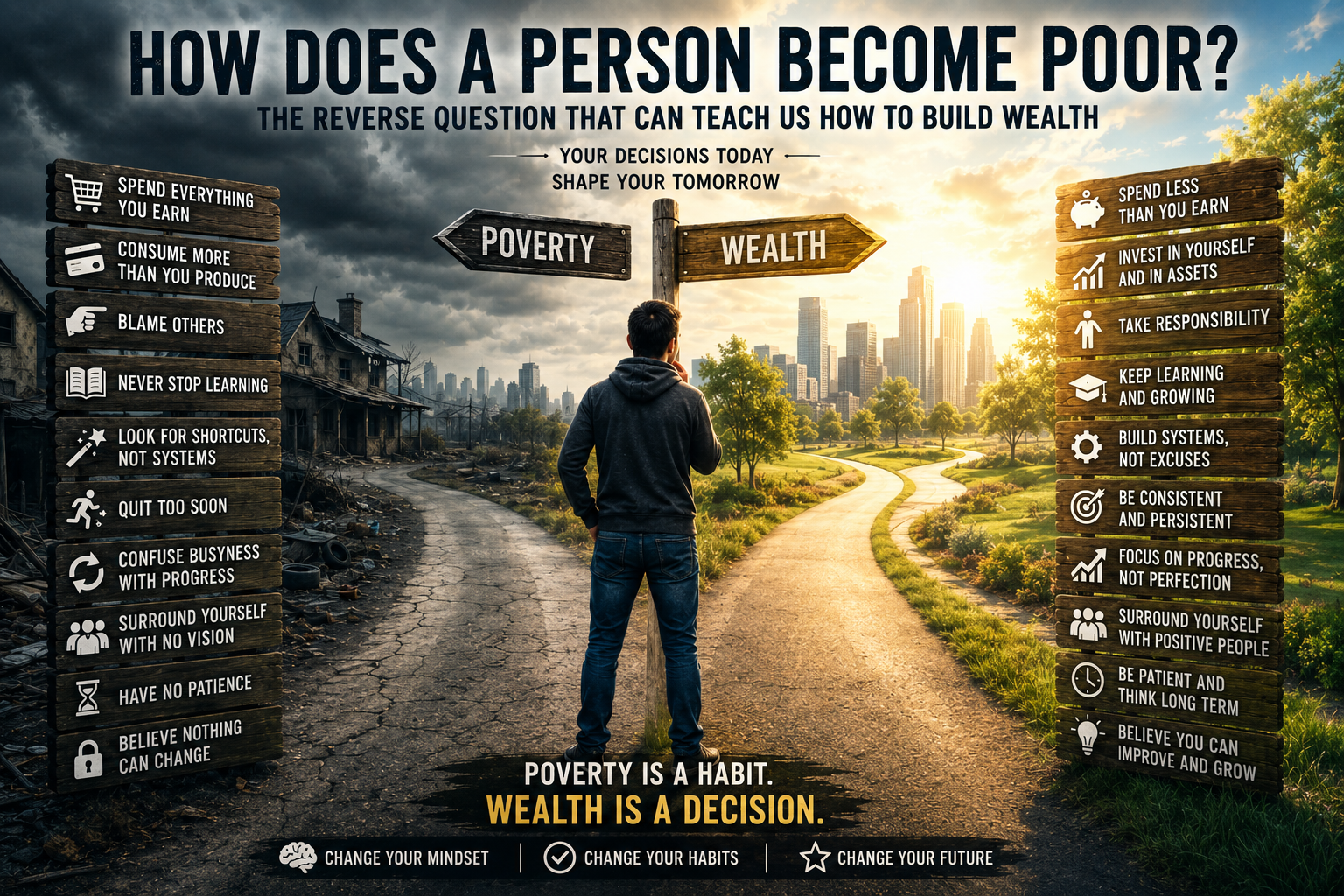
How Does a Person Become Poor? The Reverse Question That Can Teach Us How to Build Wealth

By Marvin Gandis

Most people want to know how to become rich. Every day, we see thousands of posts, videos, courses, motivational quotes, and advice about wealth, success, financial freedom, and abundance.

But even with so much information available, many people remain trapped in the same problems: debt, confusion, lack of direction, poor habits, frustration, excuses, fear, and repeated decisions that never produce different results.

So perhaps we should ask a different question:

What if instead of asking how to become rich, we asked how a person becomes poor?

  • Not as an insult.
  • Not as a cruel judgment.
  • Not to shame anyone.

But as an honest way to examine the habits, decisions, and mindsets that often prevent people from moving forward.

Because maybe, by studying what keeps a person stuck, we can understand more clearly what needs to change in order to build a wiser, more disciplined, and more abundant life.


Wealth does not begin only with money

Many people believe wealth begins when more money arrives. But the truth is that money often magnifies what already exists inside a person.

  • If someone cannot manage a little, they may not manage a lot.
  • If someone lacks discipline with a small income, they may lose a larger income.
  • If someone lives without direction, more money will not automatically create purpose.
  • If someone cannot control their habits, they may destroy valuable opportunities.

True wealth begins long before a large amount of money appears in a bank account. It begins in the mind, in behavior, in responsibility, and in the ability to make better decisions.

Being rich is not only about having more. It is also about thinking better, acting better, managing better, and serving better.


So, how does a person become poor?

A person does not always become poor overnight. Many times, it happens gradually through a series of small decisions that seem harmless at the moment.

  • An unnecessary purchase.
  • An ignored opportunity.
  • A skill never learned.
  • An excuse repeated too often.
  • A fear that controls action.
  • A debt is accepted as normal.
  • A negative environment.
  • A lack of vision that becomes a habit.

Not all poverty comes from personal mistakes. That would be unfair to say. There are difficult circumstances, injustice, illness, family crises, unemployment, weak economies, and situations that people cannot always control.

But there is also a truth we should not ignore: while we may not always choose our circumstances, we often choose our responses.

And repeated responses become our path.


Habits that keep a person poor

1. Spending everything they earn

One of the most common mistakes is living as if every dollar earned must be spent immediately.

When a person does not set money aside for savings, emergencies, investment, or growth, they remain vulnerable. Any problem can become a crisis because there is no margin.

Poverty often becomes stronger when money comes in, but it is never organized.


2. Consuming more than they produce

We live in a society that constantly promotes consumption. Buying, upgrading, showing off, impressing others, and spending have become part of many people’s identity.

But a life built only on consumption becomes fragile.

Wealth is built when a person learns to produce value through skills, services, solutions, knowledge, creativity, business, honest work, and discipline.

  • The person who only consumes depends.
  • The person who produces value begins to create options.

3. Always blaming others

Indeed, unfair systems, poor opportunities, economic crises, and harmful people exist. But living in constant blame can become a mental prison.

When a person always blames the government, the economy, the family, luck, the boss, the competition, or the past, they give away their power.

Responsibility does not mean denying reality. It means asking:

“Even if this is difficult, what can I do now?”

That question can change a life.


4. Refusing to learn new skills

The world changes. Technology changes. Business changes. The way people work changes.

But many people want better results with the same skills they had ten or twenty years ago.

Education does not end in school. Today, learning digital marketing, sales, communication, artificial intelligence, personal finance, leadership, writing, technology, or entrepreneurship can open doors that did not exist before.

A person who stops learning begins to limit their future.


5. Looking for shortcuts instead of systems

Many people want quick results, but they do not want a process. They want money, but not discipline. They want freedom, but not structure.

That is why they fall for empty promises, questionable schemes, magical ideas, or motivation without action.

Wealth is not built with emotional impulses. It is built with systems.

  • A system to manage money.
  • A system to learn.
  • A system to work.
  • A system to sell.
  • A system to save.
  • A system to measure results.
  • A system to improve every week.

Shortcuts excite people.
Systems transform people.


6. Quitting too soon

Many people start with excitement, but they quit when they do not see immediate results.

  • They post for a few days and get discouraged.
  • They try to sell and become frustrated.
  • They start a project and abandon it.
  • They begin learning something new and get tired.
  • They compare their beginning with someone else’s results.

But almost everything valuable requires time.

Poor results often do not come because a person lacks talent. They come because the person did not stay long enough with the right process.


7. Confusing movement with progress

Being busy does not mean moving forward.

A person can spend all day checking social media, watching videos, sharing posts, replying to messages, and feeling active, while still producing no real results.

Progress requires direction.

It is not enough to do many things. You must do the right things, measure results, correct mistakes, and improve.

The question is not only:

“Am I busy?”

The better question is:

“Is what I am doing moving me closer to a better life?”


8. Surrounding themselves with people who have no vision

The people around us influence our mindset, conversations, decisions, and expectations.

If a person surrounds themselves with negative, careless, irresponsible, mocking, or directionless people, that influence eventually affects the way they think.

This does not mean rejecting people arrogantly. It means protecting the mind, the environment, and the direction of your life.

A person who wants to grow needs conversations that elevate, relationships that healthily challenge them, and examples that inspire responsibility.


9. Having no patience

Impatience causes many people to make poor decisions.

  • They want quick money.
  • They want results without process.
  • They want success without training.
  • They want to harvest without planting.

But life operates by principles. First you plant, then you nurture, then you wait, then you harvest.

Patience is not passivity. It is discipline with vision.


10. Believing that nothing can change

This may be one of the deepest forms of poverty: poverty of hope.

When a person believes nothing can improve, they stop trying. And when they stop trying, they confirm their own belief.

But many lives begin to change when a person decides to start again, even with small steps.

  • You do not need to have everything figured out to begin.
  • You need to begin with what you have, where you are, and with a willingness to learn.

Mental poverty can be more dangerous than financial poverty

A person can have little money and still have a mindset of growth, faith, discipline, humility, and vision.

But a person can also have money and still live with a poor mind: fear, selfishness, disorder, irresponsibility, appearance, pride, and lack of purpose.

That is why this article is not about judging people who have less. It is about bringing awareness to the habits that destroy opportunities.

  • Financial poverty can be temporary.
  • Mental poverty can become a prison if it is never confronted.

What is the real formula for building wealth?

Maybe the formula is not as mysterious as it seems. Perhaps it is not a hidden secret, but a set of principles repeated with patience.

  • Keep learning.
  • Spend less than you earn.
  • Save with intention.
  • Invest with wisdom.
  • Serve others better.
  • Create value.
  • Develop skills.
  • Avoid destructive debt.
  • Take responsibility.
  • Think long term.
  • Persist when others quit.
  • Measure results and correct mistakes.
  • Surround yourself with better influences.
  • Build systems, not only desires.

Wealth does not appear simply because someone wants it. It is built when a person changes their daily decisions.


The question that can change everything

Maybe the right question is not:

“How do I become rich?”

Maybe the better question is:

“What habits must I stop repeating so I do not continue living poor?”

That question is more honest. More practical. More powerful.

Because when we identify what is making us poor, we begin to discover what can set us free.

  • Sometimes we do not need more information. We need more applications.
  • We do not need more motivation. We need more discipline.
  • We do not need more excuses. We need more responsibility.
  • We do not need to look rich. We need to build foundations.

Conclusion

Most people want to learn how to become rich, but few are willing to honestly study what keeps them poor.

This reflection is not meant to condemn anyone. On the contrary, it is meant to open a door.

Because if a person can recognize the habits that keep them stuck, they can begin to change them. If they can change their mindset, they can change their decisions. If they change their decisions, they can change their direction. And if they change their direction, with time, discipline, and faith, they can change their life.

True wealth does not begin with a full bank account. It begins with an awakened mind, a humble heart, a responsible attitude, and small actions repeated with wisdom.

Perhaps learning how a person remains poor is one of the clearest ways to discover how a person can begin to build wealth.


Disclaimer

This article is for educational, reflective, and informational purposes only. It should not be interpreted as financial, legal, accounting, professional, or investment advice. Every person’s situation is different, and financial results may vary depending on decisions, habits, knowledge, resources, environment, and opportunities.

This content is not intended to judge, shame, or generalize anyone who may be facing financial hardship. Poverty can be influenced by many personal, family, social, economic, and structural factors. The purpose of this reflection is to encourage responsibility, learning, discipline, financial awareness, and personal growth.

Before making important decisions related to money, investments, debt, business, or personal finances, it is recommended to consult with a qualified professional.

Publicado en Discipline, Faith, Mindset, Motivation, Personal Development, Personal Growth

Silent Discipline: What You Build When Nobody Is Watching

By Marvin Gandis

The Invisible Also Builds Your Future

There is a part of life almost nobody sees.

  • It does not appear in photos.
  • It does not receive applause.
  • It does not always generate comments.
  • It is not published as an achievement.
  • It does not look impressive from the outside.

But that silent part can be one of the most important.

It is what you do when nobody is watching.

  • The way you work when there is no recognition.
  • The way you keep learning when nobody congratulates you.
  • The honesty with which you fulfill your responsibilities.
  • The discipline with which you do what is right, even when nobody notices.
  • The faithfulness with which you keep planting, even when you do not yet see fruit.

We can call this silent discipline.

And many times, what a person builds in silence determines what they will be able to sustain in public.


Character Is Formed When Nobody Is Watching

Public image can impress, but private character sustains.

Many people want to be recognized, admired, and respected, but they neglect what they do in private.

However, life eventually reveals what a person has truly built.

  • If someone practices responsibility in silence, it eventually shows.
  • If someone develops patience in small things, it eventually shows.
  • If someone learns to be honest when nobody supervises them, it eventually shows.
  • If someone works with excellence even when nobody applauds, it eventually shows.

Character is not improvised in the moment of opportunity.

It is trained beforehand.


Discipline Does Not Always Feel Inspiring

Many times, we think discipline should feel exciting.

But real discipline is usually simple, repetitive, and humble.

  • Getting up and doing what is right.
  • Finishing what you started.
  • Studying even when you do not feel like it.
  • Organizing what you have postponed.
  • Responding with respect.
  • Correcting a mistake.
  • Keeping a promise.
  • Following up.
  • Trying again.

Discipline does not always come with emotion. Many times, it comes with a decision.

It does not say, “Today I feel motivated.”

It says, “Today I will do what is necessary.”

That attitude may look small, but over time, it builds a stronger life.


Small Things Repeated Have Power

A common mistake is despising small actions.

  • One post.
  • One email.
  • One call.
  • One prayer.
  • One written page.
  • One reading session.
  • One training.
  • One adjustment.
  • One honest conversation.
  • One daily improvement.

By themselves, they may seem small.

But repeated with consistency, they can change a life.

  • A drop may not seem strong, but over time it can mark stone.
  • A seed may seem small, but it can become a tree.
  • A habit may seem simple, but it can define a destiny.

Silent discipline understands that small things are not insignificant when repeated with purpose.


Public Life Cannot Sustain What Private Life Has Not Formed

Many people desire more opportunities, more audience, more sales, more leadership, more influence, and more results.

But they are not always ready to sustain what they desire.

  • A big opportunity can reveal how little preparation is needed.
  • A large platform can expose a weak character.
  • A major responsibility can break neglected discipline.
  • A great blessing can become a burden without maturity.

That is why, before asking for more, we should ask ourselves:

  • Am I strengthening my private life?
  • Am I faithful in small things?
  • Am I being responsible with what I already have?
  • Am I developing habits that can sustain growth?
  • Am I building character or only seeking visibility?

Silent preparation is not wasted time. It is a foundation.


Silent Discipline Protects Your Purpose

Purpose needs protection.

Not everything that distracts you looks bad. Some distractions seem urgent, interesting, or justified.

But little by little, they can steal focus.

  • Watching too much of what others are doing.
  • Constantly comparing yourself.
  • Changing direction every week.
  • Living in reaction to comments.
  • Quitting when results are not fast.
  • Depending on emotion to take action.

Silent discipline helps you return to the center.

  • It reminds you what you are building.
  • It helps you say no.
  • It helps you manage your time.
  • It helps you continue even when the process is slow.
  • It helps you work with direction, not only impulse.

A disciplined person does not live enslaved to every distraction.

They live guided by purpose.


Nobody Can Do Your Part For You

  • You can receive advice.
  • You can read books.
  • You can take courses.
  • You can listen to messages.
  • You can have mentors.
  • You can receive encouragement.
  • You can pray and ask for direction.

All of that helps.

But there is a part nobody can do for you.

  • Nobody can practice for you.
  • Nobody can organize your life for you.
  • Nobody can take action for you.
  • Nobody can develop your habits for you.
  • Nobody can defeat your excuse for you.
  • Nobody can be consistent for you.

Silent discipline begins when you accept personal responsibility without living under condemnation.

It is not about punishing yourself. It is about taking ownership.


God Also Sees What Others Do Not See

For a person of faith, this is deeply important:

God sees what others do not see.

  • He sees the prayer nobody heard.
  • He sees the effort nobody applauded.
  • He sees the tear nobody noticed.
  • He sees the right decision that nobody celebrated.
  • He sees the sacrifice nobody understood.
  • He sees faithfulness in small things.

This does not mean we should not seek excellence, results, or growth. But it does mean our value does not depend only on human approval.

There are silent acts of obedience that carry great spiritual weight.

There are hidden processes that form depth.

And there are private seasons where God prepares what He will later use with purpose.


Discipline Is Also Learned Through Failure

Being disciplined does not mean never failing.

It means learning to return.

  • There will be difficult days.
  • There will be moments of exhaustion.
  • There will be distractions.
  • There will be mistakes.
  • There will be weeks when you do not do everything as you wanted.
  • There will be times when you lose rhythm.

But a fall does not have to become abandonment.

Mature discipline says:

  • “I failed, but I return.”
  • “I fell behind, but I continue.”
  • “I made a mistake, but I corrected it.”
  • “I lost focus, but I return to my purpose.”

You do not need perfection to grow.

You need honesty, humility, and constant return.


How to Practice Silent Discipline

First, define what truly matters.

You cannot be disciplined in everything at the same time. Choose clear priorities.

Second, create small routines.

A simple routine sustained over time is worth more than a huge plan abandoned in three days.

Third, eliminate unnecessary distractions.

Not everything deserves your attention. Protect your focus.

Fourth, keep small promises.

Self-trust grows when you do what you said you would do.

Fifth, review your progress without destroying yourself.

Evaluate, correct, and continue. Do not use your mistakes as an excuse to quit.

Sixth, work even when nobody applauds.

The reward does not always come immediately, but character is being formed.

Seventh, keep your purpose in front of you.

When you remember why you are doing something, it becomes easier to endure the process.


What You Build in Silence May Speak Later

Maybe today nobody sees your effort.

  • Maybe nobody notices your habits.
  • Maybe nobody applauds your consistency.
  • Maybe nobody understands your process.
  • Maybe nobody recognizes how much it costs you to keep going.

But that does not mean you are not building.

  • You are building character.
  • You are building endurance.
  • You are building clarity.
  • You are building maturity.
  • You are building confidence.
  • You are building a foundation for what is coming.

And when the right time arrives, many things that seemed invisible will begin to make sense.


Silent Discipline Is Inner Power

My dear reader and friend, do not underestimate what you do when nobody is watching.

  • Do not underestimate the page you write.
  • Do not underestimate the prayer you pray.
  • Do not underestimate the habit you correct.
  • Do not underestimate the promise you keep.
  • Do not underestimate the small step you repeat.
  • Do not underestimate the right decision you make in silence.

Because the invisible also shapes your future.

Silent discipline does not seek to impress. It seeks to build.

It does not depend on applause. It depends on the purpose.

It is not fed only by emotion. It is sustained by a decision.

And even if nobody sees it today, what you are forming in private may sustain tomorrow’s opportunities.

What you do when nobody is watching reveals the kind of future you are preparing.


Disclaimer:


This article is provided for educational, motivational, inspirational, and informational purposes only. It is intended to encourage reflection, personal growth, discipline, faith, consistency, responsibility, and responsible decision-making.

The content should not be interpreted as financial, legal, medical, psychological, spiritual counseling, business, or professional advice. Any examples related to personal development, discipline, habits, faith, success, leadership, productivity, or life improvement are not guarantees of specific results.

Individual outcomes may vary depending on effort, consistency, personal circumstances, discipline, available resources, emotional readiness, timing, environment, and other factors beyond our control.

Readers are encouraged to use their own judgment, conduct their own research, and seek qualified professional guidance when necessary. The purpose of this content is to inspire and educate, not to promise instant results or replace professional advice.