By Marvin Gandis
Before you quit digital marketing, review your message, audience, content, capture page, follow-up, traffic, and strategy with clarity.
There comes a moment in digital marketing when frustration becomes heavy.
- You post.
- You write.
- You promote.
- You create capture pages.
- You prepare follow-up emails.
- You share good offers.
- You stay active.
And still, the results seem small, slow, or completely invisible.
You may start asking yourself painful questions:
- “Am I bad at this?”
- “Why does nobody see my content?”
- “Why are others getting results faster than I?”
- “Should I just give up?”
But before you make a permanent decision from a temporary season of discouragement, pause.
- Many times, the problem is not you.
- The problem may be one part of your system that needs adjustment.
Digital marketing is not just about posting more. It is about building a system that connects the right message with the right audience, through the right content, with the right follow-up and traffic strategy.
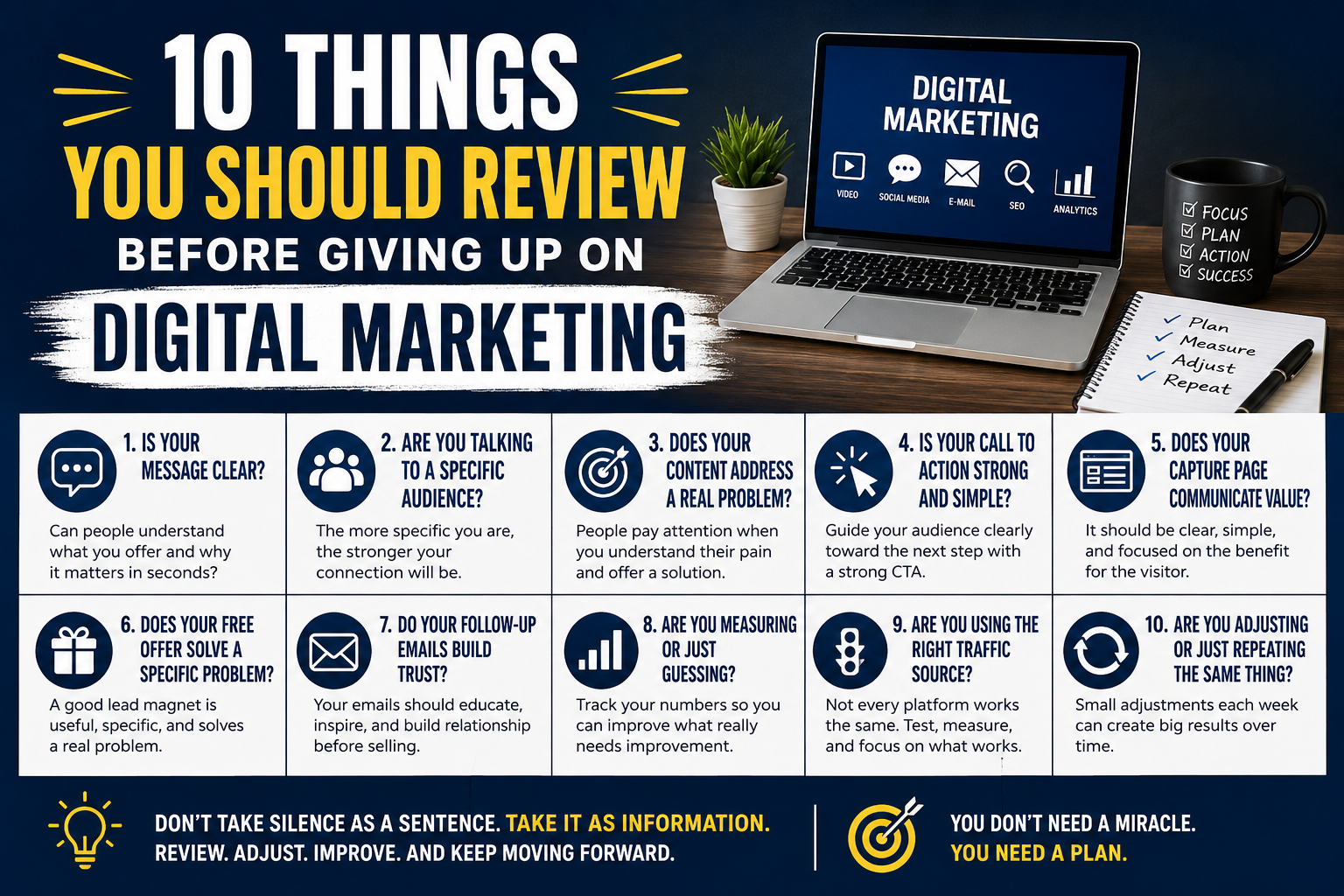
Before giving up, review these 10 important areas.
1. Is Your Message Clear?
A confused message creates confused visitors.
If someone lands on your post, email, or capture page, they should understand quickly:
- What are you offering?
- Who is it for?
- What problem does it solve?
- Why should they care?
- What should they do next?
Many marketers lose attention because their message is too broad.
They say things like:
- “I have a great opportunity.”
- “This can help you make money online.”
- “Check this out.”
Those phrases are too general. They do not tell the reader why the message matters to them personally.
A stronger message sounds like this:
“If you are posting every day but getting no clicks, this guide will help you review your message, capture page, and follow-up strategy.”
That message speaks to a specific person with a specific problem.
Ask yourself:
Can a person understand in less than five seconds what I offer and why it matters?
Review:
- Your headline.
- Your opening line.
- Your main promise.
- Your main benefit.
- Your call to action.
Clarity is not optional. It is the foundation of conversion.
2. Are You Speaking to a Specific Audience?
When you try to speak to everybody, your message often connects with nobody.
Digital marketing becomes more powerful when you know exactly who you are trying to help.
Are you speaking to:
- Beginner entrepreneurs?
- Affiliate marketers without results?
- Small business owners?
- People who post but get no clicks?
- People who want to generate leads?
- People who need better email follow-up?
- People who feel overwhelmed online?
Each audience has different fears, goals, questions, and objections.
For example, a beginner does not need the same message as an advanced marketer. A person struggling with traffic does not need the same message as someone struggling with follow-up.
When your audience is specific, your content becomes stronger.
Ask yourself:
Does my content speak directly to one type of person?
Example:
Instead of saying:
“This is for anyone who wants success online.”
Say:
“This is for digital entrepreneurs who are posting consistently but not getting enough clicks, leads, or conversations.”
Specificity creates connection.
3. Does Your Content Address a Real Problem?
People do not pay attention just because you have something to say.
They pay attention when they feel understood.
Your content should connect with real frustrations, such as:
- “I post, and nobody responds.”
- “I have good offers, but nobody clicks.”
- “I do not know how to generate leads.”
- “My capture pages are not converting.”
- “I do not understand traffic.”
- “I feel invisible online.”
If your content only talks about your product, opportunity, or tool, people may ignore it.
But if your content starts with their pain, they may stop and listen.
Weak opening:
“Here is a great digital marketing tool.”
Stronger opening:
“If you are tired of posting every day and still getting no response, the problem may not be your effort. It may be your message.”
That speaks to the reader’s experience.
Ask yourself:
Does my content begin with the reader’s problem or only with my product?
Content that connects begins with empathy.
4. Is Your Call to Action Strong and Simple?
A call to action is the bridge between attention and results.
If you create content but do not tell people what to do next, many will simply move on.
Avoid weak CTAs like:
- “Click here.”
- “Check this out.”
- “More info.”
- “Let me know.”
Those are not terrible, but they are often not specific enough.
Try stronger CTAs:
- Download the free checklist.
- Comment “INFO” and I will send you the details.
- Start with this 30-day plan.
- Click here to review your strategy.
- Get the free resource now.
Your CTA should be clear, direct, and connected to a benefit.
Ask yourself:
Am I guiding the reader toward the next step?
A good CTA does not pressure people. It helps them know what to do.
5. Does Your Capture Page Communicate Value Quickly?
Your capture page has one main job:
Turn visitors into subscribers.
To do that, it must communicate value quickly.
Your page should answer three questions:
- What will I receive?
- Why do I need it?
- What should I do now?
If your capture page is confusing, too long, too vague, or visually weak, people may leave without subscribing.
A strong capture page usually includes:
- A clear headline.
- A benefit-driven subtitle.
- An attractive image.
- A simple form.
- A visible button.
- A privacy message.
- A specific promise.
Weak headline:
“Free Marketing Guide.”
Stronger headline:
“Download the 30-Day Plan to Stop Feeling Invisible Online.”
The second headline feels more specific, emotional, and useful.
Ask yourself:
Does my capture page quickly show the value of subscribing?
Remember: people do not subscribe because you have a form. They subscribe because they see value.
6. Does Your Free Offer Solve a Specific Problem?
Your lead magnet should not feel generic.
A strong free resource helps the reader solve a specific problem or move one step closer to a desired result.
Instead of offering:
“Digital Marketing Tips”
offer something more focused:
“10 Things You Should Review Before Giving Up on Digital Marketing.”
or
“The 30-Day Plan to Stop Feeling Invisible Online.”
These titles connect with a specific emotional situation.
A good lead magnet should have:
- A clear problem.
- A desired result.
- An emotional title.
- A practical benefit.
- A realistic promise.
Ask yourself:
Does my free resource solve a clear problem?
If the lead magnet feels valuable, people are more likely to subscribe.
7. Do Your Follow-Up Emails Build Trust?
Many marketers make the mistake of sending only promotional emails.
But email follow-up should not only sell.
It should build trust.
Your emails should:
- Deliver value.
- Educate.
- Motivate.
- Tell stories.
- Explain problems.
- Present solutions.
- Invite action.
- Create a relationship.
The first email should deliver the promised resource quickly.
After that, your follow-up should guide the subscriber step by step.
For example:
Email 1: Deliver the checklist.
Email 2: Explain why the message matters.
Email 3: Teach how to improve content.
Email 4: Review capture page mistakes.
Email 5: Introduce a helpful tool or next step.
Ask yourself:
Do my emails create a relationship before asking for a decision?
People are more likely to act when they trust the person guiding them.
8. Are You Measuring or Just Guessing?
You cannot improve what you do not measure.
If you are not tracking your numbers, you may blame yourself for something that only needs a small technical or strategic adjustment.
Start measuring:
- Views.
- Clicks.
- Subscribers.
- Email opens.
- Email clicks.
- Replies.
- Conversions.
These numbers help you locate the real problem.
- Maybe your posts are getting attention, but nobody clicks.
- Maybe people click, but your page does not convert.
- Maybe people subscribe, but they do not open your emails.
- Maybe they open emails, but do not click.
- Maybe they click, but the offer is not clear enough.
Each number tells a story.
Ask yourself:
Where am I losing attention?
Your results are not a final judgment. They are information.
9. Are You Using the Right Traffic Source?
Not every platform works the same way.
Different audiences respond differently on different platforms.
You can test:
- Facebook.
- LinkedIn.
- Pinterest.
- YouTube Shorts.
- Safelists.
- Blog SEO.
- Email marketing.
- Online groups.
- Paid advertising.
But do not try to be everywhere at once.
Choose two traffic sources and measure them for 30 days.
For example:
- Main source: Facebook.
- Secondary source: Safelists.
or
- Main source: Blog SEO.
- Secondary source: Pinterest.
The goal is not to chase every platform. The goal is to find where your message gets the best response.
Ask yourself:
Am I testing traffic with patience and measurement, or am I jumping from one platform to another?
Traffic requires consistency, testing, and time.
10. Are You Adjusting or Just Repeating the Same Thing?
Consistency is important.
But repeating the same weak strategy over and over can lead to frustration.
Every week, adjust one thing:
- Your headline.
- Your CTA.
- Your image.
- Your capture page.
- Your email subject line.
- Your core message.
- Your audience.
- Your free offer.
- Your traffic source.
Do not change everything at once. That creates confusion.
Change one thing, measure, and learn.
Ask yourself:
Am I learning from my results or only feeling discouraged by them?
Smart marketers do not quit at the first sign of silence. They review, adjust, and continue.
Mini Self-Evaluation
Before giving up, ask yourself:
- Is my message clear?
- Is my audience specific?
- Does my content address a real problem?
- Is my CTA strong and simple?
- Does my capture page communicate value?
- Does my free offer solve a specific problem?
- Do my emails build trust?
- Am I measuring results?
- Do I have a defined traffic source?
- Am I adjusting weekly?
If you answered “no” to several of these questions, that does not mean you should quit.
It means you have found where to improve.
A Simple 7-Day Action Plan
Day 1
Rewrite your main message in one clear sentence.
Day 2
Define one specific audience and write their top three frustrations.
Day 3
Improve one old post with a stronger headline and CTA.
Day 4
Review the headline and button on your capture page.
Day 5
Improve your welcome email with more empathy and clarity.
Day 6
Choose two traffic sources to measure for 30 days.
Day 7
Write down your numbers and decide what to adjust next week.
Small steps create direction.
Before you give up on digital marketing, review your system
- Maybe you are not bad at this.
- Maybe your message needs clarity.
- Maybe your audience needs focus.
- Maybe your page needs improvement.
- Maybe your follow-up needs more connection.
- Maybe your traffic needs better direction.
Do not take silence as a final sentence.
Take it as information.
- You do not need a miracle.
- You need a plan.
- You need to measure.
- You need to adjust.
- You need to continue with intelligence.
Your breakthrough may not come from doing more of everything.
It may come from improving the right thing at the right time.
Before you quit, download the free checklist:
10 Things You Should Review Before Giving Up on Digital Marketing
Use it to review your message, audience, content, capture page, follow-up, traffic, and strategy.
Your next step is not to give up. Your next step is to review, adjust, and move forward with clarity.
Disclaimer
This article is for educational, motivational, and informational purposes only. It does not guarantee income, sales, clicks, subscribers, financial results, or social media growth. Results depend on individual effort, strategy, consistency, traffic, content quality, follow-up, market conditions, tools used, and other external factors. Some recommendations may include affiliate links, which means the creator may earn a commission if you choose to purchase through those links, at no additional cost to you.

Debe estar conectado para enviar un comentario.