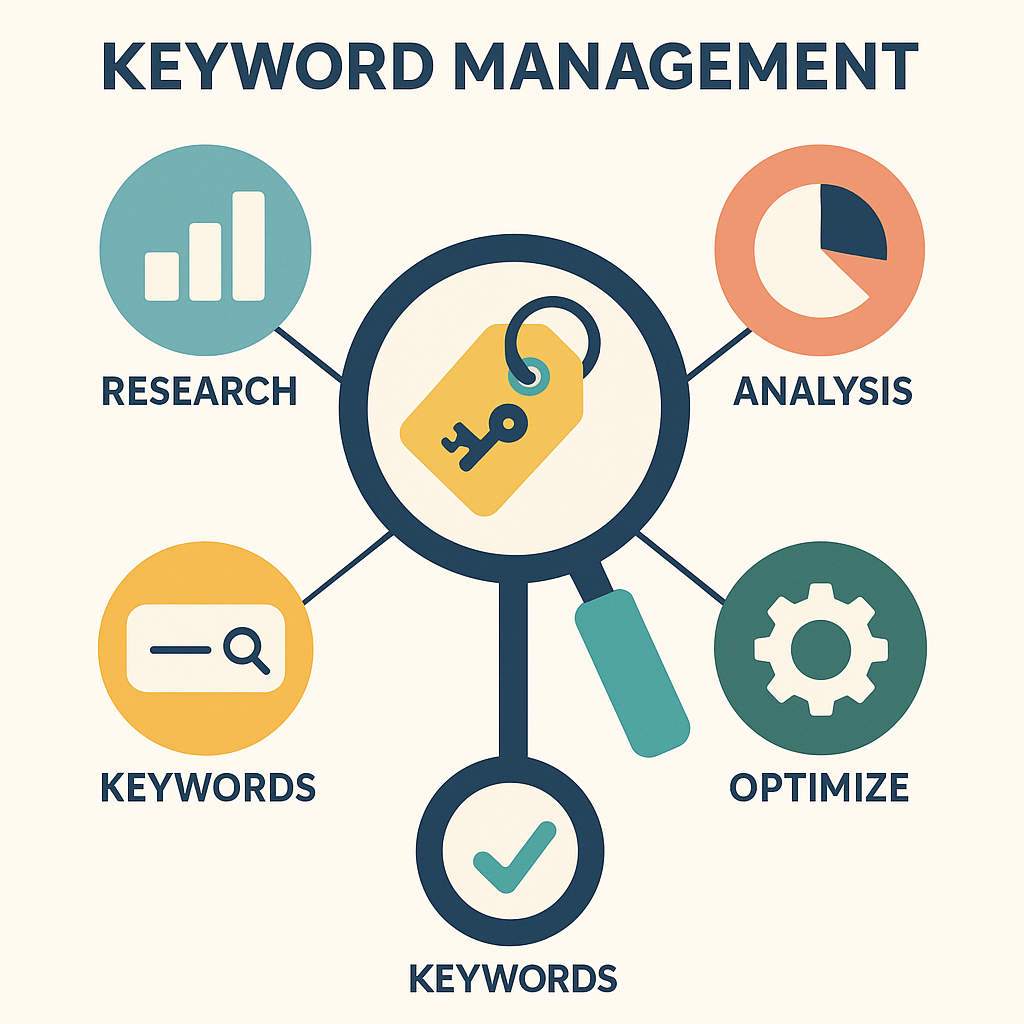
🔑 Week 13: Keyword Management
Discover how to find, organize, and optimize the right keywords for your website and campaigns. Learn how keyword management improves SEO, increases visibility, and drives qualified traffic.
🌟 Introduction
Behind every successful digital marketing campaign is one simple truth — keywords are the bridge between you and your audience. They’re the words people type into search engines when they’re looking for solutions, products, or inspiration.
Keyword management is the art of selecting, organizing, and optimizing those words strategically to boost visibility, attract the right visitors, and convert them into loyal customers. Let’s dive into how mastering keywords can elevate your entire digital presence.
🧠 1. What Is Keyword Management?
Keyword management is the ongoing process of researching, selecting, analyzing, and refining the keywords your business targets in SEO and paid campaigns.
It’s not just about finding words — it’s about understanding intent.
When you manage your keywords effectively, you connect with people who are ready to take action.
Example:
- Someone searching “best running shoes 2025” is ready to buy.
- Someone searching “how to start running” is seeking education.
Both are valuable — but require different strategies.
📈 2. Why Keyword Management Matters
Keywords are the foundation of all digital marketing strategies. They determine how search engines index your content and how your audience finds you.
Here’s why keyword management is vital:
- 🚀 Increases Visibility: Helps your content appear on relevant searches.
- 🎯 Improves Targeting: Reaches the right people with the right message.
- 💰 Maximizes ROI: Ensures your ad spend and SEO efforts focus on profitable terms.
- 🧩 Guides Content Creation: Provides direction for blog posts, videos, and campaigns.
- 📊 Tracks Performance: Allows you to measure and refine strategies based on data.
Without keyword management, you’re shooting in the dark. With it, you’re aiming with precision.
🔍 3. Types of Keywords You Should Know
Understanding the different types of keywords helps you build a balanced strategy:
1. Short-Tail Keywords (Head Terms)
- Example: “Shoes,” “Digital Marketing”
- High volume, high competition, but broad intent.
2. Long-Tail Keywords
- Example: “Best running shoes for women under $100”
- Lower competition, highly specific, and higher conversion rates.
3. LSI (Latent Semantic Indexing) Keywords
- Related terms that help search engines understand context.
- Example: For “email marketing,” related words might be “automation,” “lead nurturing,” or “open rates.”
4. Geo-Targeted Keywords
- Focused on location to attract local customers.
- Example: “Digital marketing agency in Las Vegas.”
5. Branded vs. Non-Branded Keywords
- Branded: “Nike running shoes”
- Non-Branded: “lightweight running shoes”
A strong SEO strategy blends all these types for maximum impact.
⚙️ 4. The Keyword Management Process
Here’s a simple 5-step system to manage your keywords effectively:
Step 1: Research
Use tools like Google Keyword Planner, Ahrefs, or Semrush to find terms people are searching for in your niche.
Step 2: Analyze
Evaluate keywords based on:
- Search Volume
- Competition
- Relevance
- Intent
Step 3: Organize
Group keywords by theme or campaign goal — such as “Product Keywords,” “Educational Keywords,” or “Local Keywords.”
Step 4: Implement
Integrate them naturally into:
- Website copy
- Blog posts
- Product descriptions
- Meta titles and descriptions
- Ad campaigns
Step 5: Monitor & Optimize
Track performance regularly and adjust based on which keywords bring traffic or conversions.
💡 5. Tools for Effective Keyword Management
These tools simplify research and help you stay ahead of your competitors:
- Google Keyword Planner – Free and reliable keyword insights.
- Semrush / Ahrefs – In-depth analytics and keyword tracking.
- Ubersuggest – Great for beginners and content ideas.
- Moz Keyword Explorer – Measures keyword difficulty and opportunity.
- AnswerThePublic – Generates questions and phrases people search for.
Each tool gives you a different layer of insight — together, they form your keyword command center.
📊 6. Common Mistakes to Avoid
❌ Stuffing too many keywords into your content.
❌ Ignoring long-tail and local search terms.
❌ Not tracking performance or revisiting your keyword list.
❌ Using the same keywords for every page.
SEO success is about relevance and strategy, not repetition.
🚀 Conclusion & Call to Action
Keyword management is like tuning an instrument — precision and consistency create harmony. The right words attract the right audience, leading to higher visibility, engagement, and conversions.
👉 This week, perform a keyword audit. Identify 10 new keywords that match your goals, and optimize one existing article or ad around them.
Next week: Week 14 — Google Analytics: Understanding Your Data Like a Pro.

Here is a thoughtful comment you can post on that blog section:
This is a very clear explanation of keyword management. I like how you emphasized that it’s not just about finding keywords but understanding search intent. Many people focus only on search volume, but the intent behind a query often determines whether that traffic will actually convert.
The example comparing “best running shoes 2025” with “how to start running” is a great way to show the difference between transactional and informational searches. Both can be valuable, but they definitely require different content strategies.
I also appreciate the breakdown of keyword types. Long-tail keywords are often overlooked, yet they can bring highly targeted visitors with much better conversion potential. For newer websites especially, targeting these specific phrases can be a smart way to build traffic and authority over time.
Overall, this section does a great job explaining why keyword management is such a critical part of a successful SEO strategy. Looking forward to reading more insights in the rest of the article.
Nazib, thank you for such a thoughtful and detailed reflection.
You highlighted exactly what many people miss in SEO: keywords alone don’t create results — intent does. Search volume can bring visitors, but understanding why someone is searching is what determines whether that traffic becomes engagement or conversion.
I’m glad the example helped clarify the difference between informational and transactional searches. Both play important roles, but they serve very different stages of the user journey.
Your point about long-tail keywords is also spot on. They may look small individually, but together they often build the most stable and targeted traffic — especially for newer sites trying to establish authority.
I really appreciate the depth of your comment and the way you engaged with the ideas. Thanks for taking the time to share your perspective, and I’m glad the section was useful to you.
Thanks a lot.. Can we connect each other to get updated?
Nazib, thank you — I appreciate the interest.
The best way to stay updated is simply to follow the blog and the upcoming posts. I’ll keep sharing new insights and practical ideas there, and you’re always welcome to join the discussion in the comments.
Looking forward to seeing your thoughts on future articles as well.
Solid guide on keyword management! The focus on transactional keywords over informational ones is spot on for driving actual conversions. Very actionable tips.
Thank you — I really appreciate that. 🙌
You’re absolutely right: informational keywords build visibility, but transactional keywords build revenue. When someone searches with buying intent, the conversation is already halfway there.
The key is balance:
Informational → attract and educate
Commercial investigation → nurture
Transactional → convert
When those layers work together, traffic stops being vanity metrics and starts becoming measurable results.
Glad the guide felt actionable — that’s always the goal.
You are always welcome friend Marvin 🤗
My dear friend Rohitash,
thank you — your warmth is always felt. 🤗
I truly appreciate the openness, kindness, and steady presence you bring into our conversations. It’s a pleasure walking this path of reflection and growth together.
Grateful for you, always. 🙏✨
Thank you that’s very interesting. I’m not marketing a product for a business, I’m marketing myself and my purpose to reach many people with stories of encouragement, enriched teaching and supportive content for living our best lives. When I read your content I read from that perspective. I find it thought provoking and helpful. Thank you
Thank you so much for sharing this — it truly means a lot.
What you said is powerful, because marketing yourself and your purpose is one of the most meaningful (and courageous) paths there is.
Reaching people through stories of encouragement, thoughtful teaching, and supportive content isn’t about selling — it’s about serving, connecting, and planting seeds that help others live more grounded and hopeful lives. When that’s the intention, everything else becomes secondary.
I’m really grateful that you read my content from that perspective, and that you find it thought-provoking and helpful. Your clarity about your purpose is inspiring, and it shows in the way you express yourself.
Thank you for being here and for the work you’re doing. It matters more than you know. 🙏✨
You are welcome and Thank you for your kind comment and support. I appreciate it 🙏
Thank you — I truly appreciate your openness and the way you shared this. 🙏
What you said is powerful: marketing yourself and your purpose is one of the most honest and meaningful forms of communication. Reaching people with encouragement, enriched teaching, and supportive content is real service, and it shows in the way you write.
I’m grateful that you read my content through that lens, and I’m glad it feels thought-provoking and helpful to you. Your presence, support, and clarity of intention mean a lot. ✨
Happy new year from Germany!
Happy New Year to you as well — greetings from my side! 🎉✨
Wishing you a joyful, healthy, and successful year ahead all the way to Germany. 🇩🇪🥂
Yes, you are absolutely right freind Marvin,
Consistency and relevance is quite important to stand out in higher competition world.
You gave a well organised and lucid way of understanding different aspects of Seo .
Thank you for writing with such genousity and calmness.
🙏💐👌
Thank you, my dear friend — your words mean a great deal to me. 🙏💐
You’re absolutely right: in a world of growing competition, consistency and relevance are what quietly set us apart over time. I’m really glad the way I shared SEO felt clear and lucid to you — that was exactly my intention: to bring understanding without noise.
Your recognition of the calmness behind the writing touches me deeply. Writing with generosity only works when it’s received with the same openness, and you always meet it that way.
I truly appreciate you, Rohitash — for your insight, your kindness, and the thoughtful presence you bring to every exchange. 👌✨