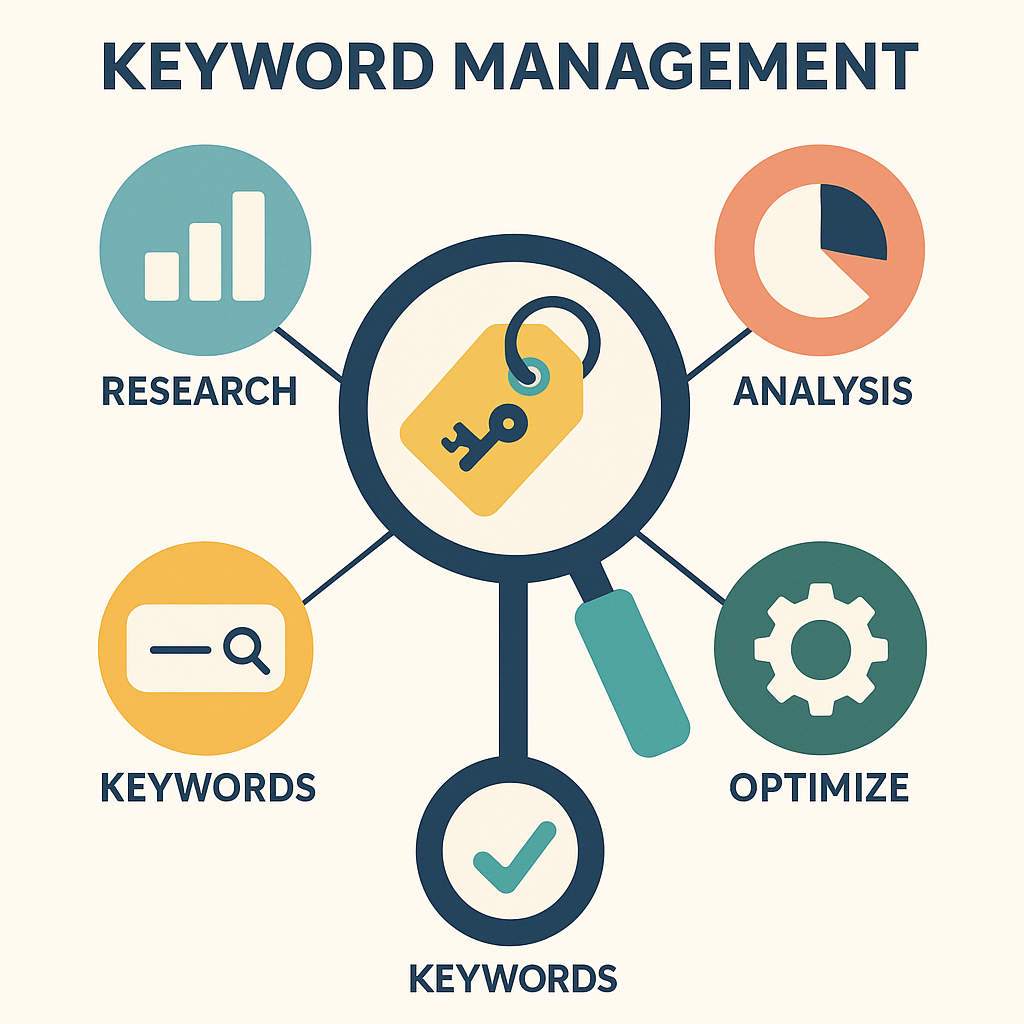
🔑 Week 13: Keyword Management
Discover how to find, organize, and optimize the right keywords for your website and campaigns. Learn how keyword management improves SEO, increases visibility, and drives qualified traffic.
🌟 Introduction
Behind every successful digital marketing campaign is one simple truth — keywords are the bridge between you and your audience. They’re the words people type into search engines when they’re looking for solutions, products, or inspiration.
Keyword management is the art of selecting, organizing, and optimizing those words strategically to boost visibility, attract the right visitors, and convert them into loyal customers. Let’s dive into how mastering keywords can elevate your entire digital presence.
🧠 1. What Is Keyword Management?
Keyword management is the ongoing process of researching, selecting, analyzing, and refining the keywords your business targets in SEO and paid campaigns.
It’s not just about finding words — it’s about understanding intent.
When you manage your keywords effectively, you connect with people who are ready to take action.
Example:
- Someone searching “best running shoes 2025” is ready to buy.
- Someone searching “how to start running” is seeking education.
Both are valuable — but require different strategies.
📈 2. Why Keyword Management Matters
Keywords are the foundation of all digital marketing strategies. They determine how search engines index your content and how your audience finds you.
Here’s why keyword management is vital:
- 🚀 Increases Visibility: Helps your content appear on relevant searches.
- 🎯 Improves Targeting: Reaches the right people with the right message.
- 💰 Maximizes ROI: Ensures your ad spend and SEO efforts focus on profitable terms.
- 🧩 Guides Content Creation: Provides direction for blog posts, videos, and campaigns.
- 📊 Tracks Performance: Allows you to measure and refine strategies based on data.
Without keyword management, you’re shooting in the dark. With it, you’re aiming with precision.
🔍 3. Types of Keywords You Should Know
Understanding the different types of keywords helps you build a balanced strategy:
1. Short-Tail Keywords (Head Terms)
- Example: “Shoes,” “Digital Marketing”
- High volume, high competition, but broad intent.
2. Long-Tail Keywords
- Example: “Best running shoes for women under $100”
- Lower competition, highly specific, and higher conversion rates.
3. LSI (Latent Semantic Indexing) Keywords
- Related terms that help search engines understand context.
- Example: For “email marketing,” related words might be “automation,” “lead nurturing,” or “open rates.”
4. Geo-Targeted Keywords
- Focused on location to attract local customers.
- Example: “Digital marketing agency in Las Vegas.”
5. Branded vs. Non-Branded Keywords
- Branded: “Nike running shoes”
- Non-Branded: “lightweight running shoes”
A strong SEO strategy blends all these types for maximum impact.
⚙️ 4. The Keyword Management Process
Here’s a simple 5-step system to manage your keywords effectively:
Step 1: Research
Use tools like Google Keyword Planner, Ahrefs, or Semrush to find terms people are searching for in your niche.
Step 2: Analyze
Evaluate keywords based on:
- Search Volume
- Competition
- Relevance
- Intent
Step 3: Organize
Group keywords by theme or campaign goal — such as “Product Keywords,” “Educational Keywords,” or “Local Keywords.”
Step 4: Implement
Integrate them naturally into:
- Website copy
- Blog posts
- Product descriptions
- Meta titles and descriptions
- Ad campaigns
Step 5: Monitor & Optimize
Track performance regularly and adjust based on which keywords bring traffic or conversions.
💡 5. Tools for Effective Keyword Management
These tools simplify research and help you stay ahead of your competitors:
- Google Keyword Planner – Free and reliable keyword insights.
- Semrush / Ahrefs – In-depth analytics and keyword tracking.
- Ubersuggest – Great for beginners and content ideas.
- Moz Keyword Explorer – Measures keyword difficulty and opportunity.
- AnswerThePublic – Generates questions and phrases people search for.
Each tool gives you a different layer of insight — together, they form your keyword command center.
📊 6. Common Mistakes to Avoid
❌ Stuffing too many keywords into your content.
❌ Ignoring long-tail and local search terms.
❌ Not tracking performance or revisiting your keyword list.
❌ Using the same keywords for every page.
SEO success is about relevance and strategy, not repetition.
🚀 Conclusion & Call to Action
Keyword management is like tuning an instrument — precision and consistency create harmony. The right words attract the right audience, leading to higher visibility, engagement, and conversions.
👉 This week, perform a keyword audit. Identify 10 new keywords that match your goals, and optimize one existing article or ad around them.
Next week: Week 14 — Google Analytics: Understanding Your Data Like a Pro.
Debe estar conectado para enviar un comentario.