Publicado en Entrepreneurship, Personal Development, Productivity, Self-Improvement, Wealth Mindset

Quitting Too Soon: The Invisible Enemy of Progress

By Marvin Gandis

Many people do not fail because they lack talent. They fail because they quit too soon.

They begin with enthusiasm, but abandon the process when results do not come quickly. They start a project, but become discouraged at the first obstacle. They publish content for a few days, but feel frustrated because nobody responds. They try to sell, learn, save, improve, or start a business, but leave the process before it has time to mature.

In this eighth part of the series “The Reverse Question,” we will reflect on a silent enemy of growth: quitting too soon.

  • This is not about blindly continuing something that does not work.
  • This is not about ignoring real warning signs.
  • This is not about suffering without correction.

It is about understanding that many seeds need time before they show fruit.


The problem with expecting immediate results

We live in a culture of speed.

  • Fast messages.
  • Fast food.
  • Fast videos.
  • Fast shopping.
  • Fast replies.
  • Fast results.

That is why many people bring the same mindset into their goals. They want quick wealth, quick success, quick sales, quick followers, quick change, and quick recognition.

But life does not always work that way.

What is valuable almost always requires a process. Learning a skill takes time. Building trust takes time. Creating an audience takes time. Healing takes time. Organizing finances takes time. Forming discipline takes time.

Impatience can cause a person to abandon the process just when they were beginning to learn.


Quitting too soon can seem logical

Sometimes quitting appears to make sense.

  • “I don’t see results.”
  • “Nobody supports me.”
  • “This is too slow.”
  • “Maybe I am not good at this.”
  • “Others are moving faster.”
  • “I already tried.”
  • “I am not lucky.”

But many times, these phrases appear before the process has had enough time, practice, and correction.

A person may be closer to understanding the path than they realize, but they quit because they confuse slowness with failure.

Not everything slow is dead. Sometimes what is slow is developing roots.


The difference between quitting and correcting

It is important to clarify this: not every decision to stop is a lack of character. There are moments when a person needs to change strategy, adjust a goal, leave something toxic, or recognize that a certain path is not right.

But correcting is not the same as quitting.

Quitting says:
“Nothing works.”

Correcting says:
“What part needs to improve?”

Quitting abandons everything.
Correcting reviews the process.

Quitting is controlled by frustration.
Correcting learns from reality.

A wise person does not insist on error, but they also do not abandon purpose at the first problem.


Comparison speeds up quitting

One of the reasons many people quit is because they constantly compare themselves to others.

They see someone else’s results, but not their years of work. They see their sales, but not their rejections. They see their audience, but not their ignored posts. They see their success, but not their losses, doubts, mistakes, and long hours of effort.

Comparing your beginning with someone else’s advanced result can destroy your motivation.

Comparison makes you feel behind. Clarity reminds you that every process has its own time.

You do not need to copy someone else’s pace. You need to be faithful to the right process for your current stage.


The early stages are almost always quiet

When a person begins something new, often nobody applauds.

  • Nobody comments.
  • Nobody buys.
  • Nobody replies.
  • Nobody congratulates.
  • Nobody seems to notice the effort.

But that does not mean nothing is happening.

In the early stages, you are learning. You are practicing. You are correcting. You are discovering what works and what does not. You are developing endurance. You are forming an identity.

Silence does not always mean failure. Sometimes it means formation.

Many people quit because they want fruit before they have roots.


Consistency produces experience

When a person remains in a process with humility, they begin to gain something that cannot easily be purchased: experience.

  • Experience teaches what to improve.
  • Experience teaches what to avoid.
  • Experience teaches how to communicate better.
  • Experience teaches where to adjust.
  • Experience teaches how to recognize patterns.
  • Experience teaches patience.

The person who quits too soon never accumulates enough experience to improve truly.

Every attempt can teach you something, but only if you do not quit before learning the lesson.


Rejection does not always mean failure

In business, marketing, sales, leadership, and life, rejection is part of the process.

  • A “no” does not always mean you are not capable.
  • A “no” does not always mean your idea is bad.
  • A “no” does not always mean you should quit.

Sometimes it means you need to improve your message, find another audience, explain the value more clearly, practice more, follow up, or wait for the right time.

The person who interprets every rejection as a sentence quits quickly. The person who interprets rejection as information learns and improves.


Discipline sustains what emotion begins

Enthusiasm is useful, but it does not last every day.

At first, there is excitement. There is energy. There is hope. But then normal days arrive: tiredness, doubt, responsibilities, problems, distractions, and lack of replies.

That is where discipline matters.

Discipline does not depend on feeling inspired. Discipline says:

  • “Today I will take the small step in front of me.”
  • “Today I will learn something.”
  • “Today I will correct something.”
  • “Today I will continue even if I do not see everything clearly.”

Emotion can begin the path, but discipline sustains it.


How to avoid quitting too soon

1. Define a minimum commitment period

Before abandoning a goal, decide to work on it for a reasonable period of time.

Do not evaluate everything after three days. Do not declare failure after one week. Do not abandon a serious process without applying it consistently.

Define 30, 60, or 90 days of commitment, depending on the goal.


2. Measure the right kind of progress

Do not measure only final results. Also measure internal progress.

  • Am I learning?
  • Am I becoming more consistent?
  • Am I improving my message?
  • Am I reducing mistakes?
  • Am I creating better habits?
  • Am I understanding the process more clearly?

Sometimes your capacity changes before your results change.


3. Correct one thing at a time

When something does not work, do not change everything out of desperation.

Review one part of the process.

  • The message.
  • The audience.
  • The habit.
  • The offer.
  • The follow-up.
  • The routine.
  • The discipline.
  • The use of time.

Small corrections can create big differences over time.


4. Celebrate small progress

Do not wait for a major victory to recognize progress.

Celebrating a step is not settling. It is emotional fuel.

  • You finished a task.
  • You learned something new.
  • You saved a little.
  • You posted consistently.
  • You made a call.
  • You improved your message.
  • You did not quit.

That also counts.


5. Remember why you started

When the process becomes difficult, purpose must speak louder than frustration.

  • Why did you begin?
  • What life are you trying to build?
  • Who do you want to help?
  • What do you want to change?
  • What future are you trying to protect?

A clear purpose can sustain you when results have not appeared yet.


Remaining does not mean staying the same

Being consistent does not mean repeating the same thing without thinking. True consistency combines perseverance with learning.

  • Remain, but learn.
  • Remain, but measure.
  • Remain, but correct.
  • Remain, but improve.
  • Remain, but listen to reality.

This is not about being stubborn. It is about being faithful to growth.


Conclusion

Quitting too soon can destroy dreams, projects, businesses, habits, and opportunities that were only beginning to grow.

My dear reader or friend, maybe you are not failing. Maybe you are in the stage where you are still learning, planting, and forming roots.

  • Do not confuse silence with defeat.
  • Do not confuse slowness with failure.
  • Do not confuse correction with quitting.
  • Do not confuse tiredness with inability.

Rest if necessary. Correct if necessary. Learn if necessary. But do not abandon a valuable purpose only because you cannot yet see all the fruit.

Many times, the difference between the person who moves forward and the person who remains stuck is not talent, luck, or resources. It is the decision to continue long enough to learn, improve, and grow.

Consistency may not look impressive at first, but over time, it can become one of the most powerful forces in your life.


Disclaimer

This article is for educational, reflective, and informational purposes only. It should not be interpreted as financial, legal, professional, psychological, medical, business, or investment advice. The purpose of this content is to encourage awareness about consistency, patience, discipline, correcting mistakes, and personal growth.

The recommendation not to quit too soon does not mean staying in harmful, abusive, illegal, dangerous, or emotionally destructive situations. Every person should evaluate their reality with wisdom and seek professional help when necessary.

Results in personal projects, business, marketing, finances, professional development, or personal growth can vary depending on each person’s situation, resources, skills, health, support, market, decisions, and consistency. This content does not guarantee income, success, emotional recovery, or specific results.

Before making important decisions related to business, money, emotional health, relationships, work, studies, or life changes, it is recommended to consult qualified professionals.

Publicado en Entrepreneurship, Faith, Mindset, Motivation, Personal Development, Personal Growth

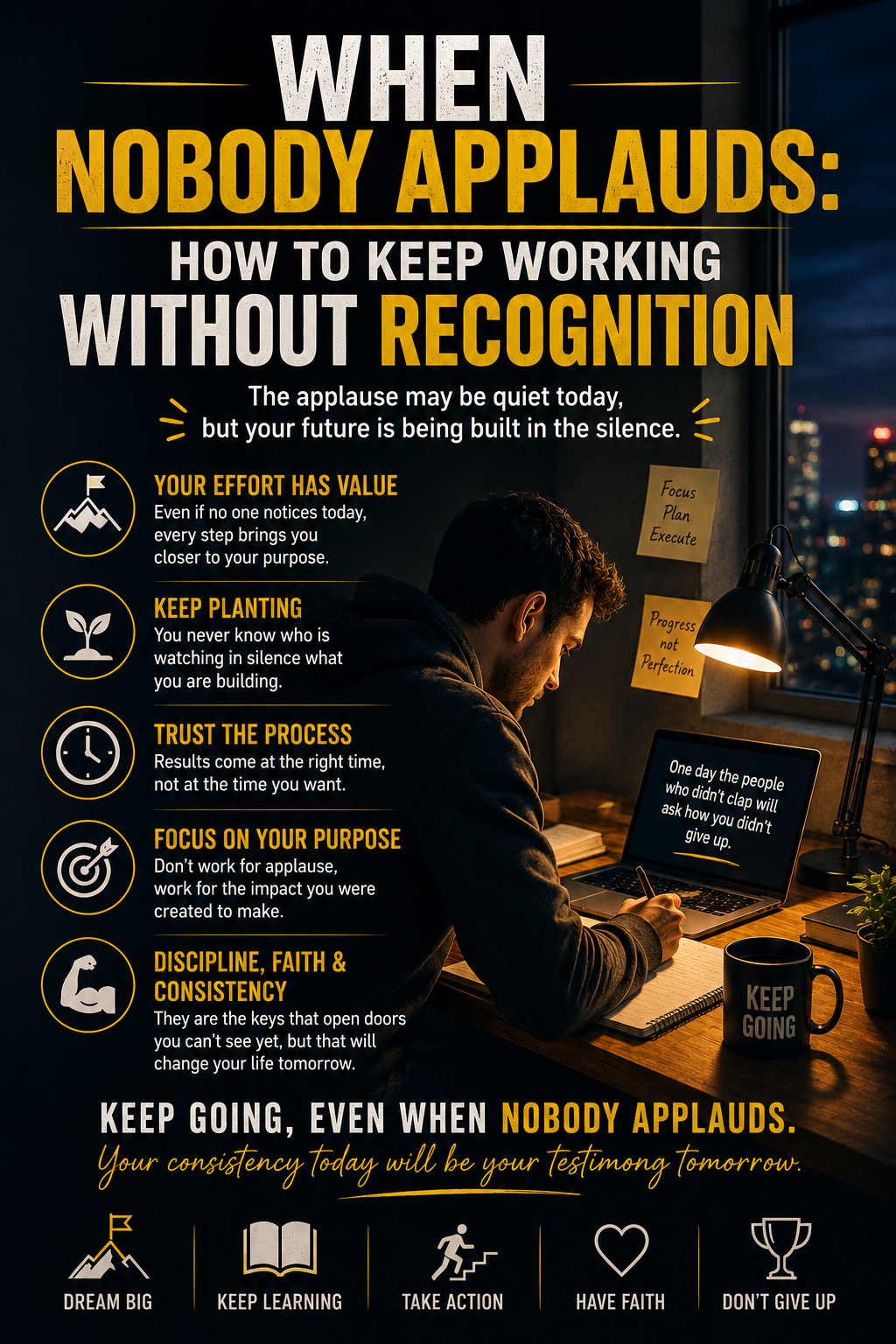
When Nobody Applauds: How to Keep Working Without Recognition

By Marvin Gandis

The Season Almost Nobody Sees

There is a season in life that many people experience, but few admit honestly:

The season where you work, publish, help, learn, try, improve… and still, it feels like nobody notices.

  • No applause.
  • No comments.
  • No recognition.
  • No visible results.
  • No clear signs that anything is working.

Then a quiet question begins to appear:

  • “Is it still worth continuing?”

That question does not always come from laziness. Many times, it comes from exhaustion. It comes from having planted so much without seeing an immediate harvest. It comes from feeling that your effort is hidden, that your voice is not reaching people, and that your work is not producing the impact you expected.

But there is one truth we must remember:

  • The fact that nobody is applauding yet does not mean your effort has no value.

Sometimes, the most important seasons of your life are exactly the ones nobody sees.


Not All Growth Makes Noise

We live in a culture that measures value with visible numbers: likes, comments, sales, followers, visits, applause, recognition, and quick results.

But not all growth can be measured publicly.

  • A seed does not make noise while it grows under the ground.
  • A root does not receive applause while it becomes stronger.
  • Character is not always formed in front of an audience.
  • A vision is not always born on a stage.

Many times, the most valuable things are built in silence.

  • The problem is that we confuse silence with failure.

We think that if nobody responds, we are not moving forward. We think that if nobody comments, nobody is reading. We think that if nobody celebrates, nothing is happening.

But reality may be different.

  • Maybe someone is observing quietly.
  • Maybe someone is learning from your consistency.
  • Maybe someone will return later to content that seems ignored today.
  • Maybe you are developing discipline before receiving visibility.

Not everything unseen is dead. Some things are simply growing in secret.


Recognition Does Not Always Come at the Beginning

One of the most common mistakes is expecting recognition too soon.

We want the world to confirm our value from the beginning. We want quick signs. We want to make every effort to receive an immediate response.

But important things often need time.

  • A good message needs repetition.
  • A brand needs trust.
  • An audience needs familiarity.
  • A relationship needs consistency.
  • A reputation needs proof.

Nobody deeply trusts what they have only just discovered.

That is why, when you are starting or rebuilding your presence, it is normal that not everyone responds immediately.

People observe before they trust.

  • They observe whether you are consistent.
  • They observe whether you truly provide value.
  • They observe whether you only show up when you want to sell.
  • They observe whether your message has depth.
  • They observe whether you intend to serve or only to receive.

Recognition does not always arrive when you want it to. Many times, it comes after you have demonstrated consistency when nobody was watching.


Working Without Applause Reveals Your True Motivation

When nobody applauds, something important is revealed: the reason why you do what you do.

  • If you only work for approval, you will get tired quickly.
  • If you only publish for likes, you will quit when they do not come.
  • If you only serve when you are recognized, you will stop serving when recognition is delayed.
  • If you only build because of emotion, you will stop when the emotion fades.

But when you have purpose, you can continue even without applause.

  • Purpose does not remove tiredness, but it gives it meaning.
  • It does not remove frustration, but it reminds you why you started.
  • It does not remove difficult days, but it helps you avoid making permanent decisions during temporary moments.

Working without applause forces you to ask yourself:

  • “Am I doing this for vanity or for mission?”

That question may be uncomfortable, but it can also purify your path.


Consistency Is More Powerful Than Emotion

Emotion is useful for starting, but it is not enough to sustain you.

You may feel inspired one day and discouraged the next. You may have a week full of ideas and another week with no energy. You may feel confident in the morning and doubtful at night.

That is why you cannot depend only on emotion.

  • You need consistency.

Consistency does not always feel exciting. Sometimes it feels repetitive, slow, and silent. But it is one of the most powerful forces for building real results.

Consistency says:

  • “Today I will do what is right even if I do not feel like it.”
  • “Today I will keep learning even if I do not see immediate results.”
  • “Today I will improve my message even if nobody responded yesterday.”
  • “Today I will plant even if the harvest is not visible yet.”

Consistency turns small actions into great transformations.


Silence Can Also Be Training

Sometimes, silence is not punishment. It is training.

  • Silence teaches you to depend less on external opinion.
  • It teaches you to strengthen your discipline.
  • It teaches you to improve without applause.
  • It teaches you to listen to your purpose.
  • It teaches you to work with humility.

If you received applause too soon, you might build on ego instead of character.

That is why some silent seasons are necessary.

  • Not because they are easy.
  • Not because they do not hurt.
  • Not because they do not make you tired.

But because they form something that recognition cannot always form: depth.

Some people want visibility, but they have not developed stability. They want a platform, but they have not strengthened their character. They want an audience, but they have not learned to serve with patience.

Silence can form the messenger before expanding the message.


Do Not Confuse Little Response with Little Impact

In the digital world, we often believe impact means visible interaction.

But that is not always true.

  • Some people read and do not comment.
  • Some people observe and do not react.
  • Some people keep their words quietly in their hearts.
  • Some people need time to trust.
  • Some people are touched by a message but never tell you.

This does not mean you should ignore metrics. Metrics are useful. They show you what to improve, what to adjust, and what to repeat.

But metrics do not always tell the whole story.

  • A message may have few likes and still deeply touch one person.
  • An article may not go viral and still change a perspective.
  • A post may seem small and still plant an idea that will bear fruit later.

Do not despise what seems small.

Sometimes, one person impacted in the right way is worth more than one hundred distracted people.


Improve, But Do Not Destroy Yourself

When you do not receive recognition, it is wise to review your strategy. But it is not healthy to destroy your identity.

Ask yourself:

  • Is my message clear?
  • Am I speaking to the real pain of my audience?
  • Am I educating or only promoting?
  • Do my titles create interest?
  • Does my content offer practical value?
  • Am I being consistent?
  • Am I building trust before expecting results?

These questions help you improve.

But avoid questions that destroy you:

  • “Maybe I am not good enough?”
  • “Maybe nobody wants to hear me?”
  • “Maybe all my effort is useless?”
  • “Maybe it is too late for me?”
  • You are not your result today.
  • You are not your numbers this week.
  • You are not one post with low engagement.
  • You are not one attempt that did not work.

You can improve your strategy without condemning your values.


Patience Is Not Passivity

Some people confuse patience with doing nothing.

But true patience is not inactivity. True patience is continuing to do what is right while the result matures.

  • Patience is not saying, “I will do nothing.”
  • Patience is saying, “I will keep working with wisdom.”
  • Patience is not waiting without direction.
  • Patience is planting with faith and adjusting with intelligence.
  • Patience is not denying reality.
  • Patience is recognizing that some things take time but are still worth building.

Mature patience does not sit down to complain. Mature patience works, learns, observes, corrects, and continues.


When Nobody Applauds, God Still Sees

For a person of faith, there is a truth that brings peace:

Not everything you do needs to be seen by people to have value before God.

  • There are acts of obedience that nobody celebrates.
  • There are honest efforts that nobody recognizes.
  • There are tears that nobody notices.
  • There are sacrifices that nobody applauds.
  • There are steps of faith that nobody understands.

But God sees.

  • God sees the intention.
  • God sees the perseverance.
  • God sees the tired heart that still chooses to continue.
  • God sees the seed that others ignore.
  • God sees faithfulness in small things.

Sometimes we want people to validate what only God needs to confirm.

This does not mean we should not improve, learn, or seek results. Of course, we should. But our value cannot depend completely on human response.

  • Human approval is variable.
  • Obedience with purpose is deeper.

How to Continue When There Is No Recognition

Here are some practical steps:

Remember why you started

Return to your original purpose. Did you want to help? Educate? Inspire? Build freedom? Serve your family better? Create something useful?

When the result takes time, return to the reason.

Reduce comparison

Excessive comparison can steal your energy. You do not know how many years, mistakes, resources, or processes are behind the person you are watching.

Compare your progress with your previous version, not with someone else’s visible season.

Create a system, not only inspiration

Define schedules, topics, processes, posts, follow-up, and review. When you have a system, you depend less on your mood.

Celebrate small victories

  • A finished article is a victory.
  • A clearer message is a victory.
  • A new lesson learned is a victory.
  • A consistent week is a victory.
  • One touched reader is a victory.

Ask for honest feedback

Not all silence means rejection. Sometimes you need to ask, listen, and adjust.

Wise feedback can become a tool for growth.

Keep planting with intelligence

It is not about repeating without thinking. It is about planting, observing, learning, and improving.

  • Consistency without analysis can exhaust you.
  • Analysis without action can paralyze you.
  • You need both.

Your Invisible Season May Be Your Greatest School

Nobody loves feeling invisible.

But temporary invisibility can teach you things that quick success cannot.

  • It teaches you patience.
  • It teaches you humility.
  • It teaches you discipline.
  • It teaches you focus.
  • It teaches you to improve.
  • It teaches you not to depend on applause.
  • It teaches you to value the process.

The invisible season may feel like a loss, but many times it is preparation.

Because when more visibility comes, you will need character to sustain it.

When more opportunities come, you will need wisdom to manage them.

When more people come, you will need clarity to guide them.

Not every delay is rejection. Sometimes it is preparation.


Keep Going Even If Nobody Applauds Yet

My dear reader and friend, do not allow the lack of applause to make you abandon what can still bear fruit.

  • Maybe today you do not see big results.
  • Maybe today, only a few people respond.
  • Maybe today you feel like you are working in silence.
  • Maybe today you wonder whether anyone notices your effort.
  • But keep growing.
  • Keep learning.
  • Keep improving.
  • Keep serving.
  • Keep planting with wisdom.

Do not work only for applause. Work with purpose.

Because applause may arrive late. It may be small. It may not come in the way you expected. But the character you develop while continuing without recognition can become one of your greatest strengths.

  • When nobody applauds, you can still move forward.
  • When nobody comments, you can still learn.
  • When nobody recognizes you, you can still build.
  • When nobody is watching, you can still be faithful.

And many times, what is built in silence ends up speaking with greater power at the right time.


Disclaimer:


This article is provided for educational, motivational, inspirational, and informational purposes only. It is intended to encourage reflection, personal growth, perseverance, discipline, faith, and responsible decision-making.

The content should not be interpreted as financial, legal, medical, psychological, or professional advice. Any personal development, business, marketing, or success-related examples mentioned are not guarantees of specific results. Individual outcomes may vary depending on effort, consistency, experience, strategy, personal circumstances, market conditions, and other factors beyond our control.

Readers are encouraged to use their own judgment, do their own research, and seek qualified professional guidance when necessary. The purpose of this content is to inspire and educate, not to promise instant results or replace professional advice.