by Marvin Gandis
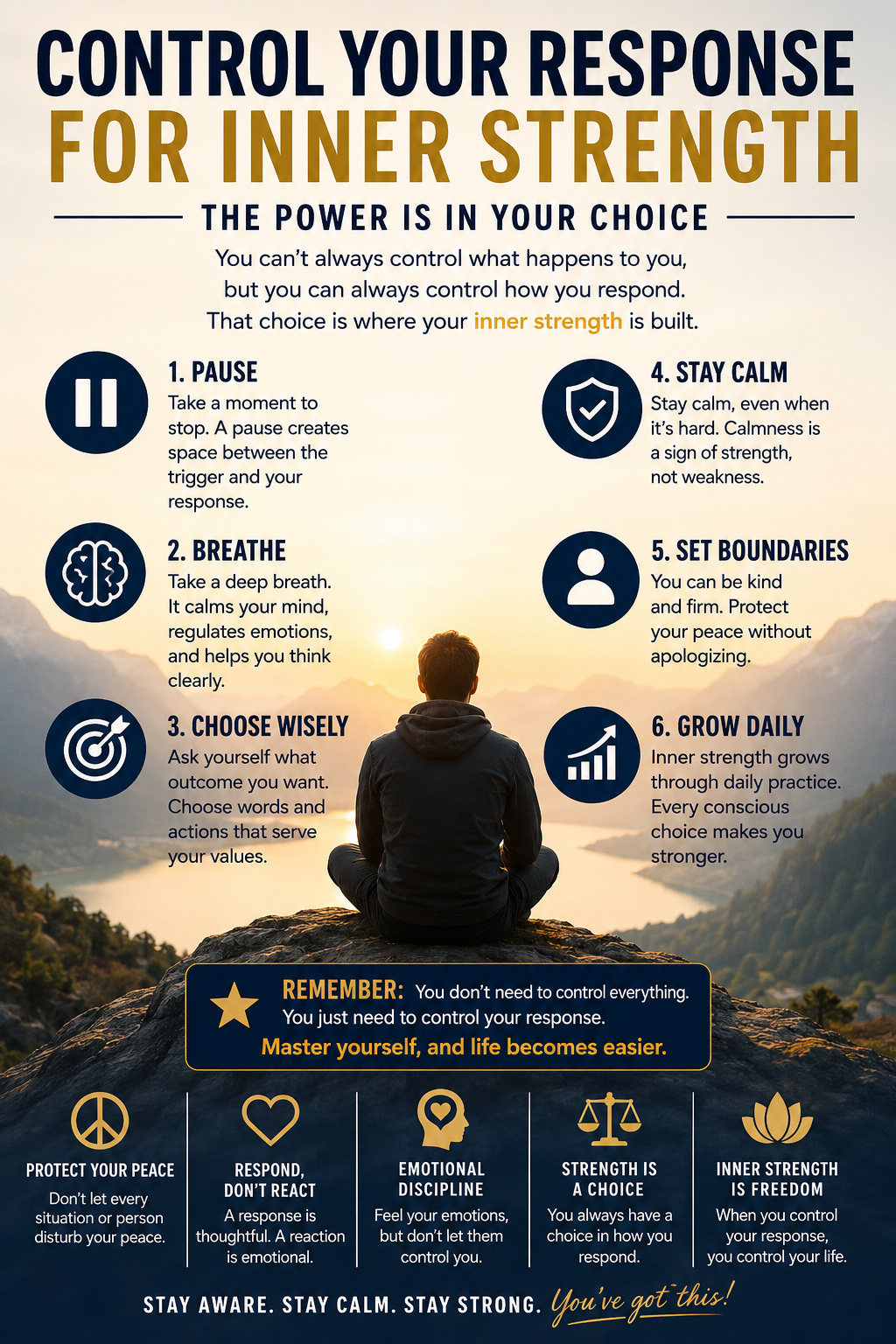
There is a powerful moment between what happens to you and how you respond.
That moment may be small. It may last only a few seconds. But inside that small space lives your strength, your wisdom, your peace, and your personal power.
Many people believe strength means speaking louder, reacting faster, or proving a point immediately. But true inner strength is often quiet. It is the ability to pause when emotions rise. It is the discipline to choose wisdom over impulse. It is the maturity to respond with purpose instead of reacting to pain.
Life will test everyone. People may disappoint you. Situations may change unexpectedly. Plans may fail. Words may hurt. Delays may frustrate you. But even when you cannot control everything around you, you can learn to control the way you respond.
That is where real strength begins.
The Difference Between Reacting and Responding
A reaction is usually emotional, fast, and uncontrolled. It often comes from anger, fear, pride, frustration, or insecurity.
A response is different. A response is chosen. It comes from awareness. It allows you to think, breathe, and decide what kind of person you want to be in that moment.
Reacting says, “I must defend myself right now.”
Responding says, “Let me handle this with wisdom.”
Reacting can damage relationships, create regret, and make a temporary problem worse. Responding can protect your peace, strengthen your character, and help you make better decisions.
You cannot always choose what happens, but you can choose whether your next action comes from weakness or strength.
Inner Strength Begins With the Pause
One of the most powerful habits you can develop is the pause.
Before answering a rude comment, pause.
Before sending an emotional message, pause.
Before deciding while angry, pause.
Before judging someone’s intention, pause.
The pause is not a weakness. The pause is power under control.
When you pause, you give your mind time to catch up with your emotions. You create space between the trigger and your response. In that space, you can ask yourself:
- “Is this worth my peace?”
- “Will my response solve the problem or make it worse?”
- “Am I speaking from wisdom or from wounded pride?”
- “What kind of example do I want to be right now?”
These questions can protect you from unnecessary conflict and emotional regret.
Emotional Control Is Not Emotional Suppression
Controlling your response does not mean pretending you are not hurt. It does not mean ignoring injustice. It does not mean allowing people to disrespect you.
Emotional control means you do not allow your emotions to drive without direction.
You can feel anger without becoming destructive.
You can feel pain without becoming bitter.
You can feel disappointment without losing your dignity.
You can set boundaries without cruelty.
You can speak the truth without losing control.
Real emotional strength is not about being cold or silent. It is about being clear, calm, and intentional.
Why Your Response Reveals Your Character
Anyone can act calm when life is easy. But pressure reveals what has been built inside.
Your response under pressure shows your level of discipline, patience, wisdom, and maturity. When you are provoked and still choose respect, that is strength. When you are misunderstood and still choose peace, that is strength. When you are disappointed and still choose faith, that is strength.
The strongest people are not those who never feel emotion. They are those who do not become slaves to every emotion they feel.
Your response is your signature. It tells the world what controls you.
Does anger control you?
Does fear control you?
Does pride control you?
Or do wisdom, faith, and discipline guide your actions?
The Cost of Uncontrolled Reactions
Uncontrolled reactions can be expensive.
They can cost you peace.
They can damage relationships.
They can close opportunities.
They can create unnecessary enemies.
They can cause you to say words you later wish you could take back.
A moment of reaction can create days, months, or even years of consequences.
This is why self-control is not just a personal virtue. It is a life strategy.
Every time you control your response, you protect your future. You protect your reputation. You protect your emotional energy. You protect the person you are becoming.
How to Control Your Response in Difficult Moments
The first step is awareness. Notice what triggers you. Is it criticism? Rejection? Delay? Disrespect? Feeling ignored? Feeling misunderstood?
When you know your triggers, you can prepare yourself instead of being controlled by surprise.
The second step is breathing. A slow breath can interrupt an emotional reaction. It gives your nervous system a signal that you are safe and do not need to explode.
The third step is choosing your words carefully. Not every thought needs to become a sentence. Not every emotion needs to become an announcement. Not every argument deserves your energy.
The fourth step is asking yourself what outcome you want. Do you want peace? Do you want clarity? Do you want a resolution? Do you want to protect your dignity?
Your response should serve your purpose, not your impulse.
Silence Can Be a Strong Response
Sometimes the strongest response is silence.
Silence does not always mean you have nothing to say. Sometimes it means you have too much wisdom to waste words in the wrong place.
You do not need to attend every argument.
You do not need to correct every misunderstanding.
You do not need to prove yourself to people committed to misjudging you.
Silence can protect your peace. Silence can give you time to think. Silence can prevent emotional damage. Silence can show that you are not controlled by every provocation.
But silence should be used with wisdom. There are moments to speak, and there are moments to step back. Inner strength is knowing the difference.
Boundaries Are Part of Inner Strength
Controlling your response does not mean allowing people to walk over you.
A calm person can still be firm.
A peaceful person can still say no.
A kind person can still create distance.
A mature person can still refuse disrespect.
Boundaries are not anger. Boundaries are clarity.
You can say:
“I need time to think before I answer.”
“I do not want to continue this conversation if it becomes disrespectful.”
“I understand your point, but I do not agree.”
“I choose not to respond in anger.”
“This is not healthy for me, so I need to step away.”
These statements are not weak. They are powerful because they are controlled, clear, and respectful.
Inner Strength Grows Through Daily Practice
Self-control is not built in one day. It is developed through small daily decisions.
Every time you choose patience instead of irritation, you grow stronger.
Every time you choose understanding instead of judgment, you grow stronger.
Every time you choose discipline instead of impulse, you grow stronger.
Every time you choose peace instead of drama, you grow stronger.
Inner strength is like a muscle. It grows through resistance.
The difficult person, the delay, the criticism, the disappointment, and the unexpected problem may all become training grounds for your character.
You do not have to like the test to grow from it.
Choose the Person You Want to Become
Before you respond, remember this:
Your response is not only about the situation. It is also about your identity.
Are you becoming a person of peace?
Are you becoming a person of wisdom?
Are you becoming a person of emotional maturity?
Are you becoming someone who can be trusted under pressure?
Every response is a vote for the person you are becoming.
Do not let temporary emotions make permanent decisions for you. Do not let someone else’s behavior pull you away from your values. Do not give your peace away to every situation that demands a reaction.
You are stronger when you are not easily controlled.
You are wiser when you do not answer everything immediately.
You are freer when your emotions inform you but do not rule you.
Final Reflection
Inner strength is not proven by how forcefully you react. It is proven by how wisely you respond.
Life will continue to bring pressure, conflict, disappointment, and unexpected challenges. But you can train yourself to pause, breathe, think, and choose.
That choice is your power.
Control your response, and you will protect your peace.
Control your response, and you will strengthen your character.
Control your response, and you will discover that real power is not found in controlling others.
Real power is found in mastering yourself.
Today, choose one situation where you normally react quickly
Pause before responding. Breathe. Think. Choose peace, wisdom, and strength.
Your response can become the doorway to your inner freedom.
Disclaimer
This article is for educational and motivational purposes only. It is not professional mental health, medical, legal, or financial advice. If you are dealing with severe emotional distress, trauma, abuse, or a crisis situation, please seek guidance from a qualified professional or trusted support service.
Debe estar conectado para enviar un comentario.