Publicado en Affiliate Marketing, Business Strategy 📊, Digital Marketing,, Email Marketing, Entrepreneurship, Home Business, Lead Generation, Online Business

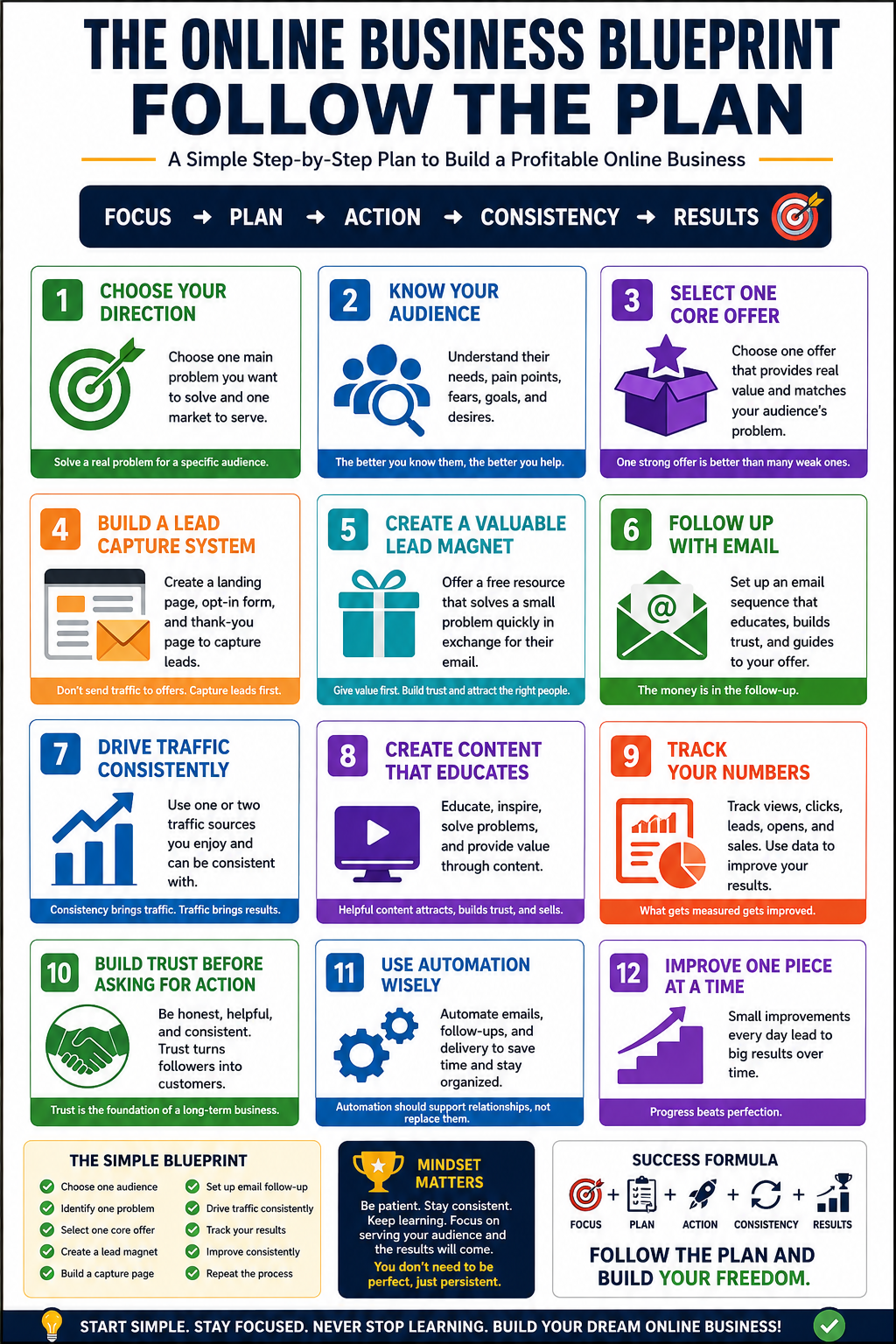
📝 The Online Business Blueprint — Follow the Plan

By Marvin Gandis

Starting an online business can feel exciting, confusing, and overwhelming all at the same time.

  • One day, you hear that you need a website.
  • The next day, someone tells you to start a YouTube channel.
  • Then another person says you need ads, funnels, social media, email marketing, automation, branding, content, traffic, and a dozen other tools.

No wonder many beginners feel lost before they even begin.

But here is the truth: building an online business does not have to be complicated. It becomes complicated when there is no plan.

A real online business is not built by guessing. It is built by following a blueprint.

A blueprint gives you direction. It tells you what to focus on first, what to avoid, what to build, and how to keep moving even when results do not happen immediately.

The purpose of this article is simple: to give you a clear online business blueprint you can follow step by step.

  • No hype.
  • No confusion.
  • No magic buttons.

Just a practical plan.


Why Most People Fail Online

Most people do not fail online because they are lazy. They fail because they are scattered.

They jump from one opportunity to another. They promote too many things at once. They post random links. They buy tools before they understand the strategy. They expect fast results but have no follow-up system.

The internet rewards clarity, consistency, and value.

It does not reward confusion.

Many beginners make the mistake of thinking, “I just need traffic.” But traffic alone is not enough. If people click your link and nothing happens after that click, the traffic is wasted.

A successful online business needs more than attention. It needs a system.

That system should help you:

  • Build trust
  • Capture leads
  • Educate prospects
  • Follow up consistently
  • Recommend helpful solutions
  • Track what works
  • Improve over time

That is the foundation of the online business blueprint.


Step 1: Choose One Main Direction

The first step is focus.

Before you build anything, ask yourself:

What problem do I want to help people solve?

Your online business should not begin with a product. It should begin with a problem.

People buy solutions. They do not buy random offers.

For example, your audience may want to:

  • Protect their files and digital memories
  • Build a home business
  • Generate more leads
  • Learn affiliate marketing
  • Save time with automation
  • Improve their health
  • Make smarter financial decisions
  • Create content faster
  • Start a side income

Once you know the problem, your message becomes clearer.

Instead of saying, “Check this out,” you can say, “Here is a simple way to solve this specific problem.”

That is much more powerful.


Step 2: Identify Your Ideal Audience

You cannot speak to everyone and expect everyone to listen.

A strong online business speaks directly to a specific group of people.

Your audience may be beginners, parents, small business owners, retirees, affiliate marketers, network marketers, bloggers, content creators, or people looking for a side income.

The more clearly you understand your audience, the easier it becomes to create content, write emails, and recommend offers.

Ask yourself:

  • What does my audience want?
  • What are they afraid of?
  • What mistakes are they making?
  • What do they already believe?
  • What solution would make their life easier?
  • What kind of language do they understand?

When you know your audience, your marketing becomes a conversation instead of a sales pitch.


Step 3: Select One Core Offer

One of the biggest beginner mistakes is promoting too many offers at the same time.

When you promote everything, people remember nothing.

Start with one core offer.

This offer should match your audience’s problem and provide a real benefit. It can be an affiliate product, service, software, training, membership, digital product, or your own solution.

A strong offer should be:

  • Easy to understand
  • Connected to a real problem
  • Useful for your audience
  • Reasonably priced or clearly valuable
  • Supported by a simple explanation
  • Easy to recommend ethically

Do not choose an offer only because it pays commissions. Choose something that makes sense for the audience you want to help.

Trust is more valuable than a quick sale.


Step 4: Build a Simple Lead Capture System

Here is a major rule of online business:

Do not send all your traffic directly to a sales page.

Why?

Because most people do not buy the first time they see an offer.

They may be interested but distracted. They may need more information. They may not trust you yet. They may want to compare options. They may simply forget.

That is why you need a lead capture system.

A basic lead capture system includes:

  • A landing page
  • A simple headline
  • A benefit-driven message
  • An email opt-in form
  • A thank-you page
  • A follow-up email sequence

The goal is not just to get a click. The goal is to build a list.

Your email list becomes an asset you control. Social media platforms can change. Ad accounts can be limited. Algorithms can shift. But when someone joins your list, you have a direct way to communicate with them.

That is smart business.


Step 5: Create a Valuable Lead Magnet

A lead magnet is something helpful you offer in exchange for someone’s email address.

It does not have to be complicated.

It can be:

  • A checklist
  • A short guide
  • A free report
  • A video training
  • A resource list
  • A cheat sheet
  • A beginner blueprint
  • A mini email course
  • A simple template

The key is that it must solve a small problem quickly.

For example:

  • “5 Steps to Protect Your Digital Files”
  • “Beginner’s Checklist for Starting an Online Business”
  • “Simple Traffic Plan for New Affiliate Marketers”
  • “Email Follow-Up Template for Beginners”

A good lead magnet attracts the right people and prepares them for your main offer.


Step 6: Follow Up With Email

Most online sales happen after follow-up.

That is why email marketing is one of the most important parts of the blueprint.

A good follow-up sequence should not only sell. It should educate, build trust, answer questions, and guide the reader toward a decision.

Your email sequence can include:

  • Welcome email
  • Problem awareness email
  • Story-based email
  • Educational tip email
  • Common mistakes in email
  • Benefits email
  • FAQ email
  • Invitation email
  • Reminder email

The goal is to help the prospect understand why the solution matters.

Do not pressure people. Guide them.

A strong email makes the reader feel understood.


Step 7: Drive Traffic Consistently

Once your system is ready, you need traffic.

Traffic means people visiting your page, reading your content, seeing your offer, or joining your list.

There are many traffic sources:

  • Facebook
  • YouTube
  • TikTok
  • Pinterest
  • Instagram
  • LinkedIn
  • Blogging
  • SEO
  • Email safelists
  • Paid ads
  • Solo ads
  • Forums
  • Online communities
  • Referral marketing

The best traffic source is not always the most popular one. The best traffic source is the one you can use consistently and improve over time.

Beginners should avoid trying every platform at once.

Choose one or two traffic sources and master them first.

Consistency beats random effort.


Step 8: Create Content That Educates

Content is how people discover you, trust you, and understand what you offer.

Your content should not sound like constant selling.

Instead, create content that helps your audience think differently, solve problems, and take action.

Good content can include:

  • How-to articles
  • Short tips
  • Personal stories
  • Mistake-based lessons
  • Product education
  • Checklists
  • Motivational posts
  • Comparison posts
  • Beginner guides
  • FAQ content

For example, instead of saying, “Buy this tool,” you can write:

  • “Why most beginners lose leads after the first click.”
  • “How to protect your digital files before disaster happens.”
  • “The simple follow-up mistake that costs online marketers sales”
  • “How to start building an email list even as a beginner.”

Educational content attracts better prospects because it creates understanding.

  • Understanding leads to trust.
  • Trust leads to action.

Step 9: Track Your Numbers

An online business grows when you track what is working.

You do not need complicated analytics in the beginning. Start with simple numbers:

  • How many people saw your content?
  • How many clicked your link get?
  • How many joined your list?
  • How many of your emails were opened?
  • How many clicked inside your emails?
  • How many purchased or took the next step?

These numbers tell a story.

If people see your content but do not click, your message may need improvement.

If people click but do not subscribe, your landing page may need improvement.

If people subscribe but do not take action, your emails may need improvement.

Tracking removes guessing.

You cannot improve what you do not measure.


Step 10: Build Trust Before Asking for Action

Trust is the real currency of online business.

People are skeptical online, and they should be. They have seen hype, fake promises, and exaggerated claims.

That is why your job is not to sound louder. Your job is to be more helpful.

Build trust by:

  • Being honest
  • Explaining clearly
  • Avoiding false promises
  • Sharing useful tips
  • Showing consistency
  • Answering questions
  • Respecting your audience
  • Recommending solutions responsibly

When people trust your guidance, they are more likely to click, subscribe, read, reply, and buy.

A business built on trust lasts longer than a business built on hype.


Step 11: Use Automation Wisely

Automation is powerful, but it should not replace human connection.

Use automation to save time, organize leads, deliver emails, and guide people through your system.

You can automate:

  • Welcome emails
  • Follow-up sequences
  • Lead delivery
  • Thank-you pages
  • Reminders
  • Educational content
  • Segmentation
  • Basic customer journeys

But do not become robotic.

People still want to feel like there is a real person behind the message.

Automation should support relationships, not destroy them.


Step 12: Improve One Piece at a Time

Many beginners try to fix everything at once.

That creates frustration.

Instead, improve one piece at a time.

  • Improve your headline.
  • Then improve your landing page.
  • Then improve your first email.
  • Then improve your lead magnet.
  • Then improve your traffic source.
  • Then improve your call to action.

Small improvements create big results over time.

Online business is not about perfection. It is about progress.


The Simple Online Business Blueprint

Here is the plan in simple form:

  1. Choose one audience.
  2. Identify one major problem.
  3. Select one core offer.
  4. Create one lead magnet.
  5. Build one landing page.
  6. Set up one email follow-up sequence.
  7. Drive traffic from one or two sources.
  8. Track your results.
  9. Improve consistently.
  10. Repeat the process.

That is the blueprint.

Simple does not mean easy. But simple is powerful.


Common Mistakes to Avoid

  • Avoid promoting too many offers at once.
  • Avoid sending traffic directly to sales pages without capturing leads.
  • Avoid copying everyone else without understanding your own audience.
  • Avoid quitting too early.
  • Avoid making unrealistic income claims.
  • Avoid ignoring follow-up.
  • Avoid focusing only on tools instead of strategy.
  • Avoid treating people like numbers.

Every mistake teaches something, but you do not have to make every mistake yourself.

Learn, adjust, and continue.


The Mindset Behind the Blueprint

A successful online business requires patience.

You are not just building pages, emails, and links. You are building skills.

  • You are learning how to communicate.
  • You are learning how to solve problems.
  • You are learning how to attract attention.
  • You are learning how to build trust.
  • You are learning how to guide people toward decisions.

At first, it may feel slow. But every article, every email, every test, and every conversation makes you better.

The people who win online are not always the smartest. They are usually the ones who stay consistent long enough to improve.


The online world is full of distractions, but success becomes easier when you follow a clear plan.

  • You do not need to chase every shiny object.
  • You do not need to promote every product.
  • You do not need to be everywhere at once.

You need a blueprint.

Start with one audience. Solve one problem. Build one system. Follow up. Track results. Improve.

That is how you build smarter.

The online business blueprint is not about doing everything.

It is about doing the right things in the right order.

Follow the plan.


If You Are Serious About Building An Online Business, Start By Creating Your Foundation Today

Choose your audience. Pick your offer. Build your lead capture system. Start your follow-up sequence. Then drive traffic consistently.

Do not wait for everything to be perfect.

Start simple.
Start focused.
Start with the blueprint.


Affiliate & Educational Disclaimer

This article is for educational and informational purposes only. It does not guarantee income, sales, business growth, or specific results. Any tools, platforms, or business opportunities mentioned should be reviewed carefully before making a decision. If affiliate links are used, the publisher may receive a commission at no additional cost to the reader. Always do your own research and make decisions based on your goals, budget, experience, and personal circumstances.
Publicado en Affiliate Marketing, Beginner Business Tips, Digital Marketing, Email Marketing, Home Business, Lead Generation, Online Business, Traffic Generation

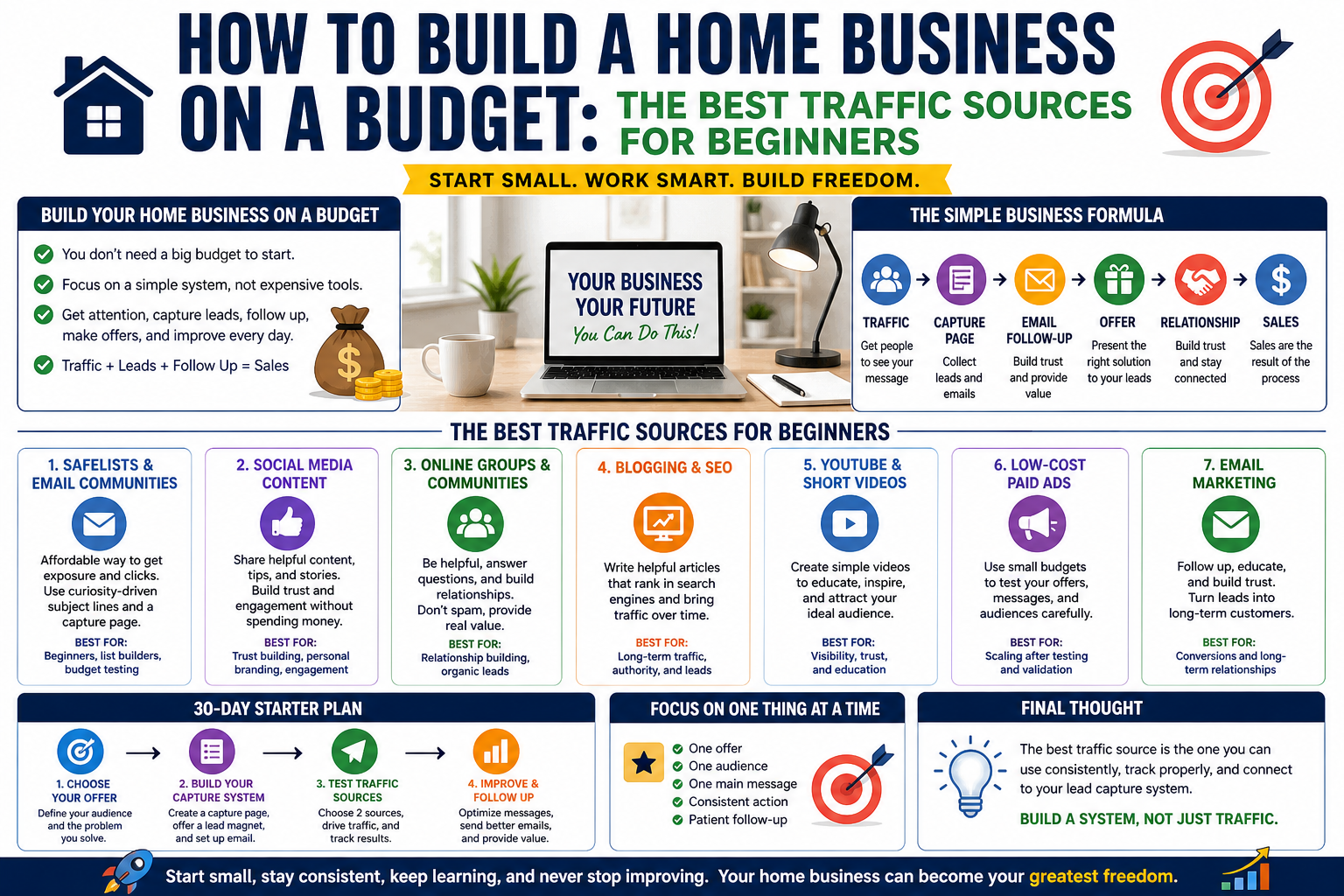
How to Build a Home Business on a Budget: The Best Traffic Sources for Beginners

By Marvin Gandis

Starting a home business sounds exciting, but for many beginners, the first big question is simple:

“How can I build a real business if I don’t have a big budget?”

The second question usually comes right after:

“Where do I get traffic?”

These are smart questions because traffic is the lifeblood of any online business. Without traffic, nobody sees your offer. Without leads, there is nobody to follow up with. Without follow-up, most people never buy.

But here is the good news: you do not need a massive budget to start building momentum. What you need is a simple system, a clear message, and the right traffic source for your stage of business.

A home business does not fail because someone starts small. Many fail because they spend money in the wrong places before they understand the basics.


The Truth About Starting on a Budget

Starting on a budget is not a weakness. In many cases, it is an advantage.

Why?

Because a small budget forces you to become strategic. You learn how to test, track, write better messages, build relationships, and avoid waste.

Many beginners make the mistake of thinking they need:

  • A fancy website.
  • Expensive software.
  • A massive ad budget.
  • Professional branding.
  • A huge social media following.
  • Perfect videos.
  • A complicated funnel.

Those things may help later, but they are not where most beginners should start.

At the beginning, your focus should be simple:

Get attention. Capture leads. Follow up. Make offers. Improve daily.

That is the real foundation of a home business.


Why Traffic Alone Is Not Enough

Many people ask, “What is the best traffic source?”

But the better question is:

“What happens after someone clicks?”

Traffic without a system is like pouring water into a bucket with holes.

You may get visitors, but if you are not capturing their information, following up, and building trust, most of that traffic disappears forever.

That is why every beginner should understand this principle:

Do not send traffic directly to a sales page if you are not also building your list.

A capture page, also called a lead capture page or opt-in page, allows you to collect a name and email address before sending people to your offer.

That means even if they do not buy today, you can continue educating, helping, and following up.

That is where long-term growth begins.


The Simple Home Business Formula

A budget-friendly home business does not need to be complicated.

Here is the simple formula:

Traffic → Capture Page → Email Follow-Up → Offer → Relationship → Sales

Let’s break it down.

1. Traffic

Traffic means people seeing your message. This can come from social media, safelists, solo ads, search engines, blogs, videos, paid ads, or communities.

2. Capture Page

This is where you invite people to subscribe, request information, watch a presentation, download a guide, or learn more.

3. Email Follow-Up

Most people do not buy the first time they see an offer. Email gives you a chance to educate them over time.

4. Offer

This is the product, service, tool, affiliate program, or business opportunity you promote.

5. Relationship

People buy when they trust the message, understand the value, and feel the solution is right for them.

6. Sales

Sales are the result of the process. They are not the beginning of the process.


What Makes a Good Traffic Source for Beginners?

Not all traffic sources are equal.

A good traffic source for a beginner should be:

  • Affordable.
  • Easy to test.
  • Simple to understand.
  • Consistent.
  • Trackable.
  • Relevant to your offer.
  • Friendly to list building.

The best traffic source is not always the one with the most visitors. The best traffic source is the one that helps you build a targeted audience and learn what message gets a response.


The Best Traffic Sources for a Budget Home Business

1. Email Safelists and List-Building Communities

Safelists are often misunderstood, but for beginners on a budget, they can be useful when used correctly.

A safelist is a community where members can send promotional emails to other members. Many people join because they are interested in online business, affiliate marketing, traffic, leads, and income opportunities.

The advantage is simple: you can get exposure without spending a lot of money.

However, the key is not to blast random hype. The key is to use curiosity-based subject lines, short messages, and a capture page.

Example subject lines:

  • “Still trying to build your business without leads?”
  • “The missing step after the click”
  • “Traffic is not the problem — follow-up is”
  • “A simple way to start smarter online”

Safelists work best when your message is short, direct, and curiosity-driven.

Best for: beginners, affiliate marketers, list builders, and budget testing.


2. Social Media Content

Social media can be free, but it requires consistency.

Platforms like Facebook, LinkedIn, Instagram, TikTok, Pinterest, and YouTube Shorts can help you attract attention without paying for ads.

The mistake many beginners make is posting only links.

Instead, educate first.

Post about:

  • Common beginner mistakes.
  • Simple business lessons.
  • Traffic tips.
  • Lead generation.
  • Productivity.
  • Mindset.
  • Personal stories.
  • Helpful tools.
  • Questions that create engagement.

For example:

“Most beginners do not have a traffic problem. They have a follow-up problem. If someone clicks your link and disappears forever, your system is leaking.”

That kind of post teaches, creates curiosity, and opens the door for conversation.

Best for: trust building, personal branding, community engagement.


3. Facebook Groups and Online Communities

Online communities can be powerful if you use them correctly.

The goal is not to spam links. The goal is to become helpful.

Join groups related to:

  • Home business.
  • Affiliate marketing.
  • Digital marketing.
  • Entrepreneurship.
  • Email marketing.
  • Small business.
  • Side hustles.
  • Online income.

Then answer questions, share insights, and provide value.

When people see you as helpful, they are more likely to check your profile, ask questions, and request more information.

Your profile should clearly explain what you help people with.

Example:

“I help beginners learn how to build simple online systems using traffic, leads, and follow-up.”

Best for: relationship building and organic lead generation.


4. Blogging and SEO

Blogging is not the fastest traffic source, but it can become one of the most valuable long-term assets.

Why?

Because a blog post can keep working for you after you publish it.

A good blog article can educate readers, rank in search engines, and direct people to your lead capture page.

Topics you can write about include:

  • How to start a home business on a budget.
  • Best traffic sources for beginners.
  • Why email follow-up matters.
  • How to avoid wasting traffic.
  • How to choose an affiliate program.
  • How to build an online business step by step.

Blogging is especially powerful when combined with email marketing. The article attracts attention. The lead magnet captures the reader. The email sequence builds the relationship.

Best for: long-term authority and search traffic.


5. YouTube and Short Videos

Video is powerful because people connect with faces, voices, and stories.

But even if you do not want to be on camera, you can still use video.

You can create:

  • Screen-recorded tutorials.
  • Faceless educational videos.
  • Quote videos.
  • Slide-style videos.
  • Product explainers.
  • Short tips.
  • Voiceover videos.

For beginners, short videos can be a simple way to test messages.

Example video topic:

“Why will more traffic not fix a broken funnel?”

Another one:

“The first thing every home business beginner should build.”

Your video does not need to be perfect. It needs to be helpful.

Best for: trust, education, and visibility.


6. Low-Cost Paid Ads

Paid ads can work, but beginners must be careful.

Many people lose money because they run ads before they have a tested offer, a capture page, and an email follow-up sequence.

Before spending money on ads, ask:

  • Do I know who my audience is?
  • Do I have a clear message?
  • Do I have a capture page?
  • Do I have an email follow-up sequence?
  • Am I tracking clicks and conversions?
  • Do I know my numbers?

If the answer is no, start with small tests.

Paid traffic can be useful, but it should be treated like testing, not gambling.

Best for: scaling after your message and funnel are working.


7. Email Marketing

Email marketing is not just a traffic source. It is also a follow-up machine.

This is where many beginners miss the opportunity.

They work hard to get a click, but they do not build a list. That means they must start from zero every day.

With email marketing, one lead can receive multiple messages over time.

Your emails can:

  • Educate.
  • Build trust.
  • Answer objections.
  • Share stories.
  • Invite action.
  • Promote offers.
  • Announce webinars.
  • Deliver value.

A simple 5-email follow-up sequence can make a major difference.

Example sequence:

Email 1: Welcome and explain the main problem.
Email 2: Teach why most beginners fail.
Email 3: Share the importance of traffic and follow-up.
Email 4: Introduce the solution.
Email 5: Invite them to take action.

Best for: converting traffic into long-term relationships.


So, What Is the Best Traffic Source?

For beginners on a budget, the best traffic source is usually the one that lets you test quickly, learn cheaply, and build your list.

That means the strongest beginner strategy is not one single traffic source.

It is this:

Use low-cost traffic sources to send people to a capture page, then follow up by email.

For example:

  • Safelists → Capture Page → Email Follow-Up
  • Facebook Posts → Capture Page → Email Follow-Up
  • Blog Article → Capture Page → Email Follow-Up
  • Short Video → Capture Page → Email Follow-Up
  • Online Community → Profile → Capture Page → Email Follow-Up

The real power is not just traffic.

The real power is turning traffic into leads.


The Biggest Mistake Beginners Make

The biggest mistake is promoting too many things too soon.

A beginner may join five or ten programs and start posting links everywhere. But without a clear message, people get confused.

Instead, focus on one main offer, one main audience, and one main message.

Ask yourself:

  • Who am I helping?
  • What problem do they have?
  • What solution am I offering?
  • Why should they trust this message?
  • What should they do next?

Clarity beats complexity.


Budget Home Business Starter Plan

Here is a simple 30-day plan.

Week 1: Choose Your Offer and Audience

  • Pick one main offer.
  • Define who it helps.
  • Write down the main problem it solves.
  • Create a simple benefit-driven message.

Week 2: Build Your Capture System

  • Create a simple capture page.
  • Offer a free guide, checklist, video, or presentation.
  • Connect it to your email autoresponder.
  • Write a short welcome email.

Week 3: Start Testing Traffic

Choose two traffic sources only.

For example:

  • Safelists and Facebook.
  • Blogging and Pinterest.
  • Short videos and LinkedIn.
  • Groups and email communities.

Track your clicks, leads, and responses.

Week 4: Improve and Follow Up

  • Review which messages got clicks.
  • Improve your subject lines.
  • Write better follow-up emails.
  • Post educational content daily.
  • Invite people to take the next step.

The goal is not perfection. The goal is progress.


What to Promote When You Are Starting on a Budget

A beginner should look for offers that are:

  • Easy to explain.
  • Affordable.
  • Useful to a broad audience.
  • Connected to a real need.
  • Supported by good follow-up materials.
  • Suitable for recurring income or long-term value.

Digital tools, email marketing platforms, lead generation tools, cloud backup services, traffic tools, and educational programs can work well because they solve business or personal problems.

The best offer is one you can explain with confidence and promote consistently.


Start With the System, Not Just the Link

Before you spend more money on traffic, build the system that catches the traffic.

Because traffic without follow-up is a wasted opportunity.

If you are ready to build smarter, start with a simple capture page, a short email follow-up sequence, and one traffic source you can test consistently.

Your goal is not to chase every opportunity. Your goal is to build a simple machine that turns attention into leads, leads into conversations, and conversations into sales.


Building a home business on a budget is possible, but it requires discipline.

  • You do not need to be everywhere.
  • You do not need to buy every tool.
  • You do not need to master every platform.
  • You do not need a perfect website.

You need a clear offer, a simple system, consistent traffic, and patient follow-up.

The best traffic source is the one you can use consistently, track properly, and connect to your lead capture system.

Start small. Test daily. Follow up faithfully. Improve your message.

That is how a budget home business becomes a real online asset.


Disclaimer

This article is for educational and informational purposes only. It does not guarantee income, business success, or specific results. Any business opportunity, affiliate program, traffic source, or marketing strategy requires effort, testing, consistency, and personal responsibility. Results vary depending on skills, audience, offer, follow-up, budget, and market conditions. Always review any platform, program, or service before investing time or money.