
Publicado en Addiction Prevention, Entertainment, Financial Education, Las Vegas, Personal Wellness, Responsible Gambling, Travel and Tourism

Casino Games and Slot Machines in Las Vegas: Entertainment, Responsibility, and Addiction Prevention

By Marvin Gandis

Las Vegas is known around the world for its shows, hotels, restaurants, lights, and casinos. For many visitors, entering a casino and trying a slot machine, card table, or roulette wheel is part of the tourist experience.

However, enjoying gambling requires understanding one essential truth: casino gambling should be treated as entertainment—not as a way to earn income, pay debts, or solve financial problems.

A visitor may win during an individual session. That same person may also lose money quickly. No system, ritual, schedule, favorite number, or betting pattern can guarantee consistent results in games primarily governed by chance.

The safest way to approach the experience is with accurate information, firm limits, and a responsible attitude.


What Is Gambling?

Gambling is an activity in which someone risks money or something of value in the hope of receiving a prize.

The outcome may depend:

  • Entirely on chance.
  • On a combination of chance and player decisions.
  • On mathematical rules that favor the operator over time.

Common Las Vegas games include:

  • Slot machines.
  • Video poker.
  • Roulette.
  • Blackjack.
  • Baccarat.
  • Craps.
  • Poker.
  • Keno.
  • Sports betting.
  • Electronic table games.

Some games allow meaningful decisions, but no casino game eliminates the possibility of losing.


How Do Slot Machines Work?

Modern slot machines use electronic systems to generate outcomes within the programmed rules of each game.

Every spin represents a new event. Previous results do not force the machine to award a prize on the next spin.

A machine is not required to pay because:

  • It has gone a long time without awarding a bonus.
  • Another player lost a large amount.
  • It recently paid a jackpot.
  • It appears to be “hot.”
  • Its meters or graphics look nearly complete.
  • The player changed the bet.
  • Someone just left the machine.

Lights, sounds, animations, and celebrations make the experience exciting. However, a visual celebration does not always represent a profitable result.

For example, if a player wagers two dollars and receives eighty cents, the machine awarded a prize, but the player still lost one dollar and twenty cents on that spin.

Players should therefore watch their total balance rather than responding only to the machine’s sights and sounds.


The House Advantage

Casinos operate as businesses. Their games are designed so that, after a very large number of wagers, the casino retains a mathematical advantage.

This does not mean that every player loses during every visit. Some visitors win during individual sessions, and a small number may receive substantial prizes.

It means that the game’s long-term mathematical structure favors the casino.

Playing longer does not guarantee that a player will recover previous losses. In fact, additional play creates more exposure to the house advantage.


Understanding Return to Player

Some casino games have a theoretical percentage known as return to player, or RTP.

RTP represents a statistical average calculated over an extremely large number of wagers. It is not a promise to an individual player or a prediction for one particular session.

A theoretical return of 90 percent does not mean that a visitor who wagers $100 will receive exactly $90.

During a short session, that player could:

  • Lose the entire budget.
  • Recover part of it.
  • Finish close to even.
  • Win more than was wagered.
  • Receive an unusually large prize.

RTP describes long-term mathematical behavior—not what will happen that evening.


Entertainment Versus Income Expectations

Responsible gambling begins by accepting that the money being used may be lost.

A show ticket, special dinner, or attraction has a cost. In the same way, a casino budget should be viewed as the cost of an entertainment experience.

A visitor should not enter the casino thinking:

  • “I need to recover what I lost.”
  • “I will pay my bills with a jackpot.”
  • “This will solve my debt.”
  • “Today has to be my lucky day.”
  • “I will continue until I win.”
  • “I can turn gambling into dependable income.”

When gambling changes from recreation into an economic or emotional necessity, the risk of harm increases.


A Responsible Gambling Plan for Visitors

Before entering a casino, prepare a simple plan.

1. Set a Budget

The gambling budget should be an amount that can be lost without affecting:

  • Rent or mortgage payments.
  • Food.
  • Utilities.
  • Medication.
  • Travel expenses.
  • Car payments.
  • Credit cards.
  • Emergency savings.
  • Family responsibilities.

Entertainment money must remain completely separate from essential money.

2. Carry a Limited Amount

Bringing only the planned cash can reduce impulsive decisions.

A visitor may also choose to limit access to:

  • ATMs.
  • Credit cards.
  • Cash advances.
  • Banking applications.
  • Additional money stored in the hotel room.

3. Establish a Loss Limit

A visitor does not have to lose the entire budget before ending the session.

Someone who brings $100 might decide to stop when the balance reaches $50.

The limit should be established before play begins—not during a losing streak.

4. Establish a Time Limit

Casino environments may make it difficult to notice how long someone has been playing.

Setting an alarm can help. A session might be limited to:

  • Twenty minutes.
  • Thirty minutes.
  • Forty-five minutes.
  • One hour.

Taking breaks provides an opportunity to review the balance and regain perspective.

5. Decide What to Do After Winning

A player should decide in advance what will happen if the balance increases.

For example:

  • Recover the original money.
  • Save part of the profit.
  • Leave after reaching a specific amount.
  • Continue only with a small portion of the winnings.

A profit can disappear quickly when someone keeps playing without a limit.


Choosing a Reasonable Bet

A responsible wager should provide enough rounds of play without consuming the budget too quickly.

With $100:

  • A 50-cent wager allows up to 200 theoretical spins.
  • A $1 wager allows up to 100.
  • A $2.50 wager allows only 40.
  • A $5 wager allows only 20.

These figures do not account for prizes received during play, but they show how bet size affects the lifespan of the budget.

A larger wager may create larger potential prizes, but it can also end the session within minutes.


Common Visitor Mistakes

Betting Too Much Immediately

The excitement of arriving in Las Vegas may lead a visitor to start with wagers that are too large.

Beginning slowly makes it easier to understand the game and its true cost.

Chasing Losses

Chasing losses means continuing or increasing bets in an attempt to recover lost money.

This behavior can turn a manageable loss into a much larger one.

Believing a Machine Is Ready to Pay

Statements such as “it is almost ready,” “it is due,” or “it has to pay soon” express emotional expectations, not mathematical guarantees.

Constantly Changing the Bet

Raising and lowering the wager because of superstition does not provide control over the outcome. It only changes how quickly the budget may disappear.

Gambling While Intoxicated

Alcohol can impair judgment, increase impulsivity, and make limits harder to follow.

Ignoring the True Cost

Some machines display credits rather than dollars. Before playing, check:

  • The denomination.
  • The number of lines.
  • The total wager.
  • The cost per spin.
  • Any bonus or jackpot requirements.

Giving Back Every Winning Dollar

Winning and continuing until everything is lost is a common experience.

Knowing when to leave is part of responsible gambling.


When Does Gambling Stop Being Entertainment?

Gambling may become a problem when it begins producing financial, personal, emotional, family, or employment difficulties.

The American Psychiatric Association describes gambling disorder as repeated, problematic gambling behavior that a person has difficulty controlling, even when it causes significant consequences.

Possible warning signs include:

  • Thinking about gambling constantly.
  • Spending more than planned.
  • Gambling longer than intended.
  • Needing larger wagers to experience the same excitement.
  • Feeling restless or irritable when trying to stop.
  • Repeatedly attempting to reduce gambling without success.
  • Gambling to escape sadness, worry, or stress.
  • Returning to recover losses.
  • Lying about gambling time or spending.
  • Hiding statements, withdrawals, or debts.
  • Neglecting work, family, or responsibilities.
  • Borrowing money to continue gambling.
  • Using funds needed for basic expenses.
  • Experiencing guilt, shame, or desperation afterward.

One isolated behavior does not establish a diagnosis, but several repeated signs are a reason to stop and seek qualified support.


The Dangerous Desire to Win It Back

One of the most harmful gambling thoughts is the belief that the next wager will repair the previous loss.

A person may think:

“I lost $100, but if I continue a little longer, I can recover it.”

After losing another $100, the person may conclude:

“Now I need an even larger prize.”

This creates a cycle in which every loss becomes another reason to continue.

The healthiest response after reaching a limit is not to recover the money. It is to stop the loss.


Gambling as an Escape

Some people begin gambling not primarily for entertainment but as temporary relief from:

  • Stress.
  • Loneliness.
  • Depression.
  • Anxiety.
  • Family conflict.
  • Financial pressure.
  • Grief.
  • Boredom.
  • Feelings of failure.

Gambling may provide temporary distraction, but it does not resolve the source of the distress. When it becomes an emotional escape, controlling the behavior can become increasingly difficult.

Speaking with someone trustworthy and obtaining professional support are healthier responses.


Practical Protective Measures

Visitors who want to reduce risk can:

  • Gamble only with cash.
  • Avoid credit.
  • Refuse to gamble while emotionally distressed.
  • Limit alcohol consumption.
  • Use time alarms.
  • Track money entering and leaving the machine.
  • Take breaks away from the gaming floor.
  • Avoid gambling alone when concerned about control.
  • Share the budget with a travel companion.
  • Include shows, meals, walking, sightseeing, and other activities in the trip.
  • Avoid spending more merely to earn casino rewards.
  • Ask about self-exclusion programs when necessary.
  • Seek support as soon as control begins to weaken.

A Simple Pre-Gambling Checklist

Before making the first wager, ask:

  1. Can I afford to lose all of this money?
  2. Have I established a loss limit?
  3. Do I know the cost of every wager?
  4. Have I chosen a time to leave?
  5. Am I gambling for entertainment?
  6. Am I sober and thinking clearly?
  7. Can I leave without recovering a loss?
  8. Can I leave after winning?
  9. Am I hiding this activity from anyone?
  10. Am I using money that I need?

When an answer creates concern, the safest decision may be not to gamble.


What to Do When Control Is Slipping

Recognizing a problem is not a sign of weakness. It is an act of responsibility.

Problem gambling is treatable, and resources are available for both gamblers and their families. The Nevada Council on Problem Gambling provides education, referrals, and access to Nevada support services; it also notes that many services may be available at no cost to affected individuals and family members.

The National Problem Gambling Helpline connects people with support, information, and local services. It can currently be reached by calling or texting 1-800-MY-RESET.

Visitors and Nevada residents may also consult the Nevada Council on Problem Gambling for current treatment and support resources.

Anyone experiencing an immediate emotional crisis or thoughts of self-harm in the United States should call or text 988.


Advice for Families and Travel Companions

When someone displays concerning behavior, respectful conversation is usually more helpful than accusation.

A person might say:

“I have noticed that you are spending more time and money gambling, and I am concerned about how it is affecting you. I want to help you find support.”

Family members should avoid:

  • Lending money for additional gambling.
  • Repeatedly paying losses without protective conditions.
  • Lying to shield the person.
  • Arguing while the person is actively gambling.
  • Treating the problem as a simple failure of willpower.
  • Waiting for an extreme crisis before seeking help.

Families and loved ones may also benefit from professional guidance.


Las Vegas Offers More Than Gambling

A balanced Las Vegas trip does not have to revolve entirely around casinos.

The city and surrounding region also offer:

  • Live entertainment.
  • Museums.
  • Restaurants.
  • Shopping.
  • Pools.
  • Art.
  • Music.
  • Tours.
  • Family attractions.
  • Themed architecture.
  • Cultural experiences.
  • Parks and nearby natural scenery.

Planning activities outside the casino reduces exposure to gambling and helps preserve the true purpose of the visit: enjoyment.


Conclusion

Casino games and slot machines may be part of an enjoyable Las Vegas visit when approached with information, limits, and self-control.

A responsible visitor understands that:

  • Gambling is not an investment.
  • No prize is guaranteed.
  • Losses do not have to be recovered.
  • Betting more does not change the chance in the player’s favor.
  • Essential money must remain protected.
  • Leaving at the right time matters more than pursuing another prize.
  • Asking for help early can prevent more serious consequences.

A successful visit should not be measured by how much money was wagered. It should be measured by whether the visitor enjoyed the experience without sacrificing peace of mind, relationships, emotional health, or financial security.

Gambling should remain entertainment. When it stops being fun, it is time to stop and seek support.

Enjoy Las Vegas responsibly. Set your limits before you play, and remember that knowing when to stop is part of a positive experience.


Educational and Responsible Gambling Disclaimer

This article is provided for educational and informational purposes only. It does not promote gambling, guarantee prizes, or provide financial, medical, psychological, or legal advice.

Gambling involves a real risk of financial loss. It should be limited to adults who meet the applicable legal age and should involve only money specifically reserved for entertainment.

When gambling causes financial, emotional, family, or employment problems, stop and seek professional help. In the United States, call or text the National Problem Gambling Helpline at 1-800-MY-RESET. During an immediate emotional crisis, call or text 988.

Publicado en Entrepreneurship, Financial Education, Growth Mindset, Leadership, Personal Development, Personal Finance, Productivity, Success Habits

The Real Formula for Building Wealth

Mindset, Value, Discipline, and Systems

«Wealth is not built through luck or overnight success. It is built through small decisions repeated with wisdom, discipline, and purpose.»

As we reach the end of this series, one thing should be clear.

This series was never about discovering a secret shortcut to becoming wealthy.

We did not promise overnight success.

We did not promote miracle investments.

We did not encourage chasing the latest trend.

Instead, we focused on something much more valuable.

We explored the habits, decisions, and principles that gradually shape a person’s future.

We began by asking an unusual question:

Why do so many people remain financially and personally stuck for years?

That question led us to an important realization.

Poverty often begins in the mind long before it appears in a bank account.

We examined the dangers of spending everything we earn.

We learned the difference between consuming and producing.

We discovered that blaming others often keeps us from taking responsibility for our own future.

We discussed continuous learning, discipline, perseverance, financial patience, and the importance of building systems instead of relying on motivation alone.

Each article represented one piece of a much larger picture.

Now it is time to bring those pieces together.

Not to reveal a magical formula.

But to understand that lasting wealth is built upon timeless principles that anyone can begin applying today.

Wealth Begins Long Before Money

Money matters.

It allows us to care for our families, invest in opportunities, support meaningful causes, and serve others more effectively.

But money rarely creates character.

More often, it reveals the character that already exists.

This explains why some people earn more yet never experience lasting financial stability.

If our habits remain unchanged, our results usually remain unchanged as well.

Lasting prosperity begins when the person changes.

When thinking changes.

When decisions improve.

When habits become stronger.

And when we learn to manage wisely what we already have before expecting more.

Pillar One: Mindset

Every lasting structure requires a strong foundation.

In life, that foundation is mindset.

People with a growth mindset understand that there is always something new to learn.

They do not view failure as a permanent identity.

They see it as valuable feedback.

Instead of waiting for perfect circumstances, they begin with the resources they already have while continuing to grow.

A healthy mindset asks better questions.

Instead of asking:

«Why is this happening to me?»

It asks:

«What can I learn from this experience?»

Instead of saying:

«I can’t do this.»

It asks:

«What skill do I need to develop?»

Better questions often lead to better decisions.

And better decisions build a better future.

Pillar Two: Value

One of the greatest lessons in this series is simple:

Money follows value.

People pay for solutions.

They pay for trust.

They pay for knowledge.

They pay for convenience.

They pay for expertise.

They pay for problems being solved.

Every profession creates value differently.

A teacher educates.

A farmer feeds people.

A doctor protects health.

An engineer improves systems.

An entrepreneur develops solutions.

The most important question is no longer:

«How can I make more money?»

It becomes:

«How can I create more value for others?»

As your value grows, your opportunities often grow as well.

Pillar Three: Discipline

Everyone experiences good days.

Everyone experiences difficult days.

The difference rarely lies in emotions.

The difference lies in discipline.

Discipline means doing what is right even when motivation fades.

Reading consistently.

Learning continuously.

Saving regularly.

Keeping your word.

Working with excellence.

Taking care of your health.

Managing your time wisely.

None of these actions seems extraordinary by itself.

Yet repeated over months and years, they produce extraordinary results.

Discipline transforms good intentions into daily habits.

And habits eventually shape character.

Pillar Four: Systems

Many people depend entirely on memory.

Others depend on motivation.

Successful people build systems.

A monthly budget.

A morning routine.

A learning schedule.

A savings plan.

A customer follow-up process.

A weekly review of goals.

Systems reduce confusion.

They simplify good decision-making.

They make progress sustainable.

Goals tell you where you want to go.

Systems help you get there.

Principles That Strengthen the Four Pillars

Throughout this series, we also explored several supporting principles that reinforce these four pillars.

Continuous Learning

Knowledge expands opportunities.

Every book.

Every course.

Every meaningful conversation.

Every life experience.

Each one can become an investment in your future.

Never stop learning.

Personal Responsibility

We cannot control every circumstance.

But we can control many of our responses.

Responsibility gives us back the power to act.

Financial Patience

Strong financial foundations take time.

Wise investments grow gradually.

Healthy habits produce long-term results.

Patience protects us from making impulsive decisions.

Perseverance

There will be seasons when progress seems invisible.

Do not confuse delayed results with failure.

Roots grow before fruit appears.

Stay faithful to the process.

Self-Control

Modern culture rewards immediate gratification.

Real success often requires delayed gratification.

The ability to sacrifice a temporary pleasure for a greater future remains one of the most valuable skills anyone can develop.

A Better Definition of Wealth

Perhaps the greatest lesson of this series is that wealth is far more than money.

A truly wealthy person develops:

  • Integrity
  • Wisdom
  • Good health
  • Strong relationships
  • The ability to serve others
  • Knowledge
  • Responsible freedom
  • Inner peace
  • A meaningful purpose

Money is an important tool.

Character determines how that tool will be used.

Real prosperity always begins on the inside before it becomes visible on the outside.

A Practical Place to Begin

You do not need to change your entire life this week.

Start small.

Read for twenty minutes each day.

Learn a new skill.

Create a simple budget.

Save consistently.

Organize your priorities.

Spend time with people who inspire growth.

Serve others with excellence.

Honor your commitments.

Review your goals regularly.

Learn from your mistakes.

Celebrate steady progress.

Great achievements are often the result of many small, wise decisions made consistently over time.

Wealth Is Meant to Be Shared

Prosperity reaches its highest purpose when it benefits others.

Share what you know.

Encourage those who are just beginning.

Mentor someone.

Strengthen your family.

Serve your community.

Build people, not just profits.

The greatest legacy rarely appears on a financial statement.

It is reflected in the lives we influence, encourage, and help transform.

Final Reflection

My dear reader,

We have reached the end of this series.

But I sincerely hope this is not the end of your growth.

By now, you know there is no magical formula.

There is a way of living.

A mindset that keeps learning.

A heart willing to serve.

A discipline that remains steady.

And systems that support long-term progress.

You may not control everything that happens around you.

But you will always have the opportunity to choose your response.

One wise decision can change a habit.

One habit can transform a year.

One year can change a life.

And one transformed life can positively influence countless others.

Never underestimate the power of today’s right decision.

Most extraordinary stories do not begin with extraordinary events.

They begin with ordinary people who choose wisdom, perseverance, responsibility, and integrity day after day.

Thank you for joining me throughout this journey.

I hope these articles have done more than expand your knowledge.

I hope they have strengthened your character, renewed your hope, and inspired you to continue growing.

Always remember:

True wealth does not necessarily belong to the person who owns the most. It belongs to the person who wisely manages what they have, creates value for others, and builds a legacy founded on principles that endure.

May this not be the end of your story.

May it be the beginning of a life built on solid foundations.

Because the greatest wealth you will ever possess is the person you become while building everything else.


Disclaimer

This article is provided for educational and informational purposes only. The ideas, principles, and examples presented are intended to encourage personal growth, financial education, leadership, and responsible decision-making.

Nothing in this article should be interpreted as financial, legal, tax, accounting, investment, or professional advice. Every individual has unique circumstances, goals, and risk tolerance. Before making financial or business decisions, readers should carefully evaluate their situation and, when appropriate, seek guidance from a qualified professional.

While the principles discussed are based on widely recognized concepts of personal development, value creation, discipline, and responsible stewardship, no specific results are guaranteed. Success depends on many factors, including individual decisions, consistent effort, experience, market conditions, and circumstances beyond the author’s control.

References to companies, products, services, or brands are included solely for educational or illustrative purposes and should not be interpreted as endorsements unless explicitly stated.

Readers are encouraged to think critically, continue learning, and apply only those principles that are appropriate to their personal and professional circumstances.

Copyright © 2026 Marvin Gandis. All rights reserved.

Publicado en Financial Education, Personal Development, Personal Finance, Self-Improvement, Wealth Mindset

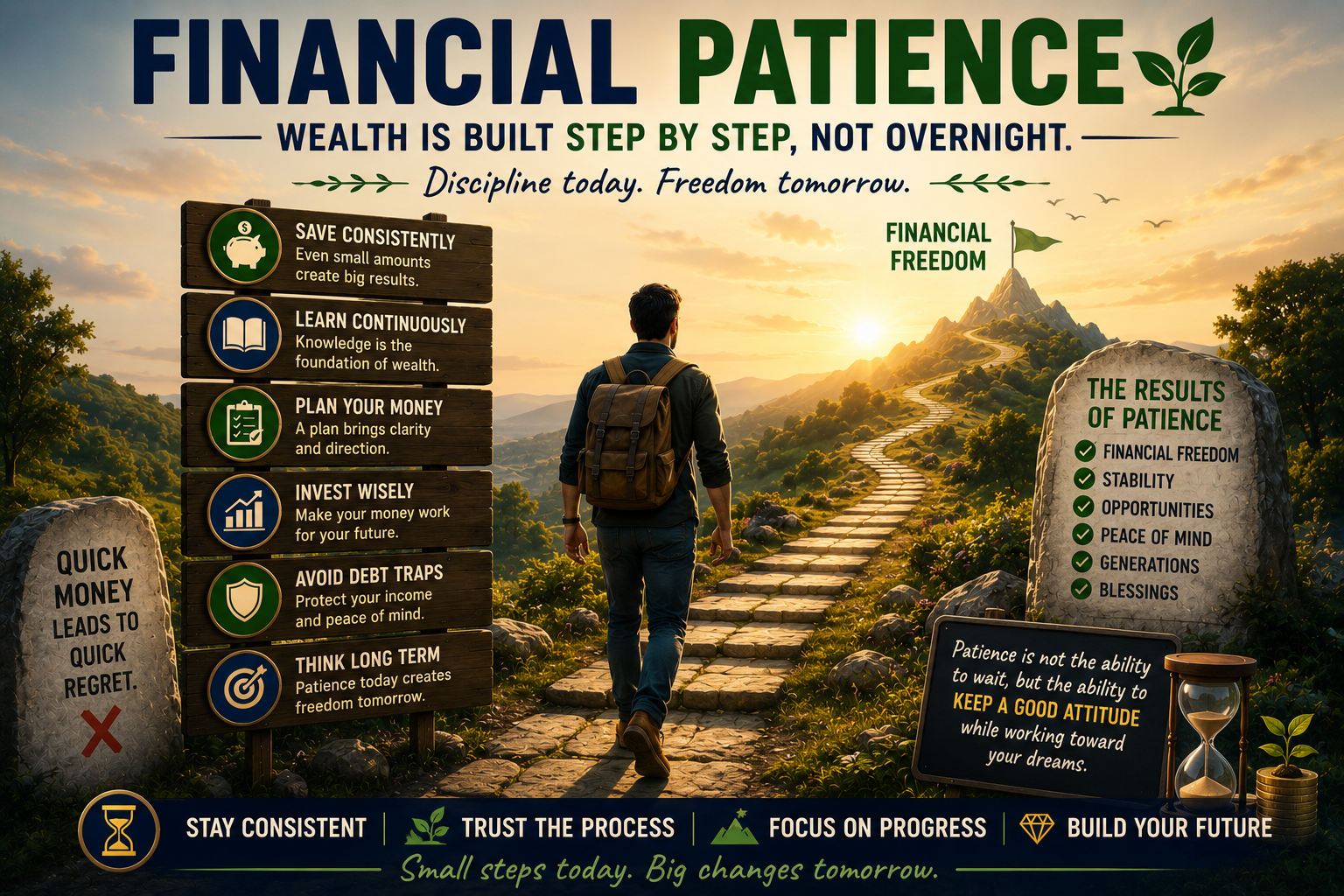
Financial Patience: Building Wealth Without Desperation

By Marvin Gandis

One of the reasons many people make poor financial decisions is desperation.

  • They want quick results.
  • They want immediate money.
  • They want to get out of debt overnight.
  • They want to build wealth without a process.
  • They want to change their lives without waiting, planting, or developing discipline.

But solid wealth rarely comes from desperation. It comes from patience, education, order, consistency, and decisions repeated with wisdom.

In this eleventh part of the series “The Reverse Question,” we will reflect on the importance of financial patience.

  • Not as an excuse to remain inactive.
  • Not as conformity.
  • Not as passivity.

But as a way to build with vision, without allowing anxiety to control our decisions.


Desperation can be expensive

When a person is desperate, they can make decisions that seem good in the moment but create more pain later.

  • They can fall into unnecessary debt.
  • They can invest in false promises.
  • They can buy programs without understanding them.
  • They can abandon a correct process too soon.
  • They can constantly switch opportunities.
  • They can spend out of anxiety.
  • They can sell under pressure.
  • They can accept agreements that are not good for them.

Desperation reduces clarity.

When a person feels they must solve everything immediately, they may lose the ability to analyze, compare, ask questions, wait, and decide with wisdom.

That is why financial patience is not a weakness. It is protection.


Solid wealth needs time

Many people want a harvest without a season of planting.

But life works by principles.

  • First, you learn.
  • First, you organize.
  • First, you plant.
  • First, you practice.
  • First, you correct.
  • First, you remain consistent.

Then, with time, fruit may appear.

True wealth is not built only through one big opportunity. It is built through small repeated habits: saving, learning, investing carefully, reducing debt, creating value, working consistently, and improving money management.

Small actions, repeated with discipline, can become large over time.


Patience does not mean standing still

Some people confuse patience with doing nothing.

But financial patience is not sitting around waiting for life to change. It is acting consistently while results mature.

  • Patience is saving, even if it is a little.
  • Patience is learning, even if you do not see income yet.
  • Patience is paying off debt little by little.
  • Patience is building a business without quitting at the first obstacle.
  • Patience is improving a skill before demanding major results.
  • Patience is reviewing your numbers even when they are uncomfortable.
  • Patience is saying “no” to expenses that destroy your future.
  • True patience is active.
  • It does not quit.
  • It does not rush without thinking.
  • It does not abandon the process because of anxiety.

The long-term mindset

A person with a long-term mindset understands that not every decision must produce an immediate reward.

  • Sometimes saving today protects tomorrow.
  • Sometimes studying today opens doors later.
  • Sometimes investing in a skill today produces income years later.
  • Sometimes rejecting an expense today avoids future debt.
  • Sometimes planting content today builds trust over time.

The short-term mindset asks:

“What can I get now?”

The long-term mindset asks:

“What am I building for tomorrow?”

That difference changes the way a person spends, works, learns, invests, and decides.


The danger of quick money

The desire for quick money can lead to many traps.

Not every opportunity is bad. Not every business is false. Not every tool is useless. But when a person looks for quick money without education, analysis, and patience, they become vulnerable.

  • They may believe any promise.
  • They may trust anyone.
  • They may invest without research.
  • They may go into debt because of emotion.
  • They may chase magical formulas.
  • They may ignore warning signs.

Quick money often attracts quick decisions. And quick decisions, without wisdom, can be expensive.

Before entering an opportunity, a person should ask:

  • Do I understand how this works?
  • Am I making this decision out of anxiety?
  • Can I handle the risk?
  • Have I researched enough?
  • Does this build something real or only promise excitement?
  • Am I looking for a solution or escaping my frustration?

Patience protects your habits

When a person is impatient, they abandon healthy habits because they do not see immediate results.

  • They stop saving because the savings seem small.
  • They stop learning because they do not see quick income.
  • They stop posting because nobody responds at first.
  • They stop investing in themselves because visible changes are slow.
  • They stop budgeting because debts still exist.
  • They stop building because the process feels slow.

But many valuable things begin small.

  • A small saving can become an emergency fund.
  • A small lesson can become a skill.
  • A small improvement can become confidence.
  • A small daily action can become a transformation.

Patience protects what is small until it grows.


Discipline defeats anxiety

Financial anxiety can cause a person to live in reaction mode.

  • They react to bills.
  • They react to debt.
  • They react to emergencies.
  • They react to pressure.
  • They react to fear.
  • They react to what others say.

Discipline helps recover direction.

  • A budget reduces confusion.
  • A debt plan reduces fear.
  • An emergency fund reduces vulnerability.
  • A learning routine increases ability.
  • A follow-up system improves results.
  • A daily action plan reduces improvisation.

Discipline does not eliminate every problem, but it reduces disorder.

And where there is less disorder, there is more peace to make decisions.


Building wealth without comparing yourself

Comparison destroys patience.

  • You see someone buying a house, and you feel left behind.
  • You see someone showing a business, and you feel like a failure.
  • You see someone traveling, and you feel your life is not moving.
  • You see someone appearing successful, and you pressure yourself to run.

But you do not always know the full story behind others.

  • You do not know their debts.
  • You do not know their sacrifices.
  • You do not know their years of process.
  • You do not know their mistakes.
  • You do not know their family reality.
  • You do not know what is behind the image.

Comparing yourself with others can lead you to make decisions to impress, not to build.

Your process needs patience, not constant competition.


Practical steps to develop financial patience

1. Define realistic goals

Do not only say: “I want to be rich.”

Define clear goals:

  • Save a specific amount.
  • Reduce a debt.
  • Create an emergency fund.
  • Learn a skill.
  • Increase income gradually.
  • Organize expenses.
  • Invest in education.
  • Build a long-term project.

Clear goals help reduce anxiety.


2. Divide the process into stages

Not everything has to be solved today.

  • First organize.
  • Then reduce unnecessary expenses.
  • Then create a margin.
  • Then save.
  • Then pay debt strategically.
  • Then learn more.
  • Then invest carefully.
  • Then build new sources of value.

Patience grows when you understand that the path has stages.


3. Celebrate small progress

Do not wait until the end to recognize advancement.

  • If you saved something, you moved forward.
  • If you paid a debt, you moved forward.
  • If you learned a skill, you moved forward.
  • If you avoided an impulsive purchase, you moved forward.
  • If you reviewed your numbers, you moved forward.
  • If you made a wise decision, you moved forward.

Small progress also deserves respect.


4. Learn before investing

Never allow pressure to lead you into investing in something you do not understand.

Before putting in money, invest time in learning.

  • Research.
  • Ask questions.
  • Compare.
  • Read.
  • Consult.
  • Analyze risks.
  • Review whether the opportunity is realistic.
  • Do not confuse emotion with evidence.

Patience before investing can prevent pain later.


5. Build habits, not only desires

Wanting wealth is not enough.

You need habits.

  • A habit of saving.
  • A habit of learning.
  • A habit of measuring.
  • A habit of reducing debt.
  • A habit of creating value.
  • A habit of following up.
  • A habit of reviewing results.
  • A habit of correcting.
  • A habit of continuing.

Desires inspire, but habits build.


Financial patience can also require faith

For many people, building with patience also requires faith.

  • Faith to keep planting when fruit is not visible yet.
  • Faith to correct without quitting.
  • Faith to learn even when it is uncomfortable.
  • Faith to manage a little with wisdom before receiving more.
  • Faith to believe that a life can change step by step.

Faith does not remove responsibility. It strengthens it.

Because mature faith does not only wait. It also works, learns, serves, manages, and perseveres.


Conclusion

Financial patience is not passivity. It is discipline with vision.

It is the ability to build without desperation, decide without anxiety, learn before acting, save before spending, correct before quitting, and think about the future before sacrificing it for an emotion in the present.

My dear reader or friend, do not allow desperation to steal your wisdom. Not everything has to be solved today. Not every fruit appears quickly. Not every seed shows results immediately.

But if you continue learning, managing, correcting, creating value, and walking with consistency, you can begin to build a more stable life.

Solid wealth is not improvised.

  • It is planned.
  • It is learned.
  • It is managed.
  • It is planted.
  • It is protected.
  • It is built.

And many times, it is built slowly, until one day the results begin to show that patience was not wasted time, but preparation.


Disclaimer

This article is for educational, reflective, and informational purposes only. It should not be interpreted as financial, legal, accounting, professional, business, or investment advice. The purpose of this content is to encourage awareness about financial patience, discipline, saving, planning, financial education, and responsible decision-making.

Every person has a different financial reality. Income, expenses, debt, family responsibilities, opportunities, risks, resources, and results can vary widely. Financial patience may help support better decisions, but it does not guarantee wealth, income, business success, profitable investments, or specific results.

Before making important decisions related to money, debt, investments, business, budgeting, career, or personal finances, it is recommended to consult qualified professionals.

The information shared is intended to inspire reflection, preparation, and responsible action.