Saltar al contenido
  • Inicio
  • Política de privacidad
  • No Vender Ni Compartir Mi Información Personal
  • 📘 Digital Marketing 18-Week Series
  • 🌍 El Nuevo Orden Económico
  • 📘 MAGNETIC MARKETING
  • 📘 Educational Article Series: From Zero to Your First 5 Digital Enrollments in 30 Days
  • 🔥MOMENTUM — Build the Life You Want One Powerful Day at a Time

Ir de Compras Online

No tiene que Ser una Pesadilla.

Etiqueta: email follow-up

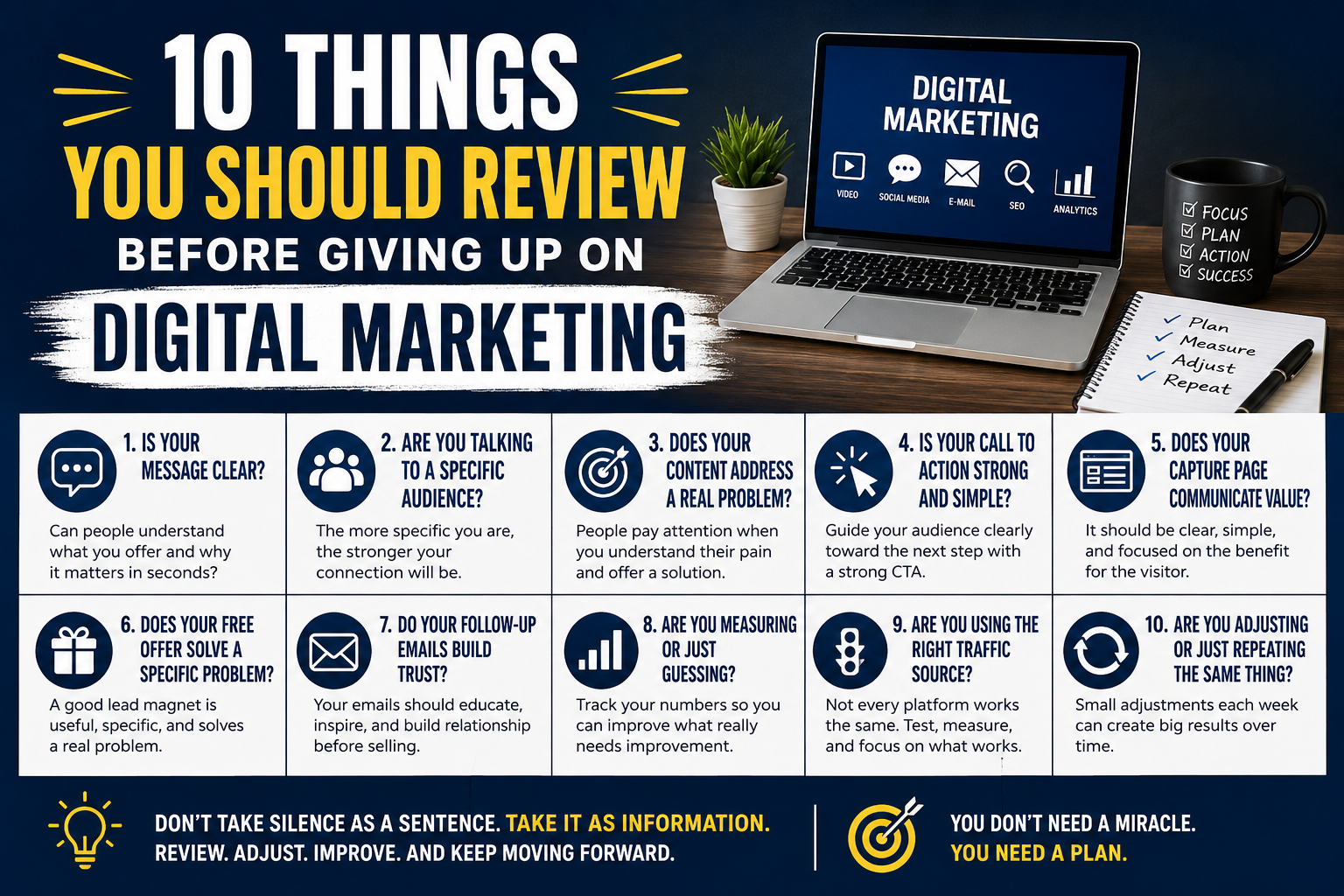
Digital marketing infographic showing a laptop, checklist, icons, and ten key areas to review before giving up, including message clarity, audience targeting, CTA, capture page, follow-up emails, metrics, traffic, and strategy.
Publicado en Affiliate Marketing, Content Strategy, Digital Marketing, Email Marketing, Entrepreneur Mindset, Lead Generation, Online Business, Traffic Generation

10 Things You Should Review Before Giving Up on Digital Marketing

Publicado el mayo 29, 2026mayo 28, 2026 por Marvin Gandis

By Marvin Gandis

Before you quit digital marketing, review your message, audience, content, capture page, follow-up, traffic, and strategy with clarity.

There comes a moment in digital marketing when frustration becomes heavy.

  • You post.
  • You write.
  • You promote.
  • You create capture pages.
  • You prepare follow-up emails.
  • You share good offers.
  • You stay active.

And still, the results seem small, slow, or completely invisible.

You may start asking yourself painful questions:

  • “Am I bad at this?”
  • “Why does nobody see my content?”
  • “Why are others getting results faster than I?”
  • “Should I just give up?”

But before you make a permanent decision from a temporary season of discouragement, pause.

  • Many times, the problem is not you.
  • The problem may be one part of your system that needs adjustment.

Digital marketing is not just about posting more. It is about building a system that connects the right message with the right audience, through the right content, with the right follow-up and traffic strategy.

Before giving up, review these 10 important areas.


1. Is Your Message Clear?

A confused message creates confused visitors.

If someone lands on your post, email, or capture page, they should understand quickly:

  • What are you offering?
  • Who is it for?
  • What problem does it solve?
  • Why should they care?
  • What should they do next?

Many marketers lose attention because their message is too broad.

They say things like:

  • “I have a great opportunity.”
  • “This can help you make money online.”
  • “Check this out.”

Those phrases are too general. They do not tell the reader why the message matters to them personally.

A stronger message sounds like this:

“If you are posting every day but getting no clicks, this guide will help you review your message, capture page, and follow-up strategy.”

That message speaks to a specific person with a specific problem.

Ask yourself:

Can a person understand in less than five seconds what I offer and why it matters?

Review:

  • Your headline.
  • Your opening line.
  • Your main promise.
  • Your main benefit.
  • Your call to action.

Clarity is not optional. It is the foundation of conversion.


2. Are You Speaking to a Specific Audience?

When you try to speak to everybody, your message often connects with nobody.

Digital marketing becomes more powerful when you know exactly who you are trying to help.

Are you speaking to:

  • Beginner entrepreneurs?
  • Affiliate marketers without results?
  • Small business owners?
  • People who post but get no clicks?
  • People who want to generate leads?
  • People who need better email follow-up?
  • People who feel overwhelmed online?

Each audience has different fears, goals, questions, and objections.

For example, a beginner does not need the same message as an advanced marketer. A person struggling with traffic does not need the same message as someone struggling with follow-up.

When your audience is specific, your content becomes stronger.

Ask yourself:

Does my content speak directly to one type of person?

Example:

Instead of saying:

“This is for anyone who wants success online.”

Say:

“This is for digital entrepreneurs who are posting consistently but not getting enough clicks, leads, or conversations.”

Specificity creates connection.


3. Does Your Content Address a Real Problem?

People do not pay attention just because you have something to say.

They pay attention when they feel understood.

Your content should connect with real frustrations, such as:

  • “I post, and nobody responds.”
  • “I have good offers, but nobody clicks.”
  • “I do not know how to generate leads.”
  • “My capture pages are not converting.”
  • “I do not understand traffic.”
  • “I feel invisible online.”

If your content only talks about your product, opportunity, or tool, people may ignore it.

But if your content starts with their pain, they may stop and listen.

Weak opening:

“Here is a great digital marketing tool.”

Stronger opening:

“If you are tired of posting every day and still getting no response, the problem may not be your effort. It may be your message.”

That speaks to the reader’s experience.

Ask yourself:

Does my content begin with the reader’s problem or only with my product?

Content that connects begins with empathy.


4. Is Your Call to Action Strong and Simple?

A call to action is the bridge between attention and results.

If you create content but do not tell people what to do next, many will simply move on.

Avoid weak CTAs like:

  • “Click here.”
  • “Check this out.”
  • “More info.”
  • “Let me know.”

Those are not terrible, but they are often not specific enough.

Try stronger CTAs:

  • Download the free checklist.
  • Comment “INFO” and I will send you the details.
  • Start with this 30-day plan.
  • Click here to review your strategy.
  • Get the free resource now.

Your CTA should be clear, direct, and connected to a benefit.

Ask yourself:

Am I guiding the reader toward the next step?

A good CTA does not pressure people. It helps them know what to do.


5. Does Your Capture Page Communicate Value Quickly?

Your capture page has one main job:

Turn visitors into subscribers.

To do that, it must communicate value quickly.

Your page should answer three questions:

  • What will I receive?
  • Why do I need it?
  • What should I do now?

If your capture page is confusing, too long, too vague, or visually weak, people may leave without subscribing.

A strong capture page usually includes:

  • A clear headline.
  • A benefit-driven subtitle.
  • An attractive image.
  • A simple form.
  • A visible button.
  • A privacy message.
  • A specific promise.

Weak headline:

“Free Marketing Guide.”

Stronger headline:

“Download the 30-Day Plan to Stop Feeling Invisible Online.”

The second headline feels more specific, emotional, and useful.

Ask yourself:

Does my capture page quickly show the value of subscribing?

Remember: people do not subscribe because you have a form. They subscribe because they see value.


6. Does Your Free Offer Solve a Specific Problem?

Your lead magnet should not feel generic.

A strong free resource helps the reader solve a specific problem or move one step closer to a desired result.

Instead of offering:

“Digital Marketing Tips”

offer something more focused:

“10 Things You Should Review Before Giving Up on Digital Marketing.”

or

“The 30-Day Plan to Stop Feeling Invisible Online.”

These titles connect with a specific emotional situation.

A good lead magnet should have:

  • A clear problem.
  • A desired result.
  • An emotional title.
  • A practical benefit.
  • A realistic promise.

Ask yourself:

Does my free resource solve a clear problem?

If the lead magnet feels valuable, people are more likely to subscribe.


7. Do Your Follow-Up Emails Build Trust?

Many marketers make the mistake of sending only promotional emails.

But email follow-up should not only sell.

It should build trust.

Your emails should:

  • Deliver value.
  • Educate.
  • Motivate.
  • Tell stories.
  • Explain problems.
  • Present solutions.
  • Invite action.
  • Create a relationship.

The first email should deliver the promised resource quickly.

After that, your follow-up should guide the subscriber step by step.

For example:

Email 1: Deliver the checklist.
Email 2: Explain why the message matters.
Email 3: Teach how to improve content.
Email 4: Review capture page mistakes.
Email 5: Introduce a helpful tool or next step.

Ask yourself:

Do my emails create a relationship before asking for a decision?

People are more likely to act when they trust the person guiding them.


8. Are You Measuring or Just Guessing?

You cannot improve what you do not measure.

If you are not tracking your numbers, you may blame yourself for something that only needs a small technical or strategic adjustment.

Start measuring:

  • Views.
  • Clicks.
  • Subscribers.
  • Email opens.
  • Email clicks.
  • Replies.
  • Conversions.

These numbers help you locate the real problem.

  • Maybe your posts are getting attention, but nobody clicks.
  • Maybe people click, but your page does not convert.
  • Maybe people subscribe, but they do not open your emails.
  • Maybe they open emails, but do not click.
  • Maybe they click, but the offer is not clear enough.

Each number tells a story.

Ask yourself:

Where am I losing attention?

Your results are not a final judgment. They are information.


9. Are You Using the Right Traffic Source?

Not every platform works the same way.

Different audiences respond differently on different platforms.

You can test:

  • Facebook.
  • LinkedIn.
  • Pinterest.
  • YouTube Shorts.
  • Safelists.
  • Blog SEO.
  • Email marketing.
  • Online groups.
  • Paid advertising.

But do not try to be everywhere at once.

Choose two traffic sources and measure them for 30 days.

For example:

  • Main source: Facebook.
  • Secondary source: Safelists.

or

  • Main source: Blog SEO.
  • Secondary source: Pinterest.

The goal is not to chase every platform. The goal is to find where your message gets the best response.

Ask yourself:

Am I testing traffic with patience and measurement, or am I jumping from one platform to another?

Traffic requires consistency, testing, and time.


10. Are You Adjusting or Just Repeating the Same Thing?

Consistency is important.

But repeating the same weak strategy over and over can lead to frustration.

Every week, adjust one thing:

  • Your headline.
  • Your CTA.
  • Your image.
  • Your capture page.
  • Your email subject line.
  • Your core message.
  • Your audience.
  • Your free offer.
  • Your traffic source.

Do not change everything at once. That creates confusion.

Change one thing, measure, and learn.

Ask yourself:

Am I learning from my results or only feeling discouraged by them?

Smart marketers do not quit at the first sign of silence. They review, adjust, and continue.


Mini Self-Evaluation

Before giving up, ask yourself:

  • Is my message clear?
  • Is my audience specific?
  • Does my content address a real problem?
  • Is my CTA strong and simple?
  • Does my capture page communicate value?
  • Does my free offer solve a specific problem?
  • Do my emails build trust?
  • Am I measuring results?
  • Do I have a defined traffic source?
  • Am I adjusting weekly?

If you answered “no” to several of these questions, that does not mean you should quit.

It means you have found where to improve.


A Simple 7-Day Action Plan

Day 1

Rewrite your main message in one clear sentence.

Day 2

Define one specific audience and write their top three frustrations.

Day 3

Improve one old post with a stronger headline and CTA.

Day 4

Review the headline and button on your capture page.

Day 5

Improve your welcome email with more empathy and clarity.

Day 6

Choose two traffic sources to measure for 30 days.

Day 7

Write down your numbers and decide what to adjust next week.

Small steps create direction.

Before you give up on digital marketing, review your system

  • Maybe you are not bad at this.
  • Maybe your message needs clarity.
  • Maybe your audience needs focus.
  • Maybe your page needs improvement.
  • Maybe your follow-up needs more connection.
  • Maybe your traffic needs better direction.

Do not take silence as a final sentence.

Take it as information.

  • You do not need a miracle.
  • You need a plan.
  • You need to measure.
  • You need to adjust.
  • You need to continue with intelligence.

Your breakthrough may not come from doing more of everything.

It may come from improving the right thing at the right time.


Before you quit, download the free checklist:

10 Things You Should Review Before Giving Up on Digital Marketing

Use it to review your message, audience, content, capture page, follow-up, traffic, and strategy.

Your next step is not to give up. Your next step is to review, adjust, and move forward with clarity.


Disclaimer

This article is for educational, motivational, and informational purposes only. It does not guarantee income, sales, clicks, subscribers, financial results, or social media growth. Results depend on individual effort, strategy, consistency, traffic, content quality, follow-up, market conditions, tools used, and other external factors. Some recommendations may include affiliate links, which means the creator may earn a commission if you choose to purchase through those links, at no additional cost to you.
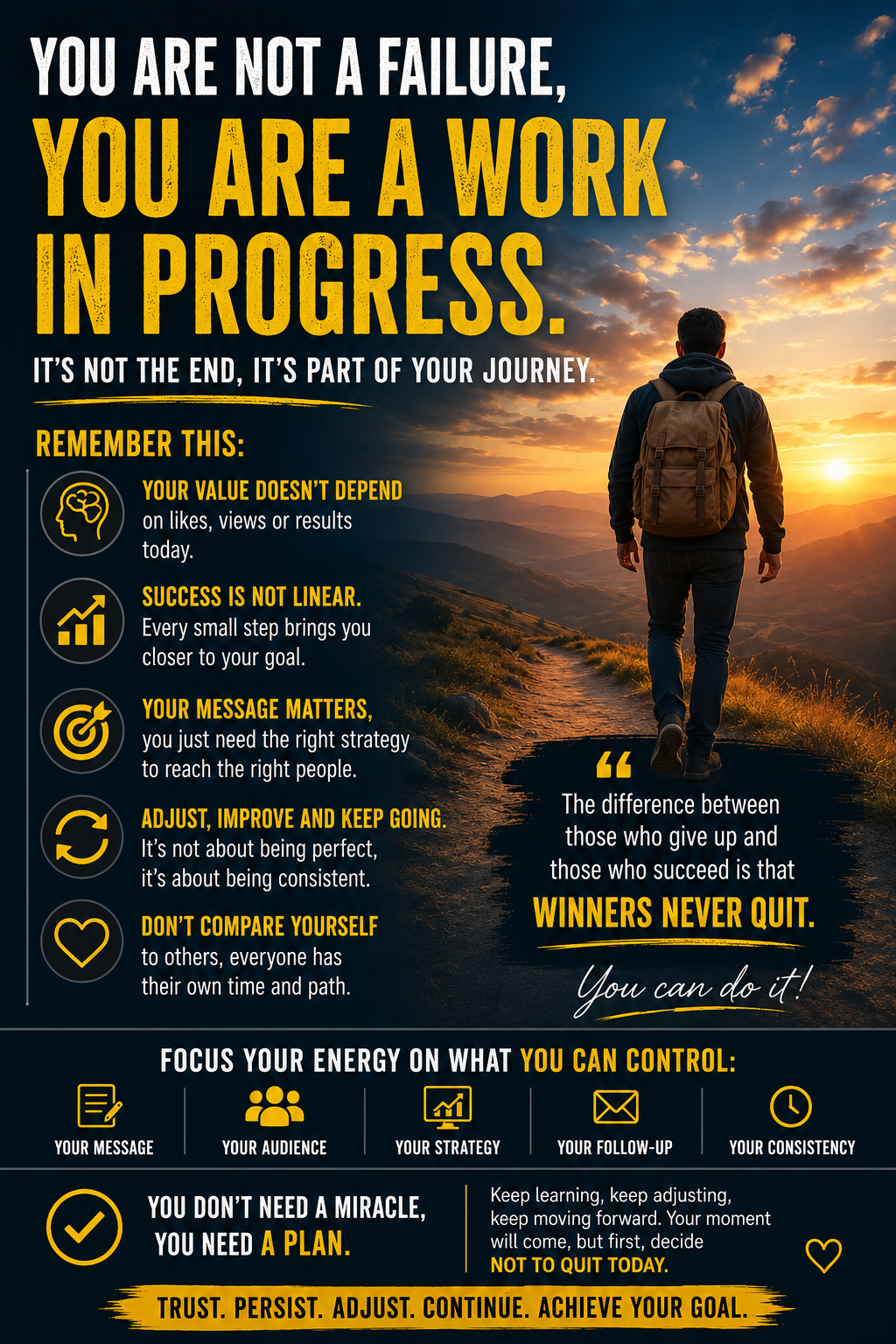
Motivational English image showing a person walking toward a sunrise, with empowering messages about perseverance, strategy, consistency, self-worth, and moving forward in digital marketing.
Publicado en Content Strategy, Digital Marketing, Entrepreneur Mindset, Home Business, Lead Generation, Online Entrepreneurship, Personal Development

When You Feel Invisible Online: The Truth About Moving Forward in Digital Marketing

Publicado el mayo 21, 2026mayo 21, 2026 por Marvin Gandis

By Marvin Gandis

There are moments in digital marketing when you quietly ask yourself:

  • “Maybe I’m just not good at this.”

You publish content. You write articles. You promote good offers. You create capture pages. You prepare follow-up emails. You stay active. You keep learning. You keep trying.

And still, the results do not come.

You see others moving faster. People with less time in the industry seem to get more attention, more clicks, more comments, more sales, and more recognition. Meanwhile, you feel like you are speaking into an empty room.

And that hurts.

It hurts because you are not lazy. It hurts because you are not doing anything. It hurts because you are trying, but the silence of the market can feel like personal rejection.

But listen carefully:

Silence does not always mean failure. Sometimes it means your message has not yet found the right path to the right people.

You do not need to quit. You do not need to wait for a miracle either. What you need is a strategic pause, an honest review, and a renewed action plan.


1. Do Not Confuse Lack of Results with Lack of Value

One of the most painful mistakes in digital marketing is believing:

  • “If nobody responds, then what I do has no value.”

But that is not always true.

The problem may not be your value. The problem may be:

  • How you present your message.
  • The audience you are attracting.
  • The clarity of your call to action.
  • The lack of social proof.
  • The wrong platform.
  • The right offer in front of the wrong people.
  • Educational content without a clear conversion path.
  • Automated follow-up without emotional connection.

In other words, you may be working hard, but not necessarily working on the exact part that needs correction.

That does not make you bad. It makes you human. It means you are still learning.


2. The Algorithm Does Not Hate You, But It Does Not Owe You Attention

Many creators feel like the algorithm is punishing them. And yes, it can feel that way.

You publish something with care, and it gets two views. Then you see a simple post with very little depth get hundreds of reactions.

That can frustrate anyone.

But the algorithm does not operate on fairness. It operates on signals.

It looks at things such as:

  • How long do people stay on your content?
  • Whether people comment, share, save, or click.
  • Whether your opening line stops attention.
  • Whether your content creates a quick reaction.
  • Whether you post consistently in a format the platform understands.
  • Whether your message is clear to a specific audience.

This means something important:

It is not enough to publish good content. You must publish content that captures attention quickly and leads people toward a specific action.

It is not just quality. It is clarity, focus, repetition, testing, and adjustment.


3. You Are Not a Ghost: Your Message May Be Too General

When we try to help everybody, we often connect with nobody.

For example, saying:

“I have a great opportunity to make money online.”

It is too general.

But saying:

“If you are a beginner, do not have a big list, and are tired of posting with no results, here is a smarter way to start building contacts and follow-up.”It

is more specific.

The second message speaks to a real person. That person may think:

“That is me.”

In digital marketing, clarity wins.

Do not only ask:
“What am I selling?”

Ask instead:
“Who am I helping, what specific problem do they have, and what next step do I want them to take?”


4. Your Posts Should Not Only Inform; They Should Start Conversations

Many articles and posts educate, but they do not create a response.

A post can be correct, useful, and well written, but if it does not create identification, curiosity, or conversation, it may be ignored.

Try structures like these:

Pain-based question:
“Do you feel like you post every day and still nobody responds?”

Short story:
“For a long time, I thought the problem was my offer. Then I realized the problem was my message.”

Contrast:
“You do not need more noise. You need a system that turns attention into contacts.”

Simple invitation:
“If this is happening to you, comment ‘INFO,’ and I will share a simple guide.”

The goal is not to post just to post. The goal is to create a micro-action.

  • A reaction.
  • A comment.
  • A click.
  • A conversation.
  • A subscription.
  • A follow-up.

5. Do Not Wait for a Miracle: Build a Measurable System

Hope is good. But in digital marketing, hope without measurement becomes frustration.

You do not need a miracle. You need data.

Start reviewing:

  • How many people see your post?
  • How many clicks?
  • How many reach your capture page?
  • How many subscribe?
  • How many of your emails?
  • How many clicks inside the email?
  • How many replies?
  • How many reach the offer?
  • How many buy or take action?

If you do not know where the system breaks, you may blame yourself unfairly.

  • Maybe it is not you. Maybe the post is not generating clicks.
  • Maybe the capture page is not converting.
  • Maybe the email does not create enough trust.
  • Maybe the offer needs more explanation.
  • Maybe you are attracting curious people, not buyers.
  • Maybe you need more traffic volume.
  • Maybe you need a more specific audience.

The solution begins when you stop saying “nothing works” and start asking:

“At what exact point am I losing attention?”


6. Stop Comparing Yourself to Others: You Do Not See Their Whole Journey

Comparison can destroy your energy.

You see other people’s results, but you may not see:

  • How much money did they invest?
  • What connections did they already have?
  • What team helps them?
  • How many years have they spent learning quietly?
  • How many posts failed before one worked?
  • What paid traffic are they using?
  • What tools do they have behind the scenes?
  • What coaching did they receive?
  • What hidden mistakes did they make?

Comparison without context is an emotional trap.

Your journey is no less valuable because someone else appears to move faster.

You are not competing against their timeline. You are building your own foundation.


7. What You Should Actually Change

Continuing does not mean doing the same thing forever.

Sometimes saying “I will not quit” does not mean repeating the same strategy. It means having the courage to change your approach.

Here are smart changes you can make:

A. Focus on One Main Message for 30 Days

Do not promote too many things at once. The market needs repetition before it remembers you.

Choose one main offer, one main problem, and one main audience.

Example:

  • Offer: GotBackUp
  • Problem: fear of losing important photos, files, and documents
  • Audience: everyday people, entrepreneurs, families, and workers who use phones or computers
  • Message: Protect your digital life before it is too late

B. Create Content in Series

Instead of random posts, create a series:

  • Day 1: The mistake of not backing up your files.
  • Day 2: Real stories about file loss.
  • Day 3: How to protect family photos.
  • Day 4: Why secure cloud storage matters.
  • Day 5: How to start with a free trial.
  • Day 6: Frequently asked questions.
  • Day 7: Direct invitation.

A series trains your audience to follow your message.

C. Use Simple Calls to Action

Do not only say:
“Click here.”

Try:

  • “Discover how to protect your files before you lose them.”
  • “Start with a free trial.”
  • “Get more information here.”
  • “Save this post if you have important photos on your phone.”
  • “Comment ‘BACKUP’ if you want the guide.”

D. Talk More About the Problem Before the Offer

People do not buy because they understand your product. They buy when they understand their own problem.

Before talking about features, talk about consequences:

  • Losing family photos.
  • Losing business documents.
  • Losing work files.
  • Losing years of memories.
  • Having no backup.
  • Believing “it will never happen to me.”

Then introduce the solution.

E. Measure One Thing Per Week

  • Week 1: Improve headlines.
  • Week 2: Improve calls to action.
  • Week 3: Improve the capture page.
  • Week 4: Improve follow-up emails.
  • Week 5: Improve traffic.
  • Week 6: Improve social proof.

Do not fix everything at once. Improve in stages.


8. The Question Is Not “Should I Quit?”

The better question is:

  • “Should I continue the same way, or should I redesign my strategy?”

And the answer is clear:

  • Do not quit from pain.
  • Do not make a permanent decision during a difficult season.
  • Do not confuse exhaustion with destiny.
  • Do not confuse silence with rejection.
  • Do not confuse slow growth with inability.

Maybe you do not need to leave digital marketing. Maybe you need to rest, reorganize, simplify your message, and return with a more precise strategy.


9. A Simple Plan to Start Again

For the next 30 days, try this plan:

Week 1: Diagnosis

Review your posts, pages, and emails. Identify where attention is being lost.

Week 2: Clarity

Define one audience, one offer, one problem, and one clear promise.

Week 3: Content

Publish an educational series with stories, questions, and calls to action.

Week 4: Conversion

Improve your capture page, review your emails, and personally follow up with people who interact.

Do not look for perfection. Look for measurable progress.


10. Final Message for Anyone Who Feels Ignored

If today you feel like nobody sees you, remember this:

Many businesses do not fail because the person lacks talent. They fail because the person quits right before discovering what needs to be adjusted.

  • You are not a ghost.
  • You are a voice that needs better direction.
  • You are not bad.
  • You are in a training season.
  • You do not need a miracle.
  • You need clarity, consistency, measurement, and a more focused strategy.

Above all, remember this:

Your value is not measured by today’s likes. Your growth is measured by your ability to learn, adjust, and continue with wisdom.

  • Do not quit defeated.
  • Rest if you need to.
  • Learn what is missing.
  • Simplify your message.
  • Return with direction.
  • Keep walking.

Because sometimes progress does not begin with more force. It begins with a better strategy.


If you are tired of posting with no results, do not punish yourself

Start by reviewing your system: message, audience, capture page, follow-up, and traffic.

Digital marketing does not only reward the person who works harder. It rewards the person who learns, measures, adjusts, and continues intelligently.

Today, you do not have to quit.

Today, you can redesign your path.

Free Download: The 30-Day Plan to Stop Feeling Invisible Online

Enter Your Details Below and Receive the Step-by-Step Plan.

Download the free guide

Disclaimer

This article is for educational and motivational purposes only. It does not guarantee financial results, sales, traffic, income, or social media growth. Every digital business requires learning, consistency, testing, adjustment, and personal responsibility. If you are experiencing deep sadness, intense anxiety, or thoughts of harming yourself, please seek professional help or contact a support line in your country.

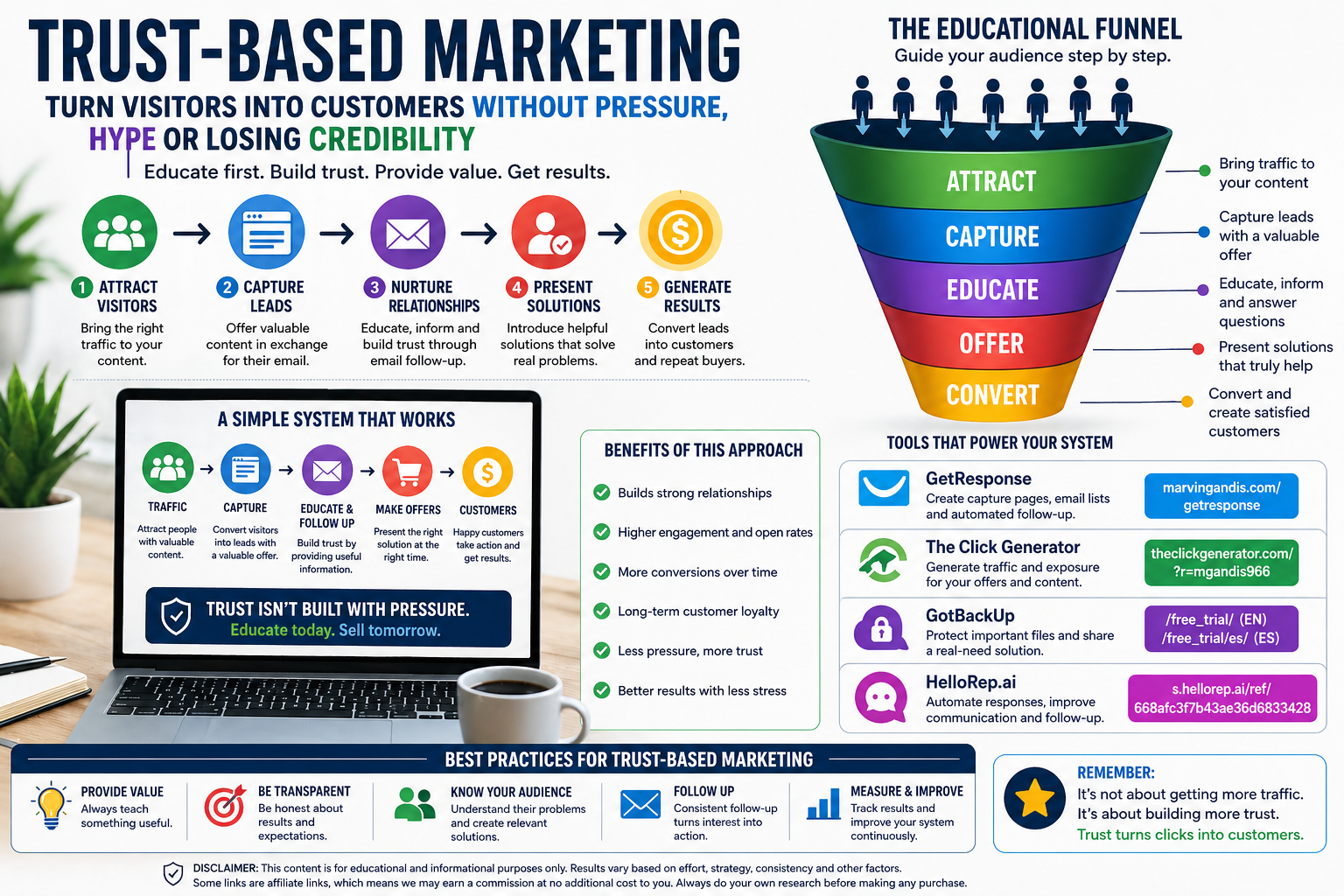
Person reviewing a digital marketing strategy with a sales funnel, email marketing, web traffic, and automation on a modern screen.
Publicado en Affiliate Marketing, Artificial Intelligence, Automation, Digital Business Education, Digital Marketing, Email Marketing, Lead Generation, Online Business, Sales Funnels, Web Traffic

Trust-Based Marketing: How to Turn Visitors Into Customers Without Pressure, Hype, or Losing Credibility

Publicado el abril 29, 2026abril 29, 2026 por Marvin Gandis

By Marvin Gandis

There is more content online than ever before. Every day, people see new ads, posts, videos, emails, capture pages, offers, and systems promising to help entrepreneurs, affiliates, and small business owners grow faster.

But there is a silent problem:

People are tired of exaggerated marketing messages.

Many readers no longer respond to phrases like “make money fast,” “secret system,” “guaranteed results,” or “copy and paste.” Not because they do not want a better future, but because they have seen too many empty promises.

That is why one of the most important strategies in modern digital marketing is not to pressure harder, but to educate better.

This is where trust-based marketing begins.

Trust-based marketing is not about forcing someone to buy. It is about helping the reader understand the problem, see a possible solution, and make an informed decision. When people feel they are learning something useful, resistance goes down, and trust goes up.

And in the digital world, trust is more powerful than any advertisement.


1. What is trust-based marketing?

Trust-based marketing is a communication strategy that educates before it sells.

Instead of telling the reader:

  • “Buy this now,”

It says:

  • “Here is the problem, here is what you need to understand, and here is a tool that may help you if you decide to move forward.”

That difference is powerful.

  • Aggressive marketing pushes.
  • Trust-based marketing guides.
  • Aggressive marketing promises.
  • Trust-based marketing explains.
  • Aggressive marketing looks for a quick sale.
  • Trust-based marketing builds a relationship.

This does not mean you should never sell. It means the sale should feel like the next logical step after value has been delivered.


2. Why do many businesses lose sales even when they have traffic

One of the most common mistakes in digital marketing is believing that the main problem is always a lack of traffic.

Many people think:

  • “I need more visitors.”
  • “I need more clicks.”
  • “I need more people to see my offer.”
  • “I need to post more.”

But the more important question is:

What happens after the click?

Because if someone clicks your link, visits your page, and leaves without giving you their contact information, you may have lost that person.

Traffic without a system is like pouring water into a bucket full of holes.

You can send hundreds or thousands of visitors to an offer, but if you are not capturing leads, educating prospects, and following up, you are depending on people buying on the first visit.

And that rarely happens.

Most people need time to trust. They need to see your message more than once. They need to understand the benefit. They need to compare. They need to feel safe.

That is why the goal should not only be getting traffic.

The real goal is building a system that turns visitors into contacts, contacts into readers, readers into prospects, and prospects into customers.


3. The new rule: do not send cold traffic directly to an offer

Sending traffic directly to a sales page can work in some situations, but for many beginners and affiliates, it is a weak strategy.

Why?

  • Because the visitor does not know you.
  • They do not understand the value yet.
  • They do not know if they can trust the offer.
  • They can get distracted.
  • They can close the page.
  • They can say, “I’ll check it later.”

And “later” often never happens.

A better strategy is to send traffic first to a capture page where the visitor can receive something valuable: a guide, video, class, report, tool list, or educational explanation.

After the person signs up, you can follow up by email.

This is where a tool like GetResponse can be useful because it allows you to create capture pages, forms, contact lists, and automated email sequences.

Recommended resource for creating capture pages and email follow-up: ( Check My Tool )

The idea is not to use a tool just for the sake of using a tool.

The idea is to build a process.


4. The educational funnel: a simple structure for selling with trust

An educational funnel does not have to be complicated. It can start with a very simple structure:

Step 1: Create useful content

This can be an article, video, post, PDF, or email where you explain a real problem.

Examples:

  • Why traffic does not convert.
  • How to avoid losing visitors.
  • Why do you need a contact list?
  • How to follow up without sounding desperate.
  • Which tools help organize your marketing?

Step 2: Send traffic to a capture page

You can use social media, blogs, safelists, paid traffic, or exposure platforms.

To generate visits, one option is to use traffic tools like The Click Generator, always ensuring that traffic is directed to a well-planned page rather than to a random link without a strategy.

Recommended resource for generating exposure and visits: ( LEARN MORE )

Step 3: Capture the contact

The page should offer something simple and clear:

  • “Get this free guide.”
  • “Learn how to turn traffic into leads.”
  • “Discover the mistakes killing your conversions.”
  • “Access a simple explanation to start smarter.”

Step 4: Educate by email

After someone signs up, do not bombard them with sales messages. Educate first.

You can send a sequence like this:

Day 1: Welcome and explain the problem.
Day 2: Common mistakes to avoid.
Day 3: How a simple solution works.
Day 4: Recommended tools.
Day 5: Invitation to take action.

Step 5: Present the right offer

The offer should appear as a logical solution, not as pressure.

For example:

If the reader wants to build a list, GetResponse may be recommended.
If they need traffic, The Click Generator may be recommended.
If they want to protect important files, GotBackUp may be recommended.
If they need automation and faster responses, HelloRep.ai may be recommended.


5. How to sell without sounding desperate

One of the biggest weaknesses in affiliate marketing is desperation in the message.

Phrases like:

  • “Buy now or lose everything.”
  • “This is your only chance.”
  • “Make money without doing anything.”
  • “This works for everyone.”

may get attention for a moment, but they can also destroy trust.

A more professional message would be:

“This tool may help if you are looking for a more organized way to follow up with your contacts.”

Or:

“This solution may be useful for people who want to protect their files and explore an additional opportunity, while understanding that results depend on effort and consistency.”

The difference is message maturity.

Good marketing does not need to exaggerate. It needs to be explained.


6. The importance of follow-up

Many sales are lost because there is no follow-up.

A person may be interested but not ready. They may open your page, read a little, and leave. They may sign up but not act immediately. They may need more information.

Follow-up allows the conversation to continue.

Good follow-up:

  • Educates.
  • Answers questions.
  • Reinforces benefits.
  • Shares examples.
  • Reduces confusion.
  • Invites action respectfully.

Email marketing remains one of the best ways to do this because it allows you to communicate directly with people who have already shown interest.

That is why building a list is not optional. It is a strategic foundation.


7. Example 5-email educational sequence

Email 1: Welcome

Subject: Thanks for signing up — let’s start with clarity

Hello,

Thanks for signing up. Over the next few days, you will receive practical information to understand how a simple digital marketing system works using traffic, capture pages, follow-up, and trust.

Before selling anything, it is important to understand one thing: marketing is not just about getting clicks. It is about building a process that helps people make better decisions.


Email 2: The Common Mistake

Subject: The mistake that wastes most clicks

Many entrepreneurs send traffic directly to an offer. The problem is that if the person does not buy in that moment, they may be gone forever.

That is why a capture page can be so important. It allows you to turn a visitor into a contact and continue educating them over time.


Email 3: The Simple Solution

Subject: How to turn visitors into contacts

A visitor is not always ready to buy, but they may be ready to learn.

That is why offering a guide, video, or free explanation can help start a relationship. Once the person signs up, you can send useful information and present relevant solutions.


Email 4: The Tools

Subject: Tools do not create magic, but they organize your system

Digital tools can help you save time, organize contacts, and automate follow-up.

For example, an email marketing platform can help you create a capture page and send automated emails. A traffic tool can help generate visits. An automation solution can help you respond faster.

The key is to use each tool with strategy.


Email 5: The Invitation To Act

Subject: Build the system before looking for more traffic

Before buying more traffic or publishing more content, make sure you have a system that can receive visitors, capture contacts, and follow up.

When you have that system, every click becomes more valuable.


8. Useful tools inside a trust-based marketing system

These tools may fit into different parts of the process:

GetResponse — Capture and follow-up

  • Useful for creating capture pages, forms, contact lists, and email sequences.

Check My Recommended Tool: ( Check Here )

The Click Generator — Traffic and exposure

  • May help generate visits to your pages, especially when you already have a capture page ready.

My Recommended Program: ( Check Here )

GotBackUp — Digital protection solution

  • Useful for people who want to protect important files, photos, documents, and memories. It may also be presented as an opportunity to share a real need solution.

( LEARN MORE )

HelloRep.ai — Automation and response

  • May help improve responses, customer support, follow-up, and automated communication without losing human intention.

Check My Recommended Program: ( Here )


9. Mistakes to avoid

Mistake 1: Promising guaranteed results

  • Never promise income, sales, or specific results. It is better to say a tool may help, but results depend on effort, strategy, consistency, and the market.

Mistake 2: Selling before educating

  • If you sell too quickly, you may lose the reader. Educate first and present the offer later.

Mistake 3: Using traffic without capture

  • Sending traffic without capturing leads is one of the fastest ways to lose opportunities.

Mistake 4: Not measuring results

  • You should review opens, clicks, sign-ups, replies, and conversions. What is not measured cannot be improved.

Mistake 5: Sounding like everyone else

  • Authenticity matters. Use stories, examples, clear language, and a human voice.

10. Conclusion

Trust-based marketing is not a trend. It is a necessary response to a marketplace filled with noise, exaggerated promises, and automated messages.

People want solutions, but they also want to feel respected.

  • They want to learn before they buy.
  • They want to understand before they decide.
  • They want to trust before they act.

That is why the best marketing system is not simply the one that gets the most clicks. It is the one that turns those clicks into relationships.

The formula is simple:

  • Educate first.
  • Capture the contact.
  • Follow up.
  • Present useful solutions.
  • Be transparent.
  • Measure and improve.

When you do this, you stop chasing sales and start building trust.

And in modern marketing, trust is one of the most valuable assets you can create.


Disclaimer

This article is for educational and informational purposes only. Some tools or resources mentioned may include affiliate links, which means a commission may be earned if the reader decides to sign up or purchase through those links, at no extra cost to the reader. No income, sales, specific results, or financial success are guaranteed. Results depend on individual effort, strategy, consistency, market conditions, skills, tools used, and other personal or business factors.

Navegación de entradas

Entradas anteriores

Suscribete Gratis a Ir de Compras

Ingresa tu Correo Electronico para recibir todas las actualizaciones del blog.

Únete a otros 22K suscriptores

Archivos

Ir de Compras Online

Sunset SwirlsMelanargia galatheaVenice
Más fotos

Temas

  • Política de privacidad
  • No Vender Ni Compartir Mi Información Personal

Cargando comentarios...

Debe estar conectado para enviar un comentario.