By Marvin Gandis
There is more content online than ever before. Every day, people see new ads, posts, videos, emails, capture pages, offers, and systems promising to help entrepreneurs, affiliates, and small business owners grow faster.
But there is a silent problem:
People are tired of exaggerated marketing messages.
Many readers no longer respond to phrases like “make money fast,” “secret system,” “guaranteed results,” or “copy and paste.” Not because they do not want a better future, but because they have seen too many empty promises.
That is why one of the most important strategies in modern digital marketing is not to pressure harder, but to educate better.
This is where trust-based marketing begins.
Trust-based marketing is not about forcing someone to buy. It is about helping the reader understand the problem, see a possible solution, and make an informed decision. When people feel they are learning something useful, resistance goes down, and trust goes up.
And in the digital world, trust is more powerful than any advertisement.
1. What is trust-based marketing?
Trust-based marketing is a communication strategy that educates before it sells.
Instead of telling the reader:
- “Buy this now,”
It says:
- “Here is the problem, here is what you need to understand, and here is a tool that may help you if you decide to move forward.”
That difference is powerful.
- Aggressive marketing pushes.
- Trust-based marketing guides.
- Aggressive marketing promises.
- Trust-based marketing explains.
- Aggressive marketing looks for a quick sale.
- Trust-based marketing builds a relationship.
This does not mean you should never sell. It means the sale should feel like the next logical step after value has been delivered.
2. Why do many businesses lose sales even when they have traffic
One of the most common mistakes in digital marketing is believing that the main problem is always a lack of traffic.
Many people think:
- “I need more visitors.”
- “I need more clicks.”
- “I need more people to see my offer.”
- “I need to post more.”
But the more important question is:
What happens after the click?
Because if someone clicks your link, visits your page, and leaves without giving you their contact information, you may have lost that person.
Traffic without a system is like pouring water into a bucket full of holes.
You can send hundreds or thousands of visitors to an offer, but if you are not capturing leads, educating prospects, and following up, you are depending on people buying on the first visit.
And that rarely happens.
Most people need time to trust. They need to see your message more than once. They need to understand the benefit. They need to compare. They need to feel safe.
That is why the goal should not only be getting traffic.
The real goal is building a system that turns visitors into contacts, contacts into readers, readers into prospects, and prospects into customers.
3. The new rule: do not send cold traffic directly to an offer
Sending traffic directly to a sales page can work in some situations, but for many beginners and affiliates, it is a weak strategy.
Why?
- Because the visitor does not know you.
- They do not understand the value yet.
- They do not know if they can trust the offer.
- They can get distracted.
- They can close the page.
- They can say, “I’ll check it later.”
And “later” often never happens.
A better strategy is to send traffic first to a capture page where the visitor can receive something valuable: a guide, video, class, report, tool list, or educational explanation.
After the person signs up, you can follow up by email.
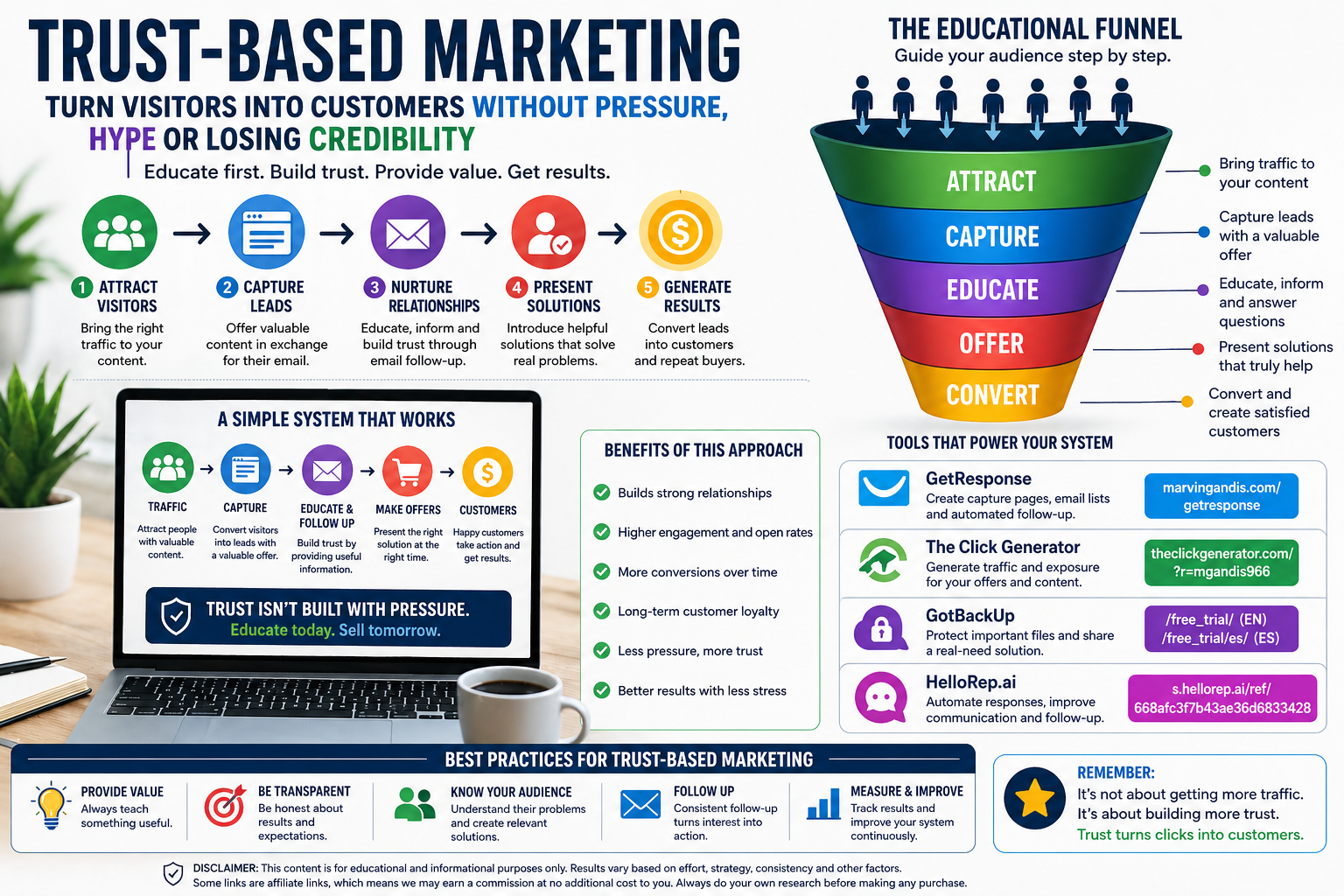
This is where a tool like GetResponse can be useful because it allows you to create capture pages, forms, contact lists, and automated email sequences.
Recommended resource for creating capture pages and email follow-up: ( Check My Tool )
The idea is not to use a tool just for the sake of using a tool.
The idea is to build a process.
4. The educational funnel: a simple structure for selling with trust
An educational funnel does not have to be complicated. It can start with a very simple structure:
Step 1: Create useful content
This can be an article, video, post, PDF, or email where you explain a real problem.
Examples:
- Why traffic does not convert.
- How to avoid losing visitors.
- Why do you need a contact list?
- How to follow up without sounding desperate.
- Which tools help organize your marketing?
Step 2: Send traffic to a capture page
You can use social media, blogs, safelists, paid traffic, or exposure platforms.
To generate visits, one option is to use traffic tools like The Click Generator, always ensuring that traffic is directed to a well-planned page rather than to a random link without a strategy.
Recommended resource for generating exposure and visits: ( LEARN MORE )
Step 3: Capture the contact
The page should offer something simple and clear:
- “Get this free guide.”
- “Learn how to turn traffic into leads.”
- “Discover the mistakes killing your conversions.”
- “Access a simple explanation to start smarter.”
Step 4: Educate by email
After someone signs up, do not bombard them with sales messages. Educate first.
You can send a sequence like this:
Day 1: Welcome and explain the problem.
Day 2: Common mistakes to avoid.
Day 3: How a simple solution works.
Day 4: Recommended tools.
Day 5: Invitation to take action.
Step 5: Present the right offer
The offer should appear as a logical solution, not as pressure.
For example:
If the reader wants to build a list, GetResponse may be recommended.
If they need traffic, The Click Generator may be recommended.
If they want to protect important files, GotBackUp may be recommended.
If they need automation and faster responses, HelloRep.ai may be recommended.
5. How to sell without sounding desperate
One of the biggest weaknesses in affiliate marketing is desperation in the message.
Phrases like:
- “Buy now or lose everything.”
- “This is your only chance.”
- “Make money without doing anything.”
- “This works for everyone.”
may get attention for a moment, but they can also destroy trust.
A more professional message would be:
“This tool may help if you are looking for a more organized way to follow up with your contacts.”
Or:
“This solution may be useful for people who want to protect their files and explore an additional opportunity, while understanding that results depend on effort and consistency.”
The difference is message maturity.
Good marketing does not need to exaggerate. It needs to be explained.
6. The importance of follow-up
Many sales are lost because there is no follow-up.
A person may be interested but not ready. They may open your page, read a little, and leave. They may sign up but not act immediately. They may need more information.
Follow-up allows the conversation to continue.
Good follow-up:
- Educates.
- Answers questions.
- Reinforces benefits.
- Shares examples.
- Reduces confusion.
- Invites action respectfully.
Email marketing remains one of the best ways to do this because it allows you to communicate directly with people who have already shown interest.
That is why building a list is not optional. It is a strategic foundation.
7. Example 5-email educational sequence
Email 1: Welcome
Subject: Thanks for signing up — let’s start with clarity
Hello,
Thanks for signing up. Over the next few days, you will receive practical information to understand how a simple digital marketing system works using traffic, capture pages, follow-up, and trust.
Before selling anything, it is important to understand one thing: marketing is not just about getting clicks. It is about building a process that helps people make better decisions.
Email 2: The Common Mistake
Subject: The mistake that wastes most clicks
Many entrepreneurs send traffic directly to an offer. The problem is that if the person does not buy in that moment, they may be gone forever.
That is why a capture page can be so important. It allows you to turn a visitor into a contact and continue educating them over time.
Email 3: The Simple Solution
Subject: How to turn visitors into contacts
A visitor is not always ready to buy, but they may be ready to learn.
That is why offering a guide, video, or free explanation can help start a relationship. Once the person signs up, you can send useful information and present relevant solutions.
Email 4: The Tools
Subject: Tools do not create magic, but they organize your system
Digital tools can help you save time, organize contacts, and automate follow-up.
For example, an email marketing platform can help you create a capture page and send automated emails. A traffic tool can help generate visits. An automation solution can help you respond faster.
The key is to use each tool with strategy.
Email 5: The Invitation To Act
Subject: Build the system before looking for more traffic
Before buying more traffic or publishing more content, make sure you have a system that can receive visitors, capture contacts, and follow up.
When you have that system, every click becomes more valuable.
8. Useful tools inside a trust-based marketing system
These tools may fit into different parts of the process:
GetResponse — Capture and follow-up
- Useful for creating capture pages, forms, contact lists, and email sequences.
Check My Recommended Tool: ( Check Here )
The Click Generator — Traffic and exposure
- May help generate visits to your pages, especially when you already have a capture page ready.
My Recommended Program: ( Check Here )
GotBackUp — Digital protection solution
- Useful for people who want to protect important files, photos, documents, and memories. It may also be presented as an opportunity to share a real need solution.
( LEARN MORE )
HelloRep.ai — Automation and response
- May help improve responses, customer support, follow-up, and automated communication without losing human intention.
Check My Recommended Program: ( Here )
9. Mistakes to avoid
Mistake 1: Promising guaranteed results
- Never promise income, sales, or specific results. It is better to say a tool may help, but results depend on effort, strategy, consistency, and the market.
Mistake 2: Selling before educating
- If you sell too quickly, you may lose the reader. Educate first and present the offer later.
Mistake 3: Using traffic without capture
- Sending traffic without capturing leads is one of the fastest ways to lose opportunities.
Mistake 4: Not measuring results
- You should review opens, clicks, sign-ups, replies, and conversions. What is not measured cannot be improved.
Mistake 5: Sounding like everyone else
- Authenticity matters. Use stories, examples, clear language, and a human voice.
10. Conclusion
Trust-based marketing is not a trend. It is a necessary response to a marketplace filled with noise, exaggerated promises, and automated messages.
People want solutions, but they also want to feel respected.
- They want to learn before they buy.
- They want to understand before they decide.
- They want to trust before they act.
That is why the best marketing system is not simply the one that gets the most clicks. It is the one that turns those clicks into relationships.
The formula is simple:
- Educate first.
- Capture the contact.
- Follow up.
- Present useful solutions.
- Be transparent.
- Measure and improve.
When you do this, you stop chasing sales and start building trust.
And in modern marketing, trust is one of the most valuable assets you can create.
Disclaimer
This article is for educational and informational purposes only. Some tools or resources mentioned may include affiliate links, which means a commission may be earned if the reader decides to sign up or purchase through those links, at no extra cost to the reader. No income, sales, specific results, or financial success are guaranteed. Results depend on individual effort, strategy, consistency, market conditions, skills, tools used, and other personal or business factors.

Lovely!
Thank you so much, Morag! 😊 I truly appreciate your kind words. I’m glad you enjoyed it — blessings and positive energy your way! 🙏✨
You are welcome. It’s very confirming as I can see that my husband and daughter operate with this mindset too. 😊🙏
That’s beautiful, Morag. 😊🙏 It’s a real blessing when the message not only resonates personally but also confirms what you already see in the people closest to you. A strong mindset, lived daily, becomes a quiet example for the whole family. Thank you for sharing that with me.
You are welcome.
Thank you, Morag. 😊 I truly appreciate your kindness and continued support. Wishing you a peaceful and blessed day. 🙏✨
🌈🕊️🙏
Thank you, Morag. 🌈🕊️🙏 Your beautiful symbols say so much — hope, peace, and faith. Blessings to you and your family. ✨
Thank you, for your family too
Thank you so much, Morag. 🙏😊 That is very kind of you. May God bless your family as well with peace, protection, health, and continued joy. I truly appreciate your thoughtful blessing. ✨
Nice 👌 Thanks for sharing the roundup.
Thank you so much, Vidisha! 😊
I’m glad you enjoyed the roundup.
I truly appreciate your support and encouragement.
More helpful insights are coming soon! 🙌