Publicado en Affiliate Marketing, Beginner Business, Business Opportunity, Cloud Backup, Data Protection, Digital Marketing, Digital Security, Educational Marketing, GotBackUp, Home-Based Business, Online Business, Work from Home

If You Don’t Like Aggressive Sales, This Opportunity May Interest You

By Marvin Gandis / Team Leader

A different way to look at building a business from home

Many people want to build an additional income from home, but they stop themselves for one very common reason: they do not like aggressive sales.

  • They do not want to chase people.
  • They do not want to pressure family or friends.
  • They do not want to feel uncomfortable pushing others to buy something.
  • They do not want to sound desperate or come across as forced salespeople.

And the truth is, that concern is valid.

For years, many business opportunities have been presented with too much pressure, exaggerated promises, and methods that make people feel uncomfortable. That is why, when many people hear the word “sales,” they immediately think of pressure, rejection, awkward conversations, or manipulation.

But selling does not have to be that way.

There is a calmer, more professional, and more human way to share an opportunity: by educating, informing, and offering a real solution to a real need.

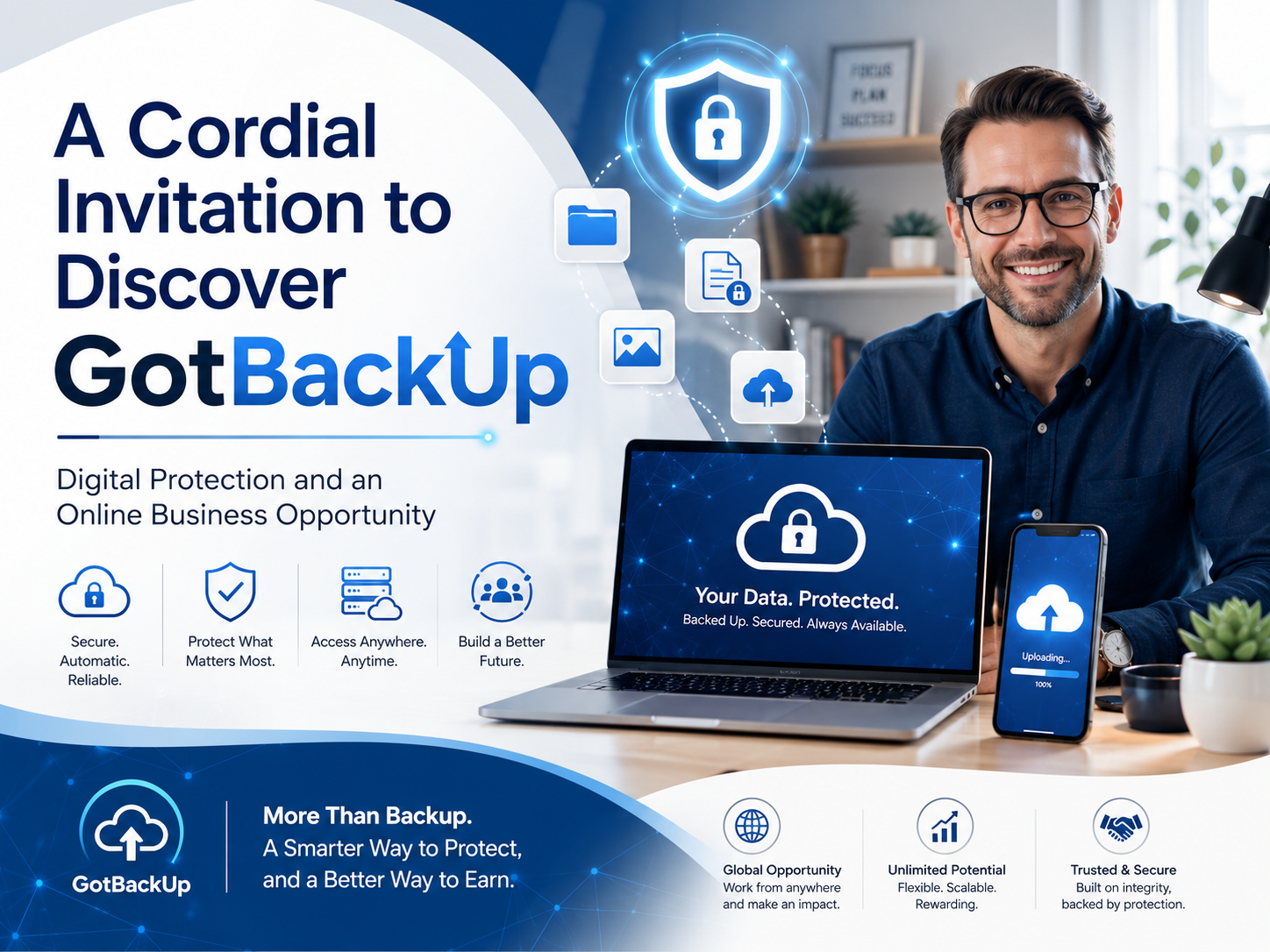
That is where GotBackUp may represent an interesting alternative for people who want to start a home-based business without depending on aggressive sales.


What is GotBackUp?

GotBackUp is a cloud backup service designed to help people protect their important digital files, such as photos, documents, videos, work files, family memories, and other personal or professional information.

Today, we live in a time where almost everything important is stored on some kind of device: phones, computers, tablets, or external hard drives. However, many people do not think about backing up their information until a problem happens.

  • A phone can be lost.
  • A computer can break.
  • A hard drive can fail.
  • A virus can delete important files.
  • An accident can make years of memories disappear in seconds.

That is why data protection is no longer a luxury. It is a necessity.

GotBackUp offers a practical solution to this problem: helping people back up and protect their digital information in a safer and more accessible way.


An opportunity based on a real service

One of the reasons GotBackUp may be different from other opportunities is that it is not simply based on selling an empty idea. It is based on sharing a useful service.

When a person understands the importance of protecting their files, the conversation changes.

It is no longer about convincing someone to buy something they do not need.
It is about showing them a solution to a problem many people already have, even if they have not recognized it yet.

That difference is very important.

When you share a real service, you can communicate from a place of education, not pressure. You can explain, guide, and help. You can invite people to consider a solution without forcing them or chasing them.

This allows you to build a business with more calm, more confidence, and more dignity.


Why this opportunity may be ideal for beginners

Many people who want to start a home-based business have no experience in sales, digital marketing, or technology. Some even feel insecure because they think they need to be experts before they begin.

But in reality, every serious process begins by learning step by step.

GotBackUp may be interesting for beginners because it combines three important elements.

First, it offers a service that is easy to understand. Everyone can understand the importance of protecting photos, documents, and important files.

Second, it allows you to share a common need. Almost everyone uses digital devices and has information they do not want to lose.

Third, it allows you to learn how to promote education. You do not need to start as an expert salesperson. You can begin by learning how to communicate the value of the service with clarity, patience, and consistency.

The beginner who understands this stops thinking, “I have to sell something to someone,” and starts thinking, “I can help others discover a useful solution.”

That shift in mindset makes a big difference.


It is not about chasing people

One of the most common mistakes in home-based businesses is thinking that success depends on chasing people.

  • Sending desperate messages.
  • Following up again and again with pressure.
  • Pushing family members.
  • Trying to convince people who are not interested.
  • Talking only about money without explaining the real value of the product.

That approach usually leads to frustration, rejection, and exhaustion.

A smarter strategy is to build through education. That means sharing content, explaining the problem, presenting the solution, and allowing interested people to raise their hands.

  • Not everyone will be interested.
  • Not everyone will understand the value right away.
  • Not everyone will take action.

And that is okay.

The goal is not to convince everyone. The goal is to connect with the right people: those who understand the importance of protecting their data, want to learn, and are open to a serious opportunity from home.


The real problem: most people do not back up their files

Many people believe their files are safe simply because they are stored on their phone or computer. But the reality is different.

  • Devices fail.
  • Phones get lost.
  • Computers break.
  • Files are deleted by accident.
  • Digital attacks exist.
  • Family memories can disappear without warning.

A person can lose work documents, photos of their children, family videos, business files, or important information in an instant — information they may never be able to recover.

That is why cloud backup should not be seen as optional. It should be seen as part of modern digital life.

GotBackUp responds to that need by offering a way to protect information before a loss happens.


The opportunity: share value before selling

When you share GotBackUp the right way, the focus should not begin with “join my business” or “make money fast.”

The right approach should begin with a simple question:

Are you protecting your important files?

From there, the conversation becomes more natural.

  • You can talk about digital security.
  • You can talk about prevention.
  • You can talk about family photos.
  • You can talk about important documents.
  • You can talk about peace of mind.
  • You can talk about how many people wait too long before protecting their information.

After educating, you can then present GotBackUp as a solution.

And for those who are also looking for an opportunity from home, you can explain that there is also a way to share this service with others.

That is a more professional approach: value first, invitation second.


Who this opportunity is for

This opportunity may be for you if you want to build something from home, but you do not want to depend on uncomfortable sales or aggressive pressure.

It may be for you if you are willing to learn, improve, and communicate with patience.

It may be for you if you understand that results require consistency, follow-up, and action.

It may be for you if you want to share a useful service, not simply promote an empty promise.

It may be for you if you want to develop a more professional mindset in the world of digital marketing.

But it is also important to tell the truth: this opportunity is not for everyone.

  • It is not for people looking for fast money without effort.
  • It is not for those who do not want to learn.
  • It is not for those who quit after a few days.
  • It is not for those who expect results without taking action.
  • It is not for those looking for a magic formula.

Every serious business requires time, discipline, communication, and consistency.

GotBackUp may offer an opportunity, but each person must do their part.


How to share GotBackUp without feeling like an aggressive salesperson

The key is to change the approach.

Instead of saying:

  • “Buy this.”
  • “Join now.”
  • “Do not miss this opportunity.”
  • “You have to do this today.”

You can communicate more naturally:

  • “Do you have a backup of your important files?”
  • “What would happen if you lost your phone or computer today?”
  • “I am sharing information about a cloud backup solution.”
  • “I prepared a free PDF that explains how it works.”
  • “Review it calmly and decide if it makes sense for you.”

This kind of communication reduces pressure and increases trust.

People do not want to feel chased. They want to feel respected.

When you respect another person’s decision-making process, your message becomes more human and more professional.


The importance of the free PDF

Offering a free PDF is an excellent strategy because it allows you to educate before selling.

Instead of asking someone to make an immediate decision, you give them clear information so they can review the proposal calmly.

A good PDF can explain:

  • What problem GotBackUp solves.
  • Why cloud backup is important.
  • How the service works.
  • What benefits does it offer?
  • How it can also become a home-based opportunity.
  • What steps can an interested person take next?

This helps build trust.

When a person receives educational information, they feel less pressure and more control over their decision.

That is why a capture page with a free PDF can be a powerful tool to attract more serious prospects.


A more serious way to build online

The digital world is full of noise.

  • Too many exaggerated promises.
  • Too many “get rich quick” messages.
  • Too many opportunities without a real foundation.
  • Too much pressure and not enough education.

That is why a serious strategy must be different.

It must focus on clarity, trust, and value.

GotBackUp can be presented as a more solid opportunity because it begins with a real need: protecting digital information.

When the message is communicated correctly, the person does not feel like they are being sold empty hype. They feel like they are being shown a practical solution.

That is a big difference.


How to improve the capture page

For a capture page to convert better, it is not enough to have a nice image and a form. It also needs clarity.

A good page should quickly answer these questions:

  • What am I receiving?
  • Why should I care?
  • What problem does it solve?
  • Can I trust this?
  • What should I do now?

That is why the page should include a short text before the form, such as:

“Download this free proposal and discover how GotBackUp combines a needed service — secure cloud backup — with an opportunity to build income from home, without depending on aggressive sales.”

It can also include trust-building points such as:

  • A real cloud backup service.
  • Ideal for protecting photos, documents, and important files.
  • Can be shared educationally and professionally.
  • Not based on pressure, but on value.
  • Perfect for people willing to learn and take action.

These small details can increase visitor trust and help them decide to request the PDF.


If you are looking for a calmer and more professional way to explore a home-based opportunity, GotBackUp may be an option worth reviewing.

  • You do not need to begin as an expert.
  • You do not need to use pressure.
  • You do not need to chase people.
  • You do not need to promise unrealistic results.

You can begin by learning, educating, and sharing a solution that many people need: protecting their digital information.

Download the free PDF, review it calmly, and decide if this opportunity makes sense for you.

Request your free PDF and discover the complete GotBackUp proposal.


Final reflection

  • Not every business has to feel uncomfortable.
  • Not every sale has to be aggressive.
  • Not every opportunity has to be filled with exaggerated promises.

Sometimes, the best way to build is to begin with something simple: a real problem, a useful solution, and an honest way to share it.

GotBackUp may be an opportunity for those who want to learn how to build from home with more clarity, more purpose, and less pressure.

  • The key is not to chase people.
  • The key is to educate, serve, and remain consistent.

Because when you share value with respect, the right people listen.


Disclaimer

This article is for educational and informational purposes only. GotBackUp may offer a business opportunity, but individual results may vary depending on each person’s effort, consistency, training, strategy, follow-up, and personal action. No specific income or automatic results are guaranteed. Anyone interested should review the complete information, evaluate the opportunity responsibly, and make their own decisions.

Publicado en Entrepreneurship, Financial Education, Personal Development, Productivity, Wealth Mindset

Refusing to Learn New Skills: The Mistake That Makes Your Future Poorer

By Marvin Gandis

One of the most dangerous ways to fall behind in life is to stop learning.

The world changes. Technology changes. Business changes. The way people work changes. The way we communicate changes. Opportunities change.

But many people want new results with old skills.

They want more income, but they do not develop new abilities. They want better opportunities, but they do not prepare. They want financial freedom, but they do not learn how to manage, sell, communicate, create value, or adapt to the times.

In this sixth part of the series “The Reverse Question,” we will reflect on a simple but powerful truth: the person who stops learning begins to limit their future.

  • This is not about having perfect degrees.
  • This is not about knowing everything.
  • This is not about comparing yourself to anyone.

It is about keeping a teachable, humble, and willing mind.


The world does not wait for those who stay the same

Many people live as if the world will stay the same forever. But reality is different.

  • What worked ten years ago may not work the same way today.
  • What used to be enough may not be enough tomorrow.
  • What once felt secure can change suddenly.

Today, there are new tools, new platforms, new business models, new ways to sell, new ways to learn, and new opportunities for those willing to prepare.

The problem is not that the world changes. The problem is refusing to change while the world keeps moving forward.


Lack of skills creates dependency

When a person does not develop skills, they depend too much on one income source, one opportunity, one company, one person, or one circumstance.

  • They depend on the boss giving them an opportunity.
  • They depend on the economy improving.
  • They depend on someone rescuing them.
  • They depend on things not changing.
  • They depend on others deciding for them.

But a person with skills has more options.

  • They can adapt.
  • They can offer services.
  • They can solve problems.
  • They can start a business.
  • They can sell.
  • They can teach.
  • They can create content.
  • They can use digital tools.
  • They can increase their value in the marketplace.

Skills do not eliminate every problem, but they increase the ability to respond better.


Learning does not end in school

Many people believe learning belongs to the past: school, college, an old course, or an earlier stage of life.

But life itself is a school.

  • Every problem can teach.
  • Every mistake can teach.
  • Every failure can teach.
  • Every customer can teach.
  • Every conversation can teach.
  • Every book can teach.
  • Every tool can teach.
  • Every attempt can teach.

Continuous learning is an attitude. It is the decision not to live closed, proud, or resigned.

  • A person who keeps learning keeps growing.
  • A person who believes they already know everything begins to stop.

Skills are seeds of opportunity

One skill can change a life.

  • Learning to communicate better can open doors.
  • Learning sales can increase income.
  • Learning personal finance can reduce chaos.
  • Learning digital marketing can help promote a business.
  • Learning artificial intelligence can improve productivity.
  • Learning leadership can influence others better.
  • Learning to write can help educate, sell, or inspire.
  • A learning organization can reduce stress.
  • Learning customer service can improve results.

Each new skill is a seed. It may not produce fruit immediately, but if practiced with discipline, it can become an opportunity.


Pride can also make a person poorer

Sometimes a person does not learn because they believe they already know enough.

  • They do not ask.
  • They do not listen.
  • They do not accept correction.
  • They do not study.
  • They do not update their knowledge.
  • They do not recognize their weaknesses.
  • They do not allow anyone to teach them.

Pride closes doors that humility could open.

A humble mind says:

  • “I can still learn.”
  • “I can still improve.”
  • “I can still correct.”
  • “I can still ask for help.”

That attitude is powerful because it keeps the person growing.


The fear of learning new things

Many people do not learn because they are afraid.

  • Afraid of feeling ignorant.
  • Afraid of making mistakes.
  • Afraid of technology.
  • Afraid of starting late.
  • Afraid of not understanding.
  • Afraid that others will laugh.
  • Afraid of failing again.

But nobody is born knowing everything. Every expert was once a beginner. Every skill began with discomfort. Every breakthrough began with a first attempt.

Refusing to learn because of fear is allowing fear to decide the future.

The question should not be:

“What if I fail?”

The question should be:

“What could happen if I never learn?”


Important skills for building a better future

Not everyone needs to learn the same things, but some skills can help almost anyone grow.

1. Financial education

Learning how to manage money, create a budget, reduce debt, save, invest carefully, and make better financial decisions.

2. Communication

Knowing how to express ideas, listen, write clear messages, negotiate, explain, and connect with other people.

3. Sales

Selling is not manipulation. Selling is knowing how to present value, solve problems, and help others make informed decisions.

4. Digital marketing

Learning how to share messages, create content, build an audience, use platforms, attract prospects, and communicate offers ethically.

5. Artificial intelligence and technology

Using modern tools to research, organize ideas, create content, automate tasks, and improve productivity.

6. Leadership

Learning how to influence by example, serve, guide, build teams, and take responsibility.

7. Problem solving

People who solve problems become valuable. Where there are problems, there are also opportunities to serve.

8. Time management

Time used poorly makes life poorer. Time organized wisely builds.


Learning without applying does not transform

Learning is important, but applying is also important.

Some people buy courses, save videos, read quotes, listen to audios, and take notes, but never execute.

That creates an illusion of progress.

Learning without action is like storing seeds without planting them.

Transformation happens when what is learned is practiced.

  • Read, but apply.
  • Listen, but act.
  • Study, but produce.
  • Learn, but correct.
  • Research, but execute.

One small applied action is worth more than a large amount of unused information.


How to begin learning new skills

You do not need to change your entire life in one day. You can begin with small and consistent steps.

  • Choose one important skill.
  • Dedicate 20 or 30 minutes a day.
  • Look for reliable resources.
  • Take notes.
  • Practice what you learn.
  • Make mistakes without quitting.
  • Measure your progress.
  • Apply it in a real project.
  • Look for people who know more.
  • Repeat until you improve.

Consistency turns learning into ability.


The skill you need most may be connected to your current problem

Many times, the problem you are facing reveals the skill you need to develop.

  • If your finances are disorganized, you need financial education.
  • If you are not selling, you need sales and communication.
  • If nobody sees your message, you need marketing and content creation.
  • If you lack time, you need organization.
  • If you struggle to move forward, you need discipline.
  • If you do not know how to use digital tools, you need technology training.
  • If you struggle to lead, you need to develop leadership.

Problems can be signals. They show where you need to grow.


The future belongs to those who keep learning

  • The person who learns adapts.
  • The person who adapts survives change better.
  • The person who practices improves.
  • The person who improves creates more value.
  • The person who creates more value increases their opportunities.

The most talented person does not always win. Many times, the person who moves forward is the one who is more teachable, consistent, and willing to improve.

Continuous learning is a form of humility, but it is also a form of preparation.


Conclusion

Refusing to learn new skills can make a person’s future poorer. Not always immediately, but gradually.

While the world moves forward, the person who refuses to learn becomes more vulnerable, more dependent, and less prepared for opportunities.

My dear reader or friend, your age, your story, and your past mistakes do not have to stop you. You can still learn. You can still improve. You can still develop a skill that changes your direction.

You do not need to know everything. You only need to begin.

Learn something useful. Practice something new. Improve an ability. Ask for help. Use your time better. Develop value.

Because every skill you develop can become a door.

And an open door can change your future.


Disclaimer

This article is for educational, reflective, and informational purposes only. It should not be interpreted as financial, legal, professional, academic, employment, or investment advice. The purpose of this content is to encourage awareness about continuous learning, skill development, adaptation, discipline, and personal responsibility.

Every person’s circumstances are different. Access to education, technology, time, resources, family support, employment opportunities, and economic conditions can vary widely. Learning new skills may increase opportunities, but it does not guarantee income, employment, financial success, or specific results.

This content is not intended to judge, blame, or shame anyone facing educational, economic, technological, or personal limitations. Before making important decisions related to studies, career, business, investments, professional changes, or personal finances, it is recommended to consult qualified professionals.

The information shared is intended to inspire reflection, preparation, and responsible action.

Publicado en Digital Marketing, Entrepreneurship, Leadership, Mindset, Personal Development, Productivity

The Difference Between Having Information and Having Direction

By Marvin Gandis

When You Know a Lot, But Still Feel Confused

We live in a time when information is more available than ever before.

There are videos, courses, books, articles, podcasts, posts, trainings, tutorials, motivational messages, business strategies, and advice for almost everything.

  • You can learn about digital marketing.
  • You can learn about finances.
  • You can learn about leadership.
  • You can learn about technology.
  • You can learn about faith, discipline, habits, sales, entrepreneurship, and personal growth.

But here is a modern paradox:

Many people have more information than ever, but less direction than before.

  • They know a lot, but they do not know what to do first.
  • They consume content, but they do not take action.
  • They save ideas, but they do not build systems.
  • They listen to advice, but remain confused.
  • They start many things, but finish almost nothing.

The problem is not always a lack of information.

Sometimes the problem is a lack of direction.


Information Shows You Possibilities; Direction Shows You the Path

Information can open your mind.

  • It shows you options.
  • It gives you ideas.
  • It presents tools.
  • It teaches concepts.
  • It helps you understand what exists.

But direction does something different.

  • Direction helps you decide.
  • It helps you prioritize.
  • It helps you choose a path.
  • It helps you say yes to what matters and no to what distracts.
  • It helps you turn knowledge into concrete steps.

Information says, “Here are many things you can do.”

The direction says, “This is what you should do now.”

And that difference can change a life.


Too Much Information Can Paralyze You

Although information is valuable, too much information without order can create anxiety.

  • You hear one piece of advice, and it sounds good.
  • Then you hear another piece of advice, and it also sounds good.
  • Then you see a new strategy, and it feels urgent.
  • Later, someone says you need to change your method.
  • Then a new tool appears.
  • Then another expert says something different.

And in the end, instead of moving forward, you freeze.

Not because you are incapable, but because your mind is overloaded.

Information overload can make you feel busy without being productive.

You can spend hours learning and still avoid the most important action.

That is why you do not need to consume everything. You need to discern what information truly serves your current season.


Not All Information Is for You Right Now

One key to maturity is understanding that something can be good, but not necessary for this moment.

  • A course may be good, but not your priority.
  • A strategy may work, but not fit your stage.
  • A tool may be useful, but not solve your main problem.
  • An opportunity may sound interesting, but pull you away from your purpose.

Not everything good is right for now.

Direction helps you filter.

It asks:

  • What do I need to strengthen first?
  • What problem must I solve now?
  • What action creates the greatest progress?
  • What information can I save for later?
  • What should I stop consuming because it only distracts me?

Wisdom is not knowing everything. Wisdom is knowing what to apply at the right time.


Information Without Action Becomes Weight

Learning is important. But if you never apply what you learn, information can become a burden.

You have notes, ideas, links, files, saved videos, and recommendations.

But there is no implementation.

Then knowledge begins to create guilt:

  • “I should have done this.”
  • “I should have started that.”
  • “I should have finished that course.”
  • “I should have applied that strategy.”
  • “I should have been more consistent.”

Unapplied information can feel like mental debt.

That is why, after learning something valuable, ask:

How can I apply this in one small action this week?

You do not need to apply everything. But you do need to apply something.

Action turns information into transformation.


Direction Is Born From Clarity

To have direction, you need clarity.

  • Clarity about who you are.
  • Clarity about what you are building.
  • Clarity about whom you want to serve.
  • Clarity about what problem you want to solve.
  • Clarity about your values.
  • Clarity about your priorities.
  • Clarity about your next step.

Without clarity, any advice can move you.

  • A post moves you.
  • A criticism moves you.
  • A new trend moves you.
  • A comparison moves you.
  • An offer moves you.
  • An emotion moves you.

But when you have clarity, not everything pulls you away.

You can listen to information without losing your center.


Direction Helps You Say No

Many people believe progress means saying yes to more things.

  • More courses.
  • More platforms.
  • More ideas.
  • More projects.
  • More strategies.
  • More opportunities.

But many times, progress requires saying no.

  • No to distraction.
  • No to excess information.
  • No to starting another project before finishing the previous one.
  • No to copying everyone’s strategy.
  • No to acting under pressure.
  • No to living in comparison.
  • No to changing direction every week.

Saying no is not always a loss.

Sometimes it is protection.

  • Protection of your time.
  • Protection of your focus.
  • Protection of your energy.
  • Protection of your purpose.

Direction gives you the strength to choose.


Having Direction Does Not Mean Having Everything Figured Out

Some people wait to have the full map before they begin.

  • They want to know every step.
  • They want to eliminate every risk.
  • They want to feel completely sure.
  • They want guarantees before they act.

But many times, direction does not appear as a complete map.

Sometimes it appears as the next right step.

You may not always know the whole path, but you can know what to do today.

  • Send the email.
  • Publish the article.
  • Learn the tool.
  • Create the page.
  • Call the person.
  • Organize your ideas.
  • Correct the message.
  • Make the pending decision.

Direction does not always show you ten years. Sometimes it shows you the next hour clearly.

And that also counts.


Faith Also Needs Direction

For a person of faith, it is not enough to say, “God will open doors,” and then live without order, discipline, or responsibility.

Faith does not remove the need for direction.

  • Faith sustains you.
  • Prayer strengthens you.
  • Wisdom guides you.
  • Discipline moves you.
  • Obedience aligns you.
  • Action positions you.
  • You can trust God and still organize your life.
  • You can pray and still create a plan.
  • You can have hope and still correct mistakes.
  • You can believe in a purpose and still prepare yourself.

Mature faith is not passivity. It is trust with direction.


How to Move From Information to Direction

First, define your main objective.

What do you want to accomplish in this season? Not twenty things. One clear priority.

Second, identify your biggest current obstacle.

What is really blocking you? Lack of clarity? Lack of traffic? Lack of follow-up? Lack of discipline? Lack of trust? Lack of skills?

Third, choose only one strategy to move forward.

You do not need to apply ten methods at the same time.

Fourth, turn information into weekly action.

After learning, decide: What will I do with this?

Fifth, review results without desperation.

Direction can also be adjusted. Not everything will work perfectly at first.

Sixth, protect your focus.

Reduce the noise. Do not consume information that only feeds anxiety.

Seventh, seek wisdom, not only motivation.

Motivation encourages you, but wisdom guides you.


Direction Turns Knowledge Into a Path

A person with information can talk about many things.

But a person with direction begins to build.

  • They build habits.
  • They build messages.
  • They build relationships.
  • They build systems.
  • They build trust.
  • They build results.
  • They build character.

Information can inspire you for a moment.

Direction can transform your life over time.


You Do Not Need to Know Everything; You Need to Walk With Clarity

My dear reader and friend, do not allow the abundance of information to become a new form of confusion.

  • You do not need to consume everything.
  • You do not need to master everything.
  • You do not need to follow every trend.
  • You do not need to compare your process with everyone else’s.
  • You do not need to have every answer before moving forward.
  • You need clarity.
  • You need focus.
  • You need wisdom.
  • You need one priority.
  • You need the next step.
  • You need direction.

Because information without direction can exhaust you.

But direction turns what you know into a path, what you learn into action, and what you dream into construction.

  • Do not seek only more information. Seek direction.
  • And when you have it, walk with faith, discipline, and purpose.

Disclaimer:


This article is provided for educational, motivational, inspirational, and informational purposes only. It is intended to encourage reflection, personal growth, mental clarity, focus, responsible learning, better decision-making, and purposeful action.

The content should not be interpreted as financial, legal, medical, psychological, spiritual counseling, business, marketing, educational, or professional advice. Any examples related to personal development, digital marketing, entrepreneurship, productivity, leadership, faith, direction, or success are not guarantees of specific results.

Individual outcomes may vary depending on personal effort, consistency, experience, discipline, clarity, available resources, timing, market conditions, audience response, personal circumstances, and other factors beyond our control.

Readers are encouraged to use their own judgment, conduct their own research, and seek qualified professional guidance when necessary. The purpose of this content is to inspire and educate, not to promise instant results or replace professional advice.