
“Whatever you practice repeatedly becomes easier to repeat—and eventually it can begin to feel like who you are.”
— Marvin Gandis
Every day, whether we realize it or not, we rehearse.
We rehearse how we respond to pressure.
How we speak to ourselves.
How quickly we become discouraged.
How we handle money.
How we use our time.
How we respond when someone disagrees with us.
How long we remain focused before reaching for distraction.
How we behave when nobody is watching.
These repetitions may seem insignificant because they do not produce dramatic results immediately.
But repetition is training.
And training eventually becomes familiarity.
Familiarity becomes automatic behavior.
Automatic behavior can become part of identity.
That is why Day 11 of The Inverse Question asks:
What are you practicing so often that it is quietly becoming part of who you are?
YOU ARE PRACTICING SOMETHING EVERY DAY
We usually associate practice with intentional improvement.
An athlete practices.
A musician practices.
A speaker practices.
A writer practices.
But practice is not always intentional.
You can practice impatience.
You can practice distraction.
You can practice complaining.
You can practice avoiding uncomfortable conversations.
You can practice spending impulsively.
You can practice giving up when progress becomes slow.
You can practice assuming the worst.
You can also practice:
Patience.
Focus.
Courage.
Gratitude.
Financial discipline.
Consistency.
Listening.
Responsibility.
What matters is not merely what you say you value.
It is what you repeatedly rehearse.
REPETITION MAKES BEHAVIOR FAMILIAR
Think about learning to drive.
At first, everything requires attention.
Mirrors.
Pedals.
Signals.
Traffic.
Speed.
Steering.
Eventually, many actions become automatic.
Why?
Because repetition reduces the amount of conscious effort required.
Our personal behaviors can develop in similar ways.
The first time you postpone something important, it may bother you.
Repeat it often enough and postponement becomes familiar.
The first time you establish a difficult boundary may feel uncomfortable.
Practice it responsibly, and clarity becomes easier.
The first time you speak publicly may feel terrifying.
Practice changes the experience.
Repetition trains response.
✦ THE INVERSE QUESTION ✦
For Day 11, ask yourself:
What behavior have I repeated so often that I no longer question it?
That question is important because the most influential patterns are often the ones we stop noticing.
Maybe you automatically:
Reach for your phone when uncomfortable.
Spend when stressed.
Complain when frustrated.
Avoid when uncertain.
Interrupt when challenged.
Assume failure before beginning.
Say yes when you want to say no.
Procrastinate until urgency forces action.
Or perhaps you have trained yourself to:
Prepare.
Save.
Listen.
Reflect.
Keep commitments.
Learn.
Recover after setbacks.
Continue when motivation disappears.
Both kinds of repetition matter.
YOUR REACTIONS ARE ALSO REHEARSALS
Habits are not limited to visible activities.
We also rehearse emotional responses.
Someone criticizes us.
Do we immediately become defensive?
Something goes wrong.
Do we automatically look for someone to blame?
An opportunity appears.
Do we immediately imagine why it will fail?
A challenge arrives.
Do we panic—or pause and evaluate?
Every response reinforces a pattern.
That does not mean emotions are wrong.
Emotions provide information.
But the response we repeatedly attach to them can become trained behavior.
YOU CAN PRACTICE PAUSING
One of the most useful habits is surprisingly simple:
Pause.
Before answering.
Before purchasing.
Before reacting.
Before sending the message.
Before making the decision.
Before assuming someone’s intention.
A pause creates space.
And space creates choice.
Without that space, old rehearsals often take control.
A few seconds can sometimes separate reaction from judgment.
YOUR INNER CONVERSATION IS TRAINING TOO
What do you repeatedly tell yourself?
“I never get anything right.”
“I am too old to begin.”
“I always fail.”
“Nothing works for me.”
“I am terrible with money.”
“I cannot learn this.”
Repeated statements can become mental rehearsals.
They influence what we expect.
And expectations influence behavior.
This does not mean replacing reality with empty positive statements.
A better approach is accurate language.
Instead of:
- “I cannot do this.”
Try:
- “I do not know how to do this yet.”
Instead of:
- “I always fail.”
Try:
- “This attempt did not work. What can I learn?”
Accuracy is more powerful than exaggeration—negative or positive.
ATTENTION IS SOMETHING WE PRACTICE
Modern life constantly competes for our attention.
Notifications.
Videos.
Messages.
News.
Advertisements.
Social feeds.
Entertainment.
Our attention becomes fragmented.
Then we wonder why sustained concentration feels difficult.
But perhaps we have been practicing interruption.
Every time we abandon an important task at the first notification, we reinforce a pattern.
Focus also requires rehearsal.
Ten uninterrupted minutes.
Then twenty.
Then thirty.
Protecting attention is not only productivity.
It is training the mind to remain present.
WHAT YOU REHEARSE UNDER EASY CONDITIONS APPEARS UNDER PRESSURE
Pressure reveals preparation.
An athlete does not invent technique during competition.
Training prepared the response.
Life often works similarly.
If we practice calm decision-making when circumstances are manageable, we may respond more effectively when difficulty arrives.
If we regularly manage money responsibly, an unexpected expense may be easier to navigate.
If we practice honest communication, conflict may become less destructive.
If we practice discipline when motivation is high, we are better prepared when motivation disappears.
Daily practice prepares us for days that are not ordinary.
FINANCIAL BEHAVIOR IS REHEARSAL
Every financial choice teaches something.
Checking your spending teaches awareness.
Saving regularly teaches delayed gratification.
Ignoring statements teaches avoidance.
Impulse purchases reinforce immediate reward.
Following a budget reinforces intentionality.
Again, one purchase does not create an identity.
But repetition can.
Ask:
What financial behavior am I rehearsing every month?
Your future finances may eventually reflect the answer.
RELATIONSHIPS ARE BUILT THROUGH REHEARSAL
Strong relationships are not created through one extraordinary conversation.
They are built through repetition.
Listening.
Showing up.
Respect.
Honesty.
Forgiveness.
Boundaries.
Gratitude.
Reliability.
Unfortunately, harmful patterns are also repeated.
Sarcasm.
Silence.
Disrespect.
Avoidance.
Defensiveness.
Neglect.
Every interaction teaches the relationship what to expect next.
✦ THE MIRROR ✦
Take a few minutes and examine your rehearsals.
When I feel stressed, I usually: __________
When I feel uncertain, I usually: __________
When I make a mistake, I usually tell myself: __________
When something becomes difficult, I usually: __________
When I receive money, I usually: __________
When I have free time, I usually: __________
When someone disagrees with me, I usually: __________
Now ask:
If these responses became stronger over the next five years, would I like the person they create?
If not, identify one rehearsal worth changing.
STOP PRACTICING THE FUTURE YOU DO NOT WANT
Sometimes growth begins not by adding something, but by interrupting a rehearsal.
Stop rehearsing:
“I will start tomorrow.”
Stop rehearsing:
“I need to feel motivated first.”
Stop rehearsing:
“I cannot change.”
Stop rehearsing:
“It is everyone else’s fault.”
Stop rehearsing:
“One more purchase will not matter.”
Stop rehearsing:
“I do not have time.”
Some statements describe temporary circumstances.
But when repeated constantly, they can become scripts.
And scripts influence behavior.
REPLACE, DO NOT ONLY REMOVE
Breaking a pattern is easier when we create an alternative.
Instead of scrolling immediately when bored:
Read five pages.
Walk.
Write.
Reflect.
Instead of purchasing impulsively:
Wait twenty-four hours.
Instead of reacting immediately when angry:
Pause.
Instead of postponing an intimidating project:
Work on it for ten minutes.
Instead of complaining about a recurring problem:
Identify one action within your control.
The goal is not simply:
- Stop doing this.
It is:
Practice something better instead.
SMALL REHEARSALS CAN PRODUCE LARGE CHANGES
You do not need a dramatic transformation tomorrow morning.
Practice arriving five minutes earlier.
Practice saving a small percentage.
Practice completing one important task before checking social media.
Practice reading instead of scrolling for ten minutes.
Practice asking one more question before giving your opinion.
Practice finishing something you normally abandon.
Tiny repetitions can create new evidence.
New evidence can change self-perception.
CONSISTENCY OUTPERFORMS OCCASIONAL INTENSITY
A dramatic effort feels impressive.
Five hours of exercise one day.
A huge burst of work.
An extreme financial restriction.
A weekend of nonstop study.
But sustainable change usually comes from repeatable behavior.
Twenty minutes repeated may accomplish more than five hours performed once.
A small amount saved consistently may matter more than one occasional deposit.
A page written every day eventually becomes a manuscript.
The question is not:
- “How intense can I be today?”
It is:
“What can I realistically continue practicing?”
BE CAREFUL WHAT YOU PRACTICE WHEN YOU ARE TIRED
Fatigue reduces resistance.
When exhausted, we often return to familiar behavior.
That makes our automatic patterns especially important.
Under fatigue, do you:
Eat impulsively?
Spend impulsively?
React emotionally?
Abandon routines?
Scroll endlessly?
Or have you created systems that reduce dependence on willpower?
Good systems protect good rehearsals.
YOUR ENVIRONMENT CAN REHEARSE FOR YOU
Leave your phone beside you while working, and distraction becomes easier.
Prepare healthy food, and better choices become easier.
Automate savings, and financial discipline requires less repeated decision-making.
Schedule focused work, and important projects gain protected space.
Environment is powerful because it changes the friction around behavior.
Ask:
Is my environment making the person I want to become easier—or harder—to practice?
WHAT YOU REPEAT BECOMES WHAT YOU EXPECT
If you repeatedly abandon your commitments, you may begin expecting yourself to quit.
If you repeatedly follow through, you begin expecting reliability.
If you repeatedly recover after setbacks, difficulty stops feeling like the end.
Expectation grows from evidence.
This is why small victories matter.
Each one changes the story you can honestly tell about yourself.
IDENTITY SHOULD BE FLEXIBLE ENOUGH TO GROW
There is another danger.
Sometimes we become proud of an identity that no longer serves us.
“I am always busy.”
“I am the person everyone depends on.”
“I never need help.”
“I always say yes.”
“I work harder than everyone.”
Those identities may initially sound admirable.
But they can become unhealthy when they prevent boundaries, rest, delegation, or change.
Identity should guide us.
It should not imprison us.
PRACTICE THE RESPONSE BEFORE YOU NEED IT
Suppose you know a difficult conversation is coming.
Do not only worry about it.
Practice what you want to say.
Suppose you tend to overspend in certain situations.
Decide the rule before temptation arrives.
Suppose you become overwhelmed by criticism.
Prepare a question:
“Is there something useful here that I can learn?”
Rehearsal can be intentional.
We do not have to wait for the moment to decide who we will be.
COURAGE IS SOMETHING WE CAN PRACTICE
Courage is not the absence of fear.
It is action despite fear when action is appropriate.
That means courage can be rehearsed.
Speak when you normally remain silent.
Ask the question.
Submit the work.
Say no respectfully.
Try again.
Admit the mistake.
Start before you feel completely ready.
Each courageous action becomes evidence.
And evidence makes the next courageous action slightly more familiar.
PATIENCE IS ALSO A PRACTICE
We often say:
- “I am not a patient person.”
But patience is not only personality.
It can also be behavior.
Waiting before reacting.
Listening without interrupting.
Allowing progress to take time.
Accepting that some results cannot be forced.
Continuing responsible effort without demanding immediate reward.
Every act of patience is rehearsal.
WHAT HAPPENS WHEN NOBODY IS WATCHING?
Public behavior is influenced by reputation.
Private behavior reveals standards.
Do you complete the work when nobody will know?
Do you keep the promise you made only to yourself?
Do you behave according to your values when there is no recognition?
Private rehearsals matter because identity is strongest when it does not depend on an audience.
YOUR DAILY LIFE IS YOUR TRAINING GROUND
You do not need a special retreat to begin changing.
Today contains enough opportunities.
The next interruption.
The next temptation.
The next purchase.
The next disagreement.
The next difficult task.
The next moment of boredom.
The next promise.
Each one gives you a chance to rehearse.
The question is:
What response do you want to make more automatic?
MY DEAR READER AND FRIEND
By Day 10, we asked:
- Who are you becoming through the choices you repeat every day?
Day 11 goes one level deeper.
Because before behavior becomes identity, it is usually rehearsal.
Something practiced.
Again.
And again.
And again.
So pay attention to what you practice.
Not only during your best moments.
During your ordinary ones.
Because ordinary repetition has extraordinary power.
You are training yourself every day.
The only question is:
What are you training yourself to become?
WHAT ARE YOU REHEARSING EVERY DAY THAT IS QUIETLY BECOMING YOUR IDENTITY?
Your future character may be developing in moments that seem insignificant today.
One response.
One decision.
One repeated thought.
One boundary.
One act of courage.
One excuse rejected.
One promise kept.
You do not need to change everything at once.
Choose one rehearsal.
Make it intentional.
Repeat it.
And give the person you want to become something new to practice.
With gratitude,
Marvin Gandis
Author of La Pregunta Inversa and The Inverse Question
CONTINUE THE JOURNEY
This is Day 11 of The Inverse Question English series.
Day 1: Today Begins a New Chapter
Day 2: Why Did I Write The Inverse Question?
Day 3: The Question That Changed the Way I Think
Day 4: Maybe You Have Been Looking for Answers to the Wrong Question
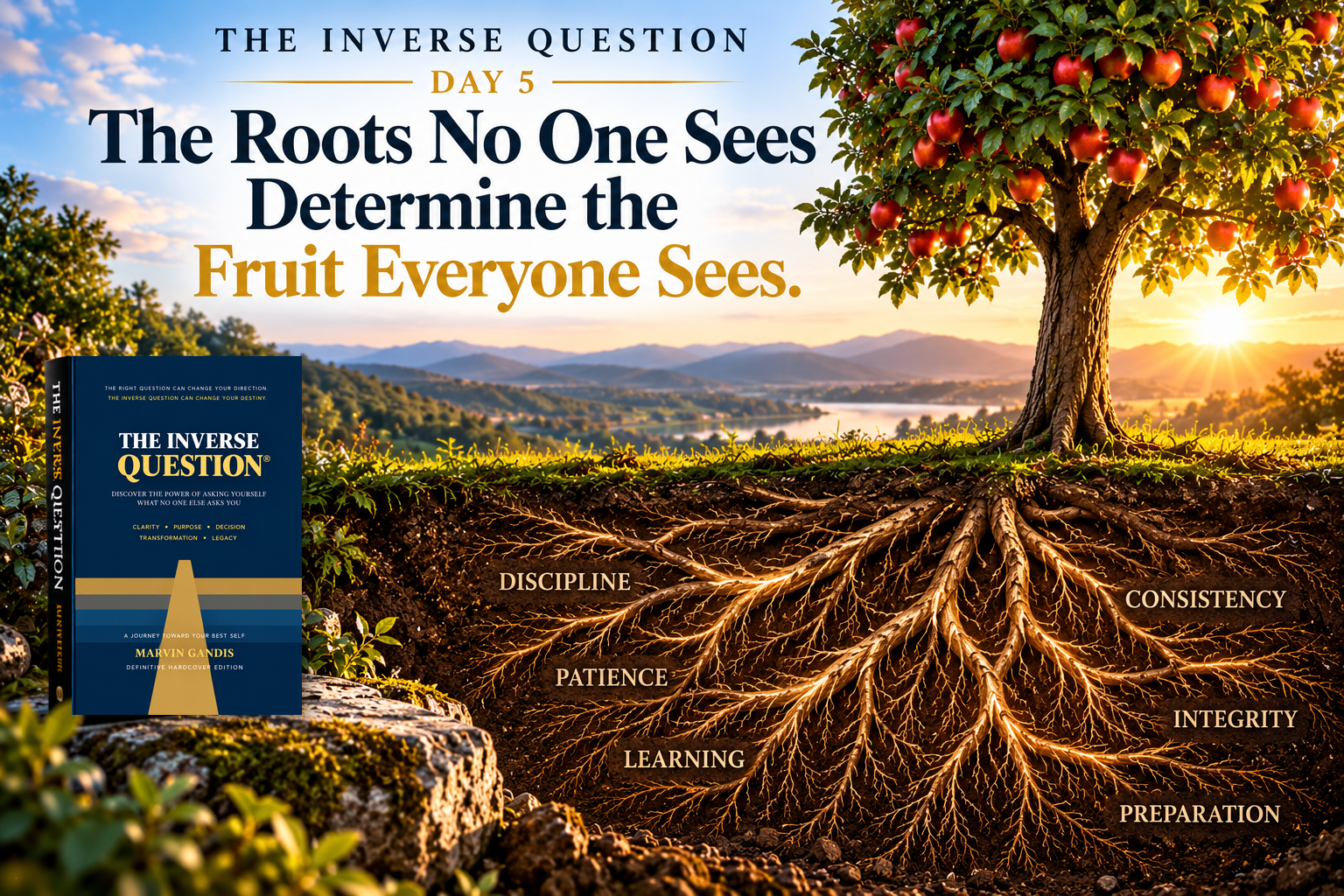
Day 5: The Roots No One Sees Determine the Fruit Everyone Sees
Day 6: Not Everything That Looks Like Progress Is Moving You Forward
Day 7: What Are You Tolerating Today That Is Building the Future You Do Not Want?
Day 8: Do Not Confuse Movement With Direction
Day 9: What Are You Doing Today That Your Future Self Will Thank You For?
Day 10: Who Are You Becoming Through the Choices You Repeat Every Day?
Day 11: What Are You Rehearsing Every Day That Is Quietly Becoming Your Identity?
Next:
Day 12 — How Much Is It Costing You to Keep Being the Same Person?
Because staying unchanged can feel safe while quietly becoming one of the most expensive decisions we make.
DISCLAIMER
This article is provided for educational, informational, motivational, and personal-reflection purposes only. It does not constitute medical, psychological, mental-health, legal, financial, business, career, relationship, or other professional advice.
The discussion of habits, self-talk, emotional responses, attention, identity, finances, relationships, discipline, and personal growth is general and may not apply equally to every person or circumstance.
Persistent emotional, behavioral, psychological, medical, financial, relationship, or other significant difficulties may require support from an appropriately qualified professional.
No specific personal, professional, financial, business, relationship, health, or life result is promised or guaranteed.
The Inverse Question series is intended to encourage thoughtful reflection, learning, awareness, responsible decision-making, intentional growth, and independent judgment.

Debe estar conectado para enviar un comentario.