By Marvin Gandis
Your Mind Can Be Your Prison or Your Bridge
My dear reader, many people want to change their lives, but very few start in the right place: the mind.
We want better results, better relationships, more money, more peace, more discipline, and more success, yet we continue thinking the same way, reacting the same way, and repeating the same habits that keep us stuck.
Here is the truth:
- You cannot build a new life with an old mental program.
Mental reprogramming does not mean denying reality, living in fantasy, or repeating beautiful phrases without action. It means learning to observe your thoughts, identify the patterns that limit you, and replace them with beliefs, habits, and decisions that help you move forward.
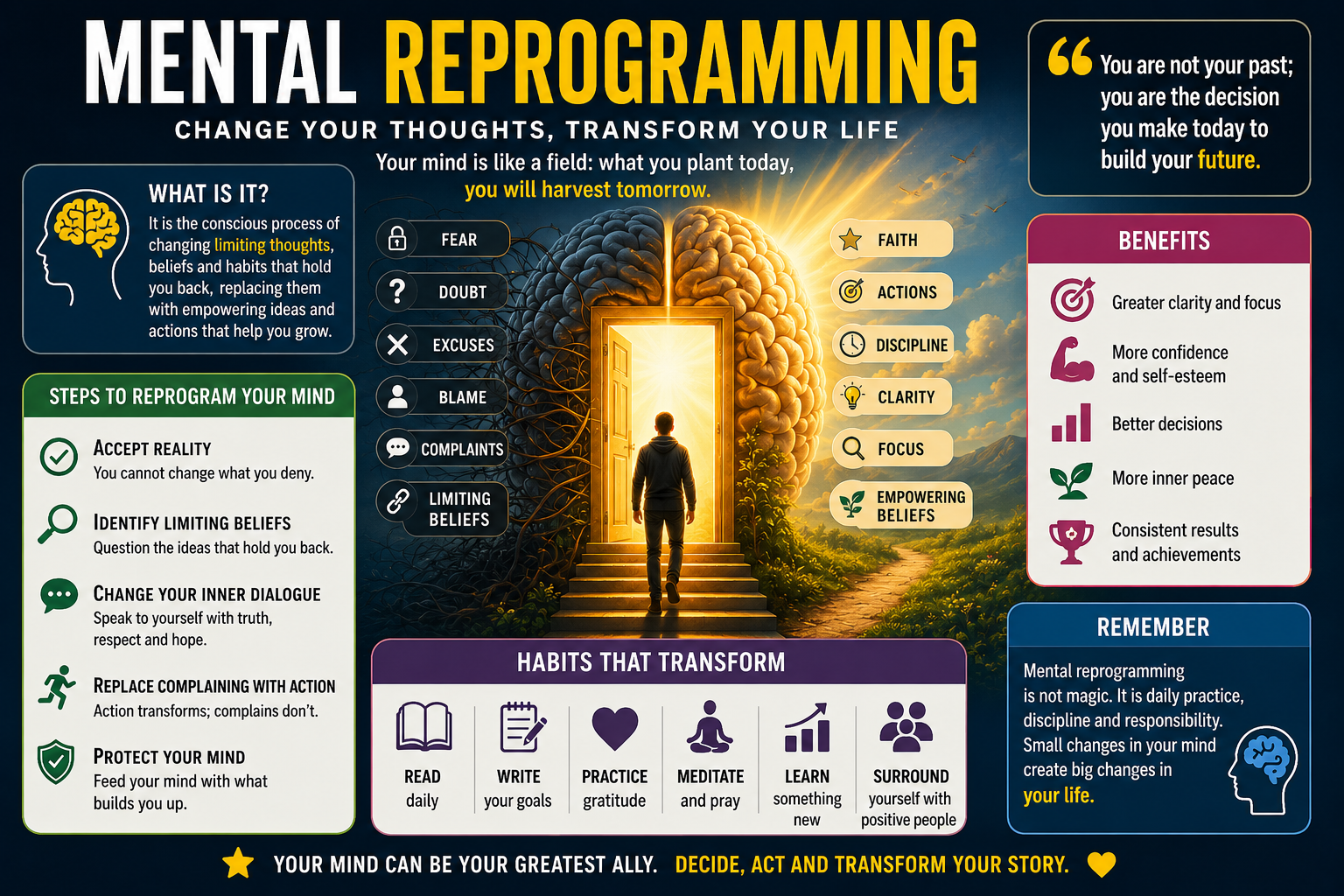
Your mind is like a field. If you plant fear, complaints, blame, and excuses, you will eventually harvest frustration. But if you plant responsibility, faith, discipline, clarity, and action, you begin to build a different life.
What Is Mental Reprogramming?
Mental reprogramming is the process of consciously changing the thoughts, beliefs, emotional habits, and inner patterns that influence your daily behavior.
We have all been programmed in some way.
Since childhood, many people have heard phrases such as:
- “That is too hard.”
- “We were not born for that.”
- “Money is bad.”
- “I cannot do it.”
- “I always fail.”
- “Life is unfair.”
- “Nobody supports me.”
- “It is too late.”
Many of those phrases enter the mind like seeds. At first, they seem small, but over time, they become beliefs. Those beliefs become decisions. And those decisions eventually create results.
That is why many people do not fail because they lack ability. They fail because they live under a mental program that tells them they cannot.
The Subconscious Mind: The Hidden File That Directs Much of Your Life
The subconscious mind stores memories, emotions, experiences, fears, wounds, habits, and automatic responses.
For example, a person may want to start a business, but if deep inside they believe that “selling is bothering people,” they will be afraid to offer their product or service.
Another person may want to save money, but if they grew up hearing that “money never lasts,” they may live with financial anxiety even when opportunities appear.
Another person may want to speak in public, but if they were embarrassed in the past, they may avoid being seen because of fear of rejection.
We do not always act according to what we want. Many times, we act according to what we deeply believe.
That is why mental reprogramming is so important. It is not just about feeling motivated for one day. It is about working on the root.
Signs That You Need to Reprogram Your Mindset
You may need to renew your mindset if you often:
- Feel like you want to move forward, but something inside stops you.
- Start projects but do not finish them.
- Fear rejection, failure, or criticism.
- Compare yourself too much with others.
- Self-sabotage when things begin to improve.
- Say “that is just who I am” as an excuse not to change.
- Always blame other people for your results.
- Struggle to take responsibility for your decisions.
- Wait for motivation, but avoid discipline.
- Have big dreams but small actions.
The good news is that no mental program has to be permanent. What was learned can be unlearned. What is negative can be replaced. The mind can be trained.
Step 1: Accept Reality Without Covering It Up
The first step toward true mental reprogramming is accepting reality.
You cannot change what you deny.
Many people want to improve, but they do not want to recognize their mistakes. They prefer to blame the government, the economy, their family, their past, their boss, their partner, their friends, or their circumstances.
- Yes, life can be difficult.
- Yes, injustice exists.
- Yes, inequality is real.
- Yes, many people face serious obstacles.
But it is also true that many of our results are connected to our decisions, habits, thoughts, and lack of action.
Accepting this is not about punishing yourself. It is about freeing yourself.
Because when you accept responsibility, you recover power.
The victim asks: “Why is this happening to me?”
- The responsible person asks: “What can I learn, and what can I do now?”
Step 2: Identify Your Limiting Beliefs
A limiting belief is an idea you accepted as truth, even though it is holding back your growth.
Examples:
- “I am not smart enough.”
- “I do not have time.”
- “I do not have talent.”
- “I am too old.”
- “Everything goes wrong for me.”
- “Success is only for other people.”
- “I was not born to build a business.”
- “I do not deserve better.”
The important question is: Who told you that?
- Was it an experience?
- Was it a person?
- Was it a failure?
- Was it a comparison?
- Was it fear?
Many limiting beliefs are not truths. They are wounds speaking.
To reprogram your mind, you must question those ideas.
Instead of saying: “I cannot.”
- You can begin saying: “I am still learning.”
Instead of saying: “I always fail.”
- You can say: “Every mistake is showing me what I need to improve.”
Instead of saying: “I have no opportunity.”
- You can say: “I will look for a way, a tool, a guide, or a new path.”
Step 3: Change Your Inner Dialogue
Your inner conversation creates your mental environment.
If every day you tell yourself:
- “I am a mess.”
- “I am not good enough.”
- “I will never make it.”
- “Everything is lost.”
- “Nobody understands me.”
Your mind will begin to obey those emotional instructions.
But if you begin speaking to yourself with more responsibility, faith, and direction, your behavior will also begin to change.
This is not about lying to yourself. It is about speaking truth with hope.
You can practice phrases like:
- “I am improving every day.”
- “My mistakes do not define my future.”
- “I can learn what I do not know.”
- “I will act even when I feel afraid.”
- “My discipline will become stronger than my excuses.”
- “I am building a new version of myself.”
Inner dialogue does not change everything by itself, but it prepares the mind to take better action.
Step 4: Replace Complaining With Action
Complaining can become an emotional addiction.
It makes us feel like we are doing something when, in reality, we are only repeating the problem.
- Complaining about the economy does not change your economy.
- Complaining about a lack of opportunities does not create opportunities.
- Complaining about past mistakes does not correct the present.
- Complaining about a lack of support does not build discipline.
Action transforms.
- If you lack knowledge, study.
- If you lack contacts, begin connecting.
- If you lack discipline, create a routine.
- If you lack money, learn skills that can produce income.
- If you lack clarity, write your goals and organize your priorities.
Mental reprogramming is not passive. It is practical.
A new mind requires new actions.
Step 5: Protect What Enters Your Mind
Your mind is fed by what you watch, hear, read, and repeat.
If every day you consume fear, drama, gossip, negative news, vulgar content, comparisons, and toxic conversations, your mind will eventually become filled with anxiety, anger, and confusion.
Not everything deserves your attention.
Your attention is a seed. Wherever you place it, something grows.
So ask yourself:
- What am I watching daily?
- What am I listening to?
- Who am I talking to?
- What ideas am I allowing into my mind?
- What type of content is shaping my view of life?
You cannot feed your mind with garbage and expect clarity, peace, and purpose.
Protect your mind the way you protect your home.
Step 6: Create New Mental Habits
The mind is reprogrammed through repetition.
It is not enough to read something inspiring once. You need daily habits that reinforce your new mindset.
Powerful habits include:
- Reading educational or spiritual content daily.
- Write your goals in the morning.
- Practicing gratitude.
- Meditating or spending time in silence.
- Praying, if that is part of your faith.
- Listening to positive audio.
- Learning new skills.
- Surround yourself with growth-minded people.
- Reviewing your progress weekly.
- Celebrating small wins.
Transformation does not happen overnight. It happens when you repeat the right decisions until they become part of your identity.
Step 7: Stop Using the Past as a Prison
We have all made mistakes. We have all failed. We have all made poor decisions. We all have stories that could become excuses.
But the past should be a teacher, not a prison.
- A poor decision can teach you.
- A fall can awaken you.
- A loss can mature you.
- A betrayal can give you discernment.
- A failure can reveal a new strategy.
But if you turn your past into your identity, you will remain trapped in what has already happened.
- You are not only what you suffered.
- You are not only what you lost.
- You are not only what you did wrong.
- You can still learn.
- You can still change.
- You can still begin again.
Step 8: Use Visualization Responsibly
Visualization is not fantasy without work.
Visualization means training your mind to see a clear direction and then acting with intention.
You can visualize yourself:
- Speaking with more confidence.
- Finishing a project.
- Take better care of your health.
- Managing your finances with discipline.
- Building a business.
- Overcoming a fear.
- Responding calmly instead of reacting with anger.
But after visualization, you must act.
- Vision without action becomes illusion.
- Action without vision becomes disorder.
- When you combine vision and action, you begin to move with purpose.
Step 9: Surround Yourself With People Who Elevate Your Mindset
Not everyone should have deep access to your mind.
Some people constantly criticize, mock, discourage, manipulate, or plant fear. If you spend too much time with them, sooner or later, you may begin to think like them.
- Look for people who healthily challenge you.
- People who inspire you.
- People who are growing.
- People who speak the truth with respect.
- People who do not feed your excuses.
- People who celebrate your progress.
Your environment influences your mindset.
You do not need to hate anyone, but you do need to protect your circle.
Step 10: Act Even When You Do Not Feel Ready
Many people wait until they feel ready to begin. But confidence does not always appear before action. Many times, it appears after the action.
Do not wait for everything to be perfect.
- Start with what you have.
- Learn as you move.
- Correct as you grow.
- Accept that progress will be imperfect.
The mind is reprogrammed when you prove through action that a new life is possible.
Every time you act despite fear, you teach your mind:
- “I am not a slave to my emotions.”
Every time you choose discipline over excuses, you teach your mind:
- “I can trust myself.”
Every time you rise after falling, you teach your mind:
- “My story is not over.”
Mental Reprogramming Also Requires Humility
Humility is essential because many people do not change, believing they already know everything.
But a person who wants to grow must be willing to recognize:
- “I was wrong.”
- “I need to learn.”
- “I need to improve.”
- “I need to apologize.”
- “I need to change my attitude.”
- “I need to stop blaming others.”
Humility does not make you weak. It makes you teachable.
And a teachable person always has more opportunity to grow than a proud person trapped in excuses.
Practical Mental Reprogramming Exercise
Take a sheet of paper and create three columns.
Column 1: Limiting Thought
- Example: “I am not good at selling.”
Column 2: New Truth
- Example: “I can learn to communicate the value of what I offer.”
Column 3: Daily Action
- Example: “I will study communication for 20 minutes a day and practice with one person.”
Do this with your main negative thoughts.
It is not enough to change phrases. You must connect each new belief with an action.
Powerful Phrases to Reprogram Your Mind
- “I am not my past; I am the decision I make today.”
- “My mistakes can teach me, but they do not have permission to rule me.”
- “I can start small and grow with discipline.”
- “Clarity comes when I stop running and start acting.”
- “I do not need to have everything figured out to take the first step.”
- “My mind becomes stronger when I choose truth, responsibility, and action.”
- “Today I will not feed excuses; I will build solutions.”
Change Your Mind, Change Your Direction
My dear reader, mental reprogramming is not magic. It is a daily responsibility.
It is decided that you will no longer live under the control of thoughts that destroy your confidence. It refuses to justify what keeps you stuck. It is accepting your mistakes without hating yourself. It is looking at reality without covering it up. It is taking action even when fear is still present.
You do not need to become a perfect person. You need to become an honest, disciplined, and teachable person.
- Your mind can be renewed.
- Your story can take a new direction.
- Your habits can improve.
- Your character can become stronger.
- Your future can be different.
But it all begins with one decision:
Stop obeying the old programming and start building a new mindset.
If This Message Spoke To Your Life
Share it with someone who needs to remember that they can still change, rise, and begin again.
Sometimes, The Right Word At The Right Moment Can Awaken A New Direction.
Disclaimers
Educational disclaimer: This article is for educational, motivational, and personal reflection purposes only. It does not replace professional medical, psychological, financial, legal, or therapeutic advice. If you are dealing with severe anxiety, depression, trauma, emotional crisis, or any mental health condition, please seek help from a qualified professional.
Results disclaimer: Mental reprogramming requires practice, consistency, and personal responsibility. Results may vary depending on each person’s situation, commitment, and actions.

Debe estar conectado para enviar un comentario.