Publicado en Business Growth, Education, Leadership, Mindset, Personal Development, Success

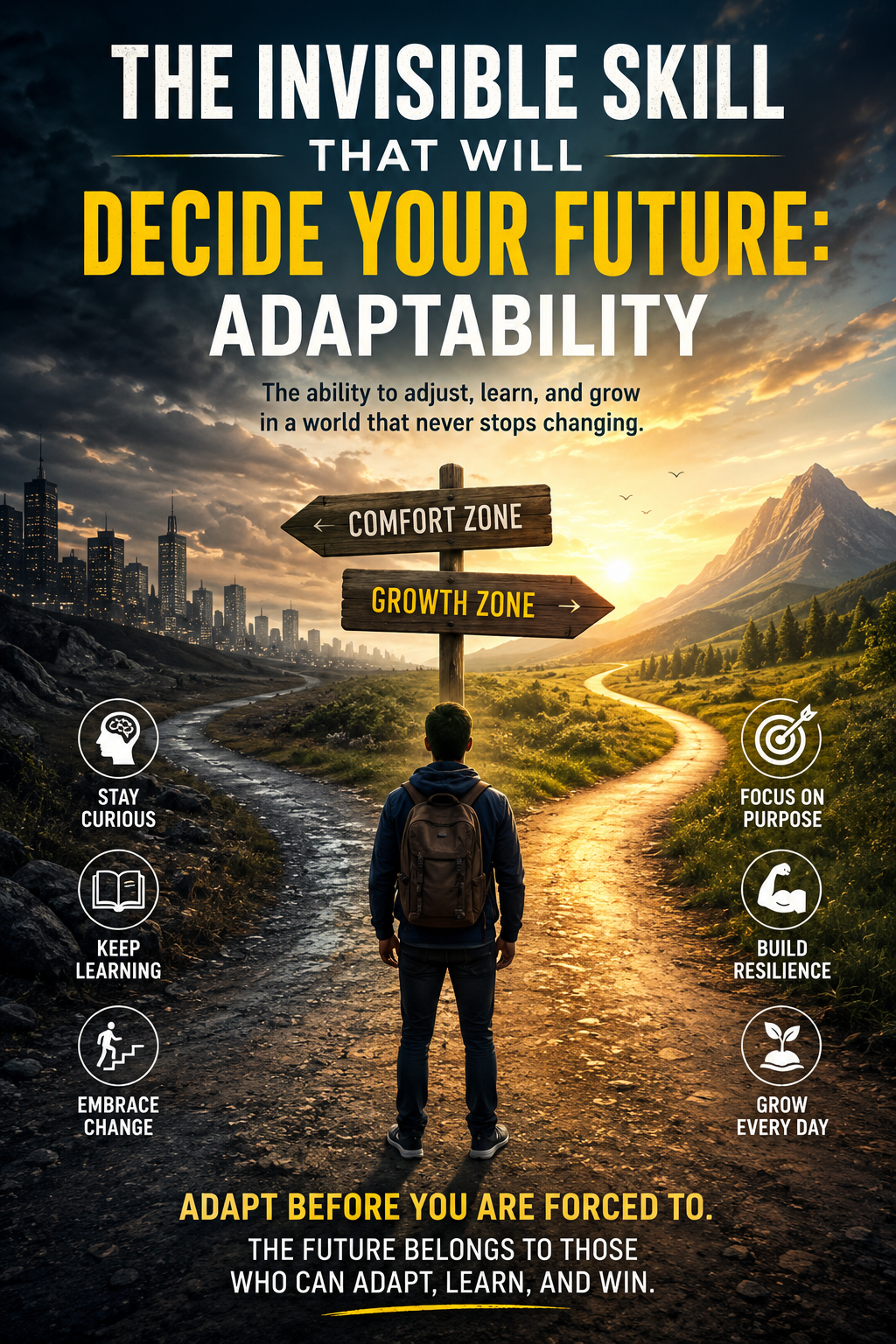
The Invisible Skill That Will Decide Your Future: Learning How to Adapt Before Life Forces You To

By Marvin Gandis

The World Is Not Waiting for Anyone

There is a quiet truth many people ignore until life becomes uncomfortable:

The future does not belong only to the strongest, the smartest, or even the most talented. The future belongs to those who know how to adapt.

We live in a time where everything changes quickly. Technology changes. Jobs change. Businesses change. Relationships change. The economy changes. Even the way people communicate, buy, learn, work, and trust others is changing.

Yet many people are still trying to succeed with the same mindset they had five, ten, or twenty years ago.

They are waiting for things to return to normal.

But what if “normal” is not coming back?

What if the new advantage in life is not simply having more money, more education, or more contacts—but having the ability to adjust, learn, improve, and move forward when the world changes around you?

That skill has a name:

Adaptability.

And in the coming years, it may become one of the most valuable skills a person can develop.


Adaptability Is Not Weakness — It Is Intelligence in Motion

Many people confuse adaptation with surrender.

They think adapting means giving up your values, changing your identity, or accepting defeat. But true adaptation is not about becoming someone else. It is about becoming strong enough to respond wisely to new circumstances.

A tree that refuses to bend in a storm may break. But a tree that bends without losing its roots survives.

That is adaptability.

It means you keep your principles, but you change your methods.

You keep your purpose, but you adjust your strategy.

You keep your dream, but you improve your plan.

The person who adapts is not unstable. The person who adapts is awake.


The Most Dangerous Phrase Is: “I Have Always Done It This Way”

There is nothing wrong with experience. Experience is valuable. But experience becomes dangerous when it turns into resistance.

Many people fail not because they lack ability, but because they become emotionally attached to old methods.

They say:

  • “I have always done it this way.”
  • “That will never work.”
  • “I don’t need to learn that.”
  • “This new generation doesn’t understand.”
  • “Things were better before.”

Maybe some things were better before. But life does not move backward to comfort us. Life moves forward and asks us to grow.

In business, this can destroy progress.

A person may have a good product, a good message, or a good opportunity, but if they refuse to learn new tools, new platforms, new ways to communicate, and new ways to build trust, they slowly become invisible.

Not because they are bad.

Not because they have nothing to offer.

But because they stopped adapting.


The Marketplace Rewards Those Who Pay Attention

The marketplace is always speaking.

People’s habits tell us what they care about. Their questions reveal their fears. Their silence reveals confusion. Their clicks reveal curiosity. Their complaints reveal problems waiting for solutions.

The wise person pays attention.

Instead of saying, “Why is nobody listening to me?” they ask:

  • “What are people actually struggling with?”
  • “How can I explain this more clearly?”
  • “Is my message helping, teaching, or only selling?”
  • “Am I building trust before asking for action?”
  • “Am I using the tools people actually use today?”

Adaptability begins when we stop blaming the audience and start studying the audience.

This does not mean blindly chasing trends. It means understanding people deeply.

Trends change, but human needs remain: security, hope, clarity, belonging, progress, peace, confidence, and opportunity.

The adaptable person learns how to connect timeless human needs with modern communication.

That is powerful.


Adaptability Requires Humility

One of the hardest parts of adapting is admitting that we still need to learn.

This is difficult because the ego wants to appear finished, polished, and certain. But growth requires honesty.

A beginner who knows they are learning is often more dangerous than an expert who thinks they already know everything.

Humility says:

  • “I can improve.”
  • “I can ask better questions.”
  • “I can study what is working.”
  • “I can correct my mistakes.”
  • “I can learn from younger people.”
  • “I can learn from failure without becoming failure.”

This kind of humility is not weakness. It is maturity.

A humble person can be corrected without being destroyed. They can receive feedback without feeling attacked. They can change direction without feeling ashamed.

That is why humility and adaptability go hand in hand.

You cannot adapt while pretending you already know everything.


The Future Will Punish Passive People

This may sound strong, but it is necessary:

The future will not be kind to passive people.

Passive people wait too long.

They wait for perfect timing.

They wait until they feel ready.

They wait until someone explains everything.

They wait until success is guaranteed.

They wait until fear disappears.

But fear does not disappear before action. Fear usually gets smaller after action.

The adaptable person does not need perfect confidence to begin. They begin, observe, learn, adjust, and continue.

That is how progress is built.

Not in one dramatic moment.

Not in one lucky opportunity.

Not in one viral post.

Progress is built through repeated adjustment.

You try. You learn. You improve. You try again.

That cycle is one of the greatest secrets of successful people.


Adaptability Does Not Mean Following Every Trend

There is a difference between being adaptable and being distracted.

Some people jump from idea to idea, tool to tool, business to business, and strategy to strategy. They call it adaptation, but it is really confusion.

True adaptability is not panic.

It is an intelligent adjustment.

You do not need to follow every trend. You do not need to use every platform. You do not need to copy everyone who seems successful.

You need to know your mission, understand your audience, and improve your method.

The question is not:

  • “What is everyone doing?”

The better question is:

“What change would make my message clearer, my service better, and my results stronger?”

That is focused adaptation.


The Person Who Learns Faster Has the Advantage

In the past, people often competed based on resources: money, location, connections, or formal education.

Those things still matter, but today there is another advantage:

  • learning speed.

The person who learns faster can recover faster.

They can test ideas faster.

They can understand tools faster.

They can recognize mistakes faster.

They can improve communication faster.

They can respond to change faster.

This is why continuous learning is not optional anymore. It is survival.

But learning does not only mean taking courses or reading books. It also means paying attention to your own life.

  • Every failure is data.
  • Every rejection is information.
  • Every delay is a lesson.
  • Every mistake is a mirror.

The question is: are you learning from what happens to you, or are you only suffering through it?

The adaptable person turns experience into education.


Emotional Adaptability May Be Even More Important

Adapting is not only about technology, business, or strategy. It is also emotional.

  • Can you stay calm when things change?
  • Can you think clearly when plans fail?
  • Can you keep moving when results are slow?
  • Can you receive criticism without losing your identity?
  • Can you adjust without becoming bitter?

Many people are mentally capable but emotionally fragile. They know what to do, but frustration controls them. They have ideas, but disappointment paralyzes them.

This is why emotional adaptability matters.

It teaches you to say:

  • “This did not work, but I am not finished.”
  • “This season is difficult, but I can still grow.”
  • “This result disappointed me, but it can teach me.”
  • “I may need a new strategy, but I do not need to quit my purpose.”

That kind of emotional strength is rare.

And rare things have value.


How to Build Adaptability in Your Daily Life

Adaptability is not built in theory. It is built in practice.

Here are simple ways to develop it:

Ask better questions

Instead of asking, “Why is this happening to me?” ask, “What can this teach me?”

Instead of asking, “Why don’t people support me?” ask, “How can I communicate with more clarity and value?”

Update your skills regularly

Do not wait until you are forced to learn. Learn before pressure arrives.

Study communication, digital tools, financial habits, leadership, emotional discipline, and problem-solving.

Detach from one method

Your goal may remain the same, but your path may need to change.

Do not worship the method. Respect the mission.

Review your results honestly

If something is not working, do not pretend it is. Look at the facts. Adjust with wisdom.

Honesty saves time.

Stay rooted in values

Adaptability without values becomes compromise. Values without adaptability can become rigidity.

You need both: strong roots and flexible branches.


The Real Winners Will Be the Ones Who Can Reinvent Without Losing Themselves

Life will ask every person to reinvent something.

Maybe your career.

Maybe your business.

Maybe your habits.

Maybe your mindset.

Maybe your communication.

Maybe your relationship with money.

Maybe your relationship with yourself.

Reinvention does not mean your past was wasted. It means your past prepared you for a new level.

The lessons you learned still matter. The pain you survived still matters. The skills you developed still matter. The wisdom you gained still matters.

But now you may need to use them in a new way.

That is not failure.

That is evolution.

The person who can reinvent without losing their soul becomes very difficult to defeat.


Adapt Before You Are Forced To

The greatest mistake is waiting until life gives you no choice.

Do not wait until your job disappears to learn new skills.

Do not wait until your business fails to improve your message.

Do not wait until your audience ignores you to study communication.

Do not wait until your confidence is broken to develop emotional strength.

Do not wait until the storm arrives to strengthen your roots.

  • Adapt now.
  • Learn now.
  • Adjust now.
  • Grow now.

The future is not asking you to be perfect.

It is asking you to be awake.

And those who are awake, humble, flexible, and willing to grow will always have a chance to rise again.

Because the world may change, but the adaptable person does not disappear. The adaptable person transforms.


Disclaimer:


The articles and content ideas provided are for educational, inspirational, and informational purposes only. They are designed to encourage reflection, personal growth, digital awareness, and responsible decision-making. They should not be considered financial, legal, medical, psychological, or professional advice.

Any business, marketing, personal development, or income-related examples mentioned are not guarantees of results. Individual outcomes may vary depending on effort, consistency, experience, market conditions, personal discipline, and other factors beyond our control.

Readers are encouraged to do their own research, seek qualified professional guidance when necessary, and make decisions based on their own situation, values, and responsibilities.
Publicado en Inner Growth, Mindset, Motivation, Personal Development, Self-Improvement

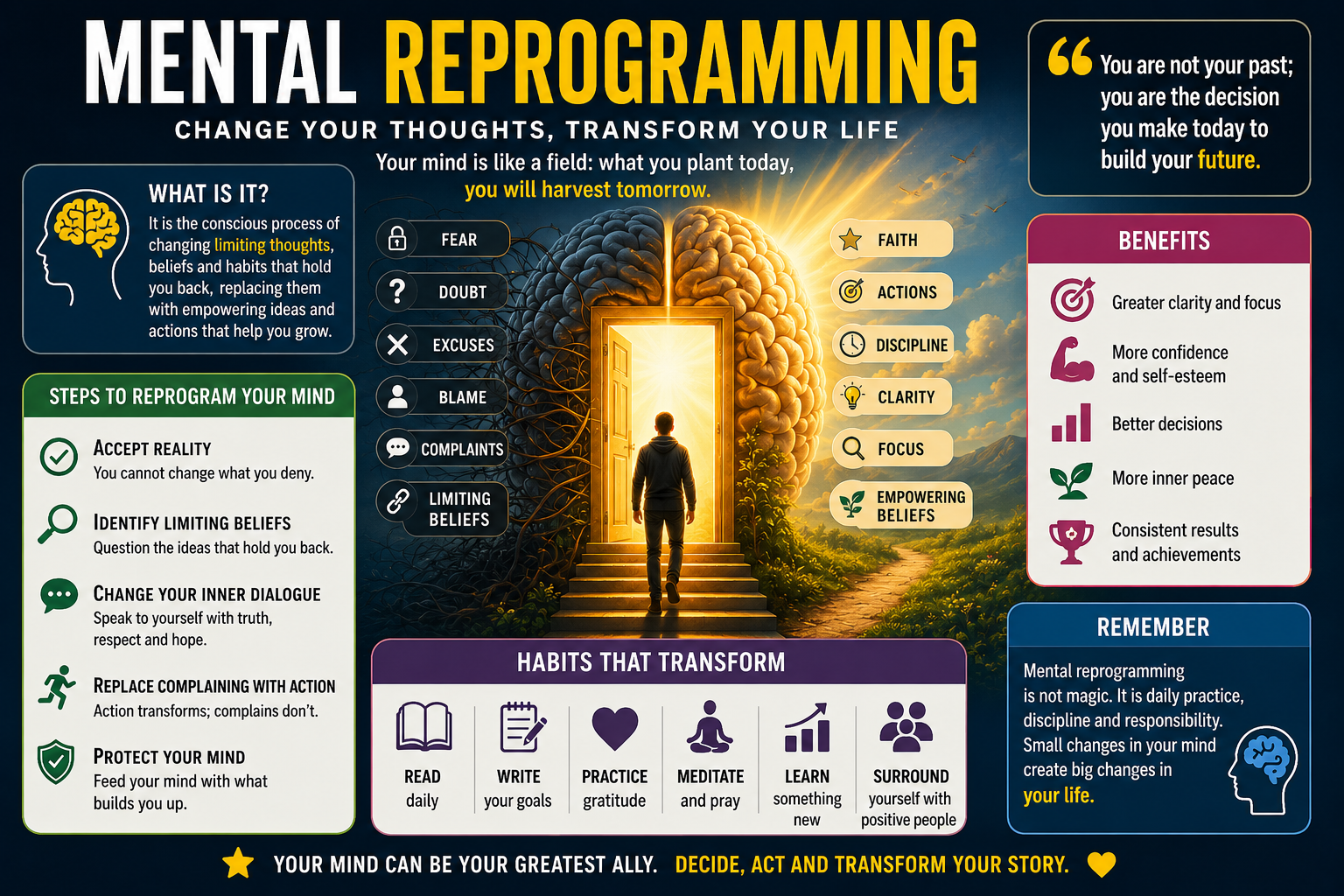
Mental Reprogramming: How to Renew Your Thoughts and Transform Your Life

By Marvin Gandis

Your Mind Can Be Your Prison or Your Bridge

My dear reader, many people want to change their lives, but very few start in the right place: the mind.

We want better results, better relationships, more money, more peace, more discipline, and more success, yet we continue thinking the same way, reacting the same way, and repeating the same habits that keep us stuck.

Here is the truth:

  • You cannot build a new life with an old mental program.

Mental reprogramming does not mean denying reality, living in fantasy, or repeating beautiful phrases without action. It means learning to observe your thoughts, identify the patterns that limit you, and replace them with beliefs, habits, and decisions that help you move forward.

Your mind is like a field. If you plant fear, complaints, blame, and excuses, you will eventually harvest frustration. But if you plant responsibility, faith, discipline, clarity, and action, you begin to build a different life.


What Is Mental Reprogramming?

Mental reprogramming is the process of consciously changing the thoughts, beliefs, emotional habits, and inner patterns that influence your daily behavior.

We have all been programmed in some way.

Since childhood, many people have heard phrases such as:

  • “That is too hard.”
  • “We were not born for that.”
  • “Money is bad.”
  • “I cannot do it.”
  • “I always fail.”
  • “Life is unfair.”
  • “Nobody supports me.”
  • “It is too late.”

Many of those phrases enter the mind like seeds. At first, they seem small, but over time, they become beliefs. Those beliefs become decisions. And those decisions eventually create results.

That is why many people do not fail because they lack ability. They fail because they live under a mental program that tells them they cannot.


The Subconscious Mind: The Hidden File That Directs Much of Your Life

The subconscious mind stores memories, emotions, experiences, fears, wounds, habits, and automatic responses.

For example, a person may want to start a business, but if deep inside they believe that “selling is bothering people,” they will be afraid to offer their product or service.

Another person may want to save money, but if they grew up hearing that “money never lasts,” they may live with financial anxiety even when opportunities appear.

Another person may want to speak in public, but if they were embarrassed in the past, they may avoid being seen because of fear of rejection.

We do not always act according to what we want. Many times, we act according to what we deeply believe.

That is why mental reprogramming is so important. It is not just about feeling motivated for one day. It is about working on the root.


Signs That You Need to Reprogram Your Mindset

You may need to renew your mindset if you often:

  • Feel like you want to move forward, but something inside stops you.
  • Start projects but do not finish them.
  • Fear rejection, failure, or criticism.
  • Compare yourself too much with others.
  • Self-sabotage when things begin to improve.
  • Say “that is just who I am” as an excuse not to change.
  • Always blame other people for your results.
  • Struggle to take responsibility for your decisions.
  • Wait for motivation, but avoid discipline.
  • Have big dreams but small actions.

The good news is that no mental program has to be permanent. What was learned can be unlearned. What is negative can be replaced. The mind can be trained.


Step 1: Accept Reality Without Covering It Up

The first step toward true mental reprogramming is accepting reality.

You cannot change what you deny.

Many people want to improve, but they do not want to recognize their mistakes. They prefer to blame the government, the economy, their family, their past, their boss, their partner, their friends, or their circumstances.

  • Yes, life can be difficult.
  • Yes, injustice exists.
  • Yes, inequality is real.
  • Yes, many people face serious obstacles.

But it is also true that many of our results are connected to our decisions, habits, thoughts, and lack of action.

Accepting this is not about punishing yourself. It is about freeing yourself.

Because when you accept responsibility, you recover power.

The victim asks: “Why is this happening to me?”

  • The responsible person asks: “What can I learn, and what can I do now?”

Step 2: Identify Your Limiting Beliefs

A limiting belief is an idea you accepted as truth, even though it is holding back your growth.

Examples:

  • “I am not smart enough.”
  • “I do not have time.”
  • “I do not have talent.”
  • “I am too old.”
  • “Everything goes wrong for me.”
  • “Success is only for other people.”
  • “I was not born to build a business.”
  • “I do not deserve better.”

The important question is: Who told you that?

  • Was it an experience?
  • Was it a person?
  • Was it a failure?
  • Was it a comparison?
  • Was it fear?

Many limiting beliefs are not truths. They are wounds speaking.

To reprogram your mind, you must question those ideas.

Instead of saying: “I cannot.”

  • You can begin saying: “I am still learning.”

Instead of saying: “I always fail.”

  • You can say: “Every mistake is showing me what I need to improve.”

Instead of saying: “I have no opportunity.”

  • You can say: “I will look for a way, a tool, a guide, or a new path.”

Step 3: Change Your Inner Dialogue

Your inner conversation creates your mental environment.

If every day you tell yourself:

  • “I am a mess.”
  • “I am not good enough.”
  • “I will never make it.”
  • “Everything is lost.”
  • “Nobody understands me.”

Your mind will begin to obey those emotional instructions.

But if you begin speaking to yourself with more responsibility, faith, and direction, your behavior will also begin to change.

This is not about lying to yourself. It is about speaking truth with hope.

You can practice phrases like:

  • “I am improving every day.”
  • “My mistakes do not define my future.”
  • “I can learn what I do not know.”
  • “I will act even when I feel afraid.”
  • “My discipline will become stronger than my excuses.”
  • “I am building a new version of myself.”

Inner dialogue does not change everything by itself, but it prepares the mind to take better action.


Step 4: Replace Complaining With Action

Complaining can become an emotional addiction.

It makes us feel like we are doing something when, in reality, we are only repeating the problem.

  • Complaining about the economy does not change your economy.
  • Complaining about a lack of opportunities does not create opportunities.
  • Complaining about past mistakes does not correct the present.
  • Complaining about a lack of support does not build discipline.

Action transforms.

  • If you lack knowledge, study.
  • If you lack contacts, begin connecting.
  • If you lack discipline, create a routine.
  • If you lack money, learn skills that can produce income.
  • If you lack clarity, write your goals and organize your priorities.

Mental reprogramming is not passive. It is practical.

A new mind requires new actions.


Step 5: Protect What Enters Your Mind

Your mind is fed by what you watch, hear, read, and repeat.

If every day you consume fear, drama, gossip, negative news, vulgar content, comparisons, and toxic conversations, your mind will eventually become filled with anxiety, anger, and confusion.

Not everything deserves your attention.

Your attention is a seed. Wherever you place it, something grows.

So ask yourself:

  • What am I watching daily?
  • What am I listening to?
  • Who am I talking to?
  • What ideas am I allowing into my mind?
  • What type of content is shaping my view of life?

You cannot feed your mind with garbage and expect clarity, peace, and purpose.

Protect your mind the way you protect your home.


Step 6: Create New Mental Habits

The mind is reprogrammed through repetition.

It is not enough to read something inspiring once. You need daily habits that reinforce your new mindset.

Powerful habits include:

  • Reading educational or spiritual content daily.
  • Write your goals in the morning.
  • Practicing gratitude.
  • Meditating or spending time in silence.
  • Praying, if that is part of your faith.
  • Listening to positive audio.
  • Learning new skills.
  • Surround yourself with growth-minded people.
  • Reviewing your progress weekly.
  • Celebrating small wins.

Transformation does not happen overnight. It happens when you repeat the right decisions until they become part of your identity.


Step 7: Stop Using the Past as a Prison

We have all made mistakes. We have all failed. We have all made poor decisions. We all have stories that could become excuses.

But the past should be a teacher, not a prison.

  • A poor decision can teach you.
  • A fall can awaken you.
  • A loss can mature you.
  • A betrayal can give you discernment.
  • A failure can reveal a new strategy.

But if you turn your past into your identity, you will remain trapped in what has already happened.

  • You are not only what you suffered.
  • You are not only what you lost.
  • You are not only what you did wrong.
  • You can still learn.
  • You can still change.
  • You can still begin again.

Step 8: Use Visualization Responsibly

Visualization is not fantasy without work.

Visualization means training your mind to see a clear direction and then acting with intention.

You can visualize yourself:

  • Speaking with more confidence.
  • Finishing a project.
  • Take better care of your health.
  • Managing your finances with discipline.
  • Building a business.
  • Overcoming a fear.
  • Responding calmly instead of reacting with anger.

But after visualization, you must act.

  • Vision without action becomes illusion.
  • Action without vision becomes disorder.
  • When you combine vision and action, you begin to move with purpose.

Step 9: Surround Yourself With People Who Elevate Your Mindset

Not everyone should have deep access to your mind.

Some people constantly criticize, mock, discourage, manipulate, or plant fear. If you spend too much time with them, sooner or later, you may begin to think like them.

  • Look for people who healthily challenge you.
  • People who inspire you.
  • People who are growing.
  • People who speak the truth with respect.
  • People who do not feed your excuses.
  • People who celebrate your progress.

Your environment influences your mindset.

You do not need to hate anyone, but you do need to protect your circle.


Step 10: Act Even When You Do Not Feel Ready

Many people wait until they feel ready to begin. But confidence does not always appear before action. Many times, it appears after the action.

Do not wait for everything to be perfect.

  • Start with what you have.
  • Learn as you move.
  • Correct as you grow.
  • Accept that progress will be imperfect.

The mind is reprogrammed when you prove through action that a new life is possible.

Every time you act despite fear, you teach your mind:

  • “I am not a slave to my emotions.”

Every time you choose discipline over excuses, you teach your mind:

  • “I can trust myself.”

Every time you rise after falling, you teach your mind:

  • “My story is not over.”

Mental Reprogramming Also Requires Humility

Humility is essential because many people do not change, believing they already know everything.

But a person who wants to grow must be willing to recognize:

  • “I was wrong.”
  • “I need to learn.”
  • “I need to improve.”
  • “I need to apologize.”
  • “I need to change my attitude.”
  • “I need to stop blaming others.”

Humility does not make you weak. It makes you teachable.

And a teachable person always has more opportunity to grow than a proud person trapped in excuses.


Practical Mental Reprogramming Exercise

Take a sheet of paper and create three columns.

Column 1: Limiting Thought

  • Example: “I am not good at selling.”

Column 2: New Truth

  • Example: “I can learn to communicate the value of what I offer.”

Column 3: Daily Action

  • Example: “I will study communication for 20 minutes a day and practice with one person.”

Do this with your main negative thoughts.

It is not enough to change phrases. You must connect each new belief with an action.


Powerful Phrases to Reprogram Your Mind

  • “I am not my past; I am the decision I make today.”
  • “My mistakes can teach me, but they do not have permission to rule me.”
  • “I can start small and grow with discipline.”
  • “Clarity comes when I stop running and start acting.”
  • “I do not need to have everything figured out to take the first step.”
  • “My mind becomes stronger when I choose truth, responsibility, and action.”
  • “Today I will not feed excuses; I will build solutions.”

Change Your Mind, Change Your Direction

My dear reader, mental reprogramming is not magic. It is a daily responsibility.

It is decided that you will no longer live under the control of thoughts that destroy your confidence. It refuses to justify what keeps you stuck. It is accepting your mistakes without hating yourself. It is looking at reality without covering it up. It is taking action even when fear is still present.

You do not need to become a perfect person. You need to become an honest, disciplined, and teachable person.

  • Your mind can be renewed.
  • Your story can take a new direction.
  • Your habits can improve.
  • Your character can become stronger.
  • Your future can be different.

But it all begins with one decision:

Stop obeying the old programming and start building a new mindset.


If This Message Spoke To Your Life

Share it with someone who needs to remember that they can still change, rise, and begin again.

Sometimes, The Right Word At The Right Moment Can Awaken A New Direction.


Disclaimers

Educational disclaimer: This article is for educational, motivational, and personal reflection purposes only. It does not replace professional medical, psychological, financial, legal, or therapeutic advice. If you are dealing with severe anxiety, depression, trauma, emotional crisis, or any mental health condition, please seek help from a qualified professional.

Results disclaimer: Mental reprogramming requires practice, consistency, and personal responsibility. Results may vary depending on each person’s situation, commitment, and actions.

Publicado en Emotional Strength, Mindset, Motivation, Personal Development, Self-Mastery, Stoic Wisdom

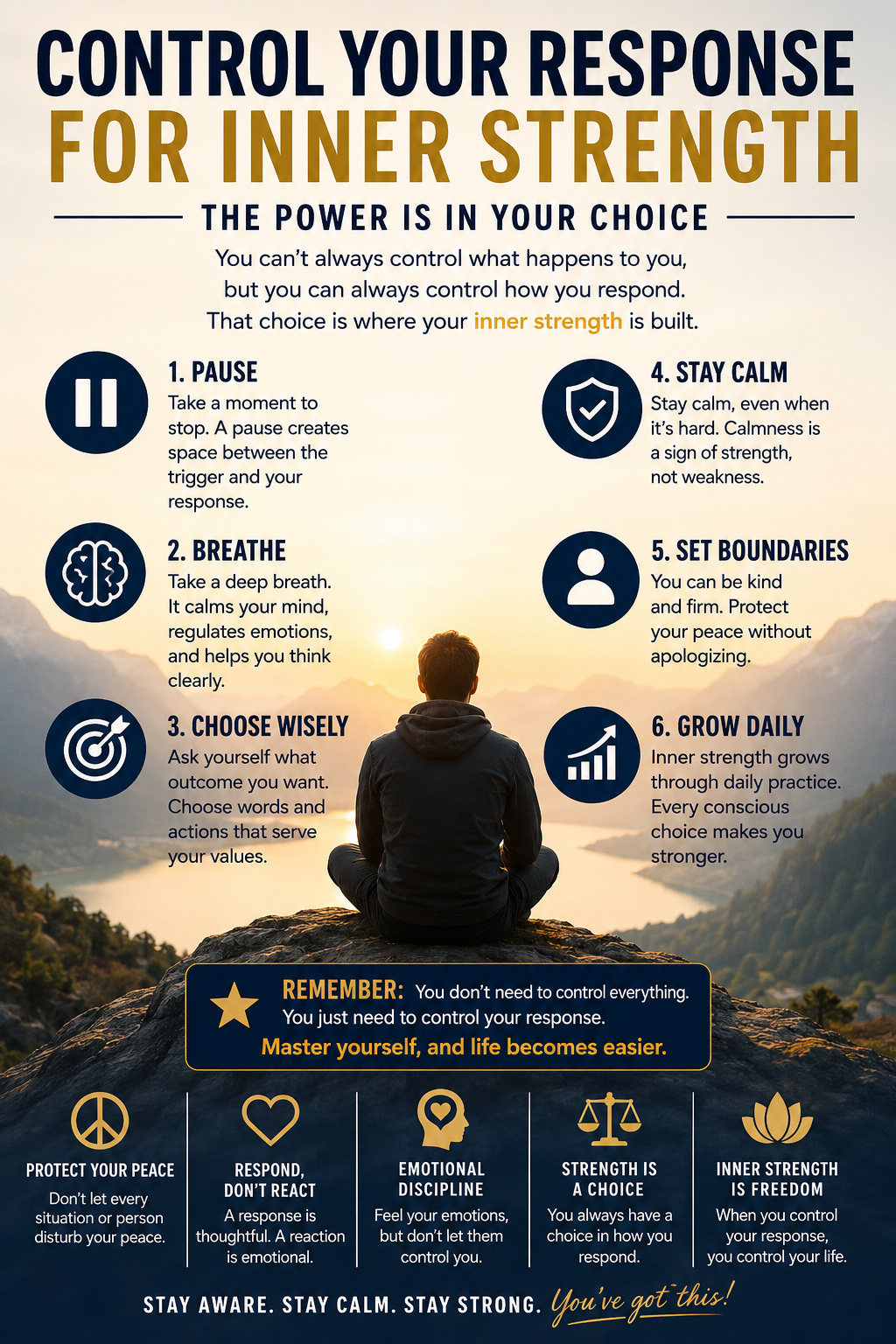
Control Your Response for Inner Strength: The Quiet Power of Self-Mastery

by Marvin Gandis

There is a powerful moment between what happens to you and how you respond.

That moment may be small. It may last only a few seconds. But inside that small space lives your strength, your wisdom, your peace, and your personal power.

Many people believe strength means speaking louder, reacting faster, or proving a point immediately. But true inner strength is often quiet. It is the ability to pause when emotions rise. It is the discipline to choose wisdom over impulse. It is the maturity to respond with purpose instead of reacting to pain.

Life will test everyone. People may disappoint you. Situations may change unexpectedly. Plans may fail. Words may hurt. Delays may frustrate you. But even when you cannot control everything around you, you can learn to control the way you respond.

That is where real strength begins.


The Difference Between Reacting and Responding

A reaction is usually emotional, fast, and uncontrolled. It often comes from anger, fear, pride, frustration, or insecurity.

A response is different. A response is chosen. It comes from awareness. It allows you to think, breathe, and decide what kind of person you want to be in that moment.

Reacting says, “I must defend myself right now.”

Responding says, “Let me handle this with wisdom.”

Reacting can damage relationships, create regret, and make a temporary problem worse. Responding can protect your peace, strengthen your character, and help you make better decisions.

You cannot always choose what happens, but you can choose whether your next action comes from weakness or strength.


Inner Strength Begins With the Pause

One of the most powerful habits you can develop is the pause.

Before answering a rude comment, pause.

Before sending an emotional message, pause.

Before deciding while angry, pause.

Before judging someone’s intention, pause.

The pause is not a weakness. The pause is power under control.

When you pause, you give your mind time to catch up with your emotions. You create space between the trigger and your response. In that space, you can ask yourself:

  • “Is this worth my peace?”
  • “Will my response solve the problem or make it worse?”
  • “Am I speaking from wisdom or from wounded pride?”
  • “What kind of example do I want to be right now?”

These questions can protect you from unnecessary conflict and emotional regret.


Emotional Control Is Not Emotional Suppression

Controlling your response does not mean pretending you are not hurt. It does not mean ignoring injustice. It does not mean allowing people to disrespect you.

Emotional control means you do not allow your emotions to drive without direction.

You can feel anger without becoming destructive.

You can feel pain without becoming bitter.

You can feel disappointment without losing your dignity.

You can set boundaries without cruelty.

You can speak the truth without losing control.

Real emotional strength is not about being cold or silent. It is about being clear, calm, and intentional.


Why Your Response Reveals Your Character

Anyone can act calm when life is easy. But pressure reveals what has been built inside.

Your response under pressure shows your level of discipline, patience, wisdom, and maturity. When you are provoked and still choose respect, that is strength. When you are misunderstood and still choose peace, that is strength. When you are disappointed and still choose faith, that is strength.

The strongest people are not those who never feel emotion. They are those who do not become slaves to every emotion they feel.

Your response is your signature. It tells the world what controls you.

Does anger control you?

Does fear control you?

Does pride control you?

Or do wisdom, faith, and discipline guide your actions?


The Cost of Uncontrolled Reactions

Uncontrolled reactions can be expensive.

They can cost you peace.

They can damage relationships.

They can close opportunities.

They can create unnecessary enemies.

They can cause you to say words you later wish you could take back.

A moment of reaction can create days, months, or even years of consequences.

This is why self-control is not just a personal virtue. It is a life strategy.

Every time you control your response, you protect your future. You protect your reputation. You protect your emotional energy. You protect the person you are becoming.


How to Control Your Response in Difficult Moments

The first step is awareness. Notice what triggers you. Is it criticism? Rejection? Delay? Disrespect? Feeling ignored? Feeling misunderstood?

When you know your triggers, you can prepare yourself instead of being controlled by surprise.

The second step is breathing. A slow breath can interrupt an emotional reaction. It gives your nervous system a signal that you are safe and do not need to explode.

The third step is choosing your words carefully. Not every thought needs to become a sentence. Not every emotion needs to become an announcement. Not every argument deserves your energy.

The fourth step is asking yourself what outcome you want. Do you want peace? Do you want clarity? Do you want a resolution? Do you want to protect your dignity?

Your response should serve your purpose, not your impulse.


Silence Can Be a Strong Response

Sometimes the strongest response is silence.

Silence does not always mean you have nothing to say. Sometimes it means you have too much wisdom to waste words in the wrong place.

You do not need to attend every argument.

You do not need to correct every misunderstanding.

You do not need to prove yourself to people committed to misjudging you.

Silence can protect your peace. Silence can give you time to think. Silence can prevent emotional damage. Silence can show that you are not controlled by every provocation.

But silence should be used with wisdom. There are moments to speak, and there are moments to step back. Inner strength is knowing the difference.


Boundaries Are Part of Inner Strength

Controlling your response does not mean allowing people to walk over you.

A calm person can still be firm.

A peaceful person can still say no.

A kind person can still create distance.

A mature person can still refuse disrespect.

Boundaries are not anger. Boundaries are clarity.

You can say:

“I need time to think before I answer.”

“I do not want to continue this conversation if it becomes disrespectful.”

“I understand your point, but I do not agree.”

“I choose not to respond in anger.”

“This is not healthy for me, so I need to step away.”

These statements are not weak. They are powerful because they are controlled, clear, and respectful.


Inner Strength Grows Through Daily Practice

Self-control is not built in one day. It is developed through small daily decisions.

Every time you choose patience instead of irritation, you grow stronger.

Every time you choose understanding instead of judgment, you grow stronger.

Every time you choose discipline instead of impulse, you grow stronger.

Every time you choose peace instead of drama, you grow stronger.

Inner strength is like a muscle. It grows through resistance.

The difficult person, the delay, the criticism, the disappointment, and the unexpected problem may all become training grounds for your character.

You do not have to like the test to grow from it.


Choose the Person You Want to Become

Before you respond, remember this:

Your response is not only about the situation. It is also about your identity.

Are you becoming a person of peace?

Are you becoming a person of wisdom?

Are you becoming a person of emotional maturity?

Are you becoming someone who can be trusted under pressure?

Every response is a vote for the person you are becoming.

Do not let temporary emotions make permanent decisions for you. Do not let someone else’s behavior pull you away from your values. Do not give your peace away to every situation that demands a reaction.

You are stronger when you are not easily controlled.

You are wiser when you do not answer everything immediately.

You are freer when your emotions inform you but do not rule you.


Final Reflection

Inner strength is not proven by how forcefully you react. It is proven by how wisely you respond.

Life will continue to bring pressure, conflict, disappointment, and unexpected challenges. But you can train yourself to pause, breathe, think, and choose.

That choice is your power.

Control your response, and you will protect your peace.

Control your response, and you will strengthen your character.

Control your response, and you will discover that real power is not found in controlling others.

Real power is found in mastering yourself.


Today, choose one situation where you normally react quickly

Pause before responding. Breathe. Think. Choose peace, wisdom, and strength.

Your response can become the doorway to your inner freedom.


Disclaimer

This article is for educational and motivational purposes only. It is not professional mental health, medical, legal, or financial advice. If you are dealing with severe emotional distress, trauma, abuse, or a crisis situation, please seek guidance from a qualified professional or trusted support service.