Publicado en Education, Entrepreneurship, Leadership, Mindset, Personal Development, Technology

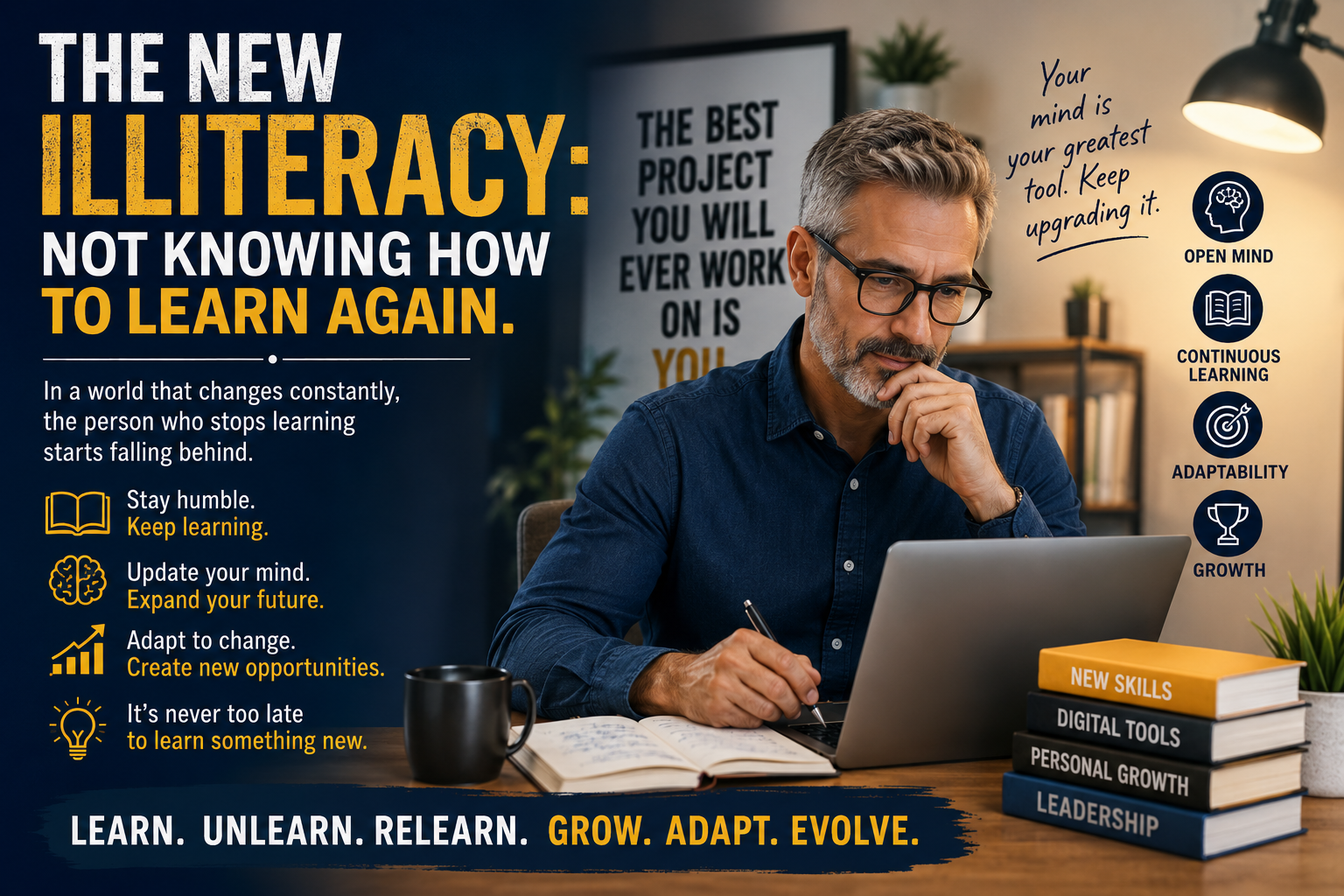
The New Illiteracy: Not Knowing How to Learn Again

By Marvin Gandis

The Problem Is No Longer Just Not Knowing

For a long time, when people talked about illiteracy, they thought about someone who could not read or write. But in today’s world, there is a new and dangerous form of illiteracy:

  • Not knowing how to learn again.

Today, a person may know how to read, write, use a phone, send messages, and browse the internet, yet still fall behind because they refuse to keep up.

The problem is not always a lack of intelligence. Many times, it is resistance to change.

We live in a time when tools, jobs, businesses, technology, the economy, and the way we communicate change.

That is why one of the most dangerous phrases a person can say is:

  • “I already know enough.”

Because in a constantly changing world, believing that you no longer need to learn can become a silent trap.


Knowing Yesterday Does Not Guarantee Understanding Today

Experience is valuable. No one should despise the years lived, the lessons learned, or the knowledge earned through effort.

But experience can become a limitation when we stop updating it.

  • What worked before may not work the same way today.
  • The way people sell has changed.
  • The way people communicate has changed.
  • The way people learn has changed.
  • The way people build trust has changed.
  • The way people work has changed.

This does not mean everything old is useless. It means we must learn how to combine wisdom with updating.

A wise person does not reject experience, but they also do not use it as an excuse to reject what is new.


Pride Is the Enemy of Learning

One of the biggest obstacles to learning again is pride.

Pride says:

  • “That is not for me.”
  • “I do not need to learn that.”
  • “That is for young people.”
  • “I have always done it this way.”
  • “That will not work.”
  • “I am too old to start.”

But humility says:

  • “I can learn.”
  • “I can improve.”
  • “I can ask for help.”
  • “I can start slowly.”
  • “I can update myself without losing my identity.”

Learning requires humility because it forces us to recognize that we do not know everything.

And that is not shame. That is wisdom.

The person who can learn again, even with experience, stays mentally alive.


Technology Does Not Wait Until We Feel Ready

Many people wait until they feel ready before learning something new.

But technology does not wait.

  • Platforms change.
  • Digital tools evolve.
  • Artificial intelligence advances.
  • Businesses become automated.
  • Consumers change their habits.
  • Audiences move into new spaces.

The person who waits too long may end up depending on others for everything.

This is not about becoming an expert overnight. It is about maintaining an attitude of constant learning.

  • Learn a new tool.
  • Understand a new concept.
  • Try a new strategy.
  • Read a guide.
  • Watch a tutorial.
  • Practice a little every day.

Technological ignorance does not always arrive suddenly. Sometimes it builds slowly through years of resistance.


Learning Again Does Not Mean Starting From Zero

Many people are afraid to learn something new because they feel it invalidates everything they already know.

But learning again does not erase your past.

It improves it.

  • Your experience is still valuable.
  • Your story still matters.
  • Your mistakes still teach.
  • Your character still counts.
  • Your wisdom still has weight.

The difference is that now you need to use all of it in a new context.

  • A teacher can learn digital tools.
  • A salesperson can learn online marketing.
  • A leader can learn modern communication.
  • An entrepreneur can learn automation.
  • An older person can learn technology step by step.

You are not starting from zero. You are building on what you already are.


The Person Who Learns Becomes Harder to Defeat

When a person decides to keep learning, they develop a quiet advantage.

  • They can adapt better.
  • They can recover faster.
  • They can understand new opportunities.
  • They can avoid repeated mistakes.
  • They can communicate with new generations.
  • They can find solutions where they once saw obstacles.

Learning does not guarantee an easy life, but it increases your ability to respond to life with intelligence.

The person who learns does not remain trapped in one version of themselves.

They can evolve.

And in times of change, evolving is a form of survival.


Learning Is Also a Personal Responsibility

It is easy to blame the world.

  • “The economy is difficult.”
  • “Technology is moving too fast.”
  • “People do not listen anymore.”
  • “Social media has changed.”
  • “Business is not like it used to be.”

There may be truth in those phrases. But we also need to ask ourselves:

  • What am I learning?
  • What am I avoiding learning?
  • What skill have I delayed for too long?
  • What tool intimidates me?
  • What part of my mindset needs to be updated?

Personal responsibility does not mean blaming yourself for everything. It means recognizing that you still have power to grow.

You cannot control every change in the world, but you can decide how you will respond to those changes.


Learning Requires Patience

One of the biggest mistakes is wanting to learn something new without going through the discomfort of the beginning.

Every learning process has an awkward stage.

  • At first, you may feel slow.
  • You may make mistakes.
  • You may get confused.
  • You may need help.
  • You may feel frustrated.

That is normal.

No one masters something important without going through a learning stage.

Patience helps you avoid quitting too soon.

  • Do not say, “I am not good at this.”
  • Say, “I am still learning.”

That small difference changes your mindset.


Education No Longer Ends With a Diploma

In the past, many people thought education was one stage of life.

You studied, you worked, and then you repeated what you learned for years.

But today, learning must be continuous.

  • It does not matter your age.
  • It does not matter what your profession is.
  • It does not matter your experience.
  • It does not matter what your current level is.

There is always something to learn.

  • Communication.
  • Technology.
  • Finances.
  • Marketing.
  • Leadership.
  • Emotional intelligence.
  • Digital security.
  • Content creation.
  • Human relationships.
  • Critical thinking.

Modern education does not end. It renews itself.


How to Overcome the New Illiteracy

First, accept that not knowing something is not shameful.

The shame is not in not knowing. The real loss is refusing to learn.

Second, choose one skill at a time.

Do not try to learn everything at once. Choose one important thing and begin.

Third, practice in small steps.

Dedicate 15 or 20 minutes a day to learning or practicing something new.

Fourth, ask without fear.

Asking for help does not make you less capable. It makes you wiser.

Fifth, apply what you learn.

Knowledge that is not used is forgotten. Learn, practice, adjust, and repeat.

Sixth, keep a flexible mind.

Not every change is a threat. Some changes are opportunities in disguise.


The Future Favors Learners

The future will not be kind to those who refuse to grow.

But it will offer opportunities to those willing to learn, unlearn, and learn again.

  • You do not need to know everything.
  • You do not need to master everything today.
  • You do not need to compete with experts immediately.

You only need to maintain a humble and active attitude:

  • “I can learn something new.”
  • “I can improve step by step.”
  • “I can update my mind.”
  • “I can adapt without losing my essence.”

That attitude can change your life.


It Is Never Too Late to Learn Again

My dear reader and friend, the new illiteracy is not the inability to read. It is the refusal to keep learning in a world that keeps changing.

Do not allow pride, fear, age, comfort, or frustration to steal your opportunity to grow.

  • Learning again does not make you weak.
  • It makes you flexible.
  • It makes you wise.
  • It makes you useful.
  • It keeps you relevant.
  • It makes you better prepared.

The world will keep changing.

The question is:

  • Will you also change with wisdom?

You do not have to do everything perfectly. Just begin.

  • Learn something new.
  • Ask a question.
  • Read a guide.
  • Practice a tool.
  • Improve a skill.
  • Update your mind.

Because in the modern world, the person who stops learning begins to fall behind.

But the person who learns again opens new doors.


Disclaimer:


This article is provided for educational, motivational, inspirational, and informational purposes only. It is intended to encourage reflection, continuous learning, personal growth, digital awareness, adaptability, and responsible decision-making.

The content should not be interpreted as financial, legal, medical, psychological, technological, educational, or professional advice. Any examples related to personal development, technology, digital tools, business, entrepreneurship, leadership, online learning, or success are not guarantees of specific results.

Individual outcomes may vary depending on effort, consistency, experience, access to resources, personal discipline, market conditions, technological changes, learning ability, and other factors beyond our control.

Readers are encouraged to use their own judgment, conduct their own research, and seek qualified professional guidance when necessary. The purpose of this content is to inspire and educate, not to promise instant results or replace professional advice.

Publicado en Communication, Digital Marketing, Entrepreneurship, Mindset, Personal Development, Personal Growth

The Art of Not Disappearing in a World Full of Noise

When You Feel Like Your Voice Is Getting Lost

We live in a world full of messages, ads, posts, videos, opinions, offers, and distractions. Everyone is talking. Everyone is publishing. Everyone wants to be seen.

And in the middle of so much noise, many people begin to feel something painful:

  • “I am here, but it feels like nobody sees me.”

You create content. You share ideas. You work on your project. You promote your products. You try to help. You learn. You adjust. You keep trying.

But the response feels small.

  • Few comments.
  • Few visits.
  • Few messages.
  • Few sales
  • Little attention.

Then a quiet frustration begins to grow: the feeling of disappearing.

But here is an important truth:

You do not disappear because you have no value. Many times, you disappear because your message needs more clarity, direction, repetition, and human connection.


The Problem Is Not Always Your Value

When nobody responds, it is easy to think:

  • “Maybe I am not good enough.”
  • “Maybe my message does not matter.”
  • “Maybe nobody needs what I offer.”
  • «Maybe it is too late for me.”

But be careful.

A low response does not always mean low value. Sometimes it means your message has not yet been presented in the right way, to the right audience, with the right frequency and the right clarity.

You can have a good idea, but if it is hidden inside a confusing message, people will not see it.

You can have a useful product, but if you only talk about features and not the real problem, people will not connect.

You can have experience, a story, and wisdom, but if you do not communicate them with humanity, they may go unnoticed.

  • Value needs a voice.
  • Voice needs clarity.
  • Clarity needs consistency.

Digital Noise Is Exhausting People

Many people are already overwhelmed.

  • They see so many ads that they ignore them.
  • They receive so many emails that they do not open them.
  • They hear so many promises that they no longer believe easily.
  • They see so many posts that they scroll without stopping.

That is why, if we want to be heard, it is not enough to shout louder.

We need to communicate better.

  • People do not need more pressure. They need clarity.
  • They do not need more empty promises. They need trust.
  • They do not need more noise. They need value.
  • They do not need you to sell all the time. They need to feel understood.

In a saturated world, authenticity becomes an advantage.


Not Disappearing Requires Identity

Many people publish without a clear identity.

  • One day, they talk about one thing.
  • The next day, they talk about something else.
  • Then they change their tone.
  • Then they change their offer.
  • Then they quit.
  • Then they return confused.

And the audience does not know how to remember them.

To avoid disappearing, people need to associate you with something clear.

It may be:

  • Faith and personal growth.
  • Educational digital marketing.
  • Data protection and digital security.
  • Home-based entrepreneurship.
  • Motivation for people who want to start again.
  • Human content for those who feel invisible.

The question is:

  • What do you want your audience to remember you for?

When you have an identity, your content stops being random. It begins to build presence.


Clarity Is More Powerful Than Quantity

Posting a lot does not always mean communicating well.

You can publish every day and still fail to connect if your message is not clear.

Clarity answers three questions:

  • Who am I speaking to?
  • What problem am I touching?
  • What hope, solution, or direction am I offering?

When those three questions are not clear, the content becomes weak.

But when they are clear, even a simple post can carry strength.

Do not only say: “This product is good.”

Say instead:

“If you are worried about losing your photos, documents, or important files, you need a simple way to protect your digital life before it is too late.”

Do not only say: “Keep going.”

Say instead:

“If you are working without applause today, do not confuse silence with failure. Maybe you are building roots before seeing fruit.”

Clarity gives the message room to breathe.


People Remember Stories, Not Only Information

Information teaches, but story connects.

You can explain an idea with facts, but a story helps the reader see themselves inside the message.

Talk about real moments:

  • When someone works, and nobody responds.
  • When an entrepreneur posts without receiving comments.
  • When a family loses important files because they had no backup.
  • When a person wants to start again but feels ashamed.
  • When someone is tired of trying and needs a word of direction.

Stories make the reader say:

  • “That is happening to me.”

And when a person feels understood, they lower their defenses and begin to listen.


Not Disappearing Also Requires Repetition

Many people give up too soon because they repeat their message a few times without seeing results.

But trust needs repetition. Your audience needs to see you several times.

  • They need to hear your message several times.
  • They need to confirm that you are consistent.
  • They need to feel that you do not show up only when you want to sell.
  • They need to become familiar with you.

Do not repeat in a boring way. Repeat with different angles.

The same message can be taught as a reflection, story, list, question, tip, article, short video, email, post, or testimonial.

Smart repetition does not exhaust people. Smart repetition builds recognition.


Serve Before You Ask

One of the fastest ways to disappear is to ask too much before serving enough.

  • “Buy.”
  • “Join.”
  • “Register.”
  • “Click.”
  • “Follow me.”
  • “Share.”

All of that may have its place, but value must come first.

  • Educate.
  • Inspire.
  • Clarify.
  • Support.
  • Answer questions.
  • Help people avoid mistakes.
  • Share practical steps.
  • Show understanding.

When you serve consistently, your call to action no longer feels like pressure. It feels like the natural next step.

Trust is built before conversion.


Not Everyone Will See You at First, But Some Are Watching

Some people do not comment, but they read.

  • They do not react, but they observe.
  • They do not buy today, but they remember.
  • They do not write, but they evaluate.
  • They do not respond, but they are watching your consistency.

That is why you should not measure everything only by immediate reaction.

Presence is built over time.

Sometimes a person needs to see you for weeks or months before trusting. Sometimes they need to go through a specific problem before remembering your message. Sometimes they are not ready today, but they may be ready tomorrow.

Do not underestimate the silent observer.


Adjust Without Losing Your Essence

To avoid disappearing, you must be willing to improve.

  • Improve your titles
  • Improve your images.
  • Improve your calls to action.
  • Improve your emails. Improve your landing pages.
  • Improve the way you tell stories.
  • Improve your consistency.

But do not lose your essence.

You do not need to become fake to be visible. You do not need to copy someone else’s voice. You do not need to exaggerate promises. You do not need to act as if everything is perfect.

Visibility without integrity may attract attention, but it does not build lasting trust.

  • Be clear.
  • Be human.
  • Be useful.
  • Be consistent.
  • Be honest.

That has more power than it may seem.


How to Stop Disappearing: Practical Steps

First, define your central message.

What do you want people to understand when they read your content? Hope? Direction? Education? Protection? Opportunity? Faith? Discipline?

Second, speak to one specific person.

Do not write for everyone. Write for someone who has a real problem and needs a clear answer.

Third, use more human titles.

A good title should touch pain, desire, curiosity, or hope.

Fourth, combine value with story.

Do not only teach. Connect. Do not only inform. Help the person see themselves inside the message.

Fifth, repeat your main message in different formats.

Article, short post, email, image, quote, video, reflection, practical list.

Sixth, review your results without destroying yourself emotionally.

Metrics are useful for adjustment, not for self-condemnation.

Seventh, remain present.

It is not about showing up once with strength and then disappearing. It is about building a trustworthy presence.


Your Voice Can Still Find Its Place

My dear reader and friend, do not confuse a season of low response with a life without impact.

  • Maybe your message needs more clarity.
  • Maybe your audience needs more time.
  • Maybe your strategy needs adjustment.
  • Maybe your content needs more story.
  • Maybe your presence needs more consistency.

But that does not mean you should quit.

In a world full of noise, the winner is not always the one who speaks the loudest. Many times, the one who wins is the one who communicates with more truth, more clarity, more patience, and more humanity.

Do not disappear.

  • Sharpen your message.
  • Strengthen your identity.
  • Serve with intention.
  • Repeat with wisdom.
  • Improve without losing your soul.
    Stay present.

Because a clear, consistent, and human voice can still make its way through the noise.


Disclaimer:


This article is provided for educational, motivational, inspirational, and informational purposes only. It is intended to encourage reflection, personal growth, digital awareness, communication improvement, and responsible decision-making.

The content should not be interpreted as financial, legal, medical, psychological, or professional advice. Any examples related to business, digital marketing, online visibility, personal branding, or success are not guarantees of specific results. Individual outcomes may vary depending on effort, consistency, experience, strategy, audience, market conditions, technology changes, and other factors beyond our control.

Readers are encouraged to use their own judgment, do their own research, and seek qualified professional guidance when necessary. The purpose of this content is to inspire, educate, and support better decision-making, not to promise instant results or replace professional advice.

Publicado en Entrepreneurship, Faith, Mindset, Motivation, Personal Development, Personal Growth

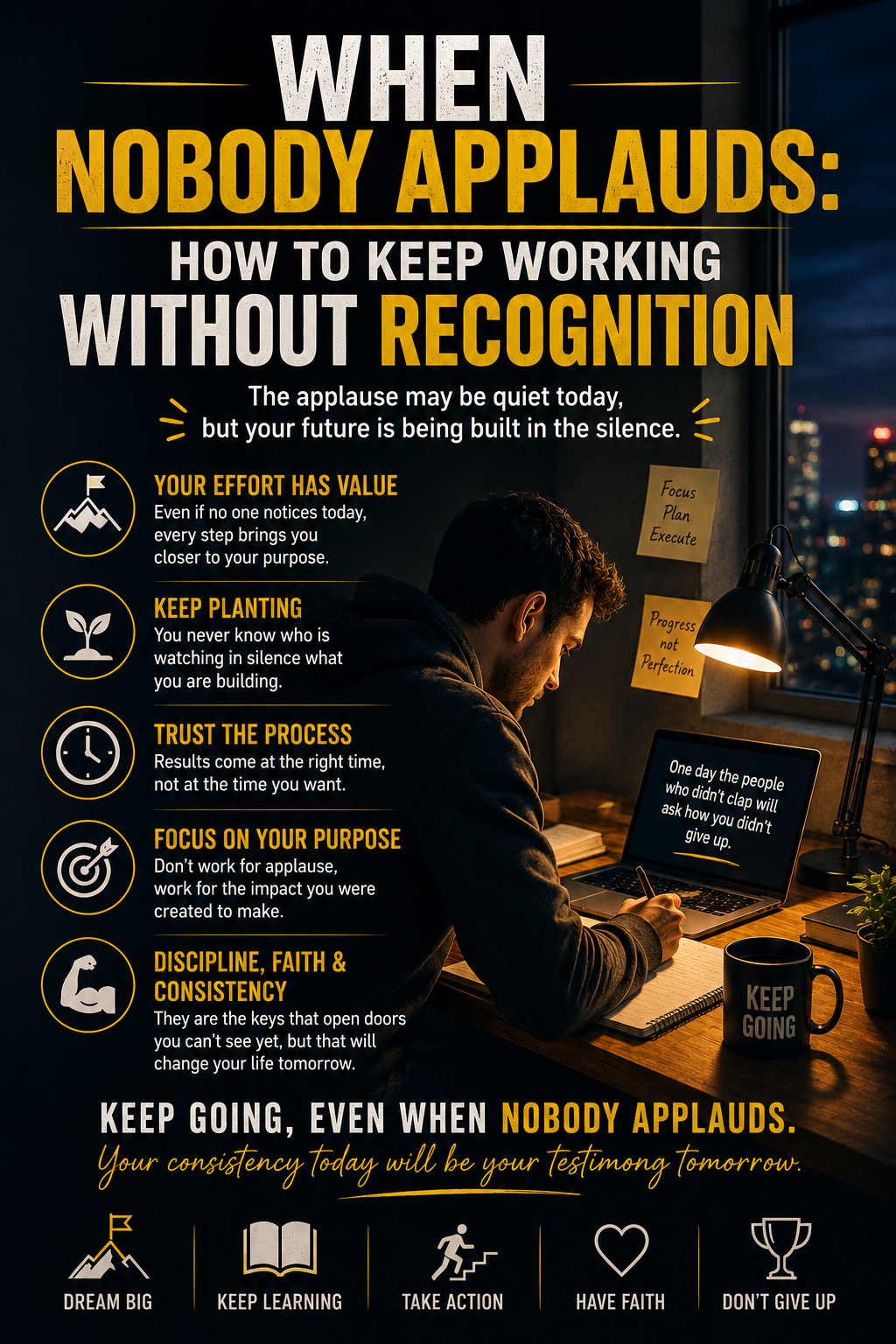
When Nobody Applauds: How to Keep Working Without Recognition

By Marvin Gandis

The Season Almost Nobody Sees

There is a season in life that many people experience, but few admit honestly:

The season where you work, publish, help, learn, try, improve… and still, it feels like nobody notices.

  • No applause.
  • No comments.
  • No recognition.
  • No visible results.
  • No clear signs that anything is working.

Then a quiet question begins to appear:

  • “Is it still worth continuing?”

That question does not always come from laziness. Many times, it comes from exhaustion. It comes from having planted so much without seeing an immediate harvest. It comes from feeling that your effort is hidden, that your voice is not reaching people, and that your work is not producing the impact you expected.

But there is one truth we must remember:

  • The fact that nobody is applauding yet does not mean your effort has no value.

Sometimes, the most important seasons of your life are exactly the ones nobody sees.


Not All Growth Makes Noise

We live in a culture that measures value with visible numbers: likes, comments, sales, followers, visits, applause, recognition, and quick results.

But not all growth can be measured publicly.

  • A seed does not make noise while it grows under the ground.
  • A root does not receive applause while it becomes stronger.
  • Character is not always formed in front of an audience.
  • A vision is not always born on a stage.

Many times, the most valuable things are built in silence.

  • The problem is that we confuse silence with failure.

We think that if nobody responds, we are not moving forward. We think that if nobody comments, nobody is reading. We think that if nobody celebrates, nothing is happening.

But reality may be different.

  • Maybe someone is observing quietly.
  • Maybe someone is learning from your consistency.
  • Maybe someone will return later to content that seems ignored today.
  • Maybe you are developing discipline before receiving visibility.

Not everything unseen is dead. Some things are simply growing in secret.


Recognition Does Not Always Come at the Beginning

One of the most common mistakes is expecting recognition too soon.

We want the world to confirm our value from the beginning. We want quick signs. We want to make every effort to receive an immediate response.

But important things often need time.

  • A good message needs repetition.
  • A brand needs trust.
  • An audience needs familiarity.
  • A relationship needs consistency.
  • A reputation needs proof.

Nobody deeply trusts what they have only just discovered.

That is why, when you are starting or rebuilding your presence, it is normal that not everyone responds immediately.

People observe before they trust.

  • They observe whether you are consistent.
  • They observe whether you truly provide value.
  • They observe whether you only show up when you want to sell.
  • They observe whether your message has depth.
  • They observe whether you intend to serve or only to receive.

Recognition does not always arrive when you want it to. Many times, it comes after you have demonstrated consistency when nobody was watching.


Working Without Applause Reveals Your True Motivation

When nobody applauds, something important is revealed: the reason why you do what you do.

  • If you only work for approval, you will get tired quickly.
  • If you only publish for likes, you will quit when they do not come.
  • If you only serve when you are recognized, you will stop serving when recognition is delayed.
  • If you only build because of emotion, you will stop when the emotion fades.

But when you have purpose, you can continue even without applause.

  • Purpose does not remove tiredness, but it gives it meaning.
  • It does not remove frustration, but it reminds you why you started.
  • It does not remove difficult days, but it helps you avoid making permanent decisions during temporary moments.

Working without applause forces you to ask yourself:

  • “Am I doing this for vanity or for mission?”

That question may be uncomfortable, but it can also purify your path.


Consistency Is More Powerful Than Emotion

Emotion is useful for starting, but it is not enough to sustain you.

You may feel inspired one day and discouraged the next. You may have a week full of ideas and another week with no energy. You may feel confident in the morning and doubtful at night.

That is why you cannot depend only on emotion.

  • You need consistency.

Consistency does not always feel exciting. Sometimes it feels repetitive, slow, and silent. But it is one of the most powerful forces for building real results.

Consistency says:

  • “Today I will do what is right even if I do not feel like it.”
  • “Today I will keep learning even if I do not see immediate results.”
  • “Today I will improve my message even if nobody responded yesterday.”
  • “Today I will plant even if the harvest is not visible yet.”

Consistency turns small actions into great transformations.


Silence Can Also Be Training

Sometimes, silence is not punishment. It is training.

  • Silence teaches you to depend less on external opinion.
  • It teaches you to strengthen your discipline.
  • It teaches you to improve without applause.
  • It teaches you to listen to your purpose.
  • It teaches you to work with humility.

If you received applause too soon, you might build on ego instead of character.

That is why some silent seasons are necessary.

  • Not because they are easy.
  • Not because they do not hurt.
  • Not because they do not make you tired.

But because they form something that recognition cannot always form: depth.

Some people want visibility, but they have not developed stability. They want a platform, but they have not strengthened their character. They want an audience, but they have not learned to serve with patience.

Silence can form the messenger before expanding the message.


Do Not Confuse Little Response with Little Impact

In the digital world, we often believe impact means visible interaction.

But that is not always true.

  • Some people read and do not comment.
  • Some people observe and do not react.
  • Some people keep their words quietly in their hearts.
  • Some people need time to trust.
  • Some people are touched by a message but never tell you.

This does not mean you should ignore metrics. Metrics are useful. They show you what to improve, what to adjust, and what to repeat.

But metrics do not always tell the whole story.

  • A message may have few likes and still deeply touch one person.
  • An article may not go viral and still change a perspective.
  • A post may seem small and still plant an idea that will bear fruit later.

Do not despise what seems small.

Sometimes, one person impacted in the right way is worth more than one hundred distracted people.


Improve, But Do Not Destroy Yourself

When you do not receive recognition, it is wise to review your strategy. But it is not healthy to destroy your identity.

Ask yourself:

  • Is my message clear?
  • Am I speaking to the real pain of my audience?
  • Am I educating or only promoting?
  • Do my titles create interest?
  • Does my content offer practical value?
  • Am I being consistent?
  • Am I building trust before expecting results?

These questions help you improve.

But avoid questions that destroy you:

  • “Maybe I am not good enough?”
  • “Maybe nobody wants to hear me?”
  • “Maybe all my effort is useless?”
  • “Maybe it is too late for me?”
  • You are not your result today.
  • You are not your numbers this week.
  • You are not one post with low engagement.
  • You are not one attempt that did not work.

You can improve your strategy without condemning your values.


Patience Is Not Passivity

Some people confuse patience with doing nothing.

But true patience is not inactivity. True patience is continuing to do what is right while the result matures.

  • Patience is not saying, “I will do nothing.”
  • Patience is saying, “I will keep working with wisdom.”
  • Patience is not waiting without direction.
  • Patience is planting with faith and adjusting with intelligence.
  • Patience is not denying reality.
  • Patience is recognizing that some things take time but are still worth building.

Mature patience does not sit down to complain. Mature patience works, learns, observes, corrects, and continues.


When Nobody Applauds, God Still Sees

For a person of faith, there is a truth that brings peace:

Not everything you do needs to be seen by people to have value before God.

  • There are acts of obedience that nobody celebrates.
  • There are honest efforts that nobody recognizes.
  • There are tears that nobody notices.
  • There are sacrifices that nobody applauds.
  • There are steps of faith that nobody understands.

But God sees.

  • God sees the intention.
  • God sees the perseverance.
  • God sees the tired heart that still chooses to continue.
  • God sees the seed that others ignore.
  • God sees faithfulness in small things.

Sometimes we want people to validate what only God needs to confirm.

This does not mean we should not improve, learn, or seek results. Of course, we should. But our value cannot depend completely on human response.

  • Human approval is variable.
  • Obedience with purpose is deeper.

How to Continue When There Is No Recognition

Here are some practical steps:

Remember why you started

Return to your original purpose. Did you want to help? Educate? Inspire? Build freedom? Serve your family better? Create something useful?

When the result takes time, return to the reason.

Reduce comparison

Excessive comparison can steal your energy. You do not know how many years, mistakes, resources, or processes are behind the person you are watching.

Compare your progress with your previous version, not with someone else’s visible season.

Create a system, not only inspiration

Define schedules, topics, processes, posts, follow-up, and review. When you have a system, you depend less on your mood.

Celebrate small victories

  • A finished article is a victory.
  • A clearer message is a victory.
  • A new lesson learned is a victory.
  • A consistent week is a victory.
  • One touched reader is a victory.

Ask for honest feedback

Not all silence means rejection. Sometimes you need to ask, listen, and adjust.

Wise feedback can become a tool for growth.

Keep planting with intelligence

It is not about repeating without thinking. It is about planting, observing, learning, and improving.

  • Consistency without analysis can exhaust you.
  • Analysis without action can paralyze you.
  • You need both.

Your Invisible Season May Be Your Greatest School

Nobody loves feeling invisible.

But temporary invisibility can teach you things that quick success cannot.

  • It teaches you patience.
  • It teaches you humility.
  • It teaches you discipline.
  • It teaches you focus.
  • It teaches you to improve.
  • It teaches you not to depend on applause.
  • It teaches you to value the process.

The invisible season may feel like a loss, but many times it is preparation.

Because when more visibility comes, you will need character to sustain it.

When more opportunities come, you will need wisdom to manage them.

When more people come, you will need clarity to guide them.

Not every delay is rejection. Sometimes it is preparation.


Keep Going Even If Nobody Applauds Yet

My dear reader and friend, do not allow the lack of applause to make you abandon what can still bear fruit.

  • Maybe today you do not see big results.
  • Maybe today, only a few people respond.
  • Maybe today you feel like you are working in silence.
  • Maybe today you wonder whether anyone notices your effort.
  • But keep growing.
  • Keep learning.
  • Keep improving.
  • Keep serving.
  • Keep planting with wisdom.

Do not work only for applause. Work with purpose.

Because applause may arrive late. It may be small. It may not come in the way you expected. But the character you develop while continuing without recognition can become one of your greatest strengths.

  • When nobody applauds, you can still move forward.
  • When nobody comments, you can still learn.
  • When nobody recognizes you, you can still build.
  • When nobody is watching, you can still be faithful.

And many times, what is built in silence ends up speaking with greater power at the right time.


Disclaimer:


This article is provided for educational, motivational, inspirational, and informational purposes only. It is intended to encourage reflection, personal growth, perseverance, discipline, faith, and responsible decision-making.

The content should not be interpreted as financial, legal, medical, psychological, or professional advice. Any personal development, business, marketing, or success-related examples mentioned are not guarantees of specific results. Individual outcomes may vary depending on effort, consistency, experience, strategy, personal circumstances, market conditions, and other factors beyond our control.

Readers are encouraged to use their own judgment, do their own research, and seek qualified professional guidance when necessary. The purpose of this content is to inspire and educate, not to promise instant results or replace professional advice.