Publicado en Affiliate Marketing, ClickBank Marketing, Digital Marketing, Email Marketing, Online Business

The Smarter Way to Start Affiliate Marketing: Why Building Your Own List Matters

By Marvin Gandis

The Problem Most Beginners Never See

Many people enter Affiliate Marketing with excitement.

  • They find a product.
  • They get an affiliate link.
  • They share that link on social media, emails, safelists, blogs, or ads.
  • Then they wait for commissions.

At first, this sounds simple. But there is one major problem many beginners do not understand:

If you send traffic directly to someone else’s sales page, you may get a commission,

But you usually do not build your own long-term asset.

That means every visitor, every email address, every interested prospect, and every future buyer may become part of the vendor’s audience — not yours.

This is one of the reasons many affiliates struggle. They work hard to generate traffic, but they do not build something they control.

That is where a smarter affiliate marketing strategy begins.


What Is The ClickBank Profit Club?

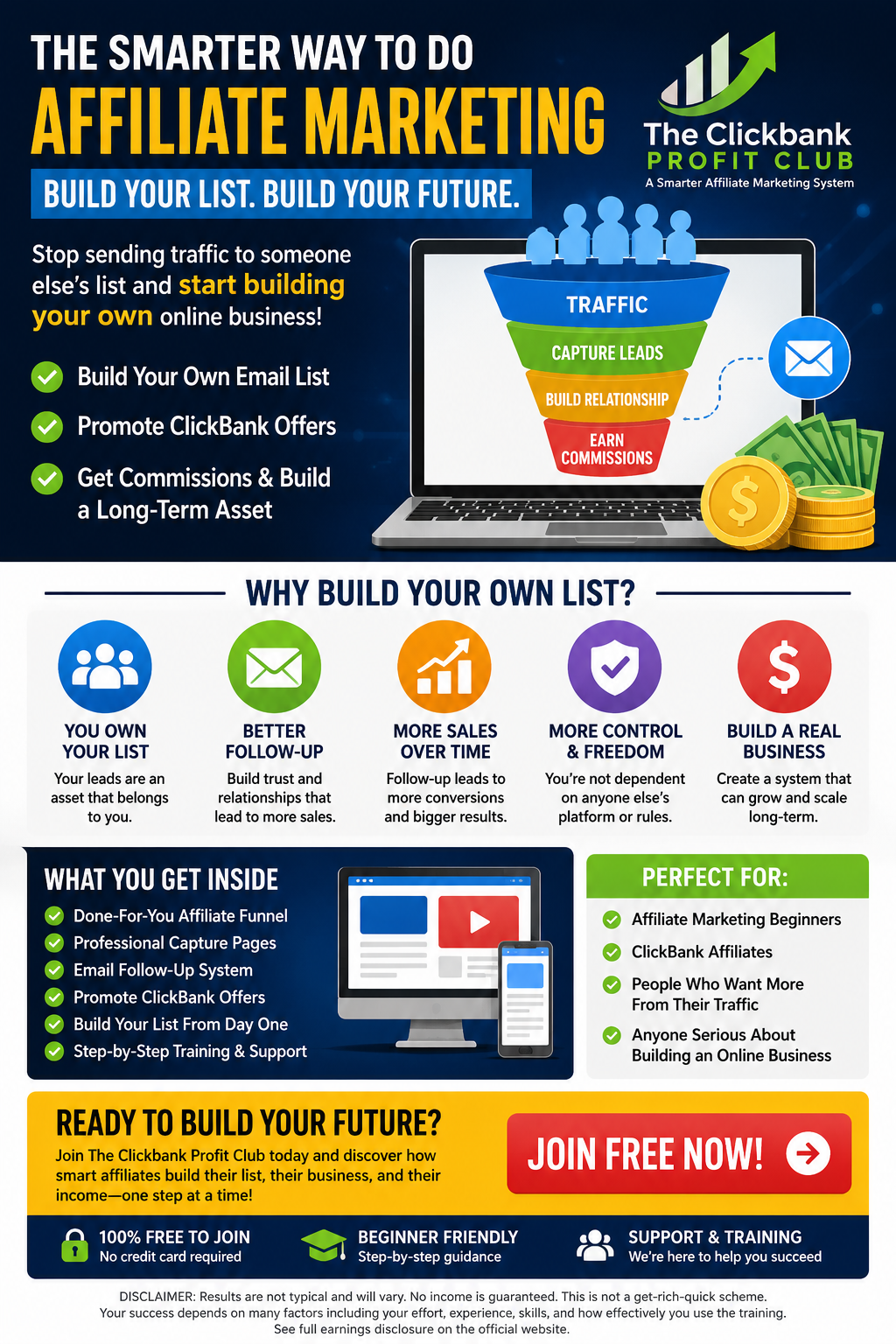
The ClickBank Profit Club is presented as a Free Affiliate Marketing System designed to help people promote ClickBank offers while building their own list.

Instead of focusing only on sending visitors directly to a vendor’s page, the system emphasizes a better model:

Collect the lead first. Build your list. Follow up. Then promote.

The offer page explains that members can get access to a done-for-you marketing funnel that is built, branded, and hosted for them. It also highlights that leads entering the funnel go to the member’s email list rather than someone else’s.

This is important because email list ownership is one of the most valuable principles in online marketing.


Why Building Your Own List Is So Important

A visitor may not buy the first time they see an offer.

That does not mean they are not interested. It may simply mean they need:

  • More information
  • More trust
  • More time
  • More education
  • More follow-up
  • More proof
  • A better understanding of the opportunity

If you send that visitor directly to a sales page and they leave, you may never speak to them again.

But when you collect the lead first, you create a relationship.

  • You can send helpful emails.
  • You can educate them.
  • You can answer common questions.
  • You can introduce related tools.
  • You can build trust over time.

That is the difference between chasing one-time clicks and building a real marketing asset.


Traditional Affiliate Marketing

vs.

Smarter Affiliate Marketing

Traditional affiliate marketing often looks like this:

  • You find a product.
  • You grab your affiliate link.
  • You send traffic.
  • Some people buy.
  • Most people leave.
  • You start over again.

The problem is that the vendor may keep the lead, continue following up, and profit from future sales.

Smarter affiliate marketing looks different:

  • You send traffic to your own capture page.
  • You collect the lead.
  • You follow up by email.
  • You provide education and value.
  • You introduce the offer.
  • You continue building a relationship.

This gives you a stronger foundation.

  • A commission is good.
  • A growing email list is better.
  • A relationship with your audience is even more powerful.

Why Beginners Need a System

Many beginners do not fail because they are lazy.

They fail because they are missing a system.

They may not know how to:

  • Create a capture page
  • Build an email list
  • Set up a funnel
  • Write follow-up emails
  • Choose traffic sources
  • Promote consistently
  • Track results
  • Stay compliant
  • Build trust before asking for a sale

A beginner-friendly system can help reduce confusion. It gives people a path to follow instead of forcing them to figure out every technical piece alone.

The ClickBank Profit Club positions itself as a done-for-you system that helps simplify this process for people who want to start promoting ClickBank offers with more structure.


The Power of Follow-Up

Most sales do not happen instantly.

  • People are busy.
  • They get distracted.
  • They compare options.
  • They hesitate.
  • They forget.

That is why follow-up matters.

Email follow-up allows you to stay connected with people who showed interest. Instead of hoping they return, you can continue the conversation.

A good follow-up sequence can:

  • Welcome the subscriber
  • Explain the opportunity
  • Share helpful tips
  • Build confidence
  • Handle objections
  • Tell stories
  • Invite action
  • Remind people why the offer matters

This is why list-building and affiliate marketing work so well together.

  • Traffic gets attention.
  • A funnel captures the lead.
  • Email builds the relationship.
  • Follow-up creates more opportunities.

Who Is The ClickBank Profit Club Best For?

The ClickBank Profit Club may be a good fit for people who are interested in learning affiliate marketing and want a more guided approach.

It may be especially useful for:

1. Beginners

People who are new to affiliate marketing often need a simple place to start. A done-for-you funnel can remove some of the technical pressure.

2. ClickBank Affiliates

People already promoting ClickBank products may benefit from learning how to build their own list instead of relying only on direct linking.

3. Email Marketers

Anyone who understands the value of email marketing may appreciate a model that focuses on lead ownership and follow-up.

4. Traffic Builders

People who use safelists, social media, blogs, ads, or traffic exchanges need a way to capture leads before sending visitors to an offer.

5. Online Business Seekers

People looking for an online business education system may find value in learning how funnels, traffic, leads, and commissions work together.


What Makes This Offer Interesting?

The offer is interesting because it focuses on a common weakness in affiliate marketing:

Many affiliates promote, but they do not build.

  • They promote links.
  • They send traffic.
  • They hope for sales.
  • But they do not build a list, a brand, or a follow-up system.

The ClickBank Profit Club uses a different message:

  • Do not just promote someone else’s business.
  • Start building your own asset.

That is a strong educational angle because it teaches readers to think like business owners, not just link promoters.


A Smart Way to Promote This Offer

If you are promoting The ClickBank Profit Club, avoid hype.

  • Do not promise guaranteed income.
  • Do not say people will make money fast.
  • Do not suggest that the system works without effort.

Instead, promote it as:

  • A beginner-friendly affiliate marketing education system
  • A free way to explore the ClickBank promotion
  • A smarter list-building approach
  • A funnel-based affiliate marketing model
  • A way to learn how traffic, leads, follow-up, and commissions connect

This keeps the message honest, professional, and compliant.


Want to learn how affiliate marketing can work smarter when you build your own list first?

Explore The ClickBank Profit Club and see how the system is designed to help beginners understand funnels, leads, follow-up, and ClickBank promotion.


Affiliate Marketing is not just about sharing links

  • It is about building a system.

The people who treat affiliate marketing like a business usually understand the importance of traffic, leads, follow-up, trust, and consistency.

The ClickBank Profit Club introduces a simple but powerful idea:

Do not just send traffic away. Build your own list. Own your audience.

Create a follow-up. Build something that can grow over time.

For Beginners, That Lesson Alone Can Change The Way They Approach Online Marketing.


Disclaimer

This article is for educational and informational purposes only. It does not guarantee income, commissions, or business results. Affiliate marketing involves effort, learning, testing, consistency, and personal responsibility. Individual results will vary based on experience, skills, work ethic, traffic quality, follow-up, and market conditions. Some links may be affiliate links, which means a commission may be earned if a purchase or signup is completed through the link, at no additional cost to the visitor.
Publicado en Affiliate Marketing, Business Strategy 📊, Digital Marketing,, Email Marketing, Entrepreneurship, Home Business, Lead Generation, Online Business

📝 The Online Business Blueprint — Follow the Plan

By Marvin Gandis

Starting an online business can feel exciting, confusing, and overwhelming all at the same time.

  • One day, you hear that you need a website.
  • The next day, someone tells you to start a YouTube channel.
  • Then another person says you need ads, funnels, social media, email marketing, automation, branding, content, traffic, and a dozen other tools.

No wonder many beginners feel lost before they even begin.

But here is the truth: building an online business does not have to be complicated. It becomes complicated when there is no plan.

A real online business is not built by guessing. It is built by following a blueprint.

A blueprint gives you direction. It tells you what to focus on first, what to avoid, what to build, and how to keep moving even when results do not happen immediately.

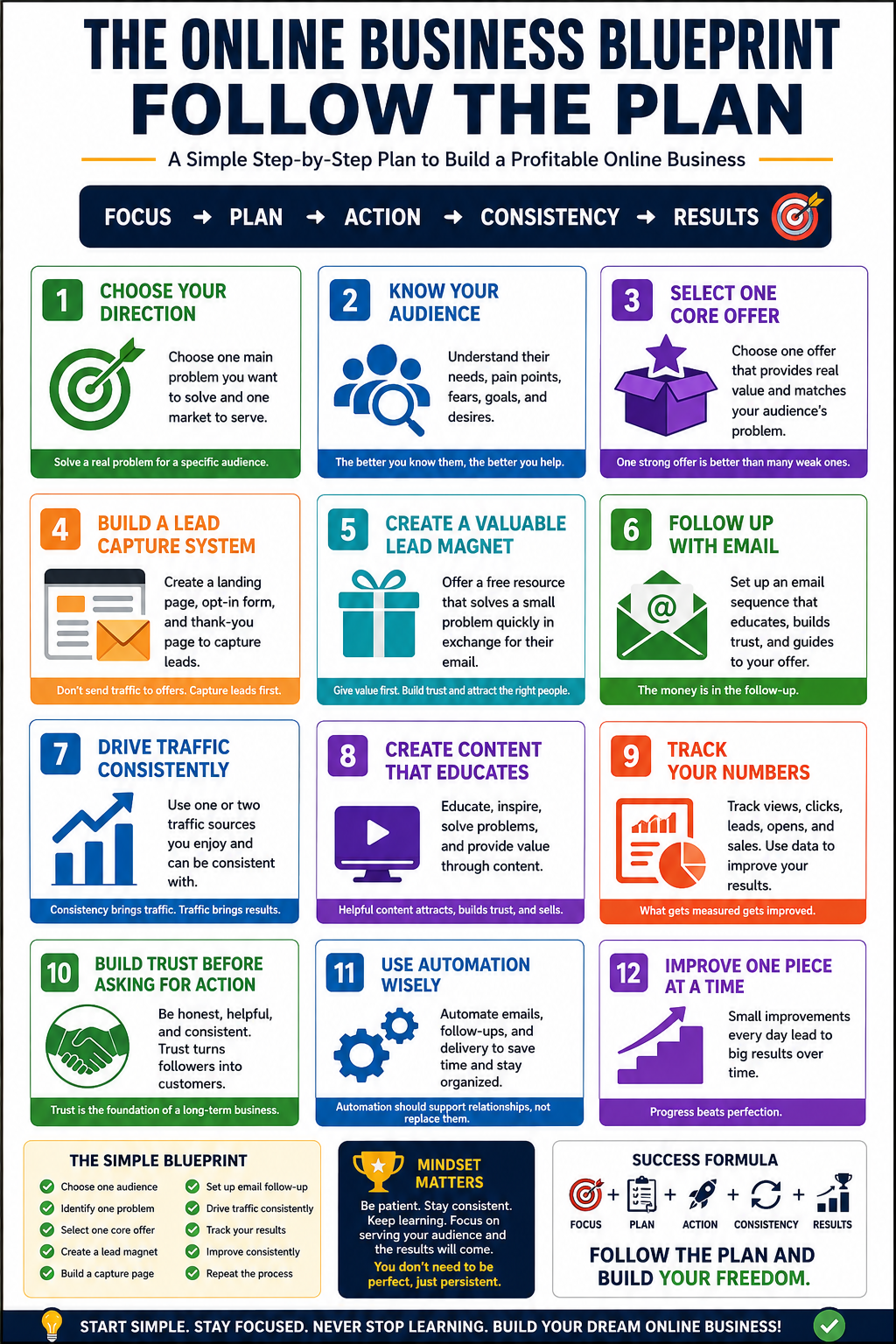
The purpose of this article is simple: to give you a clear online business blueprint you can follow step by step.

  • No hype.
  • No confusion.
  • No magic buttons.

Just a practical plan.


Why Most People Fail Online

Most people do not fail online because they are lazy. They fail because they are scattered.

They jump from one opportunity to another. They promote too many things at once. They post random links. They buy tools before they understand the strategy. They expect fast results but have no follow-up system.

The internet rewards clarity, consistency, and value.

It does not reward confusion.

Many beginners make the mistake of thinking, “I just need traffic.” But traffic alone is not enough. If people click your link and nothing happens after that click, the traffic is wasted.

A successful online business needs more than attention. It needs a system.

That system should help you:

  • Build trust
  • Capture leads
  • Educate prospects
  • Follow up consistently
  • Recommend helpful solutions
  • Track what works
  • Improve over time

That is the foundation of the online business blueprint.


Step 1: Choose One Main Direction

The first step is focus.

Before you build anything, ask yourself:

What problem do I want to help people solve?

Your online business should not begin with a product. It should begin with a problem.

People buy solutions. They do not buy random offers.

For example, your audience may want to:

  • Protect their files and digital memories
  • Build a home business
  • Generate more leads
  • Learn affiliate marketing
  • Save time with automation
  • Improve their health
  • Make smarter financial decisions
  • Create content faster
  • Start a side income

Once you know the problem, your message becomes clearer.

Instead of saying, “Check this out,” you can say, “Here is a simple way to solve this specific problem.”

That is much more powerful.


Step 2: Identify Your Ideal Audience

You cannot speak to everyone and expect everyone to listen.

A strong online business speaks directly to a specific group of people.

Your audience may be beginners, parents, small business owners, retirees, affiliate marketers, network marketers, bloggers, content creators, or people looking for a side income.

The more clearly you understand your audience, the easier it becomes to create content, write emails, and recommend offers.

Ask yourself:

  • What does my audience want?
  • What are they afraid of?
  • What mistakes are they making?
  • What do they already believe?
  • What solution would make their life easier?
  • What kind of language do they understand?

When you know your audience, your marketing becomes a conversation instead of a sales pitch.


Step 3: Select One Core Offer

One of the biggest beginner mistakes is promoting too many offers at the same time.

When you promote everything, people remember nothing.

Start with one core offer.

This offer should match your audience’s problem and provide a real benefit. It can be an affiliate product, service, software, training, membership, digital product, or your own solution.

A strong offer should be:

  • Easy to understand
  • Connected to a real problem
  • Useful for your audience
  • Reasonably priced or clearly valuable
  • Supported by a simple explanation
  • Easy to recommend ethically

Do not choose an offer only because it pays commissions. Choose something that makes sense for the audience you want to help.

Trust is more valuable than a quick sale.


Step 4: Build a Simple Lead Capture System

Here is a major rule of online business:

Do not send all your traffic directly to a sales page.

Why?

Because most people do not buy the first time they see an offer.

They may be interested but distracted. They may need more information. They may not trust you yet. They may want to compare options. They may simply forget.

That is why you need a lead capture system.

A basic lead capture system includes:

  • A landing page
  • A simple headline
  • A benefit-driven message
  • An email opt-in form
  • A thank-you page
  • A follow-up email sequence

The goal is not just to get a click. The goal is to build a list.

Your email list becomes an asset you control. Social media platforms can change. Ad accounts can be limited. Algorithms can shift. But when someone joins your list, you have a direct way to communicate with them.

That is smart business.


Step 5: Create a Valuable Lead Magnet

A lead magnet is something helpful you offer in exchange for someone’s email address.

It does not have to be complicated.

It can be:

  • A checklist
  • A short guide
  • A free report
  • A video training
  • A resource list
  • A cheat sheet
  • A beginner blueprint
  • A mini email course
  • A simple template

The key is that it must solve a small problem quickly.

For example:

  • “5 Steps to Protect Your Digital Files”
  • “Beginner’s Checklist for Starting an Online Business”
  • “Simple Traffic Plan for New Affiliate Marketers”
  • “Email Follow-Up Template for Beginners”

A good lead magnet attracts the right people and prepares them for your main offer.


Step 6: Follow Up With Email

Most online sales happen after follow-up.

That is why email marketing is one of the most important parts of the blueprint.

A good follow-up sequence should not only sell. It should educate, build trust, answer questions, and guide the reader toward a decision.

Your email sequence can include:

  • Welcome email
  • Problem awareness email
  • Story-based email
  • Educational tip email
  • Common mistakes in email
  • Benefits email
  • FAQ email
  • Invitation email
  • Reminder email

The goal is to help the prospect understand why the solution matters.

Do not pressure people. Guide them.

A strong email makes the reader feel understood.


Step 7: Drive Traffic Consistently

Once your system is ready, you need traffic.

Traffic means people visiting your page, reading your content, seeing your offer, or joining your list.

There are many traffic sources:

  • Facebook
  • YouTube
  • TikTok
  • Pinterest
  • Instagram
  • LinkedIn
  • Blogging
  • SEO
  • Email safelists
  • Paid ads
  • Solo ads
  • Forums
  • Online communities
  • Referral marketing

The best traffic source is not always the most popular one. The best traffic source is the one you can use consistently and improve over time.

Beginners should avoid trying every platform at once.

Choose one or two traffic sources and master them first.

Consistency beats random effort.


Step 8: Create Content That Educates

Content is how people discover you, trust you, and understand what you offer.

Your content should not sound like constant selling.

Instead, create content that helps your audience think differently, solve problems, and take action.

Good content can include:

  • How-to articles
  • Short tips
  • Personal stories
  • Mistake-based lessons
  • Product education
  • Checklists
  • Motivational posts
  • Comparison posts
  • Beginner guides
  • FAQ content

For example, instead of saying, “Buy this tool,” you can write:

  • “Why most beginners lose leads after the first click.”
  • “How to protect your digital files before disaster happens.”
  • “The simple follow-up mistake that costs online marketers sales”
  • “How to start building an email list even as a beginner.”

Educational content attracts better prospects because it creates understanding.

  • Understanding leads to trust.
  • Trust leads to action.

Step 9: Track Your Numbers

An online business grows when you track what is working.

You do not need complicated analytics in the beginning. Start with simple numbers:

  • How many people saw your content?
  • How many clicked your link get?
  • How many joined your list?
  • How many of your emails were opened?
  • How many clicked inside your emails?
  • How many purchased or took the next step?

These numbers tell a story.

If people see your content but do not click, your message may need improvement.

If people click but do not subscribe, your landing page may need improvement.

If people subscribe but do not take action, your emails may need improvement.

Tracking removes guessing.

You cannot improve what you do not measure.


Step 10: Build Trust Before Asking for Action

Trust is the real currency of online business.

People are skeptical online, and they should be. They have seen hype, fake promises, and exaggerated claims.

That is why your job is not to sound louder. Your job is to be more helpful.

Build trust by:

  • Being honest
  • Explaining clearly
  • Avoiding false promises
  • Sharing useful tips
  • Showing consistency
  • Answering questions
  • Respecting your audience
  • Recommending solutions responsibly

When people trust your guidance, they are more likely to click, subscribe, read, reply, and buy.

A business built on trust lasts longer than a business built on hype.


Step 11: Use Automation Wisely

Automation is powerful, but it should not replace human connection.

Use automation to save time, organize leads, deliver emails, and guide people through your system.

You can automate:

  • Welcome emails
  • Follow-up sequences
  • Lead delivery
  • Thank-you pages
  • Reminders
  • Educational content
  • Segmentation
  • Basic customer journeys

But do not become robotic.

People still want to feel like there is a real person behind the message.

Automation should support relationships, not destroy them.


Step 12: Improve One Piece at a Time

Many beginners try to fix everything at once.

That creates frustration.

Instead, improve one piece at a time.

  • Improve your headline.
  • Then improve your landing page.
  • Then improve your first email.
  • Then improve your lead magnet.
  • Then improve your traffic source.
  • Then improve your call to action.

Small improvements create big results over time.

Online business is not about perfection. It is about progress.


The Simple Online Business Blueprint

Here is the plan in simple form:

  1. Choose one audience.
  2. Identify one major problem.
  3. Select one core offer.
  4. Create one lead magnet.
  5. Build one landing page.
  6. Set up one email follow-up sequence.
  7. Drive traffic from one or two sources.
  8. Track your results.
  9. Improve consistently.
  10. Repeat the process.

That is the blueprint.

Simple does not mean easy. But simple is powerful.


Common Mistakes to Avoid

  • Avoid promoting too many offers at once.
  • Avoid sending traffic directly to sales pages without capturing leads.
  • Avoid copying everyone else without understanding your own audience.
  • Avoid quitting too early.
  • Avoid making unrealistic income claims.
  • Avoid ignoring follow-up.
  • Avoid focusing only on tools instead of strategy.
  • Avoid treating people like numbers.

Every mistake teaches something, but you do not have to make every mistake yourself.

Learn, adjust, and continue.


The Mindset Behind the Blueprint

A successful online business requires patience.

You are not just building pages, emails, and links. You are building skills.

  • You are learning how to communicate.
  • You are learning how to solve problems.
  • You are learning how to attract attention.
  • You are learning how to build trust.
  • You are learning how to guide people toward decisions.

At first, it may feel slow. But every article, every email, every test, and every conversation makes you better.

The people who win online are not always the smartest. They are usually the ones who stay consistent long enough to improve.


The online world is full of distractions, but success becomes easier when you follow a clear plan.

  • You do not need to chase every shiny object.
  • You do not need to promote every product.
  • You do not need to be everywhere at once.

You need a blueprint.

Start with one audience. Solve one problem. Build one system. Follow up. Track results. Improve.

That is how you build smarter.

The online business blueprint is not about doing everything.

It is about doing the right things in the right order.

Follow the plan.


If You Are Serious About Building An Online Business, Start By Creating Your Foundation Today

Choose your audience. Pick your offer. Build your lead capture system. Start your follow-up sequence. Then drive traffic consistently.

Do not wait for everything to be perfect.

Start simple.
Start focused.
Start with the blueprint.


Affiliate & Educational Disclaimer

This article is for educational and informational purposes only. It does not guarantee income, sales, business growth, or specific results. Any tools, platforms, or business opportunities mentioned should be reviewed carefully before making a decision. If affiliate links are used, the publisher may receive a commission at no additional cost to the reader. Always do your own research and make decisions based on your goals, budget, experience, and personal circumstances.

Publicado en Affiliate Marketing, Attraction Marketing, Digital Marketing, Lead Generation, Online Business, Personal Branding

🚀 READY TO STOP CHASING AND START ATTRACTING?

How to Build Trust, Create Curiosity, and Let the Right People Come to You

By Marvin Gandis

The Problem With Chasing People

Have you ever felt like you are doing everything possible to grow your business, but people still ignore your messages?

  • You send invitations.
  • You follow up.
  • You explain the opportunity.
  • You try to convince people.
  • You post your links.
  • You wait for someone to respond.

And still… silence.

This is where many beginners get frustrated. They think the problem is the product, the company, the offer, or even themselves. But often, the real problem is not the offer.

The real problem is the approach.

Most people online are tired of being sold to. They do not want to feel pressured. They do not want to be chased. They do not want another message that sounds like, “Join my business,” “Buy my product,” or “Don’t miss this opportunity.”

What people want is value. They want education. They want solutions. They want to feel understood before they feel invited.

That is where attraction marketing changes everything.

Instead of chasing people, you learn how to position yourself so the right people become curious, interested, and open to learning more.


What Does It Mean to Stop Chasing?

Stopping the chase does not mean you stop working. It does not mean you sit back and do nothing. It means you stop begging for attention and start earning attention.

There is a big difference.

Chasing sounds like this:

  • “Please take a look.”
  • “Please join me.”
  • “Please support my business.”
  • “Please buy this.”
  • “Please watch my video.”

Attracting sounds like this:

  • “Here is a problem many people face.”
  • “Here is something useful that can help.”
  • “Here is a lesson I learned.”
  • “Here is a smarter way to think about this.”
  • “Here is a simple step you can take today.”

When you chase, people feel pressure.

When you attract, people feel curiosity.

And curiosity is much more powerful than pressure.


Why Chasing Pushes People Away

People protect their time, money, and attention. They are careful about what they click, who they trust, and what they believe.

If your first message feels too aggressive, too salesy, or too focused on your own benefit, people may close the door before they even understand what you offer.

Chasing creates resistance because it often feels like the conversation is about what you want.

Attraction works because it starts with what they need.

That is a major shift.

Instead of asking, “How can I get this person to join?” ask, “What problem does this person have, and how can I educate them?”

Instead of asking, “How can I make a sale today?” ask, “How can I become the person they trust when they are ready?”

This mindset creates a more professional, respectful, and effective way to grow.


Attraction Marketing Begins With Understanding the Audience

To attract the right people, you must understand what they are already thinking.

Your audience may be asking questions like:

  • “How can I earn extra income from home?”
  • “How can I protect my family financially?”
  • “How can I start online without being overwhelmed?”
  • “How can I get leads?”
  • “How can I build a business without bothering friends and family?”
  • “How can I avoid losing important files, photos, or documents?”
  • “How can I use better tools to grow online?”

When your content answers the questions already living in their minds, you become relevant.

  • Relevance creates attention.
  • Attention creates interest.
  • Interest creates action.

This is why educational content is so powerful. It allows you to enter the conversation your audience is already having inside their own head.


The New Rule: Educate First, Invite Second

One of the biggest mistakes online marketers make is inviting too soon.

They introduce the offer before they have built trust.

They send the link before they have created curiosity.

They ask for action before they have delivered value.

A better approach is simple:

  • Educate first.
  • Create curiosity second.
  • Invite the third.
  • Follow up with value.

This allows the prospect to feel respected instead of pressured.

For example, instead of saying:

  • “Join my business today.”

You can say:

“Many people are trying to build an online income, but they skip the most important step: building trust before presenting an offer. Here is a simple system that helps people learn first, decide second, and take action when they are ready.”

That feels different.

It does not pressure. It positions. It teaches. It opens the door.


People Are Attracted to Solutions, Not Desperation

Desperation is easy to recognize online.

  • It sounds rushed.
  • It sounds emotional.
  • It sounds like pressure.
  • It sounds like someone needs a sale more than they want to help.

But leadership sounds different.

  • Leadership is calm.
  • Leadership is confident.
  • Leadership is educational.
  • Leadership is consistent.
  • Leadership focuses on serving before selling.

When you become a person who shares solutions, people naturally begin to pay attention.

  • You do not need to shout.

You need to communicate clearly.

  • You do not need to beg.

You need to show value.

  • You do not need to chase everyone.

You need to attract the right ones.


Content Is the Bridge Between You and the Right People

Your content is not just a post. It is a bridge.

Every article, email, video, social media post, or message should help your audience cross from confusion to clarity.

Good content can do several things:

  • It teaches.
  • It inspires.
  • It identifies a problem.
  • It explains a solution.
  • It builds trust.
  • It creates curiosity.
  • It prepares the reader for the next step.

When someone sees your content repeatedly and feels that you understand their problems, they become more open to your recommendations.

That is why consistency matters.

  • One post may create awareness.
  • One email may create curiosity.
  • One article may build trust.
  • One follow-up may create action.

But together, they create a system.


The Power of Positioning

Positioning is how people see you before they ever buy from you.

  • Are you seen as someone who is always selling?
  • Or are you seen as someone who educates, guides, and brings helpful solutions?

Your positioning determines how people respond to your message.

  • If people see you as a desperate seller, they may avoid you.
  • If they see you as a helpful guide, they may listen.

A helpful guide does not need to know everything. A helpful guide simply needs to be honest, consistent, and focused on helping others take the next step.

That is enough to create trust.


How to Start Attracting Instead of Chasing

Here is a simple attraction strategy you can begin using immediately.

1. Identify the Problem

Every strong message begins with a real problem.

Examples:

  • “Most people do not back up their important files until it is too late.”
  • “Many beginners fail online because they send traffic directly to sales pages without capturing leads.”
  • “People want extra income, but they do not know where to start.”
  • “Most marketers struggle because they follow up once and quit.”

When you name the problem clearly, the right people pay attention.


2. Teach a Simple Lesson

Do not just talk about the problem. Teach something useful.

Example:

“If you want better results online, do not send people directly to an offer. Send them to a simple capture page first, collect the lead, then follow up with helpful emails that educate and build trust.”

This kind of lesson gives people value before asking for anything.


3. Create Curiosity

Curiosity is what makes people want to learn more.

You do not need to reveal everything at once. You simply need to open a mental loop.

Example:

“There is a simple system that helps beginners turn clicks into leads and leads into follow-up opportunities without chasing people all day.”

Now the reader may wonder, “What system?”

That curiosity creates movement.


4. Offer the Next Step

After educating and creating curiosity, invite the reader to take a simple next step.

Examples:

  • “Learn how the system works.”
  • “See the simple process here.”
  • “Start with the free trial.”
  • “Watch the short presentation.”
  • “Get access to the guide.”

The call to action should feel natural, not forced.


5. Follow Up With Value

Most people do not act the first time they see an offer.

That is normal.

Follow-up is not about annoying people. It is about continuing the conversation.

Your follow-up can include:

  • Helpful tips
  • Stories
  • Common mistakes
  • Benefits
  • FAQs
  • Testimonials
  • Comparisons
  • Reminders
  • Encouragement

The goal is to help people make an informed decision.


Why Trust Is the Real Currency Online

Online, people can find thousands of offers. What they cannot always find is someone they trust.

Trust is built through consistency, honesty, and value.

When people trust you, they are more willing to click your links, read your emails, watch your videos, and consider your recommendations.

Trust does not happen overnight.

It grows every time you show up with useful content.

It grows when you do not exaggerate.

It grows when you explain things clearly.

It grows when you help people understand the problem before presenting the solution.

If you want to attract better prospects, build more trust.


Attraction Marketing Works Because It Respects People

Nobody likes to feel pushed.

But many people appreciate being guided.

Attraction marketing works because it respects the reader’s freedom to think, learn, compare, and decide.

Instead of forcing a decision, you create an environment where a decision feels natural.

That is powerful.

People are more likely to take action when they feel informed, respected, and understood.


What to Share Online to Attract the Right People

Here are content ideas you can use:

  • Educational tips
  • Beginner mistakes
  • Personal lessons
  • Simple how-to posts
  • Problem-solution articles
  • Short motivational messages
  • Behind-the-scenes insights
  • Comparison posts
  • Case studies
  • FAQ-style posts
  • Myth-busting posts
  • Step-by-step guides

For example:

  • “Why most beginners fail online before they even get started.”
  • “The simple difference between traffic and leads.”
  • “Why follow-up matters more than the first click.”
  • “How to protect your digital files before disaster happens.”
  • “How to build trust before presenting an offer.”
  • “Why chasing friends and family is not a real business strategy.”

Each of these topics can attract people because they educate first.


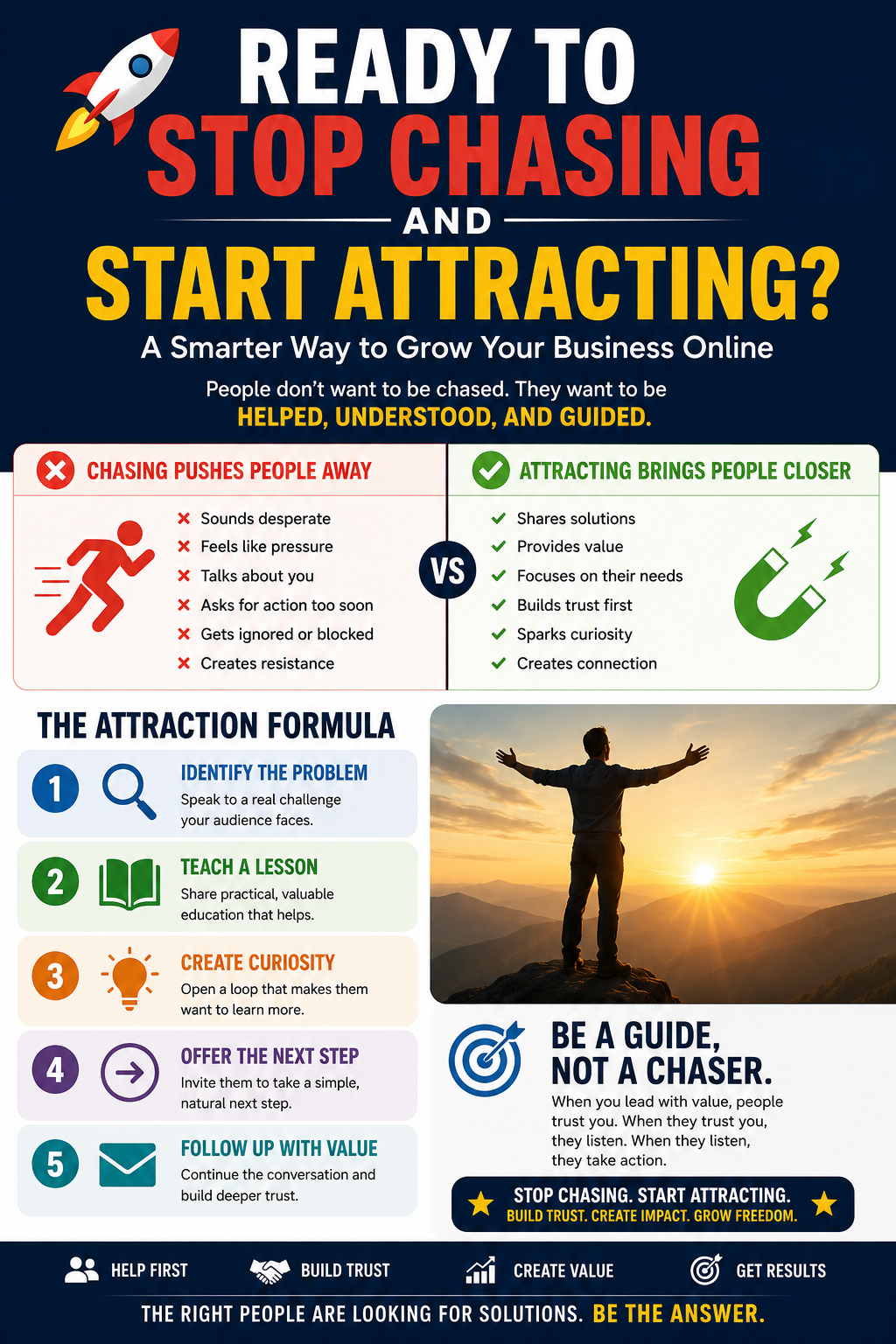
The Attraction Formula

Here is a simple formula:

Problem + Education + Curiosity + Invitation + Follow-Up = Attraction

Let’s break it down.

  • Problem: Show that you understand what the audience is facing.
  • Education: Give them a useful insight.
  • Curiosity: Make them want to know more.
  • Invitation: Offer the next step.
  • Follow-Up: Keep building trust after the first contact.

This formula works because it is not based on pressure. It is based on communication.


Example Social Post

“Most people think online business is about chasing strangers, sending links, and hoping someone says yes.

But the smarter way is different.

  • Identify a real problem.
  • Share useful education.
  • Create curiosity.
  • Invite people to learn more.
  • Follow up with value.

When people feel helped instead of hunted, they listen differently.

Stop chasing. Start attracting.”


Example Email Opening

Subject: Ready to stop chasing people?

Hi [First Name],

One of the biggest mistakes people make online is trying to convince everyone.

They send links too early.
They explain too much.
They follow up with pressure.
Then they wonder why people stop responding.

The better way is to attract people through value, education, and curiosity.

When people understand the problem and see you as a helpful guide, they become more open to learning about the solution.

That is how trust begins.


Common Mistakes to Avoid

  • Do not post only links.
  • Do not pressure people.
  • Do not make unrealistic promises.
  • Do not talk only about yourself.
  • Do not ignore follow-up.
  • Do not expect instant results.
  • Do not confuse activity with strategy.

Attraction requires patience and consistency.

But once you understand it, your marketing becomes more professional and more duplicable.


Stop Running After People Who Are Not Ready

Not everyone is your prospect.

  • Some people are not ready.
  • Some people are not interested.
  • Some people do not see the need yet.
  • Some people need more education.
  • Some people need more time.

That is okay.

  • Your job is not to force everyone to act.

Your job is to keep showing up with value so the right people can recognize the opportunity when they are ready.

  • When you stop chasing, you protect your energy.
  • When you start attracting, you build authority.
  • When you lead with education, you create trust.
  • And when you create trust, people begin to listen.

So, are you ready to stop chasing and start attracting?

The smarter path begins with value.


Ready to build smarter online conversations and attract people through trust, curiosity, and value?

Start by sharing helpful content, guiding people with education, and using a simple system that turns attention into leads and leads into meaningful follow-up.

Do not chase people.
Build trust.
Create curiosity.
Invite wisely.
Follow up with value.

That is how attraction begins.


Disclaimer

This article is for educational and informational purposes only. It does not guarantee specific business, financial, or marketing results. Any income, traffic, lead generation, or conversion outcomes depend on individual effort, strategy, market conditions, tools used, consistency, and other factors. Always do your own research before joining any business opportunity, purchasing any service, or making financial decisions.