By Marvin Gandis
A Stoic Guide to Calm Power, Clear Thinking, and Daily Resilience
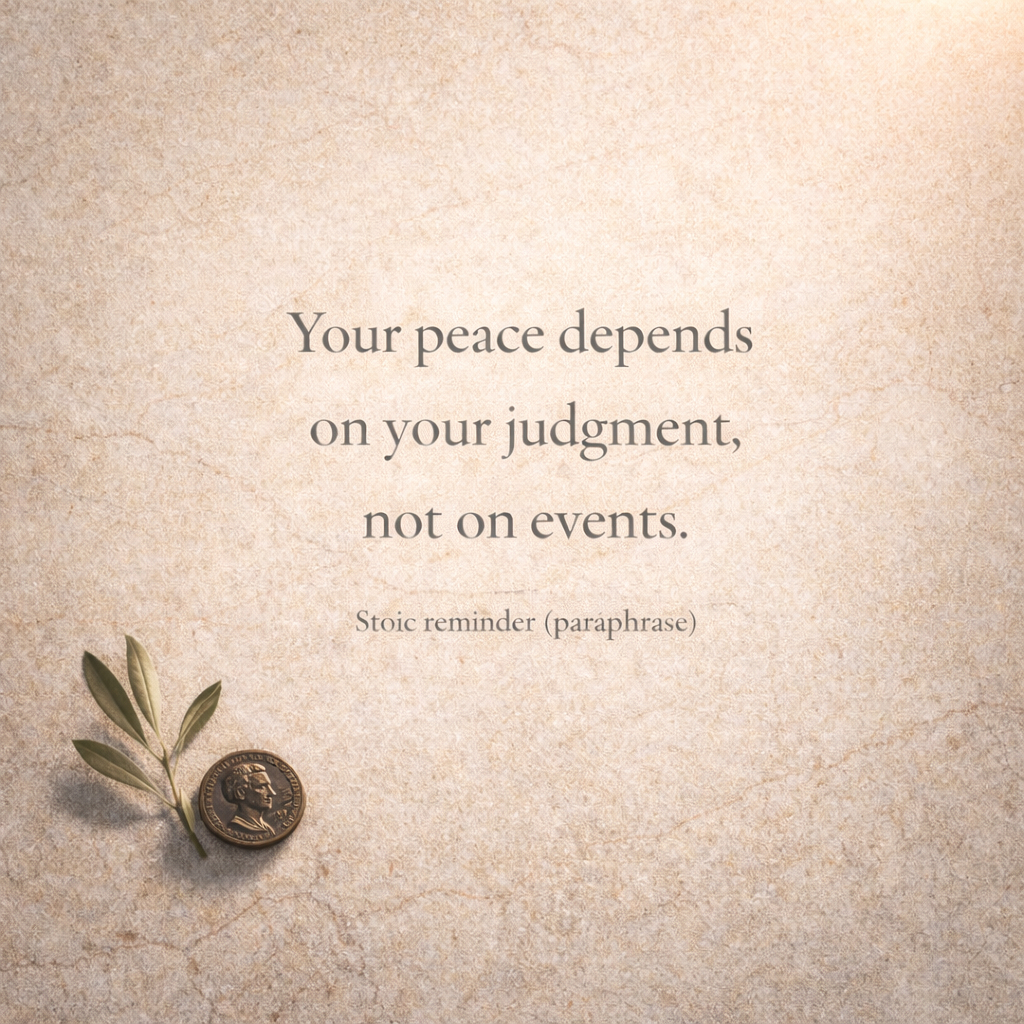
Stoic reminder (paraphrase): Your peace depends on your judgment, not on events.
Introduction: The real battle isn’t outside
Most people believe peace arrives when life finally “behaves”—when problems disappear, people cooperate, money is stable, and everything goes according to plan.
But Stoicism flips that belief:
Peace doesn’t come from controlling life.
Peace comes from controlling the meaning you assign to life.
Events happen. That is normal.
What creates suffering is often the story you attach to it.
1) The Stoic foundation: events vs. judgments
Stoics teach a simple separation:
- Event: what happens (external)
- Judgment: what you say it means (internal)
Example:
- Event: Someone ignores your message.
- Judgment: “They don’t respect me.”
- Emotion: anger, anxiety, insecurity.
But the event itself is neutral.
Your judgment creates the emotional storm.
✅ Key Stoic truth:
You can’t always control what happens, but you can control the interpretation you choose.
2) Why your mind becomes a “meaning machine”
Your brain doesn’t just experience reality—it explains it.
When you’re under stress, your mind tries to protect you by predicting danger. That’s why you may overthink:
- “What if this goes wrong?”
- “What if I fail?”
- “What if they judge me?”
Stoicism doesn’t shame fear—it trains you to manage the interpretation that fuels fear.
3) The hidden power of a pause
If you want more peace, you don’t need a new life.
You need a new pause.
A Stoic pause looks like this:
- Notice the reaction rising
- Name the judgment forming
- Choose a better judgment
- Respond, don’t react
This is where freedom lives: between stimulus and response.
✅ Practice:
When you feel disturbed, ask:
“What judgment am I making right now?”
4) “But what if the event is truly bad?”
Stoicism is not denial. It doesn’t pretend everything is fine.
It simply teaches:
- Pain may be real
- Loss may be real
- Difficulty may be real
…but despair is optional when you choose a wiser interpretation.
A Stoic doesn’t say: “This isn’t hard.”
A Stoic says: “This is hard—and I can meet it with strength.”
✅ Stoic upgrade:
Replace “This is ruining my life” with
“This is challenging me to grow.”
5) How to build calm power daily
A) Train your attention like a muscle
What you repeatedly focus on becomes your reality.
- Focus on chaos → you live in chaos
- Focus on duty → you live in purpose
- Focus on gratitude → you live in abundance
B) Reduce your emotional noise
Your peace grows when your mind stops rehearsing worst-case scenarios.
C) Make peace your leadership skill
If you lead yourself well, you can lead anything.
Calm is not weakness.
Calm is control.
6) Real-life examples (how this works in daily life)
Work / Business
- Event: Sales are slow.
- Judgment 1: “I’m failing.”
- Judgment 2 (Stoic): “This is feedback—improve the process.”
Relationships
- Event: Someone criticizes you.
- Judgment 1: “I’m not enough.”
- Judgment 2 (Stoic): “Their words can inform me, but they can’t define me.”
Personal growth
- Event: You miss a day of discipline.
- Judgment 1: “I always mess up.”
- Judgment 2 (Stoic): “Reset today. The next action matters most.”
7) A 7-day Stoic challenge for inner peace
Every day for 7 days, do this:
- Write one stressful event
- Write the judgment you attached
- Rewrite a wiser judgment
- Take one calm action
This is how peace becomes a habit.
Conclusion: Peace is a decision you make repeatedly
Events will always change.
People will always vary.
Life will always surprise you.
But your inner stability can become constant—if you guard your judgments.
Your peace depends on your judgment, not on events.
So protect your mind like it’s sacred—because it is.
Disclaimer
This article is for educational and informational purposes only and does not constitute financial, legal, medical, or professional advice. Results vary based on effort, experience, and circumstances. Always do your own research and consult qualified professionals when needed.
