
Suscríbete para seguir leyendo
Suscríbete para obtener acceso al contenido íntegro de esta entrada y demás contenido exclusivo para suscriptores.

Suscríbete para obtener acceso al contenido íntegro de esta entrada y demás contenido exclusivo para suscriptores.
By Marvin Gandis
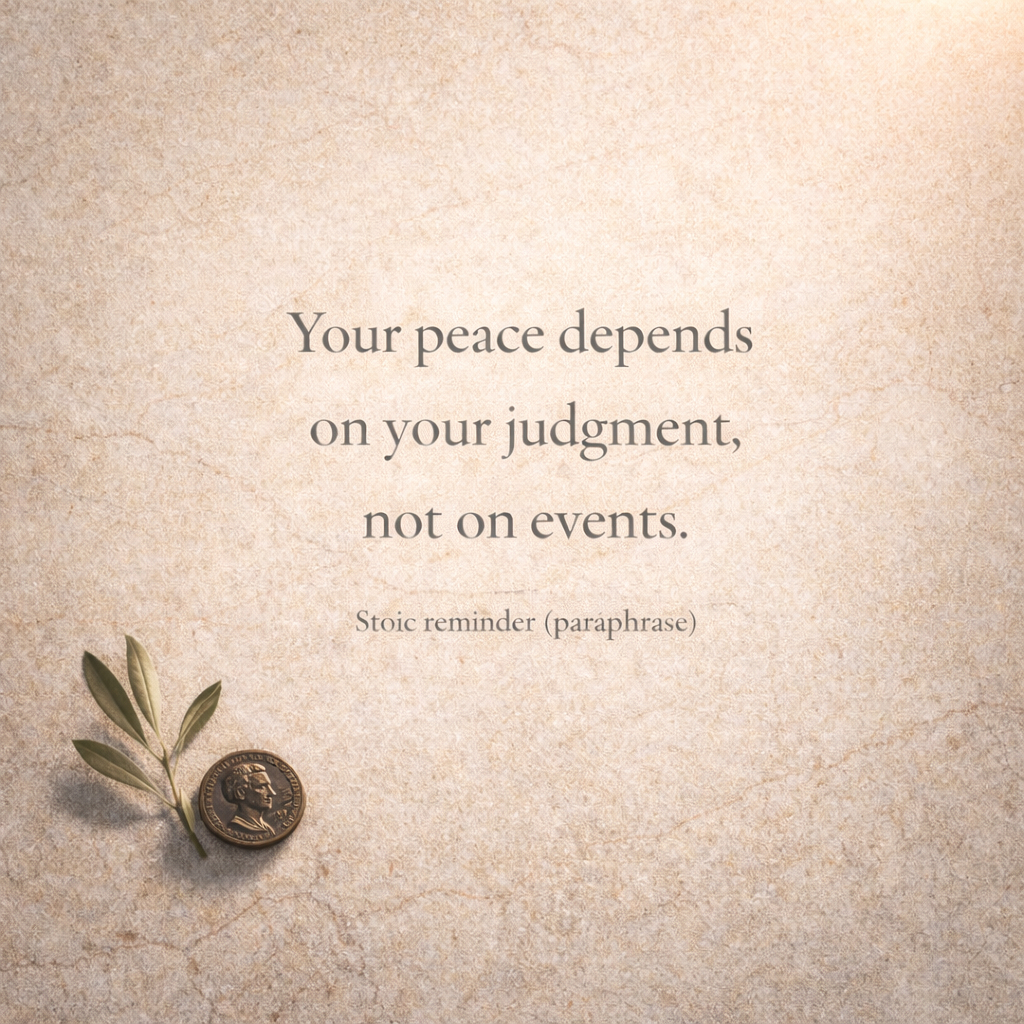
Stoic reminder (paraphrase): Your peace depends on your judgment, not on events.
Most people believe peace arrives when life finally “behaves”—when problems disappear, people cooperate, money is stable, and everything goes according to plan.
But Stoicism flips that belief:
Peace doesn’t come from controlling life.
Peace comes from controlling the meaning you assign to life.
Events happen. That is normal.
What creates suffering is often the story you attach to it.
Stoics teach a simple separation:
Example:
But the event itself is neutral.
Your judgment creates the emotional storm.
✅ Key Stoic truth:
You can’t always control what happens, but you can control the interpretation you choose.
Your brain doesn’t just experience reality—it explains it.
When you’re under stress, your mind tries to protect you by predicting danger. That’s why you may overthink:
Stoicism doesn’t shame fear—it trains you to manage the interpretation that fuels fear.
If you want more peace, you don’t need a new life.
You need a new pause.
A Stoic pause looks like this:
This is where freedom lives: between stimulus and response.
✅ Practice:
When you feel disturbed, ask:
“What judgment am I making right now?”
Stoicism is not denial. It doesn’t pretend everything is fine.
It simply teaches:
A Stoic doesn’t say: “This isn’t hard.”
A Stoic says: “This is hard—and I can meet it with strength.”
✅ Stoic upgrade:
Replace “This is ruining my life” with
“This is challenging me to grow.”
What you repeatedly focus on becomes your reality.
Your peace grows when your mind stops rehearsing worst-case scenarios.
If you lead yourself well, you can lead anything.
Calm is not weakness.
Calm is control.
Every day for 7 days, do this:
This is how peace becomes a habit.
Events will always change.
People will always vary.
Life will always surprise you.
But your inner stability can become constant—if you guard your judgments.
Your peace depends on your judgment, not on events.
So protect your mind like it’s sacred—because it is.
This article is for educational and informational purposes only and does not constitute financial, legal, medical, or professional advice. Results vary based on effort, experience, and circumstances. Always do your own research and consult qualified professionals when needed.

Have you ever felt paralyzed by worry, unsure of what to do next? 🧠 We’ve all been there. But here’s the real truth: action is the antidote to fear. When you start working on the solution, that overwhelming worry starts to melt away. 🎯 It may sound simple, but taking the first step can transform your mindset and set you on the path to success.
This article will show you how and why getting started is the key to overcoming anxiety, with plenty of real-life examples and insights from experts in the field. 🌟
This article is designed for people who feel stuck, anxious, or overwhelmed by life’s challenges—whether in business, personal development, or any area requiring focus and decision-making. If you’re looking to take control of your life and reduce the stress that comes with decision paralysis, this one’s for you!
Worry is a powerful emotion that can feel like it’s holding you hostage. We often let problems build up in our minds, making them seem larger and more daunting than they actually are. 🌪️ Whether it’s a looming deadline, a relationship issue, or financial troubles, worry feeds on inaction. The longer we delay solving the problem, the bigger and scarier it becomes.
Let’s be honest: it’s much easier to dwell on problems than to face them head-on. But that’s where the power of starting comes into play.
🔑 «Worry is like a rocking chair. It gives you something to do but never gets you anywhere.» – Erma Bombeck
This quote encapsulates the futility of worry. You’re stuck in a loop of overthinking, and the only way to break free is to move. When you begin focusing on the solution rather than the problem, the fog of anxiety starts to lift. ✨
If the idea of tackling your problems all at once feels overwhelming, break them down into smaller, more manageable tasks. 📝 For instance, if you’re stressed about launching your home business, don’t try to do everything in one go. Start with something small, like researching a niche or outlining your business plan. Even the smallest action shifts your focus from worry to progress.
🔥 Real-life example: Take the story of Sarah, a stay-at-home mom who always dreamed of starting her own embroidery business. The constant worry of failing kept her from taking any steps forward. One day, she decided to just start by buying a beginner’s embroidery kit. That small action sparked a chain reaction that led to her running a successful online store today. She didn’t wait until she had it all figured out; she just got started. Now, she says, «That first stitch I made felt like stitching away my fear.» 🧵✨
The thoughts you allow into your mind play a huge role in how you deal with problems. 💬 Negative self-talk is like adding fuel to the worry fire. If you constantly think, «This is too hard,» or «I’ll never figure this out,» then guess what? You’ll likely stay stuck.
What if you shifted that internal dialogue to something more productive?
🔑 «You don’t have to see the whole staircase, just take the first step.» – Martin Luther King Jr.
Tell yourself, «I’ll take this one step at a time,» or «I can figure this out.» 🌈 It may seem like a small change, but your mindset plays a huge role in whether you move forward or stay stuck in worry.
Worry thrives on uncertainty, but here’s a powerful reminder: You can only control your actions. Instead of obsessing over outcomes, shift your energy toward what you can control. ✋ If you’re launching a new project, focus on the work you can do today—not the potential hurdles down the road.
🔥 Real-life example: Tony Robbins, the motivational speaker, once shared a story about how his first seminar had only 7 people in the audience. Instead of worrying about how small the crowd was, he decided to focus on delivering the best experience possible for those seven people. His commitment to action led to one of the attendees recommending him, and that recommendation changed his career trajectory. Talk about the power of taking action! 💼
Every time you make progress, celebrate it! 🎉 Rewarding yourself for small victories helps build momentum and reinforces the habit of taking action. Whether it’s checking off a task from your to-do list or completing a small milestone in a larger project, acknowledge the effort you’ve put in.
🔑 «Success is the sum of small efforts, repeated day in and day out.» – Robert Collier
The more you celebrate the small wins, the easier it becomes to tackle bigger challenges. Remember, progress is progress, no matter how small. 🚀
At the end of the day, the worry we carry with us isn’t productive. It doesn’t solve problems—it creates more. The moment you shift from worrying to doing, you reclaim your power. ⚡ Every action, no matter how small, is a step toward not only solving the issue but also silencing the doubts in your head.
So, what are you waiting for? Start today. Whether it’s writing that first chapter of your book, calling a potential client, or simply organizing your thoughts, the magic lies in the doing. 💡 Your solution is waiting for you to act on it, and the best way to dissolve worry is to work on the solution.
Remember: When you start working on the solution, the worry goes away. 🌟
Now it’s your turn. Take the first step, and watch how quickly your worries fade. Start working on that solution, and before you know it, you’ll be celebrating your success. 🎉
Debe estar conectado para enviar un comentario.