
Publicado en Financial Education, Lifestyle, Motivation, Personal Development, Personal Finance, Well-Being

I Don’t Need Much to Live: Discovering That Having More Does Not Always Mean Living Better

By Marvin Gandis

We live in a culture constantly telling us that we need more.

  • More money.
  • More possessions.
  • A bigger house.
  • A newer car.
  • More followers.
  • More recognition.
  • More comfort.
  • More visible success.

Without noticing it, we can begin measuring our lives by everything we still do not have.

But somewhere along the journey, many people discover an incredibly liberating truth:

I don’t need much to live well.

That does not mean abandoning ambition, rejecting prosperity, or settling for a life without dreams. It means understanding the difference between what we genuinely need and everything modern culture teaches us to desire.

We can pursue progress without becoming servants of our possessions.

We can build wealth without allowing money to become our identity.

We can enjoy beautiful things without believing happiness depends on accumulating them.

And one of life’s greatest forms of wealth may be discovering how little we truly need to feel content.


Life becomes heavy when we believe we need too much

Everything we own carries a cost.

Not only the purchase price.

Possessions may also require maintenance, storage, insurance, repairs, attention, energy, and worry.

A larger home may mean larger expenses.

A more expensive car can mean larger payments.

More devices can mean more distraction.

More commitments can mean less freedom.

More debt can mean less peace.

So before asking:

“How can I get more?”

perhaps we should sometimes ask:

“Do I really need more?”

That question alone can transform our relationship with money and consumption.


Having enough can be an extraordinary form of wealth

There is one powerful word that receives very little attention in a consumer-driven culture:

Enough.

Enough food.

A safe place to sleep.

The clothing we need.

Reasonable access to healthcare.

People who love us.

Time to rest.

Freedom to think.

Peace when we go to bed.

A reason to get up tomorrow.

Once we begin noticing these things, we may discover that many of life’s greatest treasures were already present.

We were simply too busy noticing what was missing.


Simplicity is not the same as poverty

There is an important difference between poverty and simplicity.

Poverty can involve lacking access to necessities.

Simplicity can be a conscious choice.

Someone can have significant financial resources and still choose a simple lifestyle.

They can buy fewer things.

Avoid unnecessary debt.

Take care of what they already own.

Choose experiences over appearances.

Save and invest instead of spending primarily to impress other people.

Simple living does not say:

“I don’t want to advance.”

It says:

“I want to advance without losing my freedom along the way.”


Wanting prosperity is not the problem

There is nothing inherently wrong with wanting financial progress.

Wanting a comfortable home is reasonable.

Building a business can be worthwhile.

Saving is wise.

Investing can be responsible.

Wanting better opportunities for your family can be honorable.

Problems arise when we confuse prosperity with endless accumulation.

We can increase our income while keeping our needs under control.

That combination can be extremely powerful.

If every raise in income immediately produces an equal increase in expenses, we can earn more and still feel financially trapped.

But when our income grows while we continue living intentionally, financial margin appears.

That margin can become:

  • savings,
  • investments,
  • debt reduction,
  • education,
  • generosity,
  • experiences,
  • time,
  • freedom.

That is another kind of prosperity.


Comparison convinces us that enough is never enough

Many modern “needs” do not begin inside us.

They begin with comparison.

We see what someone drives.

Where they travel.

What they purchase.

How their home looks.

What they post online.

Then we begin thinking:

“Maybe I should have that too.”

But social media rarely shows the entire picture.

We see the car, but not necessarily the loan.

We see the vacation, but not the credit-card balance.

We see the house, but not the mortgage.

We see the success, but not the anxiety.

Comparing our complete reality with somebody else’s selected highlights can create permanent dissatisfaction.

Freedom begins when we stop asking:

“How does my life compare with theirs?”

and start asking:

“Am I building the life I actually want?”


Fewer needs can create greater freedom

When we need less to feel satisfied, possibilities open.

We need less money to sustain our lifestyle.

We can save more.

We can work with greater purpose.

We can reduce certain pressures.

We may have more time for family.

We can give more generously.

Career changes may become less frightening.

Unexpected expenses become easier to handle.

We can enjoy more while providing less.

In a sense, every unnecessary need we eliminate may return a little freedom to us.


Learn the difference between needs, comforts, and wants

Before purchasing something, consider three categories.

Need

Something genuinely necessary for basic living, safety, health, or essential functioning.

Comfort

Something that improves or simplifies life but that we could probably live without.

Want

Something desired mainly for enjoyment, preference, entertainment, or status.

There is nothing wrong with buying wants.

The problem begins when every want is treated like a need.

We can enjoy something while remaining financially honest.

We can say:

“I don’t need this, but I want it, and I can responsibly afford it.”

That distinction reflects financial maturity.


Buy less, but buy intentionally

Living with less does not always mean purchasing the cheapest item.

Sometimes higher-quality products can actually cost less over time.

The goal is to stop consuming automatically.

Before buying something, ask:

  • Do I genuinely need this?
  • Do I already own something that serves the same purpose?
  • Would I buy it if nobody else ever saw it?
  • Am I buying for usefulness or impulse?
  • Can I pay for it responsibly?
  • Will this still matter to me six months from now?

Questions like these can prevent purchases that bring excitement for a few hours but obligations for several years.


Learn to enjoy what you already own

One powerful modern discipline is rediscovering the things already in our lives.

Wear the clothes already in your closet.

Cook the food already in your kitchen.

Read the books already on your shelves.

Finish projects you already started.

Use the tools you already purchased.

Explore nearby places you have never visited.

Spend time with people already present in your life.

Sometimes we keep searching for something new before fully experiencing the value of what is already around us.


Your greatest possessions may not fit inside a box

Think about what has the greatest value in a human life.

  • Health.
  • Time.
  • Family.
  • Friendship.
  • Faith.
  • Knowledge.
  • Experience.
  • Character.
  • Peace.
  • Purpose.
  • Freedom.

None of these can be fully purchased in a store.

Money may help us protect or develop some of them, but it cannot guarantee them.

That is why we should be careful not to build a life where we gain objects while losing everything that truly matters.


Some people own much but enjoy very little

More possessions do not guarantee satisfaction.

Our lifestyles can expand so quickly that we never actually experience abundance.

Every new level immediately becomes the new minimum.

The small apartment is no longer enough.

Then the house becomes insufficient.

The car still works, but we want another.

The phone works perfectly, but a newer model appears.

Income rises, but expectations rise with it.

We can spend an entire lifetime chasing a finish line that keeps moving.

That is why learning to say:

“This is enough for me.”

can become one of the greatest skills for inner peace.


Living with less can strengthen your finances

Reducing unnecessary expenses lowers the amount required to sustain our lifestyle.

That may improve our ability to:

  • build an emergency fund,
  • pay down debt,
  • invest,
  • prepare for retirement,
  • survive difficult seasons,
  • take advantage of opportunities,
  • and help other people.

Simple living does not guarantee wealth.

But reasonable expenses can create a much more resilient financial foundation.


Make room for experiences, not only possessions

We may remember these things for decades:

  • an important conversation,
  • a family meal,
  • a journey,
  • a day with our children,
  • time with a friend,
  • a sunrise,
  • a walk,
  • an answered prayer,
  • an act of service,
  • an opportunity to help someone.

Meanwhile, many things we once considered essential eventually end up forgotten in a drawer.

Building a meaningful life requires deciding where our money, time, and attention truly belong.


We also need to learn how to say no

Simple living requires boundaries.

I don’t need to buy it just because it is on sale.

I don’t need to replace it because a new model was released.

I don’t need to compete with my neighbors.

I don’t need to prove that I am successful.

I don’t need to accept every invitation.

I don’t need to follow every trend.

I don’t need to turn every increase in income into another expense.

Every intentional “no” protects something.

Perhaps it protects your savings.

Your time.

Your energy.

Or your peace.


Gratitude changes our definition of wealth

Gratitude does not mean denying life’s difficulties.

It does not mean abandoning our goals.

It means recognizing what we already have while continuing to build toward something better.

When we wake up thinking only about what is missing, we begin the day from scarcity.

When we also recognize what is already present, our perspective changes.

We can still say:

“I want to grow.”

Without saying:

“I cannot be happy until I have more.”


Practical exercise: Calculate how much you truly need

One useful exercise is calculating your essential monthly number.

Write down what you reasonably need for:

  • housing,
  • food,
  • utilities,
  • transportation,
  • healthcare,
  • insurance,
  • financial obligations,
  • savings,
  • essential family needs.

Then compare that number with what you currently spend on optional items.

This is not about eliminating all enjoyment.

It is about understanding the true cost of sustaining your life.

Many people discover that they need considerably less to live with dignity than they previously imagined.

Knowing that number can produce a powerful sense of control.


A simple rule for intentional living

Before adding something new to your life, ask:

Will this increase my freedom or reduce it?

Some purchases genuinely help us.

Some investments expand our opportunities.

Some tools increase productivity.

But other purchases simply create new obligations.

The important question is not only:

“Can I buy it?”

A better question might be:

“Do I want to maintain it?”


If I had to start again tomorrow

Try this mental exercise.

Imagine that tomorrow you could keep only twenty material possessions.

What would you choose?

You might discover something surprising.

Many objects currently filling our homes would not even make the list.

That does not mean we must throw everything away.

It simply helps identify what truly matters to us.


The goal is not merely owning less; it is needing less

External minimalism can be useful.

But there is something deeper:

internal simplicity.

We can own very little and remain obsessed with getting more.

Or we can own many things and relate to them with freedom.

The deeper transformation happens when possessions stop defining us.

When we can enjoy them without emotionally depending on them.

When we can share them.

When we can lose some of them and still move forward.

When our identity rests in something deeper than our material net worth.


I don’t need much to live; I need reasons to live

Ultimately, life’s greatest question is not how many things we accumulated.

It is what we did with the days we received.

  • Did we love?
  • Did we learn?
  • Did we help?
  • Did we forgive?
  • Did we create?
  • Did we serve?
  • Did we enjoy?
  • Did we build something that helped someone else?
  • Did we live with purpose?

We can sit inside a house filled with expensive possessions and feel empty.

Or we can sit around a simple table with people we love and feel extraordinarily rich.


Conclusion

Perhaps we do not need nearly as much as we think.

Maybe we need enough to live with dignity, enough wisdom to manage what we have, and enough gratitude to recognize our blessings.

  • We can continue working.
  • Continue dreaming.
  • Build businesses.
  • Invest.
  • Prosper.

But we can also learn to say:

  • I do not need to prove my value through what I purchase.
  • I do not need to compete with somebody else’s lifestyle.
  • I do not need to sacrifice my peace to maintain an image.
  • I don’t need much to live well.
  • I need purpose.
  • I need people I love.
  • I need health to the extent that I can care for it.
  • I need wisdom.
  • I need peace.
  • I need time.
  • I need hope.

And when we finally understand the difference between having a lot and having enough, we begin discovering a kind of wealth that no bank statement can fully measure.

Sometimes having less to maintain gives us more life to enjoy.


Disclaimer: This article is provided for educational, informational, and personal reflection purposes only. It does not constitute financial, legal, medical, or individualized professional advice. Every person’s financial and personal circumstances are different. Before making significant decisions involving money, investments, debt, or lifestyle changes, consider your individual situation and consult a qualified professional when appropriate.

Publicado en Artificial Intelligence, Economics, Entrepreneurship, Family Planning, Financial Education, Financial Security, Future of Work, Personal Development, Personal Finance, Saving and Investing

Financial Education and the Economic Future

The knowledge that can protect your decisions, expand your opportunities, and change a family’s destiny

By Marvin Gandis

For generations, many people were taught that getting ahead required earning an education, finding a stable job, working for decades, saving part of their income, and patiently waiting for retirement.

That model helped many families in the past. However, the economic world is changing rapidly.

Housing, food, insurance, education, transportation, and basic services continue to place pressure on millions of households. At the same time, automation, artificial intelligence, e-commerce, independent work, and digital platforms are transforming how we work, produce, shop, save, and invest.

In this new environment, knowing how to earn money is no longer enough.

We must also learn how to manage it, protect it, grow it, and use it with purpose.

Financial education does not guarantee instant wealth. It does not eliminate every risk in life. However, it can help us avoid expensive mistakes, make more thoughtful decisions, and build a more stable economic future.


What is financial education?

Financial education is the ability to understand how money works and use that knowledge to make better economic decisions.

It includes learning how to:

  • Create and follow a budget.
  • Separate needs from wants.
  • Control spending.
  • Use credit responsibly.
  • Avoid unnecessary debt.
  • Build an emergency fund.
  • Save for important goals.
  • Understand interest and inflation.
  • Evaluate risk.
  • Invest prudently.
  • Protect income and property.
  • Prepare for retirement.
  • Recognize fraud and misleading financial promises.
  • Develop more than one source of income.

Financial education is not limited to learning banking terms or studying complex investments.

It is primarily about developing habits that allow us to take control of our decisions.


The problem with earning money without knowing how to manage it

A person can earn a high income and still live in constant financial stress.

Another person may earn a modest income and gradually build stability through discipline, planning, and wise decisions.

The difference is not always how much someone earns. It is how much they keep, how they use it, and what they build with it.

Without financial understanding, a person is more likely to:

  • Spend everything they receive.
  • Depend on credit cards for basic needs.
  • Have no emergency savings.
  • Pay excessive interest.
  • Make impulsive purchases.
  • Confuse income with wealth.
  • Ignore investment risks.
  • Believe promises of fast money.
  • Retire without sufficient preparation.

Increasing income is important, but increasing financial knowledge is equally important.

Earning more without improving our habits may simply cause us to spend more.


Inflation and the loss of purchasing power

Inflation is one of the most important concepts in financial education.

Inflation occurs when prices rise over time and money loses part of its purchasing power.

This means that an amount of money that purchases certain products today may not purchase the same products several years from now.

Inflation especially affects people who:

  • Keep all their money without earning a return.
  • Depend on fixed income that does not increase.
  • Fail to review their budgets regularly.
  • Do not plan for future expenses.
  • Carry high-interest debt.

Understanding inflation helps us recognize that saving is necessary, but we must also think long term.

This does not mean investing impulsively. It means learning about available alternatives, evaluating risk, and finding responsible ways to preserve the value of our resources.


The economic future will demand new skills

The future job market will likely become more dynamic, technological, and competitive.

Many repetitive tasks are being automated. At the same time, new opportunities are emerging in technology, data analysis, content creation, digital education, e-commerce, cybersecurity, remote service, and artificial intelligence.

This does not mean every job will disappear.

It means many roles will change.

People who develop new skills will have a greater ability to adapt. Those who depend only on what they learned many years ago may face greater challenges.

Important skills for the economic future may include:

  • Continuous learning.
  • Digital literacy.
  • Clear communication.
  • Problem-solving.
  • Adaptability.
  • Project and priority management.
  • Professional reputation building.
  • Independent and remote work.
  • Basic sales and marketing knowledge.
  • Responsible use of artificial intelligence.
  • Personal financial management.

Financial knowledge and professional development will become increasingly connected.


A job is important, but it may not be enough

For many years, stable employment was considered the primary foundation of financial security.

Employment remains essential for millions of people. However, depending entirely on one source of income can create risk.

An illness, layoff, technological change, recession, or family emergency can suddenly affect that income.

For this reason, many people are exploring additional options such as:

  • Freelance work.
  • Professional services.
  • Small businesses.
  • E-commerce.
  • Affiliate marketing.
  • Content creation.
  • Consulting.
  • Renting property or equipment.
  • Selling digital products.
  • Part-time employment.
  • Investments appropriate for their risk profile.

Developing additional income does not mean pursuing every opportunity that appears.

It means patiently building a second economic ability that can complement your primary income.

Every opportunity should be investigated carefully. Understand its costs, risks, requirements, terms, and realistic potential before investing money.


The importance of a budget

A budget is not a punishment.

It is a plan that gives your money a purpose.

Without a budget, it is easy to spend first and later wonder where the money went. With a budget, resources can be assigned to necessities, savings, debt, goals, and enjoyment.

A simple budget can contain five areas:

1. Essential expenses

Housing, food, transportation, utilities, insurance, healthcare, and required payments.

2. Savings

Emergency savings and money reserved for specific goals.

3. Debt repayment

Especially debts carrying high interest rates.

4. Personal development

Courses, books, tools, or training that can improve income potential.

5. Personal spending

Entertainment, restaurants, travel, and nonessential purchases within reasonable limits.

The goal is not to remove every enjoyable experience.

The goal is to prevent today’s spending from destroying tomorrow’s opportunities.


The emergency fund: a financial defense

An emergency can happen at any time.

A vehicle may break down. A medical bill, home repair, job loss, or unexpected family situation may arise.

Without savings, these situations often become debt.

An emergency fund is money reserved exclusively for necessary, unexpected expenses.

To begin:

  1. Establish a small initial goal.
  2. Set aside money from every paycheck.
  3. Keep it in an accessible but separate account.
  4. Do not use it for regular purchases.
  5. Replenish it after an emergency.

Over time, many people seek to accumulate several months of essential expenses. The appropriate amount depends on each household’s income, responsibilities, and employment stability.

The most important step is to begin.


Credit: a tool or a trap

Credit can be helpful when used responsibly.

It may make it possible to purchase a home, finance education, develop a business, or address an important need.

However, it can also become a burden when it is used to support a lifestyle that income cannot sustain.

Before using credit, ask:

  • Do I truly need this purchase?
  • Can I pay for it without borrowing?
  • What is the interest rate?
  • How much will I pay in total?
  • Are there additional charges?
  • Could I make the payments if my income decreased?
  • Will this debt improve my well-being or only my appearance?

Credit is not extra money.

It is future income being committed today.


Saving and investing are not the same

Saving means setting money aside for future needs and short- or medium-term goals.

Investing means placing money into an asset with the expectation that it may increase in value or generate income, while accepting a degree of risk.

Savings are commonly used for:

  • Emergencies.
  • Repairs.
  • Travel.
  • Planned purchases.
  • Near-term goals.

Investments are commonly associated with:

  • Retirement.
  • Long-term wealth building.
  • Future financial goals.
  • Potential income generation.

Every investment includes risk. No one should invest in something they do not understand.

Before making a decision, investigate:

  • How the investment works.
  • The risks involved.
  • Fees and expenses.
  • How easily the money can be accessed.
  • Who regulates or manages the product.
  • What could happen in a negative scenario.

High returns are never guaranteed. When someone promises major profits without risk, extreme caution is necessary.


Productive debt and dangerous debt

Not every debt serves the same purpose or produces the same consequences.

Debt may be productive when it helps purchase an asset, improve a skill, or develop an activity that creates value.

However, even debt considered productive can become a problem when payments exceed a person’s financial capacity.

Dangerous debt often includes:

  • Loans carrying excessive interest rates.
  • Cash advances.
  • Impulsive purchases financed over time.
  • Debt used to pay other debt.
  • Credit accepted without reading the terms.
  • Loans for unverified opportunities.
  • Minimum payments that extend debt for years.

The main question should not simply be, “Will I be approved?”

The better question is, “Can I accept this obligation without endangering my essential needs and future goals?”


Technology is changing our relationship with money

Today, people can open accounts, transfer money, invest, apply for loans, operate businesses, and purchase products through a mobile phone.

This convenience provides major advantages, but it also creates risks.

Digital platforms can encourage:

  • Impulsive purchases.
  • Forgotten subscriptions.
  • Fraud.
  • Identity theft.
  • Hasty investment decisions.
  • Exposure to false experts.
  • Unrealistic income promises.

Modern financial education must include digital security.

Essential protections include:

  • Using strong, unique passwords.
  • Activating two-factor authentication.
  • Verifying websites before entering information.
  • Never sharing security codes.
  • Reviewing accounts regularly.
  • Avoiding suspicious links.
  • Distrusting messages that create artificial urgency.
  • Protecting personal documents.
  • Never sending money to unknown individuals.
  • Researching companies and opportunities before paying.

In the digital economy, protecting information also means protecting money.


Artificial intelligence and the future of work

Artificial intelligence can assist with writing, information analysis, automation, content creation, customer service, and productivity.

It can also change job responsibilities, reduce certain tasks, and increase performance expectations.

The best response is not to ignore technology or fear it automatically.

The best response is to learn how to use it.

People can prepare by:

  • Taking introductory artificial intelligence courses.
  • Learning tools related to their professions.
  • Developing critical-thinking skills.
  • Verifying AI-generated information.
  • Using data ethically and responsibly.
  • Combining human abilities with technological tools.

Empathy, judgment, creativity, trust, experience, and the ability to understand human needs will remain valuable.

Technology can perform tasks. People must still establish goals, evaluate consequences, and make responsible decisions.


Teaching financial education at home

Financial education should begin long before a person receives a first credit card.

Children and young adults can learn:

  • Money is earned by working, serving, or creating value.
  • Not every desire must be satisfied immediately.
  • Saving requires patience.
  • Purchases have consequences.
  • Sharing and helping others are also part of responsible money management.
  • Debt should be accepted carefully.
  • Opportunities that seem too good to be true require investigation.
  • Economic success does not determine human worth.

Family conversations about money should not be based only on fear or conflict.

They can also include goals, planning, generosity, responsibility, and hope.


Financial education is also emotional

Many financial decisions are not made logically. They are influenced by emotion.

People shop to feel accepted. They spend when they feel sad. They invest because they fear missing out. They borrow to impress others. They avoid reviewing their accounts because they feel anxious.

An important part of financial education is recognizing those emotions.

Before making a major financial decision, ask:

  • Am I acting from necessity or impulse?
  • Am I trying to impress someone?
  • Am I afraid of missing an opportunity?
  • Do I truly understand what I am accepting?
  • Have I investigated alternatives?
  • Can I wait 24 or 48 hours before deciding?

Sometimes the best financial decision is simply to pause and think.


Wealth is not only about money

A healthy vision of the economic future should go beyond accumulating possessions.

True stability may also include:

  • Time with family.
  • Freedom to make decisions.
  • Good health.
  • Peace of mind.
  • The ability to help others.
  • Freedom from destructive debt.
  • A safe home.
  • Emergency preparation.
  • Purposeful work.
  • A dignified retirement.
  • Resources to leave a legacy.

Money is an important tool, but it should not become the absolute measure of a person’s value.

Financial education should help us live better, not cause us to become obsessed with comparison.


How to improve your financial education

You do not need to learn everything in one day.

Begin with simple actions:

Step 1: Understand your current situation

List your income, expenses, debts, savings, and obligations.

Step 2: Track your spending

Record every expense for one month. This may reveal habits you had not previously recognized.

Step 3: Create a realistic budget

Do not create a perfect budget that is impossible to follow. Design one that fits your actual life.

Step 4: Begin an emergency fund

Even when the first amount is small, begin.

Step 5: Address expensive debt

Organize your debts and pay close attention to interest rates.

Step 6: Learn before investing

Read, compare, consult reliable sources, and avoid decisions made under pressure.

Step 7: Improve one marketable skill

Choose a skill that could increase your income or improve your employment opportunities.

Step 8: Review insurance and protection

Determine whether your family, income, health, home, and property have appropriate protection.

Step 9: Establish specific goals

Instead of saying, “I want to save,” define how much, for what purpose, and by what date.

Step 10: Review your progress monthly

Financial education is a continuing process, not a one-time assignment.


A simple monthly financial protocol

At the beginning or end of each month:

  1. Review all income.
  2. Confirm essential expenses.
  3. Identify unnecessary spending.
  4. Transfer money into savings.
  5. Make required debt payments.
  6. Review account transactions.
  7. Cancel unused subscriptions.
  8. Evaluate progress toward goals.
  9. Prepare for unusual expenses.
  10. Learn one new financial concept.

This process may require little time, but its accumulated impact can be significant.


The economic future belongs to those who prepare

No one can predict exactly what the economy will look like ten or twenty years from now.

We can expect change.

Some industries will grow. Others will decline. New professions will emerge. Tools will change. Prices will fluctuate. Technology will continue transforming daily life.

Preparation does not eliminate uncertainty.

It helps us face uncertainty with better resources.

A financially educated person does not necessarily know every answer. That person knows how to research, compare, ask questions, calculate, plan, and recognize when a decision requires more time.

That ability can make an enormous difference.


Final reflection

Financial education should not be reserved for bankers, business owners, or professional investors.

It is necessary for every worker, family, student, entrepreneur, and retiree.

Every economic decision we make affects our future in some way.

When we learn to budget, save, use credit wisely, protect ourselves from fraud, develop new abilities, and create realistic goals, we begin to build something more valuable than a bank account.

We build confidence.

We build choices.

We build stability.

We build the ability to assist our families and serve others.

We may not control the entire economy, rising prices, economic crises, or technological change. However, we can improve the way we respond to them.

The best time to learn about money may have been many years ago.

The second-best time is today.


Call to action

Use this week to conduct an honest review of your finances.

Identify one expense you can reduce, one debt you need to organize, one small amount you can save, and one skill you can begin developing.

You do not need to transform your economic life in a single day.

You need to begin with one responsible decision and continue moving forward.

The economic future is not built only through high income.

It is also built through knowledge, patience, discipline, and conscious decisions.

Begin strengthening your economic future today. Review your expenses, organize your debts, establish a savings goal, and learn one new financial concept every week.


Disclaimer

Disclaimer: This article is provided exclusively for educational, informational, and general reflection purposes. Its content does not constitute personalized financial, legal, tax, accounting, or investment advice. Individual circumstances, needs, objectives, and levels of risk tolerance may differ significantly.

Before applying for credit, making an investment, starting a business, modifying a retirement plan, or making any major financial decision, carefully investigate the relevant terms, costs, and risks. When appropriate, consult a properly qualified financial, legal, tax, or accounting professional.

Every investment involves some degree of risk, including the possible partial or total loss of the invested capital. Past performance does not guarantee future results. No income, profit, or investment return is guaranteed. References to digital businesses, additional income sources, affiliate marketing, freelance work, or entrepreneurship do not represent a promise of results. Success depends on multiple factors, including preparation, experience, effort, costs, market conditions, and individual decisions.

The author and website assume no responsibility for losses, damages, or consequences arising from the use or interpretation of this information. Each reader is responsible for verifying the information, evaluating personal circumstances, and making decisions according to individual needs and objectives.

Publicado en Budgeting, Family Finance, Financial Education, Personal Finance, Resilience

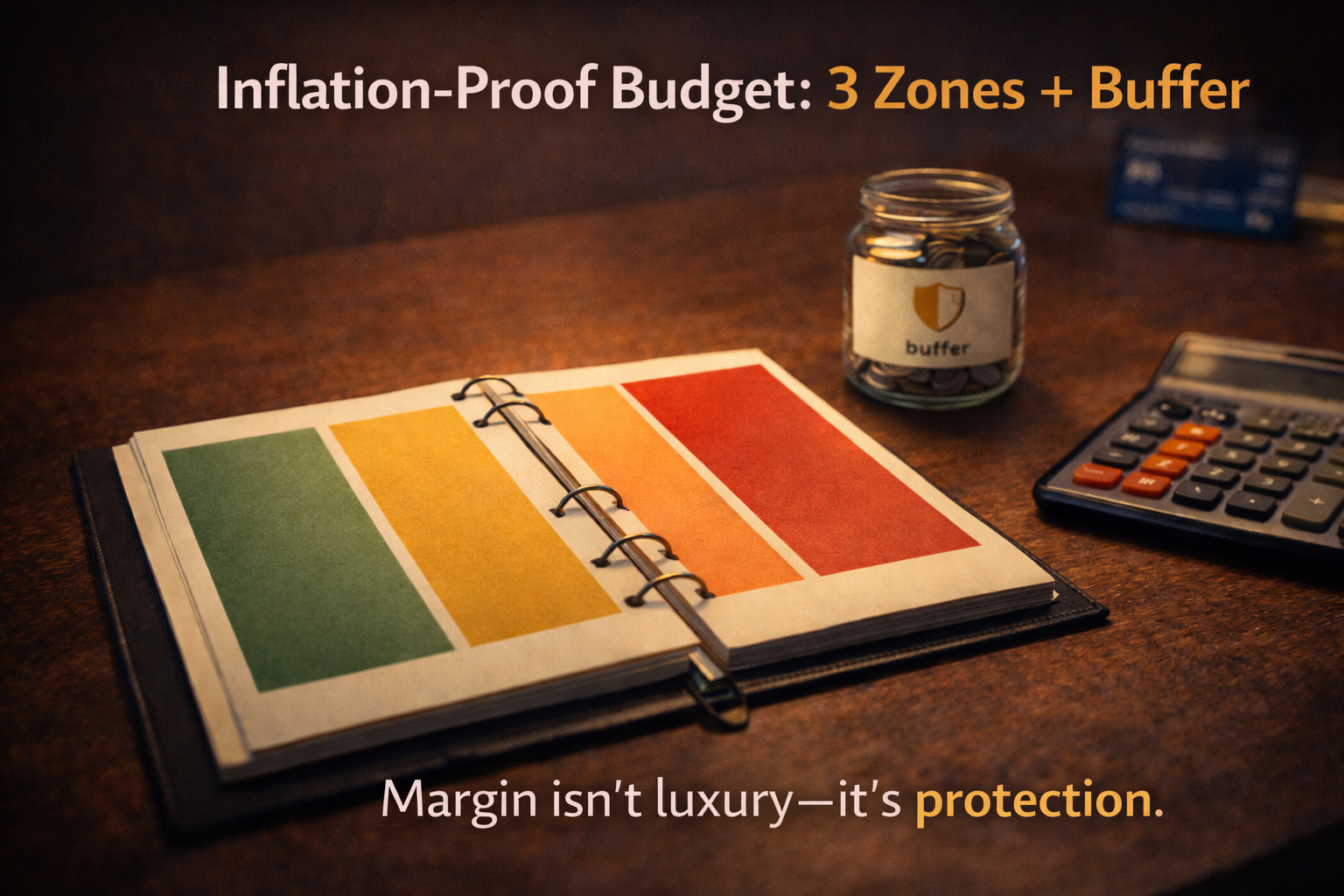
Inflation-Proof Budgeting: The 3-Zone Method + a Volatility Buffer (2026)

By Marvin Gandis

✅ ARTICLE 5

Introduction

When everything rises—food, gas, utilities, insurance—many people say:
“There’s nothing I can do.”

But there is.

Inflation isn’t fought only with more income. It’s fought with something powerful:

A budget that can take hits without breaking.

Most people have a “pretty budget” that works in normal times… and collapses in expensive times.

Today you’ll learn a simple, realistic 2026 system:

3 spending zones
✅ + a volatility buffer (for sudden spikes)


1) Why Budgets Fail When Prices Rise

They fail because:

  1. They don’t separate essentials from negotiables
  2. They have no margin for surprises
  3. They’re based on hope, not reality

In uncertain times, the keyword is: margin.


2) The 3-Zone Method (Simple and Powerful)

Zone 1: ESSENTIAL (non-negotiable)

Housing, core food, basic transportation, minimum utilities, insurance, essential meds.

Zone 2: FLEXIBLE (adjustable)

Entertainment, dining out, non-urgent shopping, subscriptions, extras.

Zone 3: EMERGENCY CUT (shut off in crisis)

Impulse spending, “stress buys,” luxuries disguised as normal, duplicate subscriptions.


3) The Volatility Buffer (What Saves Your Budget)

Inflation creates sudden spikes.

A volatility buffer is a budget line for “price jumps and surprises.”

Suggested levels:

  • 3% if tight
  • 5% if possible
  • 10% for strong protection

Rule: the buffer is protected.


4) Build It in 20 Minutes

  1. Write net monthly income
  2. List essentials first
  3. Assign buffer before fun
  4. Allocate the remaining to flexible
  5. Set one automatic adjustment rule

5) The Gold Trick: Weekly Budgeting

Monthly budgets feel “endless” and break faster.

Split your plan into weeks and track weekly like mini-months.


Checklist — Start Today

Define your 3 zones
Identify 5 “Zone 3” expenses to remove
Add a 3–5% buffer
Create a weekly budget
Set one auto-adjustment rule
Review 15 minutes every Sunday


Closing

Inflation doesn’t ask permission.
But you don’t have to live in reaction mode.

A strong budget isn’t the prettiest one.
It’s the one that keeps you steady when everything rises.


Disclaimer

This content is for educational purposes only and is not financial, legal, or investment advice. Consult a qualified professional before making decisions.