By Marvin Gandis
We live in a culture constantly telling us that we need more.
- More money.
- More possessions.
- A bigger house.
- A newer car.
- More followers.
- More recognition.
- More comfort.
- More visible success.
Without noticing it, we can begin measuring our lives by everything we still do not have.
But somewhere along the journey, many people discover an incredibly liberating truth:
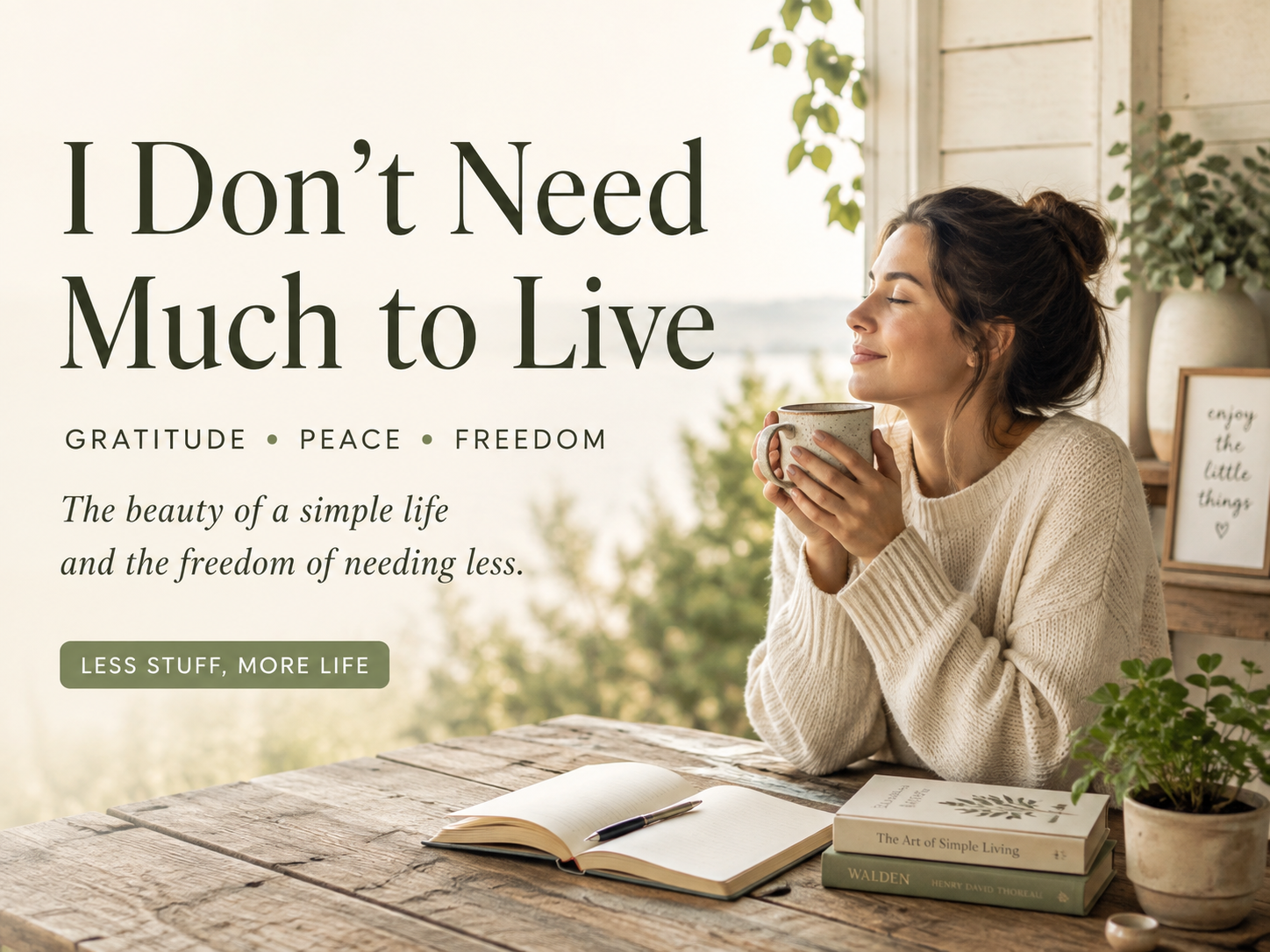
I don’t need much to live well.
That does not mean abandoning ambition, rejecting prosperity, or settling for a life without dreams. It means understanding the difference between what we genuinely need and everything modern culture teaches us to desire.
We can pursue progress without becoming servants of our possessions.
We can build wealth without allowing money to become our identity.
We can enjoy beautiful things without believing happiness depends on accumulating them.
And one of life’s greatest forms of wealth may be discovering how little we truly need to feel content.
Life becomes heavy when we believe we need too much
Everything we own carries a cost.
Not only the purchase price.
Possessions may also require maintenance, storage, insurance, repairs, attention, energy, and worry.
A larger home may mean larger expenses.
A more expensive car can mean larger payments.
More devices can mean more distraction.
More commitments can mean less freedom.
More debt can mean less peace.
So before asking:
“How can I get more?”
perhaps we should sometimes ask:
“Do I really need more?”
That question alone can transform our relationship with money and consumption.
Having enough can be an extraordinary form of wealth
There is one powerful word that receives very little attention in a consumer-driven culture:
Enough.
Enough food.
A safe place to sleep.
The clothing we need.
Reasonable access to healthcare.
People who love us.
Time to rest.
Freedom to think.
Peace when we go to bed.
A reason to get up tomorrow.
Once we begin noticing these things, we may discover that many of life’s greatest treasures were already present.
We were simply too busy noticing what was missing.
Simplicity is not the same as poverty
There is an important difference between poverty and simplicity.
Poverty can involve lacking access to necessities.
Simplicity can be a conscious choice.
Someone can have significant financial resources and still choose a simple lifestyle.
They can buy fewer things.
Avoid unnecessary debt.
Take care of what they already own.
Choose experiences over appearances.
Save and invest instead of spending primarily to impress other people.
Simple living does not say:
“I don’t want to advance.”
It says:
“I want to advance without losing my freedom along the way.”
Wanting prosperity is not the problem
There is nothing inherently wrong with wanting financial progress.
Wanting a comfortable home is reasonable.
Building a business can be worthwhile.
Saving is wise.
Investing can be responsible.
Wanting better opportunities for your family can be honorable.
Problems arise when we confuse prosperity with endless accumulation.
We can increase our income while keeping our needs under control.
That combination can be extremely powerful.
If every raise in income immediately produces an equal increase in expenses, we can earn more and still feel financially trapped.
But when our income grows while we continue living intentionally, financial margin appears.
That margin can become:
- savings,
- investments,
- debt reduction,
- education,
- generosity,
- experiences,
- time,
- freedom.
That is another kind of prosperity.
Comparison convinces us that enough is never enough
Many modern “needs” do not begin inside us.
They begin with comparison.
We see what someone drives.
Where they travel.
What they purchase.
How their home looks.
What they post online.
Then we begin thinking:
“Maybe I should have that too.”
But social media rarely shows the entire picture.
We see the car, but not necessarily the loan.
We see the vacation, but not the credit-card balance.
We see the house, but not the mortgage.
We see the success, but not the anxiety.
Comparing our complete reality with somebody else’s selected highlights can create permanent dissatisfaction.
Freedom begins when we stop asking:
“How does my life compare with theirs?”
and start asking:
“Am I building the life I actually want?”
Fewer needs can create greater freedom
When we need less to feel satisfied, possibilities open.
We need less money to sustain our lifestyle.
We can save more.
We can work with greater purpose.
We can reduce certain pressures.
We may have more time for family.
We can give more generously.
Career changes may become less frightening.
Unexpected expenses become easier to handle.
We can enjoy more while providing less.
In a sense, every unnecessary need we eliminate may return a little freedom to us.
Learn the difference between needs, comforts, and wants
Before purchasing something, consider three categories.
Need
Something genuinely necessary for basic living, safety, health, or essential functioning.
Comfort
Something that improves or simplifies life but that we could probably live without.
Want
Something desired mainly for enjoyment, preference, entertainment, or status.
There is nothing wrong with buying wants.
The problem begins when every want is treated like a need.
We can enjoy something while remaining financially honest.
We can say:
“I don’t need this, but I want it, and I can responsibly afford it.”
That distinction reflects financial maturity.
Buy less, but buy intentionally
Living with less does not always mean purchasing the cheapest item.
Sometimes higher-quality products can actually cost less over time.
The goal is to stop consuming automatically.
Before buying something, ask:
- Do I genuinely need this?
- Do I already own something that serves the same purpose?
- Would I buy it if nobody else ever saw it?
- Am I buying for usefulness or impulse?
- Can I pay for it responsibly?
- Will this still matter to me six months from now?
Questions like these can prevent purchases that bring excitement for a few hours but obligations for several years.
Learn to enjoy what you already own
One powerful modern discipline is rediscovering the things already in our lives.
Wear the clothes already in your closet.
Cook the food already in your kitchen.
Read the books already on your shelves.
Finish projects you already started.
Use the tools you already purchased.
Explore nearby places you have never visited.
Spend time with people already present in your life.
Sometimes we keep searching for something new before fully experiencing the value of what is already around us.
Your greatest possessions may not fit inside a box
Think about what has the greatest value in a human life.
- Health.
- Time.
- Family.
- Friendship.
- Faith.
- Knowledge.
- Experience.
- Character.
- Peace.
- Purpose.
- Freedom.
None of these can be fully purchased in a store.
Money may help us protect or develop some of them, but it cannot guarantee them.
That is why we should be careful not to build a life where we gain objects while losing everything that truly matters.
Some people own much but enjoy very little
More possessions do not guarantee satisfaction.
Our lifestyles can expand so quickly that we never actually experience abundance.
Every new level immediately becomes the new minimum.
The small apartment is no longer enough.
Then the house becomes insufficient.
The car still works, but we want another.
The phone works perfectly, but a newer model appears.
Income rises, but expectations rise with it.
We can spend an entire lifetime chasing a finish line that keeps moving.
That is why learning to say:
“This is enough for me.”
can become one of the greatest skills for inner peace.
Living with less can strengthen your finances
Reducing unnecessary expenses lowers the amount required to sustain our lifestyle.
That may improve our ability to:
- build an emergency fund,
- pay down debt,
- invest,
- prepare for retirement,
- survive difficult seasons,
- take advantage of opportunities,
- and help other people.
Simple living does not guarantee wealth.
But reasonable expenses can create a much more resilient financial foundation.
Make room for experiences, not only possessions
We may remember these things for decades:
- an important conversation,
- a family meal,
- a journey,
- a day with our children,
- time with a friend,
- a sunrise,
- a walk,
- an answered prayer,
- an act of service,
- an opportunity to help someone.
Meanwhile, many things we once considered essential eventually end up forgotten in a drawer.
Building a meaningful life requires deciding where our money, time, and attention truly belong.
We also need to learn how to say no
Simple living requires boundaries.
I don’t need to buy it just because it is on sale.
I don’t need to replace it because a new model was released.
I don’t need to compete with my neighbors.
I don’t need to prove that I am successful.
I don’t need to accept every invitation.
I don’t need to follow every trend.
I don’t need to turn every increase in income into another expense.
Every intentional “no” protects something.
Perhaps it protects your savings.
Your time.
Your energy.
Or your peace.
Gratitude changes our definition of wealth
Gratitude does not mean denying life’s difficulties.
It does not mean abandoning our goals.
It means recognizing what we already have while continuing to build toward something better.
When we wake up thinking only about what is missing, we begin the day from scarcity.
When we also recognize what is already present, our perspective changes.
We can still say:
“I want to grow.”
Without saying:
“I cannot be happy until I have more.”
Practical exercise: Calculate how much you truly need
One useful exercise is calculating your essential monthly number.
Write down what you reasonably need for:
- housing,
- food,
- utilities,
- transportation,
- healthcare,
- insurance,
- financial obligations,
- savings,
- essential family needs.
Then compare that number with what you currently spend on optional items.
This is not about eliminating all enjoyment.
It is about understanding the true cost of sustaining your life.
Many people discover that they need considerably less to live with dignity than they previously imagined.
Knowing that number can produce a powerful sense of control.
A simple rule for intentional living
Before adding something new to your life, ask:
Will this increase my freedom or reduce it?
Some purchases genuinely help us.
Some investments expand our opportunities.
Some tools increase productivity.
But other purchases simply create new obligations.
The important question is not only:
“Can I buy it?”
A better question might be:
“Do I want to maintain it?”
If I had to start again tomorrow
Try this mental exercise.
Imagine that tomorrow you could keep only twenty material possessions.
What would you choose?
You might discover something surprising.
Many objects currently filling our homes would not even make the list.
That does not mean we must throw everything away.
It simply helps identify what truly matters to us.
The goal is not merely owning less; it is needing less
External minimalism can be useful.
But there is something deeper:
internal simplicity.
We can own very little and remain obsessed with getting more.
Or we can own many things and relate to them with freedom.
The deeper transformation happens when possessions stop defining us.
When we can enjoy them without emotionally depending on them.
When we can share them.
When we can lose some of them and still move forward.
When our identity rests in something deeper than our material net worth.
I don’t need much to live; I need reasons to live
Ultimately, life’s greatest question is not how many things we accumulated.
It is what we did with the days we received.
- Did we love?
- Did we learn?
- Did we help?
- Did we forgive?
- Did we create?
- Did we serve?
- Did we enjoy?
- Did we build something that helped someone else?
- Did we live with purpose?
We can sit inside a house filled with expensive possessions and feel empty.
Or we can sit around a simple table with people we love and feel extraordinarily rich.
Conclusion
Perhaps we do not need nearly as much as we think.
Maybe we need enough to live with dignity, enough wisdom to manage what we have, and enough gratitude to recognize our blessings.
- We can continue working.
- Continue dreaming.
- Build businesses.
- Invest.
- Prosper.
But we can also learn to say:
- I do not need to prove my value through what I purchase.
- I do not need to compete with somebody else’s lifestyle.
- I do not need to sacrifice my peace to maintain an image.
- I don’t need much to live well.
- I need purpose.
- I need people I love.
- I need health to the extent that I can care for it.
- I need wisdom.
- I need peace.
- I need time.
- I need hope.
And when we finally understand the difference between having a lot and having enough, we begin discovering a kind of wealth that no bank statement can fully measure.
Sometimes having less to maintain gives us more life to enjoy.
Disclaimer: This article is provided for educational, informational, and personal reflection purposes only. It does not constitute financial, legal, medical, or individualized professional advice. Every person’s financial and personal circumstances are different. Before making significant decisions involving money, investments, debt, or lifestyle changes, consider your individual situation and consult a qualified professional when appropriate.
