Publicado en Beginner Investing, Financial Education, Investing, Money Management, Personal Finance, Wealth Building

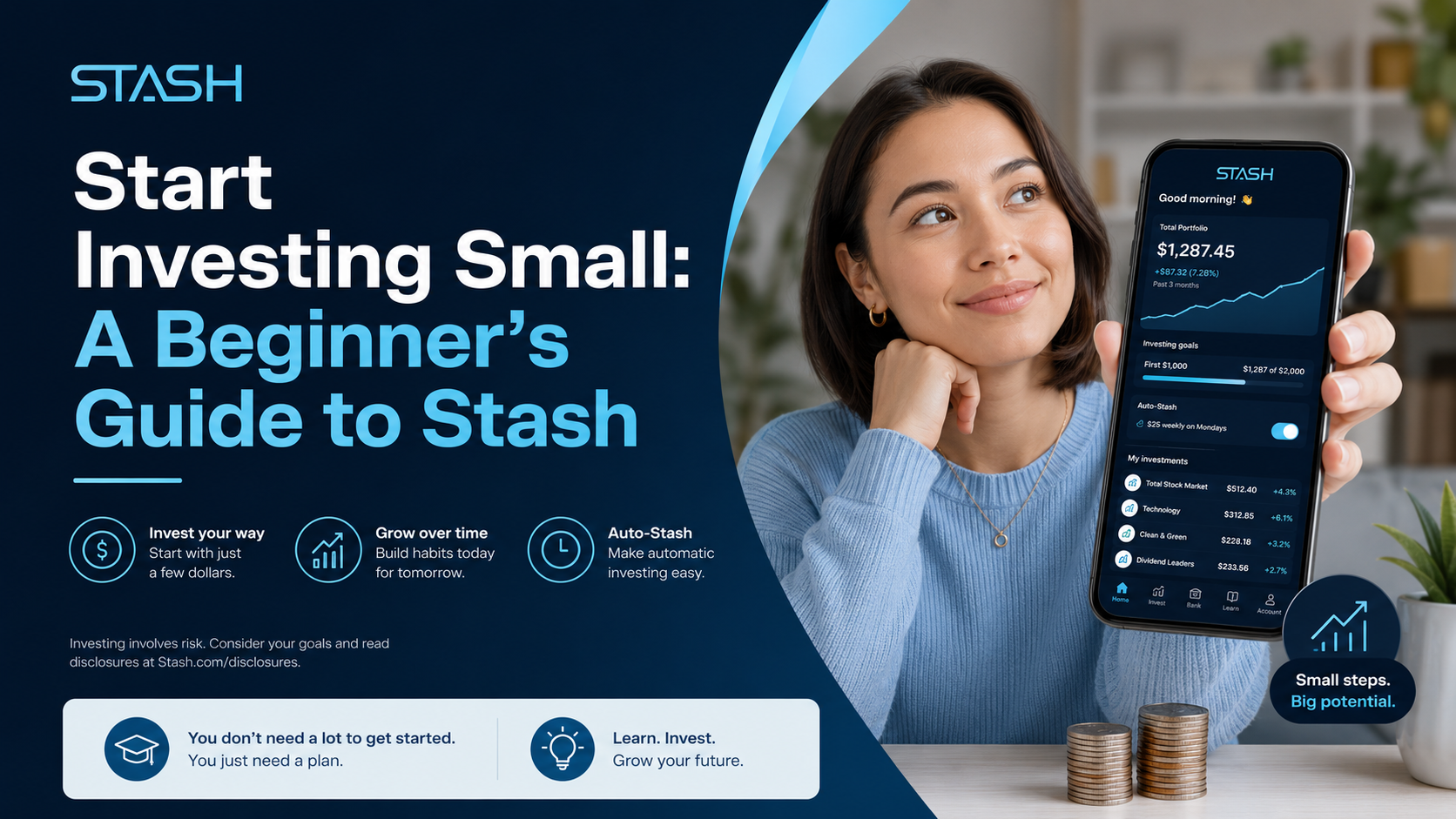
Start Investing With a Small Step: How Stash Can Help Make Investing More Accessible

By Marvin Gandis

For many people, investing sounds like something that belongs to another world.

They imagine complicated charts, Wall Street professionals, thousands of dollars in starting capital, and financial terminology that seems impossible to understand.

That perception keeps millions of people on the sidelines.

But investing does not necessarily have to begin with thousands of dollars.

Sometimes it begins with a decision.

A small amount.

And the willingness to learn.

Today, technology has made financial education and investing tools more accessible to ordinary people. Platforms such as Stash are part of that transformation, giving individuals an opportunity to learn about investing, develop financial habits, and begin building toward long-term financial goals.

And for eligible new customers, there is currently an additional incentive to begin: a $30 investment bonus after joining through a qualifying referral invitation and depositing at least $5 within 30 days.

You Do Not Have to Be Wealthy to Begin Investing

One of the biggest misconceptions about investing is that you need a large amount of money before you can start.

That idea can lead people to wait for years.

They tell themselves:

“I’ll start when I make more money.”

“I’ll invest after I pay everything off.”

“I’ll begin when I understand the stock market.”

“I need thousands of dollars first.”

But waiting for the “perfect” financial situation can become a permanent excuse.

The more important first step is often education.

Understanding basic concepts such as saving, investing, diversification, risk, compound growth, budgeting, and long-term planning can gradually transform the way a person manages money.

Stash itself says users can begin investing with small amounts and provides access to stocks, exchange-traded funds, automated portfolios, and financial guidance.

What Is Stash?

Stash is a personal finance and investing platform designed to make investing more accessible to everyday consumers.

Rather than assuming that every user is already an experienced investor, the platform combines investing tools with guidance intended to help people make financial decisions based on their goals, experience, timeline, and comfort with risk.

Among the tools promoted by Stash are:

  • Individual stocks and ETFs
  • Personalized investment guidance
  • Automated investing through Smart Portfolio
  • Recurring investing tools
  • Retirement investing
  • Investing accounts for children
  • Financial education
  • Banking-related features and financial tools

Stash describes itself as a registered investment adviser and says it provides recommendations based on an individual’s goals and risk tolerance.

This does not mean investments are guaranteed to increase in value.

No legitimate investment platform can promise that.

Investing always involves risk.

The important distinction is that technology can make the process of learning, starting, and managing investments more approachable.

Why Starting Small Can Be Powerful

A person who invests $5 today is obviously not going to become wealthy tomorrow because of that $5.

That is not the point.

The real value of beginning small is the habit it can create.

Consider the difference between these two mindsets:

Mindset #1:

“I don’t have enough money, so investing isn’t for me.”

Mindset #2:

“I may not have much today, but I can start learning how investing works.”

The second mindset creates movement.

A small beginning can lead to:

Financial education.

Better budgeting.

Regular contributions.

Understanding investments.

Greater awareness of spending habits.

Long-term financial planning.

And eventually, larger financial goals.

This is why starting can matter more than starting big.

Investing Is Different From Saving

It is also important to understand that saving and investing are not the same thing.

Saving generally means keeping money somewhere relatively accessible for future expenses or emergencies.

Investing means putting money into assets with the expectation that they may increase in value over time.

Those assets can also decline.

That distinction matters.

Money needed for rent next month, groceries, emergency expenses, medical bills, or essential living expenses generally should not be treated the same way as money designated for long-term investing.

Before investing, it is wise to evaluate your overall financial situation.

The Power of Consistency

Many people look for the perfect stock.

Experienced long-term investors often focus instead on something much less exciting:

Consistency.

Investing a manageable amount regularly can create a discipline that one large, occasional investment may not.

For example, someone might decide to contribute:

$5 per week.

$10 per week.

$25 per month.

$50 per month.

Or another amount appropriate for his or her financial circumstances.

The amount should be determined by the investor’s budget and financial priorities.

The goal is not to invest money you cannot afford to risk.

The goal is to create sustainable financial habits.

Automation Can Help Build the Habit

One useful feature of modern investing platforms is automation.

Stash provides an Auto-Stash feature that can be used for recurring investments. The company also offers managed Smart Portfolios for users who prefer an automated approach based on their financial profile.

Automation can help remove a common obstacle:

Forgetting.

Instead of depending entirely on motivation every month, an investor can establish a systematic approach.

The principle extends beyond investing.

Strong financial habits are often built through systems rather than occasional bursts of enthusiasm.

But Never Confuse Investing With Guaranteed Income

This point is critical.

Stocks go up.

Stocks go down.

ETFs fluctuate.

Markets experience corrections.

Economic conditions change.

No investment strategy eliminates risk.

An investment account should therefore never be presented as a guaranteed way to make money.

The objective is not to predict every market movement.

For many long-term investors, the objective is to build a diversified financial strategy aligned with personal goals, risk tolerance, and time horizon.

Understand the Cost Before Joining

A promotional bonus should never be the only reason to open a financial account.

You should understand the product itself.

As of August 27, 2026, the referral landing page states that The Stash Plan costs $12 per month, with pricing subject to change. The plan includes Stash’s investing and other financial features.

That means a prospective customer should ask:

Will I actually use the service?

Do the available tools fit my financial goals?

Do I understand the monthly cost?

Am I comfortable with investment risk?

Have I read the current terms?

These questions are more important than any promotional bonus.

The Current $30 Stash Referral Opportunity

For eligible new customers, Stash is currently offering a referral promotion connected to my invitation.

The process shown on the Stash referral page is straightforward:

Step 1: Join Stash through my referral invitation.

Step 2: Deposit at least $5 within 30 days.

Step 3: Once the qualifying deposit is completed and the applicable requirements are satisfied, the $30 bonus is added to the account.

Stash’s current general bonus terms also state that qualifying bonus funds must remain in the Stash account for 90 days and that the offer is available to U.S. residents, subject to eligibility and additional terms.

A $30 Bonus Is Not the Real Opportunity

The promotional bonus may attract attention.

But the more important opportunity is learning.

If opening an account motivates someone to begin understanding:

How stocks work.

What ETFs are.

Why diversification matters.

How compound growth works.

Why consistency matters.

How risk and reward are connected.

How to establish long-term financial goals.

Then the education may ultimately be worth far more than the original promotional incentive.

That is the perspective I encourage.

Don’t simply chase bonuses.

Use opportunities like this to increase your financial knowledge.

Begin With Education, Not Emotion

Never invest because someone tells you:

“You can’t lose.”

“This stock is guaranteed.”

“You’ll double your money.”

“You need to act immediately.”

Those are warning signs.

Responsible investing begins with understanding what you are buying and why you are buying it.

Ask questions.

Read the disclosures.

Understand the fees.

Understand the risks.

Investigate the investment.

Determine whether it fits your objectives.

Financial confidence comes from knowledge—not hype.

Your Financial Future Is Built One Decision at a Time

You may not be able to change your entire financial situation today.

But you can make one better financial decision.

Then another.

And another.

Maybe your first step is creating a budget.

Maybe it is eliminating expensive debt.

Maybe it is establishing an emergency fund.

Maybe it is learning how investing works.

Or perhaps you are financially ready to make your first small investment.

The important thing is to move from financial avoidance toward financial education.

You do not need to know everything before you begin learning.

You simply need to begin.

Ready to Explore Stash?

If you’ve been thinking about learning how investing works and believe Stash may fit your financial goals, you can explore the current offer through my personal referral invitation.

🎁 Current Referral Offer

Eligible new users can currently receive $30 to invest after joining through my invitation and depositing at least $5 within 30 days, subject to Stash’s eligibility requirements and promotion terms.

👉 Use my Stash referral invitation and explore the $30 offer

Before enrolling, review the current pricing, promotion requirements, investment disclosures, and account terms directly with Stash.

Don’t begin because of a bonus alone. Begin because you’re ready to learn more about your financial future.


Referral Disclosure

This article contains my personal Stash referral link. I may receive compensation or a referral reward if you use my link, open a qualifying account, link a funding source, deposit funds, and/or satisfy other applicable Stash requirements. Using my referral link does not increase the fees Stash charges you. Referral eligibility, amounts, deadlines, account requirements, pricing, and promotional terms may change or expire. Please verify the current terms directly with Stash before participating.

Financial Disclaimer

This article is provided for educational and informational purposes only and does not constitute personalized financial, investment, tax, accounting, or legal advice. Investing involves risk, including the possible loss of principal. Past performance does not guarantee future results. No investment, stock, ETF, portfolio, or financial strategy is guaranteed to generate profits. Consider your financial circumstances, objectives, time horizon, and risk tolerance before investing, and consult an appropriately qualified financial, tax, or legal professional when necessary. Stash is a third-party company, and the author of this article is not acting as a financial adviser or representative of Stash.


Publicado en Financial Education, Investing, Money Management, Personal Development, Personal Finance, Wealth Management

Sudden Wealth Syndrome

When Money Arrives Before You Are Ready

By Marvin Gandis

Millions of people dream about suddenly becoming wealthy.

They imagine that a large inheritance, lottery jackpot, business sale, legal settlement, investment windfall, major contract, or unexpected financial breakthrough would immediately solve their problems.

Sometimes it does solve important financial problems.

But unexpected wealth can also create completely new ones.

A person may suddenly experience anxiety, fear, guilt, confusion, family pressure, distrust, identity changes, and uncertainty about how to manage the money.

These reactions are sometimes popularly described as Sudden Wealth Syndrome.

The issue is not simply having too much money.

The deeper issue is receiving more money than your habits, relationships, financial knowledge, and emotional preparation can handle.

The lesson is powerful:

Your bank account can change overnight. Your financial wisdom usually cannot.


What Is Sudden Wealth Syndrome?

The expression is commonly used to describe emotional, psychological, relational, and financial difficulties that may appear after someone suddenly acquires substantial wealth.

This may happen after:

  • receiving an inheritance;
  • winning a lottery;
  • selling a company;
  • receiving a major legal settlement;
  • signing a lucrative entertainment or sports contract;
  • selling valuable real estate;
  • experiencing explosive business growth;
  • receiving unexpected investment gains;
  • becoming financially successful after years of scarcity.

From the outside, the situation may look perfect.

From the inside, it may feel overwhelming.

Yesterday someone was wondering how to pay the mortgage.

Today that same person may be deciding how to manage several million dollars.

The money arrived quickly.

The experience required to manage it may not have.


Money Can Arrive Faster Than Financial Maturity

Sudden wealth immediately changes what someone can purchase.

Old financial limits disappear.

Luxury vehicles, expensive homes, travel, investments, and major purchases suddenly become possible.

But the ability to buy something does not automatically mean buying it is wise.

There is an enormous difference between:

having money

and

knowing how to manage money.

Long-term wealth requires knowledge of budgeting, taxes, investing, risk management, insurance, estate planning, and asset protection.

Without those skills, even a large fortune can disappear.


The Dangerous Thought: “I Can Afford Anything Now”

Sudden wealth can create the psychological illusion of unlimited money.

A million dollars may feel enormous.

But it is not infinite.

A home.

Two vehicles.

Vacations.

Helping relatives.

Taxes.

Maintenance.

Lifestyle upgrades.

Bad investments.

Loans that are never repaid.

Within a surprisingly short period, a fortune can shrink dramatically.

This is why one of the most important principles of sudden wealth is:

Never confuse having a lot of money with having unlimited money.


The Identity Shift

Money changes more than purchasing power.

It can change identity.

Someone may suddenly ask:

Who am I now?

Perhaps the person spent decades identifying as a worker, employee, entrepreneur, professional, or provider.

Suddenly, working may no longer be financially necessary.

That can create an unexpected identity crisis.

When financial survival is no longer the primary daily challenge, a deeper question may appear:

What do I actually want to do with my life?

Money can solve financial problems.

It cannot automatically provide purpose.


Fear of Losing Everything

Ironically, sudden wealth can sometimes increase anxiety.

Before the money arrived, there was less to lose.

Now there is something significant to protect.

Thoughts may begin appearing:

“What if I lose it?”

“What if I make the wrong investment?”

“What if someone takes advantage of me?”

“What if the market crashes?”

These fears can create two opposite reactions.

Some people spend aggressively because they want to enjoy the money before it disappears.

Others become so afraid of making mistakes that they refuse to make any decision at all.

Healthy wealth management requires avoiding both extremes.


When Friends and Family Begin Asking for Money

One of the most difficult consequences of sudden wealth can occur inside relationships.

Once others know that someone has money, requests may begin.

“I only need a small loan.”

“Help me buy a house.”

“Invest in my business.”

“We are family.”

“That amount is nothing to you.”

The wealthy person may feel guilty saying no.

But constantly saying yes can turn that person into the family bank.

Helping others can be wonderful.

Helping without limits can destroy both money and relationships.

A useful principle is:

Never make major financial decisions primarily because of guilt, pressure, or fear of disappointing someone.


Suddenly Everyone Has an Investment Opportunity

Money attracts opportunities.

Some are legitimate.

Many are not.

Newly wealthy individuals may suddenly hear about:

  • private investments;
  • businesses;
  • cryptocurrencies;
  • real estate projects;
  • startup opportunities;
  • friends seeking capital;
  • “guaranteed” investments;
  • exclusive financial deals.

Frequently, these opportunities include urgency:

“You must act now.”

That is exactly why caution matters.

A financially strong sentence is:

“I need time to review this.”

A legitimate investment can usually survive reasonable due diligence.

A scam often depends on urgency.


Lifestyle Inflation

Lifestyle inflation occurs when spending permanently rises because income or wealth increased.

First comes a larger home.

Then better vehicles.

More travel.

More expensive restaurants.

Higher insurance costs.

More subscriptions.

More maintenance.

More employees or services.

Individually, each expense may appear manageable.

Together, they create an entirely new cost structure.

Buying something may take one day. Maintaining it may require money for decades.

Before permanently increasing lifestyle expenses, calculate the annual cost of sustaining them.


Protect Your Privacy

One of the smartest things someone can do after receiving substantial wealth is often very simple:

Do not announce everything.

There is rarely a good reason for everyone to know the size of your financial windfall.

Privacy can protect against:

  • scams;
  • pressure;
  • constant loan requests;
  • manipulation;
  • opportunistic friendships;
  • impulsive commitments.

Financial privacy is not secrecy born from fear.

It can be prudent asset protection.


During the First Months, Avoid Dramatic Decisions

Sudden financial change creates excitement.

That excitement can produce impulsive decisions.

A healthier approach may be to keep life relatively normal while building a plan.

During the first few months:

organize documentation;

understand tax obligations;

review debts;

establish financial reserves;

study investment options;

consult qualified professionals;

identify long-term priorities.

Patience can be a financial strategy.


Build a Team, Not an Entourage

Wealth attracts people.

But wealth requires competent advisors, not admirers.

Depending on the circumstances, a newly wealthy person may benefit from consulting independent professionals such as:

  • a certified public accountant or tax professional;
  • an attorney;
  • a qualified financial planner;
  • a properly credentialed investment professional;
  • an estate-planning specialist;
  • an insurance professional;
  • a therapist or counselor if the transition becomes emotionally difficult.

The key word is:

independent.

Do not blindly give one person complete control over your financial life.

Understand where the money is.

Understand the investments.

Ask about fees.

Ask how advisors are compensated.

Ask about risk.

Wealth requires stewardship.

Not blind trust.


Give Different Dollars Different Jobs

One practical technique is to divide wealth into categories.

For example:

Security

Emergency reserves and stability.

Obligations

Taxes, liabilities, and debt.

Investment

Long-term growth.

Lifestyle

Housing, transportation, travel, and experiences.

Generosity

Family assistance, charity, church, community, or humanitarian causes.

Opportunities

Capital allocated to businesses or higher-risk investments.

When all the money appears as one large number, almost anything feels affordable.

When each portion has a defined purpose, financial decisions become clearer.


Protect the Capital Before Trying to Multiply It

A common mistake after receiving wealth is immediately thinking:

“How can I turn one million into ten million?”

That question can wait.

The first question should be:

“How do I make sure this wealth survives?”

Before chasing extraordinary returns, consider:

capital preservation;

diversification;

liquidity;

inflation;

taxes;

risk;

time horizon.

In wealth management, surviving financially for several decades may matter more than producing spectacular returns in one year.


Be Careful About Becoming Everyone’s Bank

Lending money to friends and family sounds generous.

It can also damage relationships.

The moment money is lent, the relationship changes.

You are no longer only a friend, sibling, parent, cousin, or relative.

You may also become a creditor.

Late payments can quickly become emotional conflicts.

A useful rule is:

Before providing money, decide clearly whether it is a loan or a gift.

Ambiguity creates resentment.

Clear expectations protect relationships.


Wealth Guilt

Some newly wealthy people may experience guilt.

They ask:

“Why me?”

“Do I deserve this?”

“How can I enjoy wealth when others are suffering?”

Those feelings can sometimes lead to destructive financial behavior.

Generosity can be meaningful.

But sacrificing your own financial stability does not necessarily help others.

There is an important difference between:

responsible generosity

and

financial guilt.

Someone who preserves wealth responsibly may be able to help people for decades.

Someone who gives everything away impulsively may only be able to help temporarily.


Money Often Amplifies What Already Exists

Money does not always transform character.

Sometimes it simply magnifies existing tendencies.

A generous person may become more generous.

An impulsive person may make larger impulsive purchases.

An insecure person may seek validation through expensive possessions.

A disciplined person may use wealth to build long-term security.

This is why preparation for wealth should begin before wealth arrives.

Develop:

discipline;

financial literacy;

patience;

judgment;

purpose;

self-control.


Ask: What Job Should This Money Perform?

Every dollar should have a mission.

When someone receives substantial wealth, one of the most valuable questions is:

What do I want this money to accomplish?

Possible answers include:

financial security;

debt elimination;

education;

retirement;

business ownership;

passive income;

family support;

charitable giving;

legacy creation.

Without purpose, money tends to find places to disappear.

With purpose, money can become a powerful tool.


True Wealth Is Bigger Than a Bank Balance

There is a difference between looking wealthy and being financially free.

Someone may own a multimillion-dollar home while carrying enormous obligations.

Another person may have much less wealth but enjoy greater freedom and peace.

Real wealth includes:

time;

health;

relationships;

choice;

purpose;

financial security;

freedom.

Money matters.

But money is only one part of a prosperous life.


A Practical Sudden-Wealth Protocol

If you unexpectedly receive significant wealth, consider the following sequence.

First: Protect your privacy.

Avoid unnecessary announcements.

Second: Delay permanent decisions.

Allow your emotions to settle.

Third: Identify taxes and legal obligations.

Do not assume every dollar received is available to spend.

Fourth: Protect substantial reserves.

Security should come before speculation.

Fifth: Review and strategically eliminate debt.

Especially high-interest obligations.

Sixth: Establish boundaries with friends and relatives.

Decide in advance how much you are willing to give, lend, or invest.

Seventh: Build an independent professional team.

Never surrender complete control to one advisor.

Eighth: Develop a diversified investment strategy.

Avoid concentrating everything in one opportunity.

Ninth: Upgrade your lifestyle gradually.

Make sure your wealth can sustain your new expenses permanently.

Tenth: Define your purpose.

Decide what kind of life and legacy you want this wealth to create.


The Great Wealth Paradox

Millions of people want more money.

Very few ask:

Am I prepared to manage it if it arrives?

That may be the more important question.

Making money and keeping money are different skills.

Creating wealth requires one set of abilities.

Managing wealth requires another.

Preserving wealth across generations requires even greater discipline and planning.


Conclusion: Prepare for Wealth Before It Arrives

Sudden Wealth Syndrome teaches us something valuable.

Financial education is not only for people who are struggling financially.

It is equally important for people who may one day become wealthy.

If tomorrow you inherited a fortune, sold a business, or experienced an extraordinary financial breakthrough, the most important question would not be:

“What can I buy?”

It would be:

“How can I steward this opportunity wisely?”

The goal should not simply be to look rich.

The goal should be to build a stable, generous, meaningful, and financially sustainable life.

The best preparation for wealth begins before the money arrives.

Learn.

Save.

Invest.

Develop discipline.

Understand risk.

Build purpose.

Then, if significant wealth eventually enters your life, you will possess something even more valuable than money:

the wisdom required to preserve it, grow it responsibly, and use it well.


Disclaimer

This article is provided for educational and informational purposes only. Its content does not constitute financial, investment, tax, legal, psychological, or other professional advice.

The term “Sudden Wealth Syndrome” is used descriptively to discuss possible emotional, behavioral, and financial reactions associated with unexpectedly receiving a significant amount of money. It should not be interpreted as a medical or psychological diagnosis.

Every financial situation is different. Before making major decisions involving investments, taxes, estate planning, asset protection, inheritances, business matters, or the management of substantial wealth, consider consulting appropriately qualified and licensed professionals.

All investments involve risk, including the possible partial or total loss of principal. Past performance does not guarantee future results.

The information presented does not guarantee any specific financial outcome and is not intended to replace professional advice tailored to your individual circumstances.

Publicado en Financial Education, Lifestyle, Motivation, Personal Development, Personal Finance, Well-Being

I Don’t Need Much to Live: Discovering That Having More Does Not Always Mean Living Better

By Marvin Gandis

We live in a culture constantly telling us that we need more.

  • More money.
  • More possessions.
  • A bigger house.
  • A newer car.
  • More followers.
  • More recognition.
  • More comfort.
  • More visible success.

Without noticing it, we can begin measuring our lives by everything we still do not have.

But somewhere along the journey, many people discover an incredibly liberating truth:

I don’t need much to live well.

That does not mean abandoning ambition, rejecting prosperity, or settling for a life without dreams. It means understanding the difference between what we genuinely need and everything modern culture teaches us to desire.

We can pursue progress without becoming servants of our possessions.

We can build wealth without allowing money to become our identity.

We can enjoy beautiful things without believing happiness depends on accumulating them.

And one of life’s greatest forms of wealth may be discovering how little we truly need to feel content.


Life becomes heavy when we believe we need too much

Everything we own carries a cost.

Not only the purchase price.

Possessions may also require maintenance, storage, insurance, repairs, attention, energy, and worry.

A larger home may mean larger expenses.

A more expensive car can mean larger payments.

More devices can mean more distraction.

More commitments can mean less freedom.

More debt can mean less peace.

So before asking:

“How can I get more?”

perhaps we should sometimes ask:

“Do I really need more?”

That question alone can transform our relationship with money and consumption.


Having enough can be an extraordinary form of wealth

There is one powerful word that receives very little attention in a consumer-driven culture:

Enough.

Enough food.

A safe place to sleep.

The clothing we need.

Reasonable access to healthcare.

People who love us.

Time to rest.

Freedom to think.

Peace when we go to bed.

A reason to get up tomorrow.

Once we begin noticing these things, we may discover that many of life’s greatest treasures were already present.

We were simply too busy noticing what was missing.


Simplicity is not the same as poverty

There is an important difference between poverty and simplicity.

Poverty can involve lacking access to necessities.

Simplicity can be a conscious choice.

Someone can have significant financial resources and still choose a simple lifestyle.

They can buy fewer things.

Avoid unnecessary debt.

Take care of what they already own.

Choose experiences over appearances.

Save and invest instead of spending primarily to impress other people.

Simple living does not say:

“I don’t want to advance.”

It says:

“I want to advance without losing my freedom along the way.”


Wanting prosperity is not the problem

There is nothing inherently wrong with wanting financial progress.

Wanting a comfortable home is reasonable.

Building a business can be worthwhile.

Saving is wise.

Investing can be responsible.

Wanting better opportunities for your family can be honorable.

Problems arise when we confuse prosperity with endless accumulation.

We can increase our income while keeping our needs under control.

That combination can be extremely powerful.

If every raise in income immediately produces an equal increase in expenses, we can earn more and still feel financially trapped.

But when our income grows while we continue living intentionally, financial margin appears.

That margin can become:

  • savings,
  • investments,
  • debt reduction,
  • education,
  • generosity,
  • experiences,
  • time,
  • freedom.

That is another kind of prosperity.


Comparison convinces us that enough is never enough

Many modern “needs” do not begin inside us.

They begin with comparison.

We see what someone drives.

Where they travel.

What they purchase.

How their home looks.

What they post online.

Then we begin thinking:

“Maybe I should have that too.”

But social media rarely shows the entire picture.

We see the car, but not necessarily the loan.

We see the vacation, but not the credit-card balance.

We see the house, but not the mortgage.

We see the success, but not the anxiety.

Comparing our complete reality with somebody else’s selected highlights can create permanent dissatisfaction.

Freedom begins when we stop asking:

“How does my life compare with theirs?”

and start asking:

“Am I building the life I actually want?”


Fewer needs can create greater freedom

When we need less to feel satisfied, possibilities open.

We need less money to sustain our lifestyle.

We can save more.

We can work with greater purpose.

We can reduce certain pressures.

We may have more time for family.

We can give more generously.

Career changes may become less frightening.

Unexpected expenses become easier to handle.

We can enjoy more while providing less.

In a sense, every unnecessary need we eliminate may return a little freedom to us.


Learn the difference between needs, comforts, and wants

Before purchasing something, consider three categories.

Need

Something genuinely necessary for basic living, safety, health, or essential functioning.

Comfort

Something that improves or simplifies life but that we could probably live without.

Want

Something desired mainly for enjoyment, preference, entertainment, or status.

There is nothing wrong with buying wants.

The problem begins when every want is treated like a need.

We can enjoy something while remaining financially honest.

We can say:

“I don’t need this, but I want it, and I can responsibly afford it.”

That distinction reflects financial maturity.


Buy less, but buy intentionally

Living with less does not always mean purchasing the cheapest item.

Sometimes higher-quality products can actually cost less over time.

The goal is to stop consuming automatically.

Before buying something, ask:

  • Do I genuinely need this?
  • Do I already own something that serves the same purpose?
  • Would I buy it if nobody else ever saw it?
  • Am I buying for usefulness or impulse?
  • Can I pay for it responsibly?
  • Will this still matter to me six months from now?

Questions like these can prevent purchases that bring excitement for a few hours but obligations for several years.


Learn to enjoy what you already own

One powerful modern discipline is rediscovering the things already in our lives.

Wear the clothes already in your closet.

Cook the food already in your kitchen.

Read the books already on your shelves.

Finish projects you already started.

Use the tools you already purchased.

Explore nearby places you have never visited.

Spend time with people already present in your life.

Sometimes we keep searching for something new before fully experiencing the value of what is already around us.


Your greatest possessions may not fit inside a box

Think about what has the greatest value in a human life.

  • Health.
  • Time.
  • Family.
  • Friendship.
  • Faith.
  • Knowledge.
  • Experience.
  • Character.
  • Peace.
  • Purpose.
  • Freedom.

None of these can be fully purchased in a store.

Money may help us protect or develop some of them, but it cannot guarantee them.

That is why we should be careful not to build a life where we gain objects while losing everything that truly matters.


Some people own much but enjoy very little

More possessions do not guarantee satisfaction.

Our lifestyles can expand so quickly that we never actually experience abundance.

Every new level immediately becomes the new minimum.

The small apartment is no longer enough.

Then the house becomes insufficient.

The car still works, but we want another.

The phone works perfectly, but a newer model appears.

Income rises, but expectations rise with it.

We can spend an entire lifetime chasing a finish line that keeps moving.

That is why learning to say:

“This is enough for me.”

can become one of the greatest skills for inner peace.


Living with less can strengthen your finances

Reducing unnecessary expenses lowers the amount required to sustain our lifestyle.

That may improve our ability to:

  • build an emergency fund,
  • pay down debt,
  • invest,
  • prepare for retirement,
  • survive difficult seasons,
  • take advantage of opportunities,
  • and help other people.

Simple living does not guarantee wealth.

But reasonable expenses can create a much more resilient financial foundation.


Make room for experiences, not only possessions

We may remember these things for decades:

  • an important conversation,
  • a family meal,
  • a journey,
  • a day with our children,
  • time with a friend,
  • a sunrise,
  • a walk,
  • an answered prayer,
  • an act of service,
  • an opportunity to help someone.

Meanwhile, many things we once considered essential eventually end up forgotten in a drawer.

Building a meaningful life requires deciding where our money, time, and attention truly belong.


We also need to learn how to say no

Simple living requires boundaries.

I don’t need to buy it just because it is on sale.

I don’t need to replace it because a new model was released.

I don’t need to compete with my neighbors.

I don’t need to prove that I am successful.

I don’t need to accept every invitation.

I don’t need to follow every trend.

I don’t need to turn every increase in income into another expense.

Every intentional “no” protects something.

Perhaps it protects your savings.

Your time.

Your energy.

Or your peace.


Gratitude changes our definition of wealth

Gratitude does not mean denying life’s difficulties.

It does not mean abandoning our goals.

It means recognizing what we already have while continuing to build toward something better.

When we wake up thinking only about what is missing, we begin the day from scarcity.

When we also recognize what is already present, our perspective changes.

We can still say:

“I want to grow.”

Without saying:

“I cannot be happy until I have more.”


Practical exercise: Calculate how much you truly need

One useful exercise is calculating your essential monthly number.

Write down what you reasonably need for:

  • housing,
  • food,
  • utilities,
  • transportation,
  • healthcare,
  • insurance,
  • financial obligations,
  • savings,
  • essential family needs.

Then compare that number with what you currently spend on optional items.

This is not about eliminating all enjoyment.

It is about understanding the true cost of sustaining your life.

Many people discover that they need considerably less to live with dignity than they previously imagined.

Knowing that number can produce a powerful sense of control.


A simple rule for intentional living

Before adding something new to your life, ask:

Will this increase my freedom or reduce it?

Some purchases genuinely help us.

Some investments expand our opportunities.

Some tools increase productivity.

But other purchases simply create new obligations.

The important question is not only:

“Can I buy it?”

A better question might be:

“Do I want to maintain it?”


If I had to start again tomorrow

Try this mental exercise.

Imagine that tomorrow you could keep only twenty material possessions.

What would you choose?

You might discover something surprising.

Many objects currently filling our homes would not even make the list.

That does not mean we must throw everything away.

It simply helps identify what truly matters to us.


The goal is not merely owning less; it is needing less

External minimalism can be useful.

But there is something deeper:

internal simplicity.

We can own very little and remain obsessed with getting more.

Or we can own many things and relate to them with freedom.

The deeper transformation happens when possessions stop defining us.

When we can enjoy them without emotionally depending on them.

When we can share them.

When we can lose some of them and still move forward.

When our identity rests in something deeper than our material net worth.


I don’t need much to live; I need reasons to live

Ultimately, life’s greatest question is not how many things we accumulated.

It is what we did with the days we received.

  • Did we love?
  • Did we learn?
  • Did we help?
  • Did we forgive?
  • Did we create?
  • Did we serve?
  • Did we enjoy?
  • Did we build something that helped someone else?
  • Did we live with purpose?

We can sit inside a house filled with expensive possessions and feel empty.

Or we can sit around a simple table with people we love and feel extraordinarily rich.


Conclusion

Perhaps we do not need nearly as much as we think.

Maybe we need enough to live with dignity, enough wisdom to manage what we have, and enough gratitude to recognize our blessings.

  • We can continue working.
  • Continue dreaming.
  • Build businesses.
  • Invest.
  • Prosper.

But we can also learn to say:

  • I do not need to prove my value through what I purchase.
  • I do not need to compete with somebody else’s lifestyle.
  • I do not need to sacrifice my peace to maintain an image.
  • I don’t need much to live well.
  • I need purpose.
  • I need people I love.
  • I need health to the extent that I can care for it.
  • I need wisdom.
  • I need peace.
  • I need time.
  • I need hope.

And when we finally understand the difference between having a lot and having enough, we begin discovering a kind of wealth that no bank statement can fully measure.

Sometimes having less to maintain gives us more life to enjoy.


Disclaimer: This article is provided for educational, informational, and personal reflection purposes only. It does not constitute financial, legal, medical, or individualized professional advice. Every person’s financial and personal circumstances are different. Before making significant decisions involving money, investments, debt, or lifestyle changes, consider your individual situation and consult a qualified professional when appropriate.