
Publicado en Faith and Hope, Inner Growth, Inspiration, Life Purpose, Personal Development, Personal Motivation, Positive Mindset, Self-Improvement

Unrealized Dreams

When Life Reminds You There Is Still Something Inside You

By Marvin Gandis

We all carry dreams hidden somewhere in the heart. Some were born when we were young, full of hope, imagination, and energy. Others appeared after a crisis, a loss, a need, or a conversation that awakened something deep within us. But as time passed, many of those dreams remained waiting.

  • Not because they were impossible.
  • Not because we had no talent.
  • Not because God forgot about us.

Many times, dreams remain unrealized because life hurt us, fear stopped us, people discouraged us, we made poor decisions, we lacked direction, or we simply became used to surviving instead of moving forward.

But an unrealized dream is not always a dead dream. Sometimes it is a sleeping seed waiting for the right moment, the right mindset, and the right decision.


What Are Unrealized Dreams?

Unrealized dreams are the goals, visions, ideas, talents, or deep desires that once set our hearts on fire but, for some reason, never became reality.

It may be:

  • A business you never started.
  • A book you never wrote.
  • A career you walked away from.
  • A family relationship you wanted to heal.
  • A trip you never took.
  • A stronger spiritual life you never developed.
  • A version of yourself you always imagined but have not yet become.

Unrealized dreams hurt because they remind us of something important: we know we could have done more.

But they also give us an opportunity: we can still wake up.


The Pain of Looking Back

There are moments in life when we stop and think:

  • “What would have happened if I had started earlier?”
  • “Where would I be today if I had not given up?”
  • “Why did I allow fear to stop me?”
  • “Is it too late to try?”

These questions can hurt, but they can also be a sign of awareness. You are not dead inside. You still feel. You still dream. There is still something in you that wants to rise.

The problem is not looking back. The problem is staying trapped there.

Looking back should help you learn, not destroy you. Your mistakes can become teachers. Your delays can become lessons. Your falls can become testimony.


Why Many Dreams Are Left Behind

Not every dream is lost because of a lack of ability. Many are lost because of a lack of decision, discipline, or faith.

Fear

Fear of failure stops more people than failure itself. Many prefer not to try because they want to avoid criticism, rejection, or embarrassment.

But not trying also has a price: the lifelong pain of wondering what could have happened.

Comfort

Sometimes we do not pursue our dreams because we become used to a safe life, even if it is not the life we truly desire. Comfort may look like peace, but many times it is a decorated cage.

The Opinions Of Others

Some people abandon their dreams because someone told them, “That is not for you,” “You are too old,” “That will never work,” or “Be realistic.”

But the truth is this: many people who criticize your dreams never dared to pursue their own.

Lack Of Direction

A dream without a plan can become frustration. Inspiration is powerful, but without organized action, the dream remains floating in imagination.

Emotional Wounds

Some people stop dreaming because they were disappointed, betrayed, humiliated, or wounded by life. When the heart is hurt, even hope can feel dangerous.

But healing is also part of the path toward purpose.


Not Every Lost Dream Is Canceled

Some dreams may not come true exactly as you once imagined. Maybe time has changed. Maybe your age has changed. Maybe your responsibilities changed. Maybe your situation changed. But that does not mean everything is over.

  • Sometimes the dream needs to mature.
  • Sometimes it needs to take another form.
  • Sometimes it needs to start small.
  • Sometimes it needs to move from fantasy to project.
  • Sometimes God does not remove the dream; He transforms it.
  • Maybe you did not write the book at 25, but you can write it now.
  • Maybe you did not start the business 10 years ago, but you can begin with what you have today.
  • Maybe you could not help others before, but your current experience can become a guide for someone else.

Lost time cannot always be recovered, but it can be redeemed with purpose.


The Danger of Living Only with Excuses

It is easy to say:

  • “I do not have time.”
  • “I do not have money.”
  • “I do not have support.”
  • “I am not an expert.”
  • “I do not know where to start.”
  • “It is too late.”

Some excuses may sound reasonable, but if we repeat them too often, they become chains.

The truth is that many people started with no money, no support, no experience, and no perfect conditions. The difference was that they decided to begin anyway.

You do not need to have everything figured out to take the first step.
You need enough humility to learn and enough courage to begin.


How to Revive an Unrealized Dream

First: identify the dream clearly

It is not enough to say, “I want something better.” Ask yourself:

  • What dream keeps coming back to my mind?
  • What desire have I tried to ignore, but it does not disappear?
  • What talent am I not using?
  • What project would bring me peace if I at least tried?

Clarity is the first act of courage.

Second: accept your reality without hiding from it

Do not deny your mistakes. Do not ignore your limitations. Do not blame everyone else for what you did not do. Accept where you are, but do not use your situation as an excuse to stay there.

Honesty heals. Denial delays.

Third: start small

A big dream can feel intimidating. But one small action can open the road.

  • One page written.
  • One call made.
  • One post shared.
  • One class taken.
  • One debt organized.
  • One habit changed.
  • One sincere prayer.
  • One 30-day plan.

Dreams are rebuilt through small actions repeated with faith and discipline.

Fourth: surround yourself with the right people

Not everyone will understand your process. Not everyone will celebrate your growth. Not everyone deserves access to your dreams.

Look for people who inspire you, correct you with love, challenge you to grow, and remind you who you are when you forget.

Fifth: stop waiting for perfect motivation

Motivation rises and falls. Discipline remains.

  • There will be days when you do not feel like it. Do something small anyway.
  • There will be days when no one applauds. Continue anyway.
  • There will be days when results do not appear. Learn and adjust anyway.

Consistency turns sleeping dreams into living testimonies.


When the Dream Changes Shape

Sometimes maturity means recognizing that a dream needs to evolve. Maybe what you wanted before no longer represents who you are now. That is not failure; it may be growth.

Do not hold on to an old version of your dream if God, life, or experience is showing you a wiser direction.

  • A transformed dream is not a lost dream.
  • It may become a deeper, more useful, and more purpose-driven dream.

Faith Also Works

Believing does not mean sitting still and waiting for everything to fall from the sky. True faith walks, learns, builds, knocks on doors, and rises after falling.

  • Pray, but also work.
  • Dream, but also plan.
  • Believe, but also act.
  • Wait on God, but do not use waiting as an excuse for passivity.

Faith does not remove effort; it gives effort direction.


It Is Never Too Late to Begin Again

Maybe you cannot change what happened, but you can decide what you will do with what remains.

  • You are not too old to learn.
  • You are not too broken to heal.
  • You have not failed too much to rise.
  • You have not arrived too late to begin.

As long as you have life, you still have an opportunity. And even if the road is not easy, it can still be meaningful.

Your dream does not need to impress the world to have value. Sometimes it is enough for it to give you hope, dignity, discipline, and the peace of knowing you tried.


Questions for Reflection

  • What dream have I abandoned because of fear or exhaustion?
  • What excuse have I repeated for too long?
  • What small step can I take this week?
  • What do I need to learn to move forward?
  • Who do I need to stop listening to?
  • What kind of person do I need to become to live that dream responsibly?

Honest answers can open a new season in your life.


Your Dream Can Still Breathe

Unrealized dreams should not be a sentence. They should be an invitation.

  • An invitation to wake up.
  • An invitation to heal.
  • An invitation to act.
  • An invitation to stop postponing life.
  • An invitation to turn regret into movement.

Do not allow the past to become stronger than your purpose. Do not allow age, criticism, fear, or mistakes to completely extinguish what can still be born within you.

Maybe you cannot do everything today, but you can begin today.

And sometimes, beginning again is the most powerful act of faith, humility, and courage.


Call to Action

My dear reader and friend, if this message touched your heart, do not ignore it. Write down the dream that still lives inside you. Then write one small action you can take within the next 24 hours.

  • Do not wait for the perfect moment.
  • Do not wait until you feel completely ready.
  • Do not wait until everyone believes in you.

Start with what you have, from where you are, and allow each step to bring you closer to the life you once imagined.

Your dream may be sleeping, but it is not necessarily dead.


Disclaimer

This article is for educational, motivational, and personal reflection purposes only. It does not replace professional financial, psychological, medical, legal, spiritual, or personal advice. Each reader is responsible for evaluating their own situation, making wise decisions, and seeking professional help when necessary.

Publicado en Faith and Hope, Inner Development, Life Purpose, Motivation, Personal Growth, Reflection, Self-Improvement, Spirituality

The Infinite Truth We Are All Searching For

A journey toward meaning, inner peace, and clarity of the soul

By Marvin Gandis


The search that never ends

Since the beginning of humanity, people have searched for answers. Regardless of culture, religion, education, financial status, or personal background, every person eventually reaches a quiet moment and asks:

  • Who am I really?
  • Why am I here?
  • What is the purpose of my life?
  • Is there a greater truth beyond what I can see?

This deep search can be called the infinite truth. It is not just information, a beautiful phrase, or a temporary idea. It is a need of the soul. It is the inner desire to understand life beyond appearances, beyond money, beyond success, beyond pain, beyond loss, and beyond daily worries.

The infinite truth is not always found in the noise of the world. Many times, it is revealed in silence, trials, failures, tears, prayer, reflection, and honest self-examination.

Although we all search for happiness, success, and security, deep inside we long for something greater: peace, direction, true love, purpose, and hope.


Truth is not always comfortable, but it always sets us free

Many people say they want the truth, but not everyone is ready to face it. Truth has a unique quality: it does not always flatter our ego, but it always awakens our conscience.

Truth may show us that we have made poor decisions. It may reveal that we have wasted time on things that do not build us. It may force us to admit that we have blamed others for mistakes that also belong to us. It may open our eyes to harmful relationships, destructive habits, or thoughts that keep us trapped.

But even when truth hurts at first, it carries healing power.

  • A lie may comfort for a moment, but it enslaves over time.
  • Truth may confront for a moment, but it frees forever.

When a person accepts the truth about their life, they stop hiding. They no longer need to pretend everything is fine. They no longer need to decorate reality. They no longer need to appear stronger than they truly feel. They can begin from where they are, with what they have, but with a clearer mind and a humbler heart.

The infinite truth begins when we stop running from ourselves.


We are all searching for something the world cannot fully satisfy

We live in a time of external abundance, but also deep internal emptiness. There is more technology, more information, more opportunity, more entertainment, and more communication than ever before. Yet many people feel lonely, confused, anxious, and spiritually tired.

Why?

Because human beings were not created only to consume, compete, and survive. There is a deeper dimension within us. The soul needs meaning. The heart needs love. The mind needs direction. The spirit needs a connection with something higher.

  • Money can buy comfort, but not inner peace.
  • Fame can attract attention, but not true love.
  • Pleasure can distract for a moment, but it cannot heal the emptiness of the soul.
  • Knowledge can inform, but it does not always transform.

The infinite truth we seek is not limited to having more things. It is about discovering who we are when the lights go out, when no one applauds us, when we lose something important, and when life forces us to look within.

That is where a powerful question begins:

Am I living a true life, or am I simply repeating a life?


The infinite truth calls us to awaken

Awakening does not mean knowing everything. Awakening means beginning to see more clearly.

Some people spend years working, buying, running, talking, and fighting without ever asking where they are going. They live reacting to circumstances, following other people’s opinions, comparing themselves to others, and seeking approval.

But there comes a moment when life shakes us. It may be a loss, an illness, a betrayal, a failure, a financial crisis, a disappointment, or simply deep exhaustion. At that moment, although painful, it can become a doorway.

Because many times the soul awakens when comfort breaks.

The infinite truth tells us:

  • You were not born only to exist.
  • You were not born only to pay bills.
  • You were not born only to please people.
  • You were not born only to carry fear.
  • You were born to live with purpose, awareness, love, and responsibility.

To awaken is to recognize that every day is an opportunity to correct, learn, forgive, build, and move closer to a more authentic life.


Truth is found in humility

One of the greatest barriers to finding truth is pride. Pride makes us believe we are always right. It prevents us from apologizing. It leads us to justify mistakes. It makes us defend lies simply to avoid shame.

But humility opens doors that pride keeps closed.

A humble person can learn. A humble person can change. A humble person can recognize their faults without destroying themselves. A humble person can listen without feeling attacked. A humble person can grow without pretending to be perfect.

The infinite truth is not revealed to an arrogant heart that believes it knows everything. It is revealed to the person willing to say:

  • “I need to learn.”
  • “I need to improve.”
  • “I need to heal.”
  • “I need direction.”
  • “I need to return to what truly matters.”

Humility does not make us weak. It makes us teachable. And a teachable person always has hope.


Truth also lives in love

There is no complete truth without love. Truth without love can become harshness. Love without truth can become deception. But when truth and love walk together, transformation is born.

True love does not always say what we want to hear. Sometimes it corrects us. Sometimes it confronts us. Sometimes it invites us to leave places where we are destroying ourselves.

But love also sustains us. It reminds us that we are not our mistakes. It helps us rise again. It teaches us that there is still opportunity.

The infinite truth reveals that love is not only an emotion. It is decision, commitment, patience, respect, service, and forgiveness. To love does not mean allowing everything. Love also sets boundaries. Love also tells the truth. Love also chooses what is right even when it is difficult.

  • A life without love becomes cold.
  • A life without truth becomes false.
  • A life with love and truth becomes powerful.

The infinite truth connects us with God and eternity

For many people, the search for truth inevitably leads to a spiritual question: Does God exist?

When we observe life, the universe, consciousness, love, morality, beauty, and the human longing for eternity, many recognize that there is something greater than matter. Something that cannot be reduced to numbers, possessions, or superficial explanations.

The infinite truth reminds us that we are not only bodies. We are also soul, conscience, and spirit. And when the spirit is disconnected, life can feel empty even when everything appears fine on the outside.

Seeking God is not escaping reality. It is seeking the root of reality. It is recognizing that we need higher wisdom to live correctly. It is understood that not everything can be solved by human strength, strategies, or intelligence.

  • Some battles are won through faith.
  • Some wounds are healed by grace.
  • Some paths open through prayer.
  • Some answers come when we learn to listen in silence.

The infinite truth does not impose itself through force. It is discovered through sincere hunger, an open heart, and a life willing to be transformed.


Personal truth: looking at ourselves without masks

Every person has a story. Some stories are filled with victories; others are filled with wounds. Some people carry guilt. Others carry resentment. Some are trapped in the past. Others are afraid of the future.

But personal truth invites us to look at our lives without masks.

Not to condemn ourselves, but to free ourselves.

Important questions for reflection:

  • What am I avoiding?
  • What habit is stealing my peace?
  • Who do I need to forgive?
  • What decision have I delayed for too long?
  • Am I living by purpose or by pressure?
  • Am I building a life with values or only chasing results?

Answering these questions honestly may be uncomfortable, but it can also become the beginning of a new season.

The infinite truth is not only “out there.” It touches our daily reality: how we speak, how we treat others, how we use our time, how we respond to pain, how we manage money, how we protect our minds, and how we nurture our faith.


Truth calls us to live with responsibility

In a world where many people search for excuses, truth calls us to take responsibility.

Responsibility does not mean carrying eternal guilt. It means recognizing that although we cannot control everything that happens to us, we can choose how we respond.

  • We may not always choose our trials, but we can choose our attitude.
  • We may not always choose our losses, but we can choose to rise again.
  • We may not always choose our wounds, but we can choose to heal.
  • We may not always choose the past, but we can build a different future.

The infinite truth teaches us that life is not transformed by wishes alone. It is transformed through decisions, discipline, faith, action, and perseverance.

The person who accepts responsibility stops living as a permanent victim and begins becoming a builder of their destiny.


Inner peace is born when we walk in truth

Many people want peace, but they live in contradiction. They want calm, but feed resentment. They want success, but avoid discipline. They want love, but do not practice patience. They want clarity, but surround themselves with noise.

True peace does not come from a perfect life. It comes from an aligned life.

When our words, decisions, values, and actions begin to walk in the same direction, the heart finds rest. We no longer need to live divided between what we pretend to be and who we truly are.

The infinite truth guides us toward that alignment.

It does not mean we will never have problems. It means we will have a stronger foundation to face them.

Peace is not always the absence of storms. Sometimes peace is the inner assurance that even while the storm continues, we are not lost.


The infinite truth must be lived, not only understood

One of the greatest mistakes is believing that truth is only studied. Truth must also be practiced.

  • It is not enough to talk about love; we must love.
  • It is not enough to talk about faith; we must trust.
  • It is not enough to talk about forgiveness; we must release.
  • It is not enough to talk about purpose; we must act.
  • It is not enough to talk about change; we must decide.

The infinite truth becomes real when it transforms how we live.

  • It is seen in how we treat our family.
  • It is seen in how we respond when someone offends us.
  • It is seen in how we handle loss.
  • It is seen in how we speak when no one is watching.
  • It is seen in how we keep moving forward when life becomes difficult.

Truth is not only a high idea. It is a force that must touch the ground of our daily life.


The truth we all search for begins within us

The infinite truth we all search for is not simply an intellectual answer. It is a deep experience of awakening, recognizing, healing, loving, believing, and living with purpose.

We all search for this truth because we all need direction. We all need something that does not break when circumstances change. We all need a light that guides us when the road becomes dark.

The infinite truth reminds us that we are not here by accident. Our life has value. Our pain can have purpose. Our past does not have to control our future. Our hearts can heal. Our minds can be renewed. Our faith can rise again.

But to find this truth, we must be willing to stop, listen, reflect, and change.

  • Because truth is not only searched for with the mind.
  • It is also searched for with the soul.
  • It is received with humility.
  • It is lived with courage.
  • And it is shared with love.

The infinite truth we are all searching for does not always shout. Sometimes it whispers in the silence of the heart: “Return to what truly matters, walk with purpose, and do not lose hope.”


Disclaimer

This article is for educational, reflective, and inspirational purposes only. It does not replace professional psychological, medical, financial, legal, or spiritual advice. Every reader should evaluate their personal situation carefully and seek appropriate professional help when facing emotional, health, financial, or family crises. The reflections shared here are general opinions intended to encourage thought, personal responsibility, and inner growth.

Publicado en Leadership, Mental Clarity, Mindset, Motivation, Personal Development, Productivity, Self-Improvement

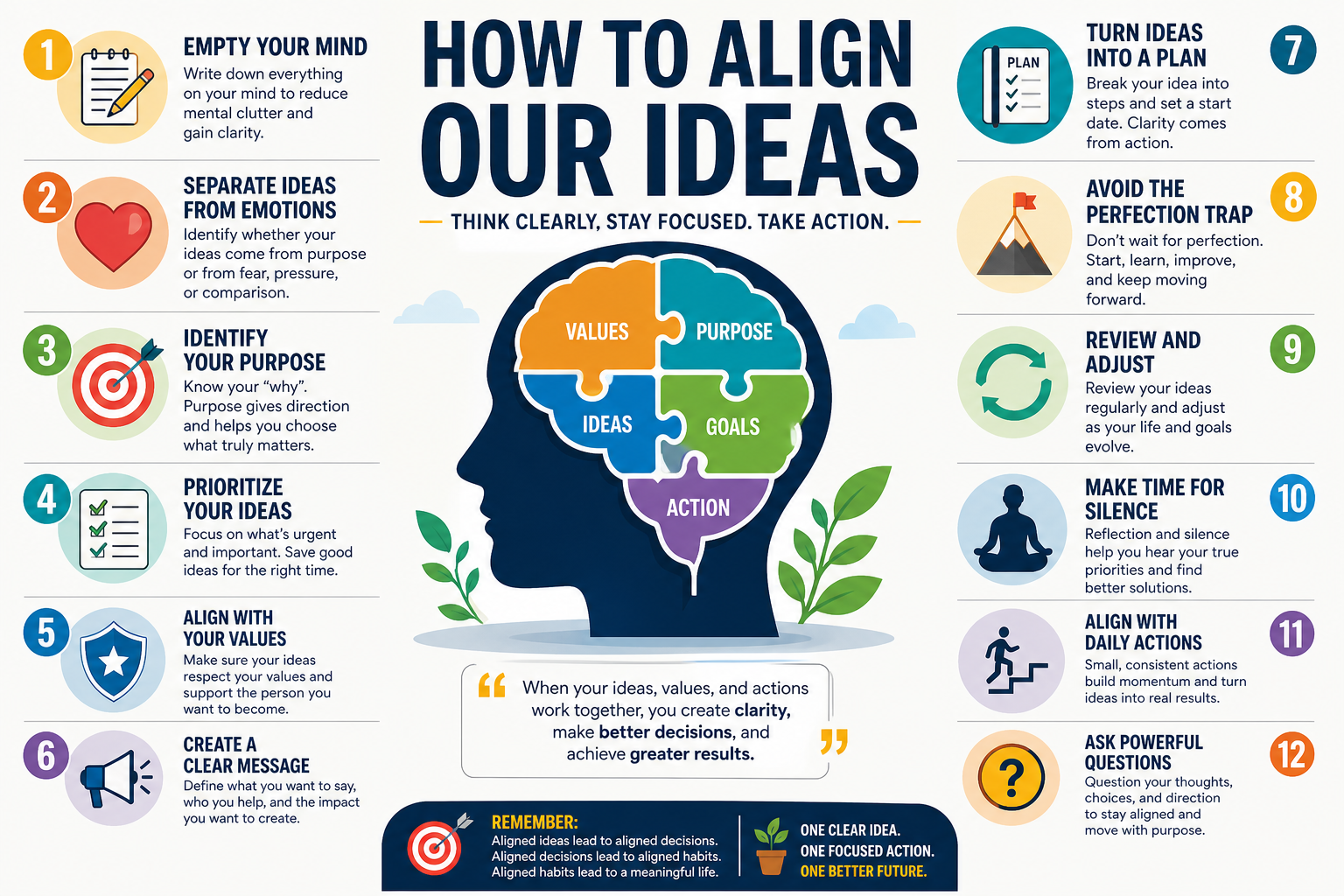
A Practical Guide to Think Clearly, Act with Purpose, and Create Better Results

Por Marvin Gandis

When Ideas Are Not Aligned, Life Feels Heavy

We all experience moments when the mind feels like a messy room: too many ideas, too many plans, too many worries, and not enough clarity.

  • We want to move forward, but we do not know where to begin.
  • We want to make decisions, but doubt gets in the way.
  • We want to create something meaningful, but our ideas seem to compete against each other.

The truth is simple: a scattered mind often creates scattered actions. But an aligned mind can turn confusion into direction, fear into decision, and loose ideas into real progress.

Aligning our ideas does not mean having everything perfect. It means learning how to organize what we think, understand what we truly want, and act according to our values, goals, and purpose.


What Does It Mean to Align Our Ideas?

Aligning our ideas means bringing our thoughts, goals, emotions, values, and actions into the same direction.

Many people live with conflicting ideas:

  • They want change, but keep repeating old habits.
  • They want peace, but feed worry every day.
  • They want success, but constantly doubt themselves.
  • They want to help others, but cannot organize their message.
  • They want progress, but never define priorities.

When our ideas are not aligned, we lose energy. When they are aligned, we gain clarity, confidence, and direction.

Alignment begins with one honest question:

Are my thoughts, words, and actions working together,

Or are they contradicting each other?


The First Step: Empty the Mind

Before we organize our ideas, we need to get them out of our heads.

Many times, we think we have a motivation problem when, in reality, we have a mental overload problem.

Take a notebook, a sheet of paper, or a digital note and write down everything on your mind:

  • Business ideas.
  • Concerns.
  • Unfinished goals.
  • Tasks.
  • Dreams.
  • Frustrations.
  • Projects.
  • Decisions you have been avoiding.

Do not judge anything at first. Just write. This exercise is powerful because it turns mental noise into visible information.

When an idea lives only in the mind, it may feel overwhelming. But once you write it down, you can look at it, evaluate it, and decide what to do with it.


Separate Ideas from Emotions

Not every idea that appears in your mind is in the right direction. Some ideas are born from inspiration, but others are born from fear, pressure, comparison, or frustration.

That is why it is important to ask:

  • Is this idea coming from purpose or anxiety?
  • Am I deciding from clarity or desperation?
  • Am I building something real or reacting to a temporary emotion?
  • Does this idea bring me closer to my values or pull me away from them?

Emotions matter, but they should not always drive the vehicle. An aligned idea may challenge you, but it should not destroy your inner peace.


Identify the Central Purpose

An idea without purpose becomes a distraction. An idea with purpose can become a mission.

Before you act, ask yourself:

Why do I want to do this?

It is not enough to say, “I want to make more money,” “I want to publish more content,” “I want to start a project,” or “I want to change my life.”

Go deeper:

  • I want to help my family.
  • I want to educate others.
  • I want to create freedom.
  • I want to use my experience to serve.
  • I want to leave a legacy.
  • I want to live with more peace and discipline.

When you understand the purpose behind your ideas, it becomes easier to decide which ideas deserve your energy and which ones are only distractions.


Prioritize: Not Every Idea Deserves Immediate Action

One reason many people do not move forward is that they try to do too much at once.

Having many ideas is not the problem. The problem is not knowing which idea should come first.

You can divide your ideas into four groups:

  • Urgent ideas: they need attention soon.
  • Important ideas: they support your main goals.
  • Future ideas: they are good, but not for this season.
  • Distracting ideas: they sound interesting, but pull you away from your path.

Mental maturity means understanding that not every good idea is an idea for today.

Sometimes saying “not yet” is a powerful way to protect your focus.


Align Ideas with Values

Your ideas must respect your values. If an idea promises results but requires you to betray your principles, it is not aligned.

Ask yourself:

  • Does this idea reflect who I want to become?
  • Can I execute it with honesty?
  • Does it help others or take advantage of them?
  • Will it give me peace or create inner conflict?
  • Is it sustainable long-term?

The most powerful ideas are not only profitable or attractive. They are ideas you can stand behind with integrity.

True alignment happens when your ambition does not destroy your character.


Create a Clear Message

Many people have good ideas, but they struggle to communicate them. And an idea that is not communicated clearly may lose its impact.

To clarify your message, answer these questions:

  • What do I want to say?
  • Who do I want to help?
  • What problem does this idea solve?
  • What transformation does it offer?
  • Why should the listener care?
  • What action do I want them to take?

An aligned idea should be easy to explain. If you need to make it too complicated, it may not be clear yet.

Clarity is not the absence of depth. Clarity is depth, well-organized.


Turn Ideas into a Plan

An idea without action remains a wish. To produce results, an idea must become a plan.

A simple plan may include:

  • Main objective.
  • Reason behind the objective.
  • Necessary steps.
  • Available resources.
  • Start date.
  • Weekly time commitment.
  • Expected result.
  • Way to measure progress.

You do not need every detail to be perfect. You need the next step to be clear.

Many people wait for complete clarity before they begin, but often clarity appears while we are already moving.


Avoid the Perfection Trap

Perfection is one of fear’s most elegant disguises. It makes us think we are preparing, when in reality we are avoiding action.

An aligned idea does not need to launch perfectly. It needs to launch with intention, structure, and honesty.

  • Publish.
  • Test.
  • Learn.
  • Correct.
  • Improve.
  • Repeat.

Imperfect action with direction is more valuable

than perfect intention without movement.


Review and Adjust Regularly

Aligning ideas is not something you do once. It is an ongoing process.

Life changes. Priorities change. Opportunities change. Your mindset must be reviewed, too.

Every week or every month, ask yourself:

  • Which ideas are still important?
  • What should I release?
  • What am I avoiding?
  • What is working?
  • What needs adjustment?
  • What action should I take now?

Alignment does not mean rigidity. It means direction with the ability to adjust.


The Importance of Silence and Reflection

We live in a noisy world. Social media, opinions, news, comparisons, messages, urgency, and distractions all compete for our attention.

That is why aligning our ideas requires moments of silence.

Silence reveals what noise hides.

In silence, you can hear your true priorities. You can distinguish between an authentic idea and external pressure. You can discover whether you are walking by conviction or comparison.

Do not underestimate the power of being still, thinking, praying, meditating, writing, or simply breathing.

Many great decisions are born in calm moments.


Align Ideas with Daily Action

The real test of an idea is not how beautiful it sounds, but how it shows up in your daily habits.

  • If you say you want to write, write.
  • If you say you want to serve, serve.
  • If you say you want to learn, study.
  • If you say you want to improve, practice.
  • If you say you want to grow, leave your comfort zone.

Alignment is proven through small, repeated actions.

You do not need to change your entire life in one day.

You need to begin living with more consistency each day.


Powerful Questions to Align Your Ideas

Use these questions when you feel confused:

  • What am I really trying to accomplish?
  • Why does this matter to me?
  • Which idea deserves my attention right now?
  • What should I save for later?
  • What thought is stealing my clarity?
  • What small action can I take today?
  • Is this decision aligned with my values?
  • Am I acting from purpose or pressure?
  • Am I building something that truly matters?

These questions do more than organize the mind. They awaken responsibility.


Clarity Does Not Happen by Accident

Aligning our ideas is an act of discipline, honesty, and purpose.

It is not about having a perfect mind. It is about learning how to direct your thoughts toward what truly matters.

When your ideas are aligned, your decisions become stronger. Your actions become more consistent. Your message becomes clearer. Your life begins to move with intention.

Remember this:

  • An idea aligned with purpose can change a decision.
  • An aligned decision can change a habit.
  • An aligned habit can change a life.

You do not need to have everything figured out today.

You only need to take the next step with clarity.


Today, take 15 minutes to write down your main ideas.

Then choose one idea that aligns with your values, your purpose, and your next season of growth.

Do not try to do everything. Begin with one clear idea, one honest action, and one firm commitment.

Your clarity begins when you decide to organize your mind and move with purpose.


Disclaimer

This article is for educational, informational, and motivational purposes only. It does not constitute professional, psychological, financial, legal, or medical advice. Every individual should evaluate their own situation, make responsible decisions, and seek professional guidance when necessary. Personal results may vary depending on discipline, circumstances, resources, decisions, and individual actions.